Moving to Singapore with a teenager is a different problem from moving with a seven-year-old. Before you can ask which international secondary school in Singapore suits your child, you have to answer three more awkward questions. Will any school take them in this particular year? Is their English strong enough for that year group? And which qualification should they finish with, given where they might go to university?
This guide covers only the secondary years (Years 7–13 or Grades 6–12, roughly ages 11 to 18). It sets out the official 2026-27 fees of ten schools by year group, then works through how to choose between the IB Diploma, A Levels and an American diploma with AP, when a student can realistically transfer, and how English requirements tighten towards the end of school. For a general introduction covering all ages and areas, see our guide to international schools in Singapore; we won’t repeat it here.
Fees and admissions rules come from the schools’ own websites and fee documents, checked on 6 November 2026. Yen equivalents use one reference rate for all schools (S$1 = JPY 124.06, 5 November 2026) and are rounded estimates.

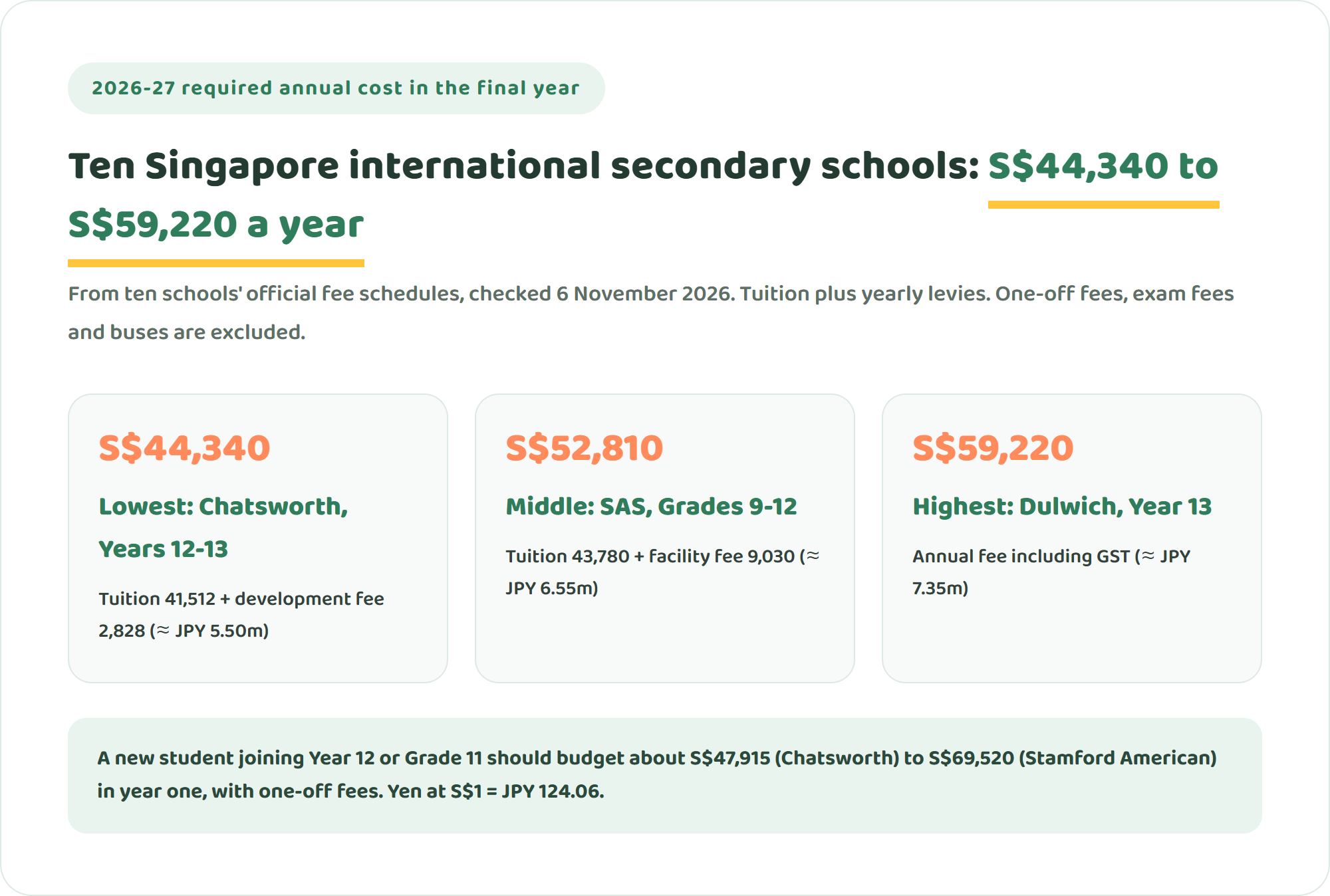
The short answer: S$44,340 to S$59,220 a year in the final year at these ten schools, but start with the qualification and the transfer point
- Fees: counting tuition plus the charges every family pays each year, the final year of school costs from S$44,340 at Chatsworth (about JPY 5.50 million) to S$59,220 at Dulwich (about JPY 7.35 million). That is a gap of about 1.3 times.
- First year: a new student joining Year 12 or Grade 11 should budget S$47,915 to S$69,520 once one-off fees are added. Dulwich has the highest final-year fee, but Stamford American has the highest first-year total because of its larger entry fees.
- Qualifications: nine of the ten schools offer the IB Diploma in the last two years. Tanglin also offers A Levels and Dulwich lists a STEM International A Level route, and AP study is available at SAS, Stamford American, CIS and XWA.
- Transfers: Tanglin does not accept new students into Year 11 or Year 13. UWCSEA does not offer Grade 11 entry after the school year starts, and CIS limits Grade 11 entry to the first two weeks of the year.
- English: requirements rise with age. GESS asks for C1 from Grade 9, Chatsworth for B2 in Year 12, and Stamford American for near-native English in Grades 11 and 12. SAS has no English as an Additional Language (EAL) programme above Grade 4.
We don’t rank these schools, because the right one depends on your child. Keep three things in mind as you read: their birth month, their English today, and the countries where they might want to study next.
Start with the qualification: IB Diploma, A Levels or an American diploma with AP
At primary level, you can choose largely on atmosphere and commute. In the secondary years, what your child finishes with starts to shape what comes next, so it pays to understand the main routes early.
- IB Diploma: a two-year programme of six subjects, normally three at Higher Level and three at Standard Level, plus core requirements including the Extended Essay. It keeps options open for students who haven’t settled on a direction, though it leaves little room to drop a weaker area such as languages or maths.
- A Levels: the British qualification, usually built around a smaller number of subjects studied in depth. It tends to suit students with a clear strength, for example in the sciences or the arts. Tanglin offers A Levels. Dulwich’s admissions policy lists Pearson Edexcel International A Levels, which its website presents as STEM International A Levels.
- American diploma with AP: students earn credits towards a high school diploma and add college-level Advanced Placement courses in their stronger subjects. This is the SAS model, where AP exams cost S$220 each. Stamford American and CIS offer routes that combine IB and AP courses as an alternative to the full Diploma.
Whichever route you lean towards, check the entry requirements of a few real universities before you commit, because required subjects and grades vary widely by country and course. Families who may return to Japan should note that the Japanese education ministry recognises 12 years of schooling abroad, the IB Diploma and GCE A Levels among the routes to university eligibility. Each university still sets its own application conditions. For a wider look at how these curricula differ, see our guide to the types of international schools.
Here is what the ten schools offer:
| School | Year groups | Middle years | Final two years | Campus |
|---|---|---|---|---|
| Tanglin Trust School | Years 7–13 | (I)GCSE in Years 10–11 | A Levels or IB Diploma | 95 Portsdown Road |
| Dulwich College (Singapore) | Years 7–13 | IGCSE | IB Diploma, IBCP, International A Levels (STEM), High School Diploma | 71 Bukit Batok West Avenue 8 |
| Nexus International School | Years 7–13 | IB MYP (Years 7–9), then IGCSE (Years 10–11) | IB Diploma | 1 Aljunied Walk |
| Chatsworth International School | Years 7–13 | IB MYP | IB Diploma, school High School Diploma | 72 Bukit Tinggi Road |
| UWCSEA | Grades 6–12 | Own Grade 9–10 programme, offered instead of the IGCSE | IB Diploma or IB courses, UWCSEA High School Diploma | 1207 Dover Road / 1 Tampines Street 73 |
| German European School Singapore (IB section) | Grades 6–12 | IB MYP | IB DP / CP | 2 Dairy Farm Lane |
| Canadian International School (CIS) | Grades 6–12 | IB MYP | IB Diploma, or a mix of IB, AP and online courses, WASC-accredited High School Diploma | 7 Jurong West Street 41 |
| XCL World Academy (XWA) | Grades 6–12 | IB MYP | IB Diploma, AP, High School Diploma | 2 Yishun Street 42 |
| Stamford American | Grades 6–12 | IB MYP | IB Diploma, or a mix of IB, AP and BTEC, US-accredited High School Diploma | 1 Woodleigh Lane |
| Singapore American School (SAS) | Grades 6–12 | American curriculum | AP within an American high school programme | 40 Woodlands Street 41 |
Sources: each school’s official website, admissions policy and programme pages, checked 6 November 2026. Access to particular qualifications can depend on prior results and English, even within one school.
Line up the year groups: Year 7 to 13, Grade 6 to 12, and why birth month matters
Year 7 and Grade 6 are the same age group, so a British “Year” number is always one higher than the American “Grade” for the same child. Most of these schools place students around a 1 September cut-off. We could confirm a 1 September reference date at Dulwich, Stamford American and XWA, the 1 September to 31 August window at GESS, and age on 31 August at CIS. Applied to the 2026-27 school year, that gives the rough guide below, which we calculated from those official rules.
| British year / American grade | Born (2026-27 intake) | Usual age on entry | Programme stage |
|---|---|---|---|
| Year 7 / Grade 6 | Sep 2014 – Aug 2015 | 11 | Start of secondary at Year-based schools |
| Year 8 / Grade 7 | Sep 2013 – Aug 2014 | 12 | Middle years |
| Year 9 / Grade 8 | Sep 2012 – Aug 2013 | 13 | Middle years |
| Year 10 / Grade 9 | Sep 2011 – Aug 2012 | 14 | First year of a two-year (I)GCSE, where offered |
| Year 11 / Grade 10 | Sep 2010 – Aug 2011 | 15 | Second year of a two-year (I)GCSE, where offered |
| Year 12 / Grade 11 | Sep 2009 – Aug 2010 | 16 | First year of the IB Diploma or A Levels |
| Year 13 / Grade 12 | Sep 2008 – Aug 2009 | 17 | Exam year |
The trap is the two-year programmes. A student born in October 2010 falls into Year 11 or Grade 10 in August 2026, which at a British-style school is the second year of the (I)GCSE. A student born just five months earlier, in May 2010, falls into Year 12 or Grade 11, the first year of the IB Diploma or A Levels. Those two teenagers may be in the same class today in another country’s school system, yet face very different options in Singapore.
This matters particularly for families coming from a system with a different cut-off. Japan, for example, groups children from 2 April to 1 April, so both of those teenagers would have started their first year of Japanese high school in April 2026. Schools also look at what a student has studied and their recent grades, not just their age, so send a date of birth and school reports with your first enquiry.
International secondary school fees in Singapore, 2026-27 (official)
The table below sets out each school’s 2026-27 fees by secondary year group. Schools draw the line around “tuition” differently, so we added the charges every family pays each year to reach a comparable “required annual cost” for the final year. Where a levy is higher in the first year, this column uses the later-year amount. The first-year column shows the total for a new student joining the first of the last two years: tuition, the first-year levy and non-refundable entry fees.
| School | Annual tuition by year group (S$) | Other yearly charges | Required annual cost, final year | One-off fees on entry (non-refundable) | First-year total, new student in Year 12 / Grade 11 | Source |
|---|---|---|---|---|---|---|
| Chatsworth | Y7 36,108; Y8–9 36,260; Y10–11 37,674; Y12–13 41,512 | Development fee 2,828 | 44,340 (≈ JPY 5.50m) | 3,575 | 47,915 | Official |
| GESS (IB) | G6–10 40,545; G11–12 43,990 | Development levy 6,130 in year one, half after that | 47,055 (≈ JPY 5.84m) | 3,950 | 54,070 | Official |
| Nexus | Y7 45,600; Y8–9 47,400; Y10–11 49,400; Y12–13 50,800 | Development levy 2,000 | 52,800 (≈ JPY 6.55m) | 6,213 | 59,013 | Official PDF |
| XWA | G6 45,750; G7 47,770; G8 48,290; G9–10 49,570; G11–12 49,810 | Development fee 3,000 | 52,810 (≈ JPY 6.55m) | 6,643 | 59,453 | Official |
| SAS | G6–8 41,560; G9–12 43,780 | Facility fee 9,030 | 52,810 (≈ JPY 6.55m) | 12,400 (Lane 1: 11,160) | 65,210 (Lane 1: 63,970) | Official PDF |
| CIS | G4–6 45,520; G7–10 51,240; G11–12 53,500 | None | 53,500 (≈ JPY 6.64m) | 11,000 | 64,500 | Official PDF |
| UWCSEA | G6–8 46,866; G9–10 47,313; G11–12 49,926 | Development levy 9,537 in year one, 5,166 after that | 55,092 (≈ JPY 6.83m) | 5,619 (application 627 + enrolment 4,992) | 65,082 | Official |
| Stamford American | G6–8 53,210; G9–12 56,110 (including technology fee of 1,270) | None | 56,110 (≈ JPY 6.96m) | 13,410 | 69,520 | Official PDF |
| Tanglin Trust | Y7–9 53,535; Y10–11 56,010; Y12–13 58,080 | None | 58,080 (≈ JPY 7.21m) | 10,000 | 68,080 | Official |
| Dulwich | Y7–9 53,850; Y10 56,540; Y11 57,540; Y12 58,470; Y13 59,220 | None | 59,220 (≈ JPY 7.35m) | 10,000 | 68,470 | Official PDF |
Sources: each school’s official website or PDF, checked 6 November 2026. Yen at S$1 = JPY 124.06 (5 November 2026). Schools are listed by final-year required cost, lowest first; this is not a ranking of quality. The later-year GESS levy (S$3,065) is our calculation from the school’s stated 50% discount. SAS totals are the school’s own new-student figures. UWCSEA’s one-off figure combines its single-campus application fee and enrolment fee, and its fee page does not mention GST; the other nine schools state that fees include GST where it applies. Buses, exam fees, uniforms, devices, EAL and trips are excluded. Fees change every year, so please confirm final amounts with each school.
Three things stand out:
- Fees rise at different speeds. From first secondary year to last, SAS rises by S$2,220, while CIS rises by S$7,980 between Grade 6 and Grades 11–12, including a single step of S$5,720 at Grade 7. If you budget only for the middle years, the senior years can cost noticeably more.
- The first-year order is different from the annual order. UWCSEA’s one-off fees are on the lower side at S$5,619, but its development levy is S$9,537 in year one, against S$5,166 later. Stamford American’s one-off fees total S$13,410, which gives it the highest first-year figure of the ten at S$69,520.
- The upper years add exam and programme costs. Official guidance puts external exam fees at about S$1,000–2,500 at Tanglin and IB assessment fees at about S$1,200–1,800 at UWCSEA. UWCSEA also lists compulsory outdoor education, at S$1,700–6,000 in Grades 9–10 (2024/25 reference figures).
For more on individual schools, see our breakdowns of Singapore American School fees and Dulwich College Singapore fees, or our direct comparison of Singapore American School and Stamford American. To compare Singapore with other cities, see international school fees across Asia.
When can a student transfer? Middle school, IGCSE and the IB Diploma
The biggest practical issue in secondary transfers is that (I)GCSEs and the IB Diploma or A Levels are all two-year courses. Joining for the second year is hard for the student and often simply not offered. Here is what we could confirm from official sources.
- Tanglin Trust states that it does not accept new students into Year 11 or Year 13, because they are the second years of two-year courses. Places outside the main entry points depend on withdrawals.
- UWCSEA does not offer Grade 11 entry after the school year starts, because late joiners would miss too much IB content. It also typically does not fill vacancies part-way through Term 1 or beyond the start of Term 2. January places up to Grade 10 depend on how many students leave during Term 1.
- CIS keeps Grades 9 and 10 open until the last Monday in February each year. Grades 11 and 12 are open only to Grade 11 students, in the first two weeks of the school year.
- Chatsworth says students joining in the second semester of Year 11 or at the start of Year 12 are monitored to check they are on the right pathway, and the school reserves the right to decide that pathway. For Higher Level, it looks for MYP grade 5 or IGCSE grade B.
- Dulwich usually asks Year 12–13 applicants for IGCSE results and a reference from their head of school. It expects the equivalent of IGCSE grade B or above for Standard Level subjects and A or above for Higher Level or A Level, and may set subject tests.
- Nexus asks Year 12–13 applicants to have at least five GCSEs (or equivalent) at grade C or above.
- SAS showed, on the day we checked, Grade 12 closed for 2026-27, Grades 9–11 by enquiry and a waitpool forming in Grades 7–8. This changes through the year, so check the official availability page.
We could not confirm from official pages whether Stamford American, XWA or Nexus take new students part-way through Grades 11–12 or Years 12–13, or how Dulwich treats Year 11 and Year 13 entry. If you are looking at those year groups, ask the school directly.
If you have any control over the timing of a move, the least disruptive points are the start of Year 10 or Grade 9, and the start of Year 12 or Grade 11. If you don’t, make “can my child join the second year of this course?” the first question you ask. We did not find schools publishing the same explicit limits for the middle-school years, though a full year group still means a waiting list.

English requirements tighten with age: where EAL stops and what level is expected
Some schools in Singapore take younger children with little English. In secondary, the bar rises quickly, both because the coursework is harder and because each school sets a point after which it no longer provides language support.
- GESS (IB section) is the most explicit: A2 for Grade 6, B1 for Grade 7, B2 for Grade 8 and C1 for Grades 9–12. EAL in Grades 6–10 costs S$3,090 a semester (S$6,180 for intensive). Its fee table lists no EAL for Grades 11–12.
- Chatsworth sets B2 for Year 12 and says Diploma students should not require language support. EAL, where needed, costs S$5,050 a year.
- Stamford American expects near-native speaking, writing and comprehension in Grades 11 and 12. Grades 6–10 are assessed, with EAL at S$9,100–14,900 a year and a Preparatory Course for Secondary School (Grades 6–10) at S$71,050 a year.
- CIS requires English Language Learner support at S$9,500 a year up to Grade 10 if its assessment shows a need. There is no such support in Grades 11 or 12, so applicants should have left language support by the end of Grade 10.
- UWCSEA welcomes applicants with two to three or more years in an English-medium school for Grades 6–8, and three or more for Grades 9–11. Its EAL programme is not for beginners.
- SAS requires English proficiency from Grade 4 upwards and has no EAL programme above Grade 4.
- Tanglin Trust requires age-appropriate fluency, checked by assessment in the Senior School, and has no special programme for students at an early stage of learning English.
- Dulwich does not run a separate EAL programme and notes that a student’s English may determine their subject options in the IGCSE or IB years.
- Nexus admits students whose English is enough for mainstream lessons in their year of entry, with support at S$3,000–6,000 a semester and limited places. Its Foundation Programme for beginners costs S$57,600 in Year 7 and S$59,400 in Year 8. An unsuccessful applicant must wait at least six months before being reassessed.
- XWA lists EAL for Grades 1–10 at S$4,035 a semester on its fee page, with Grade 10 EAL full for 2026/27. Another official page gives S$7,760 a year, so check the amount directly. The school says a higher level of English is needed at entry in the senior grades, where its intensive pathways end.
A2 to C1 are levels on the Common European Framework of Reference (CEFR), with C1 being the second-highest. The honest takeaway is that the earlier a student with developing English joins, the more choices they have. For a teenager moving later, the real question is whether they can use a supported year in Grade 10 or Year 11 to prepare, or whether their English is already strong enough for the final two years.
For Japanese families: comparing with a Japanese high school curriculum in Singapore
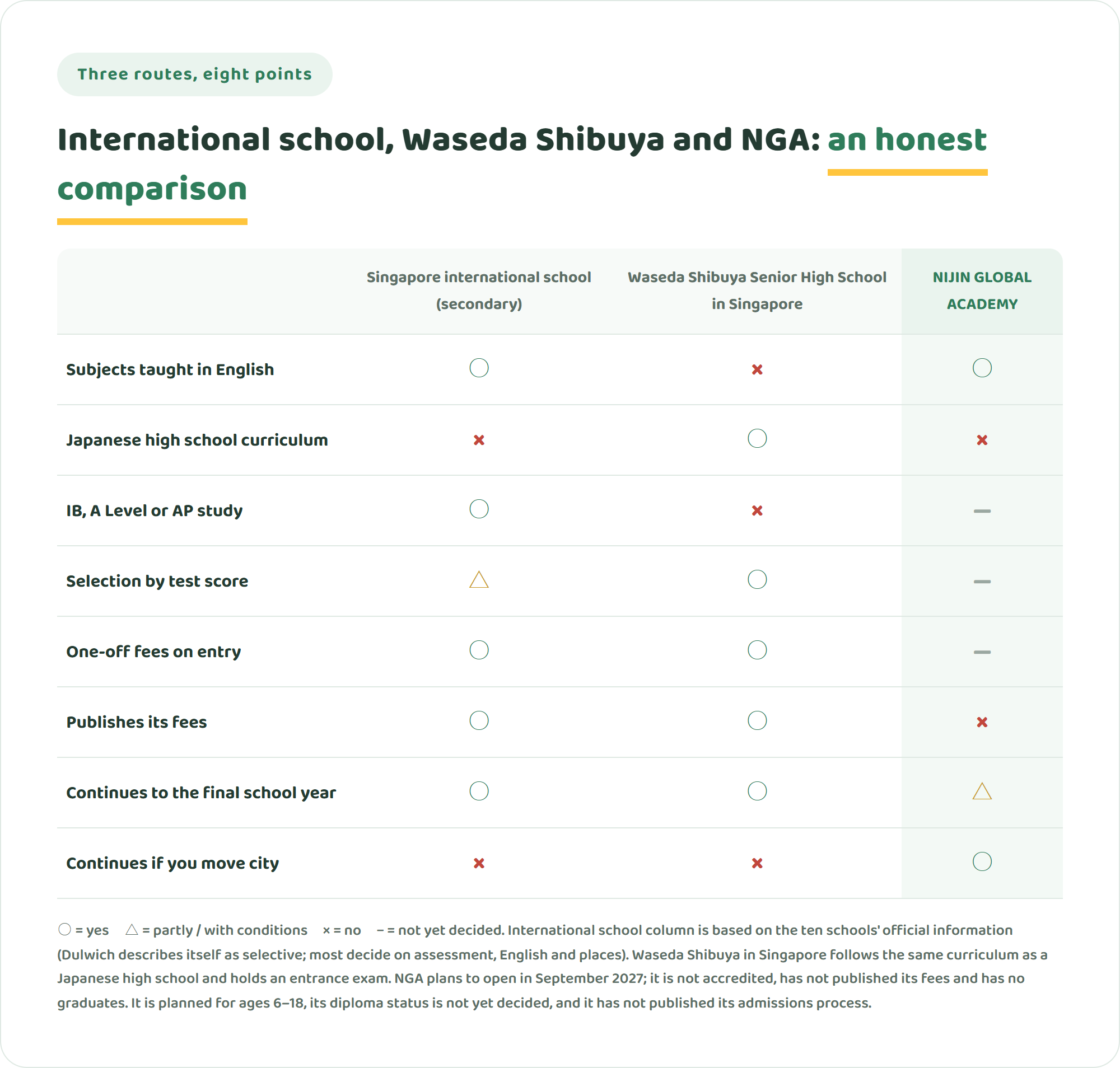
Japanese families on a posting of a few years have another route. Waseda Shibuya Senior High School in Singapore is a private overseas school certified by Japan’s education ministry and follows the same curriculum as a high school in Japan. For students entering in 2026, it charges S$37,968.69 in the first year (about JPY 4.71 million) and S$31,613.99 in later years (about JPY 3.92 million), both including GST. The final-year required costs in our table are about 1.4 to 1.9 times that later-year figure. Entry is by examination, including a route using external English test scores and a transfer exam.
Cost is not really the deciding point. The real question is what your child wants after school: a Japanese university first, or the freedom to apply abroad as well. For younger teenagers, Japanese schools abroad are also an option, and we compare them in our guide to Japanese school tuition in Asia.
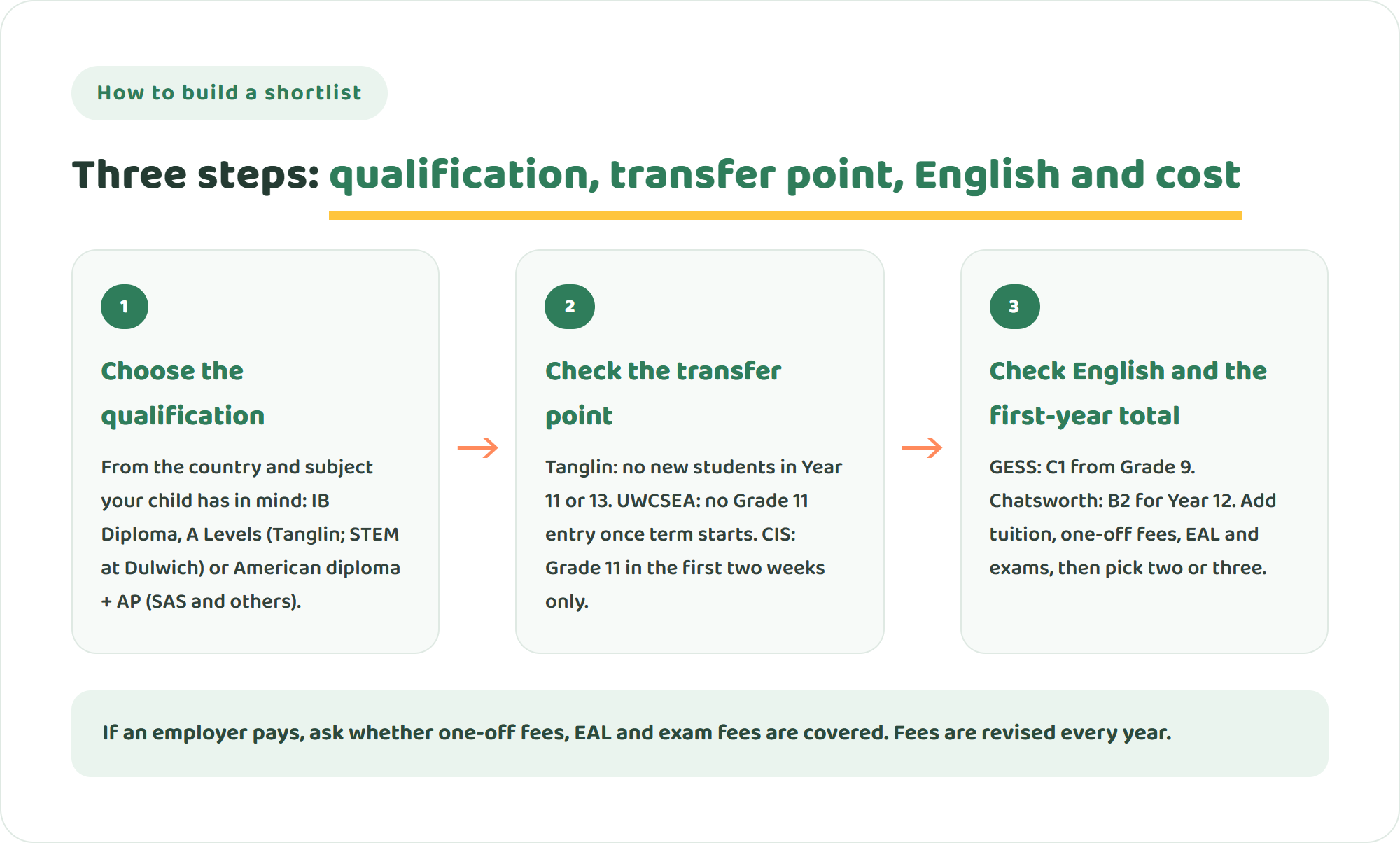
How to choose in three steps: qualification, transfer point, English and first-year total
- Step 1: choose the qualification. Talk with your child about countries and subjects, then decide whether the IB Diploma, A Levels or an American diploma with AP fits best. If A Levels matter, your list starts with Tanglin and, for STEM subjects, Dulwich. If AP matters, it starts with SAS, Stamford American, CIS and XWA.
- Step 2: check the transfer point from the birth month. Find the likely year group in the table above. If it is the second year of a two-year course, ask about entry first. Tanglin, UWCSEA and CIS all publish limits.
- Step 3: check English and add up the first year. Confirm the English level and whether EAL exists at that age. Then add tuition, one-off fees, EAL, exam fees and buses, and narrow to two or three schools you can reach each day.
If an employer is paying, ask before you move whether one-off fees, EAL and exam fees are covered. If cost is the wall, our all-ages guide to international schools in Singapore covers other schools worth a look. And if no school has a place, or another move may come within a few years, it can help to know one way of learning that doesn’t depend on where you live. You can read how it works on our online curriculum page.
Where NIJIN GLOBAL ACADEMY fits
NIJIN GLOBAL ACADEMY (NGA) is an online international school for ages 6–18, planned to open in September 2027. It is run by NIJIN Inc., which operates NIJIN Academy, an online school in Japan for children who do not attend school, where more than 1,000 children have studied. NGA plans small live classes in which subjects are taught in English and supported by bilingual Japanese–English mentors, with admission that is not based on test-score rankings. The admissions process itself has not yet been published.
To be plain about it: NGA has not opened yet. It is not accredited, it has not published its fees and it has no graduates. For a teenager who needs an IB Diploma or A Levels now, it is not a substitute for the ten schools above. It may still be worth comparing if your child is waiting for a place, needs time to build confidence in English, or is likely to leave Singapore in a few years and you don’t want their learning interrupted.
FAQ
Can my child join an international school in Singapore part-way through secondary?
It depends on the school and year. CIS accepts Grades 9 and 10 until the last Monday in February each year, and January places at UWCSEA up to Grade 10 depend on how many students leave in Term 1. Most schools will put you on a waiting list if the year is full, so ask about availability early.
Can a student transfer just before or during the IB Diploma?
The normal entry point is the start of the first year. UWCSEA does not offer Grade 11 entry after the school year starts, CIS allows only the first two weeks, and Tanglin does not take new students into Year 13. Dulwich, Chatsworth and Nexus also publish expectations for prior results.
Is there a school for a high school student with weak English?
The last two years are the hardest. GESS asks for C1 and Chatsworth for B2, and CIS and SAS offer no language support at that level. Up to Grade 10, GESS, Stamford American, CIS, Nexus and XWA have EAL or preparatory options. Outside our table, Overseas Family School says it welcomes students with limited English through its Study Preparation Program.
Which international high schools in Singapore offer A Levels?
Among these ten, Tanglin Trust lets Sixth Form students choose between A Levels and the IB Diploma, and Dulwich’s admissions policy lists Pearson Edexcel International A Levels, presented on its website as STEM International A Levels. The others focus mainly on the IB Diploma or an American high school programme.
Which is the cheapest of the ten?
By required annual cost in the final year, Chatsworth is lowest at S$44,340 (about JPY 5.50 million) and Dulwich’s Year 13 is highest at S$59,220 (about JPY 7.35 million). Other schools exist outside this list, and the figures vary by year group, so compare first-year totals too.
Before you compare schools, ask your teenager what they want to learn next
Choosing a secondary school is hard to do on a teenager’s behalf. The difference in fees across these ten may be only about 1.3 times, but the year they can enter, the English they need and the qualifications open to them vary far more. And it is your child, not you, who will sit in that classroom writing essays in demanding academic English.
So before you show them a table, ask. What do they want to study in depth? Where could they imagine living? Even an unfinished answer gives you something solid to build on. And if you would also like to compare a way of learning that carries on wherever your family lives, consider keeping NIJIN GLOBAL ACADEMY on your list. Ahead of the planned September 2027 opening, we expect to run trial classes in April–May 2027.