If you are researching a private school teacher salary in Japan — whether you are already teaching here, moving from overseas, or weighing a private school against a public one — the honest headline is that there is no single figure. What official statistics do give you is this: according to Japan’s Ministry of Education (MEXT) School Teachers Survey, FY2025 interim report, the average monthly base salary of full-time teachers is JPY 365,300 at private elementary schools versus JPY 336,100 at public ones, and JPY 381,400 at private junior high schools versus JPY 341,600 at public ones.
The more useful part comes next. At upper secondary (high school) level the averages converge — JPY 359,300 for both public and private — yet 20.0% of private high school teachers are paid JPY 450,000 or more per month, while 13.4% are paid under JPY 250,000. Identical averages, completely different realities. Private pay in Japan is set by each individual school corporation, and from the outside, before you apply, it is largely invisible. That gap is what this article is about.
| School level | Private | Public |
|---|---|---|
| Elementary — avg. monthly base salary | JPY 365,300 (MEXT, FY2025 interim) | JPY 336,100 (same) |
| Junior high — avg. monthly base salary | JPY 381,400 (same) / 28.5% earn JPY 450,000+ | JPY 341,600 (same) |
| High school — avg. monthly base salary | JPY 359,300 (same) / 20.0% earn JPY 450,000+, 13.4% under JPY 250,000 | JPY 359,300 (same) |
| High school — avg. years of service | 15.4 years (MEXT, FY2022 final) | 19.7 years (same) |
Note: these are base salary only — no allowances and no bonuses. FY2025 is an interim report and the final figures may move. Below, we break down how these numbers are actually set.
What “average monthly salary” means in Japanese education statistics
This matters more than it sounds. The figure MEXT publishes is base pay alone: it excludes dependant, regional, housing and commuting allowances, excludes the twice-yearly bonuses, and even excludes the teaching adjustment payment made to public school teachers. It is not a monthly take-home figure and it is not one twelfth of an annual salary. Compare it against anything else and the comparison breaks.
Read that way, the gap is JPY 29,200 at elementary level and JPY 39,800 at junior high, in favour of private schools. One caveat: private elementary schools are few in Japan, so the sample behind that average is small and easily pulled by individual institutions.

The distribution, not the average, is the real story
The same survey publishes the spread of monthly base salaries, and this is where private schools differ most from public ones. Among private high school teachers, 20.0% are at JPY 450,000 or above while 13.4% are below JPY 250,000. At private junior high schools, 28.5% are at JPY 450,000 or above. An average can match the public sector exactly while almost nobody actually sits at it.
FY2022 final figures add another angle. Public high schools: average base pay JPY 353,200 with 19.7 average years of service. Private high schools: JPY 355,300 with 15.4 years. Private teachers reach a similar base salary with more than four years less service — though this is a base-pay comparison only, excluding bonuses and retirement benefits.
So the fair answer to “do private schools pay more in Japan?” is neither yes nor no. It varies by school, and the range is wider than in the public sector. Where any one school sits is not something an average can tell you.
Why pay varies so much school by school
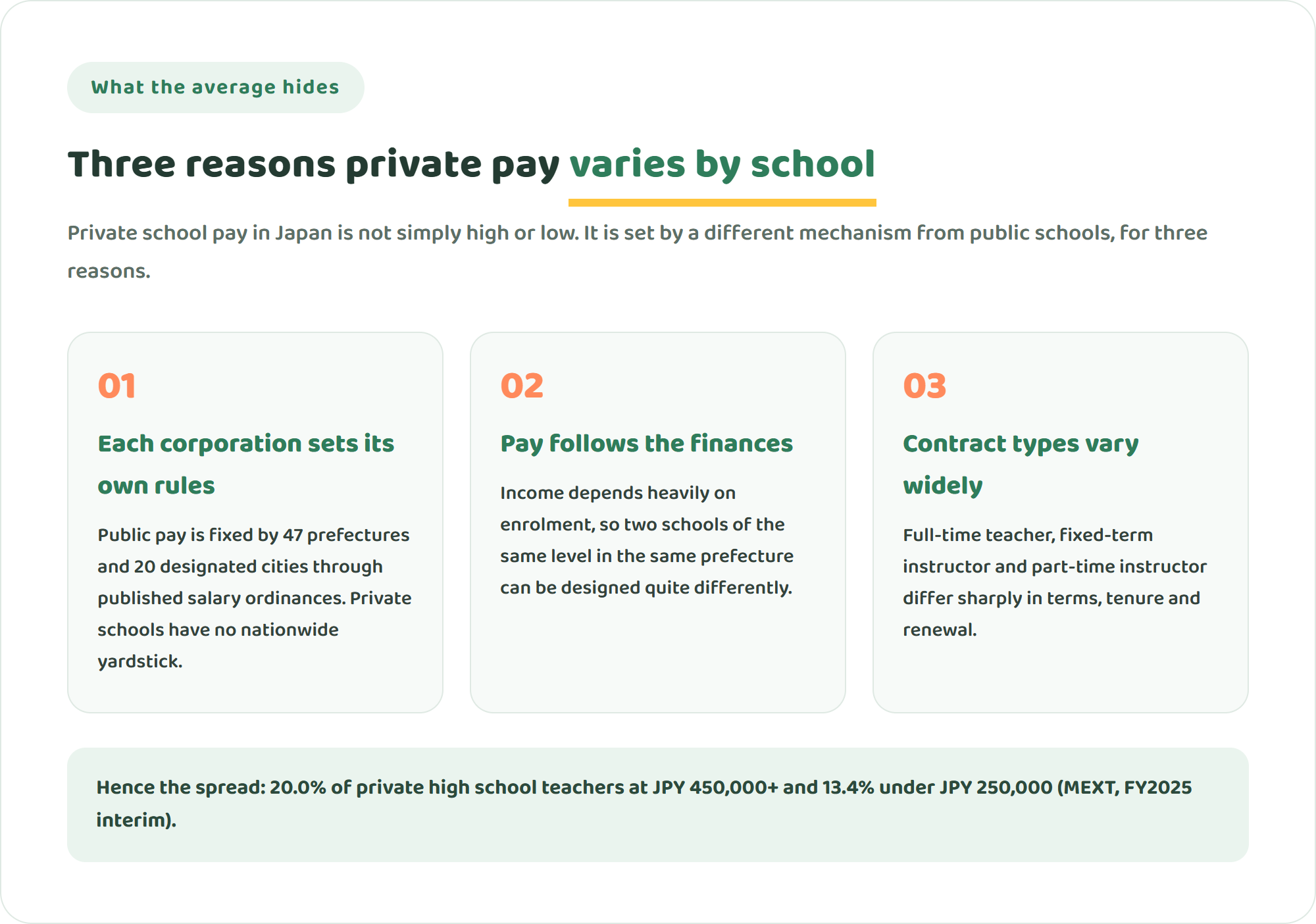
First, each school corporation writes its own pay rules. Public school teacher pay in Japan is set by 47 prefectures and 20 designated cities through salary ordinances, with the scales published. Private schools have no such nationwide yardstick: some mirror the public scale, others run an entirely separate system.
Second, pay is tied to the corporation’s finances, which depend heavily on enrolment. Two schools of the same level in the same prefecture can be designed quite differently.
Third, contract types vary widely. Full-time teacher, full-time fixed-term instructor and part-time instructor differ sharply in terms, tenure and renewal. All three factors push teachers toward both ends of the distribution.
To be clear, none of this is a criticism of private schools. The freedom to design their own pay rules is part of what lets them build a distinctive education. The problem is not the level of pay — it is the information asymmetry facing applicants.
Rankings and the “10 million yen” question: what can actually be verified
Directly: there is no official ranking of pay by named school, and no public statistic showing annual income or bonuses for private school teachers in Japan. Figures circulating on third-party salary sites cannot be traced to a primary source, so we do not use them.
One useful reference is the Promotion and Mutual Aid Corporation for Private Schools of Japan (Shigaku Kyosai), whose September 2025 statistical bulletin gives the average standard remuneration per member: JPY 386,225 overall, JPY 415,692 at elementary schools, JPY 438,072 at junior high schools, JPY 406,336 at high schools and JPY 270,410 at kindergartens. Two cautions are essential: standard remuneration is a social-insurance grade band, not an actual salary paid (it has floors and ceilings), and members include administrative staff as well as teachers.
For a wider benchmark, the National Tax Agency’s 2024 survey of private-sector pay puts the average annual income of employees working a full year at JPY 4.78 million, and JPY 5.45 million for permanent employees. That is annual income including bonuses, a different dimension entirely from a monthly base salary — you cannot simply multiply base pay by twelve. So the honest ceiling answer is that official data takes you as far as the distribution: 20.0% of private high school teachers at JPY 450,000+ per month. Beyond that, it is a per-school conversation.
Wanting your income to grow is not at odds with loving the classroom — the two sit together perfectly well. Which is exactly why it matters whether you are told the real terms before you commit. See the NIJIN GLOBAL ACADEMY founding member roles → — founding roles begin as volunteer positions ahead of the September 2027 opening, and the detailed terms are shared later in the process — better to know that first than after applying.
A third way of working: the terms, stated up front
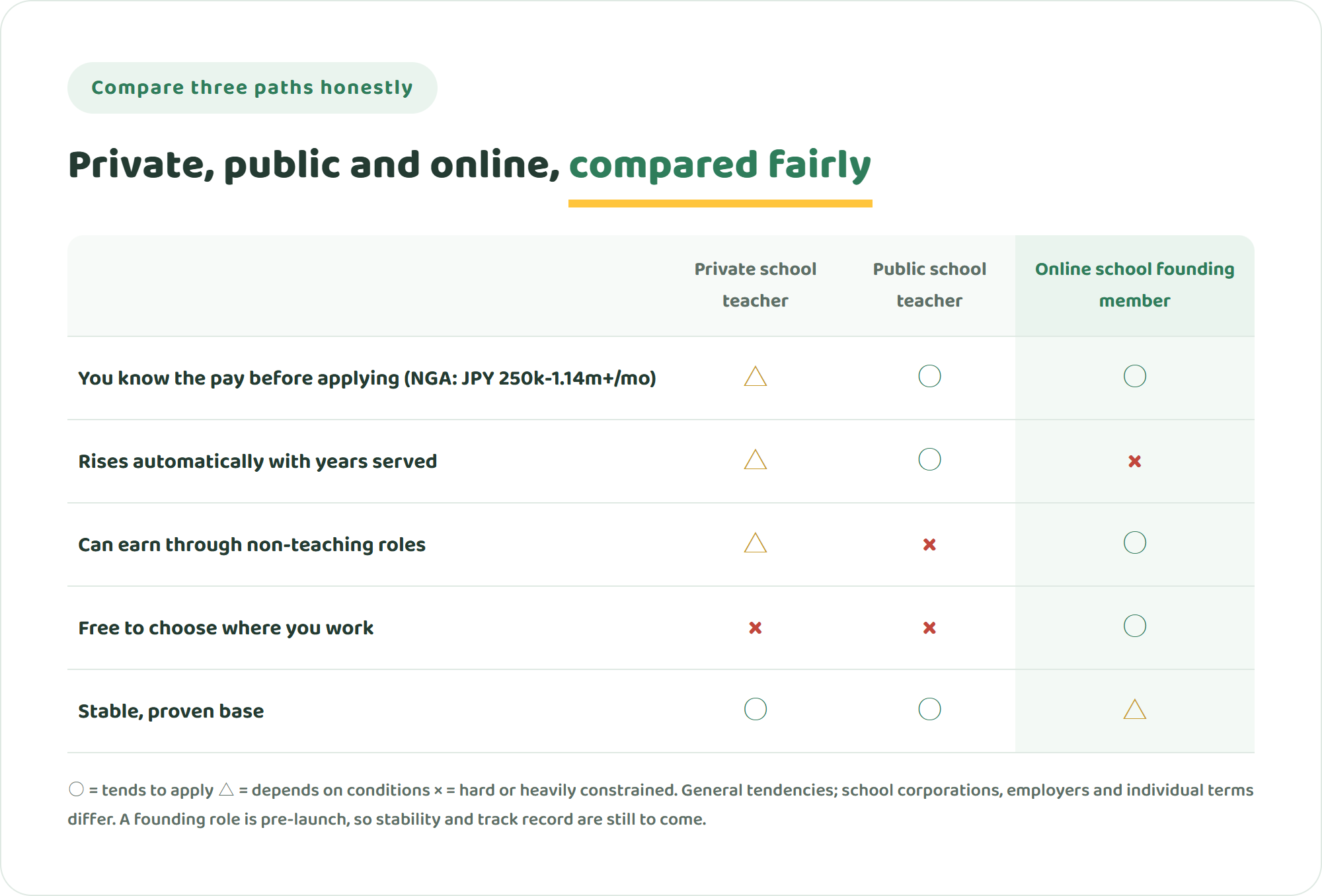
The exhausting part of private school pay may be less the level than not knowing until you are already inside. The founding members NIJIN GLOBAL ACADEMY (NGA) is recruiting for its September 2027 opening face the reverse order. Founding roles begin as volunteer positions ahead of the opening, and the detailed terms are shared later in the process. Income is diversified: alongside teaching you can take marketing, web, partnerships or HR across five working patterns. And the role is fully remote, built around working while travelling. What we look for is English at roughly CEFR B2+ and the appetite to build from zero.
It is not a universal answer. There is no automatic annual increase, and because the school has not opened yet, stability and track record are still being built. Japan has many excellent private schools, and for many teachers they are the better fit. The point is not which is superior, but that showing the numbers first is a possible design.
Three steps to read a private school offer in Japan
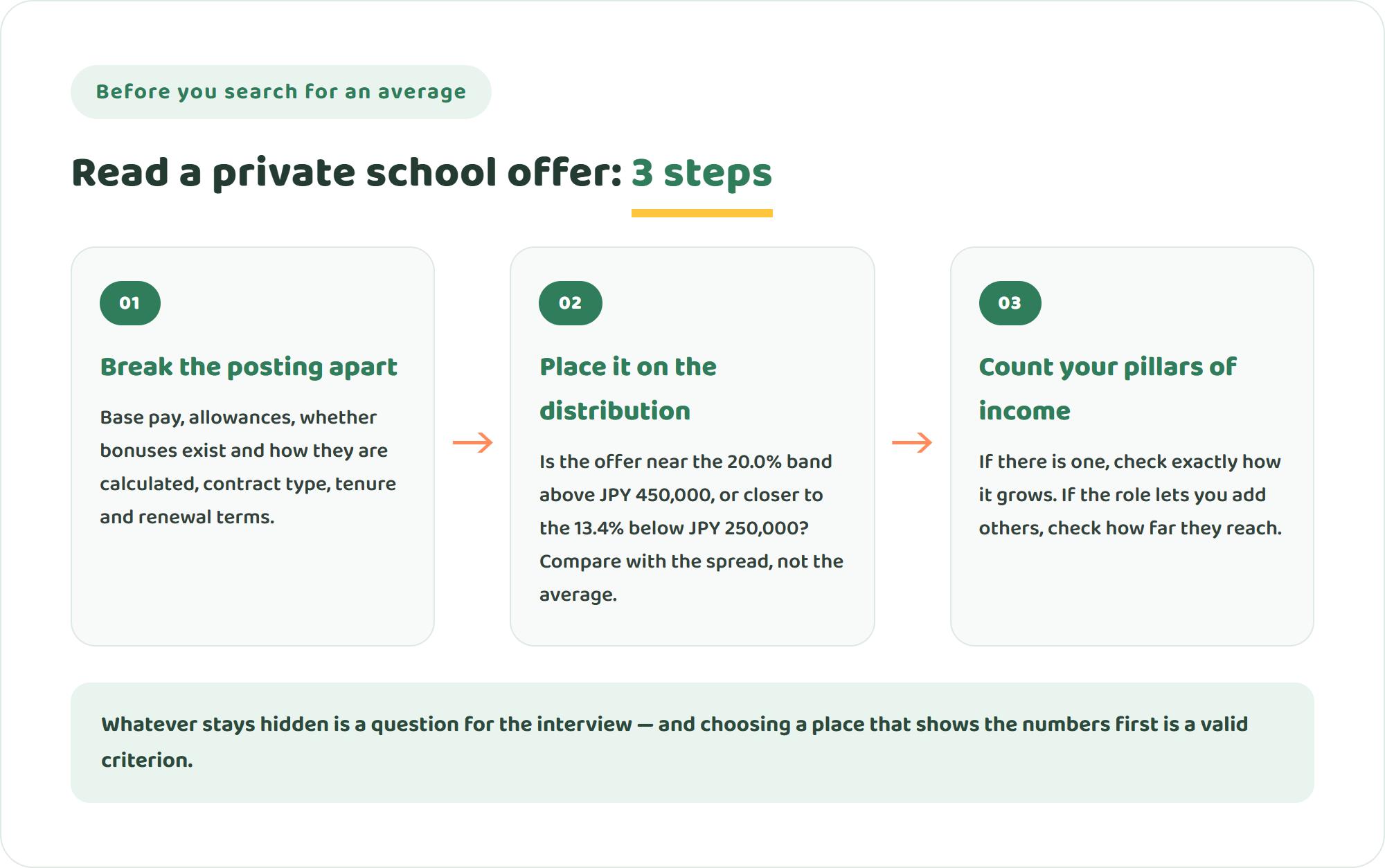
First, break the posting apart: base pay, allowances, whether bonuses exist and how they are calculated, contract type (full-time, fixed-term, part-time), tenure and renewal terms. If pay is listed only as negotiable, that is itself information. Second, place the offer against the official distribution — is it near the 20.0% band above JPY 450,000, or closer to the 13.4% below JPY 250,000? Third, count your pillars of income. If there is one, check exactly how it grows; if the role lets you add others, check how far they reach.
For pay across school levels and age bands, see our guide to how much teachers earn in Japan. If your interest is specifically international schools, see international school teacher salaries.
FAQ
Do private school teachers in Japan earn more than public school teachers?
It depends on the level. In average monthly base salary, private schools are higher at elementary (JPY 365,300 vs JPY 336,100) and junior high (JPY 381,400 vs JPY 341,600), while high schools are level at JPY 359,300 each (MEXT, FY2025 interim). But the private distribution is far wider, so an average alone settles nothing.
What does a new or early-career private school teacher earn?
No official statistic breaks private school pay down by age, so we will not state a figure. What is published is the distribution — at private high schools, 13.4% below JPY 250,000 and 20.0% at JPY 450,000 or above. The starting salary line in each school’s own posting is the only reliable number.
Do private schools in Tokyo pay more than elsewhere?
There is no official prefecture-level data on private school teacher pay. Public schools have a built-in regional allowance system; private schools follow each corporation’s rules. Even within Tokyo the variation is by corporation, so that is the level to compare at.
Can a private school teacher in Japan earn 10 million yen a year?
Official statistics only take you as far as the distribution, so no figure can be asserted. The 20.0% of private high school teachers at JPY 450,000+ per month is the upper-end fact that published data supports. Numbers tying a named school to a salary cannot be verified, so we do not use them.
Look at the school you are applying to, not the average
If you searched for a private school teacher salary in Japan, you are trying to reconcile a commitment to education with the practical shape of a life — which is exactly the right thing to do. The conclusion is simple: private pay is neither high nor low, it varies by school across a wider range than the public sector. So look at your one school, not the national average. And know that places which show the numbers early do exist.
Sources: MEXT School Teachers Survey, Shigaku Kyosai statistical bulletin, National Tax Agency Survey of Private Sector Salaries.
Working at an International School — More Articles
- international school teacher salary
- how to become an international school teacher
- career change from teaching
- career change from teaching in your 30s and 40s
- how much do teachers earn?
- how to become an IB teacher
- jobs for moving abroad
- international school staff jobs
- high-paying jobs that use English
- elementary school teacher salary in Japan
- junior high school teacher salary in Japan
- high school teacher salary in Japan
- school principal salary in Japan
- how the Japanese teacher pay scale works
- teacher bonuses in Japan
- online international school teacher salary
- remote teaching jobs from the Philippines
- online teaching jobs in Malaysia
Keep the teaching. Change how visible the numbers are.