
“Teacher to corporate career change.” If you searched that, you probably still love parts of the classroom but wonder whether the private sector might suit the next chapter — and then a quieter doubt stops you: “I’m already in my thirties (or forties). Isn’t it too late?” The long hours, the pay, the sense that your effort no longer reaches anyone. You feel there must be a road outside school, yet you fear losing what you’ve built and being dismissed on age in an industry you’ve never worked in. If you reached this page carrying both of those at once, you are far from alone.
Here is the short answer first: a career change from teaching in your 30s and 40s is not too late. But “quitting on impulse” and “preparing, then crossing over” lead to very different places. This article first meets the reality of changing careers from teaching at this age — how age is actually read and what the job market looks like — honestly. Then it lays out how to take stock of your career and prepare for the move, useful for any career change with or without us. Finally, as a “third path” that lets you cross over without giving up the joy of teaching, we introduce — with no hard sell — the option of joining the founding team of the online international school we open in September 2027.

The reality of a career change from teaching in your 30s and 40s
Search around a teacher-to-corporate move and the suggestions fill with “30s,” “40s,” “regret,” “no experience.” That alone tells you how many people share the same worry. Honestly, three realities are worth facing. First, it is not too late: changing careers in your thirties or forties is no longer unusual, and increasingly it is “what you can do and can still learn” that gets weighed, not your age itself. Second, teaching skills have market value: explaining clearly, planning, dialogue with all kinds of people, tracking progress — the abilities you sharpened daily in the classroom translate well into industry once you put them in the right words. Third, the flip side, you have to translate them: left as “classroom management” or “lesson prep,” they don’t land with a corporate recruiter. You need to recast them as management, planning, and improvement — the language the other side uses.
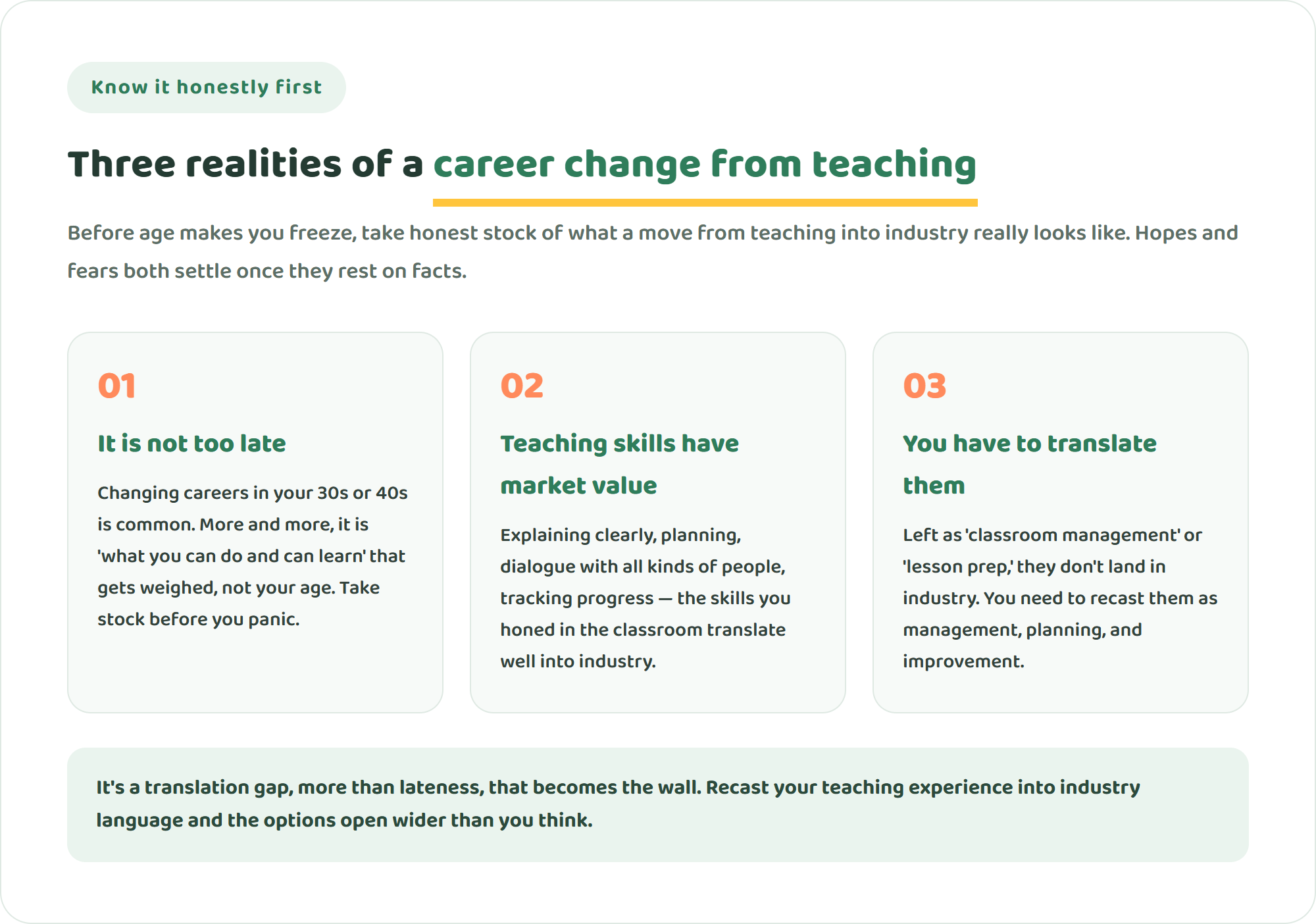
In other words, the “lateness” you feel is, in most cases, not your age. It is that the work you did as second nature in the classroom simply hasn’t been translated into industry language yet — often nothing more than that. Marshalling thirty different children as a homeroom teacher, building trust with parents, running events on a tight schedule — that experience is continuous with the team management and project delivery employers ask for. Start by making that continuity visible in your own words.
Preparing for the move — take stock of your career in 3 steps
This is the heart of the article. Whatever your age, here is how to turn the next step from “a vague anxiety” into “a concrete action.” You need no special qualification or network, and you can start alone today.
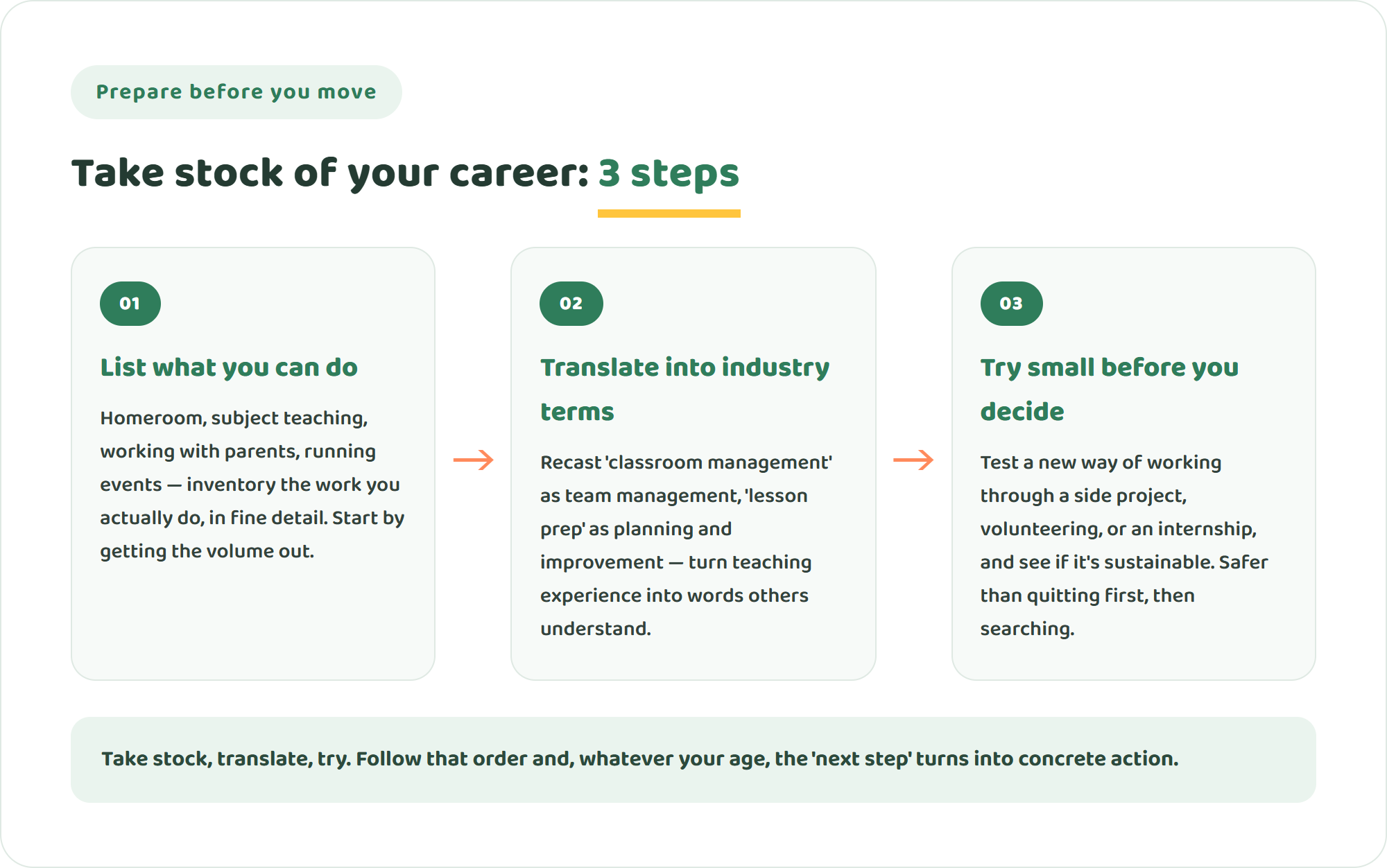
First, list what you can do. Inventory the work you actually do — homeroom duties, subject teaching, working with parents, running events, coordinating with colleagues — in fine detail. Include not only “what went well” but “what you devised” and “what you were trusted with”; getting the volume out is the starting point. Second, translate into industry terms. Recast “classroom management” as team management, “lesson prep” as planning and improvement, “working with parents” as stakeholder negotiation — turn teaching experience into words the other side understands. Third, try small before you decide. Test a new way of working for real through a side project, volunteering, or an internship, and check whether it’s sustainable. It is far safer, and far less stressful, than quitting first and searching afterward.
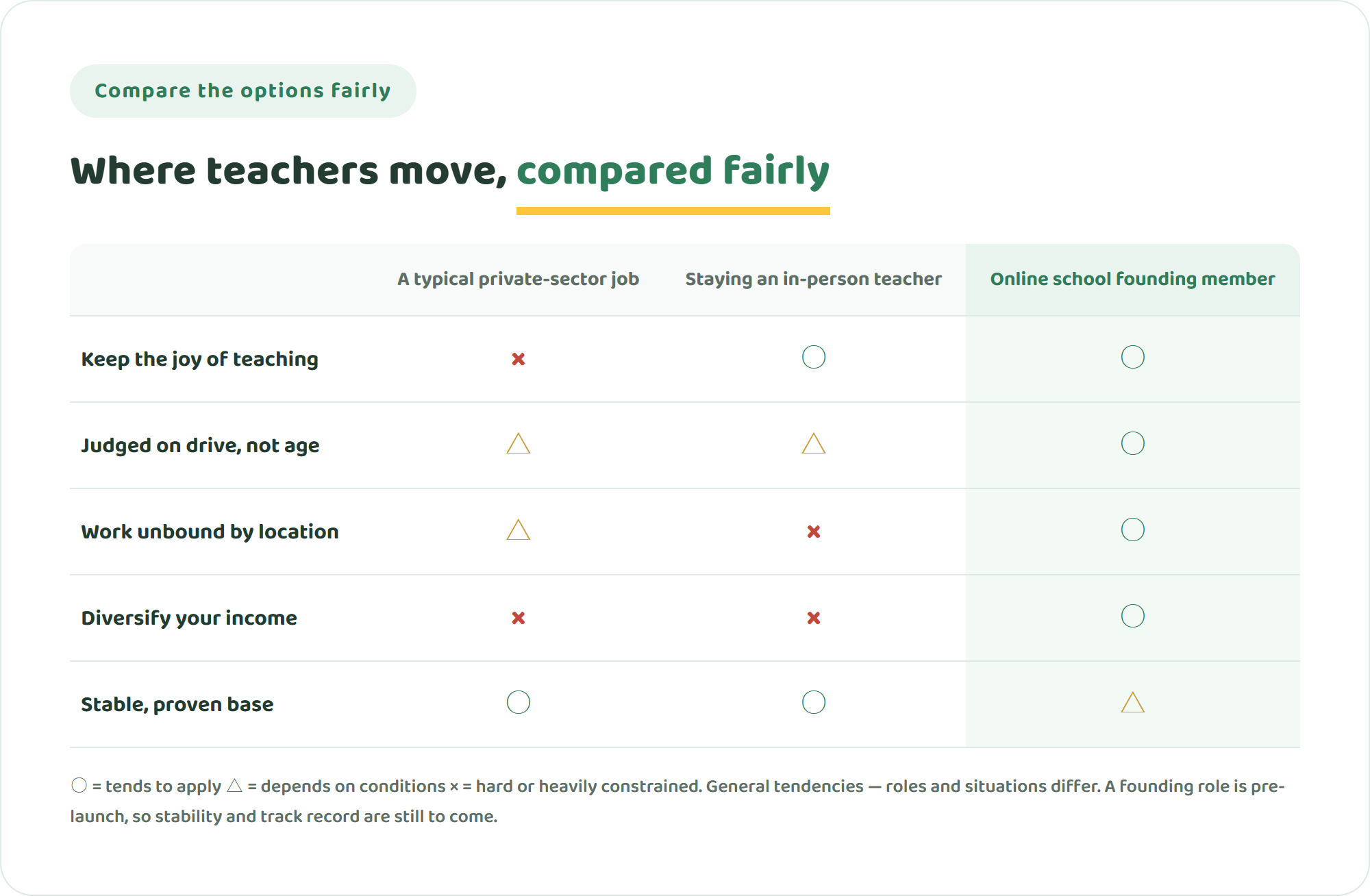
From there, it helps to weigh your options fairly. Moving to a typical private-sector job opens a new world but tends to pull you away from the joy of teaching. Staying an in-person teacher is stable but rarely offers freedom of place or working style. The table below sets their strengths and constraints out side by side. What matters is not “which is correct” but choosing against the criterion you won’t compromise on — the joy of teaching, freedom of location, or stability of income.
See NIJIN GLOBAL ACADEMY’s founding-member roles →
A third path — keep the joy of teaching, and take on the business too
Keep teaching, or change careers into industry. What looked like those two choices actually has a third road: taking part in both the teaching and the work of building the school as a business. That is the founding-member role 脱偏差値のオンラインインターナショナルスクール NIJIN GLOBAL ACADEMY (NGA) is recruiting for ahead of its September 2027 opening. As the table above makes plain, it is not a cure-all — precisely because it is a pre-launch phase, the “stability and track record” of an established school or company are still to come. Even so, for anyone in their 30s or 40s who thinks “I don’t want to give up the joy of teaching, but I do want to change how I work,” the appeal is real.
First, we look at drive and the ability to build, more than age. Rather than a license or a glossy résumé, we value an appetite for building from zero — and the on-the-ground experience you’ve stacked up in your 30s and 40s becomes a foundation for building the school. Second, you can choose work beyond teaching. You pick your involvement from five working styles spanning marketing, web, partnerships, and HR, so alongside the skills you honed as a teacher you can grow new, industry-facing ones. Third, we say plainly what the terms are: founding roles on this track begin as volunteer positions ahead of our September 2027 opening, and the detailed terms are shared later in the process. Not resting your income on a single pillar is a real reassurance for anyone supporting a family. And it is fully remote, with no fixed location. What we ask of applicants is roughly English at CEFR B2+ and a genuine agreement with learning beyond test scores — a view of education laid out in how we learn.

Frequently asked questions
Is a career change in my 30s or 40s really too late?
Generally, changing careers in your thirties or forties is no longer unusual. Increasingly it is “what you’ve done and what you can still learn” that gets weighed, not your age itself. In NGA’s founding-member selection too, we look at the drive to build from zero and the strengths forged on the ground, not at age. Start with taking stock of your career before quitting in a hurry, and lateness stops being a serious wall.
I have no private-sector experience. Is it okay if I only know teaching?
What NGA asks for is people who “can build from zero.” Experience marshalling all kinds of people as a homeroom teacher and delivering results on a tight schedule carries straight into building a business. Because you can also take on marketing, web, and more beyond teaching, industry-facing skills are something you grow after you join.
I love teaching. Do I still have to give it up?
No. An NGA founding member takes on both the teaching and the building of the school. You don’t have to let go of the joy of teaching. Rather than a binary of “quit or stay,” think of it as a third path: keep your teaching core and change only how you work.
You open in September 2027. Is there any point applying now?
Yes. It is precisely because it is pre-launch that founding members help design the substance of the learning itself. Selection runs documents → group interview → an internship at NIJIN Academy → a final presentation, so you gain experience during the lead-up while both sides get to assess the fit. If you are drawn to “joining the side that builds” rather than “entering a finished organisation,” now is arguably the moment.
Age is not a reason not to begin.
If you searched for a teacher-to-corporate career change, an attachment to teaching and a wish to try something new probably live side by side in you — and those two do not require you to discard one to hold the other. Being in your 30s or 40s is inseparable from an asset: the years of on-the-ground experience you’ve built. You don’t have to leap in blind, and you don’t have to give up on age alone. List what you can do, translate it into industry language, try it small — each step turns the anxiety of “lateness” into a concrete set of options. The power to choose your next step has always been, and remains, in your own hands.
Working at an International School — More Articles
- international school teacher salary
- how to become an international school teacher
- career change from teaching
- how much do teachers earn?
- how to become an IB teacher
- jobs for moving abroad
- career change from tutoring
- life after leaving teaching
- a second career for teachers
- private school teacher career change
- teach abroad without relocating
- thinking of quitting teaching
- digital nomad teaching jobs
- bilingual remote jobs
- high-paying jobs that use English
- careers with a teaching license
- qualifications to teach English
- elementary school teacher salary in Japan
Turn your passion for teaching into your next way of working.