“Her test scores are fine, but something in her has dimmed.” Or perhaps the opposite: “He works so hard, yet his rank won’t rise, and now he’s convinced he isn’t good enough.” Watching your child sleep at night, do you ever feel a quiet unease? A sense that the race you’re all running may not be the right one?
If you’d rather not pour your child into an exhausting exam race, if you don’t want their spirit worn thin by a number on a page, this piece is for you. Here, without pushing anything on you, we’ll think together about the skills standardized tests cannot measure, why they matter more now than ever, and how you can nurture them at home.
What are “the skills standardized tests cannot measure”?
What a test score measures is whether a child can accurately reproduce a fixed body of knowledge within a fixed amount of time. That’s a real skill, of course. But it captures only a small slice of who your child is.
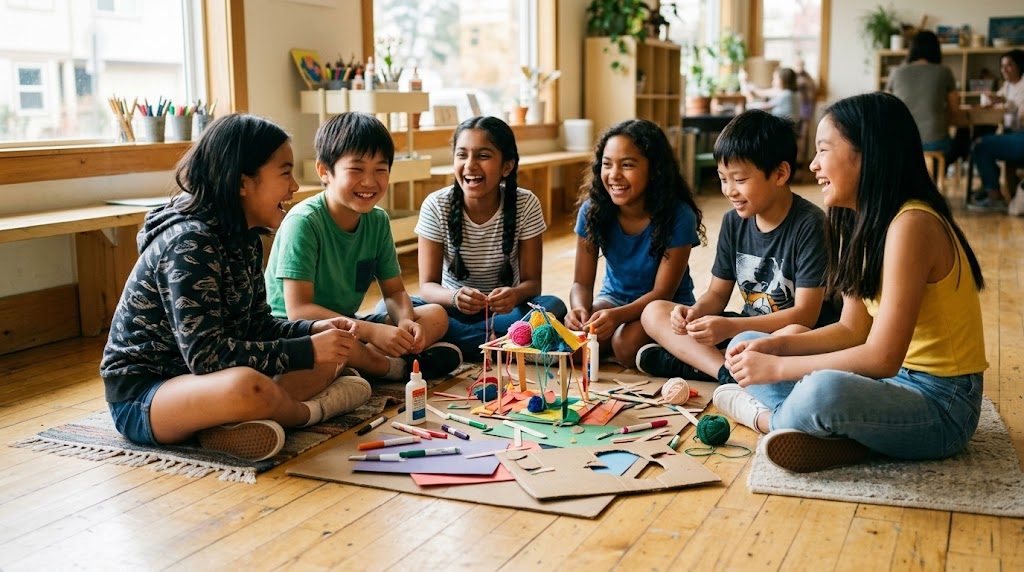
Picture, for a moment, a different set of abilities. When faced with a question that has no set answer, can your child frame their own question? Can they work with someone from a very different background, finding the words to cooperate? When things don’t go well, can they get back up rather than stay defeated? These are the skills standardized tests cannot measure — and yet they are precisely what life asks of us. You might say they are your child’s true character, the part that never fits inside an answer sheet.
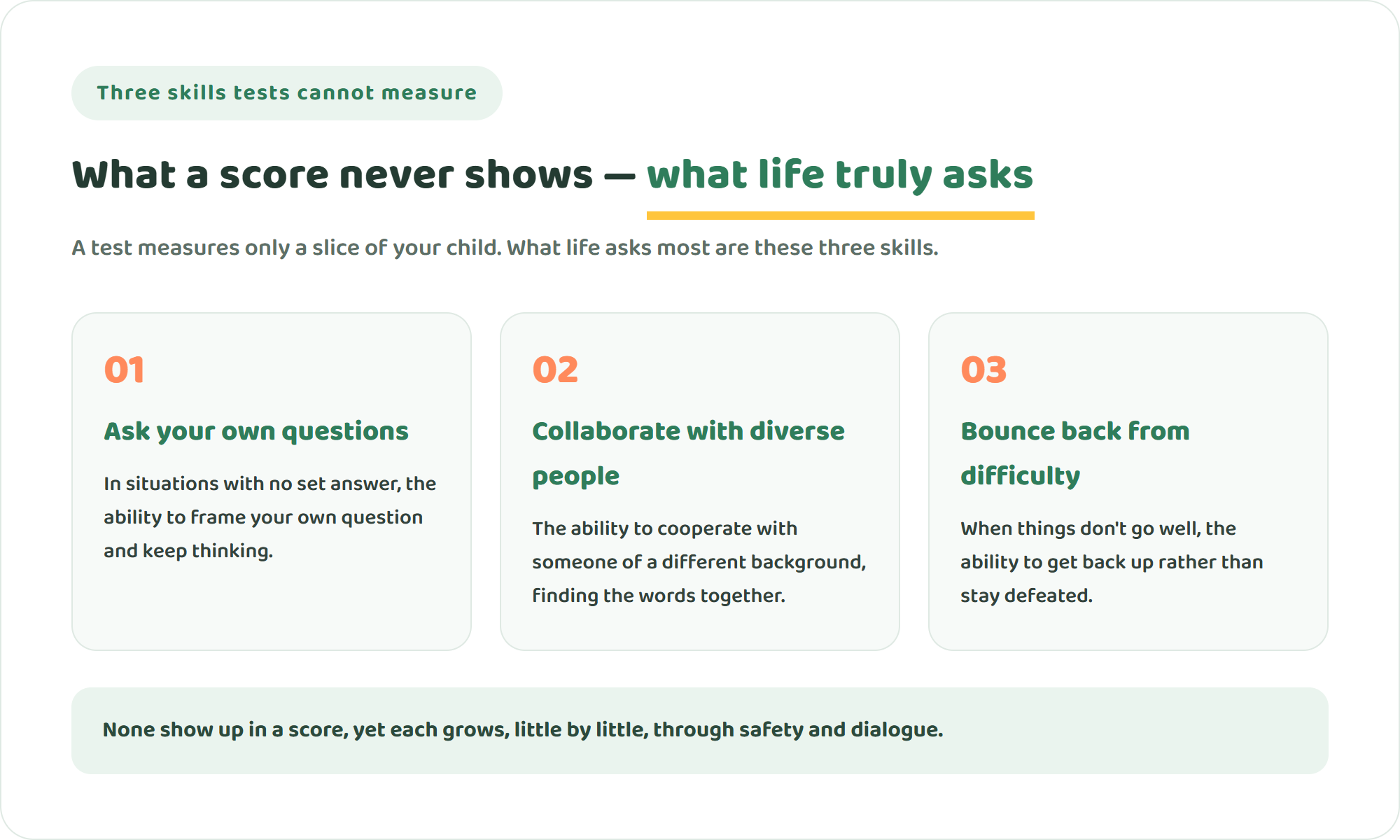
Broadly, the skills standardized tests cannot measure fall into three: the ability to ask your own questions, the ability to collaborate with diverse people, and the ability to bounce back from difficulty. None of them grow from drilling for fast, correct answers. They sprout, slowly, in a safe environment — through dialogue, and through the sense that it’s okay to fail.
Why these skills matter more now than ever
“Haven’t these always mattered?” — yes, they have. But the changes of our era have made them weigh more heavily than at any time before.
The work of producing a correct answer from memorised knowledge is increasingly handled by machines. What remains distinctly human is shifting toward asking questions, connecting with people, and keeping judgement steady in situations that have no answer key. Ironically, the very territory standardized tests are best at is the territory whose relative value is now falling.
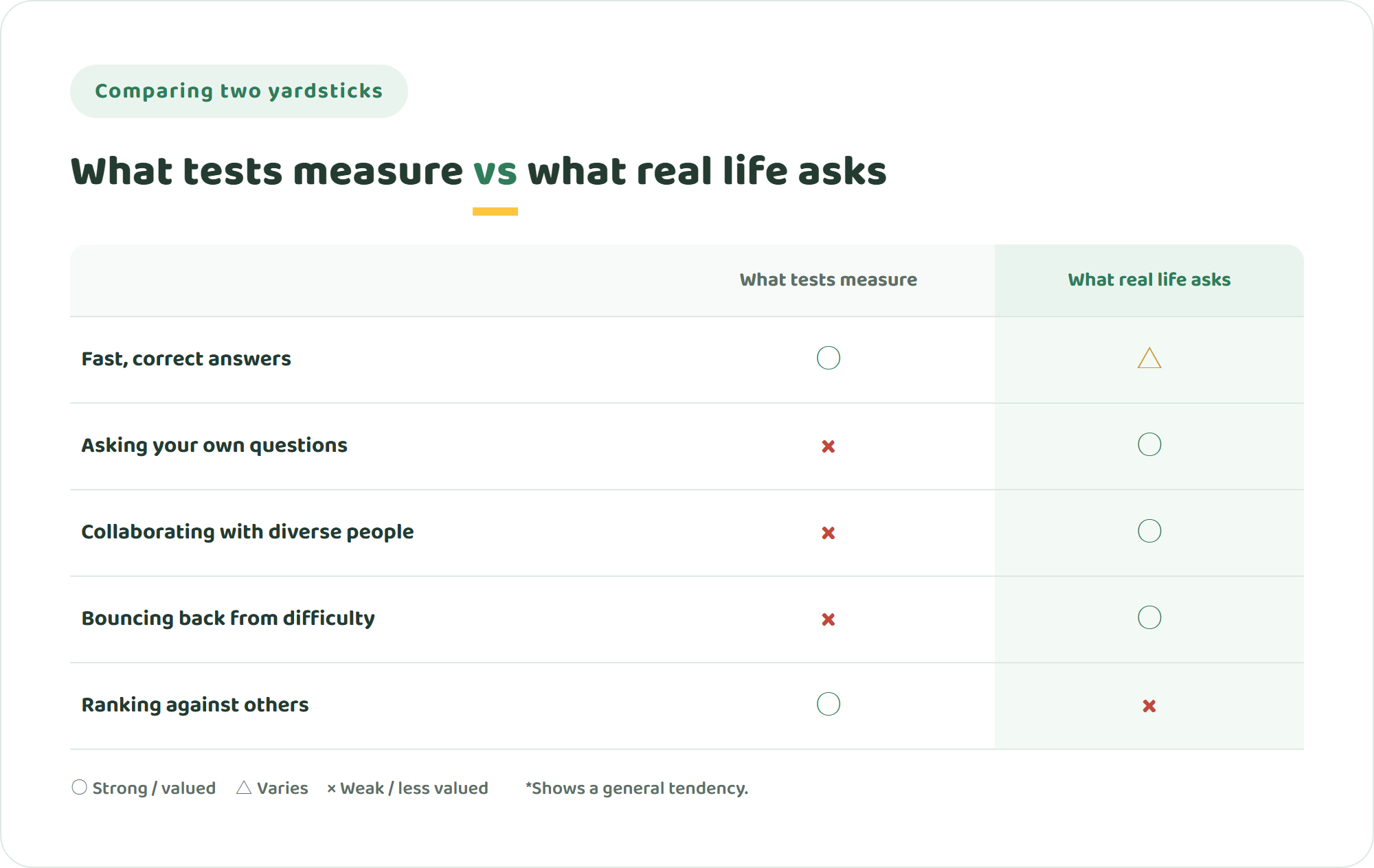
There’s another thing we can’t ignore: the intensity of the exam race across Asia and Oceania. In Japan, Korea, China, Singapore and beyond, children are ranked and compared by scores from a very young age. As a result, too many come to measure themselves only by “what number am I,” and their spirit quietly wears thin. A single yardstick — the exam score — slowly renders invisible the many-sided worth of your child. The unease you feel is not overthinking.
The honest limits of traditional school and exam-based evaluation
To be clear, this isn’t about teachers being at fault, nor is a test score itself the villain. The problem lies in the system of “measuring everyone by one yardstick and ranking them.” Don’t blame the person — re-examine the system. Seen that way, the limits come into focus.
- Only the measurable gets valued — the ability to ask questions, or the kindness to encourage a friend, goes unseen simply because it earns no points.
- Comparison is built in — an exam score is decided against others. So no matter how much a child grows, “there’s always someone higher,” and self-worth is hard to build.
- One pace, one content is treated as correct — a child who wants to think slowly and deeply, or whose curiosity runs a different way, is deemed “behind” the moment they step outside “the same as everyone.”
If your child is struggling to raise their score, it is never because their worth is low. What didn’t fit may not be your child, but the single yardstick. Simply shifting how you see it can change the whole view.
Nurturing these skills at home
So what can you do at home? No special materials, no expensive cram school required. You can nurture these skills, little by little, within everyday moments. There’s an order to it, so take one step at a time — no rush.
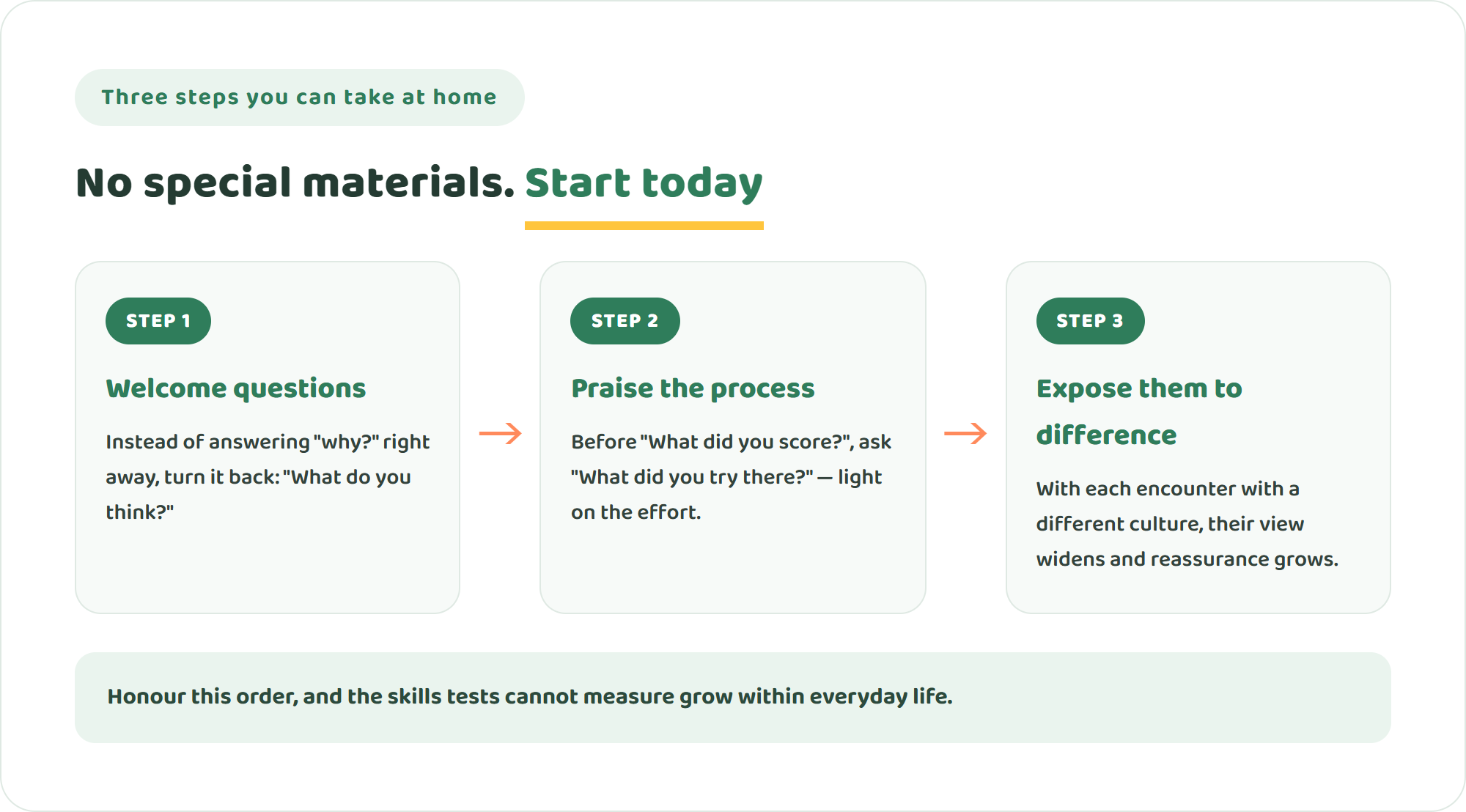
First, welcome the “why.” When your child asks “why?”, instead of handing over the answer, try turning it back: “What do you think?” Dialogue that isn’t in a hurry for the right answer grows the ability to ask questions. Next, praise the process over the result. Before “What did you score?”, ask “What did you try there?” When you shine a light on the effort rather than the number, your child is set free from comparison. And finally, open a window onto a diverse world. With every encounter with a different culture or way of thinking, your child’s view widens, and the reassurance of “I’m not the only one” takes root.
What matters most is that you yourself truly believe the exam score isn’t everything. When that reassurance reaches your child, they can finally begin to move as themselves.

The NGA way — not exam scores, but dialogue and diversity
Still, carrying all of this at home alone is hard. If only there were a place to learn, built on the same values, where these skills could grow — for parents who feel that way, here’s what we’re building.
NIJIN GLOBAL ACADEMY (NGA) is an online international school beyond the exam race, opening in September 2027. Rather than ranking children by test scores, we care above all about each child learning to love themselves and the world.
- No competing by scores — in a culture of cheering each other on rather than competing, your child can deepen their own questions in safety. They learn to grow, not to beat someone.
- Learning starts from dialogue — in small groups, we treasure time spent talking through questions rather than memorising answers. The ability to collaborate with diverse people grows naturally in this dialogue.
- The whole world as the classroom — meeting diverse peers across Asia and Oceania, encountering difference as an everyday thing, builds both perspective and resilience. Connecting with the world becomes the learning itself.
“Can a way of learning like that really work?” you may wonder. But NIJIN Academy, the alternative school we run in Japan, already has over 1000 children learning with us. Children who didn’t fit the exam race regain their confidence at their own pace. Now we’re bringing that education online, to the world. Tuition is around one-fifth of an on-campus international school — and being able to keep going matters as much as anything.
See how learning works at NGA →
An honest word — it isn’t for everyone
To be clear: learning beyond the exam score is not a cure-all. For a family with a clear exam goal, wanting to prepare intensively toward that single point, a traditional cram school may fit better at times. And because it’s online, we can’t offer the experience of sharing the same classroom air every single day.
On the other hand, if your child “finds being compared by scores painful,” “wants to think deeply at their own pace,” or “is curious about the world,” this way of learning — one that nurtures the skills standardized tests cannot measure — is likely to fit very well. What matters is less about finding the “right” school and more about how you choose an environment where your child can safely grow into themselves.
Five things to check when choosing
If you do consider learning that isn’t bound to exam scores alone, look at these points.
- What is measured — is there a way to see growth and process, beyond scores and rank?
- How much dialogue — is there time to talk through questions, not just be taught at?
- Contact with diversity — is it an environment where a child meets peers of different cultures and backgrounds?
- Psychological safety — is there an atmosphere where a child isn’t blamed for a mistake, or for staying quiet?
- Sustainability — can your family keep it up, in terms of both cost and time?
Frequently asked questions
If we nurture the skills tests can’t measure, won’t academic ability suffer?
No. The ability to ask questions and to hold dialogue is, in fact, the very foundation of academic ability. A child who treasures “why?” tries to understand the essence rather than lean on memorisation. Precisely because the score isn’t made the goal, deep learning grows — and academic results tend to follow.
My child has a low score right now and has lost confidence. Will they be okay?
Yes. An exam score is only one yardstick, measuring just a fraction of your child’s worth. Step away from comparison and into an environment where their questions and their process are recognised, and many children slowly regain confidence. What’s needed first is a place that feels safe.
Can my child learn at an online international school with no English at all?
Yes. A bilingual mentor supports your child in their home language and guides them into English step by step — learning it not as a “subject” or an object of scores, but as the language they use to talk with peers around the world.
Your child’s future lives in what can’t be measured.
An exam score is only a small mirror reflecting one part of your child. Outside that number — the ability to ask questions, to connect with people, to bounce back — your child’s true future is spread out, wide and whole. Will you believe in those unmeasurable skills, together with them?
NIJIN GLOBAL ACADEMY opens in September 2027. We’ll share how we nurture the skills standardized tests cannot measure, along with first-cohort enrolment news, straight to your inbox. A way of learning where your child can come to love themselves and the world.
Get opening updates by email →
More on choosing an international education
- The Best Age to Start Learning English for Kids——Too early? Too late?
- Online International Education in Asia and Oceania: 7 Options Compared——An honest comparison
- Where Do International School Graduates Go?——University outcomes, honestly
- Affordable International Education for Your Child——How to keep costs down
- Positive School Refusal: Supporting a Child Who Learns Outside School——Practical support for families
- International School Fees in Asia by Country——An honest comparison, and the online third path
- Are There Subsidies for International Schools?——Realistic ways to lower the cost
- A Cheaper Alternative to a Singapore International School——Affordable online options
- Affordable International Schools in Bangkok——Fees, and an online alternative
- 10 Ways to Help Your Child Learn English at Home——What parents can do