Most parents don’t research international schools because they’re excited. They research because they’re worried — about the fees, about whether the English will actually come, about whether their child will fit. Search “international school regret” and you’ll find parents in Singapore, Kuala Lumpur, Manila and beyond writing that the cost hurt more than expected, that the promised fluency never arrived, or that the whole thing simply didn’t suit them. You don’t want to become one of those stories. That instinct is a good one.
Here’s the useful part: almost every regret you’ll read about traces back to something the family could have asked before enrolling — and didn’t. So this guide works backwards. It starts with who regrets international school and why, then turns that into the concrete questions to ask when choosing an international school — at the open day, in the admissions interview, and to other parents. Take them with you, and a glossy tour turns into real information.

What parents actually regret — and what it tells you to ask
In parent forums and expat groups across Asia, the same themes recur. “The English didn’t progress, because the class was full of children who shared our home language.” “We prioritised English, and our child’s mother tongue slipped.” “The published tuition was only part of it; the extras kept coming.” “Friendships felt transient — expat families come and go.” “The pathway narrowed: the qualifications we assumed would be there weren’t obvious.” None of these are exaggerations.
But notice what they have in common. The problem is rarely that the school is “bad.” It’s whether the school fit this child and this family — and every one of those regrets maps onto a question that could have been asked at the open day. For a balanced view before you decide, our companion piece on the real pros and cons of international school is worth reading alongside this one.
The five patterns behind regret
- They outsourced it — assuming “English will sort itself out once they’re enrolled,” with no real role for the family and no clear purpose.
- They misjudged cost against budget — deciding on enrollment-day momentum without modelling the multi-year burden. The single most common driver of regret.
- They underrated the home language — prioritising English so heavily that deep talk in the mother tongue thinned out, leaving both languages half-formed for a while.
- They never checked the exit — enrolling without confirming graduation qualifications or where the pathway leads, then finding narrow options at the secondary stage.
- They didn’t test fit — choosing on reputation without seeing whether the culture, peers and way of learning actually suited their child.
One more thing about those forums: happy families rarely post. The parents who publish are usually the ones carrying a problem, so search results look more pessimistic than reality. Read regret posts not for the verdict, but for the question that went unasked.
Why regret happens — a mismatch, not a bad school
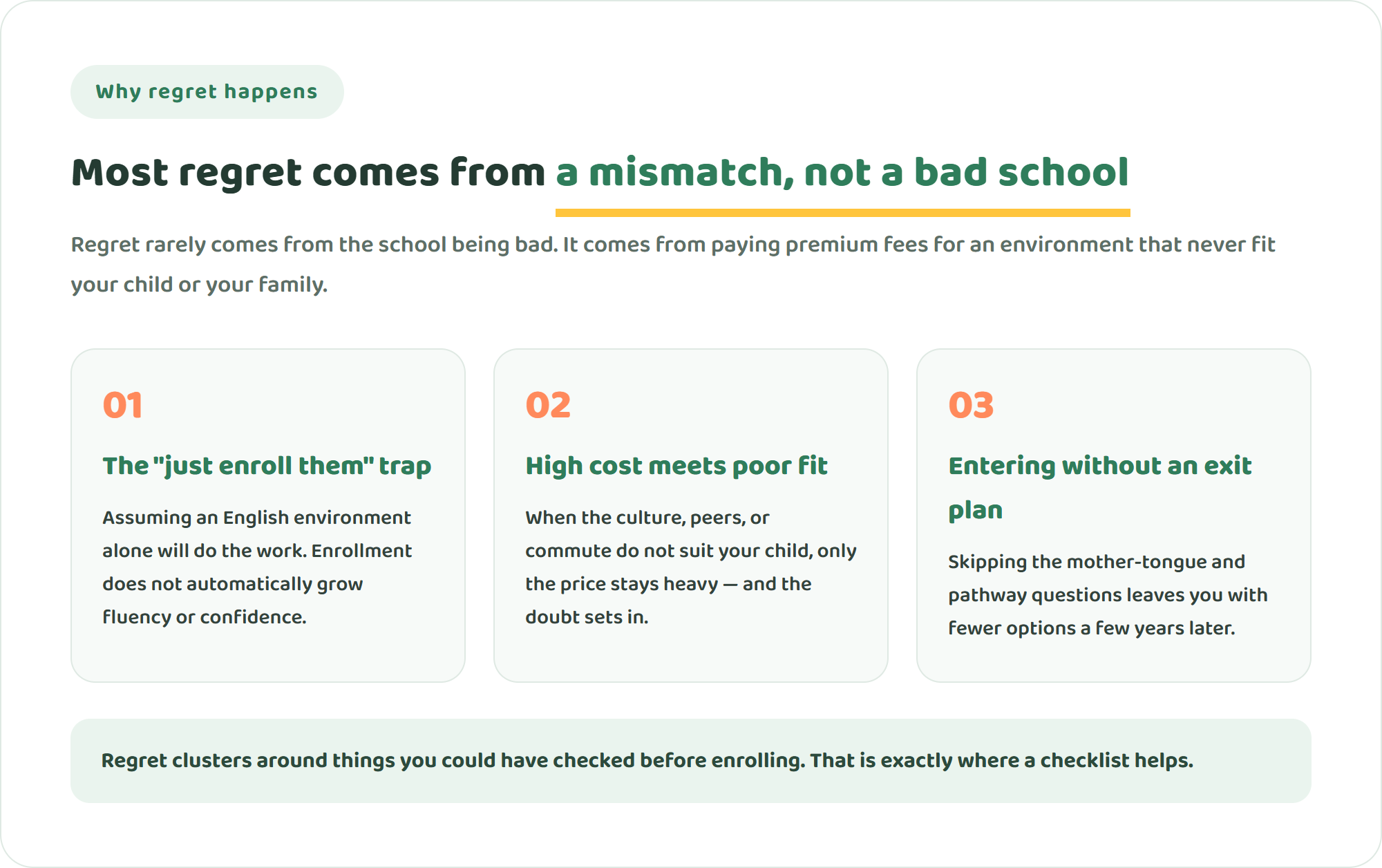
At root, regret comes from one equation: high cost meets poor fit. First there’s the “just enroll them” trap — the hope that an English environment alone will do the work. It won’t. Then, when the culture, peers or commute don’t suit your child, you get less back while the premium fee stays heavy in your hands. Third is entering without an exit plan: skip the questions about mother-tongue support and future pathways, and your options quietly narrow a few years later. If cost is the sticking point, map your options when international school feels too expensive before you decide.
What the fees actually add up to
It helps to put real numbers against the word “expensive.” According to 2026 fee guides published by the schools database iSchoolAdvisor, annual tuition in Singapore runs from around S$14,000 at the most affordable full-programme schools to more than S$47,000 at premium British and IB schools, with most families landing between roughly S$25,000 and S$50,000. In Kuala Lumpur the range is wider — about RM12,000 to RM145,000 a year, with the median Cambridge-curriculum school between RM30,000 and RM60,000.
The number that catches families out, though, is never the headline tuition. Application and enrolment fees, a deposit of roughly one term, uniforms, transport, technology, lunches, trips and exam entries typically add another 15 to 25 per cent on top — every year — and some one-off payments are non-refundable if you leave. Budget for the total to graduation, not the first invoice. If you’re weighing whether the whole thing pays off, our piece on what an international school education is really worth goes deeper on the return side.
What families regret most — and the question behind each one
Every regret below traces back to a question nobody asked in time. If you want the shorter decision framework rather than this full list, our guide on how to choose an international school covers the seven core questions. Here is the practical heart of this guide. School tours are designed to impress; your job is to get past the presentation. Admissions teams expect specific questions from serious families, and how they answer is often more revealing than what they answer.
Fees: what’s included, and what isn’t
- What is the total annual cost per child, including everything that isn’t tuition?
- Which fees are one-off, which are annual, and which are refundable if we leave?
- How much have fees risen in each of the last five years?
- What notice period applies if we withdraw mid-year, and what is not refunded?
Accreditation, curriculum and university pathways
- Which bodies accredit the school, and when was the last accreditation visit?
- Where did the last three graduating classes go — which countries, which institutions, how many students?
- If we return to our home country mid-way, how well does this curriculum transfer?
- What happens if my child doesn’t suit the exam pathway you offer?
Language: English support and the home language
- What is the nationality and home-language mix in my child’s year group, not school-wide?
- Which language do children actually speak at break time?
- Who delivers English support for beginners, for how many hours a week, for how long, and at what cost?
- Which home languages are taught to a literacy level rather than a conversational one?
Teachers, class size and support
- What proportion of teachers have been here more than three years, and what is annual turnover?
- What is the average class size, and the actual adult-to-child ratio in the classroom?
- How do you identify and support a child who is struggling academically or socially? Give me a real example.
Wellbeing, fit and the parent community
- How do you handle friendship groups when families arrive and leave mid-year?
- In which language does the school communicate with parents, and what involvement is expected of us?
- How many families withdraw in a typical year, and for what reasons?
- What kind of child thrives here — and what kind of child does not?
Two of these matter more than parents realise. High teacher turnover almost always has an internal reason, and a school that answers the withdrawal question openly has told you a great deal about its culture. Watch the hesitation as closely as the answer. Ask two or three current parents, away from the school, one blunt question too: what do you wish you’d known before you enrolled?
What to watch on the visit itself
Admissions specialists converge on the same advice: trust what you see on the visit more than what you read in the marketing. Are children speaking in lessons, or sitting quietly while an adult talks? Do teachers use children’s names? What language fills the corridor at break? And bring your child — the school adults admire and the school a child can breathe in are not always the same school.
Questions to ask at the early-years stage
If you’re looking at a preschool or kindergarten rather than a full school, the questions shift. At this age, regret rarely comes from academics — it comes from paying premium fees for gains that fade, and from a home language that quietly loses ground.
Ask where children typically go next and what that school costs; families often discover too late that the attached primary is far more expensive, and that they’re already on a track that’s hard to step off. Ask how much of the day goes on early literacy in the home language, and whether children who move to a local school afterwards are ready for it. Then ask yourself the question no brochure covers: does my child come home looking lighter or heavier? At three or four, that’s the most reliable data you will get. Our guide to raising a bilingual child without losing the mother tongue covers what the home can do alongside any school.
Who doesn’t regret it — judging fit by your own standard
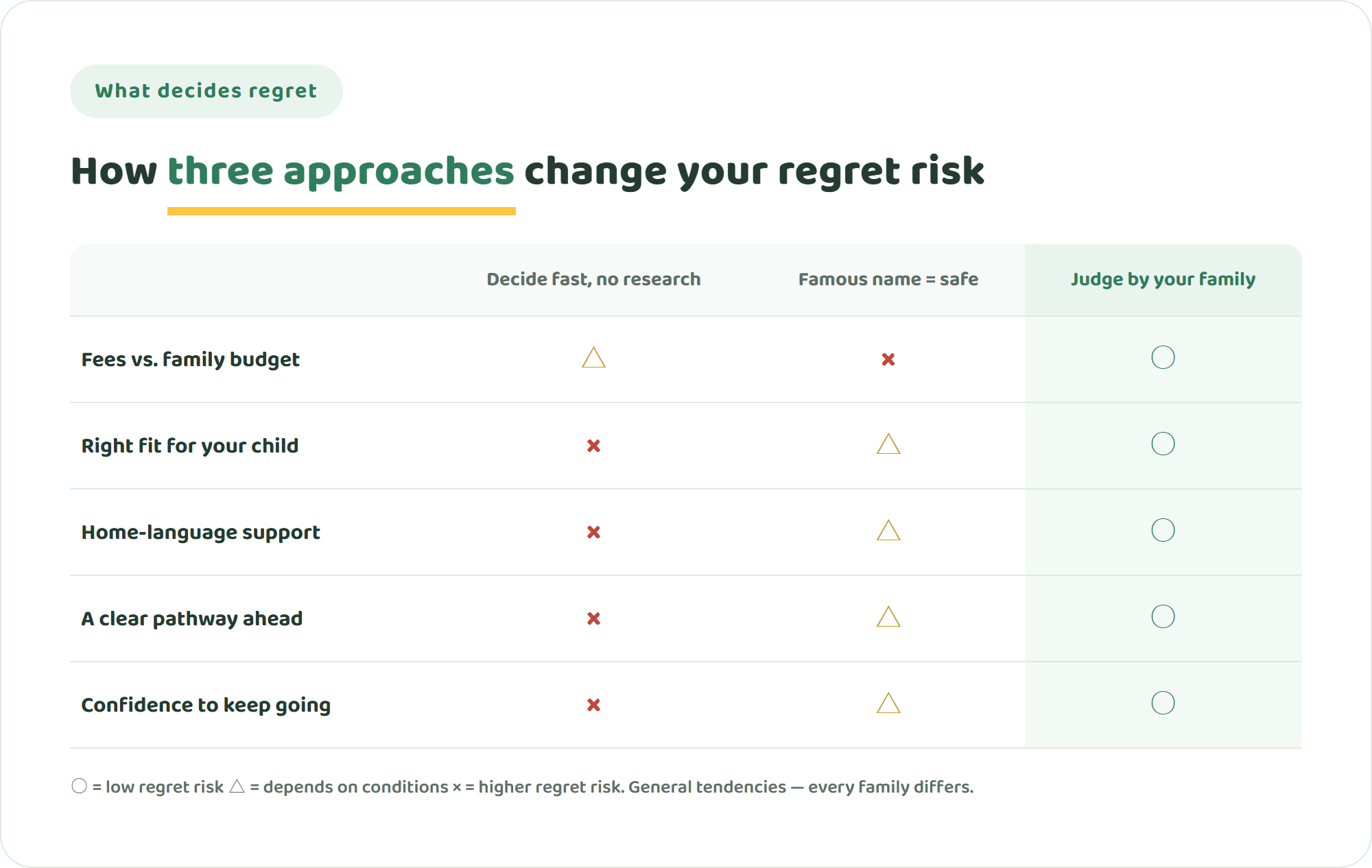
As the table shows, deciding on impulse and trusting a famous name both tend to leave a gap somewhere — in cost, fit, home language, or pathway. The families who rarely regret it are the ones who check, one by one and against their own circumstances: can we sustain the fees, does it suit our child, is the home language supported, is the pathway clear? If you’re still deciding between systems rather than between schools, our guide on choosing between an international and a local school is the better starting point.

If it isn’t working — changing course is not failure
Some readers are already enrolled and quietly unhappy. So, honestly: leaving a school that doesn’t fit is a correction, not a failure. Beware the sunk-cost trap — what you’ve already paid is gone whichever way you decide, so the only real question is whether the next few years are worth the next few years’ fees.
Warning signs worth taking seriously, if they persist for months rather than weeks: your child stops talking about school, or feels ill on school mornings; explaining an idea is visibly hard in both languages; the fees keep the household permanently tense; or you raise a concern and get reassurance instead of a plan. If you do move, check the notice period and which fees are non-refundable, secure the next place before you give notice, and — if English matters — arrange something to keep it alive during the gap. Children who leave an English environment abruptly can lose ground fast.
A third option — trying small before you commit
If most regret comes from “high cost meets poor fit,” there’s a way to lighten both: test the fit without a large, hard-to-reverse commitment. One route is an online international school. This is exactly the thinking behind NIJIN GLOBAL ACADEMY (NGA), which we’re designing to open in September 2027.
NGA is an online international school that doesn’t rank children by test scores. Learning is built around small-group dialogue that begins with “what do you think?”, and it’s designed so children ease into English with the support of their home language — raising both side by side rather than trading one for the other. It’s built for families with children aged 6 to 18 across Asia and Oceania who want a global education without uprooting their lives. NGA is operated by NIJIN Inc.; its alternative school in Japan, NIJIN Academy, already serves more than 900 children, and tuition is designed to be around one-fifth of a typical bricks-and-mortar international school. We’ll be honest about the limits: being online isn’t the same as a physical campus, and as a pre-launch school our track record is still to come. But for a family that wants to test fit before betting a large budget on it, the regret risk is structurally smaller — and every question above applies to us as much as to anyone else.
Three checks before you enroll
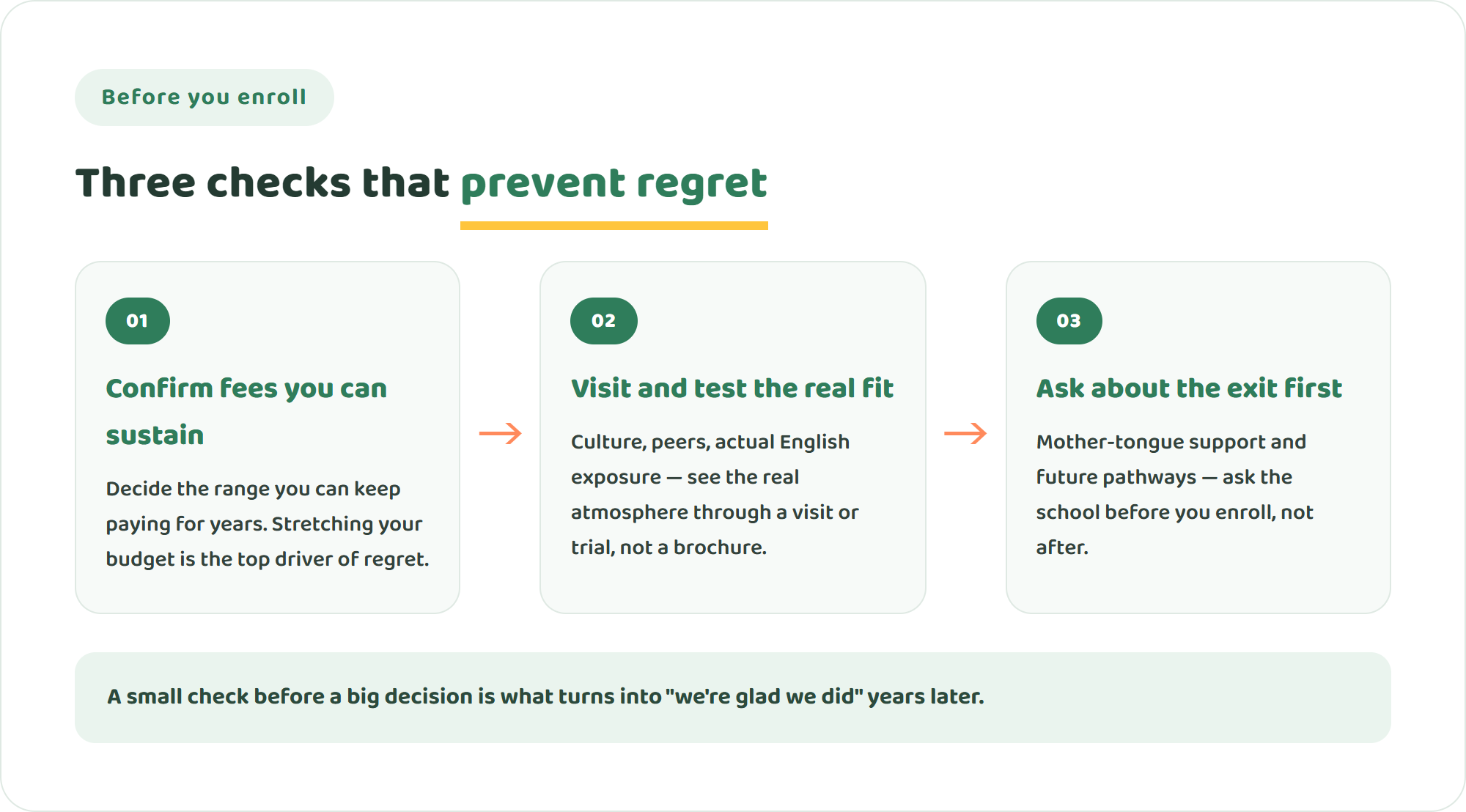
First, confirm fees you can genuinely sustain: add tuition, facilities, materials and activity costs, and decide whether you can keep paying that for years — not just next term. Second, visit and test the real fit: the culture, the peers, and how much English is actually used, through a visit, a trial period, or an online taster. Third, ask about the exit first — qualifications, university pathways, and whether the home language is supported. Those three pull most regret out by the roots before it can grow.
Frequently asked questions
What are the most important questions to ask when choosing an international school?
If you only get five minutes, ask these: the total annual cost including everything outside tuition; which bodies accredit the school; the home-language mix in my child’s year group; teacher turnover; and how many families withdraw each year and why. Those five expose cost, credibility, language reality, stability and culture faster than anything else on a tour.
Forums are full of “I regret it” posts. Should I just avoid international school?
Regret posts are easy to notice, but most describe a poor fit paid for at a high price — not a school that’s simply bad. Happy families rarely post, which skews what you read. Break the regret into its causes (cost, language, pathway, fit) and check which apply to your family.
What should I ask about fees so there are no surprises?
Ask for the total cost per child per year with every non-tuition item listed, the five-year history of increases, which payments are refundable, and what notice period applies. Across Asia, extras such as enrolment fees, transport, trips and exams often add 15 to 25 per cent on top of headline tuition.
How do I check whether my child will actually learn English there?
Ask for the home-language mix by year group, not school-wide averages — they hide a lot. Then ask which language children speak at break, who delivers beginner support, for how many hours, and whether it costs extra. If most of the class shares your home language, English gains will be slower than the brochure implies.
Should I ask about the mother tongue too?
Yes, and it’s the question most often skipped. Ask which home languages are taught to a reading-and-writing level rather than conversation, and what the school expects families to do at home. Losing the mother tongue is one of the hardest regrets to reverse, because literacy in a first language quietly supports learning in the second.
Is it different when choosing a preschool or kindergarten?
Yes. Ask where children go next and what that costs, how much of the day goes on early literacy in the home language, and whether children who move to a local school afterwards are ready for it. Early gains fade quickly without somewhere to keep using the language.
What do families who don’t regret it have in common?
They check four things in advance — cost, fit, home language, and pathway — against their own circumstances rather than reputation, and they stay involved after enrolling. They also decide in advance that changing course later is allowed, which takes the fear out of the decision.
Can we start with no English at all without regretting it?
Choose a place that treats English not as an entry requirement but as something to grow by using, and a beginner can start comfortably. Ask who provides support, for how many hours, and at what cost. A test-score-free online school that assumes home-language support means your child isn’t dropped into an English-only environment overnight.
Not wanting to regret it is your best compass.
The worry that brought you here isn’t hesitation — it’s care. And the patterns behind regret, turned around, are simply things you can prevent by asking first. Ask the awkward questions before you sign, test the fit in a small way, and give yourself permission to change course if it doesn’t work. You don’t have to bet big in a hurry. The right learning for your child is out there to be found.
NIJIN GLOBAL ACADEMY opens in September 2027. We’ll share how small-group, dialogue-based learning — with the home language supported — lets families test fit in a low-risk way, and send first-intake news early, by email. Here’s to a choice you won’t regret.
Honest Answers to Your Worries — related reading
- Will My Child Lose Their Mother Tongue?
- The Honest Pros and Cons of International School
- Disadvantages of Bilingualism in Childhood: Myths vs Research
- International School Special Needs: What to Look For
- International School vs Local School: How to Decide
- Does International School Hurt Your Child’s Home Language?
- When Your Child Is Struggling at International School
- Do International Schools Make Children Fluent in English?
- Is International School Worth It? What Happens to Graduates
- Should I Send My Child to International School?
- Transfer From a Local School to an International School
- Disadvantages of Early English Education: What Research Says
- What Happens to International School Graduates