“I’d love to send my child to an international school. But US$2,000–3,000 a month? That’s simply out of reach.”
So many families quietly give up on a global education for their child, stopped by the wall of tuition. This is not a story about parents who “can’t afford to invest in education.” It’s that, until now, the door to international education has only been open to a few.
This article is an honest look at how you can give your child a real international education — without the eye-watering price tag.

Why are international schools so expensive?
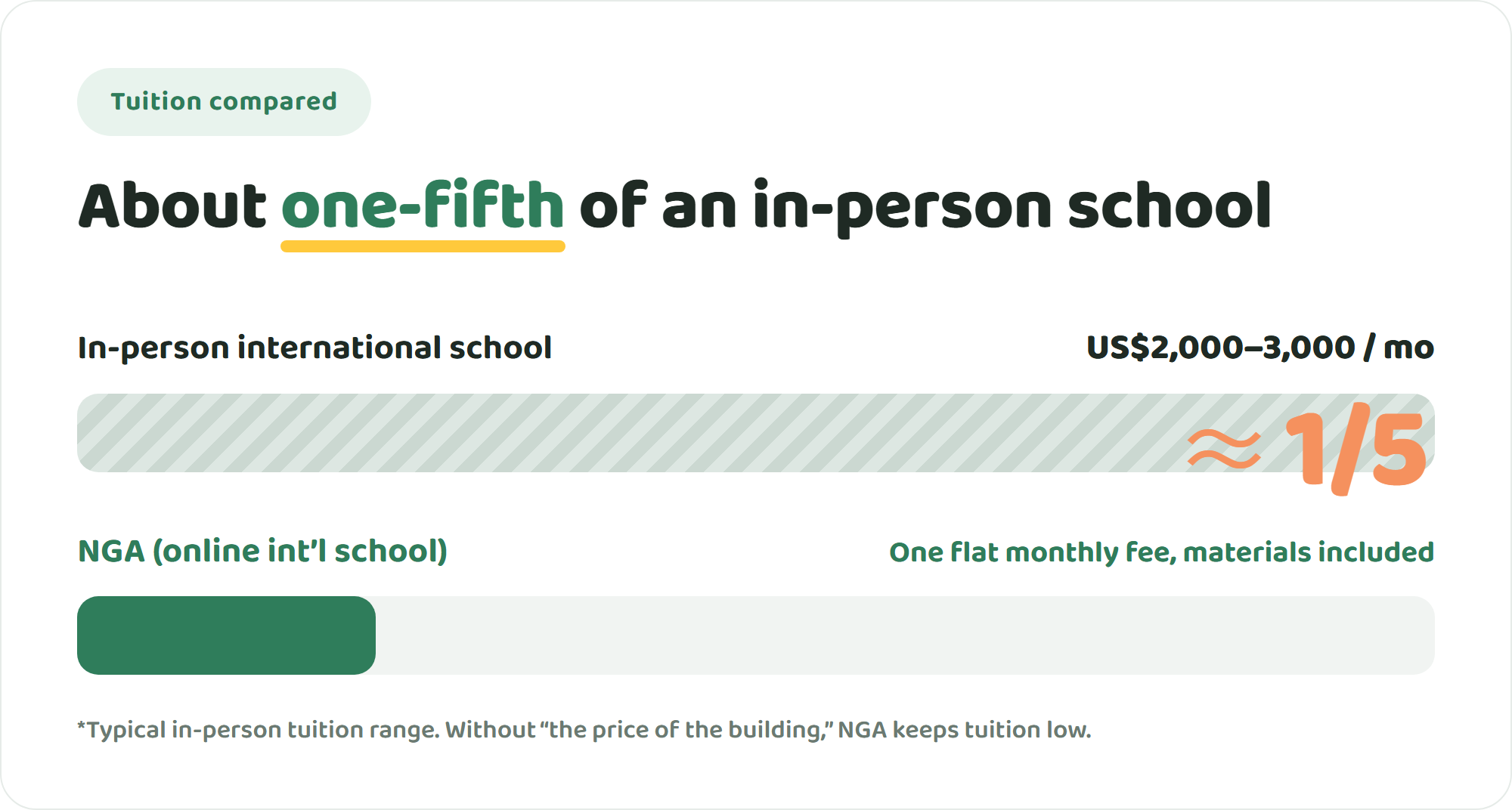
There’s a reason brick-and-mortar international schools cost so much: a campus in a major city, native-teacher salaries, small operations, facilities upkeep. A large share of that US$2,000–3,000 a month isn’t the quality of teaching itself — it’s the price of the building and the location.
And in-person schools exist only in big cities. For families in regional areas, or those who move between countries, they often aren’t even an option.
Where the usual alternatives fall short
So what do families do once an in-person international school is off the table? Let’s look honestly at three common paths.
1. Local school + English lessons or apps
The cost is manageable, but your child learns English — not how to learn alongside friends from around the world, in English. Language is a tool, not the goal. That essential part is missing.
2. Domestic IB or international-track schools
There are more of these now, but tuition is still high and locations are limited. And many ultimately sit on the same race toward a top university and a big company.
3. Moving abroad for education
Some families take the leap, but the burden of work, housing and cost is heavy. It’s not a choice everyone can make.
None of these is “wrong.” They just don’t deliver the whole wish: a global, individuality-nurturing education at a price you can actually reach. That’s exactly why a third option is needed.
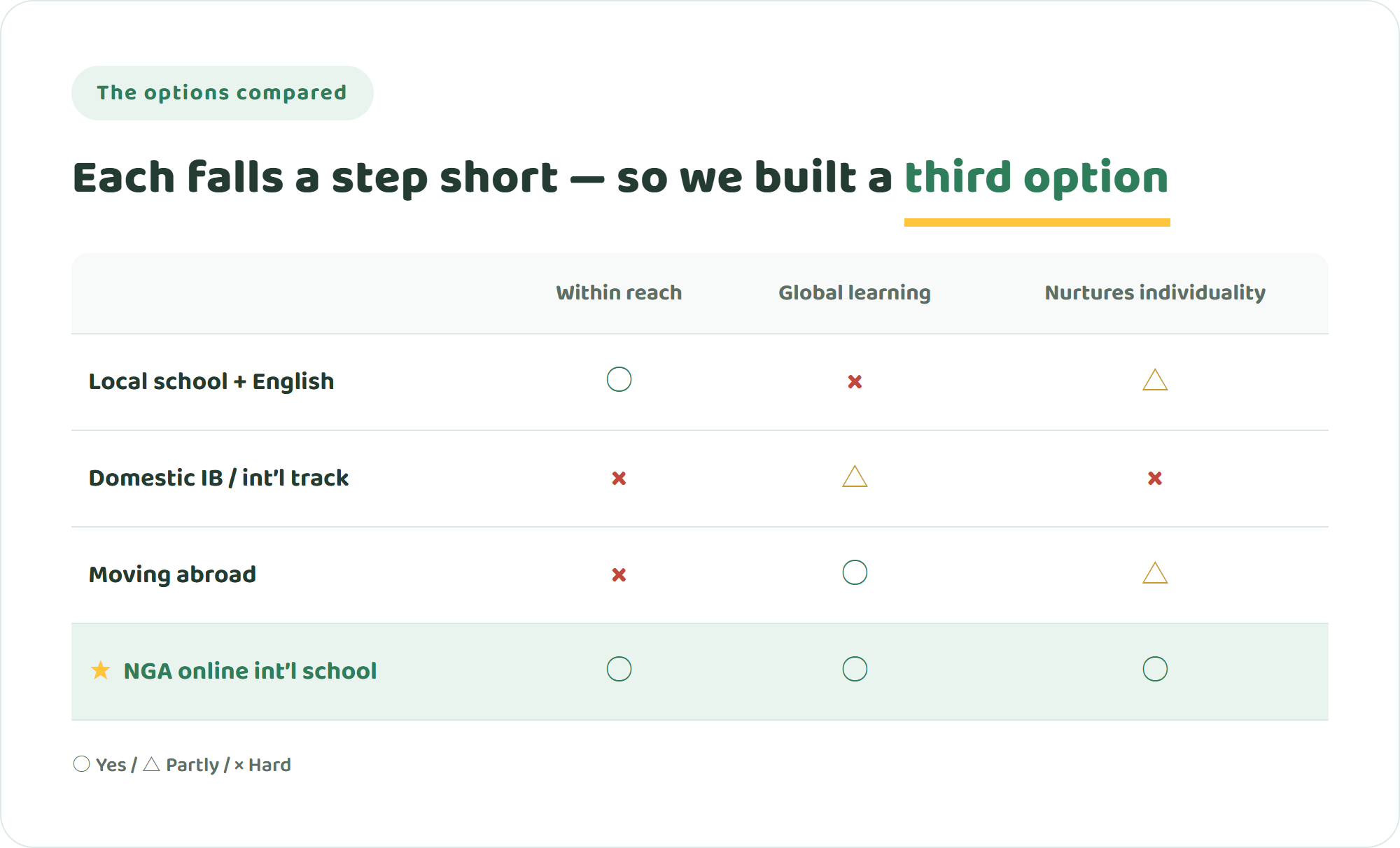
The third option: an online international school
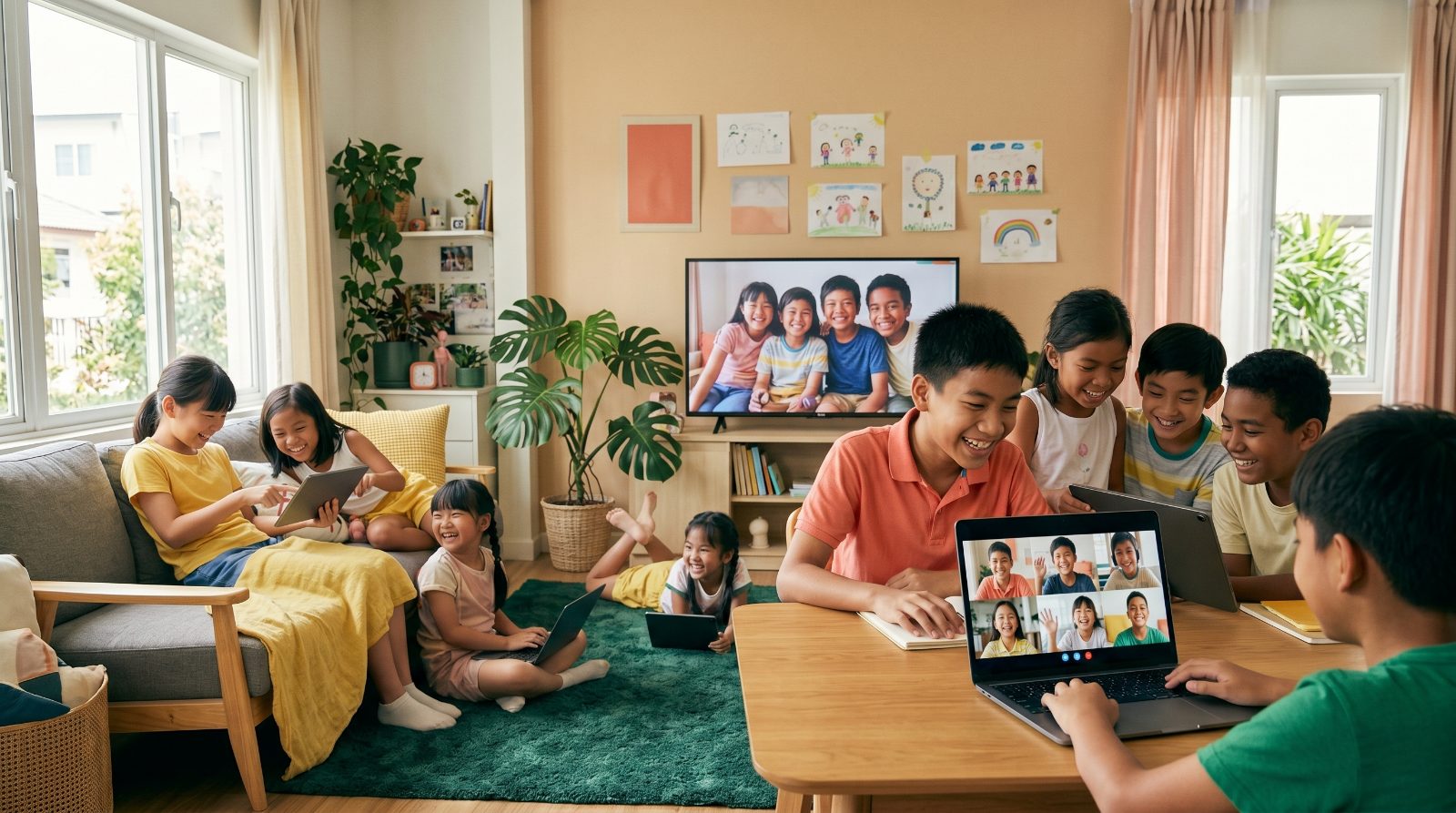
No campus. Children from around the world connecting and learning online. That’s an online international school. Without “the price of the building,” tuition drops to about one-fifth of an in-person school. At NIJIN GLOBAL ACADEMY, that’s one flat monthly fee, and the exact amount has not been announced yet (as of September 2026).
NIJIN GLOBAL ACADEMY opens in September 2027, and its tuition has not been announced yet (as of September 2026). Any specific monthly figure attributed to NIJIN GLOBAL ACADEMY elsewhere on the web is not an official price; the fee will be announced before enrolment opens.
“Cheap usually means low quality,” you might think. But NIJIN ACADEMY — the alternative school we run in Japan — already serves more than 1000 children. Kids who had stopped going to school come back to life; children once labelled “special needs” become the heroes of their class. We’re bringing that proven model to children across Asia and Oceania.
What an online international school actually is (and what it is not)
“Online international school” is not one product. Two schools using the phrase can differ far more than two campus schools in the same city. Before comparing prices, know which kind you are looking at.
Live lessons, or self-paced courseware
Some schools run a timetable of live, teacher-led classes at a set hour. Crimson Global Academy publishes a “Minimum 20 hours of live, weekly classes” for its full-time secondary programmes (official fees page); King’s InterHigh describes a “Full timetable of live teacher-led lessons” plus recordings (official fees page). Others are self-paced: Wolsey Hall Oxford gives each student “a dedicated Tutor who marks assignments within 3–5 working days” and a learning platform, rather than a live class timetable (official fees page).
Neither model is wrong; they suit different children. A child who has drifted away from school, or who is shy in English, usually needs other people on the screen at a fixed time. A self-directed teenager catching up on two A Levels may not.
Accredited — but by whom
Three separate things hide behind that one word, and a school may have one, two or all three: the school is inspected or accredited by a schools body; the curriculum is an internationally recognised one; and the qualification is awarded by an external examination board. Cambridge IGCSE — which Cambridge International calls “the world’s most popular international qualification for 14 to 16 year olds,” with over 70 subjects — is awarded by Cambridge, not by the school teaching it. Ask about all three, separately.
Full-time, or part-time alongside a local school
The price structure tells you which a school expects. Crimson Global Academy prices IGCSE at “$3,255 USD Part-Time Per Subject” or “$17,875 USD Full-Time Per Year”; King’s InterHigh sells an annual contract and also a rolling contract billed by the half term. If you want to keep your local school and add a subject or two, read the part-time line. If you want a whole school — friends, form time, a tutor who knows your child — read the full-time one. We weigh the two in international school vs local school and in transferring from a local school.
What a family needs at home
Crimson Global Academy lists what families must supply: a “Laptop or desktop computer, inbuilt or external webcam, and a stable internet connection.” Beyond hardware: a quiet hour behind a closed door; an adult within reach for younger children (a seven-year-old needs help logging in and rejoining after a dropout — by eleven or twelve, most manage alone); and a time zone you can live with. What it is not: a video library your child watches alone, a tutoring subscription, or — in most countries — an automatic legal substitute for compulsory schooling.
How online international school fees compare
Online international school fees are published — just rarely in a form you can lay side by side. Below are figures each school publishes itself, in the currency and school year stated there, checked September 2026. They are headline rates, not quotes: the final invoice depends on year group, subject count and start date.
| Online school | Published tuition | Other published costs |
|---|---|---|
| King’s InterHigh (live, UK curriculum) | 2026/27 annual: Primary £4,395; Middle £5,995; GCSE £7,250; A Levels £7,585 (3 subjects); IB Diploma £10,990 — per year | £100 registration; £500 deposit (£1,000 outside the UK); exam fees not included — paid to the exam centre, “typically £150-200 per qualification” |
| Crimson Global Academy (live) | Full-time per year: Lower Secondary US$17,100; IGCSE US$17,875; A Levels US$18,000. Part-time US$3,100–4,100 per subject | US$160 application fee per enrolment; exam fees “vary depending on location and subject”; family supplies computer, webcam, connection |
| Wolsey Hall Oxford (self-paced) | Published as downloadable primary and secondary fee schedules (from 1 April 2026) rather than one headline rate | £95 non-refundable registration per student; exam fees “paid directly to your chosen exam centre”; international book postage at cost |
| NIJIN GLOBAL ACADEMY (live, opens Sept 2027) | One flat monthly fee covering lessons and materials — a fraction of on-site international school tuition. We don’t publish the figure here; ask and we’ll send it | Materials included, no hidden costs, sibling discounts; external exam entry (e.g. IGCSE) paid to the board or centre, as at every school above |
For scale, two campus schools that publish their fees in full:
| On-site school | Published annual tuition | One-off and add-on fees |
|---|---|---|
| The American School in Japan (Tokyo) | 2026–27: Kinder–G5 ¥3,498,000; G6–8 ¥3,699,000; G9–12 ¥3,826,000 | One-off ¥50,000 application, ¥300,000 registration, ¥1,525,000 building maintenance; ¥250,000 capital assessment yearly; ¥390,000 annual bus fee |
| UWCSEA (Singapore) | 2026/2027: K1–G1 S$39,069; G2–5 S$40,743; G6–8 S$46,866; G9–10 S$47,313; G11–12 S$49,926 | S$627 application; S$4,992 enrolment; development levy S$9,537 first year then S$5,166; uniforms about S$300–400; IB assessment fees about S$1,200–1,800; bus about S$670–2,687 per term |
The cost lines families forget
Tuition is the number in the brochure; it is rarely the number that leaves your account. Here is what else appears — and which lines an online school genuinely removes.
- Capital levies — removed. A building maintenance fee or development levy has no object without a campus. Registration still exists online, but on a different scale: £100, £95 or US$160 above, against ASIJ’s ¥300,000 registration or UWCSEA’s S$4,992 enrolment fee.
- Uniforms and transport — removed. And with the bus goes the hour a day your child spent on it.
- Devices and connection — not removed, sometimes added. Campus schools bill this too, but online it is non-negotiable; if your connection is fragile, fixing it is part of the school fee in all but name.
- Materials — depends on the school, so ask. Some include everything; Wolsey Hall charges international book postage at cost. Ask whether textbooks, licences and printing sit inside or outside the headline fee.
- Exam entry fees — almost never removed. This surprises families most. King’s InterHigh states exam fees are not included and go straight to the exam centre; Wolsey Hall says the same; Crimson Global Academy notes they vary by location and subject. Going online removes the building, not the examination board — and it can add a journey to an approved exam centre.
So the honest summary: an online international school removes the campus, the commute and the uniform, keeps the exams, and asks a little more of your home. Knowing that precisely is what makes online international school fees comparable at all — otherwise you are weighing one school’s headline rate against another’s full invoice.
What does the learning actually look like?
Learning at NGA is not a one-way video feed. At its heart is dialogue.

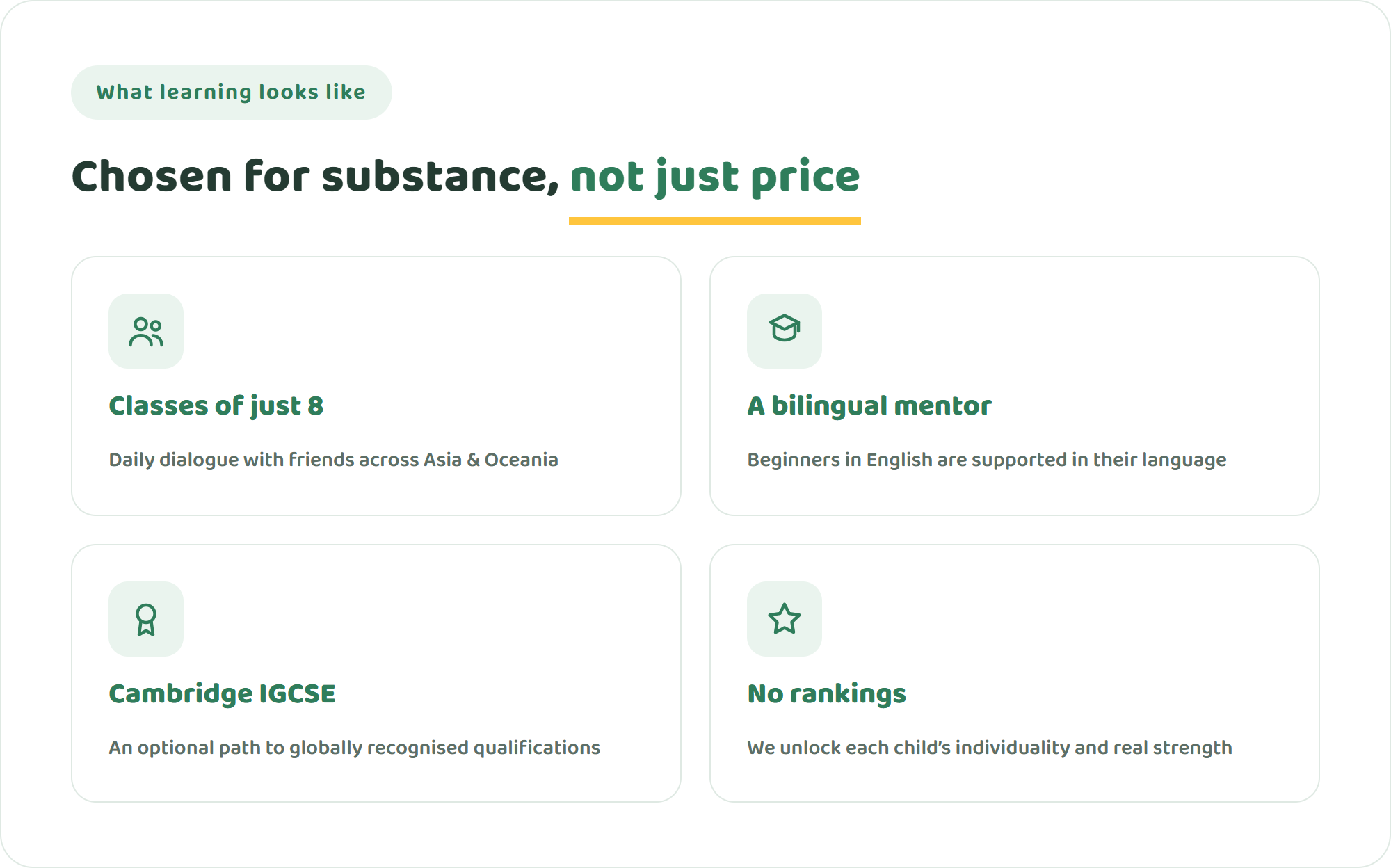
- Classes of just eight, learning together every day with friends across Asia & Oceania
- A bilingual mentor for every child — beginners in English are supported in their own language too
- An optional pathway to globally recognised qualifications such as Cambridge IGCSE
- No rankings, no test scores — we unlock each child’s individuality and real strength
There is no “foreign student” here. Everyone is foreign to someone, and local to themselves. Culture stops being a costume and becomes a lens for seeing the world.
See how learning works at NGA →
Is it really “world-class” at that price? An honest answer
To be honest: because it’s online, it isn’t identical to an in-person school. Children won’t run around the same playground or share the smell of the same classroom. That trade-off is real.
In return, online opens what a campus can’t: meeting diverse friends from around the world every day, wherever you live. Learning that doesn’t break when you move or return home. And a global education, finally, at a price within reach. It comes down to what matters most to your family.
What an online school does not replace
We would rather you heard this from us than found it out later. An online school does not replace daily in-person friendship — the unplanned play at break, the walk home, the party you get invited to because you sat next to someone. It does not replace sport played with bodies in the same space, or lab work with real apparatus. Families who choose online keep those alive elsewhere — a local club, a team, a community group — and that has to be planned deliberately. One thing more, specific to us: NIJIN GLOBAL ACADEMY opens in September 2027, so we have no graduates yet and no university destinations to show you. A school running for twenty years can show you an alumni list; we cannot, and we will not pretend otherwise. If a graduate track record matters most to your family right now, an established school is the right answer — see is international school worth it? what happens to graduates.
What to look at, beyond the price
So you don’t choose on cost alone, check these when comparing online international education:
- Class size — small enough for real dialogue, not a one-way broadcast
- A mentor beside your child — an adult who supports them when they stumble
- The pathway out — qualifications and records that lead to universities worldwide
- A track record — not just a philosophy, but proof that children are actually thriving
Questions to ask any online international school before you enrol
Take this list to every school you are considering, including ours. A school that answers all twelve plainly, in writing, is telling you how it will treat you after your child enrols. One that answers in adjectives is telling you something too.
- Who accredits or inspects the school, and when was the last report? Ask for the body’s name and a link, not the word “accredited.”
- Which qualification will my child hold at the end, and which board awards it? Both names should appear in the answer.
- Who recognises that qualification where we are likely to live? Ask for examples, not reassurance.
- Where will my child physically sit the exams, and who arranges it? Many online schools require an approved exam centre — possibly travel, and a separate fee.
- What are the teachers’ qualifications in the curriculum they teach? “Native speaker” is not a teaching qualification.
- How many children are in a live class — average and maximum? The maximum is the one that happens on a busy day.
- How many hours of live, teacher-led lessons per week at my child’s year group? This has a number: Crimson Global Academy publishes a minimum of 20 live hours a week for full-time secondary, so any school can state its own.
- Which time zone is the timetable built around? Ask for a sample week converted into your local time.
- What language support exists for a child not yet fluent in English? A paid extra course, a support teacher, or someone who speaks your child’s first language when they get stuck?
- What happens if we move country mid-year? Fees, timetable, exam arrangements, local registration — what changes?
- How is progress reported, how often, and who do I talk to? Ask to see a sample report and the job title responsible for your child’s wellbeing.
- What are the withdrawal and refund terms? Read the notice period before you pay — King’s InterHigh, for example, publishes a rolling contract cancellable at the end of any half term alongside its cheaper annual one.
If you are weighing an online school against the one your child attends now, the honest pros and cons of international school works through the same trade-offs from the other direction.
Frequently asked questions
What if my child doesn’t speak English?
That’s fine. Every child has a bilingual mentor and can be supported in their own language. There is no entrance exam and no English requirement.
Can my child attend alongside their local school?
Yes. We expect many families to learn at NGA while keeping their local school.
Are there extra costs beyond tuition?
Learning materials are included in the monthly fee, with no hidden costs. Sibling discounts are available.
Is an online international school accredited?
Some are, some are not — and the word covers three different things: whether the school is inspected or accredited by a schools body, whether the curriculum is an internationally recognised one, and whether the final qualification comes from an external board such as Cambridge International or the IB. Ask about all three by name. At NGA the qualification pathway is external and optional, towards globally recognised qualifications such as Cambridge IGCSE.
Does an online international school work for expat families who move often?
This is where online is strongest. Because the school is not attached to a city, a relocation doesn’t mean a new school, a new curriculum, a waiting list or a lost year — your child keeps the same teachers and classmates through the move. Check two things before relying on it: the time-zone shift of your new home, and whether your destination country requires local school registration alongside.
Can my child attend from any country or time zone?
In principle yes, but the timetable is the real constraint and schools rarely volunteer it: a school built around a UK or US school day can put live lessons in the small hours for a family in Asia. NGA’s timetable is built around Asia and Oceania. Whichever school you look at, ask for a sample week in your own local time before you enrol.
What age or grade range does an online international school cover?
It varies, so check each school. Published examples show the shape: King’s InterHigh sets out Key Stage 2 for ages 7–11, Key Stage 3 for 11–14, GCSE for 14–16 and sixth form for 16–19; Crimson Global Academy runs from Years 3–6 up to A Levels in Years 12–13. Very few online schools take children under about six, because the model needs a child who can read a screen and hold a conversation.
Can an online international school be combined with a local school?
Often yes, and the fee structure is the clue: schools that price per subject rather than per year — Crimson Global Academy publishes part-time per-subject fees alongside full-time annual ones — are built for it. Two cautions: check the timetables don’t collide, and be realistic about the total hours you are asking of a child who already has homework. Our piece on transferring from a local school covers how families usually phase this.
A doorway to a wider world for your child.

The day is coming when no family has to give up because “international school is too expensive.” NIJIN GLOBAL ACADEMY opens in September 2027. Be the first to hear about free trial classes and first-cohort enrolment.
For the day your child finds friends all around the world.
Honest Answers to Your Worries — related reading
- Will My Child Lose Their Mother Tongue?
- The Honest Pros and Cons of International School
- Disadvantages of Bilingualism in Childhood: Myths vs Research
- Who Regrets International School — and Who Doesn’t
- International School Special Needs: What to Look For
- International School vs Local School: How to Decide
- Does International School Hurt Your Child’s Home Language?
- When Your Child Is Struggling at International School
- Do International Schools Make Children Fluent in English?
- Is International School Worth It? What Happens to Graduates
- Should I Send My Child to International School?
- Transfer From a Local School to an International School
- Disadvantages of Early English Education: What Research Says
- What Happens to International School Graduates