There are 25 international schools we could verify inside Osaka Prefecture as of July 2026 — 37 once you include the commutable schools in Kyoto, Nara and Kobe. Annual fees span roughly ¥340,000 to ¥2.83 million, a gap of more than 8×. Assuming “an international school in Osaka costs ¥2 million a year” is the fastest way to rule out schools that might actually have worked for your family.
So before any shortlist, this guide puts all 37 schools into one table — name, area, stages served, curriculum, approximate annual fees, and international accreditation (IB, WASC, CIS, ACSI and others). Then it answers the questions the shortlists skip: whether Japanese tuition subsidies apply, whether Japanese families can enrol, whether a child with no English can start, and whether an international school graduate can sit Japanese university entrance exams. It also looks at Osaka Prefecture as a whole — what actually exists outside Osaka city, area by area.
Quick Answer: Your Options in Osaka
If you only read one section, read this. Below are the schools covered in this guide, plus the online option — so you can see every route side by side before the details.
- Schools in Osaka Prefecture that continue past kindergarten (8 schools)
- For a full IB continuum: Osaka International School of Kwansei Gakuin (OIS) — Ages — 5–18 (KA–Grade 12), Onoharanishi, Minoh City / Fees — ¥2,270,000 (KA–Grade 5), ¥2,708,000 (Grades 6–10) and ¥2,828,000 (Grades 11–12)…
- Early-years and preschool international settings in Osaka Prefecture (17 schools)
- For IB inside Osaka City: Osaka YMCA International School (OYIS) — Ages — 3–18 (preschool–Grade 12), Nishi-ku and Kita-ku, Osaka / Fees — roughly ¥1.65M–2.18M all-in for 2025–26 (preschool ~¥1,645,000; Grades 1–6…
- Commutable schools outside Osaka Prefecture (Kyoto, Nara, Hyogo — 12 schools)
- For PYP to DP in one small city school: Abroad International School Osaka (AIS) — Ages — 1 to Grade 12 (DP from August 2026), Hayashiji, Ikuno-ku, Osaka / Fees — approx. ¥1.55–1.95 million/year plus about ¥300,000 maintenance (confirm latest)
- For a genuinely multicultural, growing school: One World International School Osaka (OWIS) — Ages — approx. 3–14 as of 2026, expanding annually, Shariji, Ikuno-ku, Osaka / Fees — approx. ¥1.42–1.71 million/year (confirm latest)
- For small classes and individual attention: Kyoto International School (KIS) — Ages — 3 through middle school (top grade varies by year; confirm with the school)… / Fees — approx. ¥1.31–1.69 million/year (confirm latest)
- For entry at secondary level: Doshisha International School, Kyoto (DISK) — Ages — middle and high school (intake grades vary by year; confirm with the school)… / Fees — approx. ¥1.85 million/year for Grades 9–12, including the educational enrichment…
- For the lowest fees with a recognised pathway: Kansai Christian School (KCS) — Ages — Grades 1–12, Heguri, Nara Prefecture / Fees — approx. ¥890,000–1.08 million/year (confirm latest)
- NIJIN GLOBAL ACADEMY (online) — Ages 6–18 / opening September 2027, currently taking opening-update registrations / fees around one-fifth of a typical campus international school / Japanese-language support. An option when commute or fees are the wall.
Every International School in Osaka: The Full 37-School List (July 2026)
Most guides to international schools in Osaka cover the same five to eight names. To build a genuinely complete picture, we cross-checked the school directory published by the Osaka Prefecture-backed Global Financial City OSAKA initiative, Japan’s Ministry of Education (MEXT) list of schools designated for high-school tuition support, and each school’s own website. The result: 37 schools verified as of July 2026, grouped into three tables. Early-childhood-only settings open and close quickly, so we will not claim this is exhaustive — but it is the most complete list we could assemble.
1. Schools in Osaka Prefecture that continue past kindergarten (8 schools)
If your child is school-age, these eight are the real field. The number of schools in Osaka Prefecture offering English-medium education at primary level and beyond is far smaller than the preschool count suggests.
| School | Area | Stages | Curriculum | Approx. annual fees | Accreditation |
|---|---|---|---|---|---|
| Osaka International School of Kwansei Gakuin (OIS) | Onoharanishi, Minoh City | KA–Grade 12 (ages 5–18) | IB (PYP/MYP/DP) | ¥2.27M–2.83M | IB, WASC / MEXT-designated for subsidy |
| Osaka YMCA International School (OYIS) | Tosabori, Nishi-ku (primary) & Nakatsu, Kita-ku (secondary) | Preschool–Grade 12 (ages 3–18) | IB (PYP/MYP/DP) | ¥1.65M–2.18M (all fees in) | IB, WASC |
| Abroad International School Osaka (AIS) | Hayashiji, Ikuno-ku, Osaka | Age 1–Grade 12 (DP opens Aug 2026) | IB (PYP/MYP/DP) | ¥1.55M–1.95M + ~¥300K maintenance | IB Continuum School |
| One World International School Osaka (OWIS) | Shariji, Ikuno-ku, Osaka | Ages 3–14 (one grade added per year; Grade 12 due 2029) | IB PYP-based inquiry curriculum | ¥1.42M–1.71M | IB PYP candidate school |
| Umeda International School (UIS) | Honmachi, Chuo-ku, Osaka | Early years–high school | British-style, Christian ethos | Enquire directly | ACSI |
| AICJ International School Osaka | Suita City | Grades 1–6 | IB PYP (authorized April 2025) | approx. ¥1.5M | IB |
| Korea International School (KIS) | Ibaraki City | Middle & high school | IB DP track, multilingual | ¥340K–460K | IB / MEXT-designated for subsidy |
| Osaka YMCA International High School | Nishi-ku, Osaka | High school (international course) | English-intensive global programme | Tuition ~¥677K (national + Osaka subsidies apply) | Osaka Prefecture-approved specialised course |
Even within these eight, fees run from about ¥340,000 to ¥2.83 million. The “¥2 million a year” figure people quote for Osaka describes only the top band of this table. The “MEXT-designated” note means the school appears on Japan’s official list of foreign schools eligible for the High School Enrolment Support Fund (as of 1 March 2026) — more on that below.
2. Early-years and preschool international settings in Osaka Prefecture (17 schools)
For under-sixes the field widens dramatically. Below are the English-medium early-years settings we could verify across Osaka Prefecture. Most charge monthly, typically in the ¥70,000–110,000 range for a full-day programme, and as a rule they do not hold IB, WASC or CIS accreditation — a meaningful difference from the eight schools above.
| School / preschool | Area (city / ward) | Ages served |
|---|---|---|
| Sakura International School Tennoji (Kansai International Academy) | Abeno-ku, Osaka | Infant–pre-primary |
| Sakura International School Higashi-Osaka | Nagata, Higashi-Osaka City | Infant–pre-primary |
| Kinder Kids International School (Osaka main campus and others) | Osaka City, Toyonaka, Suita, Sakai | Age 1–pre-primary |
| W International Preschool | Nishi-ku, Osaka | Pre-primary |
| Harbourfront International School | Utsubo-Honmachi, Nishi-ku, Osaka | Ages 1–5 |
| Forest International School | Chausuyama, Tennoji-ku, Osaka | Ages 0–5 |
| Osaka Montessori International School | Higashisumiyoshi-ku, Osaka | Ages 1.5–6 |
| Royal Kids International School | Nishi-ku, Osaka | Ages 1.5–6 |
| Royal Ivy Academy | Uwashio, Tennoji-ku, Osaka | Pre-primary |
| Tezukayama Global Academy Preschool | Tezukayama, Abeno-ku, Osaka | Ages 0–5 |
| AIWIN International School | Nishimikuni, Yodogawa-ku, Osaka | Pre-primary |
| Doremi International School (Shinsaibashi, Fukushima and others) | Chuo-ku, Fukushima-ku, Osaka | From 1 yr 3 mo–pre-primary |
| Bell Kids International Preschool | Miyakojima-ku, Osaka | Pre-primary |
| Global Village International Preschool (Senrioka, Yamada and others) | Suita City | Pre-primary |
| International Preschool Blue Dolphins | Senri-Chuo (Toyonaka), Takatsuki | Pre-primary |
| Kids World (Senri-Chuo, Toyonaka, Ryokuchi-Koen, Izumigaoka, Ikeda) | Toyonaka, Sakai, Ikeda | Pre-primary |
| Ladybug International Kindergarten | Sakai City | Pre-primary |
In Japan the line between an “international school” and an English-medium unlicensed nursery is blurry at this age. The question that matters is what happens next: does the setting continue into primary, or will you be searching again when your child turns six? Ask before you enrol, not after.
3. Commutable schools outside Osaka Prefecture (Kyoto, Nara, Hyogo — 12 schools)
When nothing inside the prefecture fits, families routinely look to Kyoto, Nara and Kobe. All three are 30–60 minutes from central Osaka by JR, Hankyu or Kintetsu, and they offer school types Osaka simply does not have.
| School | Area | Stages | Curriculum | Approx. annual fees | Accreditation |
|---|---|---|---|---|---|
| Kyoto International School (KIS) | Kamigyo-ku, Kyoto | Early years–middle school | IB (PYP/MYP) | ¥1.31M–1.69M | IB, WASC / MEXT-designated |
| Doshisha International School, Kyoto (DISK) | Kizugawa, Kyoto Pref. | Middle & high school | IB (MYP/DP)-based | ~¥1.85M (Grades 9–12) | IB / MEXT-designated |
| KIU Academy | Kyotanabe, Kyoto Pref. | Elementary–high school | American-style, Christian | ~¥1.11M | ACSI, WASC |
| Lycée International de Kyoto | Shimogyo-ku, Kyoto | Ages 2–18 | French national curriculum | ¥880K–1.32M | AEFE |
| Kansai Christian School (KCS) | Heguri, Nara Pref. | Grades 1–12 | American-style, Christian | ¥890K–1.08M | ACSI |
| Canadian Academy | Higashinada-ku, Kobe | Ages 3–18 | IB (PYP/MYP/DP) | ¥1.5M–3.05M | IB, WASC, CIS / MEXT-designated |
| Kansai International School Kobe | Nada-ku, Kobe | Ages 0–18 | IB (PYP/MYP/DP) | ¥1.03M–2.12M | IB, CIS |
| Deutsche Schule Kobe | Higashinada-ku, Kobe | Early years–primary | IB PYP, Cambridge | ¥1.49M–1.62M | IB, Cambridge |
| Marist Brothers International School | Suma-ku, Kobe | Early years–high school | American-style + IB DP | ¥1.55M–1.88M | IB, WASC / MEXT-designated |
| St. Michael’s International School | Chuo-ku, Kobe | Ages 3–11 | International Primary Curriculum | ¥1.30M–1.48M | CIS |
| Ashiya International School | Ashiya, Hyogo Pref. | Ages 3–12 | American-style | ¥960K–1.06M | ACSI |
| Ascot International School Japan | Kita-ku, Kobe | Ages 2–18 | Cambridge International | ¥955K–1.63M | WASC, Cambridge |
If Kobe or Kyoto is genuinely on your list, our dedicated guides go deeper: international schools in Kobe and international schools in Kyoto. Comparing markets? See international schools in Tokyo and international schools in Nagoya.
All fees, stages and accreditations above are approximations drawn from publicly available information as of July 2026. They change with grade, academic year, exchange rate and additional charges (registration, facility, bus and materials fees). Grade ranges also shift as newer schools expand. Always confirm with the school before applying.
What the Full List Reveals About International Schools in Osaka Prefecture
Laid out together, 37 schools show a structure that no single school profile makes visible. Three patterns matter most.
- Plenty of preschools, very few school-age options. We verified 17-plus early-years settings in Osaka Prefecture but only 8 schools that continue past kindergarten. The bottleneck in Osaka is not getting in — it is what comes after age six.
- Fees vary by more than 8×, from ¥340,000 to ¥2.83 million. Full IB continuum schools sit above ¥2 million; Korea International School is around ¥400,000; Osaka YMCA International High School charges ¥677,000 in tuition and qualifies for government support. “International school equals ¥2 million” is only part of the truth.
- School-age options cluster in Ikuno-ku, Nishi-ku and the northern suburbs. AIS (Hayashiji) and OWIS (Shariji) are both in Ikuno-ku; OYIS primary is in Nishi-ku; OIS is in Minoh and AICJ in Suita. Southern Osaka and the Senshu area have essentially no school-age international options.
For help estimating the real total, see our breakdown of what international school tuition actually includes. If the numbers already feel out of reach, what to do when international school feels too expensive may be more useful than another shortlist.
Do Japanese Tuition Subsidies Apply to International Schools in Osaka Prefecture?
This changed materially in 2026, and most English-language guides have not caught up. The short answer: at high-school level, MEXT-designated international schools do qualify for Japan’s High School Enrolment Support Fund — and from April 2026 the income cap was abolished, with the ceiling for private high schools raised to ¥457,200 per year.
MEXT designates foreign schools that are “institutionally and objectively comparable to a Japanese high school course”, using two routes: (a) confirmation through an embassy that the course corresponds to Japanese upper secondary education (ethnic-community schools), or (b) confirmation of accreditation by an internationally established school evaluation body (international schools). As of 1 March 2026 the designated list includes, in Kansai, Osaka International School of Kwansei Gakuin, Korea International School, Kyoto International School, Doshisha International School Kyoto, Canadian Academy and Marist Brothers International School.
The caveats matter just as much:
- High school only. Kindergarten, primary and middle school divisions are outside the scheme. If you are budgeting a ¥2 million-a-year school, support reaches only the final three years.
- ¥457,200 is a ceiling, not a rebate. At a school charging ¥2.5 million, well over ¥2 million a year still comes out of your pocket.
- You must apply. The support is not automatic — watch for the school’s paperwork and deadlines.
- Early-childhood support is a separate scheme. If a preschool is registered as an unlicensed childcare facility, ages 3–5 may qualify for up to ¥37,000 per month under Japan’s free early childhood education programme. Treatment differs by facility and municipality, so confirm both.
Stacking Osaka Prefecture’s own private high school tuition subsidy on top of the national fund can shrink the out-of-pocket cost dramatically — at Osaka YMCA International High School, close to zero for eligible households. Do not assume international school means paying full price at every stage.
Can Japanese Families Enrol? English From Zero, and University Access Afterwards
These two questions come up more than any others, so here are the facts rather than reassurances.
Japanese students and starting with no English
Most schools in Osaka accept Japanese families, and at several of them Japanese passport holders are the majority. What changes is the age at which you join. Early years (ages 3–5) rarely requires any English at all — children absorb it through play and daily routine. From primary level, the presence and depth of EAL (English as an Additional Language) support becomes decisive. At middle and high school level, prior experience studying academic subjects in English is normally expected.
So the honest answer to “can we start from zero English?” is yes for the youngest children, conditionally for older ones. At every open day, ask two specific questions: how many years and how many lessons per week of EAL a student can receive, and whether parent communication is handled in Japanese or English only. Vagueness on either point tends to become a problem later.
Japanese university entrance qualification after an international school
Japan’s National Information Center for Academic Recognition (NIC-Japan) sets out the conditions clearly:
- Completing a 12-year course at a school accredited by an international evaluation body — WASC, CIS, ACSI, NEASC, Cognia or COBIS — confers Japanese university entrance qualification. This is exactly why the accreditation column in our tables is worth reading closely.
- Holding the International Baccalaureate, Abitur, Baccalauréat or GCE A Level confers qualification regardless of school accreditation.
- Neither of the above means the student must qualify another way, typically by passing Japan’s Upper Secondary School Equivalency Examination (kōsotsu nintei).
In practice: check accreditation and IB status at the shortlist stage and the Japanese university route stays open. Choose a high school division with neither, and it narrows.
One more point families often discover late: for Japanese nationals, attending a non-“Article 1” international school at primary or middle school level does not, in principle, discharge the legal obligation of compulsory schooling. Most municipalities keep the child registered at the local public school while they attend the international school. Practice differs by municipality — check with your local board of education before you enrol.
Commuting and School Buses: Can You Reach Kyoto or Kobe From Osaka?
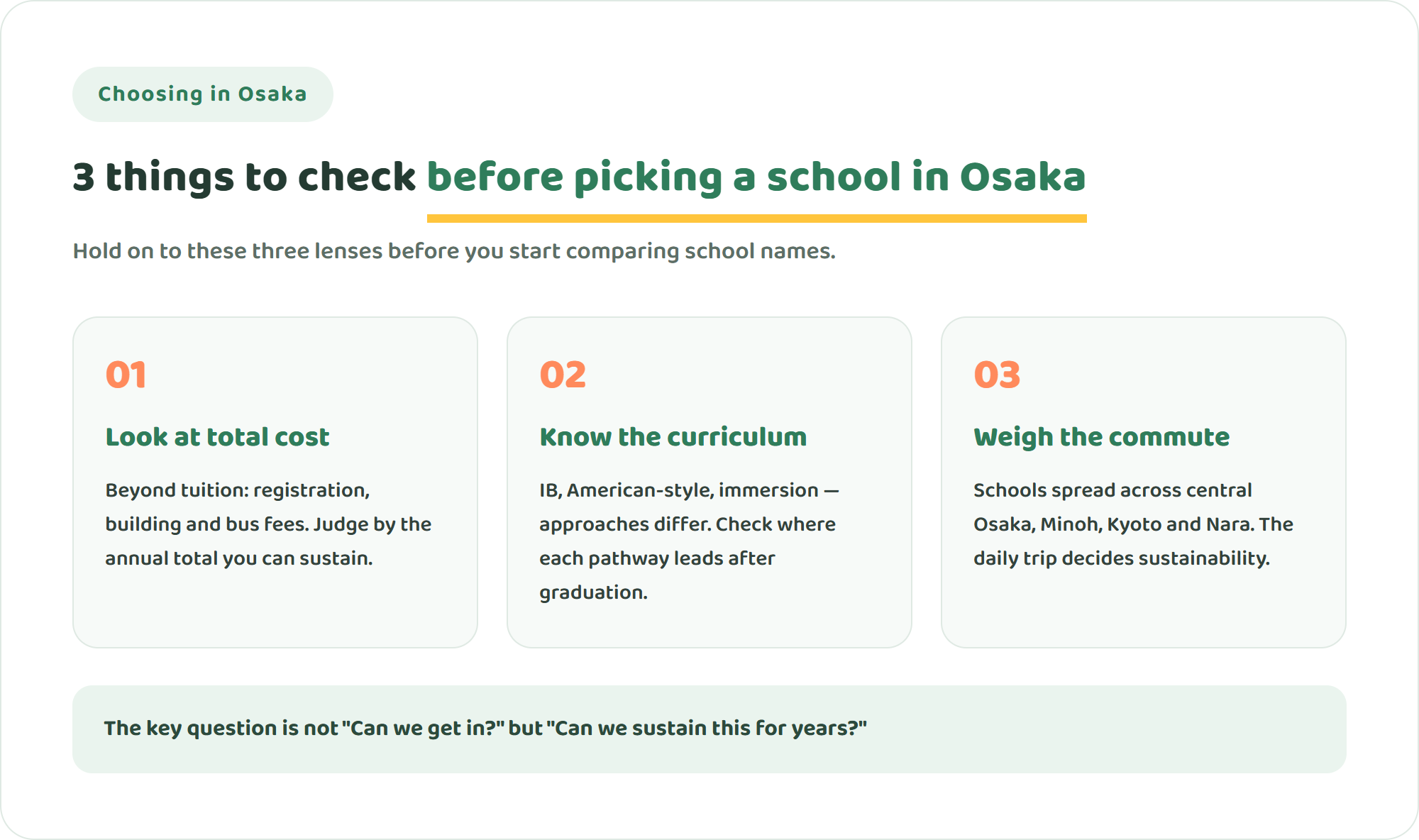
After fees, the commute is what quietly decides whether a school works. Since Osaka’s school-age options sit in Ikuno-ku, Nishi-ku, Minoh, Suita and Ibaraki, most families will be travelling.
- Bus routes redraw the catchment. OWIS Osaka runs three routes via Kujo, Senri-Chuo and Mikunigaoka, which makes Ikuno-ku reachable from well outside the ward. OIS runs buses from nearby stations and from the Kobe direction. Request the route map early.
- Kyoto is commutable from northern Osaka. Kyoto International School (Kamigyo-ku) is around an hour from central Osaka on Hankyu or Keihan; DISK (Kizugawa) is reachable from eastern and southern Osaka via Kintetsu or the JR Gakkentoshi line.
- Kobe is commutable from western and northern Osaka. Sannomiya is under 30 minutes on the JR Kobe or Hankyu Kobe lines, and some families do commute to Canadian Academy or Marist.
- An hour each way is a daily cost, not a one-off. Over six primary years that exceeds 1,000 hours. Model the wake-up time and the arrival-home time before you commit.
International Schools Across Osaka Prefecture: What Exists Outside Osaka City
Everything above treats “Osaka” as a single place. In practice Osaka Prefecture has 43 municipalities, and if you live outside Osaka city the question that matters is whether anything is reachable from your own town. The short answer, as of July 2026: only three schools outside Osaka city enrol children of school age, and all three sit in the northern Kita-Setsu area — Minoh, Suita and Ibaraki. Sakai, the Senshu coast, Minami-Kawachi and Naka-Kawachi have English-immersion preschools, but we could verify no school-age provision there.
Kita-Setsu (Minoh, Suita, Ibaraki, Toyonaka, Takatsuki, Ikeda)
Northern Osaka Prefecture is the only area outside the city where school-age international education is clustered. The three schools differ sharply in stages, curriculum and price, so compare on conditions rather than reputation.
| School | City | Stages | Curriculum | Approx. annual fees | Nearest station / rough time from central Osaka |
|---|---|---|---|---|---|
| Osaka International School of Kwansei Gakuin (OIS) | Minoh (4-4-16 Onohara-nishi) | Ages 4–18 | IB (PYP/MYP/DP) | ¥2.27M–2.83M | Hankyu bus 70/78 from Kita-Senri (approx. 12 min) or Senri-Chuo (approx. 22 min), alight at Kwansei Gakuin Senri International Campus. Around 50 min from Umeda. |
| AICJ International School Osaka (AIC World College Elementary, Osaka) | Suita (3-15-27 Tarumi-cho) | Grades 1–6 (ages 7–12) | IB PYP (accredited April 2025) | Approx. ¥1.5M | About 10 min on foot from Esaka (Midosuji line) or Toyotsu (Hankyu Senri line). Around 25 min from Umeda. |
| Korea International School (KIS) | Ibaraki (2-13-35 Toyokawa) | Middle and high school | IB DP course and multilingual programmes | ¥340,000–460,000 | About 5 min on foot from Toyokawa (Osaka Monorail); about 20 min by bus from JR Ibaraki. Around 40 min from Umeda. |
Toyonaka, Takatsuki and Ikeda do have well-established English preschools — Kinder Kids (Toyonaka, Takatsuki, Ibaraki-Saito), Blue Dolphins (Senri-Chuo and Takatsuki), Global Village (Senrioka and Yamada in Suita) and Kids World (Senri-Chuo, Toyonaka, Ryokuchi-koen, Ikeda) — but we could not verify any that continues past kindergarten. If you are in those cities, plan for a change of school at age six.
Sakai and the Senshu coast (Sakai, Izumi, Kishiwada, Izumisano)
Southern Osaka Prefecture is not short of English-immersion early years: Sakai has Ladybug International Kindergarten (Nakamozu), Kinder Kids Sakai, Blue Dolphins Otori and Mikunigaoka, Lucky Duck International School, First Learning Sakai and Kids World Izumigaoka; Izumi and Kishiwada add Rainbow (Izumi) and Blue Dolphins Kishiwada. All of them are early-years or after-school provision, however — as of July 2026 we found no school in this area teaching primary or secondary grades in English. Once a child reaches six, the realistic routes are the Mikunigaoka school-bus line run by One World International School Osaka (Ikuno ward) or a train commute into the city.
Minami-Kawachi and Naka-Kawachi (Higashi-Osaka, Yao, Habikino, Tondabayashi, Kawachi-Nagano)
Higashi-Osaka has Sakura International School Higashi-Osaka (Kansai International Academy, Nagata) and Habikino has Groovy International Preschool. Further south — Tondabayashi, Kawachi-Nagano, Taishi — we could verify neither an international school nor an English preschool in the July 2026 public record, and we would rather say so than invent one. For school-age children here, Abroad International School Osaka and One World Osaka (both Ikuno ward) are the closest, with Doshisha International School in Kizugawa, Kyoto reachable on the JR Gakkentoshi and Kintetsu Kyoto lines.
Seen prefecture-wide, the number of realistic options swings from three to well over a dozen depending on where in Osaka Prefecture you live. The 12 commutable schools outside the prefecture are covered in the section above. Locations and fees here follow each school’s official site and the Osaka Prefecture “Global Financial City OSAKA” public list (June 2026 edition); journey times are approximate — check timetables and school websites for the current position.
Seven Schools Worth a Closer Look — Chosen by What You Are Optimising For
From the full list, these seven come up most often on real shortlists. None of them is “the best” in the abstract — the right answer depends on your child and your circumstances.
1. For a full IB continuum: Osaka International School of Kwansei Gakuin (OIS)
Founded in 1991 in Minoh, north of the city, OIS is Kansai’s flagship IB continuum school, offering the PYP, MYP and Diploma Programme from kindergarten through Grade 12. It shares a campus with Senri International School (SIS), giving students daily contact with Japanese peers, and has a strong record of placing graduates in universities worldwide.
- Curriculum — International Baccalaureate (PYP/MYP/DP), WASC-accredited
- Ages — 5–18 (KA–Grade 12), Onoharanishi, Minoh City
- Fees — ¥2,270,000 (KA–Grade 5), ¥2,708,000 (Grades 6–10) and ¥2,828,000 (Grades 11–12) for 2026–27, plus a ¥330,000 registration fee and a ¥40,000 application fee
- Best for — families wanting a full K–12 IB education and able to budget for it
2. For IB inside Osaka City: Osaka YMCA International School (OYIS)
An IB World School with its primary campus in Tosabori, Nishi-ku and secondary in Nakatsu, Kita-ku, OYIS runs the PYP, MYP and DP from preschool through Grade 12. Its central location makes the commute workable from most of the city, and total fees sit noticeably below the large legacy schools.
- Curriculum — International Baccalaureate (PYP/MYP/DP), WASC-accredited
- Ages — 3–18 (preschool–Grade 12), Nishi-ku and Kita-ku, Osaka
- Fees — roughly ¥1.65M–2.18M all-in for 2025–26 (preschool ~¥1,645,000; Grades 1–6 ~¥1,896,000; Grades 10–12 ~¥2,175,000), plus a ¥200,000–300,000 registration fee
- Best for — families living in Osaka City who want an accessible, all-through IB school
3. For PYP to DP in one small city school: Abroad International School Osaka (AIS)
Based in Hayashiji, Ikuno-ku, AIS is an authorized IB Continuum School running an Early Learning Centre for ages 1–5 through Grade 10, with the Diploma Programme opening in August 2026. That makes it one of the few schools inside Osaka City where a child can move from early years to DP without changing frameworks. Classes are small and the school has long experience easing Japanese and bilingual children into English-medium study.
- Curriculum — International Baccalaureate (PYP/MYP/DP)
- Ages — 1 to Grade 12 (DP from August 2026), Hayashiji, Ikuno-ku, Osaka
- Fees — approx. ¥1.55–1.95 million/year plus about ¥300,000 maintenance (confirm latest)
- Best for — families wanting a small city school with a route through to the IB Diploma
4. For a genuinely multicultural, growing school: One World International School Osaka (OWIS)
Opened in 2023 by a Singapore-based global schools group, OWIS Osaka sits in Shariji, Ikuno-ku. It teaches an IB PYP-based inquiry curriculum as a PYP candidate school and adds one grade each year, with Grade 12 due in 2029. Three school bus routes (Kujo, Senri-Chuo, Mikunigaoka) widen the catchment considerably.
- Curriculum — IB PYP-based inquiry curriculum (candidate school)
- Ages — approx. 3–14 as of 2026, expanding annually, Shariji, Ikuno-ku, Osaka
- Fees — approx. ¥1.42–1.71 million/year (confirm latest)
- Best for — families seeking a multicultural primary education at a moderate price
5. For small classes and individual attention: Kyoto International School (KIS)
Established in 1957 in Kamigyo-ku, Kyoto, KIS is a small, warm IB school running from early years through the middle years. Class sizes are small and the inquiry-based teaching is highly personalised. Northern Osaka is a realistic commute, and the school appears on the MEXT subsidy designation list.
- Curriculum — International Baccalaureate (PYP/MYP), WASC-accredited
- Ages — 3 through middle school (top grade varies by year; confirm with the school), Kamigyo-ku, Kyoto
- Fees — approx. ¥1.31–1.69 million/year (confirm latest)
- Best for — families prioritising small classes and individual attention over big-school facilities
6. For entry at secondary level: Doshisha International School, Kyoto (DISK)
Run by the long-established Doshisha educational foundation, DISK sits in Kizugawa City in the Kansai Science City corridor — convenient from eastern and southern Osaka and from Nara. It offers English-medium education at middle and high school level leading into the IB Diploma Programme, and is MEXT-designated for tuition support.
- Curriculum — IB MYP/DP-based, English-medium secondary education
- Ages — middle and high school (intake grades vary by year; confirm with the school), Kizugawa, Kyoto Pref.
- Fees — approx. ¥1.85 million/year for Grades 9–12, including the educational enrichment fee
- Best for — students joining at secondary level who want an IB Diploma pathway near eastern Osaka or Nara
7. For the lowest fees with a recognised pathway: Kansai Christian School (KCS)
A small Christian international school in Heguri, Nara Prefecture, KCS teaches an American-style curriculum in English at fees that are strikingly accessible by international-school standards. Because it is ACSI-accredited, completing its 12-year course also confers Japanese university entrance qualification. The community is close-knit, and some families commute from southeastern Osaka.
- Curriculum — American-style, Christian ethos (ACSI-accredited)
- Ages — Grades 1–12, Heguri, Nara Prefecture
- Fees — approx. ¥890,000–1.08 million/year (confirm latest)
- Best for — budget-conscious families comfortable with the school’s faith-based values
Do International Schools in Osaka Have Rankings or Deviation Scores?
Japanese families often search for a hensachi (deviation score) for schools such as Osaka YMCA International School. The straight answer: international schools have no hensachi. A deviation score expresses a student’s relative position among people who sat the same Japanese mock exam, and Osaka’s international schools teach IB, American or immersion programmes and select applicants on English assessment, interview and prior records. The measure simply does not apply. Numbers circulating online are third-party estimates, not school-published figures.
The same caution applies to any “international schools in Osaka ranking”. Three habits keep you grounded:
- Check the criteria — a list ordered by university placement is a completely different thing from one ordered by low fees. Always ask what the ranking actually measures.
- Read reviews for whose voice it is — opinions hinge on a family’s values and a child’s temperament. It is natural for the same school to be called “attentive” by one parent and “hands-off” by another.
- Verify in person — an open day, tour or trial class is the most reliable source of all. Use lists to build a shortlist, then judge with your own eyes.
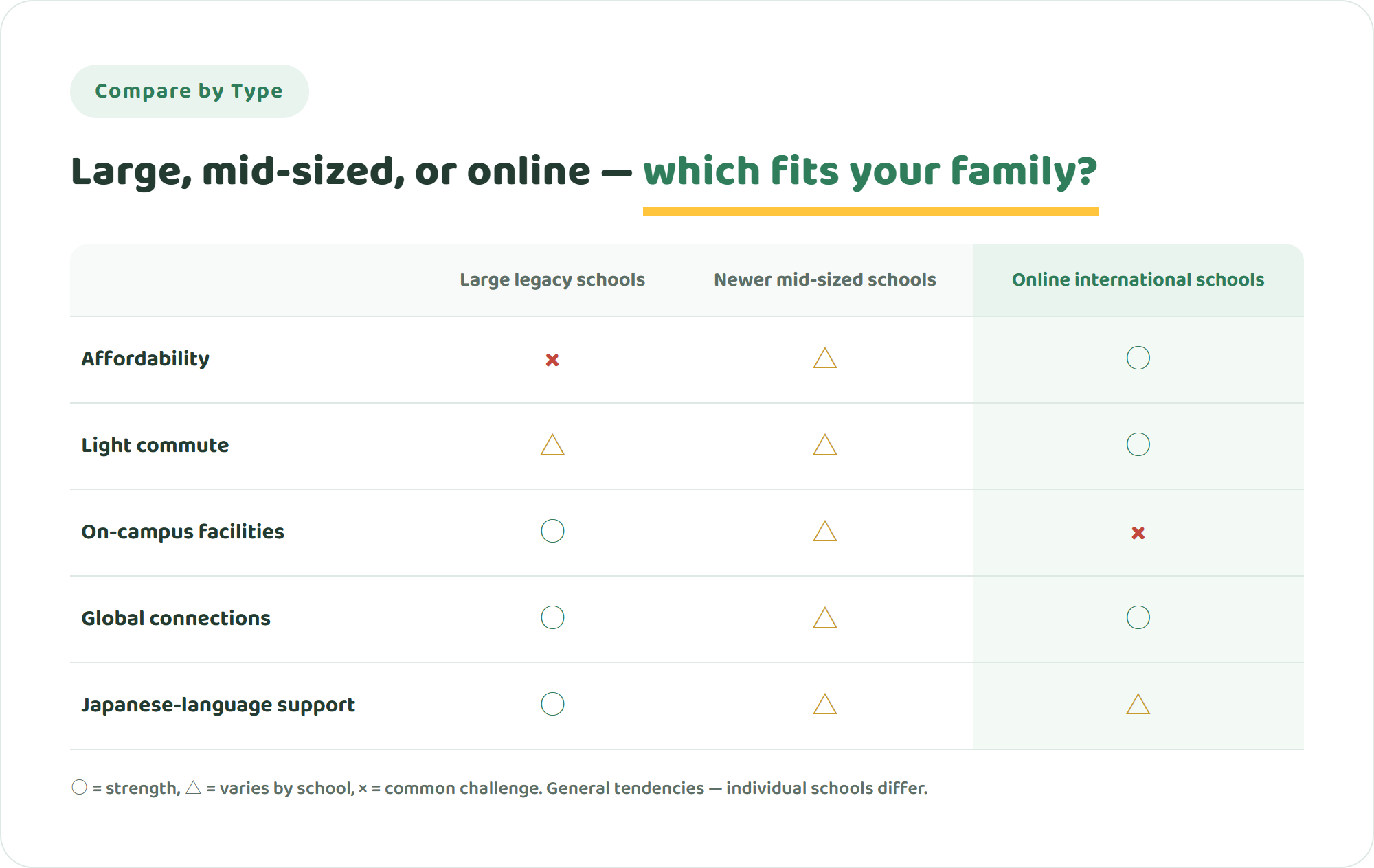
If Fees or the Commute Are the Wall — a 38th Option, Online
If you have worked through all 37 schools and thought “these look wonderful, but ¥1.5–2.8 million a year is not sustainable”, or “an hour each way is too much for a six-year-old”, or “there is nothing school-age in southern Osaka at all” — a physical campus is not the only route.
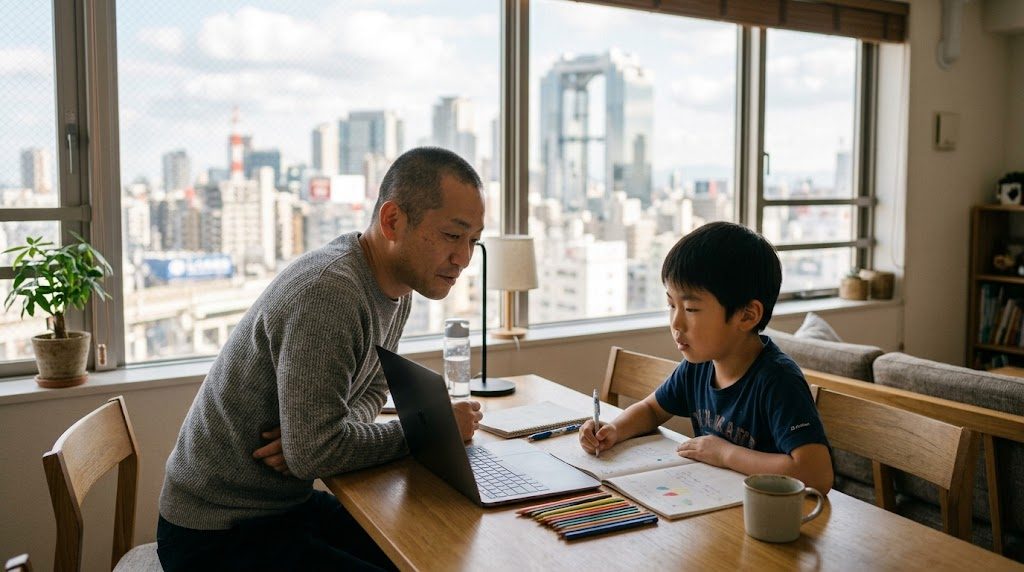
NIJIN GLOBAL ACADEMY (NGA) is an online international school opening in September 2027, run by NIJIN Inc. of Japan, whose alternative school NIJIN Academy already serves more than 1,000 students.
NGA is built around learning without test-score rankings — small-group, dialogue-centred classes for ages 6–18 across Asia and Oceania, designed so children can start with Japanese-language support and grow into English gradually. Fees are targeted at around one-fifth of a typical bricks-and-mortar international school, and where you live does not matter. To be fully honest: NGA has not yet opened, its track record is still to come, and an online school is not the same experience as a campus with playgrounds and science labs. But if cost or geography is what stands between your child and an international education, it belongs on the list alongside the 37 above. See how learning works online →.
Frequently Asked Questions About International Schools in Osaka
How many international schools are there in Osaka?
As of July 2026 we verified 25 in Osaka Prefecture — 8 that continue past kindergarten and 17 early-years settings — and 37 including commutable schools in Kyoto, Nara and Hyogo. Small preschools open and close frequently, so the true figure may be higher.
Can Japanese families enrol in international schools in Osaka?
Yes. Most schools in Osaka accept Japanese families, and at some, Japanese passport holders are the majority. English requirements rise with grade level, though. Note also that for Japanese nationals, attending a non-“Article 1” school at primary or middle level is handled differently by each municipality — check with your local board of education first.
Can a child join with no English at all?
At early-years level (ages 3–5), almost all schools accept children with no English. From primary level you will depend on EAL support, and from middle school upward, prior study of academic subjects in English is normally expected. Ask each school how many years and how many weekly lessons of EAL a student can access.
Do Japanese tuition subsidies apply to international schools in Osaka?
At high-school level, yes, for MEXT-designated schools. From April 2026 the income cap on the High School Enrolment Support Fund was abolished and the private-school ceiling rose to ¥457,200 per year. In Osaka Prefecture, Osaka International School of Kwansei Gakuin and Korea International School appear on the designation list current as of 1 March 2026. Kindergarten, primary and middle school divisions are not covered.
Can international school graduates apply to Japanese universities?
Yes. Completing a 12-year course at a school accredited by WASC, CIS, ACSI, NEASC, Cognia or COBIS confers Japanese university entrance qualification, as does holding the IB Diploma, Abitur, Baccalauréat or GCE A Level. Without either, a student typically needs to pass Japan’s Upper Secondary School Equivalency Examination. Check accreditation and IB status before you enrol, not after.
Which is the cheapest international school in Osaka?
Within Osaka Prefecture, Korea International School in Ibaraki is the most affordable at roughly ¥340,000–460,000 a year, followed by Osaka YMCA International High School (tuition around ¥677,000, with national and prefectural subsidies available). Widening to the commute zone, Kansai Christian School in Nara runs about ¥890,000–1.08 million. Always compare total cost including registration, facility and bus fees.
Do international schools in Osaka run school buses?
Some do. OWIS Osaka operates three routes via Kujo, Senri-Chuo and Mikunigaoka, and OIS runs buses from nearby stations and from the Kobe direction. Bus fees are charged on top of tuition and can add well over ¥100,000 a year. Request the route map and fee schedule alongside the prospectus.
Can you commute from Osaka to schools in Kyoto or Kobe?
Yes, and many families do. Kyoto International School is about an hour from central Osaka on Hankyu or Keihan; DISK in Kizugawa is reachable from eastern and southern Osaka; Sannomiya in Kobe is under 30 minutes by JR or Hankyu. Bear in mind that an hour each way adds up to more than 1,000 hours over six primary years.
From what age can children join, and when is the best time to transfer?
Most settings accept children from ages 1–3. The academic year generally starts in August or September on a three-term calendar, and term boundaries are the smoothest entry points, though schools with open seats often accept mid-term transfers. Once you have a shortlist, ask about capacity and waiting lists early.
What is the difference between a preschool and a school that continues past age six?
Continuity. An early-years-only setting does not guarantee a route onward, so at age six you choose again between a local public school and another international school. A school with a primary division and above lets your child build within one curriculum. Before enrolling, ask two questions: is there a primary division, and where do your leavers go?
The Right School Is the One Your Child Can Grow In
Osaka and the wider Kansai region offer a genuinely broad menu: full IB continuums, a ¥400,000-a-year ethnic-community school, a subsidised international high school course, small faith-based schools, new campuses still adding grades, and now credible online options — 37 routes and counting. You do not need to rush toward the most famous name. Weigh the total cost, the commute, and above all where your child will feel free to be themselves. That is the school worth choosing.
NIJIN GLOBAL ACADEMY opens in September 2027. To hear first about our learning model, accessible fees, and founding-cohort enrolment, join our mailing list.
International Schools in Other Cities
- International Schools in Dubai: Fees
- International Schools in Meguro: All 8 Schools
- International Schools in Kobe: All 20 Schools
- International Schools in Yokohama: Full Comparison
- International Schools in Chofu and ASIJ Fees
- International Schools in Fukuoka: Fees
- International Schools in Suginami, Tokyo
- International Schools in Sumida, Tokyo
- International Schools in Sydney
- International Schools in Tokyo
- International Schools in Nagoya: All 8 Schools
- International Schools in Minato: Fees
- International Schools in Shibuya, Tokyo
- International Schools in Setagaya: All 14 Schools
- International Schools in Kawasaki