If you have been searching for international schools in Shizuoka Prefecture and coming up mostly with English conversation classes, you are not doing it wrong — that really is the landscape here. Shizuoka has no large, well-known English-medium K-12 campus of the kind you find in Tokyo or Yokohama. What it does have is more interesting than the search results suggest: Japan’s first English immersion school, Japan’s first IB-authorised national-curriculum school, a Christian school running an American curriculum from age four, a scattering of preschools, and a cluster of Brazilian and Peruvian schools in Hamamatsu. This guide maps all of them by region, gives the fees that are actually published, and is honest about the one thing every family here runs into: the prefecture is about 150 km wide, and distance decides everything.
Quick Answer: Your Options in Shizuoka
If you only read one section, read this. Below are the areas where schools can be confirmed, with their school names, plus the online option — so you can see every route side by side before the details.
- Eastern Shizuoka (Numazu, Mishima, Fuji, Nagaizumi) — Katoh Gakuen Gyoshu Elementary School (Numazu) / Stellar International School (Numazu) / Shirayuri International Preschool (Mishima) and 1 more (4 in total)
- Western Shizuoka (Hamamatsu, Kakegawa, Iwata) — Kakegawa International Christian School (KICS) (Kakegawa) / Soramame International Preschool & After-School (Hamamatsu) / Hug Me International School (Chuo-ku, Hamamatsu)
- NIJIN GLOBAL ACADEMY (online) — Ages 6–18 / opening September 2027, currently taking opening-update registrations / fees around one-fifth of a typical campus international school / Japanese-language support. An option when distance or fees are the wall.
International schools in Shizuoka Prefecture: the landscape and what they cost
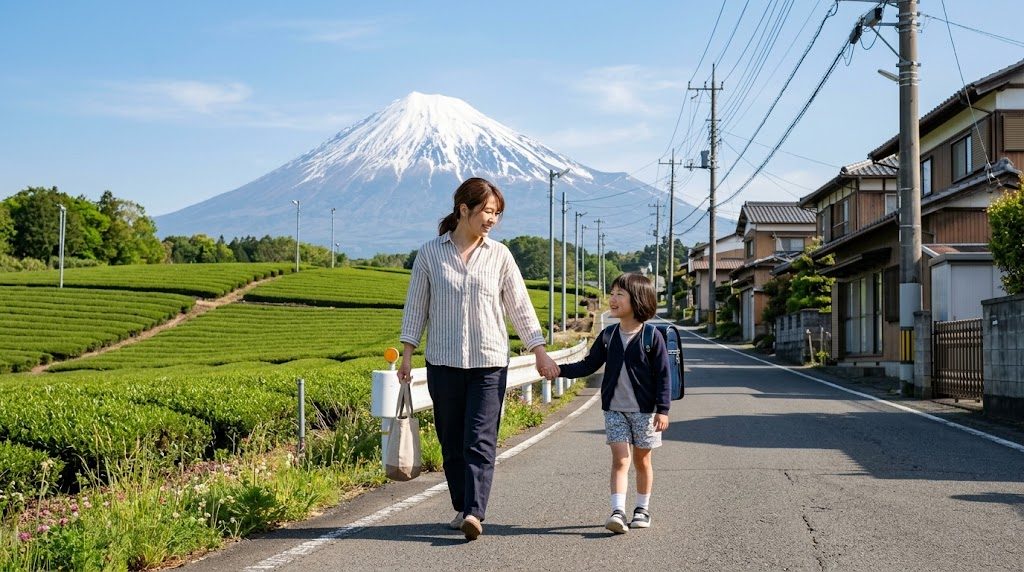
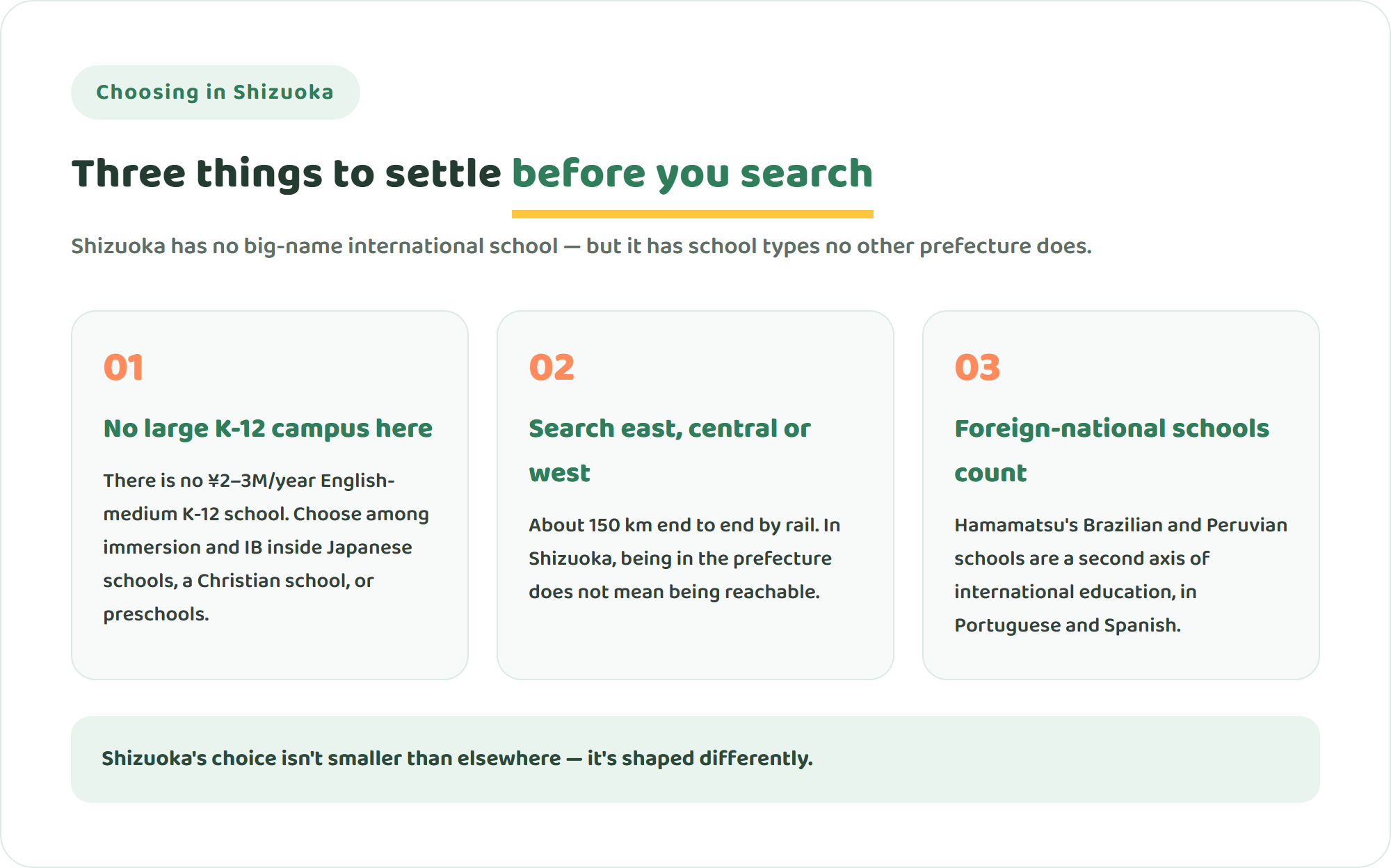
Start with the honest headline: as of July 2026, there is no large English-medium international school in Shizuoka Prefecture running a full early-years-through-grade-12 programme at the ¥2–3 million a year price point common in Tokyo. Instead, international education here comes in four distinct shapes.
The first is English immersion and International Baccalaureate programmes inside Japanese accredited schools — Katoh Gakuen in Numazu being the landmark example. The second is a Christian school: Kakegawa International Christian School, which takes students from age four through the high school years on an American curriculum. The third is preschools, found in Shizuoka City, Hamamatsu, Numazu, Mishima and Fuji. The fourth, and the one most guides skip entirely, is Shizuoka’s cluster of Brazilian and Peruvian schools.
That fourth category exists because Shizuoka is one of Japan’s most international prefectures in demographic terms. According to the Shizuoka International Relations Association (SIR), 124,281 foreign residents lived in the prefecture at the end of 2024 — a record high, up 8,639 people (7.5%) year on year. Brazilian nationals were the largest group at 32,151, followed by Filipino (20,737), Vietnamese (20,277), Chinese (10,555) and Indonesian (7,356) residents. By municipality, Hamamatsu leads with 31,210 — about a quarter of the prefecture’s total — ahead of Shizuoka City (14,169), Iwata (10,295), Fuji (7,851) and Fukuroi (6,177). Shizuoka’s manufacturing base — motorcycles, cars, musical instruments — has drawn foreign workers and their families here for decades, and the schools followed the families rather than the other way around.
Fees reflect that history. Based on published figures, the bilingual course at Katoh Gakuen Gyoshu Junior and Senior High School works out to roughly ¥900,000–1,100,000 a year, and Kakegawa International Christian School to roughly ¥550,000–600,000 a year (details below). That is a fraction of Tokyo international school pricing, though still a real commitment compared with the local public system. If you want the full anatomy of international school costs, our breakdown of international school fees goes deeper.
Then there is geography. From Atami in the east to Kosai in the west is about 150 km along the JR Tokaido Line — roughly the distance from Tokyo to Shizuoka City. So “it’s in Shizuoka Prefecture” is not the same as “we can get there”. A family in Hamamatsu cannot realistically commute to Numazu, and vice versa. Shizuoka has to be searched as three separate regions — east, central and west — not as one prefecture.
Every international school in Shizuoka Prefecture, by region
Below are the schools we could verify through official school sites or municipal government publications. For a nationwide view, see our index of international schools across all 47 prefectures of Japan.
Eastern Shizuoka (Numazu, Mishima, Fuji, Nagaizumi)
Any conversation about international education in Shizuoka begins in Numazu, with a school whose claim is not “the best in the prefecture” but “the first in Japan”.
- Katoh Gakuen Gyoshu Elementary School (Numazu) | Opened in 1972 as Japan’s first open-plan school, it introduced Japan’s first English immersion programme in 1992. Each year group runs two tracks — an open-plan course and an English immersion course, where children spend more than 50% of the school day in English. Because it is a Japanese accredited school, enrolment satisfies compulsory education requirements. An “immersion maintenance fee” of ¥30,000 per month applies; other tuition should be confirmed with the school.
- Katoh Gakuen Gyoshu Junior and Senior High School — Bilingual Course (Numazu) | The first Japanese accredited school authorised for the IB Middle Years Programme (2000) and the IB Diploma Programme (2002). Roughly 45–55% of junior high classes and about 75% of senior high classes are taught in English. Graduates hold both a Japanese high school diploma and, for DP students, an internationally recognised qualification accepted by universities in Japan and abroad. Published fee information lists ¥155,000 in enrolment procedure fees, ¥49,500 per month in tuition and related charges, plus a ¥30,000 monthly “bilingual maintenance fee” for the bilingual course.
- Stellar International School (Numazu) | A preschool-style English programme alongside courses running from age one through adult classes. Not a full-day accredited school, so it fits best as an early-years English environment or after-school continuity. Fees on enquiry.
- Shirayuri International Preschool (Mishima) | Accepts children from age one and runs after-school, summer school and English day-care programmes for primary-age children. Fees on enquiry.
- PASS Global (Nagaizumi, Shimizu-cho, Mishima, Numazu, Fuji, Fujinomiya) | Runs international preschool classes for pre-kindergarten children across several eastern Shizuoka locations, which makes it one of the easier options to reach from home.
- GSIS Preschool (Good Shepherd International School) (Fuji) | Described as the only English-environment childcare facility in Fuji City. The director and foreign teaching staff come from international school backgrounds, and the approach combines Montessori methods with immersion. Fees on enquiry.
Eastern Shizuoka has one clear advantage: it is the only part of the prefecture where an English-medium pathway runs continuously from early childhood to graduation. Mishima is also about 45 minutes from Tokyo by Shinkansen, which puts capital-region schools within reach for some families.
Central Shizuoka (Shizuoka City)
The prefectural capital has, perhaps surprisingly, no full-day international school covering primary and secondary years as of July 2026. What exists today is early-years provision.
- Alphabet Soup (Aoi-ku, Shizuoka City) | Teaching English to children in Shizuoka City since 2002, the school opened its international preschool in April 2013. Children spend the day entirely in English with native-speaker teachers. Fees on enquiry.
- MEK English Preschool (Aoi-ku, Suruga-ku and parts of Shimizu-ku, Shizuoka City) | Preschool and English education across the city. Fees on enquiry.
This is about to change. Following a November 2023 request from the Shizuoka Chamber of Commerce and Industry — driven by the need to attract skilled foreign professionals and accommodate their children — Shizuoka City is actively recruiting an operator to establish an international school on the former site of the Shizuoka Prefectural Fruit Tree Research Center in Shimizu-ku. The public proposal call was announced on 17 October 2025, with presentations in December and a preferred bidder selected on 11 December. The brief requires a school teaching primarily in English, serving children from early childhood through the high school years, and obtaining International Baccalaureate authorisation either at opening or within a set period afterwards. The school is reported as scheduled to open in September 2028. If it goes ahead, it would be central Shizuoka’s first genuine early-years-to-graduation English-medium school.
September 2028, however, is not much help if your child is nine years old today. Families in Shizuoka City need a plan for now as well as a plan for later.
Western Shizuoka (Hamamatsu, Kakegawa, Iwata)
The west has the prefecture’s largest foreign population and the widest variety of options.
- Kakegawa International Christian School (KICS) (Kakegawa) | Founded in 2008, KICS is one of the few schools in Shizuoka running an English curriculum from K4 through the high school years, with Japanese-language and bilingual programme options as well. The English curriculum uses BJU (Bob Jones University) materials, widely used in American private schools, and the school has been an ACSI (Association of Christian Schools International) member since 2008. The published fee schedule (as of January 2022) lists an ¥11,000 one-time application fee, a ¥44,000 entrance fee for preschool and kindergarten, ¥495,000 annual tuition, ¥33,000 annual materials and ¥22,000 annual facility fee — roughly ¥550,000 a year — with a ¥49,500 annual discount for second and third children. Fees have likely changed since; confirm directly with the school.
- First Learning Hamamatsu (Chuo-ku, Hamamatsu) | An international preschool opened in March 2023 for children aged one to school entry, with paired foreign and Japanese teachers in each class. Fees on enquiry.
- Soramame International Preschool & After-School (Hamamatsu) | English environment from infancy, combined with after-school care for primary students. Fees on enquiry.
- Hug Me International School (Chuo-ku, Hamamatsu) | A preschool in Hamamatsu. Fees on enquiry.
- Kids Duo Hamamatsu Chuo and Sanarudai (Hamamatsu) | English-immersion after-school care running music, crafts and games entirely in English, with up to six hours of coverage after kindergarten or school — a practical option for dual-income families.
Hamamatsu’s foreign-national schools: Shizuoka’s other international education
These will not appear in an “international school” search, but no honest guide to Shizuoka can leave them out. According to Hamamatsu City’s own published information, three foreign-national schools operate in the city.
- Mundo de Alegria School (9611-1 Ubumi, Yuto-cho, Chuo-ku, Hamamatsu) | Originally established for Peruvian children in Japan, it added Brazilian classes in April 2005 and holds status as an incorporated educational institution.
- Escola Alegria de Saber Hamamatsu (2-24-3 Handayama, Chuo-ku, Hamamatsu) | A Brazilian school accredited by Brazil’s Ministry of Education, covering kindergarten through high school, incorporated as a miscellaneous school (kakushu gakko).
- Escola Alcance (3002-3 Tomitsuka-cho, Chuo-ku, Hamamatsu) | One of Hamamatsu’s Brazilian schools.
Hamamatsu’s international affairs division reports 30,286 foreign residents as of 1 April 2025 — 3.9% of the city’s 781,011 people — with 9,505 Brazilian nationals, the largest Brazilian community of any city in Japan, followed by Vietnamese (4,958), Filipino (4,715), Chinese (2,307) and Indonesian (1,965) residents. These schools teach the Brazilian or Peruvian curriculum in Portuguese or Spanish rather than in English, so they are rarely a direct option for Japanese families seeking an English education. But they matter: they are proof that keeping a child’s home language and identity intact is a form of international education too — and that Shizuoka’s internationalisation was never only an English-language story.
Two clarifications worth making. “Shizuoka International School” in search results is a Japanese language school for adult learners, not a children’s international school. And directory sites that claim Shizuoka has “56 international schools” are counting English conversation classrooms and cram schools. The list of genuinely full-day options is the one above.
Please note: fees and programme details reflect publicly available information as of July 2026. Always confirm current figures on each school’s official website.
Comparing your options honestly
Families in Shizuoka tend to ask three questions: is an immersion programme inside a Japanese school enough? Should we commute out of the prefecture? And what can we actually start this year?
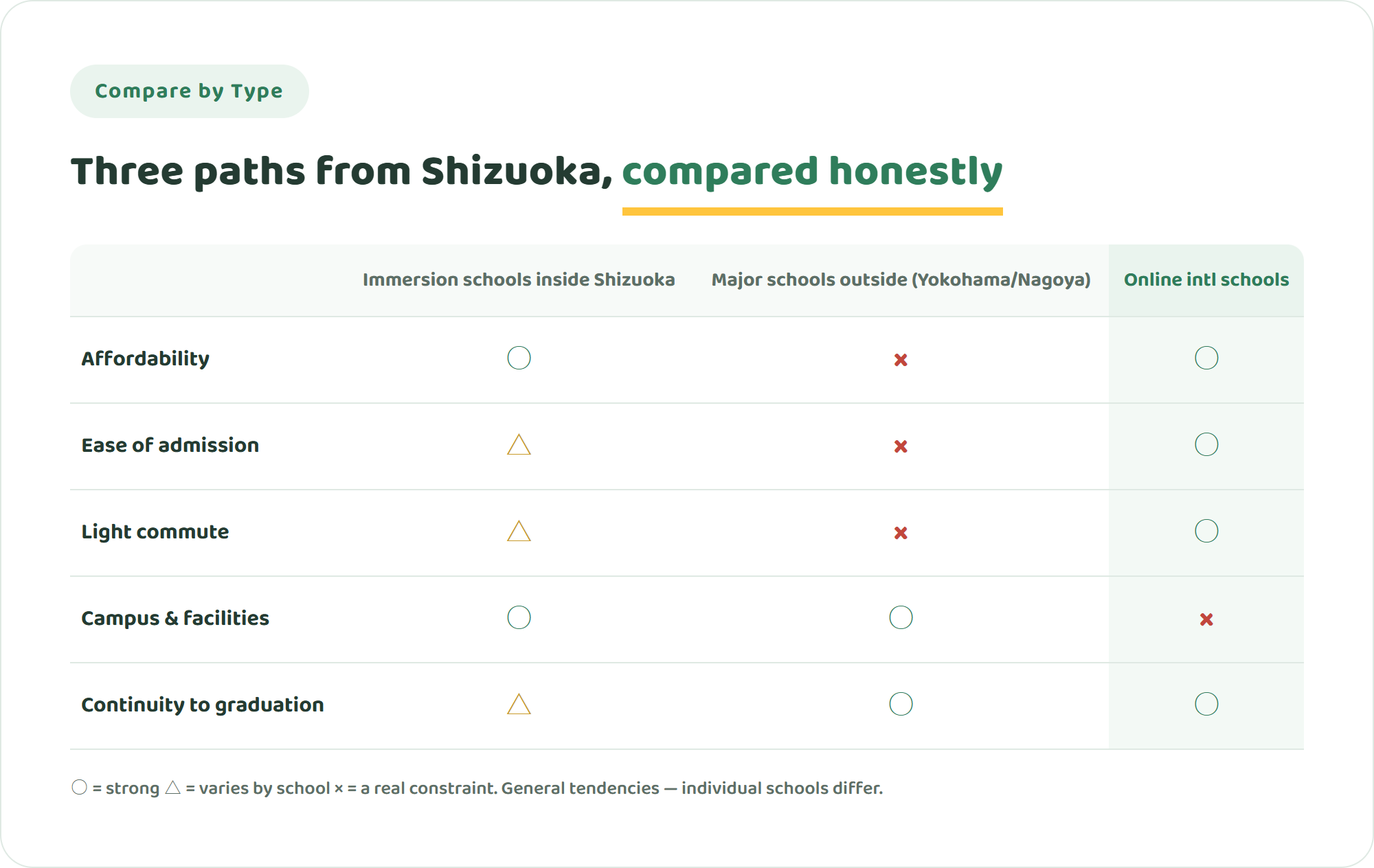
Schools inside the prefecture, like Katoh Gakuen and KICS, are realistic on both cost and commute. Katoh Gakuen in particular delivers a Japanese high school diploma alongside the IB Diploma, which keeps both domestic and overseas university routes open. The catch is location: Numazu and Kakegawa are not daily-commute distance from western Shizuoka City or Hamamatsu, and a 90-minute one-way journey costs a child real energy every single day.
Commuting to a major school in Yokohama or Nagoya is possible, but Shinkansen commuting is expensive and long. Looking at international schools in Yokohama or international schools in Nagoya alongside the local options makes the trade-off concrete.
The question that matters is not “which school will accept us” but “which learning can we keep going”. Multiply the annual fee and the daily travel time by twelve years, and the answer usually becomes clear.
See how learning works online →
When nothing is within reach: the online option
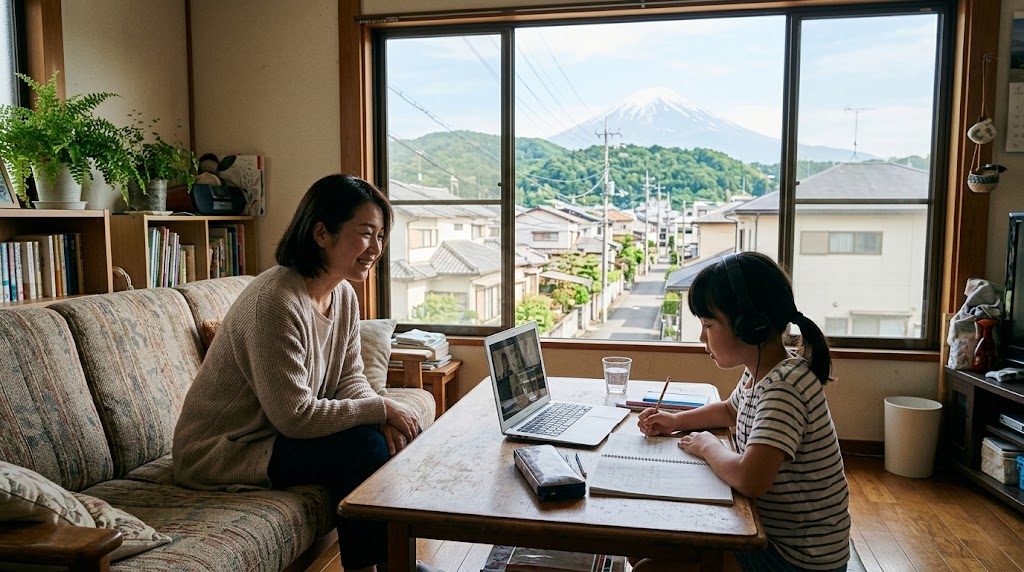
The most common dead end in a Shizuoka school search is not “there’s nothing good” — it is “we found something good, and we can’t get there”. Hamamatsu to Numazu, Shizuoka City to Kakegawa, southern Izu to Mishima: same prefecture on a map, different lives in practice. No amount of family effort shortens that distance.
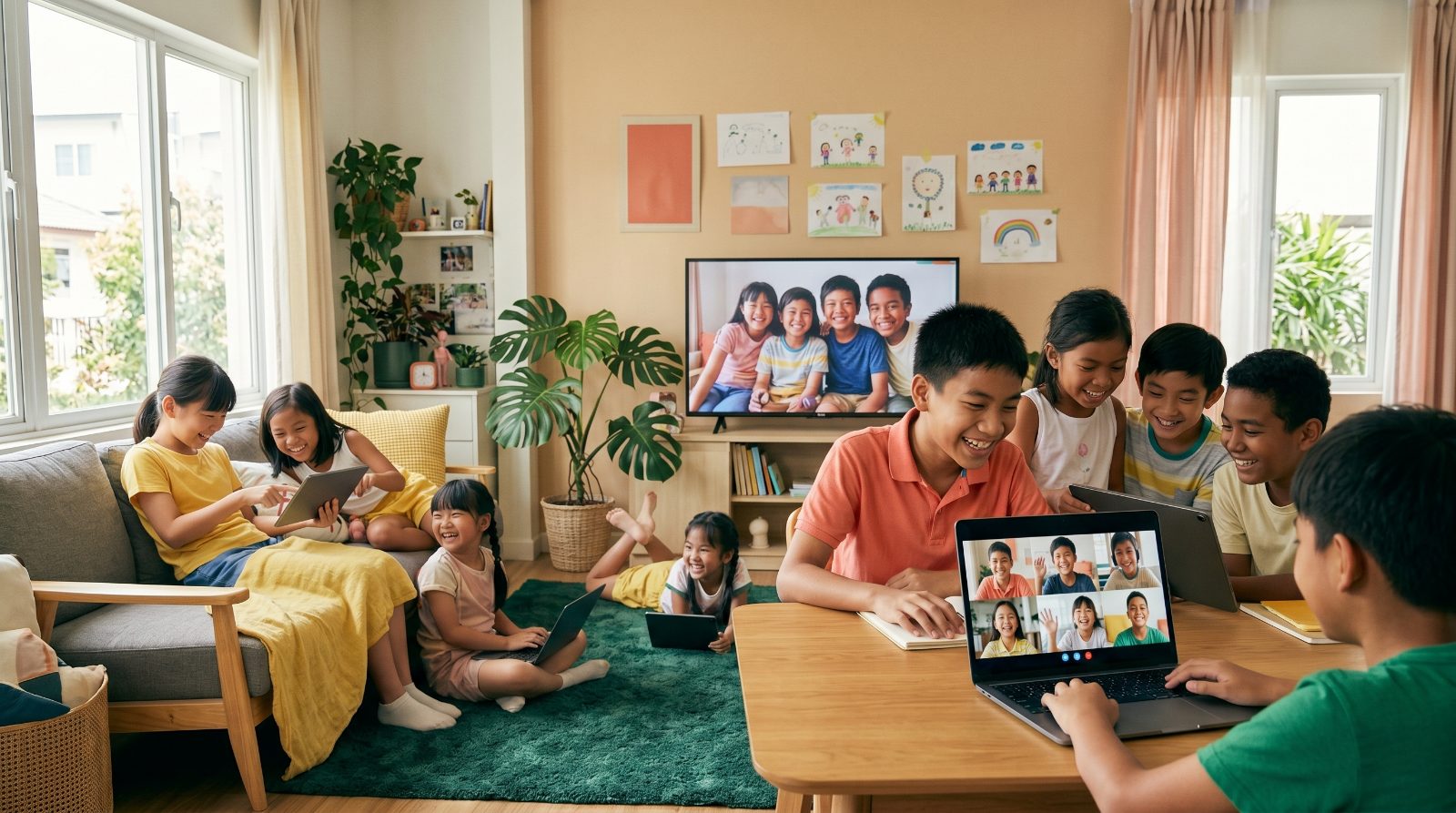
Which is why it is worth considering learning that does not depend on a commute at all. NIJIN GLOBAL ACADEMY (NGA) is an online international school opening in September 2027, operated by NIJIN Inc. in Japan. Our alternative school in Japan, NIJIN Academy, already has more than 1,000 students enrolled.
NGA is built on two commitments: moving beyond ranking children by test scores, and keeping classes small and dialogue-centred. Our promise to students is simple — to come to love themselves and the world. We serve children aged 6 to 18 across Asia and Oceania, wherever they live, and we are working to make tuition around one-fifth the cost of an in-person international school. English is introduced gradually, with Japanese-language support assumed rather than treated as a failure, so families do not have to choose between the two languages.
The honest caveats: we have not opened yet, so there are no graduate outcomes to show you. And online learning cannot replicate a schoolyard, a sports field, or the walk home with friends. If those matter most to your family, a school inside the prefecture is the better fit. But if the alternative is giving up because nothing is reachable, an option that does not require reaching is worth a look.
Frequently asked questions
Q. Can we reach a school from anywhere in Shizuoka Prefecture?
No — no single school serves the whole prefecture. It is roughly 150 km along the JR Tokaido Line from Atami in the east to Kosai in the west, about the same as Tokyo to Shizuoka City. The full-day schools are concentrated in Numazu and Kakegawa, so daily commuting from Hamamatsu or southern Izu is not realistic. Decide first how long a one-way journey your family can sustain for twelve years, then look only at what falls inside that circle.
Q. Can we attend an international school in a neighbouring prefecture?
Yes, and some families do — Tokyo-direction schools from Mishima and Numazu, Nagoya-direction schools from Hamamatsu. Budget honestly, though: a Shinkansen commuter pass runs to several hundred thousand yen a year, and primary-age children usually need an accompanying adult. A common compromise is to stay local through primary school and switch to a commute at junior high or high school age.
Q. Is no English at all a problem? What about Japanese-language support?
At preschool and kindergarten level, almost all schools here accept children with no English. From upper primary onwards, entry usually involves an English assessment, and standards vary by school. At a Japanese accredited school such as Katoh Gakuen, Japanese-language subjects remain part of the official curriculum, so first-language development is less of a worry. For families with roots outside Japan who are concerned about their child’s Japanese, our sister service Tomodachi Japan (online Japanese for children, also run by NIJIN) is worth a look.
Being in Shizuoka does not mean having no choice
It is easy to think that families in Tokyo or Yokohama have all the options. But Shizuoka is home to the school that brought English immersion to Japan first, and the school that became Japan’s first accredited institution to earn IB MYP and DP authorisation. It is home to children learning their national curriculum in Portuguese a few kilometres from a motorcycle factory. The choice here is not smaller — it is shaped differently.
And by 2028, Shizuoka City expects a new international school of its own. The prefecture is changing. Your child’s “now”, though, does not wait. So put the local schools, the cross-prefecture commute and the online route on the same table, and choose the one your family can genuinely sustain. Whichever it is, if your child ends up loving themselves and the world, you chose right.
International School Guides for Other Prefectures
- International Schools in Aichi Prefecture
- International Schools in Nagano Prefecture
- International Schools in Gifu Prefecture
- International Schools in Niigata Prefecture
- International Schools in Ishikawa Prefecture
- International Schools in Toyama Prefecture
- International Schools in Hokkaido Prefecture
- International Schools in Tochigi Prefecture
- International Schools in Tokushima Prefecture
- International Schools in Tottori Prefecture
- International Schools in Wakayama Prefecture
- International Schools in Yamagata Prefecture
- International Schools in Yamaguchi Prefecture
- International Schools in Yamanashi Prefecture
- Browse all 47 prefectures of Japan