“Working at an international school: pros and cons.” If you searched something like that, admiration and worry were probably sitting side by side in you. You want to use your English and your expertise in international education. You want to build learning that a test score can’t measure, with children from all over the world. And yet — “isn’t it actually brutally hard?”, “won’t the long hours wear me down?”, “is the job even secure?” The more you read, the more excitement and anxiety take turns washing over you. If you reached this page carrying that back-and-forth, you are far from alone.
This article meets the question of “how hard is it” honestly, from both sides — the good and the demanding. First, we’ll be candid, as a general picture, about the cons of working at an on-site international school (long hours, multicultural coordination, job insecurity, parent care) and the pros. Then we’ll look at how to choose a way of working while managing the hard parts — useful for any job search, with or without us. Finally, as a “third path” that eases those difficulties by design — fully remote, small-group, diversified income — we’ll introduce, without a hard sell, the option of joining the founding team of the online international school we open in September 2027.

Is working at an international school hard? The pros and cons, honestly
Let’s be direct: working at an international school genuinely has its hard parts. First, long hours are common. Lesson prep piles onto events, conferences, and paperwork in English, and in busy periods the load can rival any demanding public school. Second, coordinating with multinational, multicultural colleagues and parents. Aligning day to day with people whose values, educational views, and backgrounds differ is rewarding and nerve-consuming at once. Third, job insecurity. Some schools run mainly on fixed-term or single-year contracts, and your way of working can be swayed by curriculum changes or shifts in management strategy. On top of that, with many highly engaged families, parent care can be intense at certain times. This is exactly where jumping in on admiration alone tends to lead to regret.
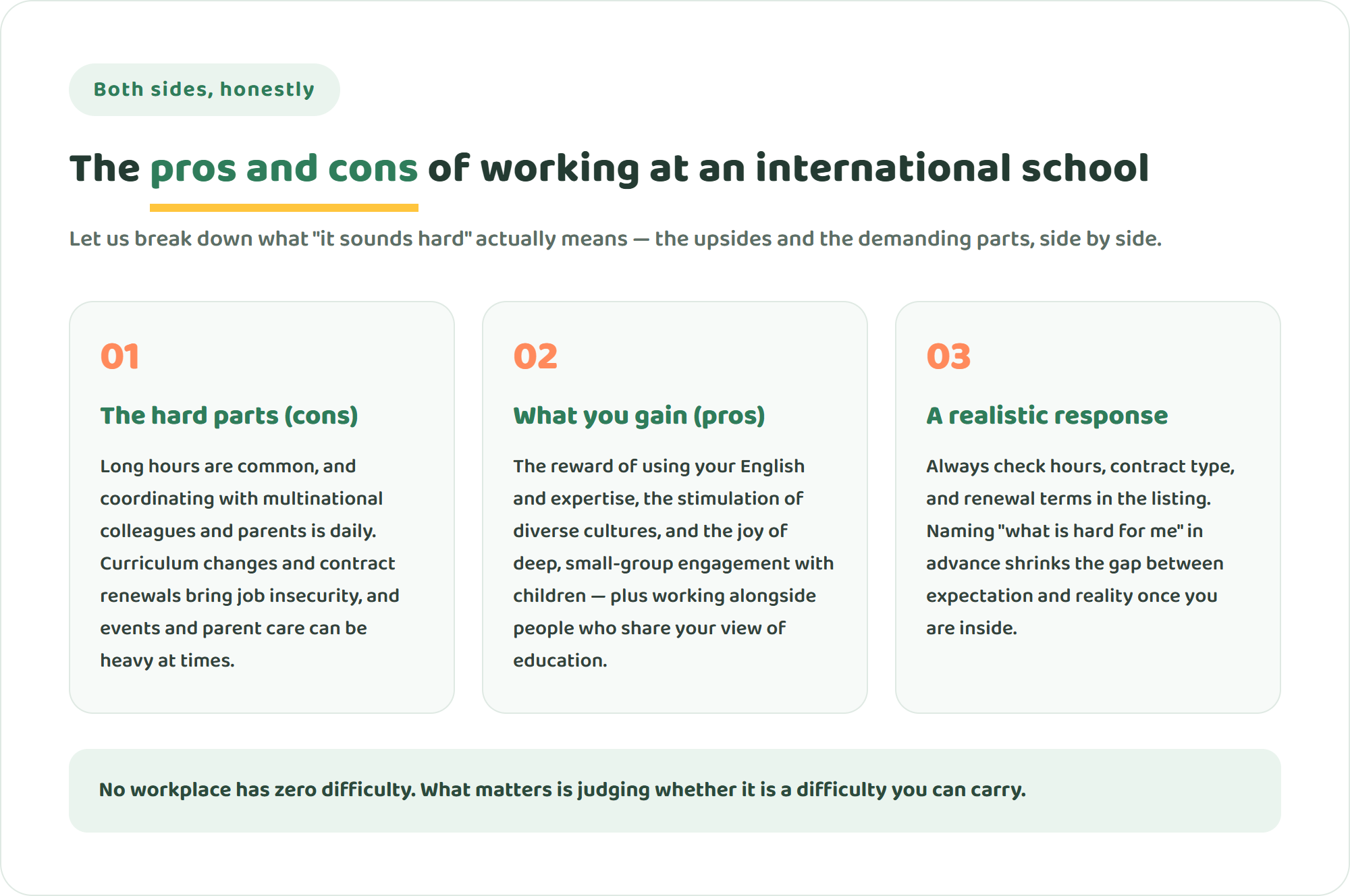
But as this chart shows, it is not all hardship. The reward of fully using your English and expertise, the daily stimulation of diverse cultures, and the joy of deep, one-on-one engagement in small groups — these are real upsides that on-site international schools offer. Many people are carried through by working alongside colleagues who share their view of education. Difficulty and appeal are two sides of one coin; judge on only one of them and you set yourself up to struggle with the gap once you’re inside.
Working with the hard parts — name what’s hard, then set your criteria
This is the heart of the article. What matters is breaking a vague “it sounds hard” into concrete words. “Hard” means different things to different people. Is it the long hours that hurt, the relationship coordination that drains you, the weight of job insecurity, or the parent care? Once you can name “what” is hard for you, the outline of workplaces to avoid — and ones you can live with — comes into focus. In a job listing, always check the hours, contract type, and renewal terms. Leave those fuzzy and much of the eventual regret is born right there.
Next, decide your own criteria for how you want to work — the priority order of what you won’t compromise on. Freedom over place and time. Little overtime. Not losing the joy of teaching. Diversifying your income. Which of these matters most to you? Browse listings with fuzzy criteria and you’ll be tossed around by surface factors like pay or prestige, and misjudge the true nature of the difficulty. With clear criteria, you can choose while thinking, “this is a difficulty I can carry.” Naming what’s hard and setting your criteria is the foundation that protects your career — whether or not you ever apply to us.
See NIJIN GLOBAL ACADEMY’s founding-member roles →
A third path — easing the hard parts by structure, not willpower
Much of the difficulty comes not from a lack of personal effort but from the structure of the working environment. If that’s true, then choosing a place whose structure itself is different is a path in its own right. The founding-member roles that オンラインインターナショナルスクールのNIJIN GLOBAL ACADEMY (NGA) is recruiting for ahead of its September 2027 opening are built on exactly that idea. The table below sets three ways of working side by side — an on-site international school, a general company, and an online international school — without exaggeration.
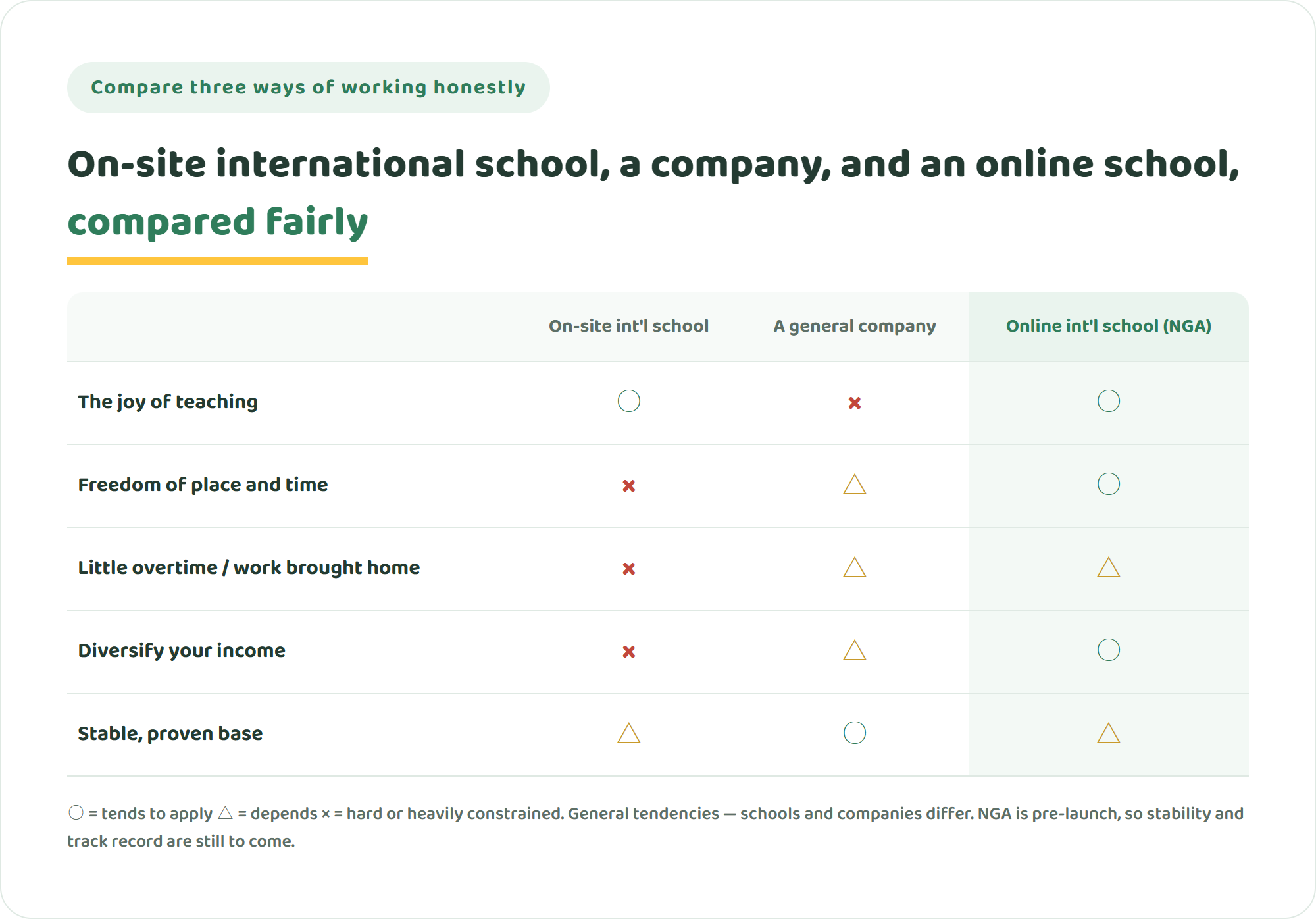
As the table makes plain, the NGA path is not a cure-all. Precisely because it is a pre-launch phase, the “stability and track record” of an established school are still to be built, and there is the particular busyness of a founding stage. Even so, it is designed to ease much of an on-site international school’s difficulty by structure. First, it is fully remote — built around the premise of “working while traveling the world,” with no commute, no fixed location, and none of the long fixed hours that come with them. Second, it centres on small-group dialogue — not the strain of one person handling a large, multinational class, but a way of engaging with each child. Third, you can combine teaching with running the business: beyond lessons, you can choose your involvement from five working styles spanning marketing, web, partnerships, and HR. And we say plainly what the terms are — founding roles on this track begin as volunteer positions ahead of our September 2027 opening, and the detailed terms are shared later in the process. On the employment side too, where single-year contracts can create anxiety, the design lets you continue your career within the 11-company NIJIN Group.
Above all, NGA stands for learning beyond test scores — no ranking of children by exam results. Our view of education, built around small-group dialogue that starts from “what do you think?”, is laid out in how we learn. It is often the teachers most worn out by drilling fixed answers, or by endless admin, who connect with this philosophy and structure. What we ask of applicants is roughly English at CEFR B2+ and an appetite for building from zero. We look at that drive more than at a teaching license or a glossy résumé.

Choosing a way of working that fits — three steps
Here is a manageable, three-step way to turn worry into action.
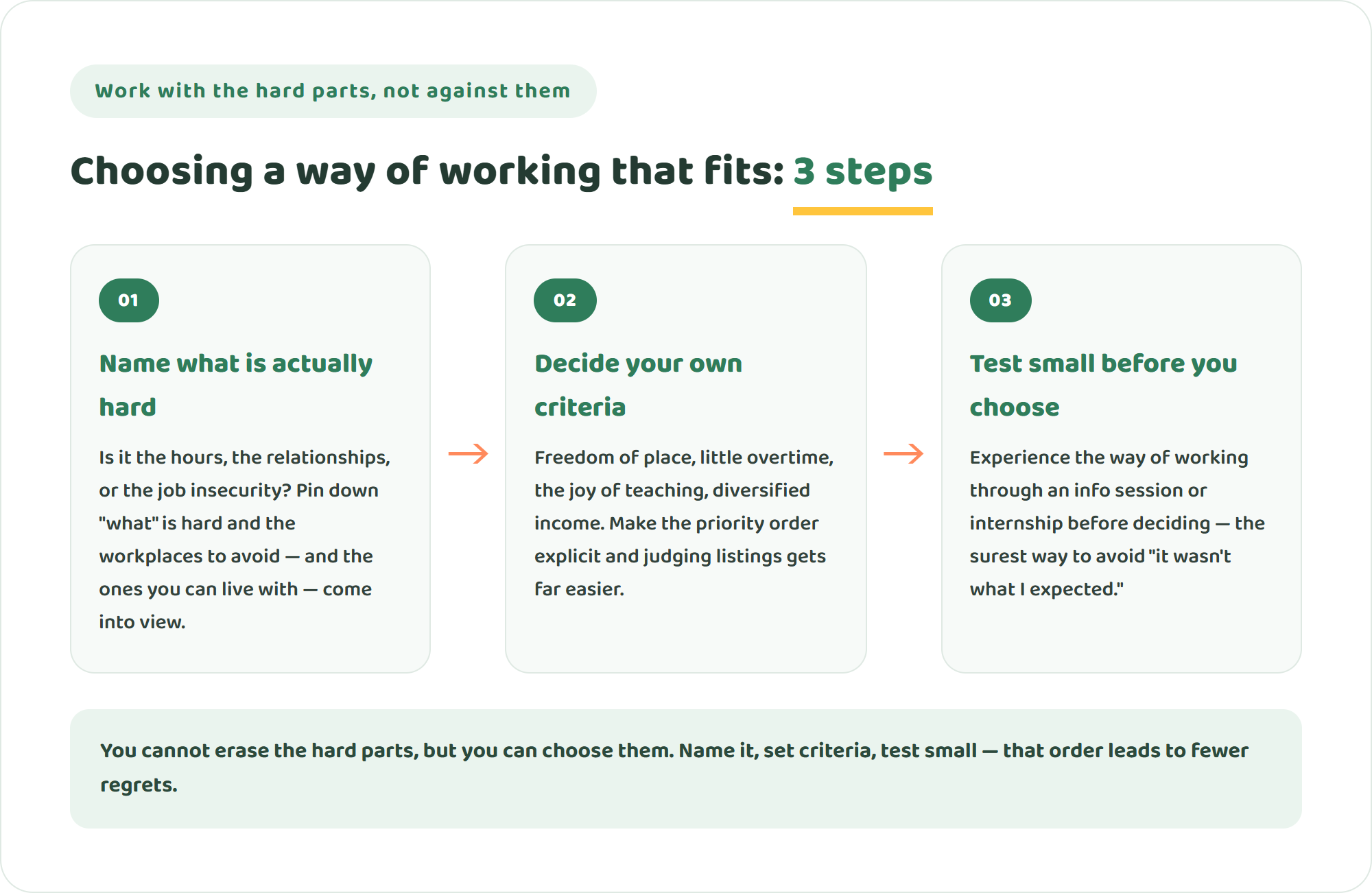
First, name what is actually hard. As in the chapter above, break down “what” is hard for you into concrete words. Second, decide your own criteria — freedom of place, little overtime, the joy of teaching, diversified income — and make the priority order explicit. Third, test small before you choose. Deciding after experiencing the real way of working through an info session or internship keeps you from “it wasn’t what I expected.” NGA’s selection runs from document screening to a group interview, an internship at NIJIN Academy, and a final presentation (applications are via a Google Form). Being able to “try before you decide” through the internship — rather than leaping in blind — is, I think, a reassuring design for anyone who wants to gauge the difficulty first.
Frequently asked questions
Is working at an international school really hard because of long hours?
It’s true that on-site schools tend toward long hours, and this varies a great deal by school — so always check the hours and contract type in the listing. NGA is fully remote with no commute and centres on small-group dialogue, so the strain that comes with running a large, multinational class is structurally lighter. That said, a founding stage has its own busyness, and we tell you that honestly during selection.
I’m not that confident in my English. Won’t it be too hard for me?
We assume roughly CEFR B2+, but we’re not looking for native-level perfection. What matters is the willingness to use English to work with children and peers around the world, and to keep growing it. We look at your room to grow and your drive more than your current level. You can confirm the exact expectations during selection.
I hear the employment is unstable. Can I work here long term?
At on-site international schools, some run mainly on fixed-term or single-year contracts, and job insecurity is an honest concern. NGA is pre-launch, so “stability and track record” are still being built, but the design lets you continue your career within the 11-company NIJIN Group. Where we can’t state specifics, we keep it to “details during selection” — but the structure differs from a working life tossed around by single-year contracts.
Can you really teach children remotely?
NGA is an online international school built around small-group dialogue. Because it is dialogue that draws out each child’s thinking — not one-way lecturing to a large class — deep engagement is possible even remotely. Being able to teach fully remotely, unbound by location, can be the thing that changes the very shape of work for anyone worried about the demands of an on-site school.
The hard parts aren’t to be erased — they’re to be chosen.
If you searched “working at an international school pros and cons,” some admiration for international education probably still lives in you. Every workplace has its hard parts. So rather than trying to reduce difficulty to zero, the shortcut to a way of working you won’t regret is to judge “is this a difficulty I can carry?” and choose accordingly. Name what’s hard, set your criteria, test small — each step turns admiration into real, grounded footing. And if you find yourself wanting to change the very structure of the difficulty, add the third path — fully remote, small-group, diversified income — to your options. The steering wheel of your career has always been in your own hands.
Working at an International School — More Articles
- international school teacher salary
- how to become an international school teacher
- career change from teaching
- career change from teaching in your 30s and 40s
- how much do teachers earn?
- how to become an IB teacher
- jobs for moving abroad
- remote jobs that use English
- digital nomad teaching jobs
- bilingual remote jobs
- career change from tutoring
- life after leaving teaching
- a second career for teachers
- high-paying jobs that use English
- careers with a teaching license
- private school teacher career change
- qualifications to teach English
- elementary school teacher salary in Japan
Toward a way of working whose difficulty you can carry.