If you are searching for international schools in Fukuoka — perhaps you have just relocated to Kyushu, or you are a local family who wants an English-medium, globally minded education for your child — you may already have noticed the options are surprisingly few. Here is the honest version up front: only about three schools in Fukuoka offer a genuine English-medium education through high school, with campus tuition running roughly ¥1.2–2.3 million per year (about USD 8,000–15,000). Add the strong preschool scene and the picture widens a little. This guide walks through seven real schools and English programmes in Fukuoka City and nearby towns such as Dazaifu and Chikushino, with honest notes on fees, curriculum, and which families each one suits.
We are not here to sell you one school. Our goal is simpler: by the end of this article, you should know exactly what to look for when choosing for your own child.
Quick Answer: Your Options in Fukuoka
If you only read one section, read this. Below are the schools covered in this guide, plus the online option — so you can see every route side by side before the details.
- Fukuoka International School (FIS) — Ages — 3–18 (early years–Grade 12), Sawara Ward, Fukuoka City / Fees — approx. ¥1.86–2.29 million/year (official 2026–27 rates) plus ¥350,000 acceptance…
- Linden Hall School (Elementary and Secondary) — Ages — 6–18 (elementary–high school), Dazaifu / Chikushino / Fees — approx. ¥1.2–1.32 million/year (higher in year one with entrance fees; public…
- Fukuoka International Islamic School (FIIS) — Ages — 3–18, Fukuoka City / Fees — not published; contact the school directly (as of 2026)
- Fukuoka Futaba (Global Communication Course) — Ages — elementary through high school, Chuo Ward, Fukuoka City / Fees — tuition approx. ¥350,000–480,000/year plus other fees (public information as of…
- Kinder Kids International School Fukuoka — Ages — approx. 1–6 (infant–pre-kindergarten), Sawara Ward, Fukuoka City / Fees — varies by course and hours; contact the school (typical preschool range)
- Little World International Kids — Ages — 1 year to pre-school entry, Sawara Ward, Fukuoka City / Fees — approx. ¥280,000–440,000/year (public information as of 2026; confirm latest)
- Fukuoka International I-School (Kindergarten) — Ages — 2 years to pre-school entry, Nishi Ward, Fukuoka City / Fees — approx. ¥540,000/year (public information as of 2026; confirm latest)
- NIJIN GLOBAL ACADEMY (online) — Ages 6–18 / opening September 2027, currently taking opening-update registrations / fees around one-fifth of a typical campus international school / Japanese-language support. An option when commute or fees are the wall.
International Schools in Fukuoka Prefecture: The Landscape and Typical Fees
Fukuoka’s international-school scene is dominated by early-years preschools, and the number of schools that carry English-medium study all the way through high school is genuinely small — even by national standards. The three that do are Fukuoka International School (FIS) in Sawara Ward, Linden Hall School across Dazaifu and Chikushino, and the American-and-Islamic Fukuoka International Islamic School. Beyond these, families round out their options with English-immersion programmes at Japanese private schools and a healthy range of preschools. It is common for Kyushu families to widen their search to nearby towns or even other prefectures.
On cost: expect roughly ¥1.2–2.3 million per year at the campus international schools, plus one-time registration, development and facility fees. English programmes at private schools and preschools sit lower, in the ¥280,000–600,000 range. Always compare the total annual cost, not the headline tuition — our breakdown of what international school tuition really includes explains how. Note: all fees in this article are based on publicly available information as of July 2026; please confirm the latest figures on each school’s official website.
The 7 Best International Schools in Fukuoka
Below are seven schools and programmes chosen for balance across curriculum, age range and price. None of them is “the best” in the abstract — the right answer depends on your child’s age and your circumstances. The first schools carry through elementary and beyond; the later ones are early-years options.
1. Fukuoka International School (FIS)
Founded in 1972 and set on the Momochi seafront in Sawara Ward, FIS is one of Kyushu’s oldest international schools and a fully authorized IB World School offering the PYP, MYP, and Diploma Programme. With students from around 40 nationalities, it delivers an inquiry-led education and a solid record of placing graduates in universities worldwide.
- Curriculum — International Baccalaureate (PYP/MYP/DP), fully authorized
- Ages — 3–18 (early years–Grade 12), Sawara Ward, Fukuoka City
- Fees — approx. ¥1.86–2.29 million/year (official 2026–27 rates) plus ¥350,000 acceptance, ¥500,000 development and ¥200,000/year facility fees (confirm latest)
- Best for — families wanting a full K–12 IB education in Fukuoka and able to budget for it
2. Linden Hall School (Elementary and Secondary)
Run by the Tsuzuki Gakuen group, Linden Hall is Fukuoka Prefecture’s only accredited Japanese (ichijo-ko) secondary-education school of its kind. Its elementary campus (Dazaifu) and secondary campus (Chikushino) deliver a twelve-year English-immersion education, and it earned IB Diploma Programme authorization in 2013 — combining the reassurance of an accredited Japanese school with a fully English environment.
- Curriculum — English immersion plus IB Diploma Programme (accredited Japanese school)
- Ages — 6–18 (elementary–high school), Dazaifu / Chikushino
- Fees — approx. ¥1.2–1.32 million/year (higher in year one with entrance fees; public information as of 2026; confirm latest)
- Best for — families in southern greater Fukuoka wanting accredited status and English education together
3. Fukuoka International Islamic School (FIIS)
FIIS delivers an American-style curriculum alongside Islamic education, taught in English. It accepts children from early years through the high-school level and holds dual American and Japanese kindergarten accreditation. It is chosen mainly by Muslim families and by families who share its values.
- Curriculum — American-style plus Islamic education (English-medium)
- Ages — 3–18, Fukuoka City
- Fees — not published; contact the school directly (as of 2026)
- Best for — families seeking an American curriculum, or who share the school’s faith and values
4. Fukuoka Futaba (Global Communication Course)
A Catholic private school in Chuo Ward, Fukuoka Futaba is not a pure international school, but its Global Communication Course teaches subjects such as maths and science in English — building strong English within the structure of a mainstream Japanese school. Because it is an accredited Japanese school, fees stay comparatively modest.
- Curriculum — Japanese curriculum with an English-immersion international course (accredited Japanese school)
- Ages — elementary through high school, Chuo Ward, Fukuoka City
- Fees — tuition approx. ¥350,000–480,000/year plus other fees (public information as of 2026; confirm latest)
- Best for — families who want the reassurance of a Japanese school while strengthening English at a lower cost
5. Kinder Kids International School Fukuoka
Part of a nationwide English-immersion preschool group, the Fukuoka campus sits in Nishijin, Sawara Ward. From infant classes through pre-kindergarten, it runs an all-English environment with native teachers — a good fit for families who want to build strong English foundations in the early years.
- Curriculum — English immersion (preschool / English-medium daycare)
- Ages — approx. 1–6 (infant–pre-kindergarten), Sawara Ward, Fukuoka City
- Fees — varies by course and hours; contact the school (typical preschool range)
- Best for — families wanting an immersive English environment in the early years
6. Little World International Kids
A bilingual (English/Japanese) preschool in Sawara Ward, Fukuoka City, Little World weaves in music and movement so children pick up both languages naturally through play. It is popular with families who want to raise bilingual children without pressure.
- Curriculum — English/Japanese bilingual (preschool)
- Ages — 1 year to pre-school entry, Sawara Ward, Fukuoka City
- Fees — approx. ¥280,000–440,000/year (public information as of 2026; confirm latest)
- Best for — families aiming for bilingualism at a moderate cost while keeping Japanese strong
7. Fukuoka International I-School (Kindergarten)
A Montessori-based English kindergarten in Nishi Ward, Fukuoka City, I-School combines Montessori’s emphasis on child-led independence with balanced English instruction — a good match for families who care as much about how their child learns in the early years as about the language.
- Curriculum — Montessori plus English (kindergarten)
- Ages — 2 years to pre-school entry, Nishi Ward, Fukuoka City
- Fees — approx. ¥540,000/year (public information as of 2026; confirm latest)
- Best for — families who value a specific early-years approach (Montessori) alongside English
International Schools Across Fukuoka Prefecture: What Exists Outside Fukuoka City
Search for international schools in Fukuoka and almost everything you find sits inside Fukuoka city. Fukuoka Prefecture has 60 municipalities, though, and if you live in Kitakyushu, Kurume or Itoshima the real question is whether anything works without a daily trip into the city. As of July 2026: outside Fukuoka city, the main option that teaches primary and secondary grades in English is Linden Hall School, split between Dazaifu and Chikushino. Kitakyushu has two bilingual settings that continue past kindergarten, Kurume has an accredited kindergarten with a strong English programme, and in Itoshima and Munakata we could verify nothing.
Chikushi area (Dazaifu, Chikushino): the only English-immersion continuum outside the city
Twenty to thirty minutes south of Fukuoka city by Nishitetsu or JR, the Chikushi area holds the one school in Fukuoka Prefecture where a child can go from grade 1 to grade 12 in English immersion. The elementary and secondary divisions sit in different cities.
| School | City | Stages | Curriculum | Published fees | Commute / school buses |
|---|---|---|---|---|---|
| Linden Hall School, Elementary Division | Dazaifu (6-16-58 Gojo) | Grades 1–6 | English immersion, accredited Japanese school (ichijo-ko) | Tuition ¥90,000/month plus ¥8,000 materials and ¥2,000 association fee; first year adds ¥300,000 entrance, ¥350,000 educational and ¥350,000 facilities fees (published 2026 figures — confirm current rates) | Gojo station (Nishitetsu Dazaifu line) and five school-bus routes: JR Futsukaichi, Nishitetsu Futsukaichi, Momochi, Kashii and Kitakyushu |
| Linden Hall School, Secondary Division | Chikushino (3-10-1 Futsukaichi-kita) | Grades 7–12 (ages 11–19) | English immersion plus IB Diploma Programme (accredited October 2013; IB or TI course from grade 10) | Tuition ¥100,000/month plus ¥20,000 IB fee and ¥2,000 association fee; first year adds ¥300,000 entrance, ¥380,000 educational and ¥370,000 facilities fees (published 2026 figures — confirm current rates) | About 9 min on foot from Nishitetsu Futsukaichi; about 10 min by taxi from JR Futsukaichi. Same five school-bus routes |
The detail most families miss is that those bus routes include a Kitakyushu line via the expressway, plus Momochi and Kashii lines inside Fukuoka city. A daily commute from Kitakyushu or eastern Fukuoka is therefore designed for, not improvised — registration is required in advance, and getting to the stop is on the family. Ask for the route map before ruling the school out on distance.
Kitakyushu: two bilingual settings that continue past kindergarten
- Bright Kids Garden (3-2-27 Muromachi, Kokura-kita ward, one minute from JR Nishi-Kokura) — an English preschool and bilingual school with elementary and junior-high divisions plus an English after-school programme. Fees are not published; enquire directly.
- Casa dei Bambini (bilingual Montessori, Kitakyushu) — three age-based divisions: a 0–3 children’s house at Riverwalk, Casa dei Bambini for 3–6, and Montessori Elementary School Kitakyushu (MEK) for 6–12. English is used through daily life while Japanese is deliberately maintained. Fees on enquiry.
- Yawata-higashi ward also has an early-years English kindergarten (Fukuoka English Kindergarten Preschool, Yawata campus).
Honestly: as of July 2026, completing an English-medium education through high school entirely within Kitakyushu is not realistic. The Linden Hall Kitakyushu bus line, or a route that does not depend on commuting at all, is what most families end up weighing.
Kurume, Chikugo, Itoshima and Munakata
Kurume has Kurume International iSchool Kindergarten (Shoei Gakuen), an accredited kindergarten rather than an unregulated preschool, which builds daily English into its programme and says it supports children’s English up to grade 6 after graduation. Beyond that, we could verify no school teaching primary grades or above in English in the Kurume and Chikugo area. Nor in Itoshima or Munakata — and we would rather report that than pad the list. From Itoshima, FIS in Sawara ward is roughly 30–40 minutes on the JR Chikuhi line and the subway it connects with; from Munakata, central Fukuoka is around 30 minutes on the JR Kagoshima line. Both assume a commute into the city.
Prefecture-wide, school-age options in Fukuoka concentrate in Fukuoka city and the Chikushi area. That is exactly why a third route — one that does not depend on where you live — is worth comparing. Locations, fees and journey times above follow each school’s official site and public information as of July 2026; confirm current figures with the schools.
Comparing Your Options: Which Type of School Fits Your Family?
With seven options in mind, it helps to step back and compare three broad types available to families in Fukuoka: the campus international schools, the English-medium private schools and preschools, and — a fast-growing category — online international schools.
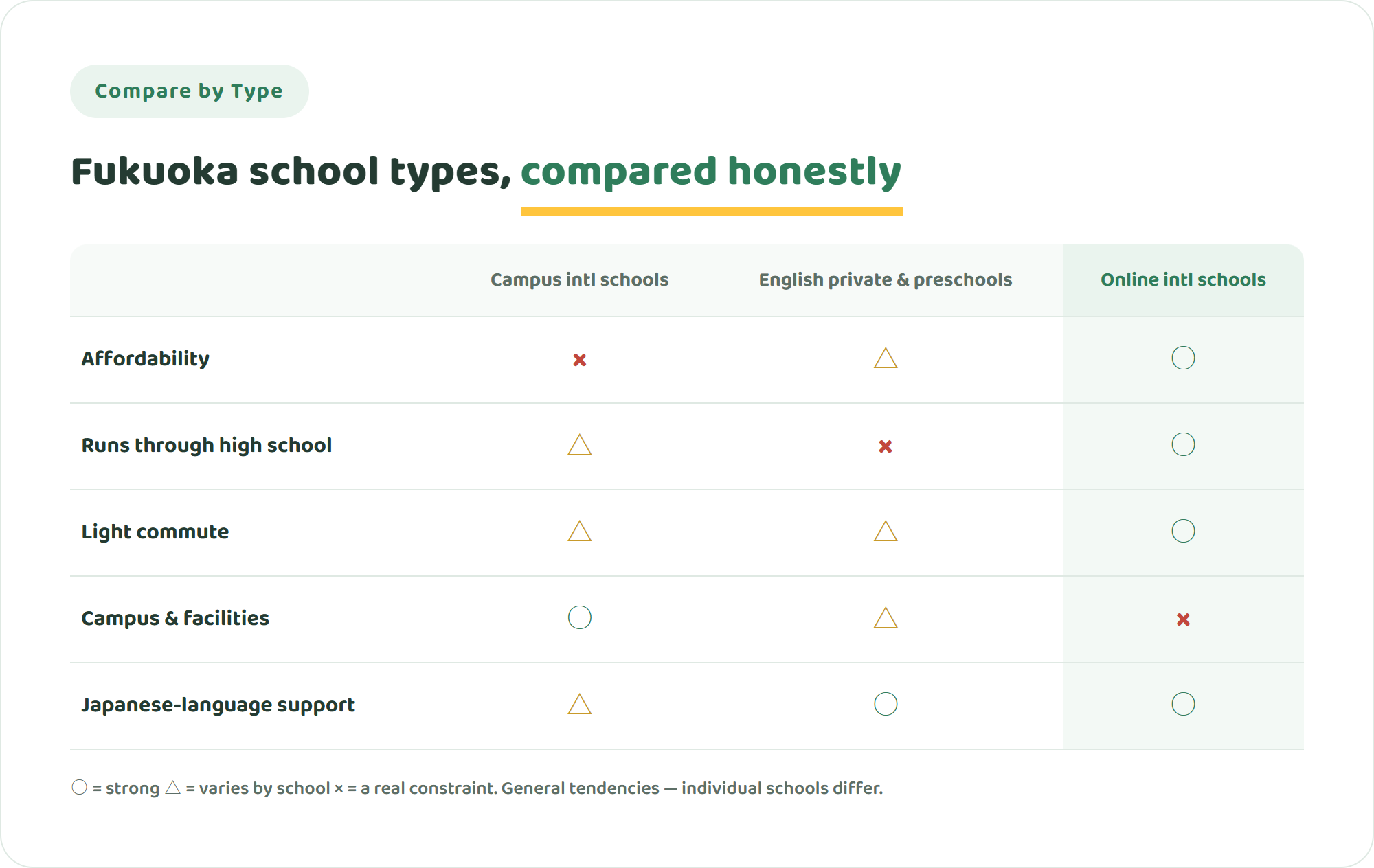
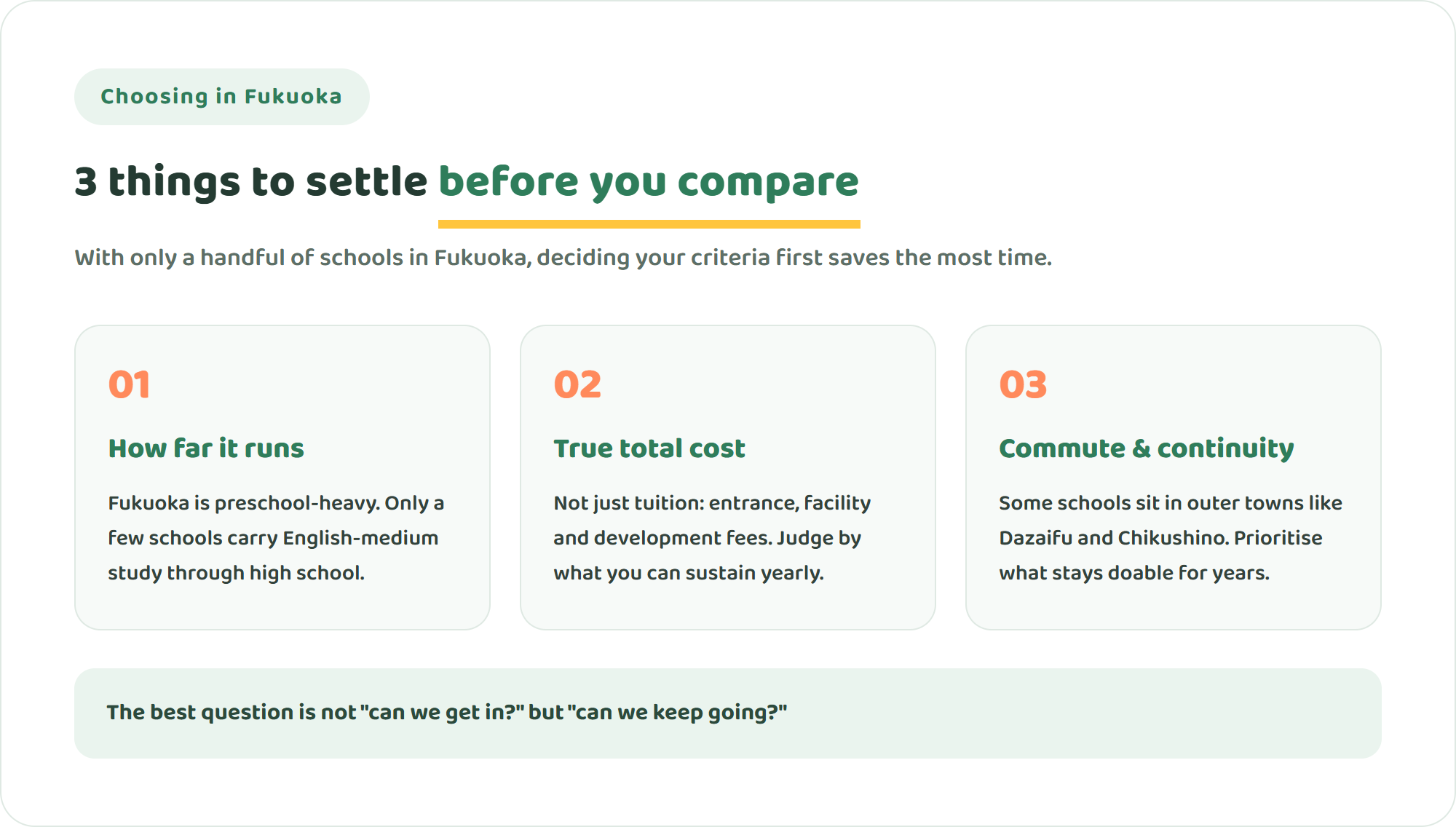
The pattern is clear: physical campuses win on facilities and daily face-to-face immersion, but in Fukuoka only a few carry through high school and fees climb toward ¥2 million a year. Online schools, by contrast, win on affordability, zero commute, and — crucially in Fukuoka — the ability to keep the same environment as your child moves up the grades. The question that matters most is not “Can we get in?” but “Can we sustain this for ten years?” — tuition compounds across an entire childhood. If you are curious how a serious online model actually works day to day, see how learning works online →.
If Fees or the Commute Are the Wall — an Online 8th Option
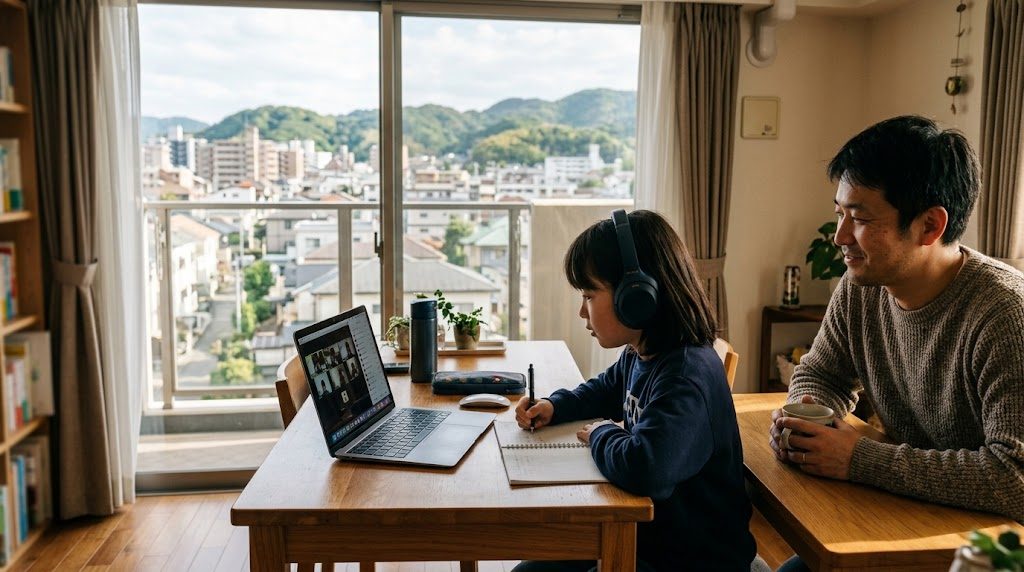
If you have read this far and thought, “There are so few schools that run through high school here, and ¥2 million a year is not sustainable for us,” or “A daily commute out to Dazaifu or Chikushino is too much” — you are not out of options. NIJIN GLOBAL ACADEMY (NGA) is an online international school opening in September 2027, run by NIJIN Inc. of Japan, whose alternative school NIJIN Academy already serves more than 1,000 students.
NGA is built around learning without test-score rankings — small-group, dialogue-centred classes for ages 6–18 across Asia and Oceania, designed so children can start with Japanese-language support and grow into English gradually. Fees are targeted at around one-fifth of a typical bricks-and-mortar international school, and it makes no difference whether you live in central Fukuoka or an outer town. To be fully honest: NGA has not yet opened, its track record is still to come, and an online school is not the same experience as a physical campus with playgrounds and science labs. But if your worry is that Fukuoka has too few options — or that cost or geography stands between your child and an international education — it is an option worth weighing alongside the seven above.
Frequently Asked Questions About International Schools in Fukuoka Prefecture
From what age can children join international schools in Fukuoka?
Most schools accept children from around age 3 into preschool or early years programmes. Entry at elementary level and above is possible, but in Fukuoka the number of schools offering English-medium study through the higher grades is limited, and language requirements tend to rise with grade level — confirm capacity and requirements directly with each school.
Do Fukuoka international schools support children (and parents) who don’t speak English?
It varies. Early-years entry usually requires no English, and accredited schools like Linden Hall and English-course private schools are experienced with Japanese and bilingual families. Parent communication, however, is often English-first at the full international schools, so ask each school what Japanese-language support is available before enrolling.
When is the best time to transfer in?
Most international schools in Fukuoka run on an August/September start, and term boundaries are the smoothest entry points; accredited Japanese schools such as Linden Hall follow the Japanese April start instead. Because Fukuoka has few schools and seats at popular ones open rarely, contact admissions early to ask about waiting lists once you have a shortlist.
The Right School Is the One Your Child Can Grow In
Fukuoka offers a genuinely varied — if not large — menu: a full IB continuum, an accredited English-immersion school, early-years preschools, and now credible online options. Precisely because choices are limited, you do not need to rush toward the most famous name. Weigh the total cost, the commute, and — most of all — where your child will feel free to be themselves. That is the school worth choosing.
NIJIN GLOBAL ACADEMY opens in September 2027. To hear first about our learning model, accessible fees, and founding-cohort enrolment, join our mailing list.
International Schools in Other Cities
- International Schools in Nagoya: All 8 Schools
- International Schools in Minato: Fees
- International Schools in Setagaya: All 14 Schools
- International Schools in Nakano, Tokyo
- International Schools in Tsukuba: Fees
- International Schools in Sendai: 7 Picks and Fees
- International Schools in Nerima, Tokyo
- International Schools in Osaka
- International Schools in Ota, Tokyo
- International Schools in Tokyo
- International Schools in Yokohama: Full Comparison
- International Schools in Shibuya, Tokyo
- International Schools in Kawasaki
- International Schools in Koto, Tokyo
- International Schools in Shinagawa, Tokyo