In Japan, the autumn of the third year of junior high school arrives with a form. First choice, second choice, third choice — three boxes, and the names that fit in them are the full-time high schools within commuting distance. When a child says none of them appeal, or when the grades clearly will not reach, families tend to arrive at the same feeling at the same moment: there is nothing else — no high school pathway options worth the name.
There is. What is narrow is not the range of routes but the map the school hands out, which is drawn around one of them. Under Japanese law there are seven routes at high school age, and — this is the part that gets lost — they do not end in the same thing. Some issue a high school diploma. Some confer eligibility to enter university. Some give you a qualification that travels internationally. Comparing them as though they were interchangeable is exactly what makes the decision feel impossible.
What follows sorts all seven using only what Japan’s Ministry of Education publishes: what each route leaves you holding, whether public funding reaches it, and who it genuinely suits. Entrance-exam rankings do not appear once.

Three axes to settle before any school names
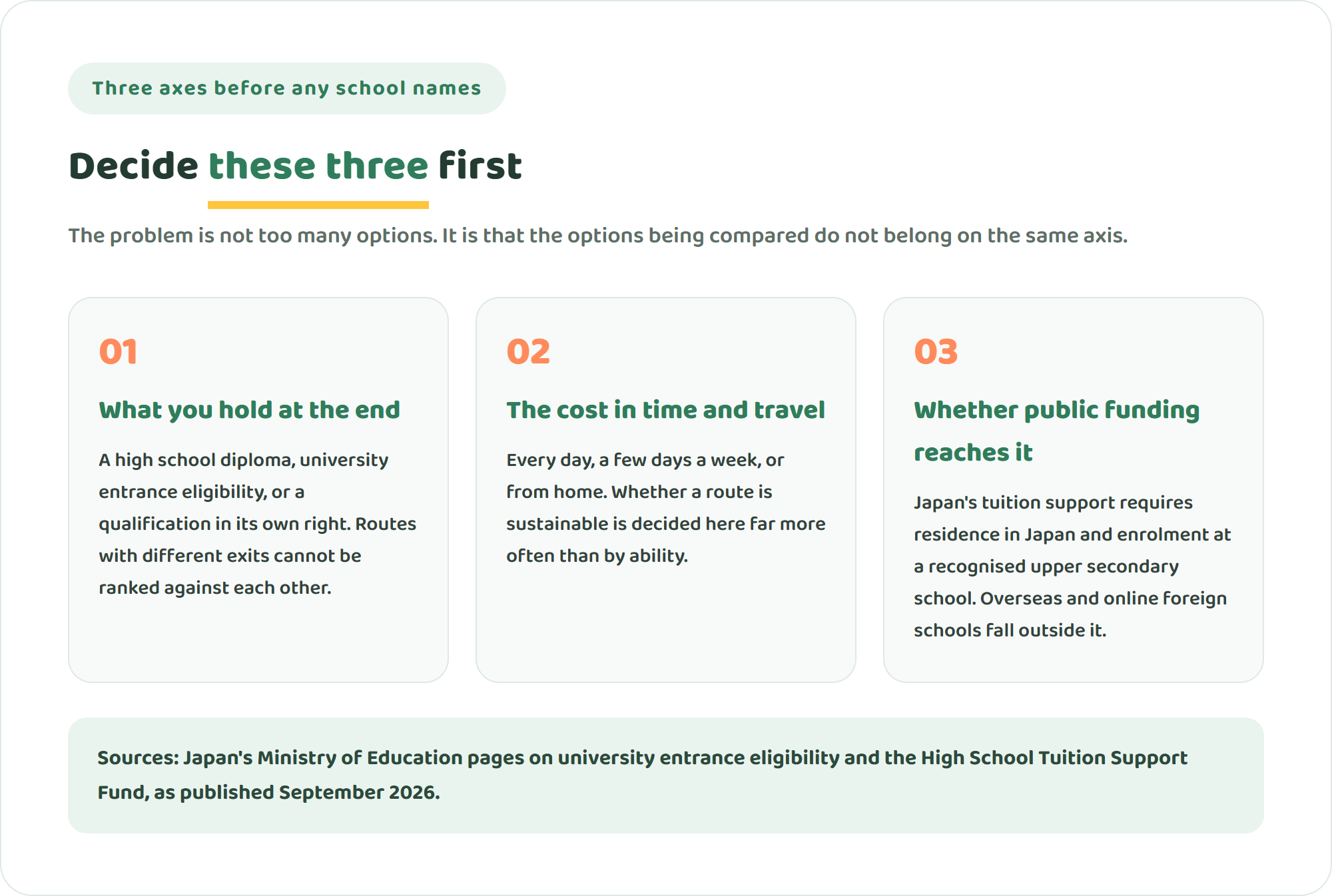
Parents often say there are too many options to choose between. What is usually happening is subtler: the options are being lined up without a shared axis. Three axes are enough.
The first is what the route leaves you holding. A Japanese high school diploma, eligibility to sit university entrance, or an internationally portable qualification. Routes with different exits cannot be ranked against one another, and trying to do it produces paralysis, not clarity.
The second is the cost in time and travel. Every weekday, a few days a week, or from home. Whether a route is sustainable is decided here far more often than by academic ability. Over three years, this is where people drop out.
The third is whether public funding reaches it. Japan’s High School Tuition Support Fund requires the student to be resident in Japan and enrolled at a recognised upper secondary school. Overseas schools and online schools based outside Japan fall outside it. That single condition often matters more than the sticker price.
Seven high school pathway options
1. Full-time high school (zennichisei)
The route most students take. Weekday attendance during the day; graduation confers the high school diploma, which carries university entrance eligibility directly. Public and private schools alike can qualify for tuition support. It suits a child for whom daily attendance is not itself the problem. The risk is that if it turns out not to fit, the only visible exit is withdrawal — so it is worth agreeing, out loud and in advance, what the family would do in that case.
2. Part-time high school (teijisei)
Classes in the evening, at night, or in morning and afternoon shifts. The credential is identical to the full-time route, and tuition support applies. It suits students with daytime work or family responsibilities, those for whom mornings are genuinely impossible, and those who settle better in small classes. Many of these schools now run three shifts, so the hours can be chosen.
3. Distance-learning high school (tsushinsei)
Credits accumulate through submitted work plus periodic face-to-face schooling. Graduation confers the same high school diploma, and tuition support applies. It suits students for whom daily commuting is not physically or emotionally sustainable, those who need their own pace, and those protecting time for something they are serious about. The honest caution: the freedom that makes it possible is also what stalls it, so look hard at what support structure comes with it — and at what that support costs.
4. KOSEN (national institutes of technology)
Five-year technical colleges, and the most under-explained option in most guidance packs. The ministry’s own list of university-entrance routes states that a student who completes the third year at a KOSEN has university entrance eligibility. So the door to university stays open at year three while the specialism continues to year five. Tuition support applies. It suits a student with a concrete pull towards mechanical, electrical, information or chemical fields. The cost is that a hard pivot to the humanities later is expensive in time.
5. Specialised upper secondary schools (koto senshu gakko)
Vocational courses entered after junior high — cooking, beauty, automotive, nursing, IT and more, typically three years. The crucial detail: completing a specialised upper secondary course designated by the Minister of Education confers university entrance eligibility. The widespread belief that a vocational route closes off university is simply false where the course is designated. Tuition support applies. There is exactly one thing to verify — whether that particular course holds the designation. The school can answer in one email.
6. Overseas schools and international qualifications
Here the field widens considerably. Alongside routes that depend on finishing a school abroad, the ministry’s list also recognises simply holding an international qualification — so “earn the qualification” is an entry route in its own right. It suits families with enough English in place to carry subject learning, and those keeping universities abroad in view. The cautions are two: Japanese tuition support does not reach it, and whether a given programme counts as twelve years of regular school education varies by country — the ministry itself directs families to confirm with the relevant embassy. If the route you are weighing is an online international school, the options are laid out in online international schools compared.
7. The high school equivalency exam, plus individual university assessment
Passing Japan’s Upper Secondary School Equivalency Examination confers university entrance eligibility (from the day after an under-18 candidate turns 18). Beyond that, the rules also recognise a person aged 18 or over whom a university accepts through its own individual eligibility assessment. It suits a student for whom the institution of school is itself the obstacle, or who is already deep in serious work elsewhere. The trade-offs: no high school diploma is issued, which matters wherever employers require one, and the route is lonely without someone walking it alongside you.
The eighth move: choose one, then add
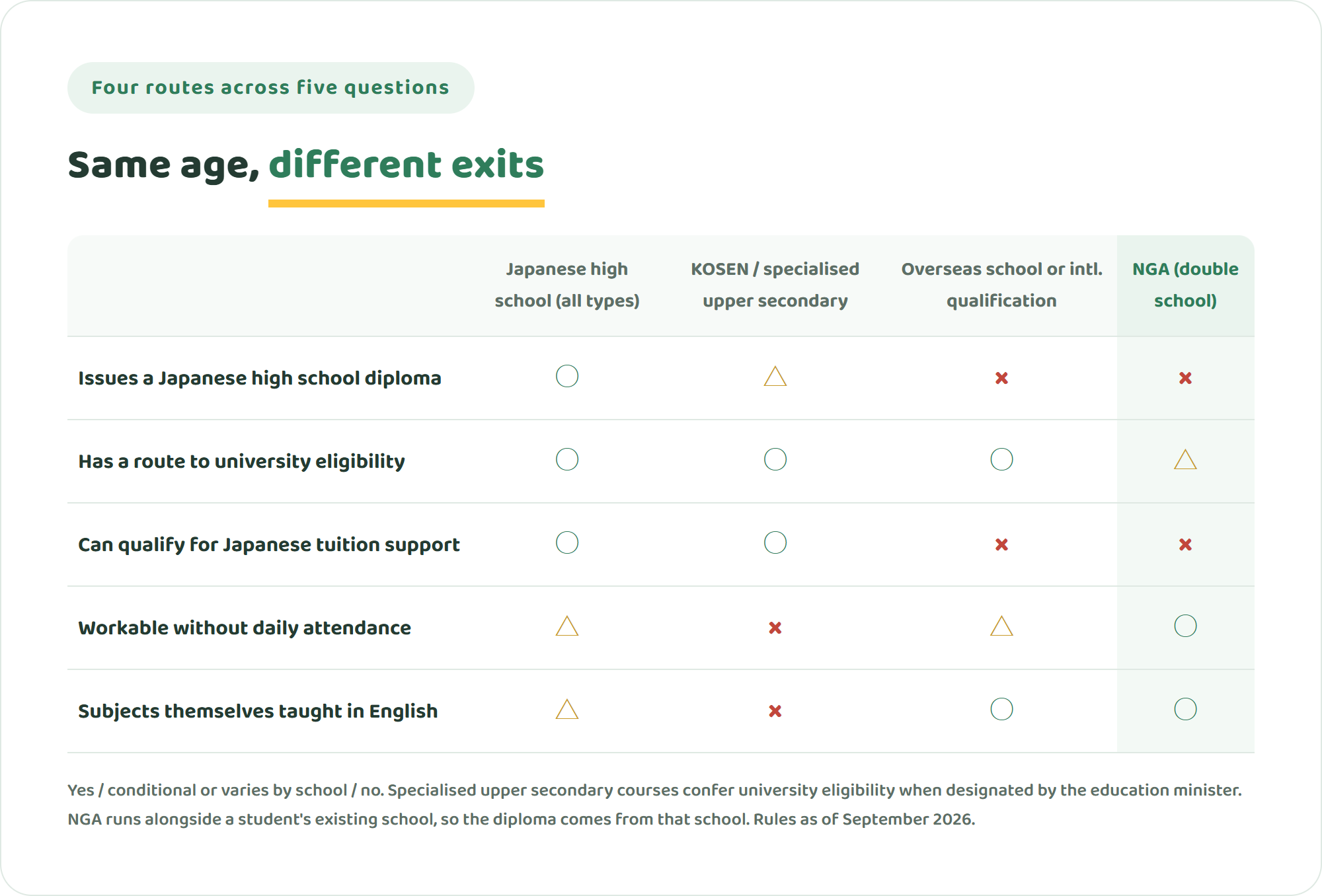
Whichever of the seven a family chooses, that choice does not have to absorb all three years. A student can stay enrolled where they are and add a few hours a week of subjects studied in English — what in Japan is called double schooling. This sits on a different axis from picking a route: enrolment and the diploma stay with the Japanese school, while the English-medium learning accumulates alongside. For families who feel that switching everything is too much but staying as they are is not enough, addition is usually the more realistic design. You can see how we build it in how we learn.
Draw the money line before you decide
Leave cost to the end and the decision gets reopened. Draw the line first.
According to the ministry, the law amending the High School Tuition Support Fund was enacted on 31 March 2026 and took effect on 1 April 2026, removing the income cap, so far more students now receive support towards tuition. The ministry also notes that although people commonly say “free high school”, the accurate description is a fund that supports tuition — costs beyond tuition (materials, transport, uniforms) are handled through separate grants.
Then the enrolment condition: the student must be resident in Japan and enrolled at a recognised upper secondary school. Two things follow. Routes 1 to 5 above can qualify. And because the condition is enrolment at a recognised upper secondary school, route 6 — overseas schools and online schools based abroad — falls outside it. If you are weighing the international route, budget the full annual cost with no public support in it. Separately, students who fall outside the new scheme can still receive support at the level of the previous scheme, and there is dedicated guidance for students at foreign schools in Japan — worth confirming with both the school and your municipal office.
Three steps, even starting late
If it feels too late, the order matters more than the hours. Get the order wrong and more time produces more doubt.
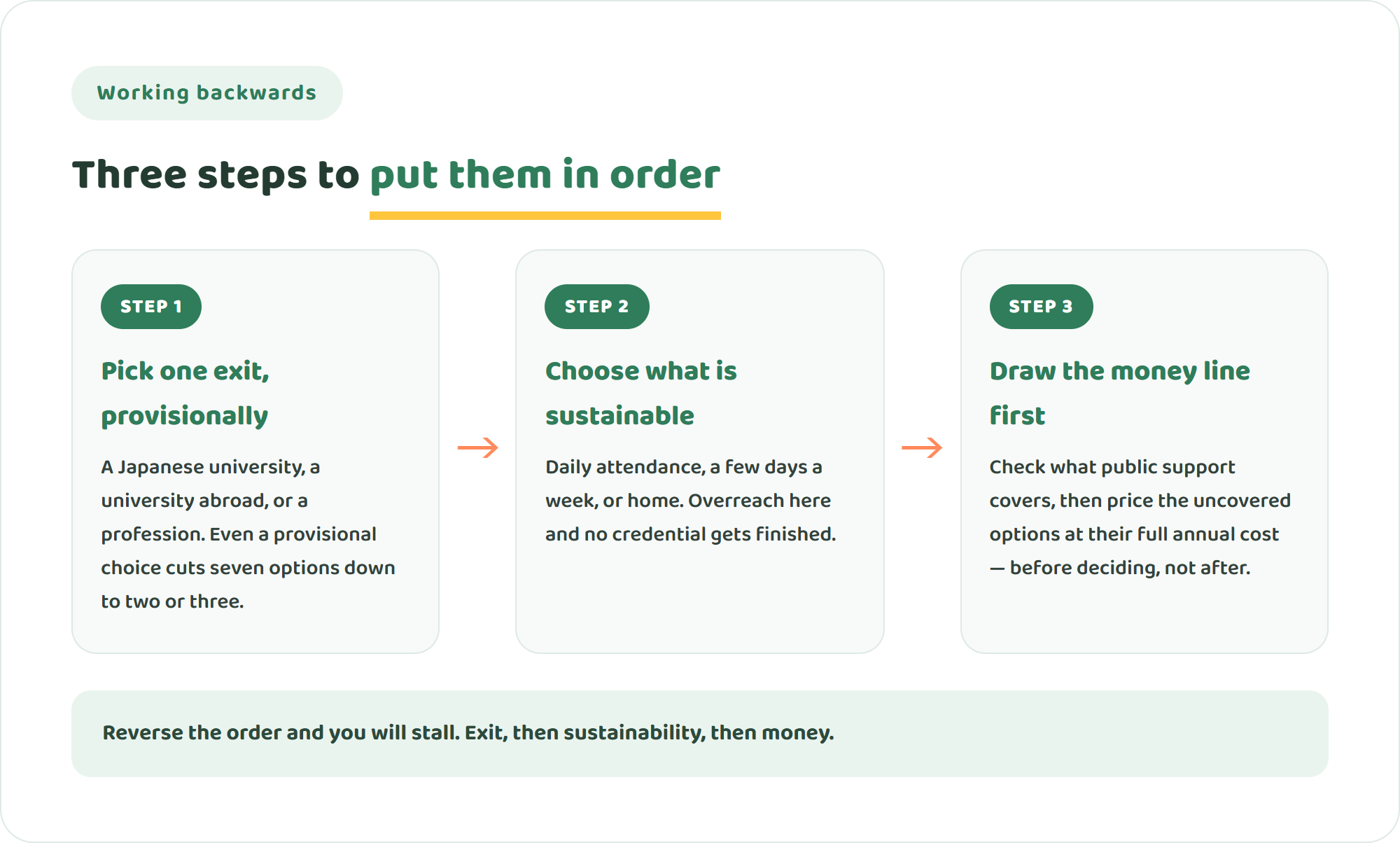
Step 1: pick one exit, provisionally. A Japanese university, a university abroad, or a profession. It does not need to be final. Naming it cuts seven routes to two or three, and comparison becomes tractable.
Step 2: choose what is sustainable. Daily attendance, a few days a week, or mostly from home. Overreach here and the finest credential stalls halfway. Decide it by remembering how mornings actually go.
Step 3: draw the money line. Check what public support covers, price the uncovered routes at full annual cost, and only then start visiting schools. What to ask when you do is in 15 questions to ask on a school visit, and the options when school itself does not fit are in where a child can learn if school doesn’t fit.
Questions families ask
Does a distance-learning high school hurt university chances?
Not in terms of eligibility: it is an upper secondary school, and graduating confers the same diploma and the same entrance eligibility. The practical difference is whether anyone is walking alongside the exam preparation. Choose on the assumption that you will need to supply that.
Does a vocational route close off university?
Not where the course is designated by the Minister of Education — completion then confers university entrance eligibility. Designation varies school by school, so ask. A great many families give up on this route without ever checking.
Our child is out of school right now. Is high school realistic?
Yes. Part-time and distance-learning schools were designed with exactly these situations in view, and ministry guidance asks that students who have been out of school be assessed appropriately in high school admissions and be told about the junior high equivalency examination. Start by asking the current school what specific accommodations are available.
There are seven routes. It is the map that is narrow
High school looks like a binary — full-time or failure — because the paperwork is drawn that way. From the rules themselves, there are seven routes, they end in different things, and public money reaches them differently. It is very rare that none of them fits a particular child.
The order, once more: name an exit, choose what is sustainable, draw the money line. Do those three and the school names sort themselves out.
NIJIN GLOBAL ACADEMY opens in September 2027 (planned), with a pre-opening term of trial classes in April–May 2027. We are built as an addition rather than a replacement: children keep the school they belong to and learn subjects in English in small, talk-based classes. Join the mailing list for fees, trial-class dates and first-intake details before they go public.