If you are shortlisting full-time online schools from Japan or elsewhere in Asia, two names keep appearing: Crimson Global Academy (CGA), founded in Auckland in 2020, and King’s InterHigh (KIH), the British online school that began in Wales in 2005. Both teach the International GCSE and A Level, both publish a lot of detail, and that is exactly why so many families stall at “so which one is right for us?”
This guide sets out Crimson Global Academy vs King’s InterHigh using only what the two schools publish themselves: fees in dollars and pounds, upfront costs, which time zones they actually timetable for, the qualifications each can and cannot offer, how exams are sat, how admissions work and the 2026/27 term dates. We skip what is already covered on each school’s own page and focus on where the two differ. Yen figures use the reference rate of 23 October 2026 (GBP 1 = JPY 209.62, US$1 = JPY 156.8) and are rounded estimates. One caveat up front: neither school publishes lesson times for specific time zones, so where we cannot tell you something, we say so and explain how to find out.
The short answer: Crimson Global Academy vs King’s InterHigh in five differences
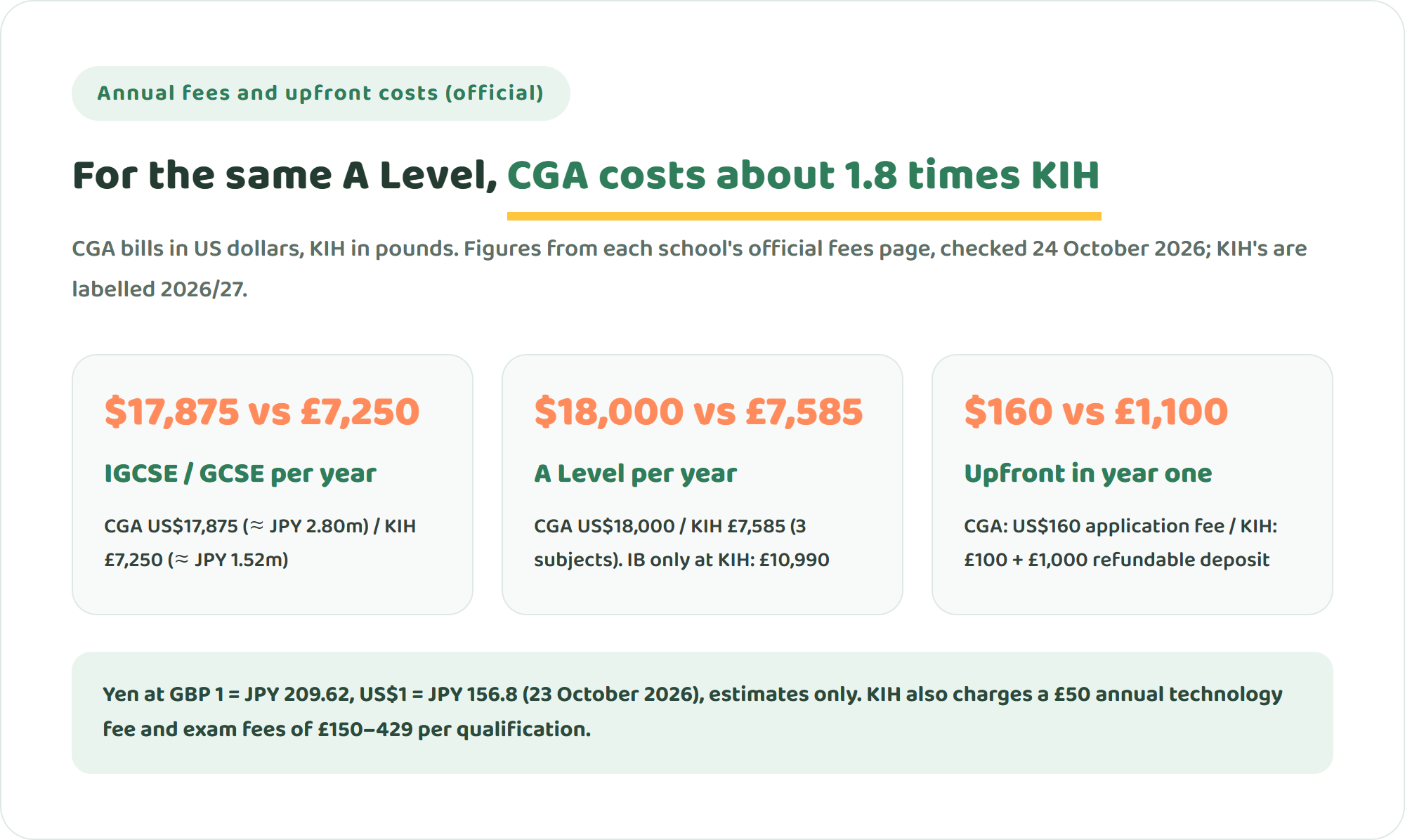
- Fees: CGA bills in US dollars: US$17,875 a year for IGCSE and US$18,000 for A Level. KIH bills in pounds: £7,250 for GCSE and £7,585 for A Level (three subjects) in 2026/27. For the same British qualifications, KIH costs a little over half as much at current exchange rates.
- Upfront costs: CGA charges a US$160 application fee and lists no deposit. KIH charges a £100 registration fee plus, on an annual contract, a £1,000 deposit for families outside the UK (£500 inside), refunded at year end once exam results are received.
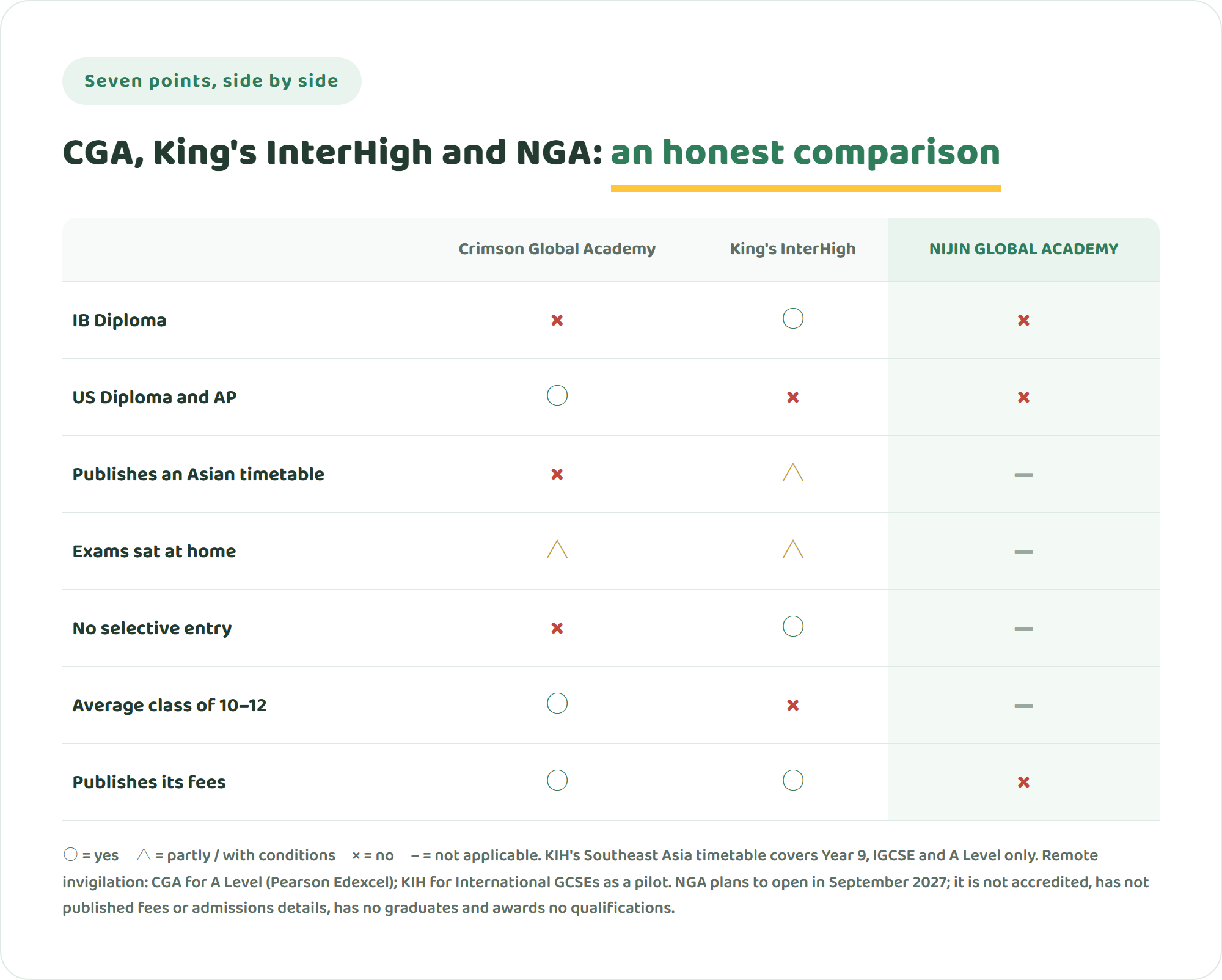
- Time zones: KIH names three timetables, UK (GMT), Middle East (GMT+4) and Southeast Asia (GMT+7), but the Southeast Asia timetable covers only Year 9, IGCSE and A Level. CGA says it runs “multiple school calendars for different time zones” but publishes no lesson times by zone.
- Qualifications: only KIH offers the IB Diploma (£10,990 a year). Only CGA offers a US High School Diploma and AP courses.
- Exams, admissions and class size: CGA’s A Level students sit Pearson Edexcel exams from home under remote invigilation; KIH students normally sit exams at an exam centre. CGA selects on school reports and interview; KIH is non-selective. CGA classes average 10–12 students; KIH’s secondary Explore lessons average 20.
In short: if you want the IB Diploma, a lower fee, or a Southeast Asian timetable for a Year 9+ student, start with King’s InterHigh. If you are aiming at US universities through the US Diploma or AP, want very small classes and a faster pace, or want to sit exams at home, start with Crimson Global Academy. Either way, get the timetable in your own time zone in writing before you commit.
Fees and upfront costs: US dollars at CGA, pounds at KIH
The first big difference is currency and price level. The table lists each school’s official fees as published, with a rough yen equivalent. KIH’s fee page is labelled “2026/27”. CGA’s fee page carries no academic-year label and its FAQ links to a 2025-2026 fee PDF, so read CGA’s figures as “current fees on the official site, checked 24 October 2026” rather than confirmed 2026/27 rates.
| Item | Crimson Global Academy (USD) | King’s InterHigh (GBP, 2026/27) |
|---|---|---|
| Primary | Primary (ages 7–10): US$18,000 a year (≈ JPY 2.82m) | Primary KS2 (Years 3–6, ages 7–11): £4,395 a year (≈ JPY 0.92m) |
| IGCSE / GCSE | US$17,875 (≈ JPY 2.80m) | £7,250 (≈ JPY 1.52m) |
| A Level | US$18,000 (≈ JPY 2.82m) | £7,585 (≈ JPY 1.59m), based on 3 subjects |
| IB Diploma | Not offered | £10,990 (≈ JPY 2.30m), annual contract only |
| US High School Diploma | US$19,250–25,500, depending on credits (≈ JPY 3.02–4.00m) | Not offered |
| Application / registration | US$160 application fee on every enrolment | £100 one-off registration fee, non-refundable |
| Deposit | None listed | Annual contract: £500 (UK) / £1,000 (outside UK), returned at year end on receipt of results. None on rolling contracts |
| Other | Exam centre fees vary by location and subject (no amounts published) | Technology fee £50 a year; exam fees £150–429 per qualification, paid to the centre |
Source: each school’s official fees page and FAQ, checked 24 October 2026. Yen figures are our estimates at the 23 October 2026 reference rate (GBP 1 = JPY 209.62, US$1 = JPY 156.8), not official prices.
Payment structures differ too. CGA says only that families “can pay annually or in instalments”. KIH offers an annual contract (paid in advance or monthly over ten months) and a rolling contract billed per half term (£1,590 for GCSE, £1,780 for A Level) with no deposit, and says committing to a year saves up to 36%. KIH charges families outside the UK the same prices regardless of local VAT; only the deposit changes with your country. If you only want one or two subjects, CGA is the more transparent: it publishes a per-subject price at every stage (US$3,255 for an IGCSE subject, US$4,100 for A Level, US$3,700 for AP), while KIH sells packages with no stand-alone single-subject fee. For a fuller reading of each schedule, see Crimson Global Academy fees and King’s InterHigh tuition.
Time zones: which school actually timetables for Asia?
After fees, the most overlooked question is when lessons happen. Here the two schools differ most in how much they tell you.
King’s InterHigh: three named timetables, but Southeast Asia only from Year 9
KIH’s FAQ states that it timetables live lessons across three time zones, British time (GMT), Middle Eastern time (GMT+4) and Southeast Asia time (GMT+7), and that you choose one when you enrol. The catch is on its Southeast Asia term-dates page: that timetable is currently offered for “Lower Secondary (Year 9), IGCSE and A Level courses (ages 13–19)”. Years 3–8 (ages 7–12) study on the UK or Middle East timetable. The IB Diploma runs on a timetable aligned to the UK. For a family in Japan (UTC+9), the Southeast Asia timetable is two hours behind local time, so a mid-morning lesson in Bangkok falls around midday in Tokyo; the UK timetable is eight or nine hours behind Japan, so younger children should expect evening lessons. KIH does not publish actual start and finish times, so ask before enrolling. Lessons run in 40-minute blocks, and every class is recorded and available 24/7.
Crimson Global Academy: “multiple time zones”, no published times
CGA’s site says it runs multiple school calendars for different time zones and that students can “attend live classes or access recorded sessions” if their schedule demands. What it does not publish is which hours lessons run in which zone. Of its three calendars, Aoraki (four terms, January to December) is described as serving the southern hemisphere, which points to New Zealand and Australian families. Full-time study means a minimum of 20 live hours a week (5–10 for Primary). If you are considering CGA from Asia, make a written timetable in your local time a condition of enrolment.
Qualifications: the IB Diploma is only at KIH; the US Diploma and AP are only at CGA
Both schools offer the International GCSE and International A Level through Pearson Edexcel and Cambridge. The differences lie beyond that core.
KIH’s distinctive offer is the IB Diploma Programme. Its first cohort started in September 2022, and the school describes it as the first fully online IBDP (the school’s own claim; we have not seen independent confirmation from the IB). The £10,990 annual fee covers the three core components and six subjects. Entry requires seven (I)GCSEs at grade 6 or above including English and Maths, registration closes at the October half term of the starting year, and final exams are sat at an IB World School.
CGA’s distinctive offer is the American route. It runs a US High School Diploma (18 credits standard, 24 for Honors) and AP courses, and is recognised by the College Board. Its pace is unusual: CGA says students complete an IGCSE subject in one year rather than the usual two. CGA does not offer the IB.
On accreditation, each school holds its home-country mark: KIH is accredited by the UK Department for Education through the Online Education Accreditation Scheme, and CGA holds full ACS WASC accreditation through to June 2030. Both are registered Cambridge International Schools and Pearson Edexcel approved centres. On outcomes, CGA reports that in 2026, 44% of its A Level grades were A* or A and students received 325 university offers; KIH reports a 2025 IB average of 32 points against a global average of 30. If you are weighing the two systems themselves, see British vs American online international schools; for how online qualifications play out at university, see where online international school graduates go.

Exams, admissions and class size: the day-to-day differences
Exams: at home with CGA, at a centre with KIH
CGA states that its A Level students “sit their examinations from home via remote invigilation” through Pearson Edexcel. For the US Diploma and AP, students find and register with their own test centre. KIH’s rule is that students “must complete these exams at an examination centre”; its own centre is in Abergavenny, Wales, with limited places, and its exams team will help you find nearby centres but cannot register you. For International GCSEs only, KIH offers a Pearson remote-invigilation pilot at a higher cost, and it warns that some practical or coursework-based subjects may require travel to the UK. KIH’s exam fees are £150–429 per qualification, paid to the centre; CGA publishes no figures. Neither school names exam centres in Japan or any specific Asian country on its website, so confirm this for your city before you enrol.
Admissions: selective at CGA, non-selective at KIH
CGA does not always require an entry test, but it may, particularly for younger students, and it assesses applicants on school reports and an interview, using the Oxford English Placement Test for English. It notes that places are limited; the process usually takes two to three days, and the main intakes are January and September. KIH describes itself as a non-selective, inclusive school: for the vast majority of its programmes there are no entry exams or minimum grades. English fluency is not an entry requirement, though it gives CEFR A2 (Primary) and B1 (Secondary) as guides. Enrolment takes from 48 hours to two weeks and is open year-round.
Class size: 10–12 at CGA, 20 at KIH
CGA publishes an average of 10–12 students per class, a cap of 15, and a maximum of 8 in Primary. KIH publishes an average of 20 in its secondary Explore lessons and gives no figures for Primary or Sixth Form. For how to read accreditation and exam-board claims yourself, see our guide to accredited online international schools.
King’s InterHigh term dates 2026/27 (there is no PDF, so here is the table)
Many parents search for “King’s InterHigh term dates 2026 pdf”. The official term-dates page has no PDF, only an HTML table, so we have transcribed the 2026/27 dates here. They are identical on the UK, Middle East and Southeast Asia pages: a 35-week year in three terms.
| Term | Starts | Ends | Half term |
|---|---|---|---|
| Autumn Term 2026 | Monday 7 September 2026 | Friday 11 December 2026 | Week of 26 October |
| Spring Term 2027 | Monday 4 January 2027 | Thursday 25 March 2027 | Week of 15 February |
| Summer Term 2027 | Monday 12 April 2027 | Friday 9 July 2027 | Week of 31 May |
Source: King’s InterHigh official term-dates page, checked 24 October 2026. CGA runs three calendars. Its southern-hemisphere Aoraki calendar for 2026-2027 has four terms: 27 January–2 April, 21 April–3 July, 22 July–25 September and 13 October–3 December. Its northern-hemisphere Greenwich calendar, the one most comparable to KIH, was only published for 2025-2026 when we checked, so we cannot set the two schools’ 2026/27 dates side by side. For a family whose local school year starts in April, KIH’s September start is six months out of step and CGA’s Aoraki January start is three.
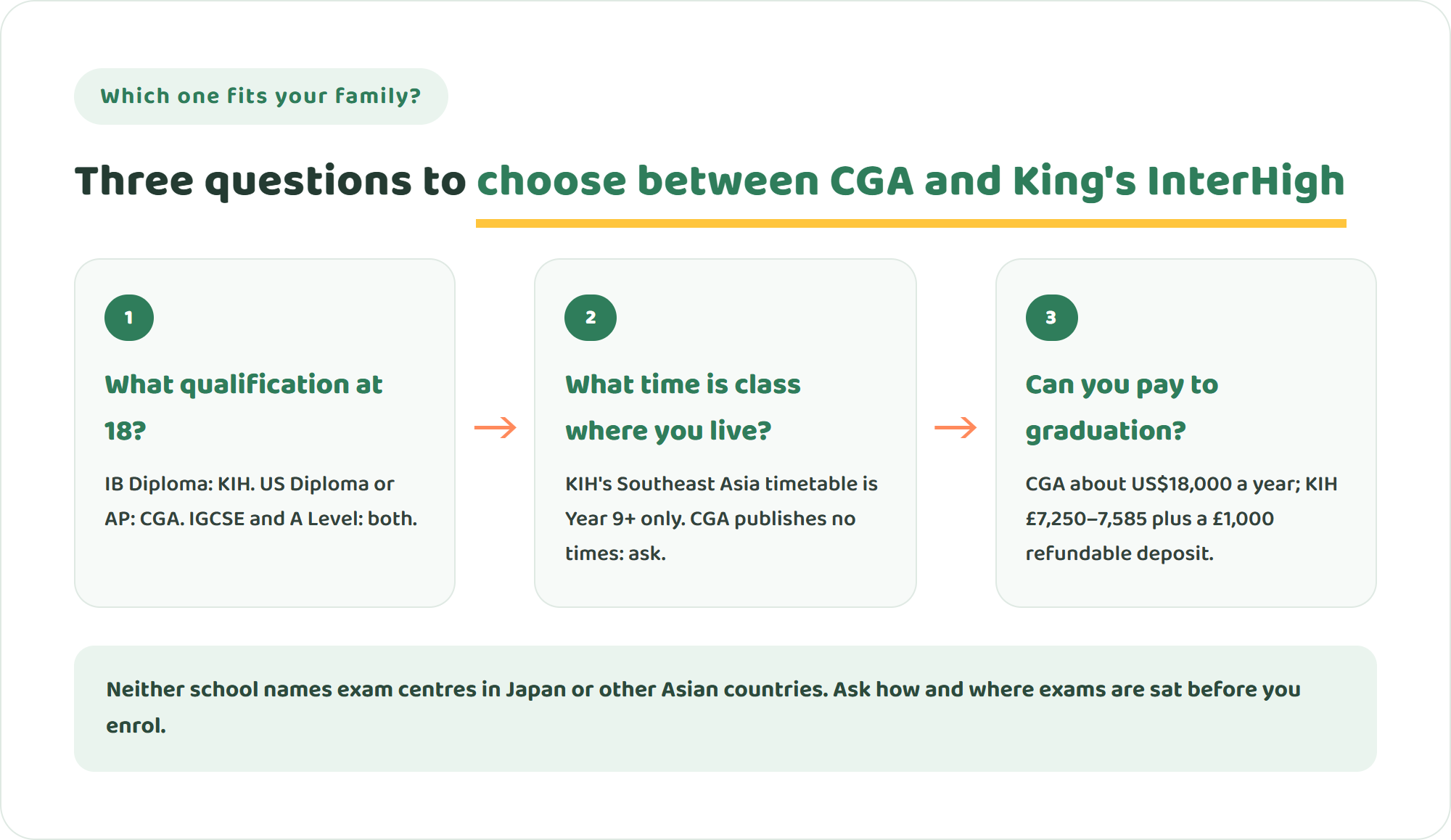
Which school fits your family? Three questions
1. What qualification should your child hold at 18?
The IB Diploma means King’s InterHigh. A US High School Diploma or AP scores for American universities means Crimson Global Academy. If the answer is simply IGCSE and A Level, both qualify, and the next two questions decide.
2. What time is class in your time zone?
At KIH, a Year 9 or older student can choose the Southeast Asia timetable (two hours behind Japan); younger children are on UK or Middle East hours. CGA publishes no times at all, so request the timetable in your local time. The most reliable test is to ask your child whether they can keep up evening lessons for a full year.
3. Can you pay the annual fee and upfront costs through to graduation?
Over four years from IGCSE to A Level, CGA costs about US$18,000 a year and KIH about £7,250–7,585. KIH needs a £1,000 refundable deposit in year one for non-UK families; CGA needs only the US$160 application fee. Both bill in a foreign currency, so build in room for exchange-rate moves. For a wider set of British options, see online British curriculum school fees.
Where NIJIN GLOBAL ACADEMY fits
NIJIN GLOBAL ACADEMY (NGA) is an online international school for ages 6–18, planned to open in September 2027. It is run by NIJIN Inc., which operates NIJIN Academy, an online school in Japan for children who do not attend school, where more than 1,000 children have studied. NGA plans small live classes, with bilingual Japanese–English mentors supporting subjects taught in English, and does not sort children by test-score rankings. You can see how a school day is designed in our online school curriculum overview.
To be clear about the limits: NGA has not opened, is not accredited, has not published its fees and has no graduates. If your child needs IGCSEs, A Levels, the IB Diploma, a US Diploma or AP scores, NGA does not replace CGA or KIH. Where we hope to be useful is earlier in the journey: as English-medium learning alongside a local school, or as a place to get used to learning in English before committing to a full-time overseas online school.

Frequently asked questions
Crimson Global Academy vs Kings InterHigh: which is cheaper?
King’s InterHigh: £7,585 a year for A Level (three subjects) in 2026/27, against US$18,000 at Crimson Global Academy. KIH does, however, require a refundable £1,000 deposit from families outside the UK on an annual contract, plus a £100 registration fee.
What time are lessons if we live in Japan or elsewhere in Asia?
Neither school publishes lesson times by time zone. King’s InterHigh offers a Southeast Asia (GMT+7) timetable for Year 9, IGCSE and A Level students, with Years 3–8 on UK or Middle East hours. Crimson Global Academy runs multiple calendars for different time zones but does not publish hours, so ask for a timetable in your local time before enrolling.
Can my child sit exams at home?
At Crimson Global Academy, A Level students sit Pearson Edexcel exams from home under remote invigilation; US Diploma and AP students use a test centre. At King’s InterHigh, exams are normally sat at an exam centre, with a remote-invigilation pilot for International GCSEs only. Neither school names exam centres in Japan or other Asian countries on its website.
Not “which is better”, but “which can we sustain in our time zone”
Crimson Global Academy and King’s InterHigh share the same British core qualifications but differ clearly in currency and fee level, in how openly they publish timetables, in IB versus the American route, in whether exams can be sat at home, and in selectivity and class size. Neither is the better school; the right one is where the qualification your child wants at 18, lesson hours they can keep in your time zone, and a fee you can pay until graduation line up. If you are also weighing KIH against a Japanese option, our King’s InterHigh vs Sophia High School comparison may help.
And if you would like to compare a gentler first step, English-medium learning alongside a local school before a full-time overseas online school, you are welcome to keep NIJIN GLOBAL ACADEMY on your list. Ahead of its planned September 2027 opening, we expect to run trial classes in April–May 2027.