The British School in Tokyo (BST) fees for 2026–27 are ¥2,960,000 a year in tuition for Primary (Nursery and Reception included), ¥2,980,000 for Years 7–9 and ¥3,070,000 for Years 10–13, plus a ¥100,000 Capital Development fee every year (official Fees page, checked 11 October 2026). New students also pay a one-time ¥500,000 Enrolment fee and ¥680,000 for Educational Resources (¥1,180,000 in total), and every application costs ¥40,000 for 2026–27 entry (¥50,000 for 2027–28 entry). All fees are quoted and paid in Japanese yen; we do not convert them to pounds or dollars here because exchange rates move.
If you searched “British School in Tokyo fees” or “BST tuition”, you are probably relocating to Tokyo — with a company, an embassy, a university or on your own contract — and you need more than the headline tuition line. This page answers the practical questions from BST’s own website first: what the first-year bill really adds up to, how the two campuses (Azabudai Hills for Nursery to Year 6, and the Showa campus in Sangenjaya for Years 7–13) work, what the curriculum looks like from the English National Curriculum through (I)GCSEs to the IB Diploma and the BST Diploma, when you can apply, and whether bursaries or company payment are possible. We then compare BST fairly with The American School in Japan, St. Mary’s International School and NIJIN GLOBAL ACADEMY, a different kind of option (an online school that opens in 2027).
The short answer: who BST suits — and who it doesn’t
- Suits: families who want a British-style education in central Tokyo, built on the National Curriculum for England, for children aged 3 to 18 — with (I)GCSEs in Years 10–11 and a choice of the IB Diploma Programme or the WASC-accredited BST Diploma in Years 12–13.
- Suits: families who want to live centrally. The Primary campus sits inside the Azabudai Hills development in Minato, a few minutes’ walk from Roppongi-Itchome and Kamiyacho stations, and the Secondary campus is two train stops from Shibuya.
- Suits: families comparing total cost across Tokyo’s long-established English-medium schools. On official 2026–27 figures, BST’s annual tuition is lower than ASIJ’s at every stage, and its one-time fees (¥1,180,000) are smaller than those at ASIJ or St. Mary’s.
- Suits: families whose employer pays school fees — BST is one of the founder members of the Corporate Contribution Programme (CCP) Association.
- Harder fit: children who are not yet proficient in English for their age. BST is not academically selective, but English proficiency is an entry requirement and at least one parent must communicate effectively in English.
- Harder fit: families where neither parent holds a non-Japanese passport, families who would need a student visa or boarding, and children who would need to be placed outside their age-based year group.
- Harder fit: families who need a guaranteed seat on a fixed date. BST’s FAQ says most year groups are typically full, and openings in full year groups may not be clear until May or later.

What the British School in Tokyo is
BST opened in 1989 as a primary school in Shibuya; its history page notes it was opened by the then UK Prime Minister, Margaret Thatcher. It grew with the support of two Japanese education partners, Shibuya Kyoiku Gakuen (SKG) and Showa Women’s University: a second Shibuya campus opened in 2000, a facility on the Showa Women’s University campus in Sangenjaya in 2006, and the Senior School (Years 12 and 13) in 2010–11, when BST began teaching students up to age 18. The first Year 13 students graduated in 2012. In August 2023 all Primary children moved to a new campus at Azabudai Hills, built in partnership with Mori Building, and a refurbished Secondary School was launched in 2025.
Today BST describes itself as providing “a broad and balanced curriculum based on the National Curriculum for England”, tailored for international students in Japan aged 3 to 18. Its FAQ gives more than 1,400 students of about 65 nationalities; the Showa campus alone has over 500 students from Year 7 to Year 13. Typical class sizes are 20 in Nursery and Reception and 22 in other years, and every Primary class has a class teacher and an educational assistant.
| Item | The British School in Tokyo (official) |
|---|---|
| Type | Private, fee-paying British international day school (no boarding) |
| Founded | 1989, Shibuya |
| Ages / year groups | Ages 3–18: Nursery and Reception, Years 1–6 (Primary), Years 7–13 (Secondary and Senior School); placement strictly by age |
| Campuses | Azabudai Hills Campus (Nursery–Year 6), 1-3-3 Azabudai, Minato-ku; Showa Campus (Years 7–13), Showa Women’s University 5th Bldg., 1-7-57 Taishido, Setagaya-ku |
| Curriculum | National Curriculum for England; GCSE and (I)GCSE in Years 10–11; IB Diploma Programme or BST Diploma in Years 12–13 (BTEC Level 3 options within the BST Diploma) |
| Accreditation and memberships named on the official site | BST Diploma accredited by WASC; COBIS and CIS; IB World School for the Diploma Programme |
| School year | Three terms, late August to late June (2026–27: 24 August 2026 – 25 June 2027) |
| Students | Over 1,400, about 65 nationalities |
| Tuition 2026–27 | ¥2,960,000 to ¥3,070,000 a year, plus ¥100,000 Capital Development |
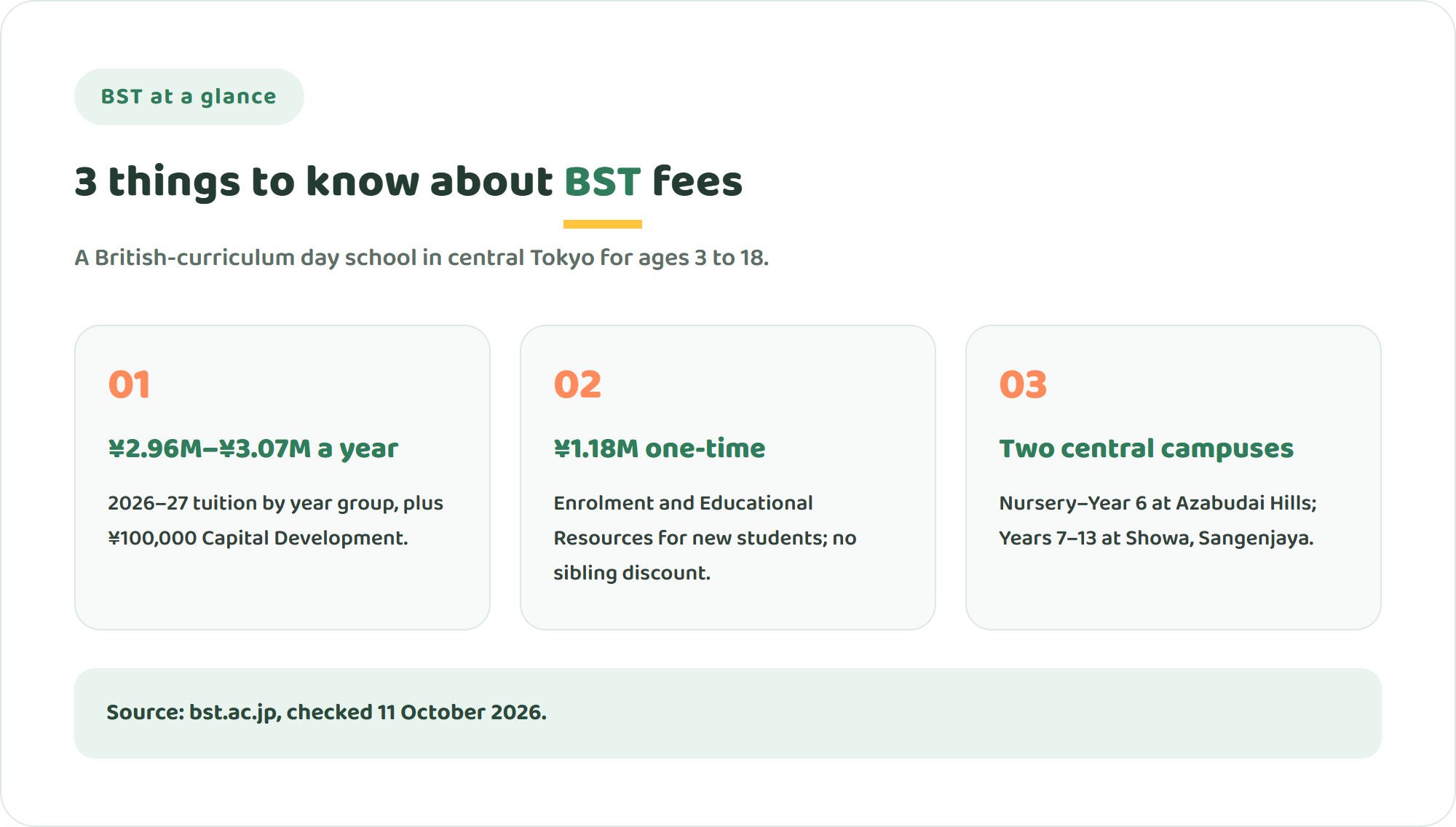
British School in Tokyo tuition and fees (2026–27, official)
BST publishes its fees on its Fees page, with the annual amount and the invoice for each of the three terms. Here is every figure as published, checked 11 October 2026.
| Fee | Full year (JPY) | Term 1 | Term 2 | Term 3 |
|---|---|---|---|---|
| Tuition — Primary School (Nursery and Reception included, to Year 6) | ¥2,960,000 | ¥1,050,000 | ¥960,000 | ¥950,000 |
| Tuition — Secondary School, Years 7–9 | ¥2,980,000 | ¥1,060,000 | ¥970,000 | ¥950,000 |
| Tuition — Secondary School, Years 10–13 | ¥3,070,000 | ¥1,100,000 | ¥1,000,000 | ¥970,000 |
| Capital Development (whole school) | ¥100,000 | ¥40,000 | ¥30,000 | ¥30,000 |
And the fees that are not part of the annual tuition line:
| Fee | Amount (JPY) | When / refundable? |
|---|---|---|
| Application fee | ¥40,000 (2026–27 entry); ¥50,000 (2027–28 entry) | Per application, paid on the online application form; non-refundable |
| Enrolment | ¥500,000 | One-time, new students only; non-refundable |
| Educational Resources | ¥680,000 | One-time, new students only; non-refundable; new-student fees due in full 2 weeks after the invoice date |
| Shuttle bus (Azabudai Hills – SKG Shibuya – Showa) | Not published on the official site | Booked and paid one term in advance; not available for Nursery |
| Lunch | Not published on the official site | Most students bring lunch; optional delivery services; Showa Women’s University canteen for Years 10+ |
| Uniform | Not published on the official site | Required (Senior School has a dress code); bought from the appointed supplier |
| Sibling discount | None — BST states it does not offer sibling discounts | Families may apply for a bursary for a younger sibling |
What tuition includes — and what it doesn’t
BST’s fee page is unusually specific. Tuition includes the books students are expected to use, and the curriculum residential trips, day trips and events that all students are expected to join (BST’s outdoor programme takes Senior School students on summer and winter trips to the Japanese Alps). Tuition does not include lunches, non-curriculum residential and day trips, SEN (special educational needs) support, some exam fees, some sports events and tournaments, instrumental lessons and some optional activities. If your child needs learning support, ask Admissions for the cost early, because it sits outside the published fee table.
What the first-year bill adds up to
Using only the official 2026–27 numbers (and leaving out the bus, lunch, uniform and optional activities, whose prices are not published):
| Case | Calculation | Total (JPY) |
|---|---|---|
| New Primary student (Nursery–Year 6), year one | ¥2,960,000 tuition + ¥100,000 Capital Development + ¥500,000 Enrolment + ¥680,000 Educational Resources | ¥4,240,000 (¥4,280,000 with the ¥40,000 application fee) |
| New student in Years 7–9, year one | ¥2,980,000 + ¥100,000 + ¥1,180,000 | ¥4,260,000 (¥4,300,000 with application) |
| New student in Years 10–13, year one | ¥3,070,000 + ¥100,000 + ¥1,180,000 | ¥4,350,000 (¥4,390,000 with application) |
| Each later year, Primary | ¥2,960,000 + ¥100,000 | ¥3,060,000 |
| Each later year, Years 7–9 | ¥2,980,000 + ¥100,000 | ¥3,080,000 |
| Each later year, Years 10–13 | ¥3,070,000 + ¥100,000 | ¥3,170,000 |
For a three-year posting with a child in Primary, if 2026–27 fees stayed the same, the total would be ¥4,240,000 + 2 × ¥3,060,000 = ¥10,360,000 (plus the application fee). For Years 10–13 (four years, through to graduation), it would be ¥4,350,000 + 3 × ¥3,170,000 = ¥13,860,000.
For a family with two children starting together — say one in Year 2 and one in Year 8 — the first year is: application 2 × ¥40,000 = ¥80,000; Enrolment 2 × ¥500,000 = ¥1,000,000; Educational Resources 2 × ¥680,000 = ¥1,360,000; Capital Development 2 × ¥100,000 = ¥200,000; tuition ¥2,960,000 + ¥2,980,000 = ¥5,940,000. Total ¥8,580,000. Because BST has no sibling discount, the second child costs the same as the first.
How the fees have moved
BST says tuition is reviewed annually and is subject to change. Earlier versions of the official Fees page (saved by the Internet Archive in 2023, 2024 and 2025) show Primary tuition at ¥2,605,000 in 2023–24, ¥2,710,000 in 2024–25 and ¥2,820,000 in 2025–26, before ¥2,960,000 in 2026–27 — an increase of ¥355,000 over three years. Years 10–13 tuition went from ¥2,740,000 to ¥3,070,000 over the same period, and the Educational Resources fee rose from ¥580,000 to ¥680,000 in 2025–26. If you are planning several years ahead, budget for annual increases rather than assuming today’s figures will hold. Fees for 2027–28 are not yet published.
Payment, notice, refunds and company payment
- How to pay: bank transfer only, from an account in the registered parent’s name (or one notified in writing). Cash is not accepted.
- When: new-student fees are due in full 2 weeks after the invoice date; existing students’ tuition 4 weeks after the invoice date. Invoices normally go out 8–14 weeks before the end of the previous term. Term 1 is the largest invoice (¥1,050,000–¥1,100,000 plus ¥40,000 Capital Development).
- Joining mid-year: fees are calculated by term; attending any part of a term means paying the full term or half the term, depending on the start date.
- Leaving: at least one full term’s written notice, or one term’s fees in lieu. Refunds are not guaranteed except when notice was given and a term was wholly unattended.
- If your company pays: parents remain responsible for timely payment even when a company pays. Under the Corporate Contribution Programme, a company makes donations requested by the school instead of paying tuition and enrolment fees directly; these fund tax-exempt corporate scholarships for employees’ dependents. BST invites organisations to contact it to discuss “potentially significant tax savings”. Ask your HR team about it before you accept a place.
Bursaries
BST offers a limited number of bursaries — currently up to 7% of the student roll — for eligible families who cannot pay full fees. A bursary can waive 100% of the enrolment fees and reduce tuition (including Capital Development) by up to 50%. It is assessed on documented family finances each year, is not available for Nursery and Reception, and priority goes to families whose main earner works full-time in education or the not-for-profit sector. The 2026–27 round has closed; BST says the 2027–28 schedule will be published in February 2027 (Bursaries page).
If you are weighing an in-person international school against other models, our guide to online vs in-person international school costs sets out what usually sits outside the tuition line.
How a school day works: campuses, shuttle bus and the school calendar
Two campuses, split by age. Children from Nursery (age 3) to Year 6 (age 11) attend the Azabudai Hills Campus, which opened on 28 August 2023 near Tokyo Tower. BST lists two sports pitches, a sports hall, a dance studio, a 25-metre indoor swimming pool, two libraries, music studios, an art studio and a Digital Technology Studio. Years 7–13 attend the Showa Campus on the grounds of Showa Women’s University in Sangenjaya, Setagaya, where students use university-level facilities including two sports halls, three pitches, a swimming pool, science and computer science labs, and a Senior School Study Centre opened in 2022. Families with children in both phases should plan for two drop-offs. Our guides to international schools in Minato, international schools in Setagaya and international schools in Shibuya map what else is nearby.
The shuttle bus. BST does not run door-to-door routes. It runs a shuttle between three stops — the Azabudai Hills campus, SKG in Shibuya and the Showa campus — with a morning service from 7:15 to 9:00 and an afternoon service from 3:15 to 5:35. It is available to Primary and Secondary students except Nursery, and seats must be booked and paid one term in advance. Most families therefore choose housing with an easy train or walking route to the campus their child attends.
Hours. According to the admissions FAQ, Nursery and Reception run from 9:00am to 3:00pm; Year 1 from 8:50 to 3:05; Year 2 from 8:50 to 3:15; Years 3–4 from 8:45 to 3:25; Years 5–6 from 8:45 to 3:35; and Years 7–13 from 8:45am to 3:45pm. After-school clubs and activities run on top of this.
Calendar. BST follows a British three-term year. For 2026–27, Term 1 runs from Monday 24 August to Friday 11 December 2026, Term 2 from Tuesday 5 January to Friday 19 March 2027, and Term 3 from Tuesday 6 April to Friday 25 June 2027, with half-term holidays in October, February and May. BST observes only two Japanese public holidays in the year (23 November 2026 and 3 May 2027).
Year groups. Placement is by age only, using the UK year-group system with a 31 August cut-off, and BST does not consider out-of-year placement. A child who has just finished a US grade or a Japanese school year may land in a different year group from the one you expect, so check the age table on the official site before applying.
Curriculum, accreditation and university recognition
Primary (Nursery–Year 6). The curriculum is founded on the English National Curriculum and covers English, maths, science, computing, history, geography, art, design technology, religious education, music, PE and PSHE. Japanese is taught from Nursery and French from Year 4, with specialist teachers for languages, music, computing, library and PE. The Azabudai Hills learning spaces are influenced by the Reggio Emilia approach.
Years 7–11. Key Stage 3 (Years 7–9) follows the English National Curriculum adapted to BST’s context. Key Stage 4 (Years 10–11) is the GCSE stage: BST uses a combination of GCSEs and (I)GCSEs, externally set and marked, with exams at the end of Year 11. French, Japanese, Spanish and Mandarin Chinese are offered in Secondary.
Years 12–13. Students choose between two pathways: the International Baccalaureate Diploma Programme (BST is an IB World School) and the BST Diploma, a WASC-accredited high school diploma completed across Years 10–13 that combines (I)GCSEs, individual IB Diploma course certificates, BTEC qualifications (Level 3 courses in Enterprise and Sport are offered) and internal BST courses; students need at least 24 credits across core subject areas. One point that sometimes confuses families: BST introduced an A-Level programme when its Senior School opened in 2010–11, but its current Senior School pages list the IBDP and the BST Diploma as the two pathways and do not list A-Levels. If A-Levels matter to you, ask Admissions directly.
Accreditation. BST’s official BST Diploma page states that the diploma holds full WASC accreditation and that the school is also recognised by the Council of British International Schools (COBIS) and the Council of International Schools (CIS). The accreditation term and next visit date are not published on the official site; if you need formal documentation for an employer or a future school transfer, ask the school or check the accreditors’ directories. University destinations and examination results are referred to on the official site, but we have not reproduced them here — ask Admissions for the latest school profile.
A Japan-specific note for residents. Japan’s Ministry of Education (MEXT) list of foreign schools designated for the national High School Tuition Support Fund (as of 1 March 2026, in the National Diet Library archive) includes the British School in Tokyo Showa course for its 11th to 13th years. Eligibility, amounts and how to apply under the reformed system from April 2026 should be confirmed with the school and the Tokyo government; it does not apply to Nursery to Year 10.
British School in Tokyo vs NIJIN GLOBAL ACADEMY vs two other options (official data)
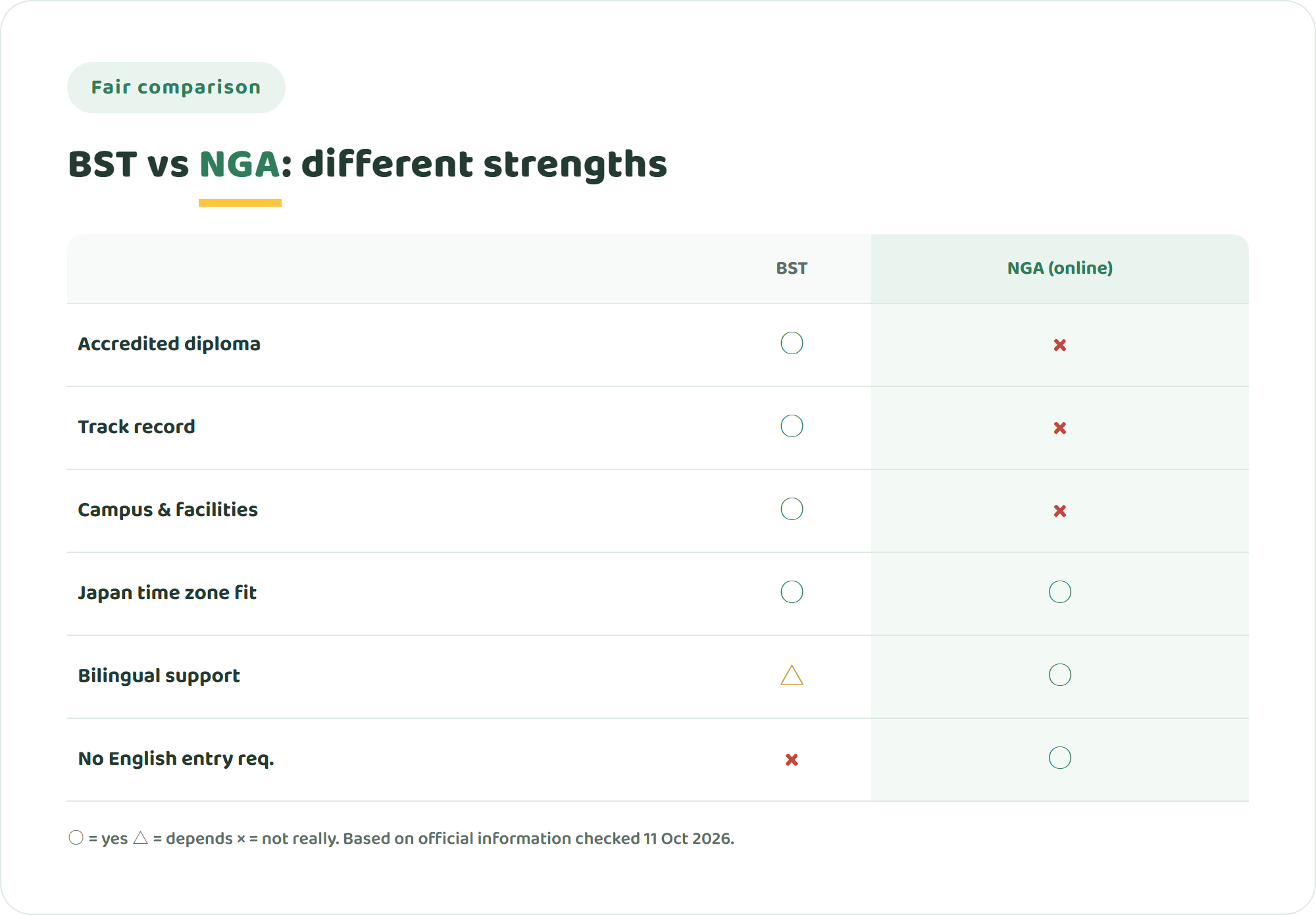
Families moving to Tokyo usually compare BST with other long-established English-medium schools that publish 2026–27 fees. We chose The American School in Japan (an American college-prep school in Chofu and Roppongi) and St. Mary’s International School (an all-boys IB school in Setagaya). NIJIN GLOBAL ACADEMY is included as a different kind of option — an online school, not a campus school.
| The British School in Tokyo | NIJIN GLOBAL ACADEMY | The American School in Japan | St. Mary’s International School | |
|---|---|---|---|---|
| School type | In-person British day school, two central campuses (Azabudai Hills; Showa, Sangenjaya); co-educational | Online international school (Asia & Oceania focus) | In-person American day school, two campuses (Chofu; Roppongi early learning) | In-person all-boys day school, Setagaya |
| Grades / ages | Ages 3–18 (Nursery to Year 13) | Ages 6–18 | Nursery (age 3) to Grade 12 | Elementary to High School (see official site for entry grades) |
| Tuition 2026–27 | ¥2,960,000–¥3,070,000/yr + ¥100,000 Capital Development; one-time ¥1,180,000 (Enrolment, Educational Resources) + ¥40,000 application | Not yet published; no enrolment, facility or uniform fees; materials included; sibling discounts | ¥3,143,000–¥3,826,000/yr + ¥250,000 capital assessment; one-time ¥1,875,000 (application, registration, building maintenance) | ¥2,860,000–¥3,050,000/yr + ¥200,000 building maintenance; one-time ¥1,450,000 (application, registration, development fund) |
| Curriculum | English National Curriculum; GCSE/(I)GCSE; IB Diploma or WASC-accredited BST Diploma | Subjects learned in English with a bilingual (English–Japanese) mentor; CEFR-based English; optional Cambridge IGCSE / A-Level pathway | American college-prep; AP and AP Capstone | IB Diploma Programme in high school |
| School day & time zone | About 8:45–3:45 (by year group); shuttle between three stops | Live small-group classes (about 8) timed for Asia–Oceania daytime — fits Japan time | Chofu 8:00–3:00; ELC 8:30–2:30; bus ¥390,000/yr on set routes | See official site; bus ¥310,000 one way / ¥420,000 both ways |
| Accreditation / diploma | WASC (BST Diploma), COBIS, CIS; IB World School | Not yet accredited; no graduates yet (opens 2027) | ACS WASC listed; ASIJ diploma; AP | CIS and IB listed on official site; IB Diploma |
| Admission | Not academically selective; age-appropriate English required; a parent proficient in English; a parent with a non-Japanese passport | No academic entrance exam, no English requirement | No general entrance exam; reports, test scores, recommendations; a parent fluent in English | Application requirements on official site |
| Sibling discount | None (bursary route instead) | Yes | Not published on the official site | See official site |
| Start dates | Late August; mid-year by term if a seat opens (most years typically full) | Opening September 2027 (planned); free trial classes monthly from September 2026; pre-opening trials April–May 2027 | August; mid-year only for families new to Japan, if seats allow | See official site |
Sources: BST Fees, BST Applications, BST Admissions FAQ, ASIJ Tuition & Fees, St. Mary’s Tuition & Fees and NGA’s curriculum and timetable page — checked 11 October 2026. For more detail on the other two schools, see our ASIJ tuition and fees guide and St. Mary’s International School tuition guide.

Admissions: eligibility, timeline and school tours
Eligibility checklist. Before you fill in the enquiry form, BST asks you to confirm three things: the applicant is proficient in English and one parent is too; at least one parent holds a valid non-Japanese passport; and the child will live with at least one parent within commuting distance and travel to school from home. BST has no boarding, does not sponsor student visas, and expects students to hold dependent visas under a parent before starting school.
How to apply. Submit the online Enquiry Form (BST aims to reply within one to two business days); you then receive access to the online Application Form, where the non-refundable application fee is paid. Once all documents and a reference from the current school are in, the applicant joins the application pool, and an interview or assessment is scheduled if and when a space is foreseen. Where English is not the child’s first language, the school assesses spoken and written English.
Timeline. Applications for 2027–28 open in mid-November 2026, and families must apply again each year. Application review runs from early February to late June, interviews and assessments from late February to late June, and decisions from early March into the summer. For year groups that are full, BST says it may not know about openings until May or later.
Visits and open days. BST does not publish open-day dates; instead it runs weekly school tours during term time, booked in advance through the enquiry form: Azabudai Hills (Primary) on Fridays at 9:15am and Showa (Secondary) on Thursdays at 11:10am. Tours take about an hour, and because they go through classrooms the school says it cannot normally offer tours outside these slots — so plan any look-see trip to Tokyo around them.
Reviews and common concerns, answered honestly
BST has a long reputation among British and international families in Tokyo. The questions families raise again and again are practical rather than about teaching quality. Here is what BST’s own site says about each.
“Will we get a seat?”
BST’s FAQ says most year groups are typically full, although this can change during the year. Acceptance rates and waitlist numbers are not published on the official site. Apply as soon as applications open in November, keep your enquiry account up to date, and email Admissions with your arrival date for current availability.
“Our child is still learning English.”
BST is not academically selective, but because all subjects are taught in English, age-appropriate English proficiency is required, and the school assesses it for children whose first language is not English. If your child is a beginner in English, ask Admissions honestly how they would assess them before you pay the application fee.
“We have one child at each campus.”
That is common at BST because Primary and Secondary are on different sites. The shuttle connecting Azabudai Hills, SKG Shibuya and Showa helps, but it runs between three fixed stops, not from your home. Look at the train route between your housing and both campuses before signing a lease.
“The one-time fees are high for a short posting.”
The Enrolment and Educational Resources fees (¥1,180,000 together) are paid once and are non-refundable, so they weigh more on a one- or two-year stay. They are lower than the one-time fees at ASIJ or St. Mary’s on official 2026–27 figures, but still worth including in any comparison. Check what your employer’s education allowance covers and whether it will consider the Corporate Contribution Programme.
“Fees keep rising.”
That is accurate: Primary tuition rose by ¥355,000 between 2023–24 and 2026–27 on BST’s own published pages. BST states fees are reviewed annually. Budget for increases if you plan to stay several years.
“Does my child need learning support?”
SEN support is listed as not included in tuition. BST has student support services, but the cost and capacity are not published on the fee page; share any reports with Admissions early and ask what support and charges would apply.
Alternatives to the British School in Tokyo worth comparing
The American School in Japan (ASIJ) — if an American college-prep curriculum with AP courses and a door-to-door bus network suits you, ASIJ publishes higher annual tuition (¥3,143,000–¥3,826,000 for 2026–27) and larger one-time fees, with a large K–12 campus in Chofu and an early learning centre in Roppongi.
St. Mary’s International School — if you have a son and want the IB Diploma, St. Mary’s publishes 2026–27 tuition of ¥2,860,000–¥3,050,000, with its own one-time fees (registration ¥400,000 and development fund ¥1,000,000) and an annual ¥200,000 building maintenance fee.
NIJIN GLOBAL ACADEMY (NGA) — an online international school for ages 6–18 focused on Asia and Oceania, opening in September 2027 (planned), with a first cohort of 100 students. Classes are small live dialogue groups of about 8, subjects are learned in English with a bilingual (English–Japanese) mentor, and English is taught by CEFR level; an optional Cambridge IGCSE / A-Level pathway is listed on its curriculum page. There is no academic entrance exam and no English requirement, it can run alongside a local school or as the main school, and it travels with the family if they relocate again. Its timetable is built for Asia–Oceania daytime, which suits families living in Japan. Tuition is not yet published; NGA says it will be far more affordable than a typical international school, with no enrolment, facility or uniform fees, materials included and sibling discounts. The honest limitations: it is not yet open, not yet accredited, has no graduates, and it is not a campus school — families who want daily in-person British school life and facilities like BST’s should choose a campus school. Free trial classes run monthly from September 2026. It is operated by NIJIN Inc. in Japan, whose alternative school NIJIN Academy has more than 1,000 students.
For a wider view, see our guide to international schools in Tokyo, our overview of online international schools compared, and how a day at an online international school works.
FAQ
How much are the British School in Tokyo fees per year?
For 2026–27, tuition is ¥2,960,000 for Primary (Nursery and Reception included), ¥2,980,000 for Years 7–9 and ¥3,070,000 for Years 10–13, plus ¥100,000 Capital Development every year. New students also pay ¥500,000 Enrolment and ¥680,000 Educational Resources once, plus a ¥40,000 application fee. A new Primary student’s first year is ¥4,240,000 before the application fee, bus, lunch and uniform.
Is the British School in Tokyo accredited?
BST states that its BST Diploma is WASC-accredited and that the school is recognised by COBIS and CIS. It is also an IB World School offering the IB Diploma Programme in Years 12–13. The accreditation term is not published on the official site, so ask the school if you need documentation.
Can international students enrol at BST?
Yes — it serves about 65 nationalities. The child must be proficient in English for their age, one parent must be proficient in English, at least one parent must hold a valid non-Japanese passport, and the child must live in Japan with a parent within commuting distance. BST has no boarding and does not sponsor student visas.
Is the British School in Tokyo worth it?
For families who want a British curriculum in central Tokyo, with (I)GCSEs and a choice of the IB Diploma or the BST Diploma, many find it is — and on official 2026–27 figures its tuition and one-time fees are lower than ASIJ’s. It is harder to justify for a very short posting paid from personal funds, because the ¥1,180,000 one-time fees are non-refundable and there is no sibling discount. Compare the full first-year cost, not just tuition.
What are the alternatives to the British School in Tokyo?
Common alternatives include The American School in Japan (American curriculum, AP), St. Mary’s International School (all-boys, IB Diploma) and other Tokyo international schools. For children aged 6–18 who need bilingual support or a flexible, lower-cost option, NIJIN GLOBAL ACADEMY opens online in September 2027 (planned); it is not yet accredited.
Planning your move calmly
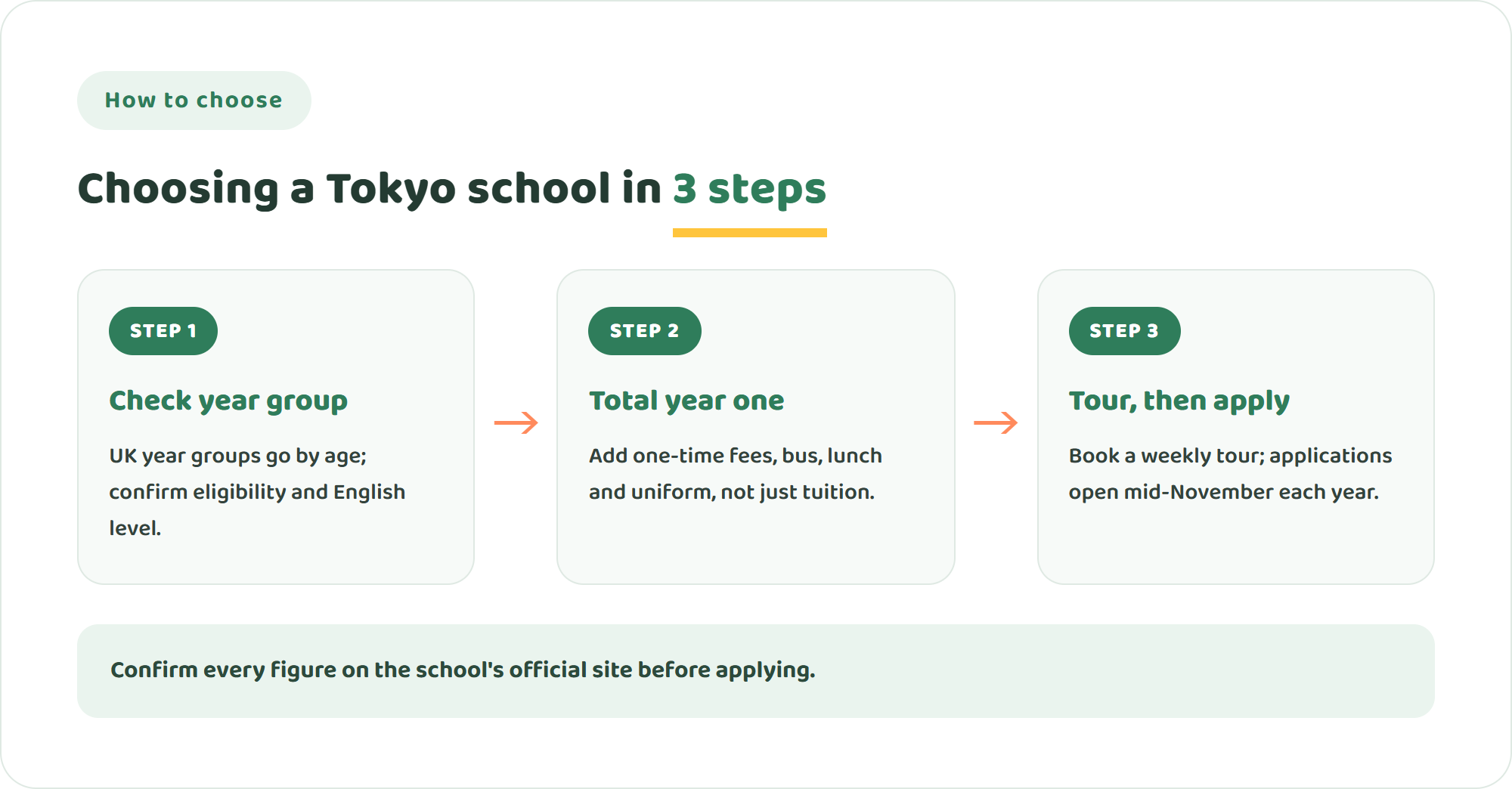
BST is the long-established British school in central Tokyo, and for many families relocating from the UK, Australia, New Zealand or elsewhere it is the natural first application in Tokyo. The best next step is concrete: check your child’s year group on the age table, confirm you meet the eligibility checklist, book a weekly tour, ask Admissions about seats for your arrival date, ask HR whether your company can use the Corporate Contribution Programme, and look at the commute to both campuses before choosing housing. If your plans are still uncertain — a short posting, a child still growing into English, or a gap before a seat opens — it is worth keeping one flexible option in view too. You can read more about why families choose an online international school.
Tuition and admissions details were checked on the official websites on 11 October 2026. Schools revise fees every year — always confirm on the official site before applying.