If you have been searching for international schools in Kumamoto Prefecture and finding a confusing mix of English conversation classes and genuine full-day schools, with almost no fee information anywhere, this guide is meant to fix that. Kumamoto is one of the fastest-changing prefectures in Japan for international education right now — TSMC’s subsidiary JASM has brought hundreds of families from Taiwan to Kikuyo Town, and the school landscape has shifted in response. Below is every international school, English immersion programme and international preschool we could verify from official sources, organised ward by ward and region by region, with the fees that are actually published, and an honest account of the one problem every family here runs into: everything full-day sits inside Kumamoto City.
Quick Answer: Your Options in Kumamoto
If you only read one section, read this. Below are the areas where schools can be confirmed, with their school names, plus the online option — so you can see every route side by side before the details.
- Chuo Ward, Kumamoto City — Emile International School (Tsuboi and Kuhonji, Chuo Ward)
- Kita Ward, Kumamoto City — Apple Bee International School (Kita Ward)
- Minami Ward and elsewhere in the city — London Bridge International School
- Kikuyo, Ozu and Koshi — Peace International School (Kikuyo Town, Kikuchi District)
- NIJIN GLOBAL ACADEMY (online) — Ages 6–18 / opening September 2027, currently taking opening-update registrations / fees around one-fifth of a typical campus international school / Japanese-language support. An option when distance or fees are the wall.
International schools in Kumamoto Prefecture: the landscape and what they cost
The honest headline first. As of July 2026, we could verify four full-day international schools taking primary-age children and above in Kumamoto Prefecture, and all four are inside Kumamoto City. Beyond those, there are roughly a dozen-plus international preschools and English-immersion nurseries, and — new since 2026 — English-medium programmes running inside Japanese accredited schools. Kumamoto is not a prefecture without international schools. It is a prefecture whose options changed shape very recently.
Semiconductors are the reason. When TSMC’s subsidiary JASM built its plant in Kikuyo Town, the foreign resident population climbed sharply: a report from the Kumamoto-based Regional Economic Research Institute puts Kumamoto Prefecture’s foreign population at 25,121 in 2024, a year-on-year increase of 24.2% — the highest growth rate of any prefecture in Japan. The Kumamoto Nichinichi Shimbun has reported that around 750 employees and family members were relocating from Taiwan, and that most of the roughly 130 children among them were expected to attend Kumamoto International School (KIS). KIS built a new campus in Toshima-nishi, Higashi Ward, and began classes there in September 2023 precisely to absorb that demand.
Fees follow that structure. From published figures, full-day schools from primary level up run roughly ¥1,150,000–1,400,000 a year, with a separate one-time enrolment fee of ¥200,000–300,000. Preschools run roughly ¥700,000–900,000 a year. There is also a middle path: at least one school lets you choose one to four days a week, starting from the low ¥200,000s annually. That is well below Tokyo pricing (¥2–3 million a year is normal there), but it is still a serious commitment against the local public system. For the full anatomy of these costs, see our breakdown of international school fees; if you are still deciding whether an international school is the right frame at all, what an international school actually is is the better place to start.
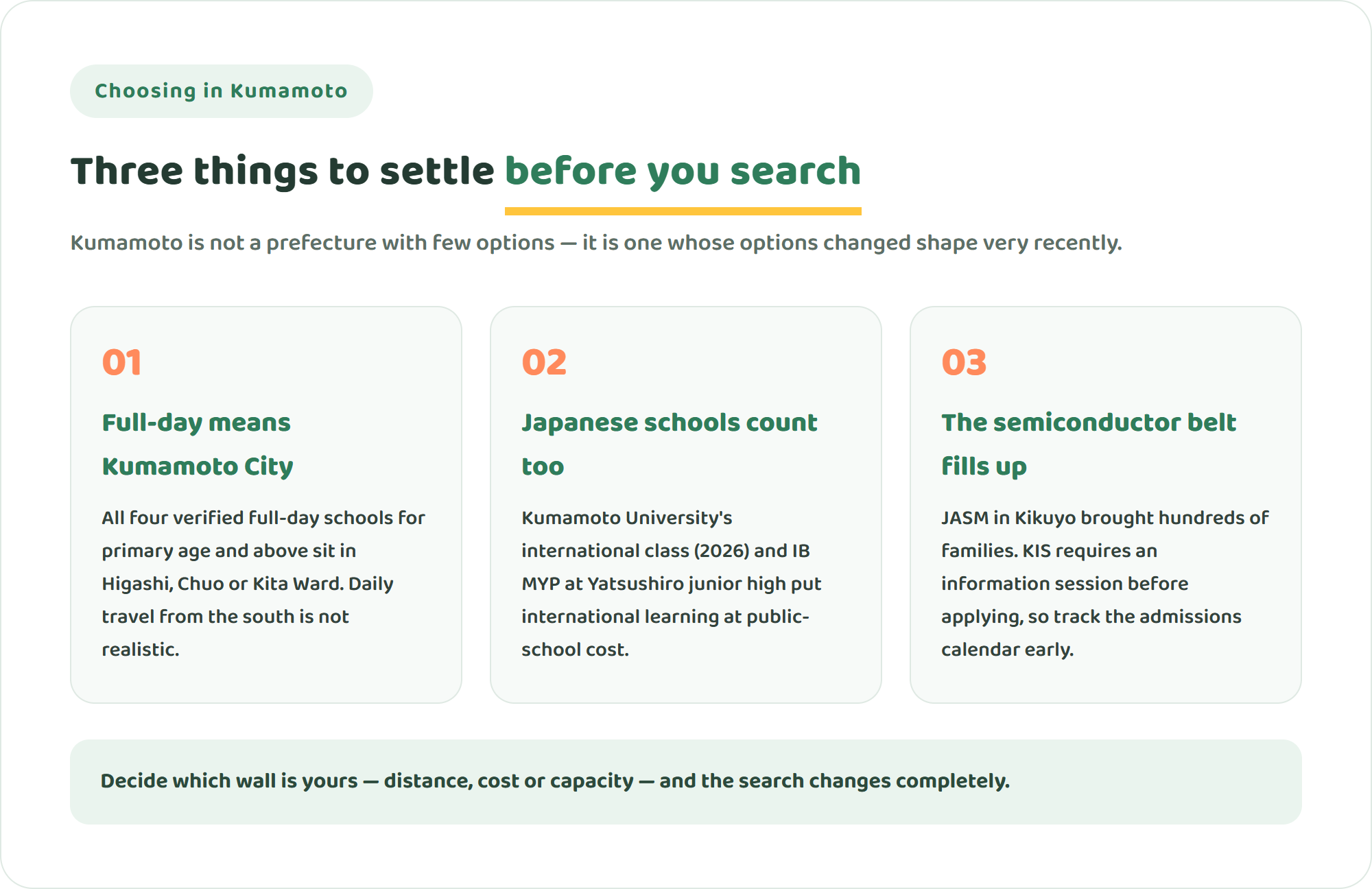
Then there is geography. Every full-day school is in Kumamoto City. Families in Kikuyo, Ozu and Koshi — the semiconductor belt — can reach Higashi Ward by car. Families in Yatsushiro, Amakusa, Hitoyoshi or Tamana realistically cannot do it daily. In Kumamoto, “it exists in the prefecture” is not the same as “we can get there”, and accepting that early makes the search much faster.
Every international school in Kumamoto Prefecture, by area
Below are the schools we could verify through official school sites or prefectural and municipal government publications. For a nationwide view, see our index of international schools across all 47 prefectures of Japan.
Higashi Ward, Kumamoto City — the centre of gravity
If you want an English-medium pathway that runs from early years through high school without changing schools, Higashi Ward is where it exists. It is also the most reachable ward from the semiconductor towns of Kikuyo and Ozu, which has made it the de facto centre of international education in the prefecture.
- Kumamoto International School (KIS) (4-2-61 Toshima-nishi, Higashi Ward; preschool at 1-22-24 Nishibaru, Higashi Ward) | The only International Baccalaureate authorised school in Kumamoto Prefecture. The primary school (grades 1–6) is a PYP school, the junior high (grades 7–10 equivalent) is an MYP candidate school, and the high school runs the DP, with grade 11 launching in 2025 and grade 12 in 2026. The preschool, Picasso, takes children from age two. KIS describes itself as offering trilingual education in English, Japanese and Mandarin Chinese, with around 300 students from nineteen countries. Published 2027 fees: a one-time entrance fee of ¥300,000, tuition of ¥83,000 per month, a facilities fee of ¥70,000 per term across three terms, and materials of about ¥52,000 a year at primary or ¥158,000 a year at secondary. That works out to roughly ¥1.26 million a year at primary and ¥1.36 million at secondary, before lunch, uniform and insurance. The preschool is ¥100,000 enrolment, ¥70,000 monthly and ¥45,000 annual facilities — roughly ¥880,000 a year. Attendance at an information session is required before applying, followed by English and mathematics assessments and interviews.
- Maple Tree International School (1-10-70 Sadowara, Higashi Ward, plus Higashi-machi and Nagamine sites) | A small-class school taking children from age one through an elementary division, and the first Cambridge International accredited school in Kyushu as of June 2024. The preschool portion qualifies for Japan’s childcare subsidy scheme. The elementary division lets families choose one to four days a week; independent research articles cite ¥216,000–600,000 a year depending on frequency, so confirm current figures with the school. Because it is not a Japanese accredited school, some families keep their child enrolled at the local public school and attend Maple Tree alongside it.
- Three Lions International School (2-6-22 Akitsu, Higashi Ward) | Runs English lessons alongside a football club for preschool and primary-age children. Not a full-day school, so it fits best as an early-years English environment or after-school continuity. Fees on enquiry.
Chuo Ward, Kumamoto City — where Japanese schools started teaching in English
Chuo Ward has seen two genuinely new things since 2024. One of them has no precedent anywhere in Japan.
- Kyushu Lutheran College International School, Primary Division (LIS) (3-12-16 Kurokami, Chuo Ward) | Opened in April 2024 for grades 1–6 and an IB PYP candidate school. It combines the Japanese national curriculum with inquiry-based learning, and sits on a university campus. Independent research articles cite about ¥1.15 million a year (¥950,000 tuition plus ¥100,000 educational enrichment plus ¥100,000 facilities), but the school publishes figures inside its admissions documents rather than on its main site, so confirm directly.
- International Class, Elementary and Junior High Schools attached to Kumamoto University’s Faculty of Education (Chuo Ward) | Launching in the 2026 academic year. It teaches many subjects in English while following Japan’s national curriculum — genuine English immersion — in classes deliberately composed of both Japanese and foreign students, taught by a Japanese teacher and a native English-speaking teacher working as a pair. It has been reported as the first international class of this kind at a national university-affiliated school anywhere in Japan. The decisive point for most families: as a national university-affiliated school, its cost structure is nothing like a private international school’s. Places are limited and there is an entrance examination, so start early.
- Emile International School (Tsuboi and Kuhonji, Chuo Ward) | An English-environment corporate-sponsored nursery taking children from birth to school age. Rather than teaching English as a subject, it builds childcare around children using English through what they already love. Open from 7:30 a.m. into the evening on weekdays, which makes it workable for dual-income households. Independent research articles cite roughly ¥15,000 a month for ages 0–2 and ¥35,000 a month for ages 3–5 with subsidy applied. Emile After School, an English after-school programme for primary-age children, runs in the same ward.
Kita Ward, Kumamoto City — a primary school that opened in 2026
- Kumamoto Christian International Elementary (KCI) (2-15-17 Tatsuta-jinnai, Kita Ward) | Opened in April 2026, built on roughly twenty years of experience at Hilltop International School, the English immersion early-years programme founded in 2006. KCI became a member of the Association of Christian Schools International (ACSI) in September 2025. Alongside its English curriculum it teaches Japanese language aligned with Japan’s national course of study. Published fees: a one-time non-refundable enrolment fee of ¥300,000, annual tuition of ¥1,020,000 (¥85,000 × 12 months), a facilities maintenance fee of ¥100,000 charged twice a year, and a technology and materials fee of ¥50,000 a year — roughly ¥1.27 million a year, with a ¥30,000 monthly reduction from the second child. Admission includes an English proficiency check calibrated to the year group.
- Hilltop International School (2-31-18 Tatsuta-jinnai, Kita Ward) | The English immersion preschool behind KCI, running since 2006. Its published price list (April 2025) shows ¥58,000 monthly tuition, a ¥60,000 enrolment fee, ¥26,500 annual facilities, ¥10,000–20,000 annual supplies, ¥5,000–10,000 annual insurance and ¥300 per lunch. Extended care runs from ¥9,500 a month (14:30–16:30) to ¥14,000 (14:30–18:30). That is roughly ¥720,000 a year, with ¥15,600 off monthly from the second child. Its real strength is continuity: early years here, then KCI for primary, within the same organisation.
- Apple Bee International School (Kita Ward) | Listed as an English preschool in Kita Ward across several preschool directories. Ages and fees on enquiry.
Minami Ward and elsewhere in the city
- London Bridge International School / London Bridge International Nursery School (236-4 Taijima, Tamukae-machi, Minami Ward; also Kyomachi-honcho, Chuo Ward) | A long-established Kumamoto school that also operates a corporate-sponsored nursery under Japan’s Children and Families Agency framework. Primarily pre-school age. Fees on enquiry.
Kikuyo, Ozu and Koshi — the semiconductor belt reality
Kikuyo Town, home to the JASM plant, along with neighbouring Ozu Town and Koshi City, has the fastest-growing foreign population in the prefecture. But we could not verify a single full-day English-medium school for primary-age children and above inside those three municipalities as of July 2026. In practice, the receiving school is KIS in Higashi Ward, Kumamoto City — around 30 minutes by car from Kikuyo, though traffic in this corridor is heavy and unpredictable. Plan on driving your child.
- Peace International School (Kikuyo Town, Kikuchi District) | Listed as an English preschool in Kikuyo Town in preschool directories. Ages and fees on enquiry. Some families use a staged plan: local preschool in Kikuyo, then Kumamoto City from primary age.
More semiconductor investment is expected, so this area’s education provision will keep changing. The flip side is that this is where places fill up fastest. Because KIS requires attendance at an information session before you can apply, note the admissions calendar early.
Yatsushiro — public-school IB, which barely exists anywhere in Japan
If you have ruled out international education on cost, this is the part of the prefecture to look at. Kumamoto Prefectural Yatsushiro Junior High School was authorised as an IB Middle Years Programme school on 25 June 2026, making it the first IB World School among public schools in Kyushu (per the prefecture’s own announcement and Kumamoto Nichinichi Shimbun reporting). And Kumamoto Prefectural Yatsushiro High School was authorised as an IB Diploma Programme candidate school on 18 February 2025, with the prefecture aiming to introduce the DP in the 2027 academic year. The prefectural board of education has been building towards this since 2021.
This is not the same thing as an English-medium international school — but access to an IB education at public-school cost is a genuinely rare opportunity in Japan. If you live in southern Kumamoto and had written international education off as unaffordable, start with the prefecture’s website and the two schools’ own admissions pages.
Elsewhere in the prefecture — Yatsushiro City, Amakusa, Hitoyoshi, Tamana — we found English preschools and conversation schools but no full-day English-medium school for primary age and above. Where aggregator sites claim several dozen international schools in Kumamoto, that count generally includes English conversation schools and cram schools.
Fees, curricula and accreditation status above reflect publicly available information as of July 2026. Figures are revised from time to time, so always confirm with each school’s official site.
Choosing the right fit for your family
Families in Kumamoto tend to arrive at the same three questions. Is a full international school at ¥1.3 million a year the right call? Is an English programme inside a Japanese accredited school enough? And what do we do if nothing is within reach? Put all three on one table.
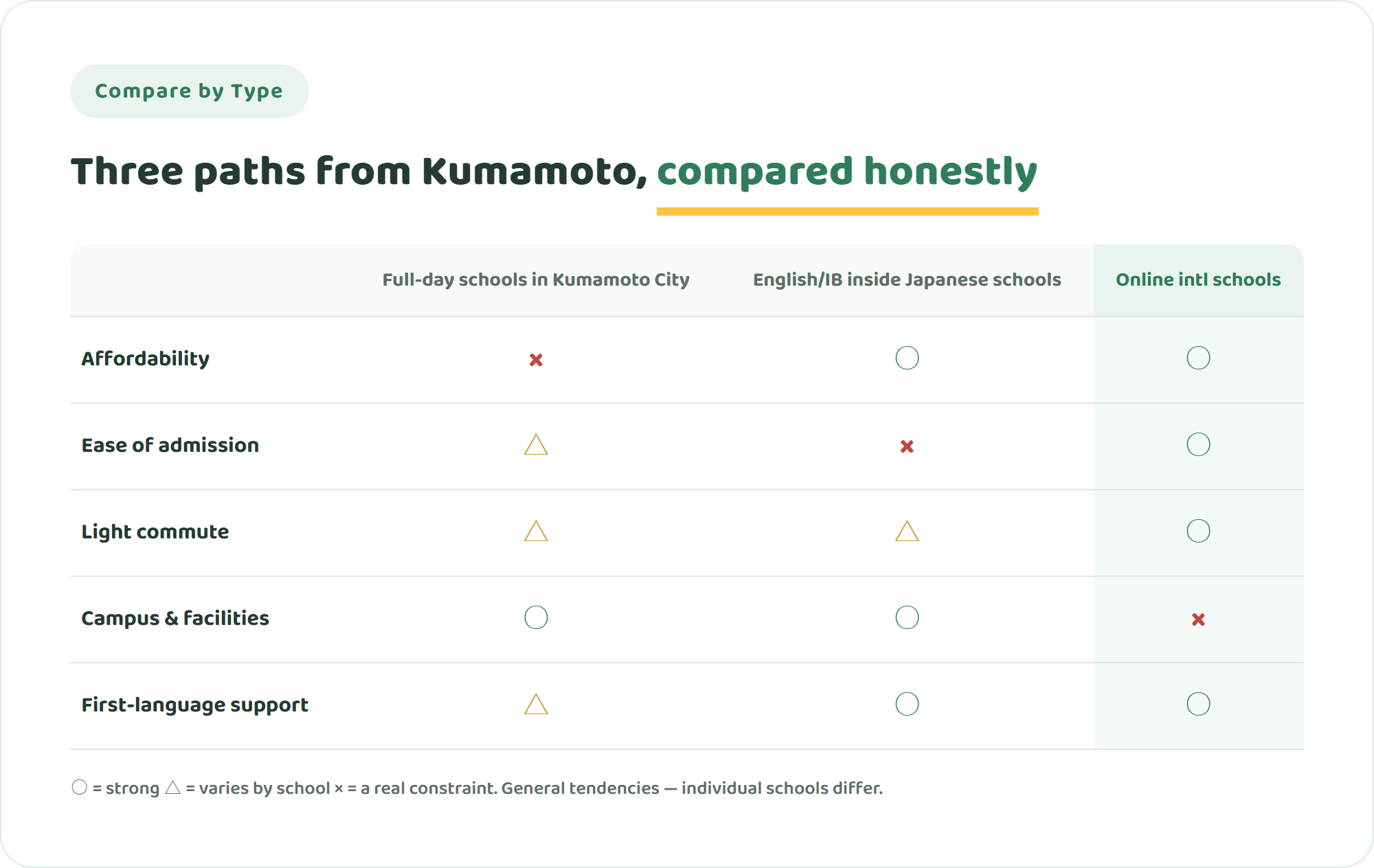
The full-day schools in Kumamoto City sit inside recognised international frameworks — IB and Cambridge — and offer a pathway that can run from early years to graduation. KIS in particular is assembling PYP, MYP and DP, which keeps both overseas and Japanese university routes open. Against that, ¥1.26–1.36 million a year plus the daily driving needs to be costed across twelve years, not one.
The programmes inside Japanese accredited schools — the Kumamoto University international class, and IB at Yatsushiro junior high and high school — operate at an entirely different price level. They also guarantee a Japanese diploma and keep Japanese-language subjects in the official curriculum, so first-language development is not a worry. The constraints are places and entrance exams. There is also a third posture: keep your child in the local school and add international learning alongside it. We unpack that approach in our guide to double schooling.
What matters is choosing learning you can sustain, not simply a school you can get into. Estimate the annual cost and the round-trip time across twelve years, and see whether it still holds.
See how learning works online →
When nothing is within reach — the online option
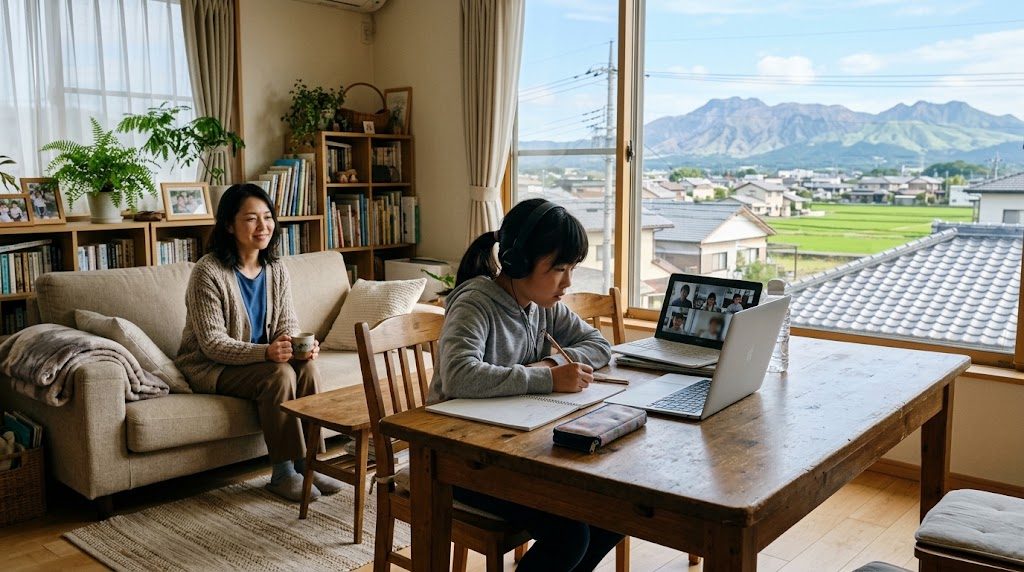
The most common wall in Kumamoto is not finding a school you like. It is finding one you like and then realising you cannot get there every day. Yatsushiro to Kumamoto City, Amakusa to Chuo Ward, Hitoyoshi to Higashi Ward — the same prefecture on a map, different lives in practice. No amount of family effort dissolves that distance. And in Kikuyo or Ozu, where a school is close by, the walls are traffic and capacity instead.
So it is worth considering learning that does not assume a commute at all. NIJIN GLOBAL ACADEMY (NGA) is an online international school opening in September 2027, run by NIJIN Inc., a Japanese company. Its domestic alternative school, NIJIN Academy, already has more than 1,000 children enrolled.
What NGA cares about is not ranking children by test scores, and learning built on small-group dialogue. Our promise is simple: to love yourself and the world. We serve children aged 6 to 18 across Asia and Oceania, wherever they live, and we are aiming for roughly one-fifth the tuition of an in-person international school. English does not arrive all at once either — the design assumes Japanese as a support and lets children move into English gradually. You should not have to give up either language. That design exists for families in exactly Kumamoto’s position: the schools are there, but not within reach of your house.
The honest caveats: we have not opened yet, so there are no graduate outcomes to show you. And online learning cannot replicate a schoolyard, a sports field, or the walk home with friends. If those matter most, a school inside Kumamoto City is the better fit. But if the alternative is giving up because nothing is reachable, an option that does not require reaching is worth a look.
Frequently asked questions
Q. Can we reach a school from anywhere in Kumamoto Prefecture?
No. Every full-day school for primary age and above that we could verify is inside Kumamoto City — in Higashi, Chuo or Kita Ward. Families in Kikuyo, Ozu, Koshi and Mashiki can manage it by car; daily travel from Yatsushiro, Amakusa, Hitoyoshi or Minamata is not realistic. Decide first how long a one-way journey your family can sustain for twelve years, then look only at what falls inside that circle. If you live in the south of the prefecture, look at the IB programmes at Yatsushiro junior high and high school before anything else.
Q. Can we attend an international school in Fukuoka or another neighbouring prefecture?
Yes, and some families do — but budget honestly. Kumamoto Station to Hakata Station is about 33 minutes at the fastest on the Kyushu Shinkansen, yet once you add getting to Kumamoto Station and from Hakata to the school, most families end up at 90 minutes to two hours each way. A Shinkansen commuter pass runs to several hundred thousand yen a year, and a primary-age child will almost certainly need an accompanying adult. A common compromise is to stay in Kumamoto through primary school and switch to a commute at junior high or high school age.
Q. Is no English at all a problem? What about Japanese-language support?
At preschool and kindergarten level, almost all schools here accept children with no English. From primary age onwards, entry normally involves an assessment: KIS holds English and mathematics tests plus interviews, and KCI checks English proficiency by year group. On the Japanese side, Kumamoto’s schools tend to protect first-language development — KIS offers trilingual education in English, Japanese and Chinese, and KCI teaches Japanese aligned with the national course of study. For families with roots outside Japan who are worried about their child’s Japanese, our sister service Tomodachi Japan (online Japanese for children, also run by NIJIN) is worth a look.
Being in Kumamoto does not mean having no choice
A few years ago, looking for international education in Kumamoto was genuinely hard. Today the prefecture has an IB-authorised international school, Kyushu’s first Cambridge International accredited school, the country’s first international class at a national university-affiliated school, and the first IB-authorised public school in Kyushu. The families who arrived for the semiconductor plants have moved this prefecture’s education forward, and quickly.
More options existing, though, is not the same as your family being able to choose one. Distance, cost, capacity — one of them always becomes the wall. So put the full-day schools in Kumamoto City, the English and IB programmes inside Japanese accredited schools, and the online route on the same table, and choose the one your family can genuinely sustain. Whichever it is, if your child ends up loving themselves and the world, you chose right.
International School Guides for Other Prefectures
- International Schools in Okinawa Prefecture
- International Schools in Kagoshima Prefecture
- International Schools in Nagasaki Prefecture
- International Schools in Hokkaido Prefecture
- International Schools in Kanagawa Prefecture
- International Schools in Aichi Prefecture
- International Schools in Hyogo Prefecture
- International Schools in Kyoto Prefecture
- International Schools in Mie Prefecture
- International Schools in Miyagi Prefecture
- International Schools in Miyazaki Prefecture
- International Schools in Nagano Prefecture
- International Schools in Nara Prefecture
- International Schools in Niigata Prefecture
- Browse all 47 prefectures of Japan