If you searched “qualifications to teach English,” what you really want is a straight answer to “which one should I actually get?” Here is the map. The names that come up fall into five categories: TESOL, CELTA, J-SHINE, children’s English teaching certificates, and a state teaching licence for secondary English. Sort out what each one is for and most of the confusion disappears. And here is the conclusion up front: a qualification is a key that opens the door — it is not what gets you hired. What most schools are finally looking at is whether your lesson actually works.
One concrete example. The founding-member roles we are recruiting for at NIJIN GLOBAL ACADEMY (NGA), ahead of our September 2027 opening, ask for English at roughly CEFR B2+ and no English-teaching certificate is required (internationally, founding roles begin as volunteer positions ahead of the opening, and detailed terms are shared later in the process). One caveat that runs through this article: the cost, length and difficulty of each qualification differ by the provider, so always check the latest requirements and fees on the official information from each certifying body. We deliberately avoid quoting figures we cannot stand behind.
Do you actually need a qualification to teach English? Start with three layers
“Qualifications to teach English” mixes together three layers with different purposes. Because people skip that split, they end up asking unanswerable questions like “is TESOL better than J-SHINE?” Different layers prove different things and pay off in different places.
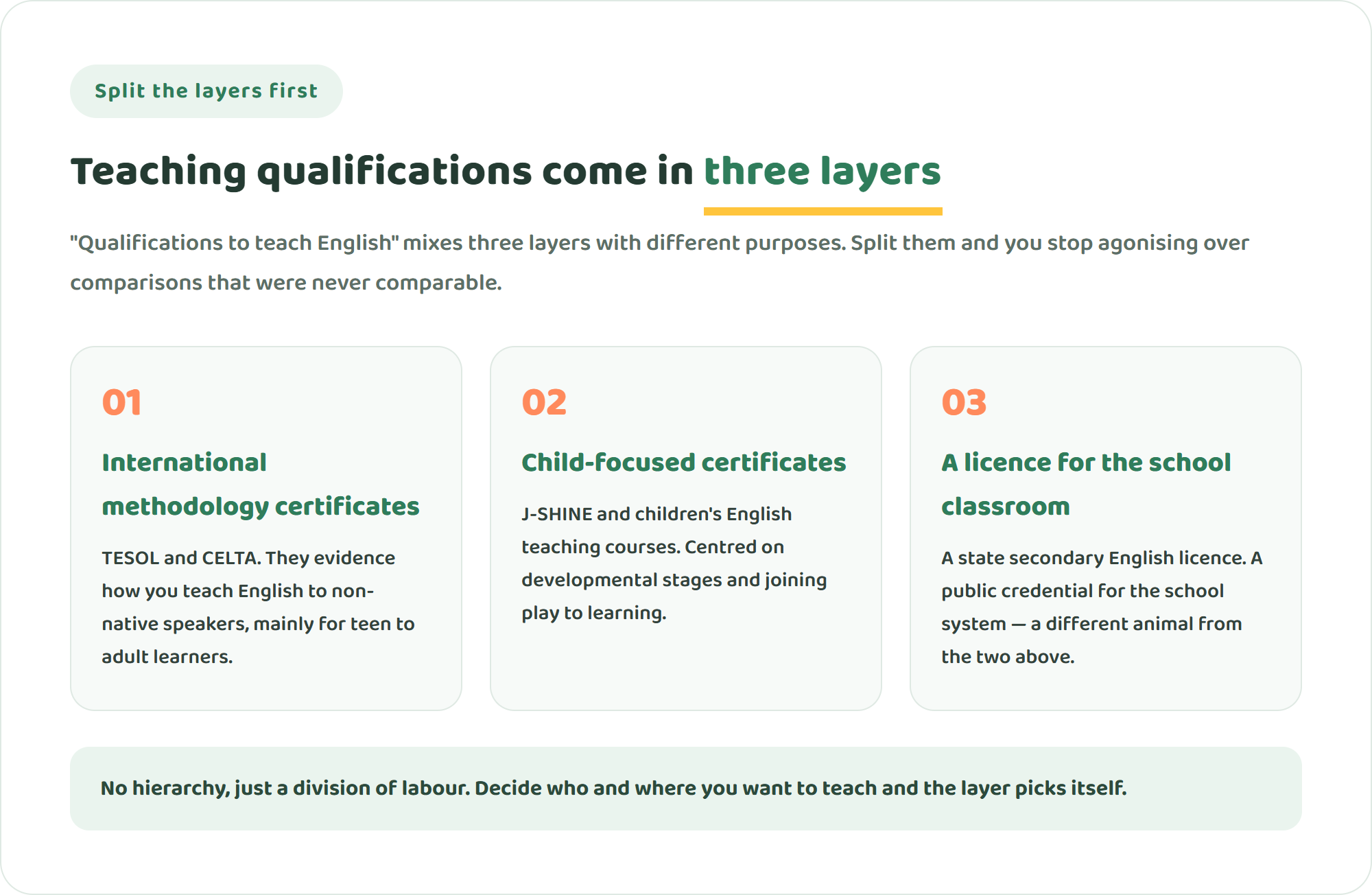
And an honest note: at private language schools, small academies and online platforms, plenty of listings do not make a certificate a hard requirement. A qualification is not worthless — it is best understood as the key that stops you being filtered out at the paper stage.

TESOL, CELTA, J-SHINE, children’s certificates and a teaching licence — sorted in one table
This is the core of the article. We line the five up by who they are for, what they prove, and where they pay off. We do not rank them by difficulty or price, because those vary so much by provider that asserting them would mislead you.
| Qualification | Who it is for | What it proves | Where it pays off |
|---|---|---|---|
| TESOL | Teachers of learners from teens to adults | Structured study of English teaching methodology. Ranges from short certificates to master’s degrees; the level varies widely by provider | Language schools, universities, institutions abroad, online teaching |
| CELTA | Those teaching mainly adult learners | A Cambridge-run international teaching qualification, known for building in assessed teaching practice with real learners | Language schools worldwide; useful if you are aiming to work abroad |
| J-SHINE | Those teaching primary-age children in Japan | Knowledge and methods for primary English instruction (a private certificate, awarded via approved course providers) | Support roles in Japanese primary schools, after-school and private children’s classes |
| Children’s English certificates | Those teaching preschool to primary age | Methods for young learners. Not one single credential but an umbrella term for courses run by various bodies to their own standards | Kids’ English schools, preschools, opening your own class |
| Secondary English licence | Those wanting a school classroom | Completion of a state teacher-education programme, covering school systems and student guidance as well as instruction | Middle and high school English; broadly trusted across education |
The five divide the work; they do not compete. There is no hierarchy. Decide who you want to teach and where, and the shortlist narrows to one or two on its own. Collect them without a destination in mind and only the cost and the years pile up.
CELTA vs TESOL — untangling two similar-sounding names
This is where most people get stuck. Put simply, TESOL is a broad field name, while CELTA is one specific named certification inside it. TESOL (Teaching English to Speakers of Other Languages) describes the whole domain of teaching English to non-native speakers, and providers offer everything from short certificates to master’s degrees under that banner — which is why “I have a TESOL” on its own tells an employer very little. CELTA, by contrast, is run by Cambridge, aimed mainly at adult learners, and delivered through approved centres around the world.
A rough rule: if your centre of gravity is adult or overseas language teaching, the CELTA name travels well; if you want to show academic depth to an institution, look at degree-level TESOL. Delivery formats and entry requirements differ by centre, so make the final call on official information. If you are researching this because you want to raise the ceiling on your career, note that in interviews the ability to explain what you learned in your own words beats the prestige of the name.
Teaching English to children, preschoolers and primary-age learners
Preschool age
With very young learners, the test is less your English and more your ability to hold a room: immersing children through songs, picture books and play, and designing for attention spans that do not last. Children’s English teaching courses are strong here, and prior early-years or childcare experience earns more trust than any certificate.
Primary age and primary schools
An honest clarification for anyone searching this in a Japanese context: the basis for taking a public primary class is, as a rule, the primary teaching licence itself. Certificates such as J-SHINE are not a permit to run the classroom; they strengthen and evidence your teaching for roles as a support teacher, an external specialist or a private-class instructor. Decide which role you are applying for before you spend on a course.
What schools are really watching: does the lesson work?
A qualification opens the door; what is judged inside the room is something else. In practice, the last three things assessed in an English teaching hire are: 1) did the learners actually speak (their talk time, not yours), 2) did you adjust the moment someone got stuck, and 3) can you shape a whole lesson — opening, activity, reflection. None of that appears on a certificate. It only shows up in a demo lesson. So put the same energy you would spend studying for a qualification into building evidence that your lesson works.
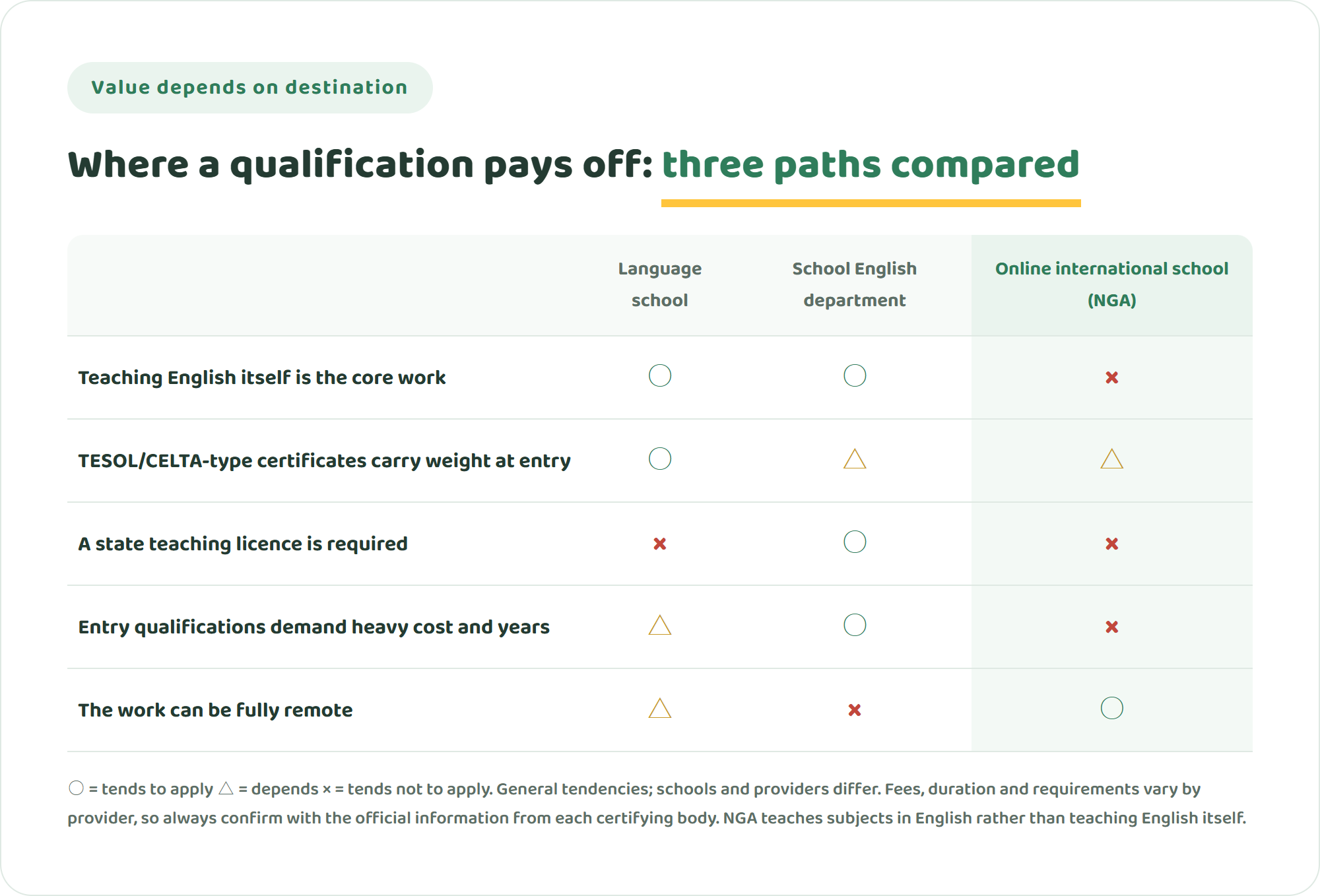
Note that this article is limited to qualifications for teaching English itself. The full route into international school teaching — degrees, English level, how to read job listings, the hiring process — is covered separately in how to become an international school teacher, and the options open without a licence in teaching jobs without a licence.
See NIJIN GLOBAL ACADEMY’s founding-member roles → — you can check the requirements (roughly CEFR B2+, no teaching certificate required) before you decide which qualification to pay for.
A third way of working — a school that teaches subjects in English, not English itself
Here is one option that is not on the qualification map. オンラインインターナショナルスクールのNIJIN GLOBAL ACADEMY (NGA) is an online international school opening in September 2027. The distinction matters: NGA is not a school that teaches English — it teaches subjects in English. So what is asked of you is not a certificate in English teaching methodology but whether you can carry inquiry and subject learning forward with children while using English as the tool. The English benchmark is CEFR B2+, and an English teaching qualification is not a requirement.
The work is fully remote, designed around working while travelling the world. There are five working styles from part-time to full, and roles beyond teaching — marketing, web, partnerships, HR — so income can be diversified. Selection runs from documents to a group interview, an internship at NIJIN Academy, and a final presentation, which means you can try before you decide. None of this requires running down the classroom you are in now. It is simply one more path on the table.
Using a qualification as a key — three steps
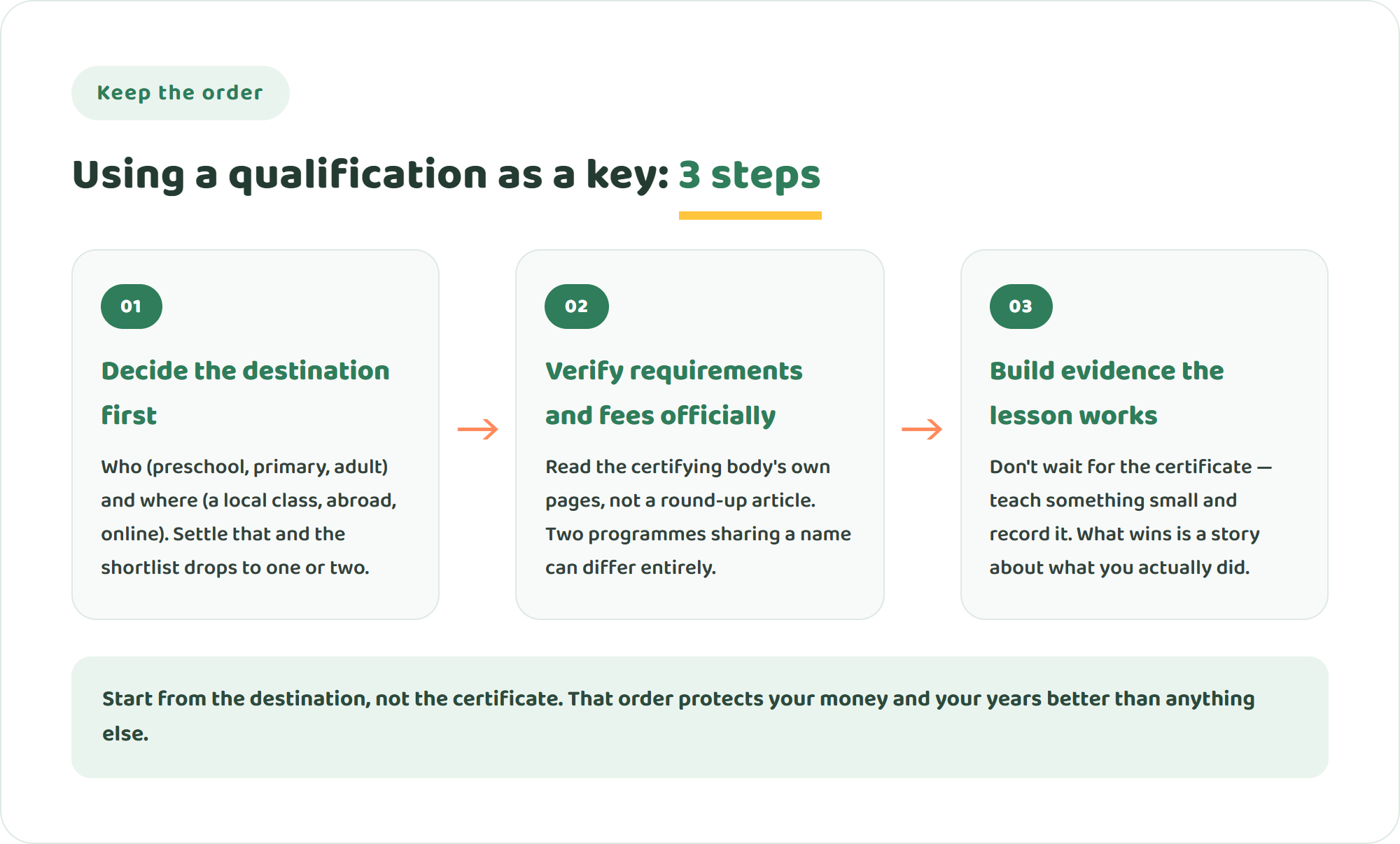
First, decide who and where you want to teach — once that is settled the shortlist drops to one or two. Second, verify requirements and fees yourself on official sources, because two programmes sharing a name can differ entirely. Third, build the evidence before the certificate: create a small teaching opportunity, record it, watch it back. What wins a hiring process is always a story about something you actually did.

FAQ
What qualification do I need to teach English to children?
At private children’s schools, many listings do not require one. If you want the methodology, children’s English teaching courses and J-SHINE (in Japan) are the usual routes. Requirements, fees and duration differ by provider, so always confirm with the official information from each certifying body.
Is there a qualification for teaching preschoolers?
Several bodies run courses aimed specifically at young learners, and children’s English certificates cover this age band. There is no single unified national credential, so content and standards vary by organisation. Early-years or childcare experience carries real weight on its own.
Do I need a qualification to teach English in a primary school?
To take a public primary class as the teacher of record, the primary teaching licence is, as a rule, the basis. Private certificates such as J-SHINE are better understood as evidence of teaching ability for support, external-specialist or private-class roles.
Can I teach English without any qualification?
In some settings, yes. Private schools and online teaching frequently decide on a demo lesson rather than paperwork alone. NGA’s founding-member roles likewise ask for roughly CEFR B2+ and do not require an English teaching qualification.
The key opens the door. You are what moves the room.
If you searched “qualifications to teach English,” you are the kind of person who wants to be properly prepared before stepping forward — and that instinct is right. But what will really speak for you is the moment a learner in front of you opens their mouth in English. So buy only the keys your destination requires, and put the time and money left over into actually teaching. Keep the passion; change only where and how you work. That path exists too.
Working at an International School — More Articles
- international school teacher salary
- how to become an international school teacher
- career change from teaching
- career change from teaching in your 30s and 40s
- how much do teachers earn?
- how to become an IB teacher
- jobs for moving abroad
- teach one class a week online
- online teaching jobs from home in India
- part-time online teaching jobs from home
- teaching jobs without a license
- careers with a teaching license
- private school teacher salary in Japan
- teach abroad without relocating
- online international school teacher salary
- remote teaching jobs from the Philippines
- online teaching jobs in Malaysia
- remote teaching jobs
Take your passion for teaching into a new way of working.