If you have just moved to Kichijoji — or to Mitaka, Musashisakai, or anywhere along the Chuo line in western Tokyo — you have probably already hit the same wall. Kichijoji is consistently voted one of the most desirable places to live in Tokyo, it is full of families, and yet searching for an international school here returns page after page of preschools for toddlers. This guide lists every international school and international preschool genuinely located in Musashino City — six of them, including one opening in April 2027 — with the ages each one serves and the fees they actually publish. Because the most important thing to understand about Kichijoji is not how many schools it has. It is that only one of them takes primary, middle and high school students full time, and everything else stops at around age six.
Quick Answer: Your Options in Kichijoji
- Axis International School (Kichijoji Honcho) | ages 1–18, preschool plus Grades 1–12 | tuition approx. ¥1,956,000/year (12-month) or ¥2,102,100/year (10-month), published as of 1 Oct 2025, plus entrance and material fees | The only full-day school in Musashino City for primary age and above
- Kichijoji Gakuen International School (Midoricho, opening April 2027) | Grade 1 upward, about 40 places in the first cohort | ¥3,500,000 first year, then roughly ¥1,800,000/year (2027 admissions guide, provisional) | Formerly Musashino Higashi Gakuen; an English-immersion stream inside a fully accredited Japanese school
- Zoo-phonics Academy Kichijoji (Kichijoji Honcho) | ages 2–6 international preschool, plus classes and an English after-school club to age 12 | contact the school | Phonics-based bilingual programme, half or full mornings
- Happy Kids International (Kichijoji Honcho) | from around 18 months, preschool and after-school | contact the school | Small English-plus-Montessori school a few minutes from Kichijoji Station
- BKI Bilingual Kids International Preschool (Sakai, near Musashisakai) | 18 months–6, plus afternoon classes for elementary, junior and senior high students | contact the school | All-English since 2003, open 7:30am to 6:30pm with extensions
- International School for Little Explorers, ISLE Mitaka (Nishikubo) | from around 18 months, preschool, kindergarten and elementary classes | contact the school | Formerly First Learning Mitaka; based on a US early-childhood curriculum
- NIJIN GLOBAL ACADEMY (online / opening September 2027, ages 6–18, roughly one-fifth the fees of an on-campus international school, Japanese-language support built in) | An online international school with no commute; currently taking registrations for opening updates
International schools in Kichijoji: the landscape and real fee ranges
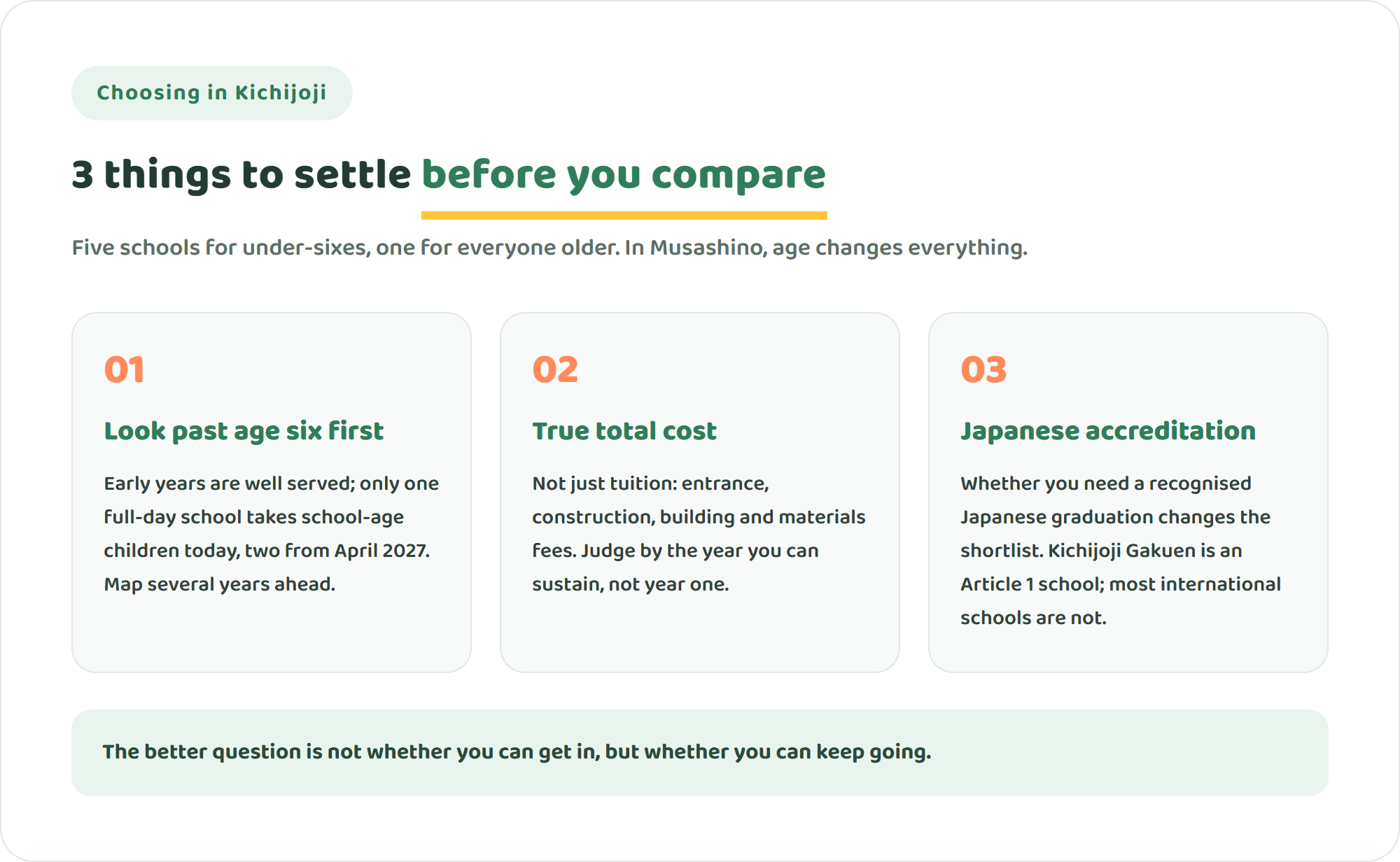
Musashino City is small — roughly three station areas, Kichijoji, the north side of Mitaka, and Musashisakai — but it is dense with families, and that shows in the number of English-language early-years options. Five of the six schools listed above take children from around one to six years old. If your child is still a toddler, you have genuine choice within walking or cycling distance.
Then the map narrows sharply. Only Axis International School runs a full-day programme for Grades 1 through 12. Every other school in the city either stops at kindergarten or continues only as an after-school club that runs alongside a Japanese elementary school. For families with a seven-year-old, the practical situation in Musashino City today is one school, not six. For families with a teenager, it is the same single school.
That picture changes slightly in 2027. In Midoricho, Kichijoji Gakuen — the school formerly known as Musashino Higashi Gakuen — is opening an international school within its elementary division in April 2027. It is worth understanding what this is and is not. It sits inside an ichijo-ko, a school formally accredited under Article 1 of Japan’s School Education Act, so it confers a recognised Japanese elementary school graduation. Roughly 70% of lessons will be taught in English, with a native-speaker teacher and a bilingual Japanese teacher paired in each class of 20. That combination — Japanese accreditation plus English immersion — is unusual, and it will make Musashino City one of the few places in western Tokyo where it is available.
On fees, expect the following. A full-day place for a school-age child in Musashino City costs roughly ¥1.8m to ¥2.1m per year in tuition alone, with a first year of ¥2.5m to ¥3.5m once entrance and facility charges are counted. That is meaningfully below the ¥3.3m-plus charged by the large campuses in central and western Tokyo, but it is still a long-term commitment. Preschools in the area mostly do not publish rates at all.
All six international schools in Musashino City
What follows is every international school and international preschool actually located inside Musashino City. We have not padded the list to reach a round number, and we have not included schools that have closed. Read for age range and fees first — those two filters usually decide the shortlist on their own.
1. Axis International School (Kichijoji Honcho)
A short walk from Kichijoji Station, Axis serves children from age one right through to Grade 12, which makes it the only school in Musashino City where a primary, middle or high school student can learn in English every day. The curriculum is American, covering Language Arts, Math, Science and Social Studies in English, with Bible study as part of the programme — it is a Christian school, accredited through bodies including the Middle States Association and Griggs International Academy. Classes are capped at eight students, one of the smallest ratios you will find anywhere in Tokyo. The academic year runs on a northern-hemisphere calendar, with the first semester from September to December and the second from January to June.
- Curriculum: American, Christian-based, very small classes
- Ages: 1–18 (toddler and preschool, kindergarten, Grades 1–12)
- Fees: tuition ¥1,956,000/year on a 12-month plan or ¥2,102,100 on a 10-month plan; entrance fee ¥330,000 (preschool) or ¥550,000 (Grades 1–12); building fee ¥200,000/year; materials ¥61,080 (preschool), ¥206,000 (G1–5), ¥256,000 (G6–8), ¥526,000 (G9–12). Published as of 1 October 2025. Sibling discounts apply
- Best for: families who want one small American-style school from toddler years to graduation, without changing schools
2. Kichijoji Gakuen International School (Midoricho, opening April 2027)
Opening in April 2027 in Midoricho, this is the most significant addition to the area in years. Its parent institution carried the name Musashino Higashi Gakuen for more than sixty years; Tokyo approved the corporate renaming to Kichijoji Gakuen on 20 October 2025, and the individual schools took their new names on 1 April 2026. The international school sits inside the elementary division of an Article 1 accredited Japanese school, so students earn a recognised Japanese elementary graduation while studying roughly 70% of their lessons in English. Each class of 20 is taught by a native-speaker teacher alongside a bilingual Japanese teacher, with a stated target of CEFR B1 by graduation and dedicated TOEFL Junior preparation. The new campus is designed by the architect Kengo Kuma. A separate, less expensive Kokusai (international) Course teaches other subjects in Japanese with intensive English.
- Curriculum: English immersion (about 70% of lessons) inside a Japanese-accredited elementary school; classes of 20 with two teachers
- Ages: from Grade 1, with about 40 places in the first cohort, progressing year by year; pathways continue to the middle and upper divisions
- Fees: first year ¥3,500,000 (entrance ¥1,000,000 + construction and development ¥700,000 + tuition ¥1,300,000 + facilities and maintenance ¥500,000); from the second year roughly ¥1,800,000/year. The Kokusai Course is ¥2,800,000 in the first year. Meals, materials and field trips are extra; the application fee is ¥30,000 (2027 admissions guide, provisional amounts)
- Best for: families who want strong English exposure without giving up a recognised Japanese school qualification
3. Zoo-phonics Academy Kichijoji (Kichijoji Honcho)
A long-established English academy in Kichijoji Honcho for children from one year old to Grade 6. Its bilingual track includes an international preschool for ages two to six, split into age bands — roughly 9:15 to 12:15 or 14:15 for the youngest group, and 9:00 to 14:15 for the pre-primary group. For school-age children there is an advanced class and an English after-school programme called E-CAMP, which is how many local families keep English going once their child starts Japanese elementary school.
- Curriculum: phonics-led bilingual programme; international preschool plus elementary classes
- Ages: 1 to Grade 6 (the international preschool covers ages 2–6)
- Fees: contact the school — no rates are published online
- Best for: building a strong phonics foundation early, then continuing English after school
4. Happy Kids International (Kichijoji Honcho)
A small school a few minutes from the south exit of Kichijoji Station, combining English with Montessori practice. It takes children from around 18 months and runs both preschool sessions and after-school classes, including options where a parent can stay for the session. This is not a place to look for facilities or graduation outcomes; it is a gentle, small-scale first step into an English environment.
- Curriculum: English plus Montessori, small groups
- Ages: from around 18 months, preschool and after-school
- Fees: contact the school
- Best for: a first, low-pressure introduction to English close to Kichijoji Station
Official website (check current availability directly)
5. BKI Bilingual Kids International Preschool (Sakai, near Musashisakai)
Open since 2003 on the Musashisakai side of the city, BKI runs entirely in English. The morning programme, 8:30 to 14:30, is banded by age: Beginner from 18 months, Learner at three to four, Pre-Reggio at five and Reggio at six. What makes it unusual locally is the afternoon programme, 15:30 to 17:30, which serves not only kindergarteners but elementary, junior high and senior high school students — one of the few places in Musashino City where a teenager can keep studying in English. Full days run 8:30 to 17:30, with extended care from 7:30 to 18:30.
- Curriculum: all-English, inquiry-influenced early years; morning, afternoon and full-day options
- Ages: 18 months–6, plus elementary and secondary students in the afternoon programme
- Fees: contact the school. The site publishes only an hourly guide — an average of ¥598 per hour for morning slots and ¥1,176 per hour for afternoon slots
- Best for: working parents on the Musashisakai side who need long hours in an English environment
6. International School for Little Explorers, ISLE Mitaka (Nishikubo)
A useful geographical note for newcomers: Mitaka Station straddles a boundary, and its northern side is Musashino City. ISLE’s Mitaka campus, in Nishikubo, sits on that northern side, about ten minutes’ walk from the station, which makes it reachable from both Mitaka and Kichijoji. Formerly First Learning Mitaka, it uses a US early-childhood approach built around play, and runs preschool, kindergarten and elementary classes.
- Curriculum: US early-childhood curriculum, play-based English immersion
- Ages: from around 18 months; preschool, kindergarten and elementary classes
- Fees: contact the school — rates vary by number of sessions
- Best for: families near Mitaka Station wanting a small English setting from the toddler years
Beyond these six, Kids Duo Mitaka in Nakacho offers English-language after-school care. It is not an international school, but for families who cannot commit to full-time fees it is a realistic way to keep English in a child’s week.
International school fees in Kichijoji and Musashino City
Fees are the single most searched question about schools in this area, so here are the published numbers, with nothing estimated or invented. Where a school does not publish figures, we say so.
Kichijoji Gakuen International School fees (2027, official admissions guide)
The 2027 student admissions guide sets out the first-year payment schedule as provisional amounts:
- Entrance fee: ¥1,000,000 (International School) / ¥300,000 (Kokusai Course)
- Construction and development fee: ¥700,000 (both)
- Tuition, annual: ¥1,300,000 (both)
- Facilities and maintenance, annual: ¥500,000 (both)
- First-year total: ¥3,500,000 (International School) / ¥2,800,000 (Kokusai Course)
- Extra: school meals, materials and off-campus study; application fee ¥30,000
Read across those lines and the ongoing cost becomes clear: from the second year, tuition plus facilities is ¥1,800,000 a year, with meals and materials on top. About 40 first-grade places are offered, applications open in late September 2026 and the entrance assessment is held in November 2026. The guide explicitly states that amounts may be revised during a student’s enrolment, so confirm current figures with the school.
Looking for “Musashino Higashi Gakuen international school fees”?
If you searched using the older name, here is what you need to know: Musashino Higashi Gakuen and Kichijoji Gakuen are the same institution. Tokyo approved the corporate renaming on 20 October 2025, and on 1 April 2026 the schools themselves were renamed — Musashino Higashi Elementary became Kichijoji Gakuen Elementary Division, Musashino Higashi Junior High became the Middle Division, the two kindergartens became the First and Second Kindergarten Divisions, and Musashino Higashi Technical High School became the Upper Division. So the fees you are looking for are the ones above: ¥3,500,000 in the first year and about ¥1,800,000 a year thereafter. Older articles and directory sites still carry pre-renaming information and estimated numbers, so always check against the official guide.
Axis International School fees
Axis publishes its schedule openly, dated 1 October 2025. Tuition is ¥1,956,000 a year on a 12-month plan or ¥2,102,100 on a 10-month plan, the same figure for preschool and for Grades 1 to 12. Added to that are an entrance fee of ¥330,000 for preschool or ¥550,000 for Grades 1–12, a building fee of ¥200,000 a year, and materials fees that rise with grade level — ¥206,000 for Grades 1–5, ¥256,000 for Grades 6–8 and ¥526,000 for Grades 9–12, the last including US accreditation costs. Sibling discounts are published at 10% for a second child and 50% for a third where no company support is provided.
Preschool fees are mostly on request
Zoo-phonics Kichijoji, Happy Kids International, BKI and ISLE Mitaka all keep their rates off their websites. BKI is the exception in publishing an hourly average — ¥598 for morning slots, ¥1,176 for afternoon slots. Because monthly totals swing widely with the number of days and hours, ask each school the same question: what does a specific weekly pattern actually cost per month? It is also worth asking whether the school is registered for Japan’s early-childhood education subsidy, which changes the real figure considerably. If you want the full anatomy of what international schools charge, our breakdown of international school costs goes through it line by line.
Fees above reflect information published as of July 2026. Always confirm the current figures on each school’s official website.
International schools near Kichijoji worth adding to your list
One full-day school inside the city is not much of a comparison, so most families widen the search. Musashino sits on the Chuo, Inokashira and Seibu lines, which makes the surrounding area unusually accessible. In Shimorenjaku, Mitaka, Musashi International School Tokyo (MIST) is Cambridge-accredited and runs from early years through Year 13, with tuition of roughly ¥1.61m–¥1.82m a year in published 2025–26 information. Aoba-Japan Bilingual Preschool Mitaka is also close by.
Further out, the larger campuses come into range: the American School in Japan in Chofu, Christian Academy in Japan in Higashikurume, Malvern College Tokyo in Kodaira, and Aoba-Japan International School at Hikarigaoka in Nerima. For the wider picture, see our guide to international schools across Tokyo.
One honest caveat. Widening the radius means adding commute time, and for a seven-year-old that is not a small thing. Kichijoji to Chofu or Higashikurume can easily be ninety minutes to two hours a day door to door. The right question is not only whether your child can get in, but whether the daily routine will still be working three years from now.
How to find the right fit for your family
The options around Kichijoji fall into three broad types, and seeing them side by side usually clarifies the decision: full-day international schools in or near the city; a preschool followed by English after-school care alongside a Japanese school; and online international schooling with no commute at all. The table below sets out how each tends to perform — including where each one is genuinely weak.
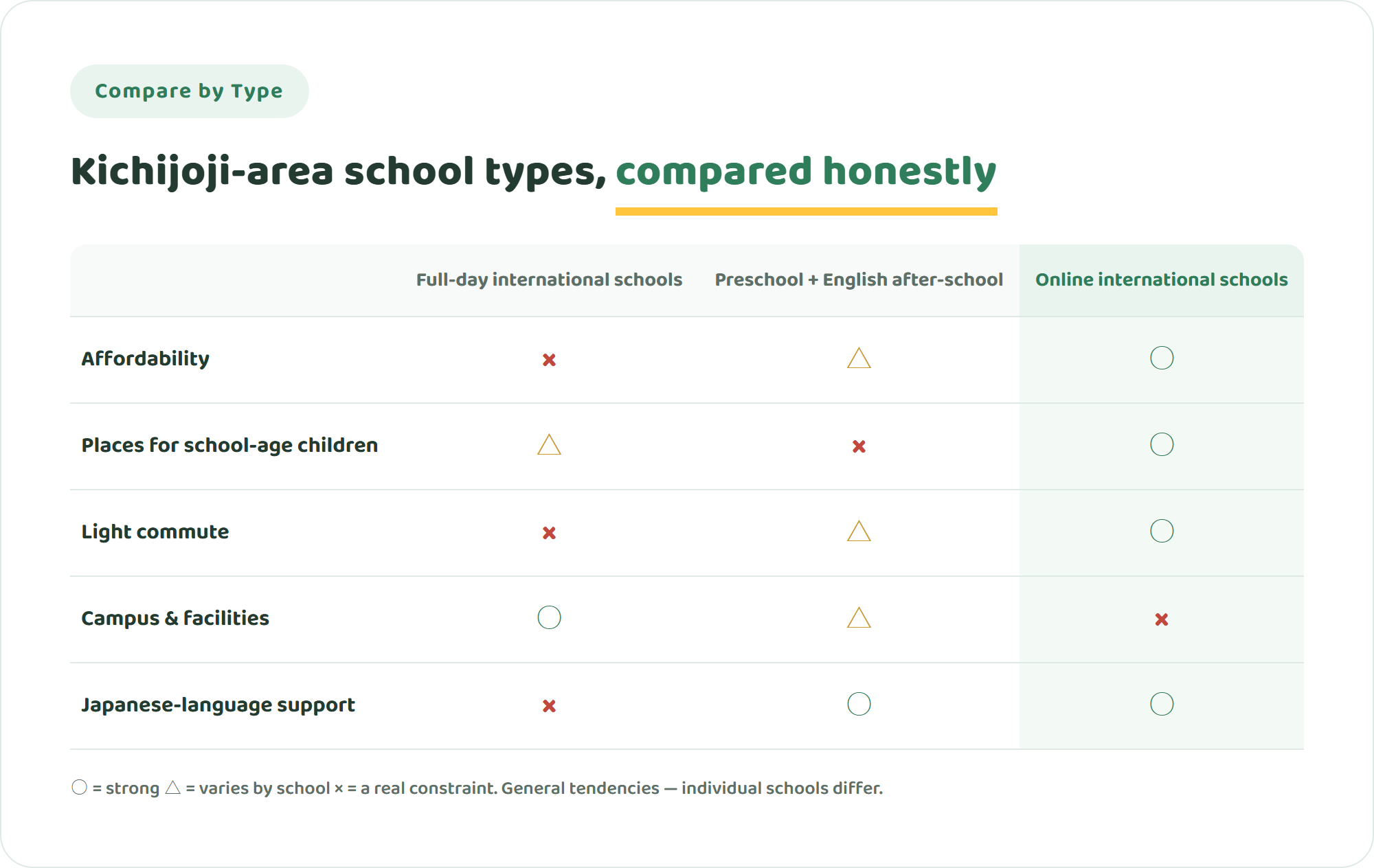
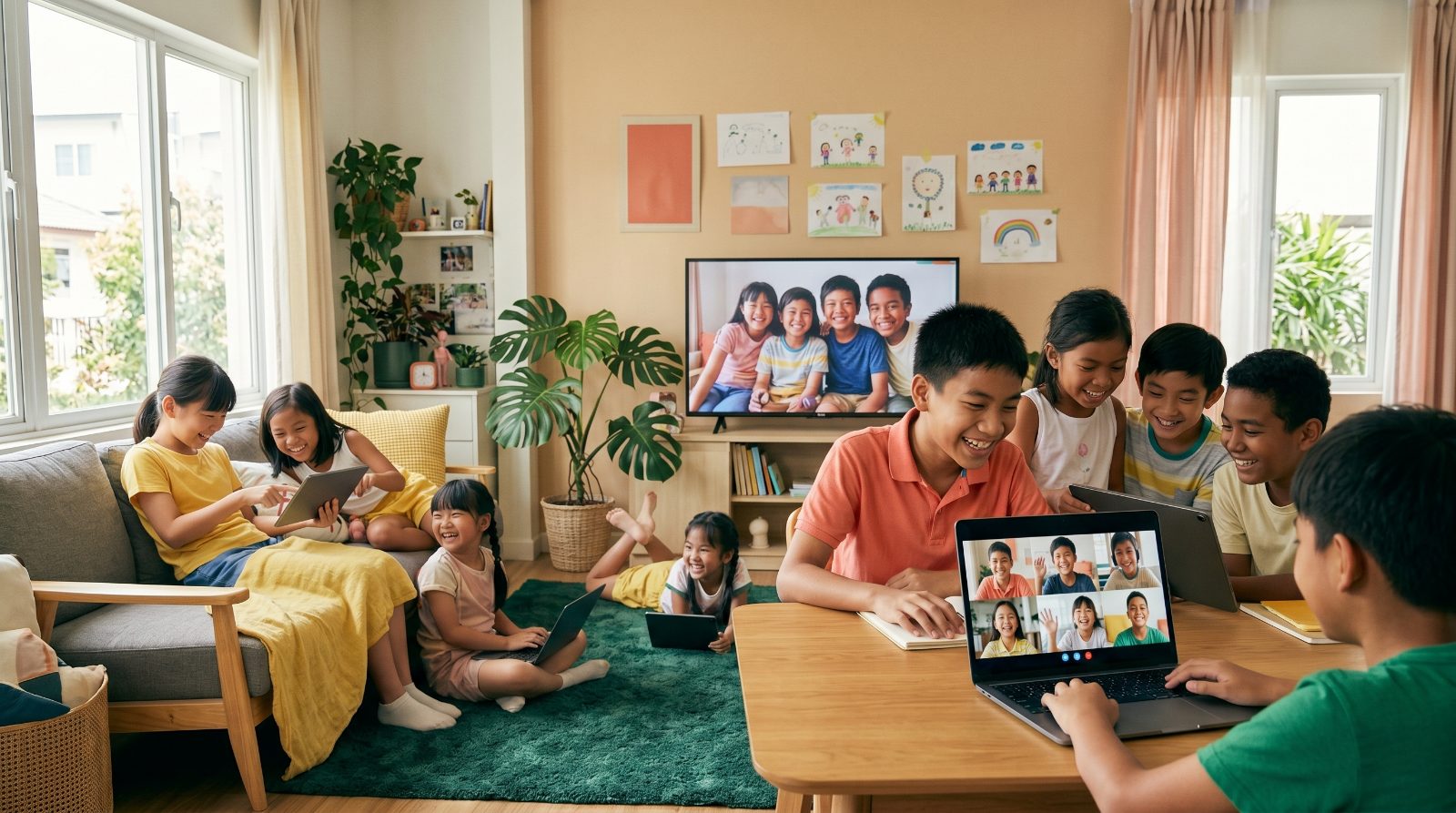
A full-day international school gives daily immersion and a peer group that thinks in English, but it costs around two million yen a year and usually assumes your child can already follow lessons in English. A preschool-plus-after-school route is far lighter on both budget and commute, yet the school day itself happens in Japanese, so the hours spent thinking in English stay limited. And there is a third path families often overlook: keeping a local school place while adding international learning around it. In a city like Musashino, where the early years are rich and everything after age six is thin, that combination is often the realistic answer.
See how learning works online →
When fees or the commute are the wall — a seventh option: online
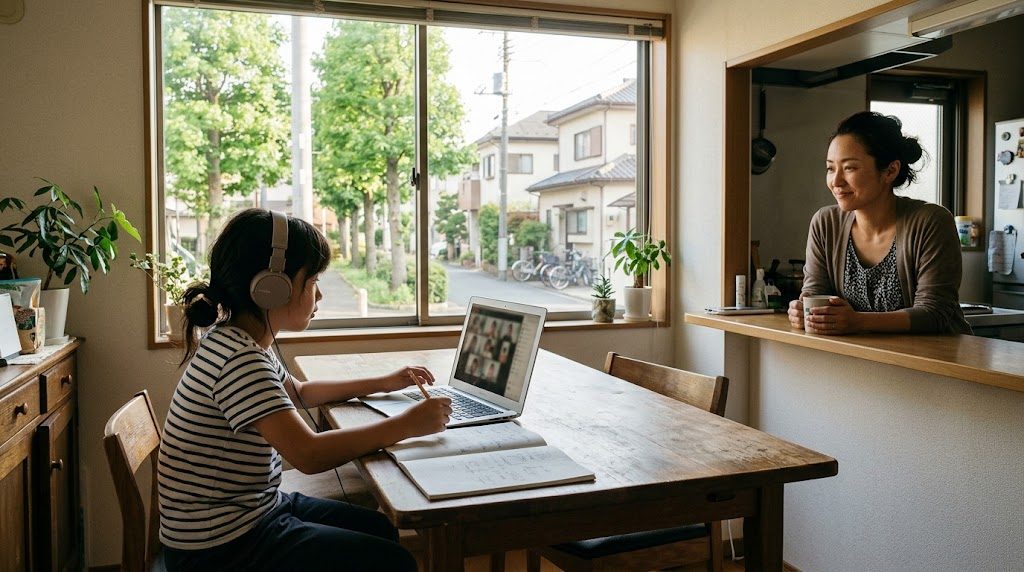
Musashino is a genuinely good place to raise a child. Even so, one full-day school for the entire school-age population, tuition near two million yen a year, and a two-hour round trip if you widen the search — those are real walls for real families. If you want an international education for your child but cannot see the cost or the commute lasting a decade, there is a seventh option that does not depend on a campus at all.
NIJIN GLOBAL ACADEMY (NGA) is an online international school opening in September 2027. It is run by NIJIN Inc., the Japanese company behind NIJIN Academy, an alternative school with over 1,000 students enrolled in Japan. Our approach rejects ranking children by test scores, and centres on small-group dialogue and the aim of helping each child come to like themselves and the world. We serve ages 6 to 18 across Asia and Oceania, wherever a family happens to live, and the design assumes Japanese-language support as a foundation so that English can be added gradually. We are working toward fees around one-fifth of a comparable on-campus international school.
To be straightforward with you: NGA has not opened yet, and our track record is still ahead of us. We cannot offer the playground, the gym or the physical campus life that a bricks-and-mortar school provides. But for a family in Kichijoji weighing a limited set of options, learning that reaches the world without a commute and without a two-million-yen annual bill is worth putting on the list.
Frequently asked questions
Q. From what age can my child start at an international school in Kichijoji?
A. From around one year old, if you are looking at early years. Axis takes toddlers from age one, BKI from 18 months, Zoo-phonics’ international preschool classes from age two, and ISLE Mitaka and Happy Kids from around 18 months. For school-age children the answer is much narrower: Axis is currently the only full-day option in the city, and Kichijoji Gakuen’s international school joins it from April 2027. Filtering by your child’s age is genuinely the fastest way to shorten the list.
Q. Is there anywhere in Musashino for primary-age children, and what about Japanese school accreditation?
A. Right now, Axis International School (Grades 1–12) is the only full-day choice in the city, with Kichijoji Gakuen’s international school opening for Grade 1 in April 2027. The distinction that matters most between them is accreditation. Most international schools in Japan are not Article 1 schools, so attending one does not count as completing Japanese compulsory education. Kichijoji Gakuen is an Article 1 school running immersion inside that framework, which means a recognised Japanese graduation alongside English-medium study. If your family may return to the Japanese system later, ask each school about this explicitly before applying.
Q. Can we transfer in mid-year, and when should we apply?
A. Transfer places exist, but small schools fill up. Axis runs a September-to-June academic year, so its intake rhythm differs from Japan’s April start — worth planning around if you are arriving from overseas. Kichijoji Gakuen’s international school is recruiting Grade 1 only for its 2027 opening, with applications from late September 2026 and assessments in November 2026. Preschools are generally more flexible about mid-year entry, though popular classes fill early, so contact schools six to twelve months before you need a place.
Time spent deciding is time spent caring for your child
There is no single right answer to this. In a city like Musashino, where the early-years choices are plentiful and the school-age choices are not, the decision feels heavier than it should. What matters more than whether your child can get in is whether the arrangement will still be sustainable in three or five years — the fees, the commute, the language demands, and your child’s own temperament. The fact that you are weighing all of it so carefully is itself a sign of how much thought you are giving their future. Take your time, visit a few schools, and compare them in person. And if you would like to keep a no-commute option in view as well, we would be glad to have you follow along with our opening.
International Schools in Other Cities
- International Schools in Nakano, Tokyo
- International Schools in Tsukuba: Fees
- International Schools in Sendai: 7 Picks and Fees
- International Schools in Shinjuku: Fees
- International Schools in Karuizawa: All 4 Schools
- International Schools in Sapporo: Fees
- International Schools in Osaka
- International Schools in Ota, Tokyo
- International Schools in Seoul
- International Schools in Tokyo
- International Schools in Minato: Fees
- International Schools in Shibuya, Tokyo
- International Schools in Setagaya: All 14 Schools
- International Schools in Koto, Tokyo
- International Schools in Shinagawa, Tokyo