If you are asking what an elementary school teacher earns in Japan, you want a figure, not a shrug. Here it is first. According to MEXT’s School Teachers Survey (FY2025, interim report), the average monthly base salary of a full-time elementary school teacher is JPY 336,600 (salary for September 2025). That figure is base pay only — no allowances, no bonus. Because no official statistic reports Japanese teachers’ annual income directly, we also show an estimate of roughly JPY 6.79 million a year, with the arithmetic spelled out.
One honest caveat before the numbers. Japan publishes no official table of teacher pay by age, so nobody can tell you what a 35-year-old earns without inventing it. Instead this article gives you the published figures, the step-increment mechanism that connects a starting salary to the national average, and how to read take-home pay. We keep the scope to elementary schools.
| Item | Figure | Source and date |
|---|---|---|
| Average monthly base salary of an elementary school teacher, and the annual figure it implies | JPY 336,600 / month annual: est. JPY 6.79m |
Monthly: MEXT School Teachers Survey, FY2025 (interim). Annual: our estimate from MIC’s 2025 Local Public Employee Salary Survey and the 2025 NPA recommendation (calculation below) |
| Public elementary schools | JPY 336,100 / month | MEXT School Teachers Survey, FY2025 (interim), September 2025 salary |
| Private elementary schools | JPY 365,300 / month | Same survey. Private elementary schools are few, so the spread around this mean is wide |
| By rank: classroom teacher (kyoyu) | JPY 308,200 / month | MEXT School Teachers Survey, FY2022 (final) — the latest published breakdown by rank |
| Starting salary example (Tokyo, university graduate) | approx. JPY 326,100 / month | Tokyo Metropolitan Board of Education teacher-training handbook, as of 1 April 2025 |
Note the definitions differ: the survey figures are base pay only, while the Tokyo starting-salary example already includes the teaching adjustment payment (4% at that time). FY2025 figures are an interim report and may move in the final release. Below, we take each number apart.
JPY 336,600 a month — and the three layers hidden inside that figure
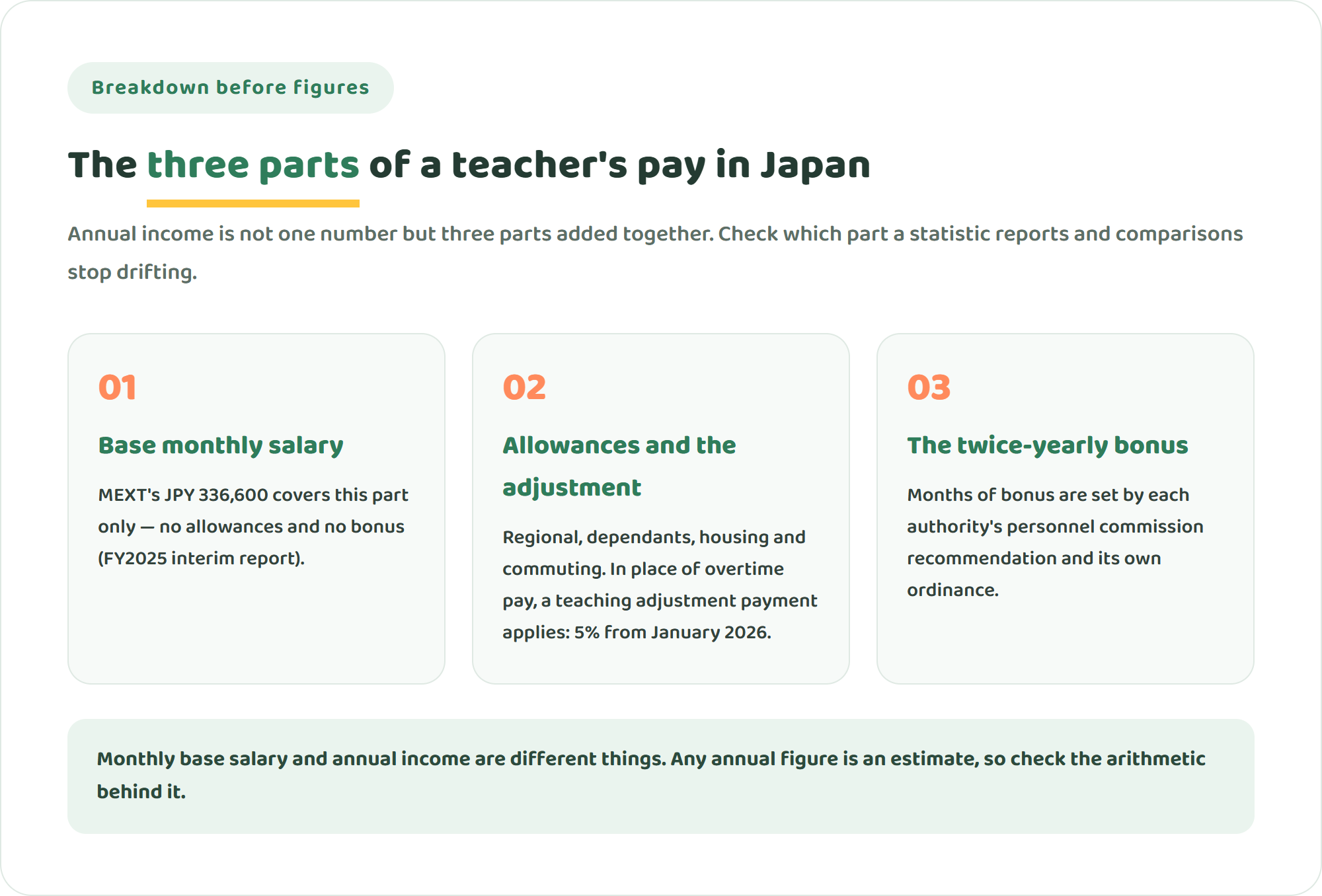
A Japanese teacher’s pay arrives in three layers: the base monthly salary set by a salary scale, monthly allowances (regional, dependants, housing, commuting) plus the teaching adjustment payment, and the twice-yearly bonus. The JPY 336,600 headline is only the first layer. Public elementary schools average JPY 336,100 and private ones JPY 365,300, but private elementary schools are rare in Japan, so that mean sits on a small and widely spread sample — not proof that private pays better.
By rank, a classroom teacher averages JPY 308,200
The headline average includes principals, vice-principals and part-time-contract teachers. Split by rank, elementary schools show classroom teacher JPY 308,200 / vice-principal JPY 426,300 / principal JPY 447,500 / contract teacher JPY 260,000 (FY2022 final figures, the most recent by-rank release; scales have since risen through annual recommendations). For pay across all school types, see how much teachers earn in Japan.
From starting salary to the average: the mechanism that fills the gap
The other anchor is the starting salary. The Tokyo Metropolitan Board of Education’s teacher-training handbook gives an example of approx. JPY 326,100 a month for a university graduate (as of 1 April 2025), noting that commuting allowance and the seasonal bonus are paid separately and that prior work experience can add to the starting step.
Now put the two side by side: a starting salary of about JPY 326,100 and a national average of JPY 336,600. The average age of public elementary teachers is 41.8, and 41.3 in the MIC job category covering elementary and lower-secondary teaching staff. So JPY 336,600 describes a workforce centred on the early forties, not a newcomer.
Pay rises because the step advances once a year
Public school teachers are paid from a salary scale with steps running down (years of service) and grades across (responsibility). Where performance is satisfactory, the step normally advances once a year. That yearly increment is what fills the distance between a starting salary and the mid-career average. To see the figure at any given age, read the scale published by the personnel commission of the specific prefecture or designated city and count steps forward from the starting step. Because each of Japan’s 47 prefectures and 20 designated cities legislates its own scale, a single nationwide table by age cannot exist.
Annual income: an estimate of about JPY 6.79 million, with the arithmetic shown
No official statistic aggregates teachers’ annual income, so what follows is an estimate. The base is the MIC 2025 Local Public Employee Salary Survey, Table 9, elementary and lower-secondary teaching staff (as of 1 April 2025): average age 41.3, average base salary JPY 364,069, monthly allowances JPY 60,342, average monthly pay JPY 424,411. Note this base salary already includes the teaching adjustment payment, unlike the MEXT figure.
The arithmetic: JPY 424,411 × 12 = JPY 5,092,932. Bonus: JPY 364,069 × 4.65 months = JPY 1,692,921 (4.65 months is the national civil service figure in the 2025 National Personnel Authority recommendation). Total JPY 6,785,853, about JPY 6.79 million.
The limits, stated plainly. The bonus base is really salary plus regional and dependant allowances and rank loading, so this understates it. The 4.65 months applies to national civil servants; teachers are local public employees and each authority differs (Tokyo’s 2025 recommendation was 4.90 months). It is a national average at age 41.3, excludes retirement benefits, and the job category also includes kindergarten teachers. Treat it as a reference point, not as anyone’s salary.
Take-home pay, and the teaching adjustment payment
No official statistic reports teachers’ take-home pay, so we will not invent one. The structure is simply gross pay minus mutual-aid contributions, income tax and residence tax. Separately, public school teachers receive no overtime pay; in its place the Kyutokuho adds a teaching adjustment payment to base salary — 5% from 1 January 2026, then 6%, 7%, 8% and 9% in the following years, reaching the statutory 10% from 1 January 2031. The steps run by calendar year, not fiscal year, and principals and vice-principals are excluded. For context, MEXT’s Teacher Working Conditions Survey (FY2022 final) records elementary classroom teachers at 10 hours 45 minutes on a weekday in school; that measure is not the legal definition of working hours, and what you make of it is yours to decide.
See the NIJIN GLOBAL ACADEMY founding member roles → — having put JPY 336,600 and an estimated JPY 6.79m on the table, we will be equally plain about our own terms: internationally, founding roles begin as volunteer positions ahead of the opening, with the detail shared later in the process. Better to know that before you decide anything.
A third way of working: terms stated plainly, and diversified income
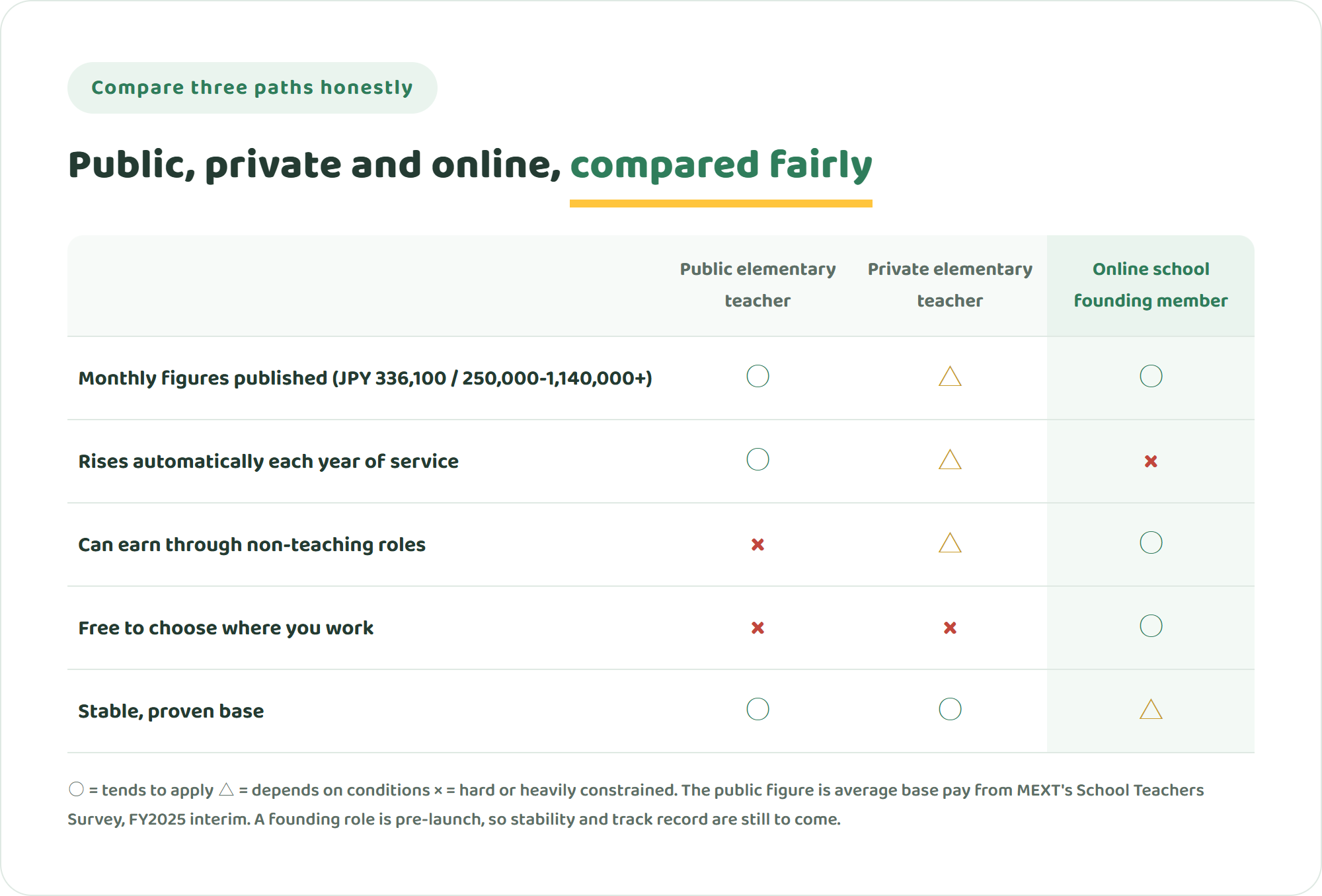
脱偏差値のオンラインインターナショナルスクール NIJIN GLOBAL ACADEMY (NGA) is recruiting founding members ahead of its September 2027 opening — a role that combines teaching with running the school as a venture. It is fully remote, with five working patterns and the option to take on marketing, web, partnerships or HR alongside teaching. What we look for is English at roughly CEFR B2+ and the appetite to build from zero, experience or not.
The weaknesses, honestly. There is no step increment that lifts your pay automatically each year, and because the school has not opened, stability and track record are still being built. That reliable annual rise is a genuine strength of the public system, and a founding role does not have it. If you want the market picture for international schools specifically, see international school teacher salaries.
Three steps to check your own figure
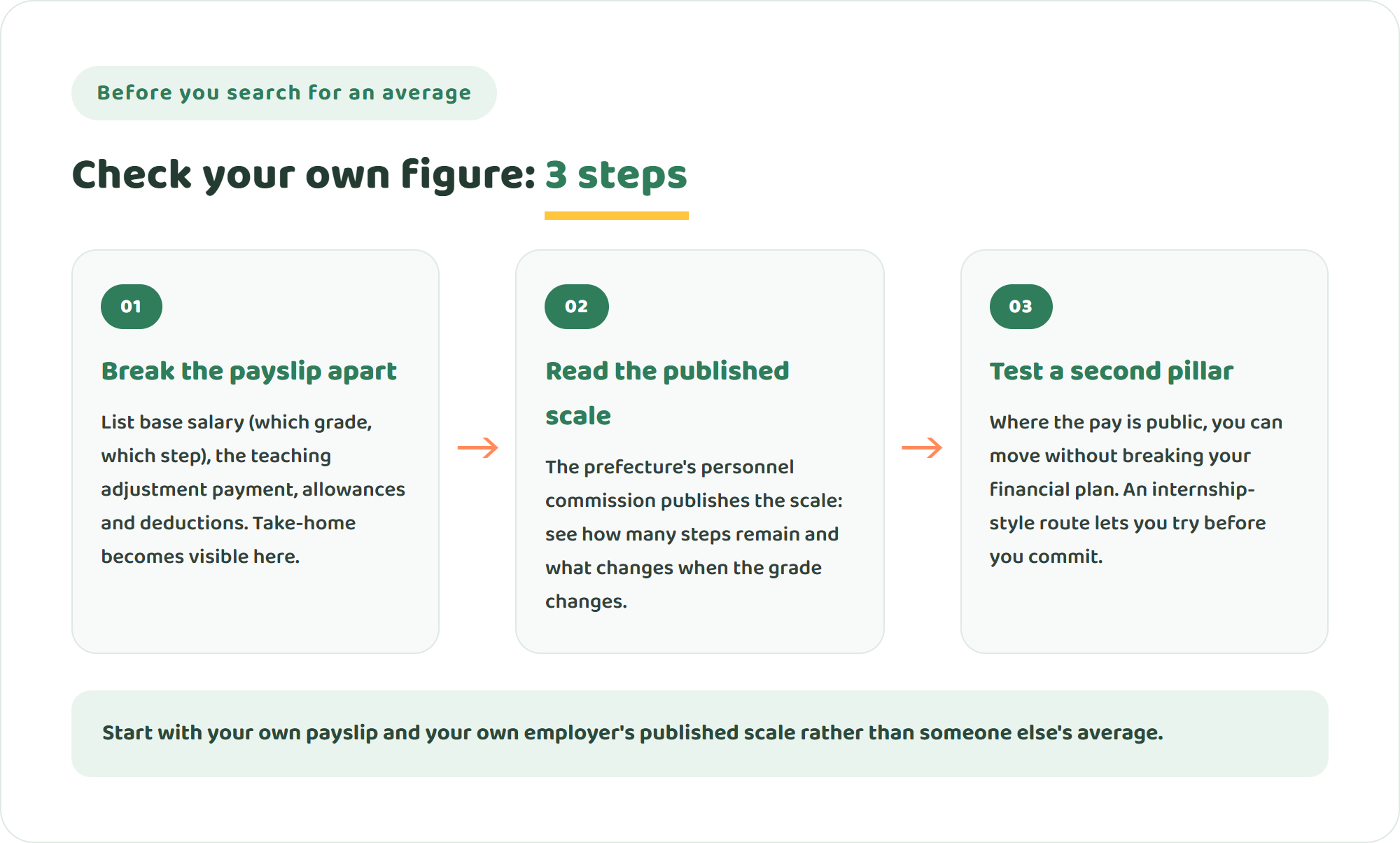
First, break the payslip apart: base salary (which grade, which step), teaching adjustment payment, allowances, deductions. Second, read the published scale to see how many steps remain and what changes when the grade changes. Third, test a second pillar of income somewhere the terms are stated plainly. NGA’s process runs from application to a group interview, an internship at NIJIN Academy and a final presentation, so you can try before you commit.
FAQ
What does an elementary school teacher earn in Japan at 25, 30 or 40?
There is no official table by age, so we will not state one. Each prefecture’s personnel commission publishes its salary scale with starting steps by qualification and the size of each increment. Since the step advances once a year, counting forward from the starting step gives you a defensible picture.
What is the starting salary?
It differs by employer. Tokyo’s published example is approx. JPY 326,100 a month for a university graduate and approx. JPY 303,700 for a junior-college graduate (as of 1 April 2025), with commuting allowance and bonus paid separately.
What is take-home pay?
No official figure exists. Take-home is gross pay minus mutual-aid contributions, income tax and residence tax, and it moves with dependants and housing circumstances. The deductions column of a payslip is the only reliable answer.
How does this compare with teaching salaries in other countries?
Compare with care. Japanese figures are usually quoted as monthly base pay excluding allowances and bonus, while many countries quote gross annual pay. Convert to the same definition first — here, roughly JPY 6.79 million a year as an estimate — before drawing conclusions.
How many months of bonus do teachers get?
It depends whose figure you mean. National civil servants were recommended 4.65 months for 2025. Public school teachers are local public employees, so each authority’s own commission and ordinance decide (Tokyo: 4.90 months).
Pay is something you can look up — and something you can design
If you searched for what an elementary school teacher earns in Japan, you are trying to see a career clearly before committing to it. What is solid here is JPY 336,600 a month in base pay, an estimated JPY 6.79 million a year, and a step that advances once a year. Your own figure lives in your employer’s published scale and your own payslip. And beyond waiting for the next step, redesigning where your income comes from — while keeping the classroom — is a real option too.
Working at an International School — More Articles
- international school teacher salary
- how to become an international school teacher
- career change from teaching
- career change from teaching in your 30s and 40s
- how much do teachers earn?
- how to become an IB teacher
- jobs for moving abroad
- online international school teacher salary
- remote teaching jobs from the Philippines
- online teaching jobs in Malaysia
- international school staff jobs
- high-paying jobs that use English
- junior high school teacher salary in Japan
- high school teacher salary in Japan
- school principal salary in Japan
- how the Japanese teacher pay scale works
- teacher bonuses in Japan
- private school teacher salary in Japan
Keep the passion for teaching. Redesign the income around it.