If you are searching for international schools in Chofu, Tokyo, you have probably run into the same two questions everyone does: how many schools are actually there, and what does the American School in Japan really cost? Chofu is home to the main campus of ASIJ — one of the oldest and largest international schools in the country — which gives the city an outsized reputation. But the number of international schools genuinely located in Chofu is small. This guide maps them honestly, without padding the list, then widens the lens to Mitaka, Musashino (Kichijoji), Fuchu, Kodaira and Higashi-Kurume, with real published fee figures, curricula, and a practical way to decide what fits your family. By the end, the shape of the right path for your child should feel much clearer.
Quick Answer: Your Options in Chofu
If you only read one section, read this. Below are the schools covered in this guide, plus the online option — so you can see every route side by side before the details.
- The American School in Japan (ASIJ), Chofu Campus — Ages: Early years at the Roppongi ELC through Grade 12; the Chofu campus covers… / Fee guide: Tuition about 3.27–3.53 million yen/year (kindergarten to Grade 12; the…
- New World International School — Ages: From around 10 months to age 6 (preschool and kindergarten), plus an after-school… / Fee guide: Confirm via the school’s official inquiry form (varies by class and hours;…
- Musashi International School Tokyo (MIST), Mitaka — Ages: Early years (around age 3) through Grade 12 / Year 13 / Fee guide: Tuition about 1.61–1.82 million yen/year (2025-2026 published figures).…
- Aoba-Japan Bilingual Preschool, Mitaka Campus — Ages: Age 1 to the final kindergarten year (K1–K5) / Fee guide: Confirm via the school’s official inquiry (varies by class and hours)
- Axis International School, Kichijoji (Musashino) — Ages: Preschool from around age 2, plus Grades 1–12 / Fee guide: Tuition about 1.96–2.10 million yen/year (2025-2026 published figures).…
- Stars & Stripes English International, Fuchu — Ages: 3–5 (kindergarten) plus elementary-age children / Fee guide: Elementary tuition about 1,161,600 yen/year (or 107,800 yen a month).…
- Christian Academy in Japan (CAJ), Higashi-Kurume — Ages: Kindergarten through Grade 12 / Fee guide: About 2.01–2.78 million yen/year depending on grade (2025-2026 published…
- Malvern College Tokyo, Kodaira — Ages: 4–16 / Fee guide: Tuition about 2.69–2.91 million yen/year (2026-2027 published figures).…
- NIJIN GLOBAL ACADEMY (online) — Ages 6–18 / opening September 2027, currently taking opening-update registrations / fees around one-fifth of a typical campus international school / Japanese-language support. An option when commute or fees are the wall.
New to this? Start with What is an international school? Types, fees, admission and how to choose for the full picture.
International schools in Chofu: the landscape and real fee ranges
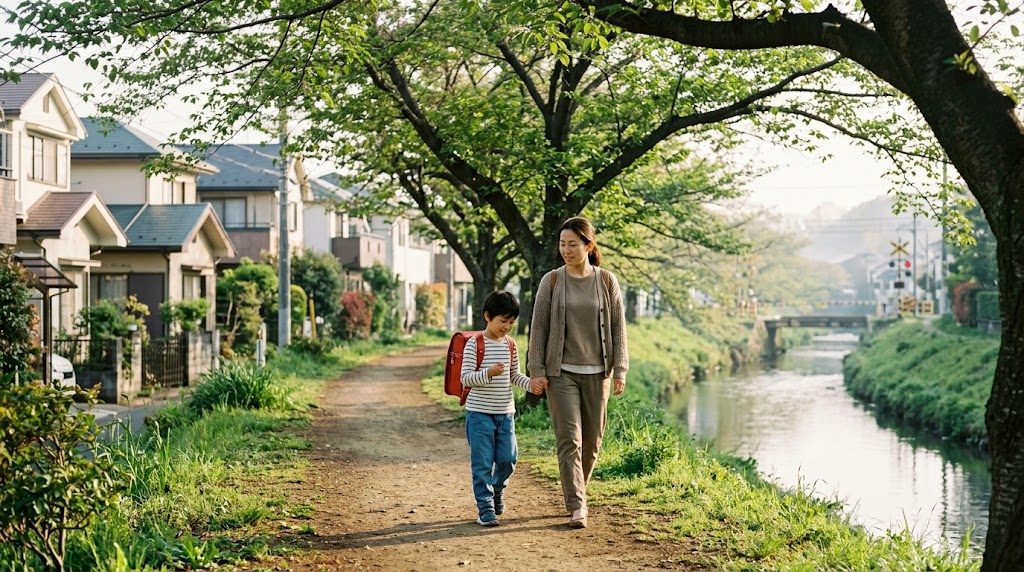
First, the geography. Chofu is a city in western Tokyo, outside the 23 wards, served by the Keio Line and the Seibu Tamagawa Line, with a settled, green residential feel. It is here that the American School in Japan (ASIJ) has its main campus — an American-style school with more than a century of history, on a large campus in Nomizu. Because ASIJ runs bus routes from central Tokyo, it functions as a realistic option not only for Chofu families but for families across the city. That is the single biggest fact about international education in Chofu.
What does not follow, though, is that Chofu is full of international schools. In practice there are two schools in the city that call themselves international schools and teach primarily in English: ASIJ and New World International School. There are also a couple of English-language early-years and after-school facilities in Sengawa and Kokuryo. But for a child of elementary age or above, ASIJ is effectively the only school inside the city limits. That is why families searching in Chofu almost always end up widening the map to Mitaka, Musashino, Fuchu, Kodaira and Higashi-Kurume.
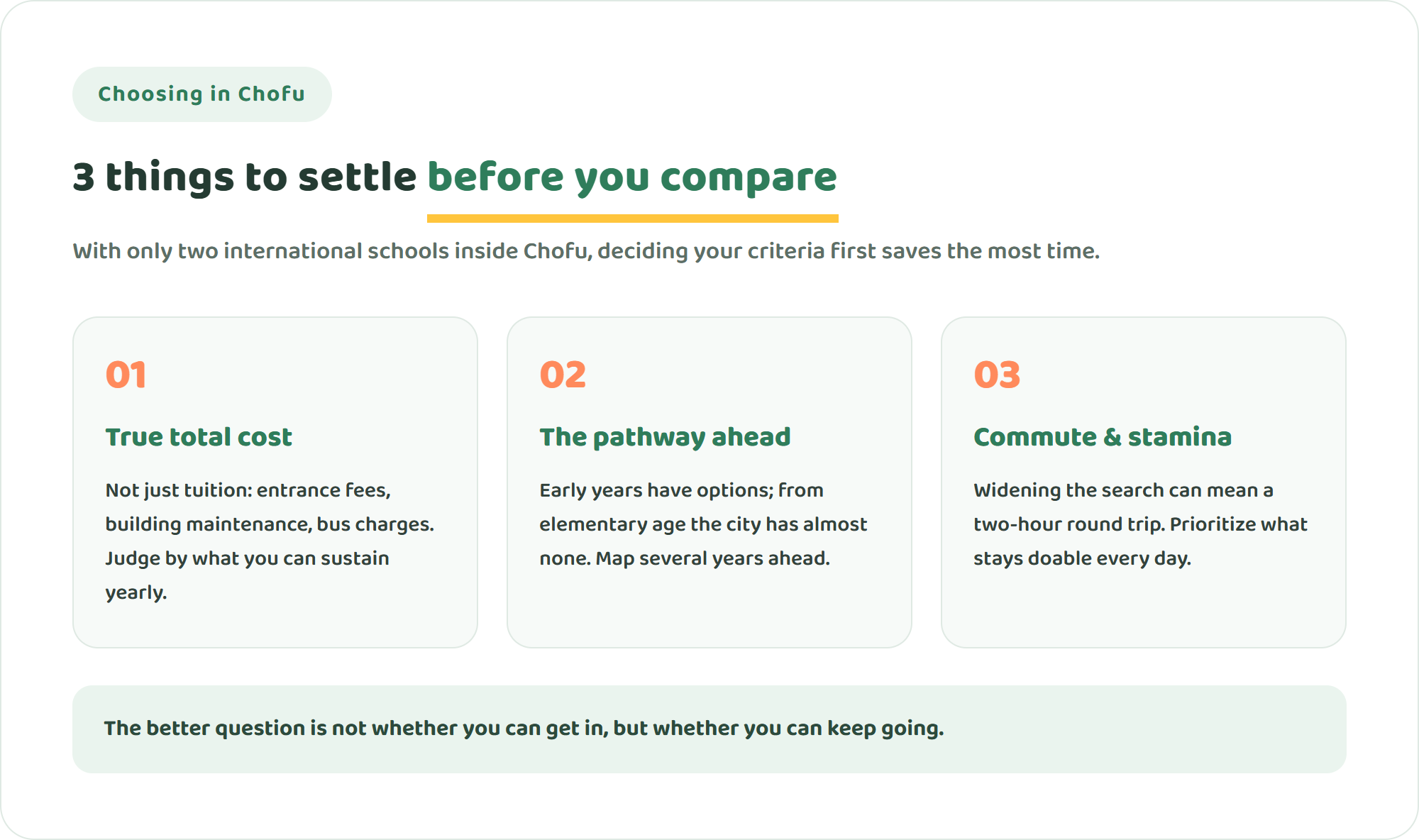
On fees: ASIJ tuition runs roughly 3.27 to 3.53 million yen a year from kindergarten through Grade 12 (the 2026-27 schedule has not yet been published, so these are the 2025-26 figures). Add a one-time building maintenance fee of 1,525,000 yen, a 300,000 yen registration fee, a 50,000 yen application fee and an annual capital assessment of 250,000 yen, and a first year comfortably exceeds five million yen. Widen the search to neighboring cities and you will find schools in the 1.6 to 2.1 million yen range — the spread is genuinely wide. If the cost side is what is really on your mind, this breakdown of international school tuition costs is a useful companion piece.
Note: figures here reflect information published as of July 2026. Always confirm the latest numbers on each school’s official site.
The two international schools actually located in Chofu
Here is the honest inventory. We will not pad it to seven. Chofu has two international schools, and they could hardly be more different: one is a large, historic campus school; the other is a small early-years school beside a Keio Line station. Read on with “does this fit our child’s age and our budget?” in mind rather than “is it famous?”
1. The American School in Japan (ASIJ), Chofu Campus
Located in Nomizu, Chofu, and nearest to Tama Station on the Seibu Tamagawa Line, ASIJ is one of Japan’s flagship international schools, with a large campus and extensive facilities. It offers an American-style college preparatory curriculum and is accredited by WASC (the Western Association of Schools and Colleges). Its early-years programme runs at the Early Learning Center in Roppongi, Minato-ku, while the Chofu campus serves elementary through high school (confirm exact grade divisions on the official site). Bus routes from multiple lines across central Tokyo are a defining practical feature.
- Curriculum: American-style college preparatory curriculum (WASC accredited)
- Ages: Early years at the Roppongi ELC through Grade 12; the Chofu campus covers elementary and above
- Fee guide: Tuition about 3.27–3.53 million yen/year (kindergarten to Grade 12; the 2026-27 schedule is not yet published, so these are the 2025-26 figures); early years about 2.99 million yen. Separately: 50,000 yen application fee, 300,000 yen registration fee, 1,525,000 yen one-time building maintenance fee, 250,000 yen annual capital assessment, and around 390,000 yen a year for bus service
- Best for: Families with the English foundation to thrive from day one, looking for a continuous path from elementary school to universities abroad
2. New World International School
Founded in 1999 and located a short walk from Sengawa Station in Chofu, this is a small international school built around play-based and project-based STEAM learning in the early years. It draws children from Setagaya, Komae, Suginami and Mitaka as well as Chofu. For elementary-age children it also runs an after-school biliteracy programme, which makes it a practical way to keep English going while attending a local Japanese school. It is a registered facility eligible for Japan’s early childhood education subsidy.
- Curriculum: Play- and project-based bilingual STEAM early education
- Ages: From around 10 months to age 6 (preschool and kindergarten), plus an after-school biliteracy class for roughly ages 6–12
- Fee guide: Confirm via the school’s official inquiry form (varies by class and hours; subsidy-eligible)
- Best for: Families wanting an early English start, or wanting to sustain English alongside a local Japanese school
Beyond these two, Chofu also has i Kids Star Sengawa, a bilingual early-years facility for roughly ages 2–5 built around English, cognitive development and physical activity, and Kids Duo Kokuryo, an English-language after-school programme for preschool and elementary children. Neither markets itself as an international school, but both are worth counting when you tally your realistic options.
International schools near Chofu worth adding to your list
If your child is elementary age or older and you want to compare something other than ASIJ, the practical move is to widen the search 30–40 minutes out, into Mitaka, Musashino, Fuchu, Kodaira and Higashi-Kurume. The price points and curricula there vary considerably.
3. Musashi International School Tokyo (MIST), Mitaka
In Shimorenjaku, Mitaka, MIST is the school formerly known as Little Angels International School. It is accredited by Cambridge International Education and runs an English-medium pathway from the early years through the final year of secondary school (Year 13). It is reachable from Chofu via the Keio and Chuo lines, and its defining advantage is price: a full K-12 English education at roughly half the cost of the largest schools in Tokyo.
- Curriculum: Cambridge International curriculum (accredited school)
- Ages: Early years (around age 3) through Grade 12 / Year 13
- Fee guide: Tuition about 1.61–1.82 million yen/year (2025-2026 published figures). Separately: 200,000 yen registration fee, 300,000 yen entrance fee, 210,000 yen campus development fee
- Best for: Families who want a full English-medium K-12 path but for whom 3.5 million yen a year is out of reach
4. Aoba-Japan Bilingual Preschool, Mitaka Campus
Also in Shimorenjaku, Mitaka, and accessible from Mitaka Station, this bilingual preschool delivers an inquiry-based programme grounded in the International Baccalaureate Primary Years Programme (PYP), taught across Japanese and English. It suits families determined not to trade one language for the other, and it connects naturally toward the wider Aoba-Japan International School group.
- Curriculum: IB PYP-based inquiry learning, bilingual (Japanese and English)
- Ages: Age 1 to the final kindergarten year (K1–K5)
- Fee guide: Confirm via the school’s official inquiry (varies by class and hours)
- Best for: Families who want to build Japanese and English together, with inquiry learning from the early years
5. Axis International School, Kichijoji (Musashino)
An eight-minute walk from JR Kichijoji Station, Axis runs a preschool campus and a separate campus for Grades 1–12 on an American curriculum. Classes are deliberately small, and students take English, mathematics, science and social studies in English. From Chofu it is reachable via the Keio and Inokashira lines.
- Curriculum: American curriculum, small class sizes
- Ages: Preschool from around age 2, plus Grades 1–12
- Fee guide: Tuition about 1.96–2.10 million yen/year (2025-2026 published figures). Separately: entrance fee 330,000 yen (preschool) or 550,000 yen (Grades 1–12), 200,000 yen annual building fee, and material fees of 61,000–526,000 yen depending on grade
- Best for: Families wanting a small-class American environment in Kichijoji, continuous from preschool to Grade 12
6. Stars & Stripes English International, Fuchu
Based in Fuchu with additional locations in Kokubunji and Tachikawa, this all-English school added an elementary division in 2022 alongside its kindergarten. Fees are noticeably lower than at most international schools, and care hours run from 7:30 a.m. to 6:00 p.m. — a genuinely practical detail for dual-income households. From Chofu it is a single ride on the Keio Line.
- Curriculum: All-English original curriculum (kindergarten and elementary)
- Ages: 3–5 (kindergarten) plus elementary-age children
- Fee guide: Elementary tuition about 1,161,600 yen/year (or 107,800 yen a month). Separately: 330,000 yen entrance fee, 22,000 yen assessment fee, 110,000 yen annual facility fee. Kindergarten 54,000 yen/month (4 days) to 64,000 yen/month (5 days), plus a 200,000 yen enrollment fee (published as of July 2026)
- Best for: Working families who want an English-medium elementary education without a two-million-yen bill
7. Christian Academy in Japan (CAJ), Higashi-Kurume
In Shinkawa-cho, Higashi-Kurume, CAJ is an American-curriculum school running kindergarten through Grade 12, grounded in a Christian ethos and long respected for its calm environment and pastoral care. The commute from Chofu involves transfers and takes real time, but as a K-12 school priced well below the largest Tokyo schools, it belongs on the comparison list for families in western Tokyo.
- Curriculum: American curriculum, Christian ethos
- Ages: Kindergarten through Grade 12
- Fee guide: About 2.01–2.78 million yen/year depending on grade (2025-2026 published figures; one-time fees separate)
- Best for: Families seeking a values-centered American K-12 school at a lower cost than the largest schools
8. Malvern College Tokyo, Kodaira
Opened in September 2023 in Josuiminami-cho, Kodaira, Malvern College Tokyo is part of the Malvern College family of schools from the UK. It is an IB continuum school offering the Primary Years Programme and Middle Years Programme, with the Diploma Programme to follow, combining British school tradition with IB inquiry. Enrollment has grown from 150 pupils to nearly 400 by its third academic year, according to figures published by the school. The commute from Chofu is not short, but it is the strongest British-style option in western Tokyo.
- Curriculum: British education plus International Baccalaureate (IB PYP and MYP; DP to follow)
- Ages: 4–16
- Fee guide: Tuition about 2.69–2.91 million yen/year (2026-2027 published figures). Separately: 22,000 yen application fee, 300,000 yen registration fee, 742,000 yen building development fee
- Best for: Families who want British school tradition and IB inquiry in the same place
One more option worth knowing, though it is not an international school: Tokyo Metropolitan Tachikawa Kokusai Secondary School and its attached elementary school — Japan’s first public integrated elementary-through-high-school programme with a strong international and English focus, in nearby Tachikawa. The cost difference is enormous, which makes it worth at least understanding before you commit. To see how Chofu compares with the rest of the city, take a look at the full picture of international schools in Tokyo.
International schools in and around Chofu compared: fees, area and age range
Both schools inside Chofu, plus the six within commuting distance, set out side by side. Figures are published tuition only; entrance fees, facility levies and bus charges are separate, and schools that do not publish fees are shown as such.
| School | Area / nearest station | Ages (stage) | Curriculum | Annual tuition guide |
|---|---|---|---|---|
| The American School in Japan (ASIJ), Chofu Campus | Nomizu, Chofu / Tama Stn (Seibu Tamagawa Line); buses from central Tokyo | Early years at the Roppongi ELC; Chofu campus is elementary to Grade 12 | American college preparatory (WASC accredited) | about ¥3.27–3.53m (early years about ¥2.99m) |
| New World International School | Sengawa, Chofu / short walk from Sengawa Stn (Keio Line) | From around 10 months to age 6, plus after-school for ages 6–12 | Play- and project-based bilingual STEAM early education | Contact the school (subsidy-eligible) |
| Musashi International School Tokyo (MIST) | Shimorenjaku, Mitaka | Early years (around age 3) to Grade 12 / Year 13 | Cambridge International curriculum (accredited) | about ¥1.61–1.82m |
| Aoba-Japan Bilingual Preschool, Mitaka Campus | Shimorenjaku, Mitaka / Mitaka Stn | Age 1 to the final kindergarten year (K1–K5) | IB PYP-based inquiry learning, Japanese and English | Contact the school |
| Axis International School, Kichijoji | Kichijoji-Honcho, Musashino / walk from JR Kichijoji Stn | Preschool from around age 2, plus Grades 1–12 | American curriculum, small class sizes | about ¥1.96–2.10m |
| Stars & Stripes English International | Fuchu (also Kokubunji and Tachikawa) / one ride on the Keio Line | Ages 3–5 (kindergarten) plus elementary | All-English original curriculum | Elementary about ¥1,161,600; kindergarten ¥54,000–64,000 a month |
| Christian Academy in Japan (CAJ) | Shinkawa-cho, Higashi-Kurume | Kindergarten through Grade 12 | American curriculum, Christian ethos | about ¥2.01–2.78m |
| Malvern College Tokyo | Josuiminami-cho, Kodaira | Ages 4–16 | British education plus IB PYP and MYP (DP to follow) | about ¥2.69–2.91m |
How to find the right fit for your family
If you are now thinking “fine, but how do we actually decide?” — that is the right reaction. It helps to sort the options around Chofu into three types: (1) large K-12 international schools such as ASIJ, (2) mid-size international schools in Mitaka, Kichijoji and Fuchu, and (3) online international schools with no commute at all. The table below shows, honestly, how each type tends to perform on cost, admission, commute and more.
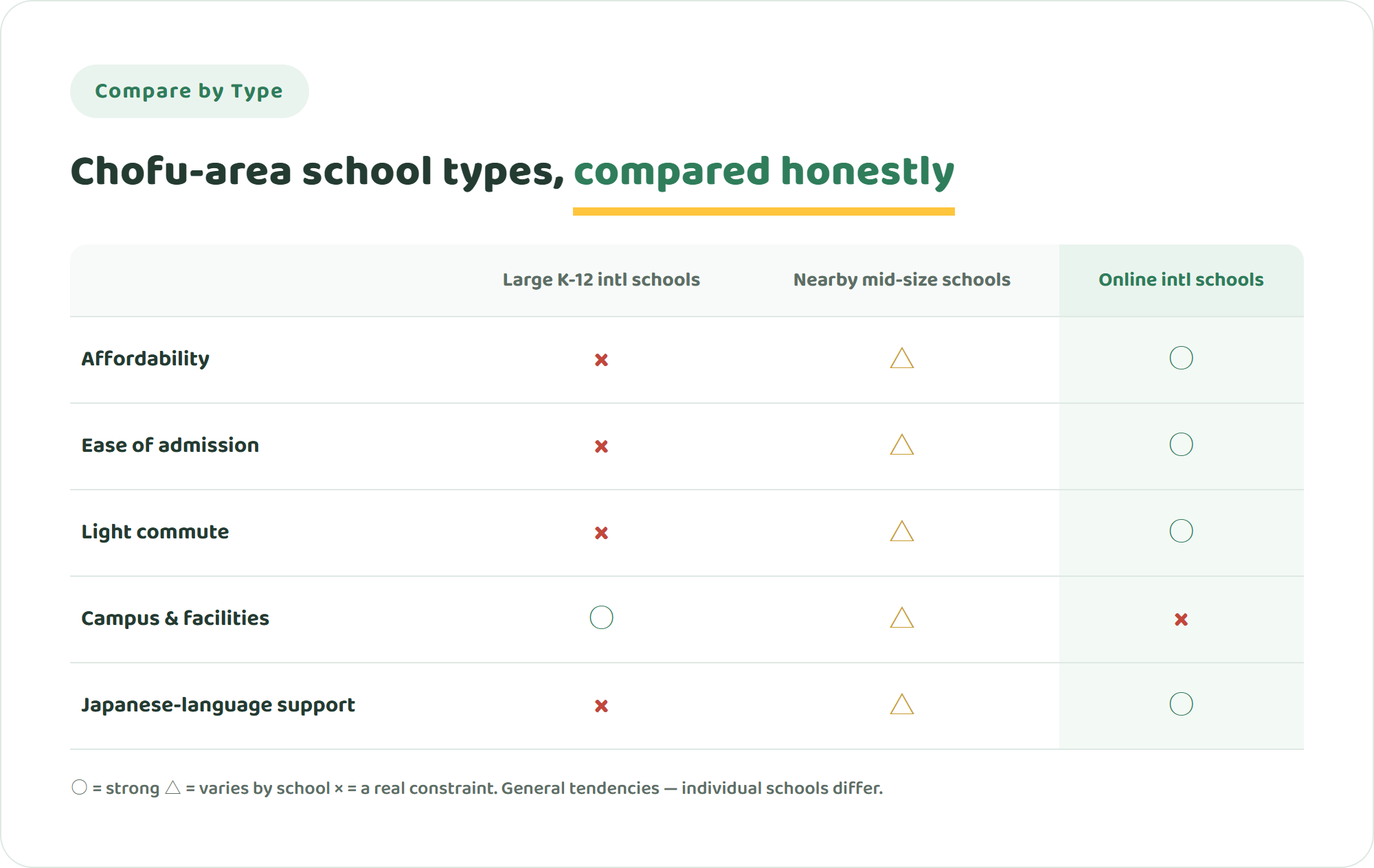
Large K-12 schools are compelling on facilities and outcomes, but tuition around 3.5 million yen a year and a high admissions bar are real. They also generally expect enough English to learn in from day one, which is its own wall for a child raised in Japanese. Mid-size schools balance cost and commute better, though scale and graduate outcomes vary a lot school by school. And it is easy to overlook the option that does not involve a full-time seat at all. Is tuition straining the household? Is a one-hour each-way commute quietly wearing your child down? These deserve an honest look. If the numbers themselves are the sticking point, this piece on whether international school is too expensive may help you think it through.
See how learning works online →
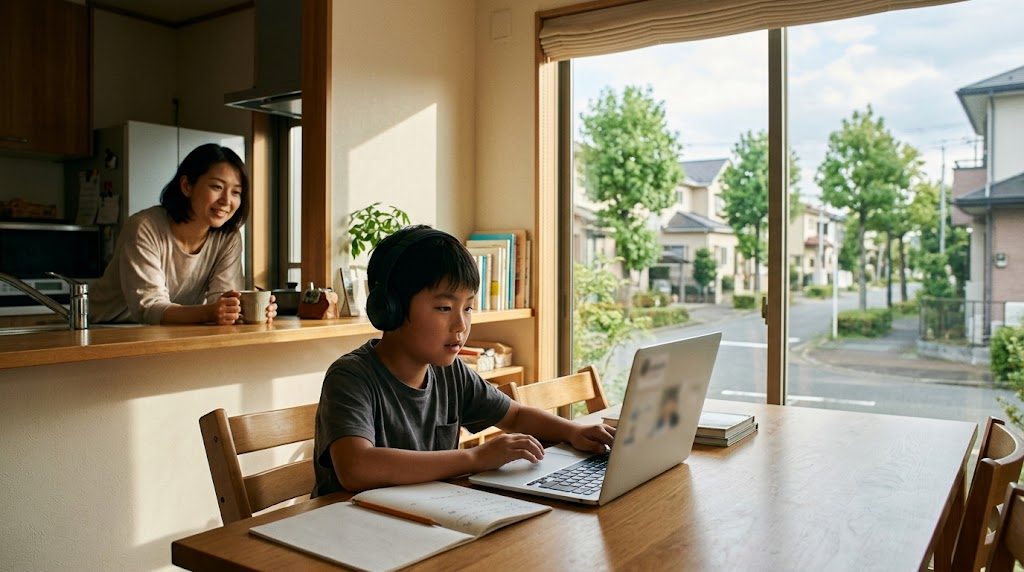
When fees or the commute are the wall — a third option: online
Chofu is a fortunate place, home to one of Japan’s most established international schools. Even so, the facts are what they are: only one school inside the city takes children from elementary age up, tuition sits near 3.5 million yen a year, and widening the search often means a round trip approaching two hours. For many families, one of those becomes the wall. If you find yourself thinking “we want an international education, but sustaining this for years…”, there is a third option that assumes no commute at all: an online international school.
NIJIN GLOBAL ACADEMY (NGA) is an online international school scheduled to open in September 2027. It is run by NIJIN Inc., the company behind “NIJIN Academy,” an alternative school in Japan with more than 1,000 enrolled students. Guided by a philosophy of moving beyond ranking children by test scores, NGA centers on small-group dialogue and aims to help children come to love themselves and the world. It is designed for ages 6–18 across Asia and Oceania, wherever they live, and built so children can ease into English with Japanese-language support underneath. It aims to keep tuition at roughly one-fifth of a face-to-face international school.
In fairness, NGA has not opened yet, and its track record is still to come. It cannot offer the campus, the field, or the in-person experience of a physical school in the same way. Even so, for a family weighing options in Chofu, learning that connects your child to the world — without the commute, at a lower cost — is a path worth considering.
Frequently asked questions
Q. From what age can children enter an international school in Chofu?
A. The early years are where Chofu has options. New World International School accepts children from around 10 months, and i Kids Star Sengawa from roughly age 2. ASIJ runs its early-years programme at the Roppongi Early Learning Center, with the Chofu campus serving elementary age and above. The first step is simply to narrow to schools that accept your child’s current age.
Q. Can a child with little English enroll? Is Japanese-language support available?
A. It varies enormously. Large American-curriculum schools generally expect enough English to access the curriculum from the start. Some mid-size schools and bilingual preschools in the surrounding cities are set up with Japanese-speaking children in mind and offer more support. If Japanese-language backing matters to you, ask each school directly, before applying, how much English is required and what support exists.
Q. Is mid-year transfer possible?
A. Most schools do take transfer students, but popular schools rarely have openings, and conditions change by timing and grade. Entrance tests, interviews and English-level requirements are common. Because Chofu has so few schools, contact each one roughly a year ahead of your intended start to check availability and requirements.
Q. How many schools in Chofu itself take children of elementary age or older?
A. In practice, one. Two schools in the city describe themselves as international schools and teach primarily in English — ASIJ and New World International School — but New World is an early-years school whose elementary provision is an after-school biliteracy class rather than a full-time programme. That leaves ASIJ as the only full-time option inside the city limits, which is why most families end up looking at Mitaka, Musashino, Fuchu, Kodaira and Higashi-Kurume as well.
Q. What does a first year at ASIJ actually cost in total?
A. Tuition runs about 3.27–3.53 million yen (the 2026-27 schedule is not yet published, so these are the 2025-26 figures). On top of that sit a one-time building maintenance fee of 1,525,000 yen, a 300,000 yen registration fee and a 50,000 yen application fee, plus an annual capital assessment of 250,000 yen and roughly 390,000 yen a year if you use the bus. Added together, a first year comfortably exceeds five million yen.
Q. Are there schools under three million yen a year?
A. Several. Musashi International School Tokyo in Mitaka is about 1.61–1.82 million yen a year, Axis International School in Kichijoji about 1.96–2.10 million, and Stars & Stripes English International in Fuchu charges about 1,161,600 yen a year for its elementary division. Christian Academy in Japan in Higashi-Kurume sits at about 2.01–2.78 million, and Malvern College Tokyo in Kodaira at about 2.69–2.91 million. Entrance and facility fees are additional at all of them.
Q. We both work full time. Which options have long hours?
A. Stars & Stripes English International in Fuchu runs care from 7:30 a.m. to 6:00 p.m., which is unusually long for an English-medium school. And if your child will attend a local Japanese school, the after-school biliteracy class at New World International School and Kids Duo Kokuryo near Kokuryo Station both keep English going outside school hours.
Time spent deciding is time spent caring for your child
There is no single right answer in choosing a school. In a city like Chofu — one outstanding school, but genuinely few options — the deliberating tends to run longer. What matters most, still, is less “can we get in?” and more “can we keep this going, unstrained, for years?” Tuition, commute time, your child’s English, your child’s temperament — every family’s situation is different. That is exactly why the time you spend agonizing over this is proof of how seriously you care about your child’s future. Take your time, visit a few schools, and compare them in person. And if you would also like to know about the paths that don’t involve commuting, we would be glad to be quietly on your list.
International Schools in Other Cities
- International Schools in Sapporo: Fees
- International Schools in Dubai: Fees
- International Schools in Meguro: All 8 Schools
- International Schools in Kobe: All 20 Schools
- International Schools in Yokohama: Full Comparison
- International Schools in Fukuoka: Fees
- International Schools in Kawasaki
- International Schools in Kita, Tokyo
- International Schools in Tokyo
- International Schools in Minato: Fees
- International Schools in Shibuya, Tokyo
- International Schools in Setagaya: All 14 Schools
- International Schools in Koto, Tokyo
- International Schools in Shinagawa, Tokyo