If you searched “careers with a teaching license,” you are really asking one question: does this credential do anything outside a classroom? Start with what is checkable. A teaching licence is issued by a specific authority — a country, a state, a prefecture — and the rules attached to it are revised from time to time. In Japan, for example, the teaching licence renewal system was developmentally dissolved in July 2022, changing how validity periods are handled. Because rules change and differ by jurisdiction, always confirm the current position with the issuing authority — in Japan, MEXT and your prefectural board of education. A licence you assumed had lapsed may still be very much alive.
But the licence itself is not the point of this article. What the market actually pays for is the design capability and group-leadership capability you built while earning it. Below we cover, in order: what your licence does and does not unlock; how to rename those skills in language used outside schools; how to compare remote, part-time and public-sector options by working style rather than job title; and a fully remote founding role at an online international school where founding roles begin as volunteer positions ahead of the September 2027 opening, with five working styles and detailed terms shared later in the process.
Before you search: what a teaching license actually unlocks
A licence is a requirement key. It opens doors where a regulation says it must — public school posts, certain civil-service categories, some accredited international schools. It is precise and powerful in exactly those places, and largely invisible everywhere else. That is not a failing of the credential; it is what a credential is for.
Two things follow. First, check the state of your own licence before you plan around it: which grade or tier it is, which authority issued it, and what the current renewal position is. These rules are revised from time to time and differ by jurisdiction, so verify with the issuing authority rather than with a forum post. Second, do not let the requirement key define your ceiling. Teaching is genuinely good work and the experience you have accumulated in your current school has real value. Nothing here asks you to disown it — only to notice that it travels further than you think.
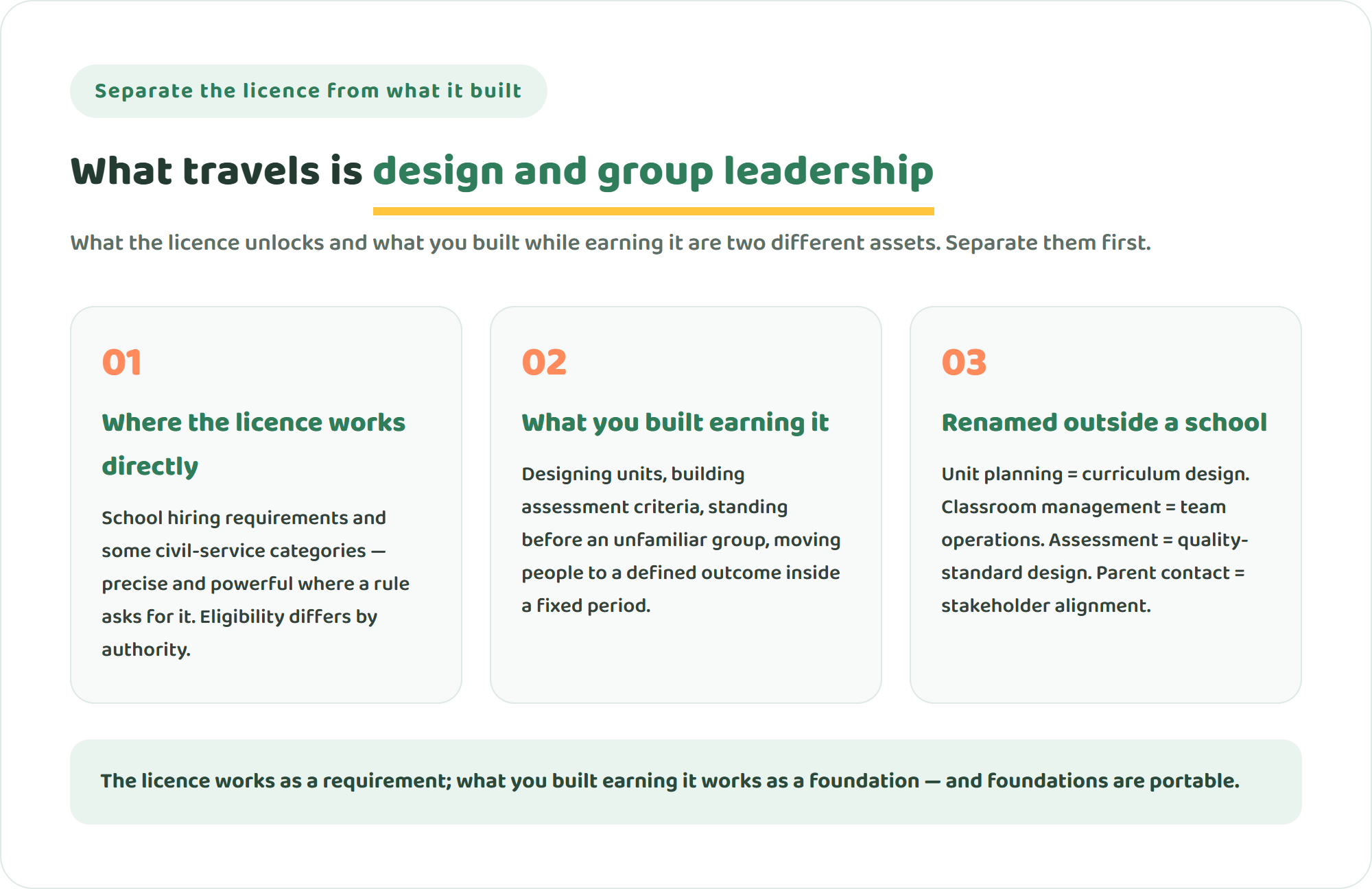

What travels further: the design and group-leadership skills behind the license
“Without a licence you are worth nothing” and “a licence is meaningless” are both wrong, and in the same way — they treat a credential as the whole story. To earn yours, you designed units of learning, built assessment criteria, stood in front of an unfamiliar group during practicum, and moved thirty-odd people to a defined outcome inside a fixed period. That is the same skeleton as work the market calls content design, learning experience design and project delivery.
Rename them and it becomes obvious. Unit and year planning is curriculum and content roadmapping. Classroom management is small-team operations and facilitation. Assessment and feedback is quality-standard design and capability building. Parent communication is stakeholder alignment between parties with different interests. Committee and administrative duties is running several projects in parallel. Written that way, “I have only ever taught” stops being an accurate self-assessment. The licence works as a requirement; what you built earning it works as a foundation — and foundations are portable.
If you do not hold a licence at all, our article on teaching jobs without a teaching license is the more useful read. From here we continue for people who hold one and want to widen its use.
Careers with a teaching license in government and the public sector
Plenty of public-sector work sits adjacent to teaching: board-of-education administration, lifelong learning and community education, public libraries and museums, child welfare and youth development, school business management. In some recruitment categories a teaching licence counts toward eligibility or is weighted in assessment. But categories, eligibility and age rules differ entirely by authority. Read the actual recruitment notice for the jurisdiction you want rather than a general summary.
New graduates who trained as teachers but want to look wider
If you finished your certification programme and now want to look beyond the classroom, there is nothing to feel guilty about. What you hold is not only the licence: it is having stood in front of a real group through practicum and having written your own instructional design down in a form someone else could follow. Few applicants your age can show either. Not using it now does not mean never using it.
Remote and part-time careers with a teaching license: choose by working style
Most people searching this are not looking for a job title — they are looking for a shape of working life. On the remote side: online tutoring and small-group instruction, materials and curriculum development, instructional design for e-learning, editing and subject review of educational content, marking and learner support. On the part-time side: adjunct and hourly teaching, learning support roles, after-school and community programmes. Both pay for exactly the design skill described above.
One practical habit. Pay is written in three different units — hourly, per-session, or a fixed monthly fee — and whether preparation and marking sit inside that unit changes the real hourly figure substantially. Comparing across units is how people get this wrong. Pick three postings only, convert each to committed hours per month and total pay per month, and line them up. Actual figures vary widely by role, region, experience and employer, so treat no published range as a rule and confirm against the individual posting.
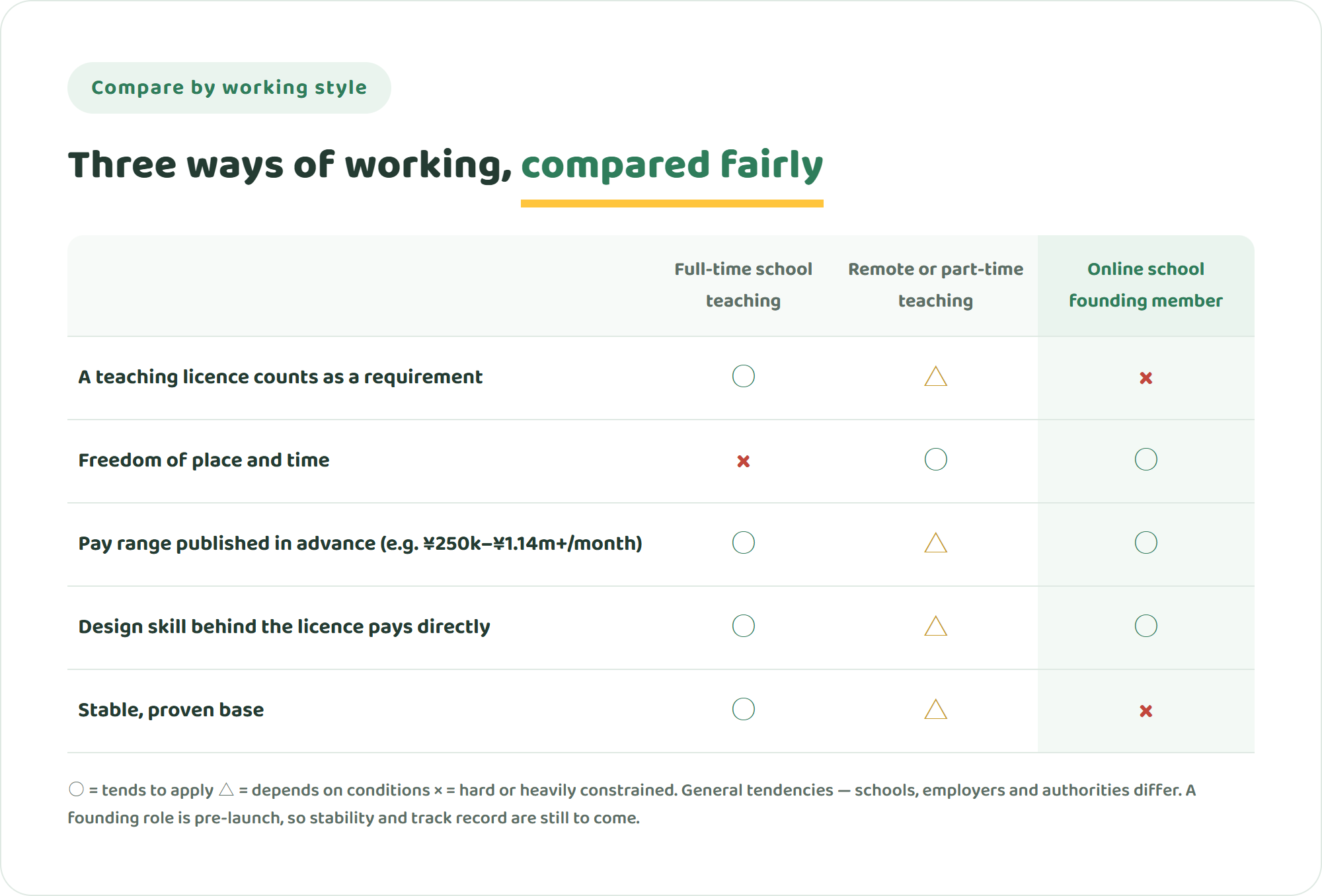
Every path has gaps. Full-time school posts are strong on stability and on clarity of requirements, and weak on freedom of place and time. Remote and part-time work inverts that, at the cost of conditions varying employer by employer. A founding role does not use a licence as a requirement and has no track record yet — and internationally it begins as a volunteer position, which we would rather say before you apply than after. What it does offer is that design skill converts directly into the work.
See the founding member roles at NIJIN GLOBAL ACADEMY → — we say up front both that a licence is not a requirement and that the international founding track begins as a volunteer role, with detailed terms shared later in the process. Better to weigh that before you decide anything.
A third way of working: treating the license as a foundation, not a requirement
脱偏差値のオンラインインターナショナルスクール NIJIN GLOBAL ACADEMY (NGA) is an online international school opening in September 2027. We are hiring founding members who both teach and build the organisation, and we do not make a teaching licence a mandatory requirement — because what we want to see is the design and group-leadership capability behind it, plus genuine appetite for building from zero. English at roughly CEFR B2+ is the guide, along with agreement with our post-deviation-score philosophy: no ranking children by test scores.
The role is fully remote, designed around working while travelling the world. You choose from five working styles, part-time through full, and beyond teaching you can take marketing, web, partnerships or HR. On terms, we will be blunt: founding roles on this track begin as volunteer positions ahead of our September 2027 opening, and the detailed terms are shared later in the process. Selection runs documents, group interview, an internship with NIJIN Academy, then a final presentation — so you can try before you commit. If you want the conventional route first, see how to become an international school teacher.
Three steps to turn a license into a career
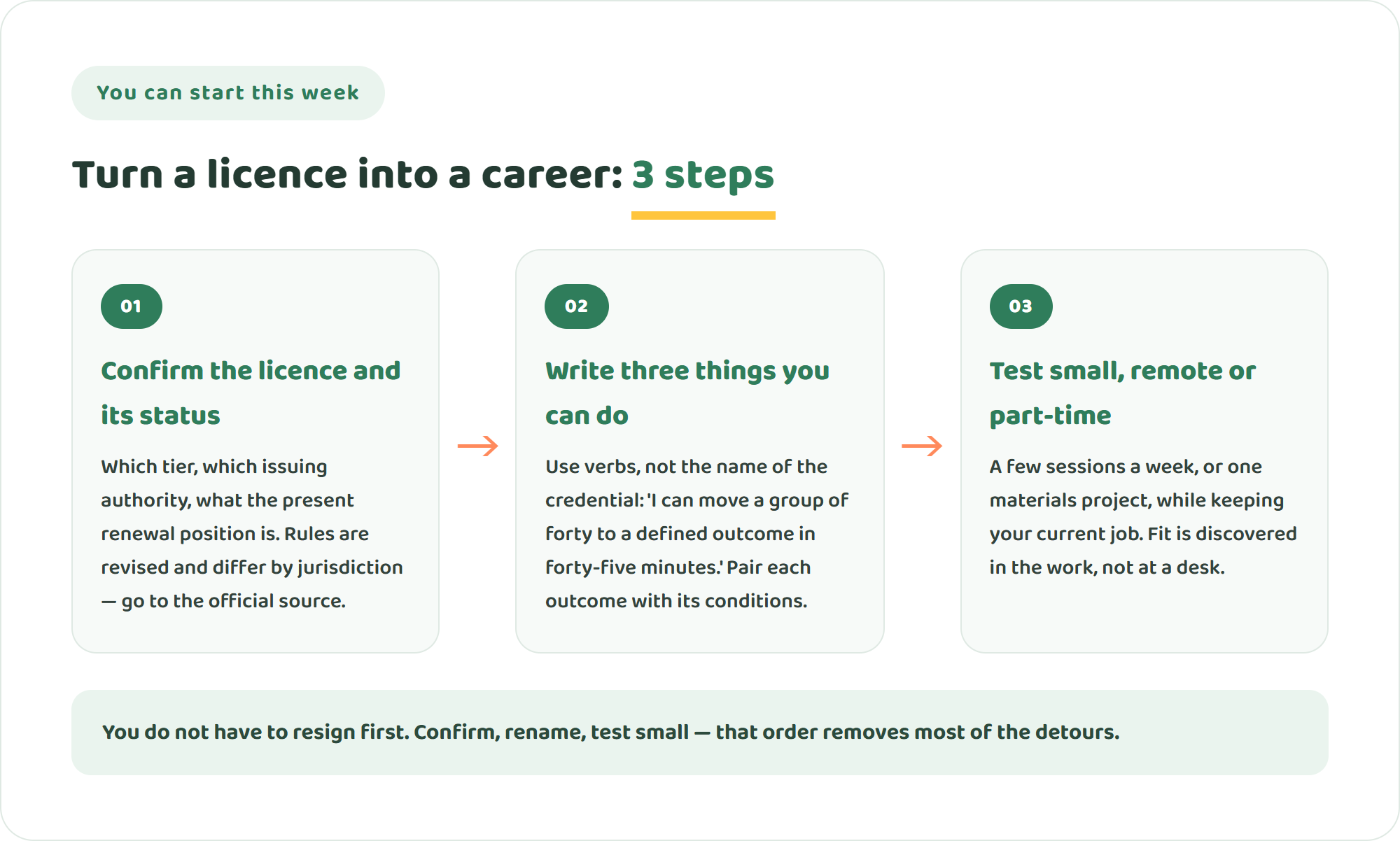
First, confirm the licence and its current status: which tier, which issuing authority, what the present renewal position is. Rules are revised and differ by jurisdiction, so go to the official source. Second, write three things you can do, not the name of the credential — for example, “I can move a group of forty to a defined outcome in forty-five minutes.” Use verbs, not titles. Third, test small through remote or part-time work: a few sessions a week, or one materials project, while keeping your current job. Fit is discovered in the work, not at a desk.
Frequently asked questions
What careers can I pursue with an elementary teaching license?
An elementary licence trains you to design across every subject rather than down one, which suits learning-materials development and subject review, children’s content planning, learning support and after-school programmes, and customer or implementation roles at education companies. Public-sector education roles are also an option, though eligibility differs by authority. In inquiry-based, small-group settings, being able to see across all subjects is a real advantage.
Are there genuinely remote careers with a teaching license?
Yes — online instruction, materials and curriculum development, instructional design for e-learning, content editing and review, marking and learner support. Because pay is written in different units by different employers, convert everything to one unit before comparing. NGA’s founding roles are fully remote by design.
Can I start part-time?
Yes. NGA offers five working styles from part-time to full, and it is possible to discuss involvement while keeping your current job. In the wider market too, adjunct teaching and learning-support roles commonly start part-time. You do not have to switch everything at once.
Can I work at an international school without a teaching license?
It depends on the school. Accredited schools may require an internationally recognised teaching qualification, but it is not universal across schools or roles. NGA’s founding member hiring does not require a licence, and what it asks for is people who can build from zero.
You open in September 2027 — is it worth applying now?
Yes. The founding roles exist to build the run-up itself: curriculum, admissions, partnerships, systems. The window to shape the design before a school starts moving does not come round often — and it is precisely where the design skill behind your licence counts most.

A license isn’t a choice between using it and throwing it away.
If you searched “careers with a teaching license,” you are someone who does not want what you have built to go to waste. It has not. The asset simply is not the certificate — it is the ability to design, and the ability to move a group. The certificate works where a rule asks for it; the ability works wherever you take it. Keeping the joy of teaching while changing only where and when you work is a real option, and it is open now.
Working at an International School — More Articles
- international school teacher salary
- how to become an international school teacher
- career change from teaching
- career change from teaching in your 30s and 40s
- how much do teachers earn?
- how to become an IB teacher
- jobs for moving abroad
- teach one class a week online
- online teaching jobs from home in India
- part-time online teaching jobs from home
- teaching jobs without a license
- qualifications to teach English
- how the Japanese teacher pay scale works
- teacher bonuses in Japan
- private school teacher salary in Japan
- teach abroad without relocating
- online international school teacher salary
- remote teaching jobs from the Philippines
Turn your passion for teaching into your next way of working.