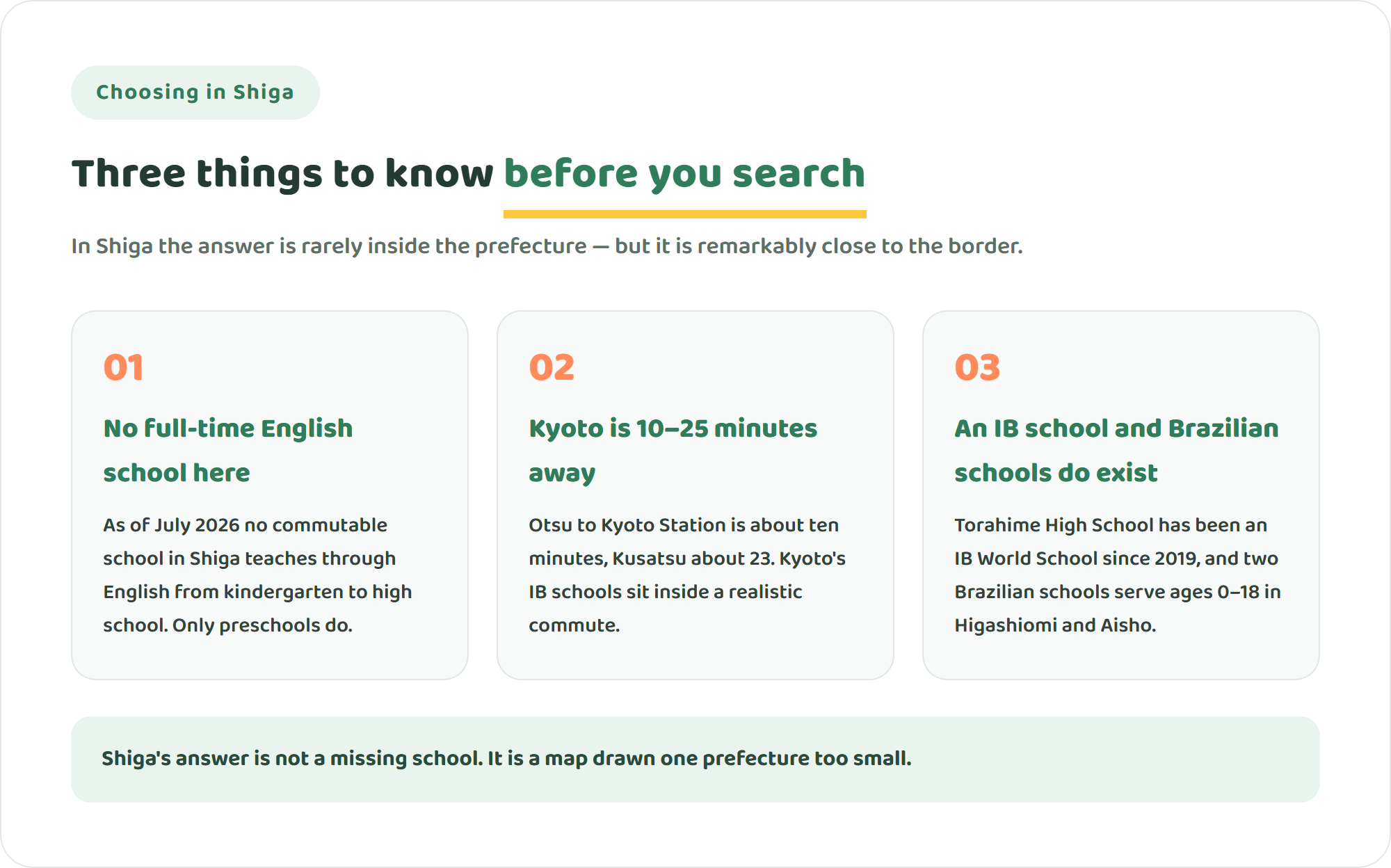
If you have been searching for international schools in Shiga Prefecture and keep landing on English-language nursery schools, you are not searching badly — you are seeing the market accurately. Shiga is home to around 1.4 million people and its foreign resident population has hit a record high four years running, yet as of July 2026 we could not confirm a single full-time, English-medium international school anywhere in the prefecture. That is not the same as saying international education is out of reach here. Shiga has an advantage almost no other prefecture can match: Kyoto Station is 10 to 25 minutes away by local train. This guide sets out the honest picture — the English-immersion preschools that genuinely exist, mapped area by area; the Brazilian schools and the one IB World School inside the prefecture; the Kyoto and Osaka schools that sit inside a realistic commute; and the online route for families for whom none of the above works.
Quick Answer: Your Options in Shiga Prefecture
If you only read one section, read this. Below are the schools covered in this guide, plus the online option — so you can see every route side by side before the details.
- Brazilian schools in Higashiomi and Aisho — real K-12 foreign schools
- An IB World School: Shiga Prefectural Torahime High School
- Japanese schools with strong English and international programmes
- NIJIN GLOBAL ACADEMY (online) — Ages 6–18 / opening September 2027, currently taking opening-update registrations / fees around one-fifth of a typical campus international school / Japanese-language support. An option when commute or fees are the wall.
International schools in Shiga Prefecture: the landscape and fee ranges
Shiga is internationalising quickly. According to the prefectural government’s resident registry survey, 44,735 foreign nationals were living in Shiga as of 31 December 2025 — up 3,260 (7.9%) in a single year, a record high for the fourth consecutive year, and 3.19% of the total population, also a record. Roughly one resident in 31 is a foreign national. Vietnam leads with 12,030 people (26.9%), followed by Brazil with 8,782 (19.6%) and China with 4,692 (10.5%). The highest concentrations are in Konan City (8.07%), Aisho Town (6.17%) and Koka City (5.71%) — the manufacturing belt of southern Shiga and the eastern lakeside.
Despite that demand, no commutable school teaching through English from kindergarten to high school could be confirmed inside Shiga in July 2026. The international-schools-database, which covers 13 areas of Japan including Tokyo and the Kyoto-Osaka-Kobe region, lists nothing in Shiga at all. What does exist falls into three layers: around ten English-immersion preschools and English after-school programmes; two foreign schools teaching the Brazilian curriculum to students from infancy through high school; and one public high school authorised as an IB World School.
Fee levels differ sharply by layer. Preschools inside Shiga generally run about ¥40,000–90,000 per month, and children aged three to five often qualify for Japan’s early-childhood education subsidy, which can cut the effective cost substantially. Kyoto’s international schools sit at roughly ¥1.5–2 million a year, and the larger Osaka schools at ¥2.2–2.8 million. For families in Shiga, that gap is where the first real decision lies.
Note: fees reflect publicly available information as of July 2026 and are subject to revision. Always confirm current figures directly with each school.
English-immersion preschools in Shiga Prefecture, by area
For children under six the picture opens up considerably. Here are the English-immersion preschools and English childcare facilities that genuinely operate in Shiga, area by area — with the caveat that these serve the early years and do not continue into elementary school.
Otsu and the western lakeshore
The densest cluster in the prefecture. Will International School in Mano, Otsu, three minutes’ walk from JR Katata Station, is a fully English-medium school for ages one to five staffed by foreign teachers, open 8:00 to 18:00, covering maths, science, art, music, sport and food education in English. Third-party databases list a four-day-a-week course from ¥42,000 per month, and the school is listed as eligible for the early-childhood subsidy. Marian Kids International School Otsu in Tsukinowa opened in 1999 and takes children from age one through the final kindergarten year, running 9:00 to 17:00 in an all-English environment with after-school piano, ballet, hip-hop and gymnastics. It operates under Japan’s corporate-sponsored childcare framework; fees are on enquiry.
Friends International Preschool, Seta campus in Oe, Otsu, near JR Seta Station, teaches music, art, rhythmic movement and cooking in English and spans ages one to eighteen across its programmes. Its Superkids class delivers English lessons during after-school care hours for elementary-age children — worth knowing if you want to stretch the English environment a little past kindergarten. Otsu also has Talking Book English Center in Hamaotsu and Kid’s & More Seta in Ogaya.
Kusatsu, Moriyama and Ritto (southern Shiga)
The fastest-growing part of the prefecture and the best connected. Friends International Preschool has a Moriyama campus in Katsube, five minutes from JR Moriyama Station, and also delivers English lessons inside Kusatsu City’s municipal after-school care facilities. LINGO International Preschool in Heso, Ritto, opened in April 2017 as an unlicensed childcare facility serving ages three to six Monday through Friday, with native-speaker teachers supported by Japanese staff who work in English; it is listed as subsidy-eligible. The English after-school chain Kids Duo also runs three locations here — Minami-Kusatsu, Moriyama and Otsu Seta — which suits families keeping their child in a local nursery or elementary school while protecting an English window after class.
Hikone and Nagahama (eastern and northern Shiga)
In the north, the first place to look is ABC ENGLISH, which runs preschools in Oyabu-cho, Hikone and Otatsumi-cho, Nagahama. It is one of very few preschools in the Kansai region certified by Shiga Prefecture as a nintei kodomoen (certified early-childhood centre), serving children from infancy to age five in an immersion setting built so that English simply exists in daily life. Afternoon clubs include rhythmic movement, piano and football, three-to-five-year-olds qualify for the early-childhood subsidy, and the school is an official test venue for Eiken and Eiken Jr. Because daily commuting to Kyoto is not realistic from Nagahama, Maibara or Takashima, families in this part of Shiga especially need to plan what happens after kindergarten well in advance.
What else counts as international education inside Shiga
There is no English-medium international school in the prefecture. But there are genuinely international schools and programmes here, and they rarely appear in other guides.
1. Brazilian schools in Higashiomi and Aisho — real K-12 foreign schools
Shiga has one of Japan’s larger Brazilian communities, and full foreign schools have taken root because of it. Nihon Latino Gakuin in Kotsubata-cho, Higashiomi City, founded in 2000 and incorporated as a quasi-school corporation, teaches around 180 students from age one to the third year of high school, following the Brazilian curriculum in Portuguese and Japanese. It is the only school in Shiga Prefecture named on MEXT’s list of designated foreign schools eligible for Japan’s high school tuition support system (for grades 1–3 of the upper secondary division). Santana Gakuen in Aisho Town, founded in 1998 and independently run, takes children from birth to eighteen across nursery, elementary, junior high and high school classes, teaching in Portuguese.
To be straightforward: neither school teaches subjects in English. Portuguese and the Brazilian curriculum are the core. So they are not the answer for a family seeking English-medium international education. But the fact that Shiga has schools where children can keep learning in their home language and home curriculum matters a great deal to families with roots abroad, which is why they belong in this guide.
2. An IB World School: Shiga Prefectural Torahime High School
Less widely known: Shiga does have an IB authorised school. Torahime High School in Nagahama was designated a research school for IB adoption in 2014, became a candidate school in 2017, and was authorised as an IB World School on 19 March 2019. It launched its Diploma Programme in 2020 and its first cohort graduated in March 2023. The programme runs as a Japanese-language DP with two subjects taught in English. Up to 20 students per year take the DP, with as many as 40 admitted as IB candidates at entry and final selection made in late July of the first year. Because it is a public high school, the cost is nowhere near private international school levels. If an internationally recognised qualification at high-school age is the goal, this route works without leaving Shiga.
3. Japanese schools with strong English and international programmes
Shiga Prefectural Kokusai Joho (International Information) High School in Ono, Ritto, is a comprehensive high school with five study streams that has prioritised international understanding and foreign languages since its founding, offering Korean and Chinese alongside English. It was designated a Super English Language High School (SELHi) by MEXT for three years from 2003 and runs overseas study in Vancouver as well as hosting educational tour groups from Taiwan and China. Ritsumeikan Moriyama Junior and Senior High School, opened in 2007 in Moriyama, is an integrated junior high, high school and university pathway and a designated Super Science High School. Neither is an English-immersion track where subjects are taught in English, but for families who want to keep Japanese school enrolment while deepening English and intercultural learning, both are practical.
Kyoto and Osaka: the international schools genuinely within reach of Shiga
This is Shiga’s real advantage. JR Otsu to Kyoto Station takes about ten minutes; Kusatsu to Kyoto about 23. That is shorter than crossing many Japanese cities. In Shiga, “no international school in the prefecture” does not translate into “no international school you can reach”.
Kyoto International School (KIS) in Kamigyo-ku, Kyoto, founded in 1957, is the only IB Continuum World School in Kyoto, offering the Early Years, Primary Years, Middle Years and Diploma Programmes, accredited by WASC and COBIS, and expanding to Grade 12 in 2026. Published 2026-27 figures on third-party databases show annual fees of ¥1,556,800 from kindergarten through Grade 5 and ¥1,951,000 for Grades 6 to 10, plus a one-time ¥31,500 application fee and ¥220,000 registration fee. Doshisha International Academy Elementary School in Kizugawa, Kyoto is an IB PYP World School running Japanese-English bilingual education under MEXT’s special curriculum designation; its 2026 admissions guidelines list a ¥250,000 entrance fee, tuition of ¥1,000,000 for grades 1–2 and ¥850,000 from grade 3, and a ¥150,000 annual enrichment fee. For the full picture see our guide to international schools in Kyoto.
Osaka is also on the table — Kusatsu to Osaka Station is roughly an hour by JR Special Rapid. Osaka International School of Kwansei Gakuin in Minoh is a K-12 school whose published 2026-27 figures on third-party databases show ¥2,275,000 a year for Grades 1–5, ¥2,713,000 for Grades 6–10 and ¥2,833,000 for Grades 11–12, plus a ¥40,000 application fee and ¥330,000 registration fee, with an approximately 4% increase announced across all grades for 2026-27. See our guide to international schools in Osaka, and our guide to international schools across all 47 prefectures for the wider region.
One honest counterweight. Those figures are station to station. Add the walk to your local station, the transfer and the walk at the other end, and most families are looking at roughly an hour each way. Ask whether a six-year-old can sustain that every morning, and price the season ticket over a full year. Before you shortlist, multiply the door-to-door time by twelve years and see how it feels.
Comparing the options: what actually fits your family
Preschools inside Shiga, schools in Kyoto and Osaka, and online international schools are not ranked best to worst — they fit different constraints. Set them against five criteria and the decision gets much clearer: affordability, whether the path continues past age six, commute burden, in-person campus experience, and support for Japanese or the home language.
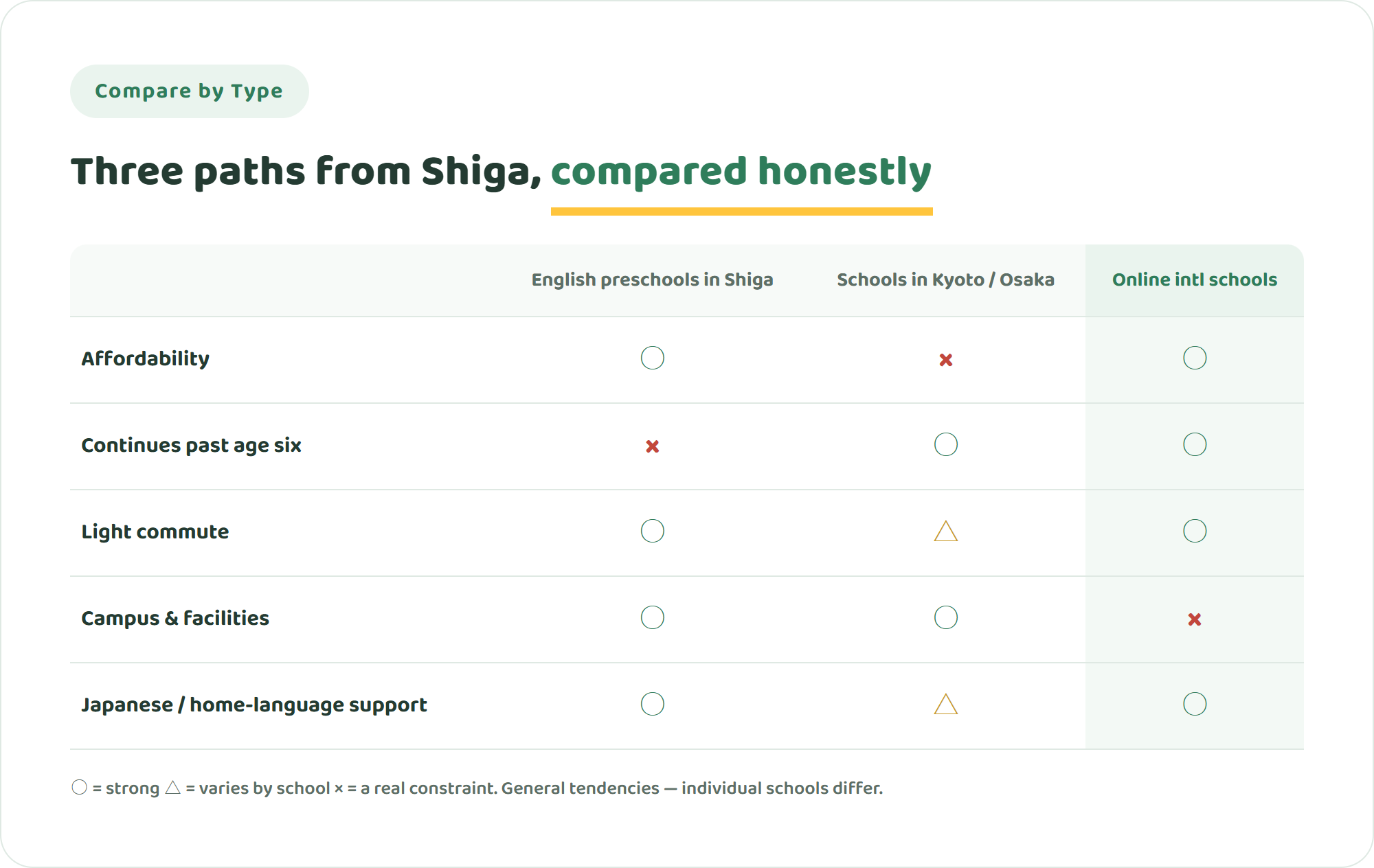
In Shiga, the row that catches most families is the second one. Preschools inside the prefecture stop at age six, so the moment you want English-medium learning to continue you are choosing again — out of prefecture, or a different format entirely. Kyoto and Osaka schools do run through to graduation, but at ¥1.5–2.8 million a year and around an hour of travel each way. If you want the cost picture in more detail, our breakdown of what international school actually costs covers the fees beyond tuition that catch families out.
See how learning works online →
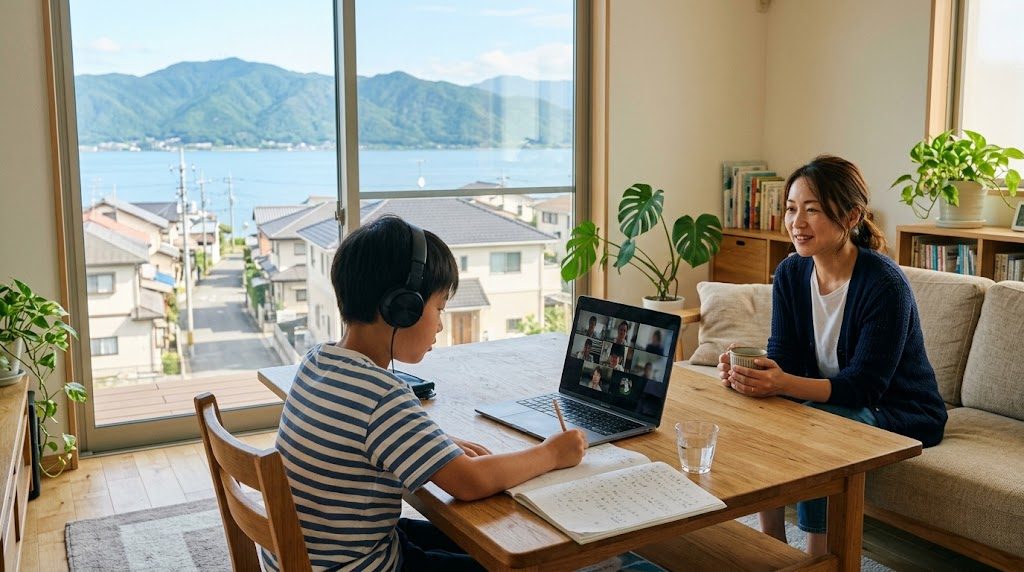
International education without the commute — the online option
Some readers will finish that section thinking: Kyoto is reachable, but an hour each way for a first-grader plus ¥1.5 million a year is not workable. Others live in Nagahama, Maibara, Takashima or Koka, where Kyoto is not a daily commute at all. That is precisely the family NIJIN GLOBAL ACADEMY (NGA) is being built for. We are an online international school opening in September 2027.
NGA is run by NIJIN Inc., the Japanese company behind NIJIN Academy, an alternative school with over 1,000 students enrolled. What we care about is moving away from ranking children by test scores. Learning happens in small, dialogue-centred groups, built around a simple aim: helping children come to like themselves and the world. We serve ages 6 to 18 across Asia and Oceania, and because location is irrelevant, a family in Otsu, Nagahama or Koka has exactly the same access as one in a major city. Japanese-language support underpins the programme so children can move into English gradually. Our goal is to make tuition roughly one-fifth of a bricks-and-mortar international school.
The honest caveats: we have not opened yet, so our track record is still ahead of us. And an online school cannot reproduce a playground, a school field, or the feeling of sitting shoulder to shoulder in the same room. Even so, for a good number of Shiga families, this is what turns “there is nothing near us, so we will give up” into “we do not need to get there at all”.
Frequently asked questions
Q. Can families anywhere in Shiga commute to a school in Kyoto?
A. The south and the north are very different. From Otsu, Kusatsu, Moriyama and Ritto, Kyoto Station is 10 to 25 minutes on the JR Biwako Line — a realistic daily commute. From Hikone, Nagahama, Maibara, Takashima or Koka it is 50 minutes to an hour and a half to Kyoto Station before you even reach the school, which is heavy for a primary-age child every day. Check the route from your nearest station to the school’s nearest station, then add the walking and bus time at both ends, and judge on the door-to-door figure.
Q. Is there really no school in Shiga where my child can learn in English from elementary age?
A. Based on public information reviewed municipality by municipality in July 2026, we could not confirm any commutable school in Shiga using English as the language of learning from kindergarten through high school. For elementary-age children there are English after-school programmes — Friends International Preschool’s Superkids class and the Kids Duo locations — which protect an English window after class. But those are not places where subjects are taught in English. If learning subjects in English is the goal, commuting to Kyoto or Osaka, or studying online, are the practical routes.
Q. What happens to my child’s Japanese?
A. It varies enormously by school. Doshisha International Academy, for instance, protects Japanese-language instruction as part of its bilingual model, while some settings are almost entirely English. Many parents worry their child will end up strong in neither language. Whatever you choose, put “how is Japanese maintained?” on your list of questions at every school visit, and ask to see the actual weekly timetable rather than the brochure description.
Choose what you can sustain, not just what is nearby
Search only inside Shiga’s borders and the answer looks like a dead end: no full-time English-medium school, and preschools that stop at age six. But that is not the same as saying international education is out of reach for your child. There are four routes here, not one: build the foundation at an English preschool in Shiga, aim for the IB Diploma at Torahime High School, commute to Kyoto or Osaka, or learn online. Thanks to a ten-minute train ride to Kyoto, Shiga is in fact one of the better-placed prefectures in the country.
The better question is not which school will accept your child, but which kind of learning your family can keep going for years. There is no need to rush. Start today by checking one travel time from your home to Kyoto Station. Even that will change how the map looks.
International School Guides for Other Prefectures
- International Schools in Hyogo Prefecture
- International Schools in Kyoto Prefecture
- International Schools in Mie Prefecture
- International Schools in Nara Prefecture
- International Schools in Hokkaido Prefecture
- International Schools in Kanagawa Prefecture
- International Schools in Aichi Prefecture
- International Schools in Shimane Prefecture
- International Schools in Shizuoka Prefecture
- International Schools in Tochigi Prefecture
- International Schools in Tokushima Prefecture
- International Schools in Tottori Prefecture
- International Schools in Toyama Prefecture
- International Schools in Wakayama Prefecture
- Browse all 47 prefectures of Japan