If you searched international school vs local school, you are almost certainly standing at a fork that feels bigger than it should. In Singapore, Kuala Lumpur, Manila or Tokyo, the decision carries real weight — tuition that can rival a mortgage on one side, questions of belonging, language and university pathways on the other. And underneath the comparison chart is a quieter worry: what if we choose wrong, and can’t undo it?
Let’s take the honest path here, without the brochure gloss. The truth is that there is no universal winner between international and local school — only the fit for one particular child, in one particular family, right now. In this piece we’ll look plainly at what each option really offers across Asia, why so many families end up second-guessing, and how to decide without regret — including a third option where it doesn’t have to be an either-or choice at all.

International school vs local school: the honest starting point
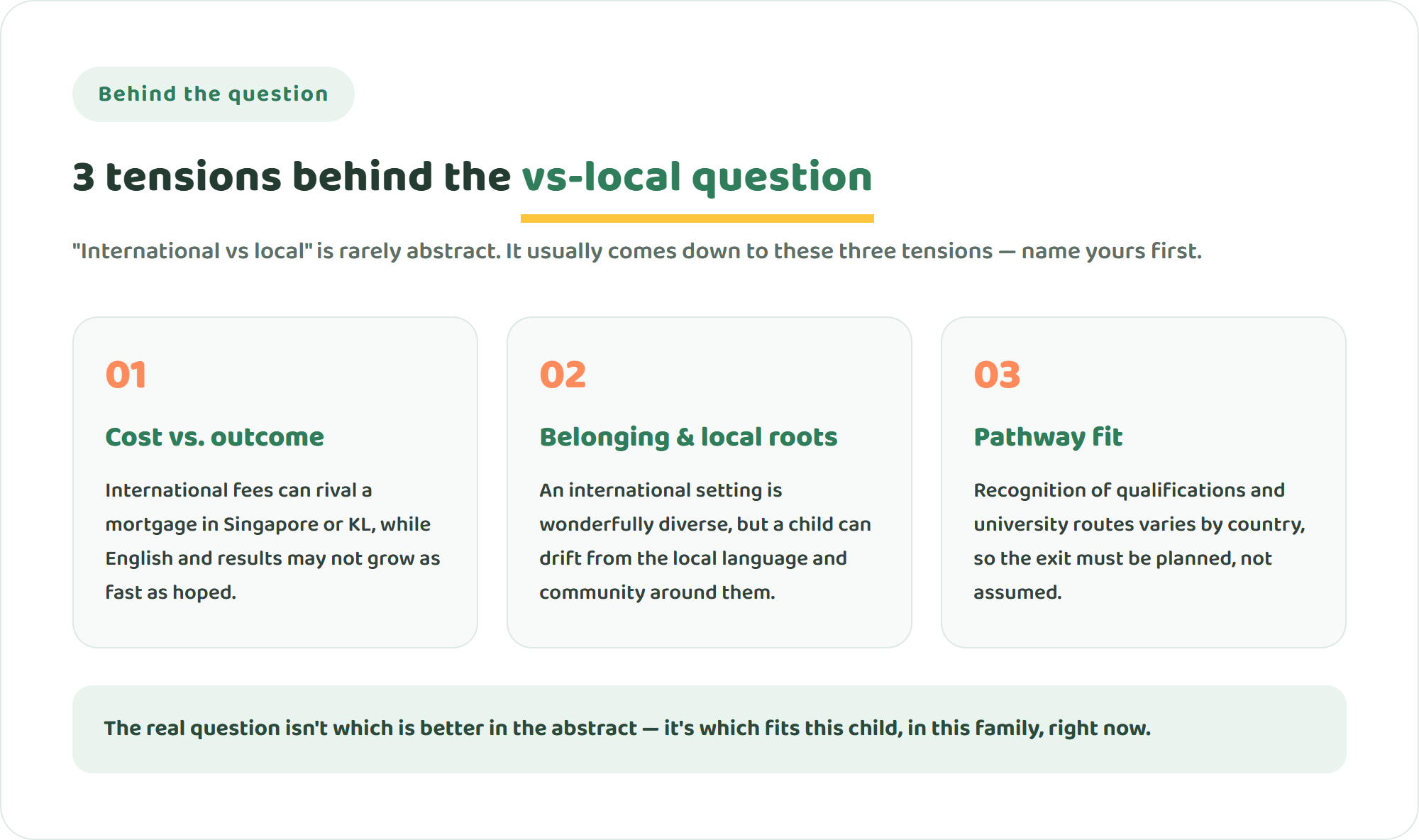
Here’s what most comparisons skip. Neither option is better in the abstract — they are simply strong at different things. A local school in Singapore or Malaysia tends to be far more affordable, roots a child in the local language and community, and offers rigorous academics. An international school offers a multicultural environment, English immersion and internationally portable qualifications like the IB. When families ask international school vs local school, they are usually weighing three tensions at once: cost against outcome, belonging against global exposure, and how a chosen pathway lines up with the universities they care about.
Fees make the contrast vivid. Across the region, international schools commonly charge somewhere from roughly USD 8,000 to 40,000 a year, while local or government schools cost a small fraction of that. But cost is only one axis. The mistake is treating the decision as a single, permanent verdict, when it is really a question of which environment fits your child at this stage. Name your own three tensions first, using the frame below.
Why families second-guess — the expectation gap and the either-or trap
So why does this fork cause so much doubt? Two structural reasons. The first is the expectation gap. “An international school will make my child fluent and global” is an appealing image, but how fast English grows, and how easily a child settles in, depends heavily on temperament, developmental stage and the school’s support. In practice, a child can sit in an international classroom yet speak mostly their home language with peers — and English may grow more slowly than the fees seemed to promise.
The second is the either-or trap: the belief that “international or local” is a one-time, irreversible choice. That belief is what turns a small dissatisfaction into a giant “should we pull them out entirely?” But a child’s needs change — an environment that fit six months ago can strain them now. If you’re still weighing the underlying trade-offs, we lay them out honestly in our guide to the pros and cons of international school, and if fees are the pressure point, our piece on when international school feels too expensive offers a grounded way to weigh it.
How to actually decide — separate the signals, then compare
This is the heart of the article. To turn an anxious “which is better?” into a confident decision, judge it on three axes rather than emotion — and start by separating what is actually going wrong.
First, if the issue is belonging: a struggle rooted in one classroom’s culture or thin support can often improve through the school itself; a child overwhelmed by the in-person group setting may need a change in the shape of the environment. Second, if it’s cost: fees that squeeze the household every term quietly narrow a family’s whole life, and that is a legitimate reason to reconsider. Third, if it’s pathway and language: if the local language, community and home-country university routes matter most to you, a setting with mother-tongue support deserves weight. Compare the three options honestly below — noticing that none is strong on every axis.
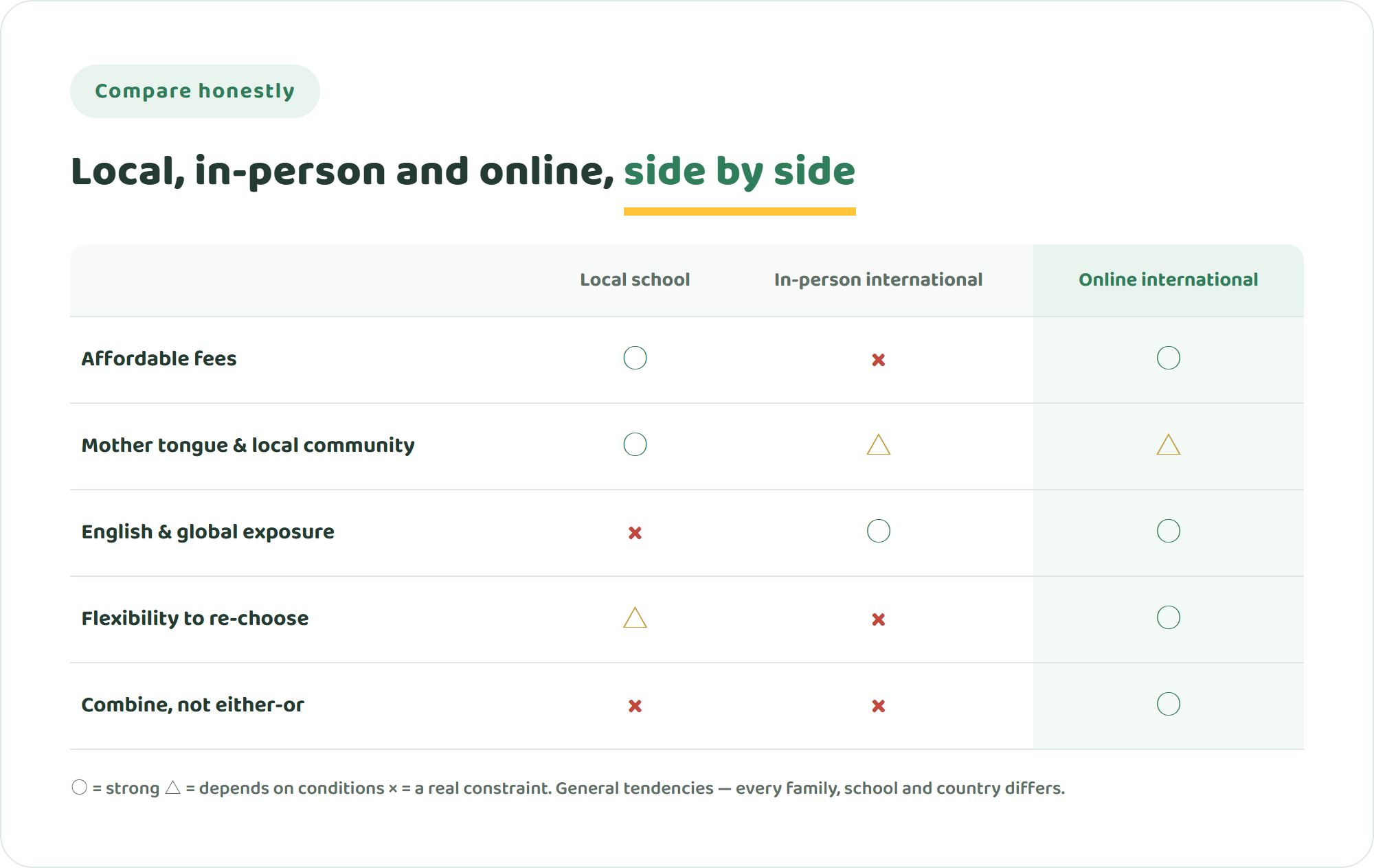
As the table shows, each option has genuine strengths and real limits. In-person international schools offer a richness that only physical presence gives; local schools offer roots in language and community that are hard to replace. The point is not to reject a whole path over today’s frustration, but to choose calmly from your child’s actual state and your family’s priorities — continue, adjust, or change.
Explore how NGA approaches global learning →
A third option — not “quit or continue,” but learning you can re-choose
Here is another way to think about it. What we at NIJIN GLOBAL ACADEMY (NGA) want to say first is this: leaving a school is not a failure. Children change; the right environment changes with them. So rather than binding yourself to “once decided, see it through,” it is entirely reasonable to re-choose learning to fit the child in front of you.
NGA is building online, international learning that doesn’t rank children by test scores, centred on small-group dialogue. Through the screen, children exchange “what do you think?” with peers across the world, and English, perspective and their own interests grow along the way. Because tuition is aimed at roughly one-fifth of a typical on-campus international school, and because home-language support is built in, it doesn’t have to be “international vs local” at all — a child can attend a local school and still connect to the world online, a genuine blend rather than an either-or. It isn’t a cure-all; compare it fairly with the others and choose it only when it fits your child.

You can decide calmly, in three steps
When the stakes feel high, the order of decisions matters most. Here is how to turn the international school vs local school question into a plan, in three unforced steps.
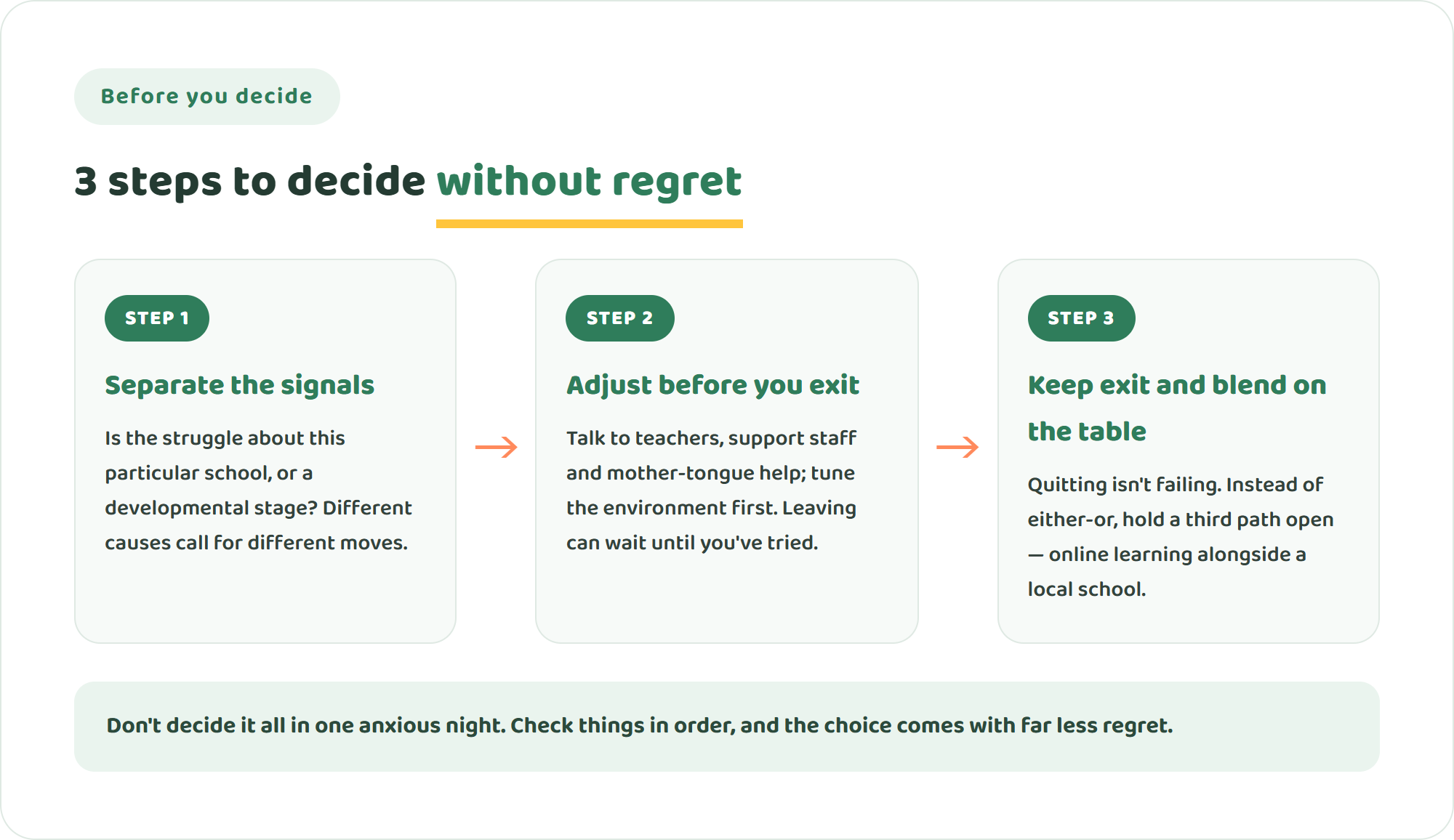
STEP 1 is to separate the signals: decide whether the struggle is about this particular school or a passing developmental stage — different causes call for different moves. STEP 2 is to adjust before you exit: talk to teachers, support staff and mother-tongue help, and tune the environment first; leaving can wait until you’ve genuinely tried. STEP 3 is to keep exit and blend on the table: quitting isn’t failing, and instead of either-or you can hold a third path open — online learning alongside a local school. Follow this order and the decision comes with far less regret.
Frequently asked questions
International school vs local school — which is actually better?
Neither, in the abstract. Local schools across Singapore and Malaysia win on affordability, local-language roots and academic rigour; international schools win on English immersion, a multicultural setting and portable qualifications. The better choice depends on your child’s temperament, your budget and the university pathways you care about — so decide from fit, not reputation, and remember the choice can be revisited as your child grows.
Is it worth pulling my child out of international school if they’re struggling?
Not automatically. First separate the cause: a struggle tied to one classroom’s culture or thin support can often improve within the school, while a deeper mismatch — cost that strains the household, or a child overwhelmed by the in-person setting — is a fair reason to change. Try adjusting the environment before deciding, and treat leaving as a re-choice, not a defeat.
If we choose local school, will my child miss out on English and global exposure?
Not necessarily. A local school gives strong local roots, and English and global connection can be added alongside it — through reading, community, or an online international programme. That blend is exactly why “international vs local” needn’t be a hard either-or; many families combine a local school with global learning online to get the strengths of both.
Does moving between countries change the international-vs-local decision?
Yes — mobility is where planning pays off most. Recognition of qualifications and university routes varies between, say, Singapore, Malaysia, the Philippines and Japan, so a strong pathway in one place may need extra steps in another. If a move is likely, favour options that travel well and confirm requirements with target universities in each country before you commit.
From “which is better?” to “this is what fits our child.”
Choosing international, choosing local, or later changing your mind — none of these is a failure. What matters is listening less to the crowd’s verdict and more to the child in front of you. Separate the causes, choose calmly between continuing, adjusting and changing, and keep a third path open where you don’t have to choose one side at all. Do that, and “which is better?” quietly becomes “this is what fits our child, right now.”
NIJIN GLOBAL ACADEMY opens in September 2027. We’ll share how our learning works — beyond the exam race, within-reach pricing, and connection with the world through small-group dialogue — along with our approach to blending local and global rather than choosing between them, and first-cohort enrolment news, straight to your inbox. Let’s find the learning that fits your child, together.
Honest Answers to Your Worries — related reading
- Will My Child Lose Their Mother Tongue?
- The Honest Pros and Cons of International School
- Disadvantages of Bilingualism in Childhood: Myths vs Research
- Who Regrets International School — and Who Doesn’t
- International School Special Needs: What to Look For
- Does International School Hurt Your Child’s Home Language?
- When Your Child Is Struggling at International School
- Do International Schools Make Children Fluent in English?
- Is International School Worth It? What Happens to Graduates
- Should I Send My Child to International School?
- Transfer From a Local School to an International School
- Disadvantages of Early English Education: What Research Says
- What Happens to International School Graduates