Start looking at international schools and the labels pile up fast: IB World School, British school, American school, bilingual school, boarding school, online international school. They sound like competing brands, but they are really answers to different questions. One label tells you what your child will study, another who runs the school, another how your child will attend.
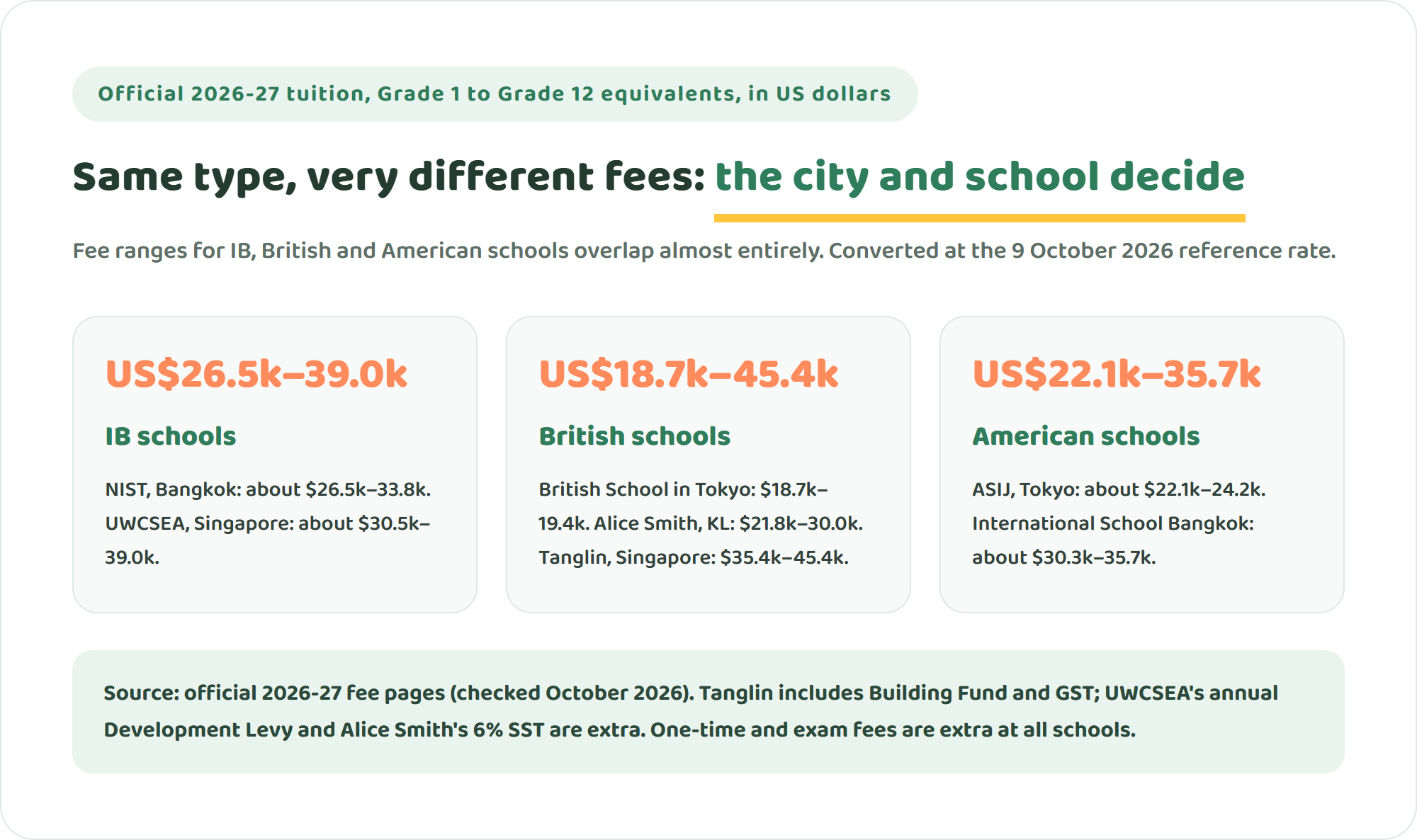
This guide sorts the main types of international schools into four simple groups, explains what each type actually changes for a family, and puts real 2026–27 tuition from official school websites next to each one, so you can see what the type does and does not tell you about cost. Fees are converted to US dollars at the 9 October 2026 reference rate (ECB, via Frankfurter); they are illustrations, not quotes.

Types of international schools: four ways to sort them
There is no single legal definition of an “international school” that applies in every country. In practice, a school usually earns the name because it teaches in English (or two languages), follows a curriculum from outside the host country, and serves families from many nationalities. Within that broad group, schools differ along four separate lines:
- Curriculum: IB, British, American, another country’s national system, or a mix.
- Language: English-medium, or bilingual (for example English and Mandarin).
- Who runs it: an independent school with its own board, a school group, or a school in a movement such as UWC.
- How your child attends: day school, boarding school, or an online international school.
Of the four, curriculum matters most for your child’s future, because it decides which exams they sit and which qualification they leave with. So we start there. If you are still at the stage of asking what an international school is in the first place, our guide What Is an International School? covers the basics.
International school types by curriculum
IB schools (International Baccalaureate)
IB World Schools teach one or more programmes from the International Baccalaureate Organization: the Primary Years Programme (PYP, ages 3–12), the Middle Years Programme (MYP, ages 11–16) and the Diploma Programme (DP, ages 16–19). Some schools offer the whole sequence; many offer only the Diploma Programme in the last two years. The IB authorizes each school for each programme, and a “candidate school” is one that has applied but is not yet authorized, so check which programmes a school is actually authorized to teach.
Real examples: UWCSEA in Singapore teaches the IB Diploma in Grades 11–12, with 2026–27 tuition of SGD 39,069 (Grade 1 band) to SGD 49,926 (Grades 11–12), about US$30,500–39,000. NIST International School in Bangkok runs PYP, MYP and DP, with tuition of THB 889,200 (Year 2) to THB 1,132,800 (Year 13), about US$26,500–33,800. For one school in depth, see our UWCSEA fees review.
British-curriculum schools
British international schools follow the curriculum of England, organised by “Years” rather than “Grades”. Students usually sit IGCSE exams at about 16 and A Levels at 18; some schools offer the IB Diploma in the Sixth Form instead of, or alongside, A Levels. Many are inspected under the UK government’s British Schools Overseas scheme or are members of COBIS.
Real examples: The British School in Tokyo charges ¥2,960,000 (Year 2) to ¥3,070,000 (Year 13) for 2026–27, about US$18,700–19,400. Tanglin Trust School in Singapore charges SGD 45,375 to SGD 58,080 including its Building Fund and 9% GST, about US$35,400–45,400; it offers both A Levels and the IB Diploma in the Sixth Form. The Alice Smith School in Kuala Lumpur charges MYR 89,070 to MYR 122,370, about US$21,800–30,000. More detail: British School in Tokyo fees and Tanglin Trust School fees.
American schools
American international schools follow a US-style K–12 structure and award a US high school diploma based on credits. Students can take Advanced Placement (AP) courses and exams run by the College Board, which many universities recognise for admission or credit. Accreditation usually comes from a US accrediting body such as WASC or Cognia.
Real examples: The American School in Japan (ASIJ) in Tokyo charges ¥3,498,000 (Grade 1) to ¥3,826,000 (Grade 12) for 2026–27, about US$22,100–24,200. Taipei American School charges TWD 956,770 to TWD 1,055,105. Seoul International School bills in two parts, Korean won plus US dollars: KRW 22,880,000 + US$8,140 for Grades 1–5, rising to KRW 27,840,000 + US$9,900 for Grades 9–12.
Mixed schools: more common than you might think
Many well-known schools do not fit one box. International School Bangkok runs an American programme with AP and also offers the IB Diploma (THB 1,015,000–1,197,000, about US$30,300–35,700). Shanghai American School offers AP and the IB Diploma. Jakarta Intercultural School combines IB programmes with AP. When a school says “IB and AP” or “A Level and IB”, ask which route most students actually take, and whether your child can switch between them.
Bilingual schools
Bilingual international schools teach in two languages throughout. Chinese International School in Hong Kong teaches in English and Mandarin and leads to IGCSE and the IB Diploma, at HKD 300,300 to HKD 359,200 a year (about US$38,300–45,800). A bilingual school can be a strong choice if both languages matter to your family, but it asks more of a child who is new to one of them.
Other countries’ national schools abroad
French lycées, German schools and Japanese schools abroad teach their own country’s national curriculum outside that country. They are often listed alongside international schools but serve a different purpose: keeping a child on track to re-enter one national system. Japan’s Ministry of Education counts 94 full-time Japanese schools abroad in 49 countries and one region (as of 15 April 2024), and they generally follow Japan’s national curriculum guidelines and textbooks. If you expect to return home within a few years, this type deserves a look.
Does the type decide the fees? Not really
Put the examples side by side and one pattern stands out: the city and the individual school move the price far more than the curriculum does. In Tokyo, the British School in Tokyo (about US$18,700–19,400) costs less than ASIJ (about US$22,100–24,200). In Singapore, the British-curriculum Tanglin Trust School (about US$35,400–45,400, including its Building Fund and GST) costs more than the IB school UWCSEA (about US$30,500–39,000, before its annual Development Levy of SGD 5,166, or SGD 9,537 in the first year). The ranges for the three main types overlap almost entirely.
Tuition is also only part of the bill. ASIJ adds a one-time building maintenance fee of ¥1,525,000; Tanglin’s application, enrolment and capital levy fees total SGD 10,000; UWCSEA adds a Development Levy every year; the Alice Smith School’s fees are subject to 6% SST; International School Bangkok charges a one-time registration fee of THB 260,000. IB Diploma and A Level exam fees often come on top in the final years. For the full table of 18 schools across 11 Asian cities, see International Schools in Asia: Fees.
So choose the type for what your child will study and where they will go next, then compare fees school by school. If the way lessons are taught matters as much to you as the label, you can also read how NGA plans its online school curriculum.
Types by who runs the school
Ownership is less visible than curriculum, but it affects how fees are set and how decisions are made.
- Independent schools with their own board. Many long-established international schools are governed by a board of trustees or a parent-elected board. Ask how the board is chosen and how fee increases are decided.
- Schools that belong to a group. Some schools are part of an education group that runs campuses in many countries. British International School Ho Chi Minh City, for example, publishes its fee schedule on the Nord Anglia Education website. A group can offer shared resources and easier moves between campuses; ask what is decided locally.
- Schools in a movement. UWCSEA belongs to the UWC movement of schools and colleges with a shared mission. In Japan, UWC ISAK Japan in Karuizawa is part of the same movement.
None of these is automatically better. The useful question is simply: who decides, and how will you hear about it?
Types by how your child attends
Day schools
Most international schools are day schools: your child lives at home and travels to campus. Every fee in this guide so far is day-school tuition. Commuting time and the school bus (Seoul Foreign School lists bus service at KRW 4,200,000 a year, for example) are part of the real cost.
Boarding schools
Boarding international schools add accommodation and pastoral care, usually from secondary age. UWC ISAK Japan is a boarding school; in the UK, many famous schools are boarding schools with international students. Boarding changes the question from “which curriculum?” to “is my child ready to live away from home?”
Online international schools
Online international schools teach through live or self-paced lessons over the internet, so a family can stay where it is. Some lead to British qualifications (IGCSE, A Level), others to an American diploma. Examples include King’s InterHigh, which follows the British route. If you are comparing the British and American routes online, our guide to British vs American online international schools lays out the differences, and IGCSE online explains how exams work from abroad.
Accreditation is not a type, but always check it
Accreditation and authorization sit on top of every type. An IB school should be authorized by the IB for each programme it offers; a British school may hold British Schools Overseas status or COBIS membership; an American school is usually accredited by WASC, Cognia or a similar body; many schools of every type are also accredited by the Council of International Schools (CIS). These are checks on quality, not types of school, and they matter most for online schools, where claims are easier to make. Our guide to checking an online international school’s accreditation shows what to look up and where.
The main types side by side, with NGA
Here is how the three main curriculum types compare with NIJIN GLOBAL ACADEMY (NGA), the online international school we are preparing to open. We have left NGA’s crosses in.
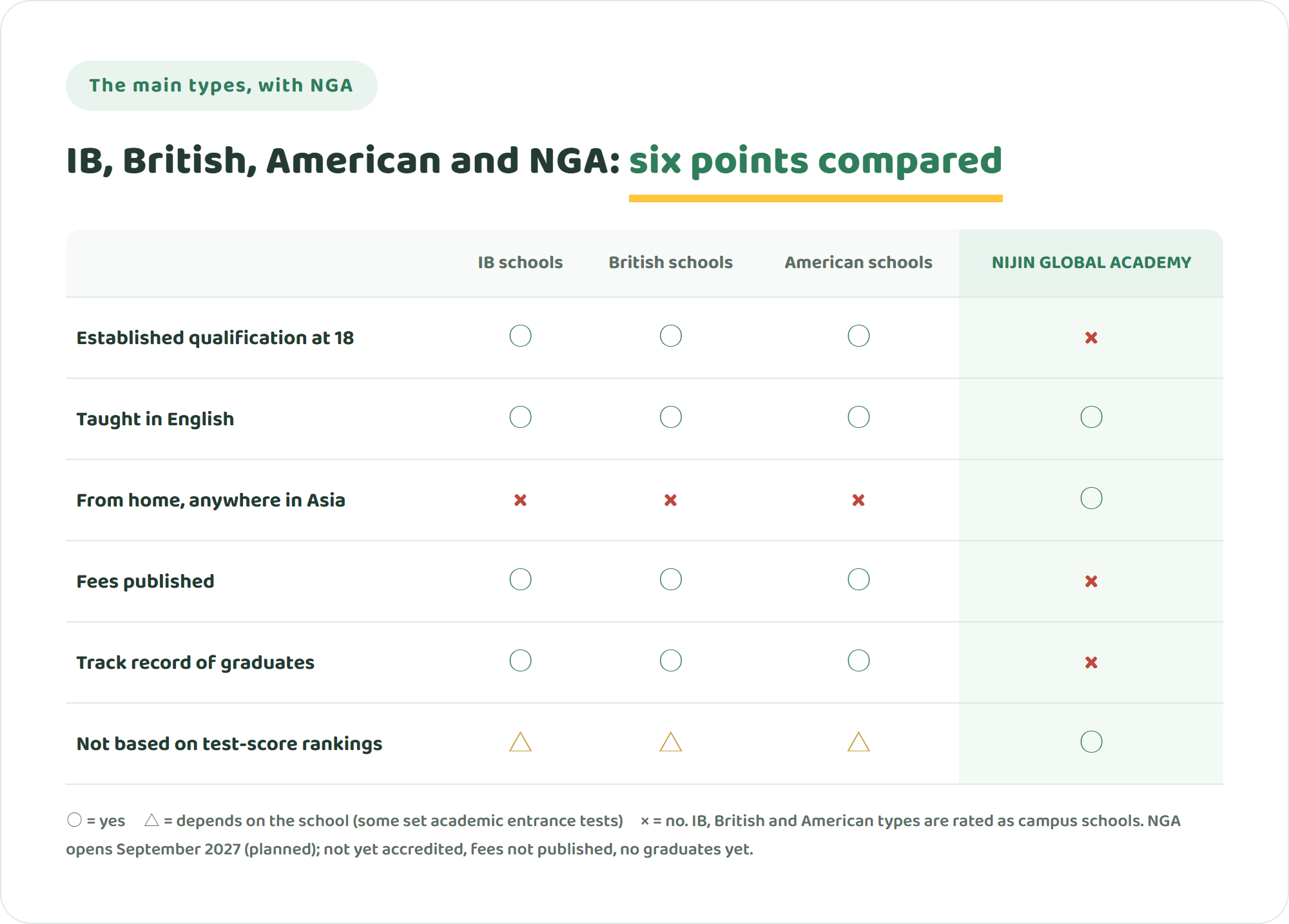
The table makes the trade-off plain. If your child needs an established qualification at 18, choose among the IB, British and American types; NGA is not yet open, not yet accredited and cannot yet award one. What NGA adds is different: learning in English from home, wherever the family lives in Asia, without moving to a campus city.
Which type of international school suits your child?
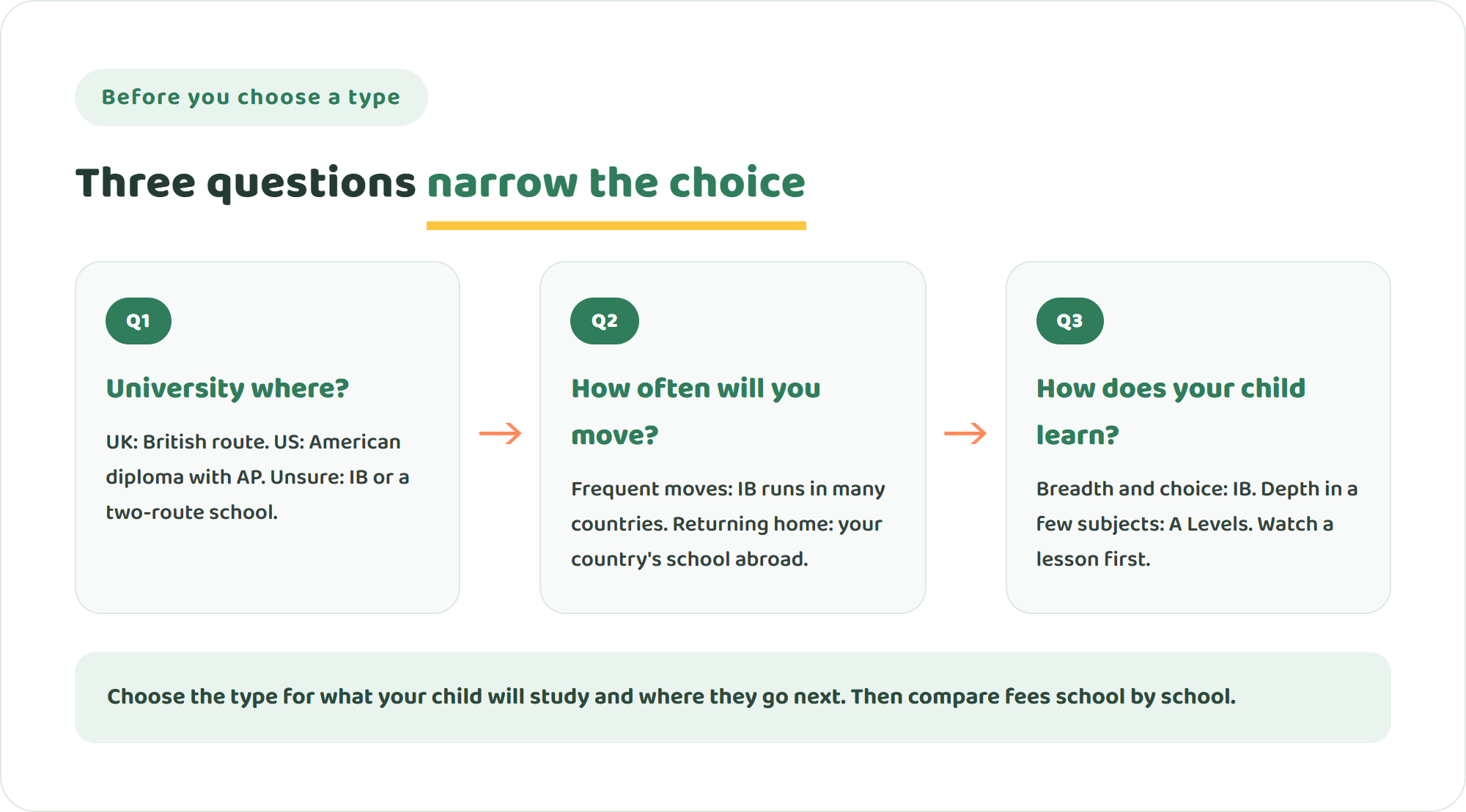
Three questions narrow the choice quickly.
- Where might your child go to university? A British route fits the UK well; an American diploma with AP fits the US well; the IB Diploma is widely recognised in many countries. If you do not know yet, the IB or a school that offers two routes keeps more doors open.
- How often will your family move? The same IB programmes run in many countries, which can make moves between schools smoother. If you will return to one national system, that country’s school abroad may be the safer bet.
- How does your child learn best? A child who thrives on choice may enjoy the IB’s breadth; a child who likes depth in a few subjects may prefer A Levels. Visit, ask to see a lesson, and ask current parents.
Where NIJIN GLOBAL ACADEMY fits
NIJIN GLOBAL ACADEMY (NGA) is an online international school for ages 6–18 focused on Asia and Oceania, opening in September 2027 (planned). It is operated by NIJIN Inc., which runs learning programmes in Japan, including NIJIN Academy for children who do not attend school, and has supported more than 1,000 children. It plans live classes in small groups of about eight, with subjects taught in English and support from a bilingual English–Japanese mentor. Admission will not be based on test-score rankings.
The honest limits: NGA is not yet open, not yet accredited and has no graduates, and tuition has not been published. It is not a replacement for an IB, British or American school when your child needs that qualification. Where it may help is for families who have no international school within reach, cannot move to a campus city, or want their child to think and speak in English through the primary and middle school years before choosing a route at 16.
FAQ
What are the main types of international schools?
By curriculum, the main types are IB schools, British-curriculum schools and American schools, plus mixed schools, bilingual schools and other countries’ national schools abroad. Schools can also be grouped by who runs them and by whether they are day, boarding or online schools.
Which is better: IB, British or American?
None is better for every child. Choose by where your child may go to university, how often you expect to move, and how your child learns. The IB Diploma, A Levels and a US diploma with AP are all widely used for university admission.
Are IB schools more expensive than British or American schools?
Not consistently. In the 2026–27 official fees we checked, prices overlapped across types and varied far more by city and school. In Singapore, the IB school UWCSEA cost less than the British Tanglin Trust School; in Tokyo, the British School in Tokyo cost less than the American ASIJ.
Is a Japanese school abroad an international school?
It is usually counted separately. Japanese schools abroad teach Japan’s national curriculum in Japanese for children who expect to return to Japanese schools, while international schools teach in English (or two languages) for a mixed community.
Start with the route, not the label
The types of international schools look confusing only until you separate the questions. Curriculum decides the qualification at 18; language, ownership and the way your child attends shape daily life; the city and the individual school decide most of the price. Choose the route first, then compare real schools on their published fees.
For families who want an English-medium route without moving to a campus city, NIJIN GLOBAL ACADEMY is preparing to open in September 2027 (planned), with trial classes in April–May 2027. We will email the timetable and curriculum once they are fixed.
There is no need to decide on a type this month. Talk as a family about where your child might want to be at 18, then shortlist two or three schools of the type that leads there. That conversation does more to narrow the choice than any label.