If you came looking for international schools in Gunma Prefecture expecting a thin list, the reality may surprise you. Ota City is home to a 12-year school where almost every subject except Japanese is taught in English. Tamamura Town has a private elementary school created through a national education deregulation zone. Maebashi, Takasaki, Ota and Isesaki together hold around ten English-immersion preschools. And a cluster of Brazilian schools serves one of the largest Brazilian communities in Japan. For a rural prefecture, Gunma is unusually well supplied — and the reason is demographic: 87,544 foreign residents lived here at the end of 2025, 4.6% of the prefecture’s population, a record high for the fourth year running. This guide maps all 16 schools we could verify as of July 2026 — two English-medium accredited schools, ten immersion preschools and four foreign schools — area by area, with published fees. It also answers the harder question underneath the list: how you connect the early years to elementary and beyond, and what to do when nothing sits within a reachable commute.
Quick Answer: Your Options in Gunma
If you only read one section, read this. Below are the areas where schools can be confirmed, with their school names, plus the online option — so you can see every route side by side before the details.
- Tomo — Gunma Kokusai Academy (GKA) / Milton’s International Academy / OCathain English School and 1 more (4 in total)
- Chumo — GIS Gunma International School / Maebashi International Kindergarten / Gunma BEA International School and 2 more (5 in total)
- Seimo — GIS Gunma International School Takasaki / International Kinder Garden Takasaki / Michelle International Kindergarten
- The other layer — EAS Ota Brazilian School / Gunma Korean Elementary and Middle School / Nippaku Gakuen
- NIJIN GLOBAL ACADEMY (online) — Ages 6–18 / opening September 2027, currently taking opening-update registrations / fees around one-fifth of a typical campus international school / Japanese-language support. An option when distance or fees are the wall.
International schools in Gunma Prefecture: the landscape and fee ranges
To understand international education in Gunma, start with manufacturing and the communities it drew. According to the prefectural government, 87,544 foreign nationals were living in Gunma at the end of December 2025 — up 6,148 (7.6%) in a year, an all-time high, and 4.6% of the prefecture’s 1,893,898 residents. The concentration is sharp: Isesaki 17,320, Ota 16,695, Maebashi 11,686, Oizumi 9,011 and Takasaki 8,176, together accounting for 71.8% of the prefecture’s foreign residents. Vietnam, Brazil, the Philippines, Indonesia and Nepal lead by nationality, and Oizumi Town is nationally known for the share of its population that is Brazilian. Schools follow people, and Gunma’s map of international education tracks that principle almost exactly.
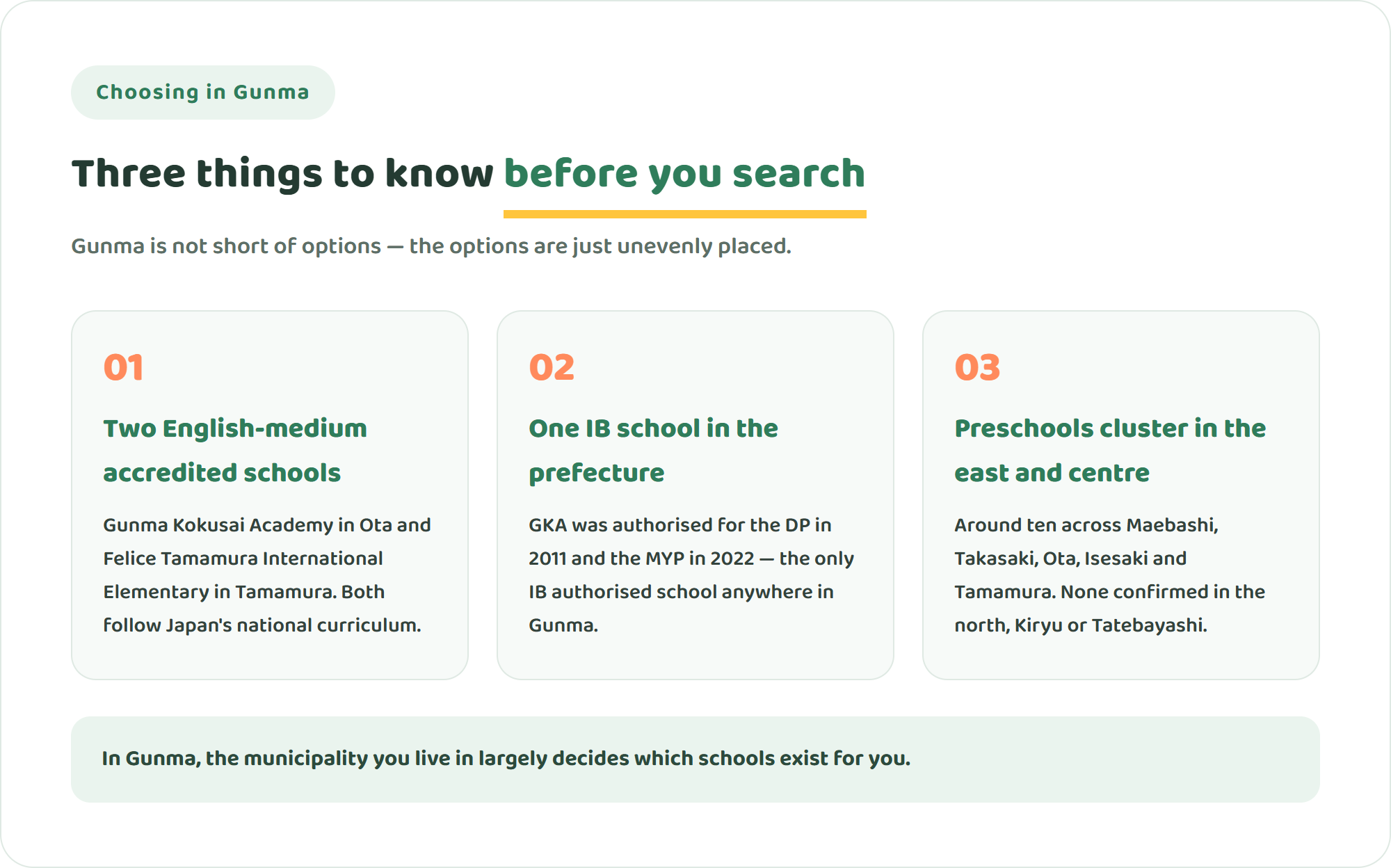
The options fall into three distinct layers. The first is schools teaching in English at elementary level and above: Gunma Kokusai Academy (GKA) in Ota and Felice Tamamura International Elementary School in Tamamura. Both are accredited Japanese schools, not foreign-system institutions. The second layer is English-immersion preschools — around ten across Maebashi, Takasaki, Ota, Isesaki and Tamamura. The third is foreign schools, mostly Brazilian, concentrated in Ota, Oizumi and Isesaki and teaching a home-country curriculum. Having all three layers coexist inside one prefecture is genuinely unusual in Japan.
Fees differ by layer. Preschools generally run ¥37,000–98,000 per month, or roughly ¥500,000–1,400,000 a year once entrance and facility fees are added — though children aged three to five often qualify for Japan’s early-childhood education subsidy, which cuts the effective cost substantially. At elementary level and above, Felice sits at roughly ¥800,000–900,000 a year, GKA’s elementary division at about ¥1.24 million a year with a ¥400,000 entrance fee in year one, and GKA’s high school division at around ¥1.6 million once the IB Diploma fee is included. Against the ¥2–3 million a year typical of major Tokyo international schools, Gunma offers something close to metropolitan substance at regional prices.
Note: fees reflect publicly available information as of July 2026 and are subject to revision. Always confirm current figures directly with each school.
Every international school in Gunma Prefecture, by area
Here are the 16 schools we could verify as of July 2026, organised by the four regions Gunma residents actually use: Tomo (east), Chumo (central), Seimo (west) and Hokumo (north). No trimming to a round number — this is the full list as far as public information allows.
Tomo: Ota, Isesaki, Oizumi, Tatebayashi and Kiryu
The densest international education cluster in the prefecture. At its centre is Gunma Kokusai Academy (GKA), opened in 2005 on the back of the Ota City Foreign Language Education Special Zone — designated in 2003 as Japan’s first structural reform special zone. Run by Ota Kokusai Gakuen, it is a continuous 12-year school teaching almost every subject except Japanese language in English, with the elementary division at the Nishihoncho campus and the junior/senior high divisions at Uchigashima. It was authorised for the IB Diploma Programme in October 2011 and the Middle Years Programme in March 2022, making it the only IB authorised school in Gunma Prefecture as of July 2026. Published figures for April 2026 show a ¥400,000 entrance fee, ¥80,000 monthly tuition (¥960,000 a year), a ¥110,000 annual facility fee, ¥50,000 in annual materials, a ¥6,000 welfare fee and — for elementary students — ¥10,000 a month for meals excluding August. That comes to roughly ¥1.24 million a year at elementary level, and about ¥1.6 million at high school once the ¥40,000 monthly IB fee is added. School buses run from Maebashi Station, Kumagaya Station South Exit, Ota Station South Exit and Bus Terminal Ota, and the school states that students commute from Tochigi and Saitama as well as within Gunma.
- Curriculum: English immersion within the Japanese school system; IB MYP and DP authorised
- Ages: Grade 1 through Grade 12, with an attached preschool
- Fees: About ¥1.24 million a year at elementary plus a ¥400,000 entrance fee in year one; about ¥1.6 million at high school (April 2026 figures; uniforms extra)
- Good fit for: Families who want subjects taught in English while keeping Japanese school enrolment and a Japanese high school diploma
Early years options here are strong too. Milton’s International Academy in Izumicho, Ota, opened in 2020 as an unlicensed childcare facility taking children from 12 months to age five, with exposure to French and Spanish alongside English and Japanese and long hours from 7:00 to 19:00. Third-party databases list ¥50,000 a month excluding snacks, falling to ¥37,000 for ages three and up or ¥42,000 for under-threes once the childcare subsidy applies. Also in Ota, in Nishihoncho, OCathain English School runs an English-immersion programme: its full-time preschool for ages two to six is listed at ¥80,000 a month for 8:00–15:00 or ¥98,000 for 8:00–18:00, with a ¥95,000 entrance fee, ¥8,000 monthly meals and ¥30,000 in materials. English classes for elementary students start from ¥12,000 a month, which makes it one of the few places where an English environment continues past kindergarten.
In Isesaki, International Kids Academy in Yasuhoricho is a certified kodomoen with a capacity of 45, running immersion-style childcare it describes as more than 600 hours of English exposure a year, plus an attached after-school programme for elementary students — a practical detail for dual-income families. Fees are on enquiry. We could not, however, confirm any permanent international school or preschool in Kiryu, Tatebayashi, Midori or Ora Town as of July 2026. Even within Tomo, the provision concentrates in Ota and Isesaki.
Chumo: Maebashi, Tamamura and Shibukawa
The prefectural capital region has the widest choice for the early years. GIS Gunma International School has its main campus on the second floor of the Harmony Building in Omotecho, Maebashi, serving ages two to six with a day course from 9:30 to 14:00 and a long course from 8:00 to 18:00. Its English childcare draws on the Ontario curriculum, and it runs an English after-school programme alongside. Fees are not published, so enquire directly. Maebashi International Kindergarten in Kitashirodacho is a small-scale setting from age two; third-party databases list an ¥80,000 joining fee and ¥50,000 a month. Gunma BEA International School in Koyaharacho, run by a registered non-profit, covers ages one to six plus English classes and after-school care for elementary students, spending most of the day in English — morning circle, lunch and all — while keeping a Japanese culture class in the timetable for balance. Fees are on enquiry.
The school not to miss in Chumo is Felice Tamamura International Elementary School in Tamamura Town, Sawa District. It opened in April 2015 after the town received Prime Ministerial designation as an international education special zone in June 2014. Classes hold around 20 students with a dual homeroom system pairing a native English-speaking teacher with a Japanese one. English runs seven periods a week using US English-language-arts textbooks, with the goal of Eiken Grade 2 by graduation. Because it follows Japan’s national curriculum as an accredited school, Japanese, mathematics, science and social studies are taught properly in Japanese and English is layered on top. It is a Christian school affiliated with ACSI, and enrolment stood at 210 students as of April 2025. The fees published at opening in 2015 were a ¥450,000 entrance fee (halved for Tamamura residents), a one-time ¥50,000 maintenance fee, ¥60,000 monthly tuition and a ¥100,000 annual facility fee — roughly ¥800,000–900,000 a year — but do confirm the current year’s figures with the school. On the same site, Felice International Kodomoen takes children from birth with a Montessori-and-English programme feeding directly into the elementary school. It is one of very few places in Gunma where a single line can be drawn from the early years into elementary.
- Curriculum: Japan’s national curriculum plus seven English periods a week using US textbooks; dual homeroom teachers; ACSI affiliated
- Ages: Grades 1–6, with an attached kodomoen from birth
- Fees: ¥450,000 entrance fee, ¥60,000 monthly tuition, ¥100,000 annual facility fee (figures published at opening; confirm current rates)
- Good fit for: Families who want serious English without giving up Japanese academic grounding
Seimo: Takasaki, Fujioka, Tomioka and Annaka
Takasaki, the prefecture’s largest city, has three early-years options. GIS Gunma International School Takasaki opened in Namiemachi in 2020, taking children from age two with meals, transport, summer school and extended care, and qualifying for the childcare subsidy as an unlicensed facility. International Kinder Garden Takasaki, in Kuzuracho beside Takasaki Station, serves mainly ages three to five with temporary care for ages one and two; published costs are a ¥130,000 entrance fee, ¥37,000 monthly base tuition plus ¥18,000–29,000 a month for English instruction depending on age, a ¥70,000 annual facility and climate-control fee, ¥10,000 for meals and ¥2,000 for snacks. Michelle International Kindergarten in Hikimacho is a corporate-sponsored facility conducting ordinary daily life in English; its published rates are ¥37,100 a month for age zero (¥39,600 on the community quota), ¥37,000 for ages one to two (¥39,500), and ¥0 for ages three to five (¥3,000), with special English classes charged separately. Buses run towards Takasaki and Maebashi.
What Seimo does not have is an English-medium school past kindergarten. We found no permanent international school in Fujioka, Tomioka or Annaka either. The typical Seimo pattern is a family who uses a Takasaki preschool and then, at elementary entry, widens the search to GKA in Ota, Felice in Tamamura, or out of the prefecture. Because GKA runs a school bus from Maebashi Station, families in Takasaki who can reach Maebashi are inside the commuting range.
Hokumo: Shibukawa, Numata, Minakami and Nakanojo
Here is the honest part. In the northern region we could confirm no permanent international school and no international preschool as of July 2026. If you live in Shibukawa, Numata, Minakami, Nakanojo or Kusatsu, reaching even an in-prefecture school generally means around an hour each way — more once winter road conditions enter the picture. For families in Hokumo, the online route described below is not a fallback but a realistic first choice.
The other layer: Brazilian and other foreign schools
Separately from the English-medium schools, Gunma hosts a cluster of foreign schools teaching a home-country curriculum. The prefecture’s official register of private schools (as of 1 May 2025) lists, among miscellaneous schools, Escola Paralelo and EAS Ota Brazilian School in Ota City, and Gunma Korean Elementary and Middle School in Maebashi. EAS Ota belongs to a Brazilian school network operated by Kurahashi Gakuen with around 1,200 students across six campuses and an age range of 3 to 18. Oizumi Town is also home to Nippaku Gakuen, founded in 1991, enrolling children from preschool age through high school. Instruction is largely in Portuguese and these are not accredited Japanese schools, so understand the implications before applying — but Gunma is a good reminder that international education is not only ever in English.
Comparing the options: what actually fits your family
Gunma’s English-medium accredited schools, its preschools, and online international schools are not ranked best to worst — they suit different constraints. Set them against five criteria and the decision sharpens: affordability, ease of admission, commute burden, in-person campus experience, and whether the path continues through high school.
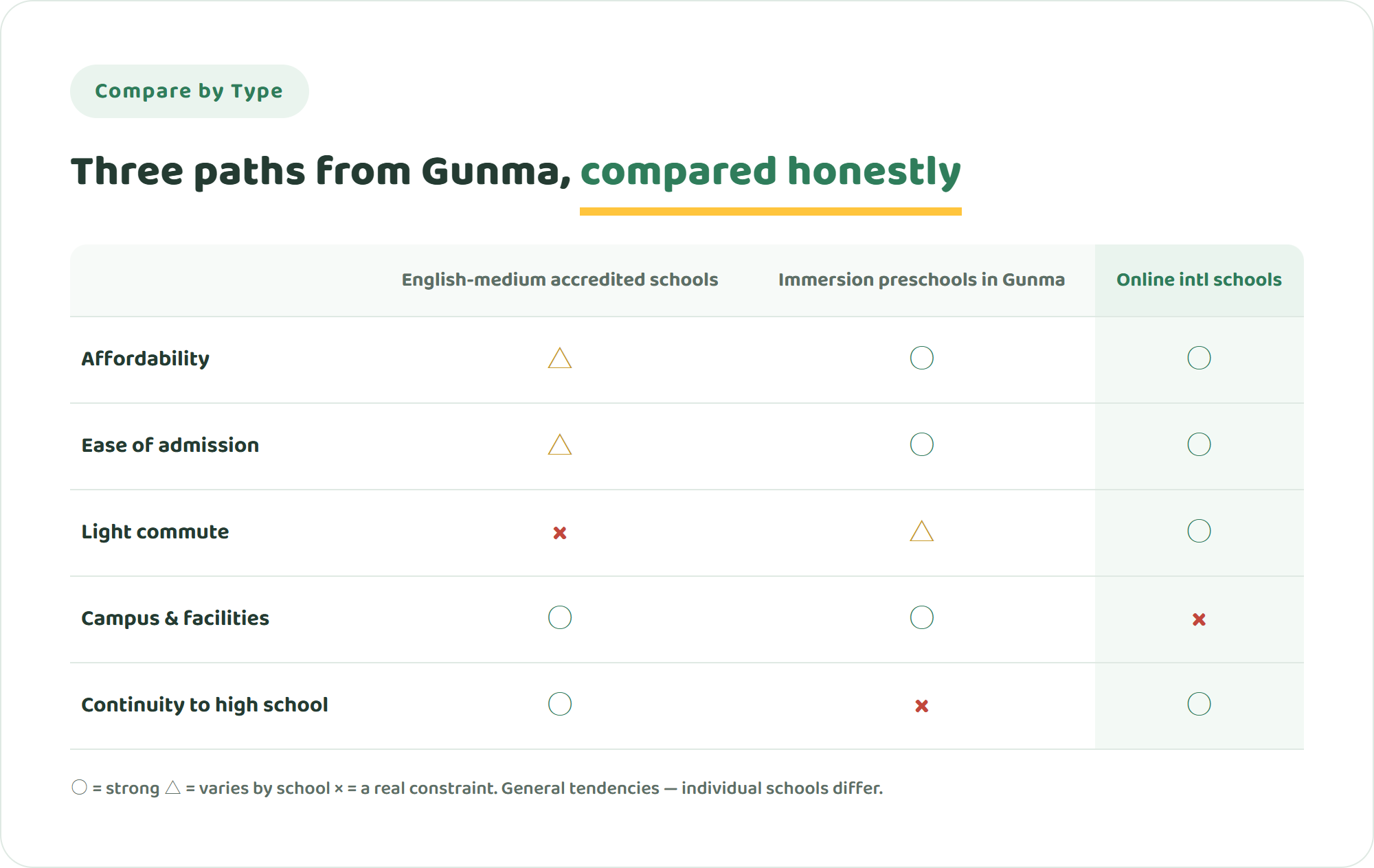
In Gunma the row that catches most families is the commute. The two English-medium accredited schools sit in Ota and Tamamura, so from Takasaki, Shibukawa, Numata, Kiryu or Tatebayashi the daily journey shapes the whole family’s routine. Conversely, if you live around Ota, Isesaki, Maebashi or Tamamura, you are in one of the better-served parts of rural Japan. Widening the search, neighbouring options include Tochigi Prefecture — its English-immersion school in Sano is close to eastern Gunma — Saitama Prefecture, reachable via GKA’s bus from Kumagaya Station South Exit, and the IB schools of Nagano and Ibaraki. Our guide to international schools across all 47 prefectures lets you compare the surrounding region at a glance, and our breakdown of what international school actually costs covers the fees beyond tuition that catch families out.
See how learning works online →
When nothing is within reach — the online option
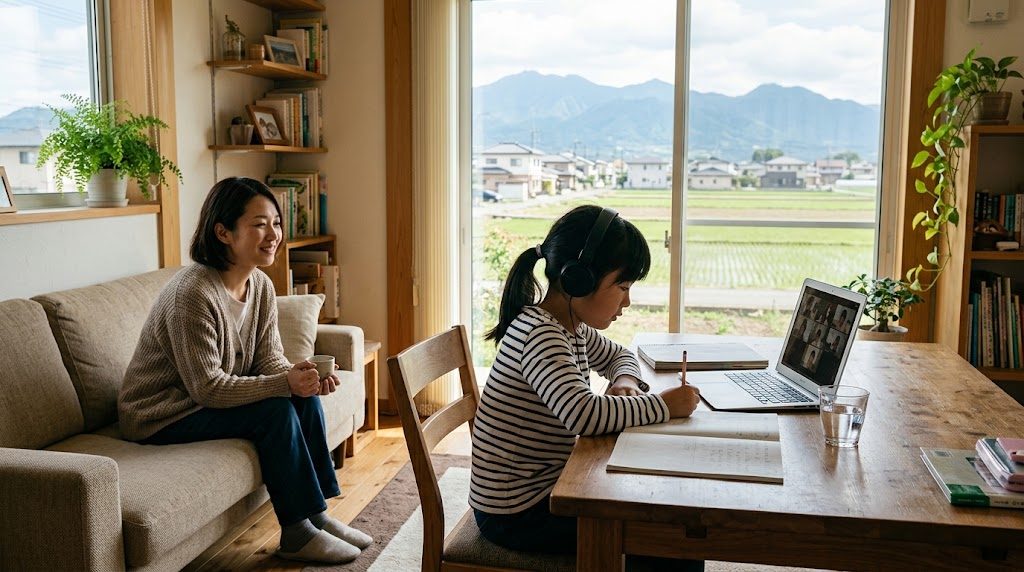
Some readers will reach this point thinking: we are in the north, Ota is not a daily trip, and a Takasaki-to-Maebashi-to-Ota chain for six years is not realistic. One answer is a double school arrangement, keeping the local school and adding English-medium learning alongside. Another is to make an online international school the centre of learning — which is what NIJIN GLOBAL ACADEMY (NGA) is being built for. We open in September 2027.
NGA is run by NIJIN Inc., the Japanese company behind NIJIN Academy, an alternative school with over 1,000 students enrolled. What we care about is moving away from ranking children by test scores. Learning happens in small, dialogue-centred groups, built around a simple aim: helping children come to like themselves and the world. We serve ages 6 to 18 across Asia and Oceania, and because location is irrelevant, a family in Ota, Numata or Minakami has exactly the same access. Japanese-language support underpins the programme so children can move into English gradually. Our goal is to make tuition roughly one-fifth of a bricks-and-mortar international school.
The honest caveats: we have not opened yet, so our track record is still ahead of us. And an online school cannot reproduce a playground, a school field, or the feeling of sitting shoulder to shoulder in the same room. Even so, for a good number of Gunma families, this is what turns “there is nothing near us, so we will give up” into “we do not need to get there at all”.
Frequently asked questions
Q. Can families anywhere in Gunma reach these schools?
A. Not evenly. The English-medium accredited schools are in Ota and Tamamura, and the preschools cluster in Maebashi, Takasaki, Ota, Isesaki and Tamamura. From Hokumo — Shibukawa, Numata, Minakami — or from Kiryu and Tatebayashi, expect around an hour each way. GKA does run school buses from Maebashi Station, Kumagaya Station South Exit, Ota Station South Exit and Bus Terminal Ota, with a published monthly pass of ¥5,500 for the junior/senior high divisions and an annual pass system at elementary. Map the actual route and travel time first, then ask whether your family can sustain that every morning for six years.
Q. Do families commute between Gunma and neighbouring prefectures?
A. In both directions. GKA states that students commute from Tochigi and Saitama, and runs a bus from Kumagaya Station South Exit in Saitama. From eastern Gunma, the English-immersion school in Sano, Tochigi is close — Ota to Ashikaga-shi is a little over ten minutes on the Tobu Isesaki Line. From the west, Takasaki Station puts northern Saitama and Tokyo within reach on paper. The honest counterweight is that Shinkansen or limited-express commuting runs to a substantial annual cost, and long daily journeys take a physical toll on younger children. Before you shortlist, check both the bus stops and the season-ticket fares.
Q. Will heavy English exposure weaken my child’s Japanese?
A. It is one of the most common worries we hear from families in Gunma. Both English-medium accredited schools here — GKA and Felice — follow Japan’s national curriculum and teach Japanese language properly, so the foundation is protected by design. Preschools and foreign schools vary far more. Whatever you choose, put “how is Japanese maintained?” on your list of questions at every school visit, and ask to see the actual weekly timetable rather than the brochure description.
Choose what you can sustain, not just what you can reach
Searching for an international school in Gunma Prefecture is less about scarcity than about geography. Two English-medium accredited schools, around ten preschools, and a cluster of Brazilian and other foreign schools — by the standards of northern Kanto, that is a good supply. Whether any of it is within reach of your front door, though, is decided by which municipality you live in.
The better question is not which school will accept your child, but which kind of learning your family can keep going for years. There is no need to rush. Start today by checking one commute route — or by asking whether a route is needed at all. Either way, the map starts to look different.
International School Guides for Other Prefectures
- International Schools in Kanagawa Prefecture
- International Schools in Chiba Prefecture
- International Schools in Saitama Prefecture
- International Schools in Ibaraki Prefecture
- International Schools in Tochigi Prefecture
- International Schools in Hokkaido Prefecture
- International Schools in Aichi Prefecture
- International Schools in Hiroshima Prefecture
- International Schools in Hyogo Prefecture
- International Schools in Ishikawa Prefecture
- International Schools in Iwate Prefecture
- International Schools in Kagawa Prefecture
- International Schools in Kagoshima Prefecture
- International Schools in Kochi Prefecture
- Browse all 47 prefectures of Japan