
If you have taught for twenty or thirty years and you are not looking for another full-time job, the question is usually much smaller than a career move: could I give one hour a week to students who need what I know? Here is the arithmetic that decides whether that is realistic. An online international school built on Japan Standard Time runs on UTC+9. Singapore is one hour behind it, Sydney one to two hours ahead, Toronto and New York 13 to 14 hours behind. One class a week is roughly 60 to 90 minutes of live teaching, plus perhaps thirty minutes of preparation once the pattern settles.
That is the whole commitment. Not a relocation, not a visa, not a new career. This article is an honest look at why online international schools want experienced teachers for exactly that slice of time, what the roles actually look like, how the time zones work out for North America, Australia and Southeast Asia, and how a volunteer arrangement usually turns into a paid one.
Why a small online school needs one class a week from an experienced teacher
A conventional school hires in whole people. A school of 60 to 200 students, distributed across time zones, does not have that problem in the same shape. It needs a Grade 9 chemistry specialist for one period a week, not five days of one. It needs someone who has actually written IB internal assessments to look over a first draft of a curriculum map. It needs a former head of year to talk a nervous 16-year-old through a university application.
Those are precisely the things a retired or semi-retired teacher can offer without disruption to their life, and precisely the things a small school cannot justify hiring a full-time person to do. The match is unusually clean. What experienced teachers bring that a new graduate cannot is calibration — knowing what a good answer looks like, what a struggling student sounds like three weeks before the grades show it, which parent conversation to have early.
Being honest about the other side: one class a week is a genuinely limited role. You will not know every student. You will miss context that full-time colleagues carry. Schools that pretend otherwise set visiting teachers up to feel peripheral. The ones that do this well define the slice narrowly and treat it as real work.
If the maths above works for your week, the next practical question is what the arrangement involves and on what terms. See the founding member roles at NIJIN GLOBAL ACADEMY → — and the honest version of the terms is this: on the international track, founding roles begin as volunteer positions ahead of the 2027 opening, and detailed terms are shared later in the process rather than in the advert. What is fixed up front is the shape of the commitment, not the money: fully remote, no visa and no relocation cost, and even one class a week is welcome.
Four ways to be involved without a full-time move
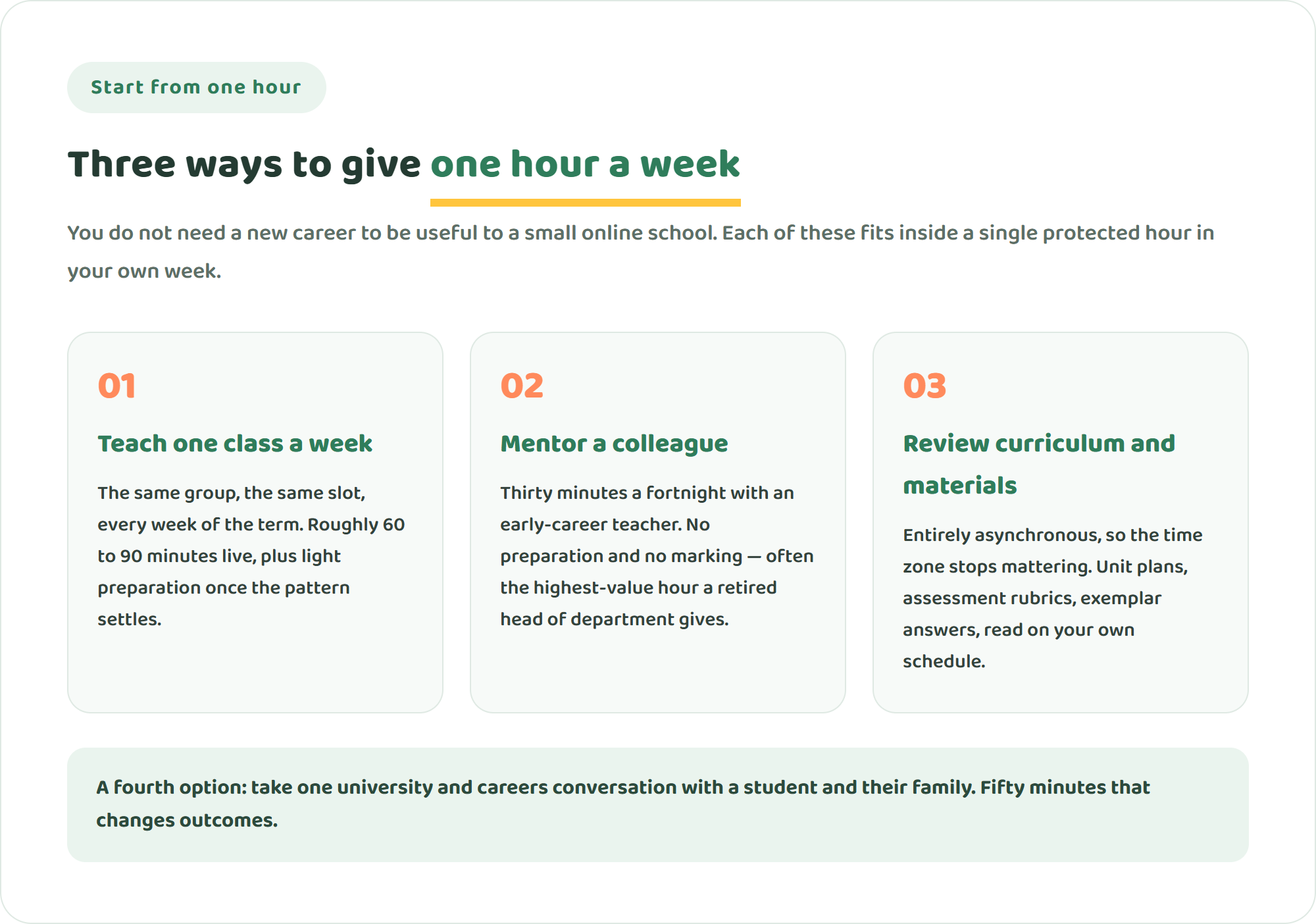
Teach one class a week. The same group, the same slot, every week of the term. This is the version that most resembles what you already know how to do, and the one where students feel the continuity most.
Mentor a colleague. Thirty minutes a fortnight with an early-career teacher, watching a recorded lesson or talking through a class that went sideways. There is no preparation and no marking, and for many retired heads of department this is the most valuable hour they give.
Review curriculum and materials. Entirely asynchronous, which means the time zone stops mattering at all. A unit plan, an assessment rubric, a set of exemplar answers — read on your own Sunday morning, whenever your Sunday morning happens.
Take university and careers conversations. Fifty minutes with one student and their parents about where to apply and why. Schools of this size rarely have a full counselling office, and an experienced voice at that moment changes outcomes.
Time zones: the honest arithmetic
This is where most give-back arrangements quietly fail, so let us do it properly. A Japan-based school day of 09:00 to 15:00 JST maps like this.
Singapore, Malaysia, the Philippines: Singapore and Manila sit at UTC+8, so the school day is 08:00 to 14:00 for you. It is simply your working morning. This is the easiest fit anywhere in the world and it is why Southeast Asia is central to online international schooling rather than peripheral to it.
Australia and New Zealand: Sydney runs one to two hours ahead depending on daylight saving, so a mid-morning Japanese class lands late morning to midday for you. Auckland is three to four hours ahead — an early-afternoon class in Japan is your late afternoon.
North America: here you have to be deliberate. Japan is 13 to 14 hours ahead of the US Eastern time zone, so 09:00 to 11:00 JST is 20:00 to 22:00 the previous evening in New York or Toronto. That is an evening class for you, not a night shift — but it is an evening class, every week, and you should decide that with your family rather than discover it in week three. West Coast teachers are three hours earlier again, which puts the same class at 17:00 to 19:00. Many retired teachers find the Pacific slot comfortable.
Europe and the Gulf: the UK is eight to nine hours behind Japan, which makes the Japanese afternoon your early morning. Dubai is five hours behind and works well for late-afternoon Japanese classes.
From volunteering to paid work, honestly
Many people want to start unpaid. That is a reasonable instinct and a good school will accept it, but it deserves plain talk. Unpaid work is easiest to sustain when it is bounded — one class, one term, then a conversation. Open-ended goodwill is what burns people out, not the hours.
The usual path runs in three moves. You begin with a single term as a volunteer, mostly to find out whether the students, the platform and the hour actually suit you. Somewhere in that term the school discovers you are load-bearing rather than decorative. Then the arrangement becomes a contracted part-time one with defined hours and pay, because a school that depends on you should be paying you.
Some people never want the third step, and that is a legitimate choice. Say so early. A school that knows you intend to stay unpaid can plan around it; a school that assumes you will convert and then finds out otherwise has a hole in its timetable.
What NIJIN GLOBAL ACADEMY offers, specifically
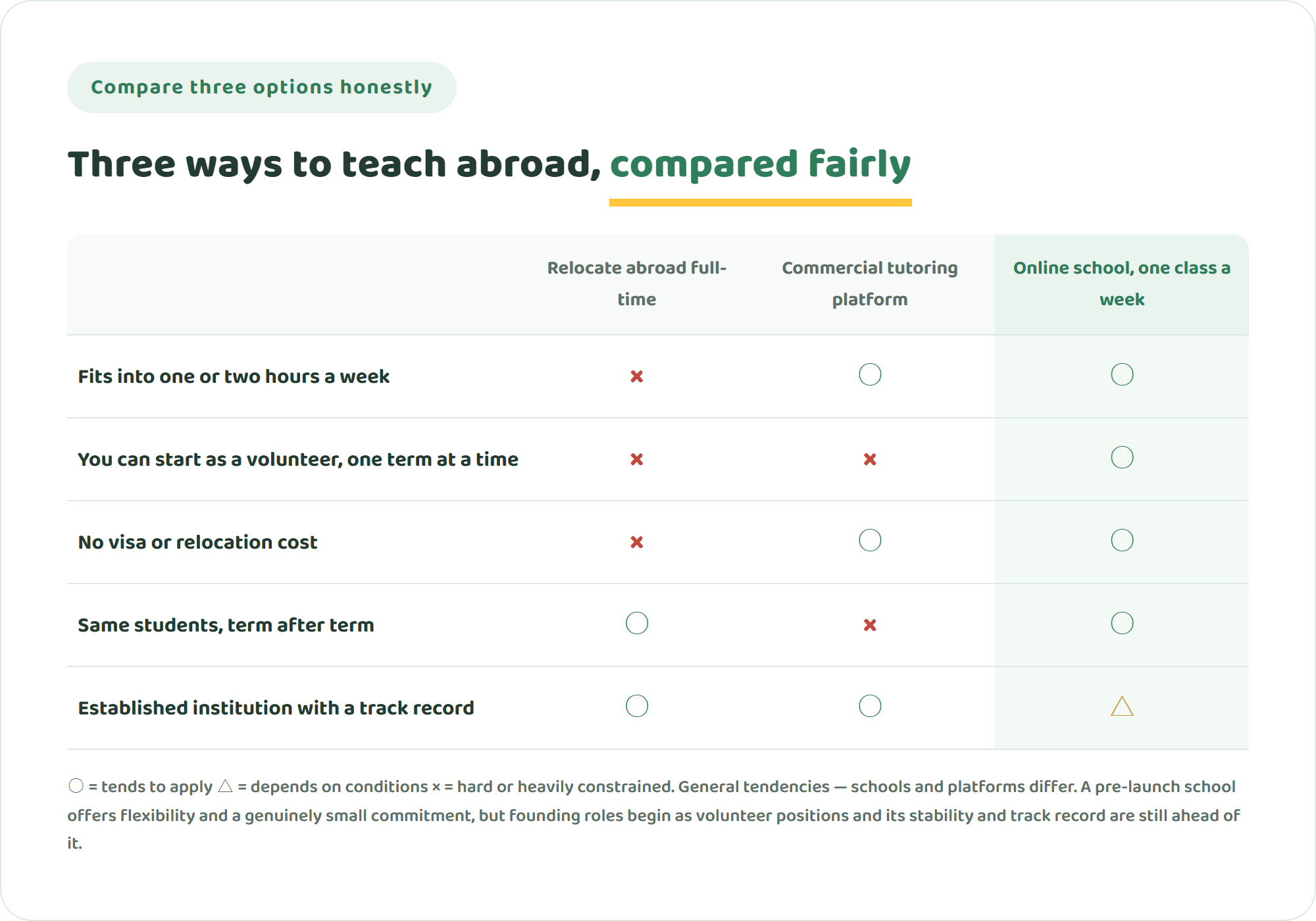
NIJIN GLOBAL ACADEMY is an online international school opening in September 2027, run by NIJIN Inc. in Japan, and it is recruiting its founding members now. Three facts matter for the readers of this article. First, even one class a week is welcome — the school says so explicitly, and names the US, Australia, Canada and Singapore as places experienced teachers already join from, on their own schedule. Second, the school is fully remote, which means no visa application, no relocation cost and no requirement to be in Japan at any point. Third, and said plainly because it is the part that changes your decision: founding roles on the international track begin as volunteer positions while the school builds toward its 2027 opening, and detailed terms are shared later in the process. If you need a paid contract from day one, this is not that.
Two honest qualifications. The school is pre-launch, so the stability and track record that an established institution offers are still ahead of it rather than behind it. And the faculty is a genuinely multinational one — teachers from across Asia, the Pacific and beyond — not an all-native-speaker line-up, which is a description rather than an apology. English at around CEFR B2 is the working benchmark, and people who enjoy building something from nothing tend to be happiest here.
Three steps to start small
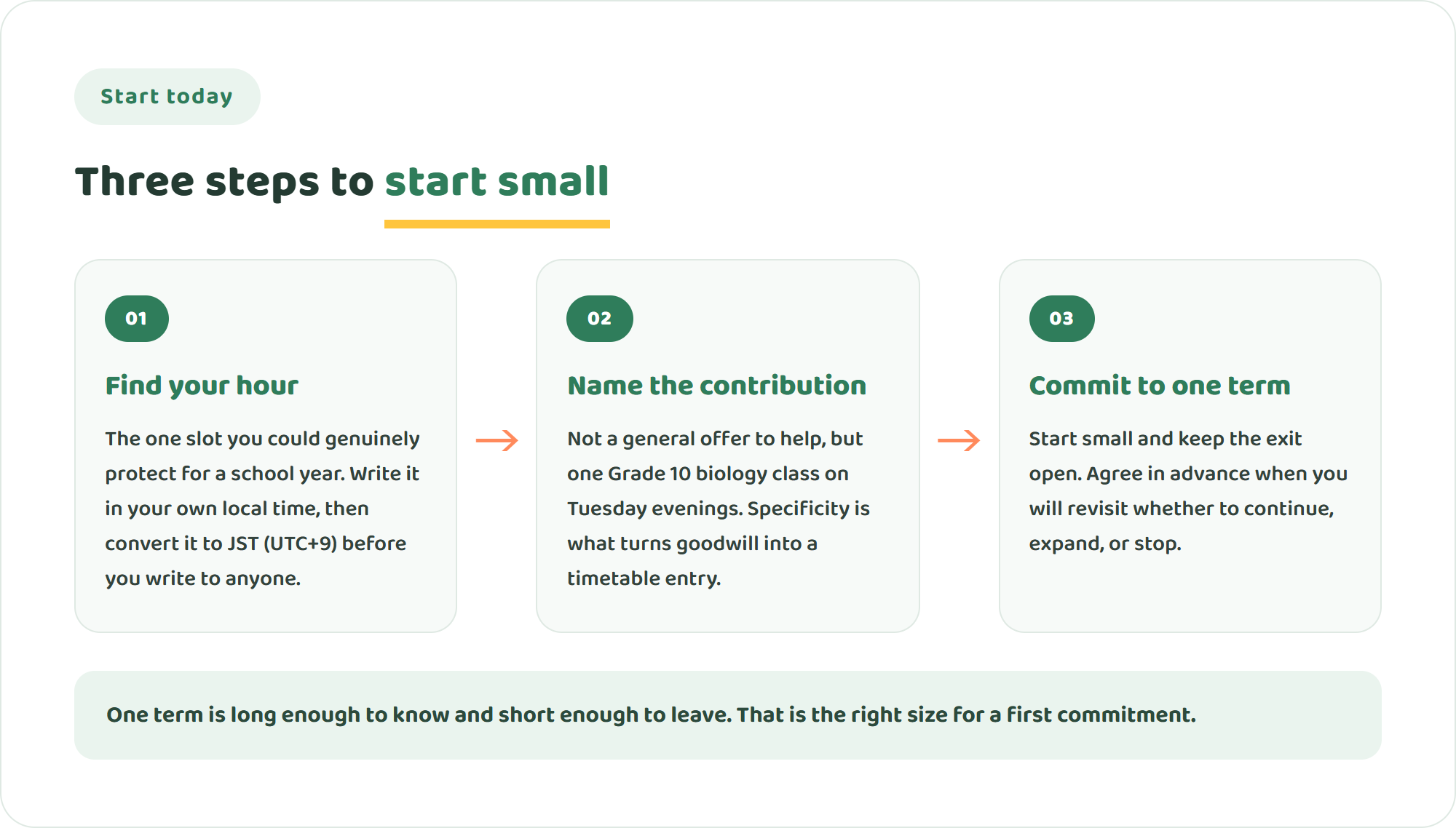
First, find your hour — the one slot in your week you could genuinely protect for a school year, expressed in your own local time. Convert it to JST before you write to anyone; it saves a round of email and shows you have thought it through.
Second, name the contribution. Not I would like to help, but I can take one Grade 10 biology class on Tuesday evenings, or I can mentor one early-career teacher fortnightly. Specificity is what turns goodwill into a timetable entry.
Third, start small and keep the exit open. One term, then a real conversation about whether to continue, expand, or stop. Nobody should sign up for three years on the strength of a good first impression.
Frequently asked questions
Can I really teach just one class a week?
Yes, and small online schools are among the few places where that is genuinely useful rather than an administrative burden. What matters is that the slot is regular and the subject is defined.
Do I need to be in Japan or hold a Japanese visa?
No. NIJIN GLOBAL ACADEMY is fully remote, so there is no relocation, no visa application and no requirement to enter Japan.
Do I need a current teaching licence?
Requirements vary by role and by school, and specific licensing questions are settled during selection rather than in an article. NGA’s own listing describes what it is looking for in terms of mindset — people who want to help build a school from nothing — rather than setting out a licence requirement.
Can I start as a volunteer and move to a paid role later?
That is a common and workable path. Keep the first commitment bounded to one term and agree in advance when you will revisit it.
Is my English good enough?
Around CEFR B2 is the working benchmark. The faculty is multinational, and clear communication with students matters more than an accent.
One hour is not a small thing
Teachers who have stopped teaching often describe missing one specific thing: not the marking, not the meetings, but the moment a student who was stuck suddenly is not. That moment does not require a full timetable. It requires one hour, one group and the years you already have behind you. If you have that hour, there are students on the other side of the world who would be lucky to get it.
Working at an International School — More Articles
- international school teacher salary
- how to become an international school teacher
- career change from teaching
- career change from teaching in your 30s and 40s
- how much do teachers earn?
- how to become an IB teacher
- jobs for moving abroad
- teaching jobs without a license
- careers with a teaching license
- qualifications to teach English
- online teaching jobs from home in India
- part-time online teaching jobs from home
- international school teaching jobs
- working at an international school: pros and cons
- online school jobs
- thinking of quitting teaching
- international school staff jobs
- remote jobs that use English
One class a week. No visa, no relocation, no full-time move.