“International school teaching jobs.” If you typed those words, you are probably in the middle of a search — for a full-time role you can settle into, a part-time role that fits around family, a way into education even though you have no teaching license, or a listing you keep filtering by city. The reasons differ, but underneath most of them sits the same quiet pull: a wish to work in an international, English-medium learning environment. Whether you are already a teacher or coming from another field entirely, in Japan or elsewhere in Asia, you are far from alone in reaching this page.
This article meets that wish honestly. First, we will be candid about the realities of the market — where the roles actually cluster, how widely terms vary, and what qualifications are really required. Then we will look at how to read a listing and prepare an application — practical and useful for any international school role, with or without us. Finally, as a “third path” that breaks the location barrier at its root, we will introduce — without a hard sell — a fully remote way of working you can apply to from anywhere: the founding team of the online international school we open in September 2027.

The realities of international school teaching jobs — an honest start
Search “international school teaching jobs” and the related queries fill with “full-time,” “part-time,” “no experience,” “without a license,” and city names. That range alone tells you how many different people, with different circumstances, are looking for a way in. So let us be candid about the three realities worth knowing first. One, the roles cluster geographically: in-person international schools concentrate in a handful of big cities, so if you live outside them, there may be few commutable roles at all. Two, terms vary enormously: full-time, contract, part-time, and agency positions are mixed together, yearly and renewal-based contracts are common, and pay and conditions differ so much by school that a listing alone rarely tells the full story. Three, whether you need a license depends on the role: some require a teaching license or an overseas credential, while others genuinely welcome candidates with no experience or license, weighing expertise, English, and the person instead.
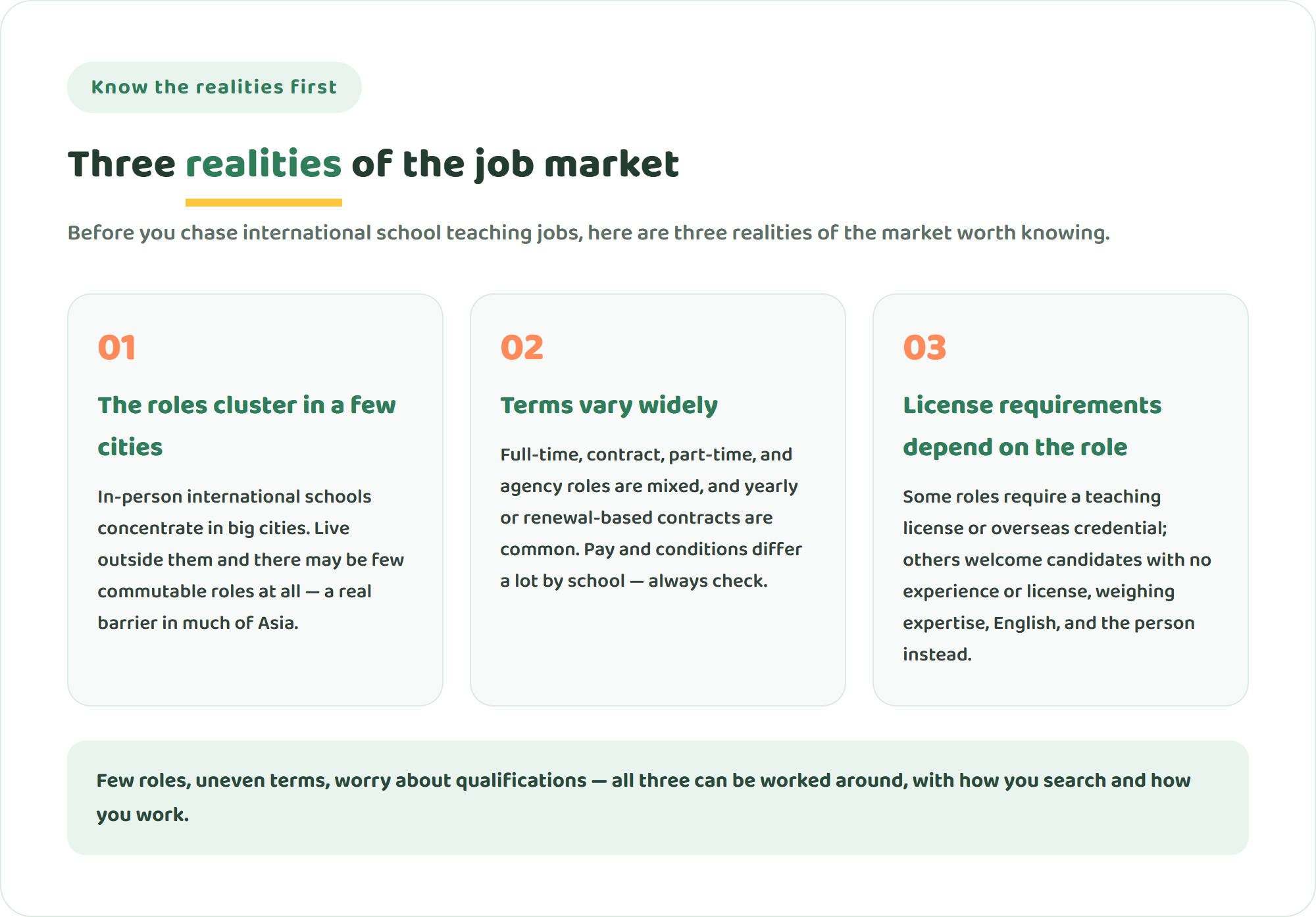
Laid out like that, it can feel a little daunting. But each of these three can be worked around — through how you search and how you work. The geographic clustering dissolves structurally once you consider a way of working that is not tied to a commute (more on that below). Uneven terms become readable once you know how to parse a listing. And the worry about qualifications shrinks as soon as you can put your non-teaching strengths into words. What matters is not looking away from the realities, but choosing your own route through them.
How to read a listing and prepare — the heart of it
This is the core of the article. Start with how to read a listing. When you look at an international school role, check each of these one by one: employment type (full-time, contract, or part-time), whether and how often the contract renews, whether a license is “required” or merely “preferred,” location and how commutable it is, and the pay range. The license line matters most: “required” and “preferred” set completely different bars for applying. Note anything vague and save it as a question for interview — it heads off a mismatch later. To get a feel for the pay on offer, a school’s scale and tuition level are useful signals; our international school tuition database lets you see levels by region and school, giving you a yardstick for whether a listed salary is high or low.あわせて、インターナショナルスクールの学費はなぜ高いのか(相場の内訳と、対面の約1/5に下げる方法)で、費用の構造そのものを分解しています。
Next, prepare your application. Before you conclude “I have no education experience,” take stock of the work you have carried, role by role. The ability to explain things clearly to a group, to read how well someone understands, to build relationships across very different people, to organise a plan and move it forward — these are real strengths in a classroom and in running a school alike. Then draft a short self-introduction and statement of motivation in English. It does not need to be perfect. Being able to say, in your own words, why you want to work in international education matters far more than flawless grammar. Taking stock and preparing is the foundation that supports your job search for any international school role — whether or not you ever apply to us.
See NIJIN GLOBAL ACADEMY’s founding-member roles →
A third path — apply from anywhere, beyond the commute
Now back to the first reality: the roles cluster in a few cities. That single barrier makes many people living elsewhere give up on working at an international school before they start. But there is a way of working that removes the barrier structurally: an online international school. With no campus to commute to, the very idea of a commuting radius disappears, and you can apply on equal footing no matter where you live. The founding-member roles that NIJIN GLOBAL ACADEMY (NGA) is recruiting for ahead of its September 2027 opening are built on exactly this idea. The table below sets three ways of searching side by side: in-person in a big city, in-person while living regionally, and an online international school.
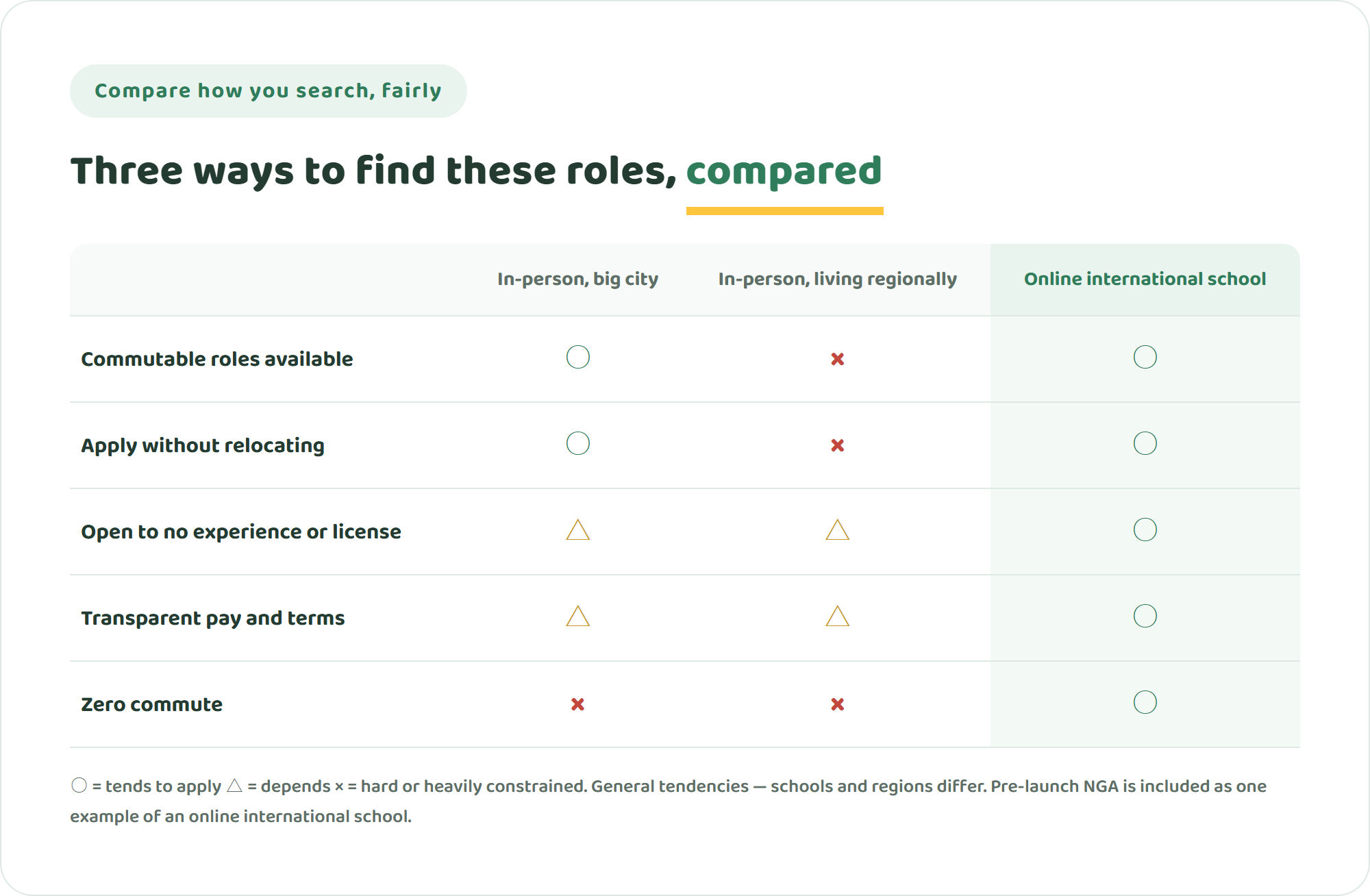
What the table makes plain is that an online option is far less constrained by location. On top of that, NGA’s way of working holds several draws for someone searching for a role. First, it is fully remote — designed around the premise of “working while traveling the world,” free of a commute or a fixed location. Second, you can choose involvement beyond teaching: alongside lessons, you can pick from five working styles spanning marketing, web, partnerships, and HR, so there is a way in even for those who want to contribute to an international school without teaching. Third, we say plainly what the role is — founding roles on this track begin as volunteer positions ahead of our September 2027 opening, and the detailed terms are shared later in the process. We would rather tell you that here than let you find out after applying. What we ask of applicants is roughly English at CEFR B2+ and an appetite for building from zero — we look at that drive more than at a teaching license. Connecting with our ethos of learning beyond test scores, rather than ranking children by exam results, is an important part of the door, too.

From listing to application — three steps
Here is everything above, distilled into a manageable three steps.
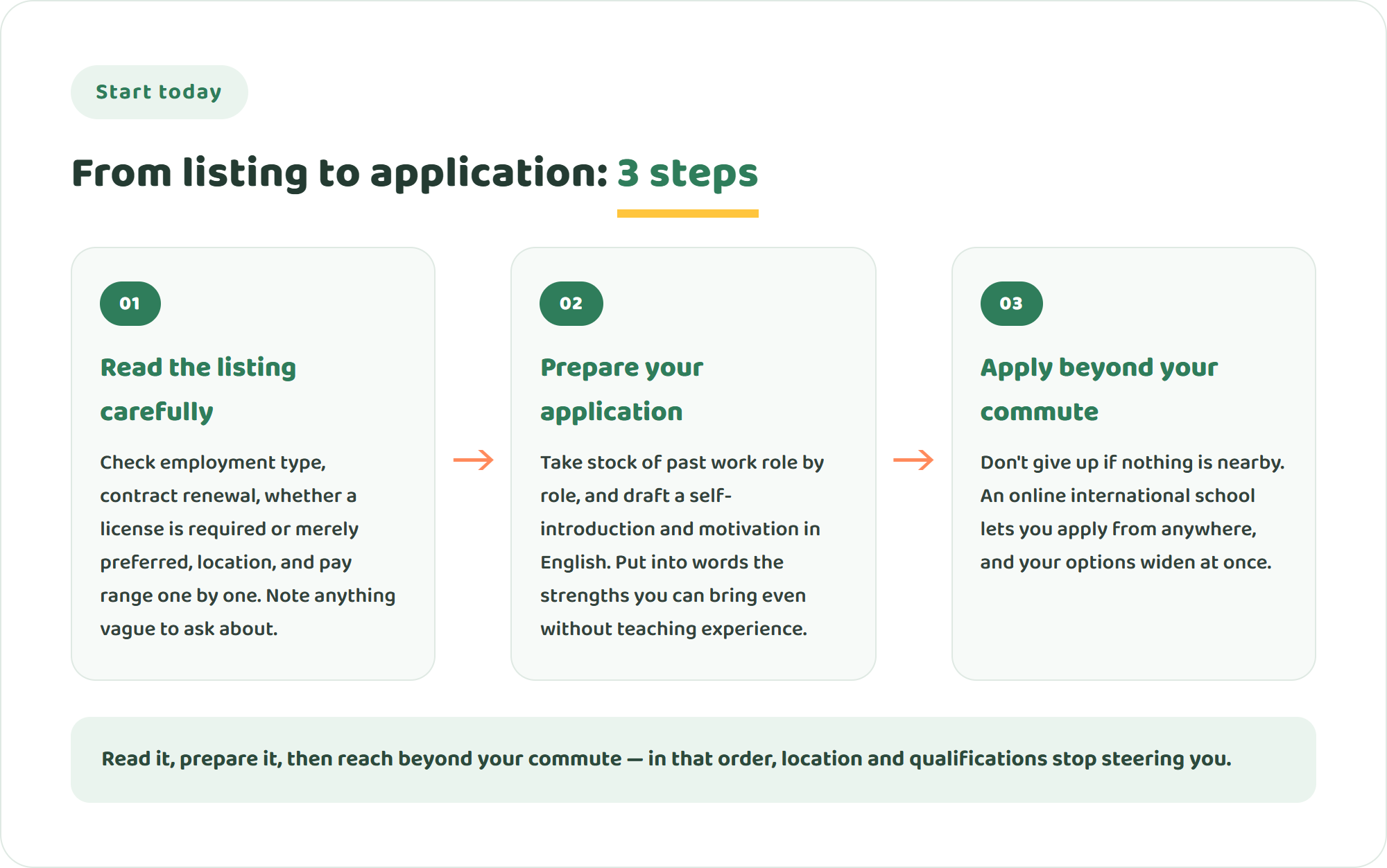
First, read the listing carefully: check employment type, contract renewal, license requirements, location, and pay range one by one, and note anything vague to ask about. Second, prepare your application: take stock of past work role by role, and ready a self-introduction and statement of motivation in English. Third, apply beyond your commute: don’t give up if nothing is nearby — widen your view to an online international school and your options open up at once. NGA’s selection runs from document screening to a group interview, an internship at NIJIN Academy, and a final presentation (applications are via a Google Form). Being able to “try before you decide” through the internship is a reassuring design for anyone stepping into international education for the first time.
Frequently asked questions
Can I get an international school teaching job with no experience or license?
It depends on the role. Some require a teaching license or overseas credential, but others genuinely welcome candidates with no experience or license, weighing expertise, English, and the person instead. What NGA asks for is people who “can build from zero,” valuing the drive to build a school together over a license. Start by taking stock of your strengths and focusing on roles where the requirement is “preferred,” not “required.”
I live outside the big cities — can I still work at an international school?
Because in-person schools cluster in major cities, living regionally does limit the roles within commuting distance. An online international school, however, has no commuting radius, so you can apply on equal terms wherever you live. For anyone who wants to work in international education without relocating, online is a strong option.
Are there more full-time or part-time roles?
It varies by school and season — full-time, contract, part-time, and agency roles are all mixed in, so always check the employment type and renewal terms on the listing. NGA offers five working styles, from something close to part-time up to full-time, so you can match it to your life. You can confirm the details during selection.
You open in September 2027. Is there any point applying now?
Yes. It is precisely because it is pre-launch that founding members help design the substance of the learning itself. The lead-up is built so you can gain experience through the NIJIN Academy internship and more. If you are drawn to “joining the side that builds” rather than “entering a finished organisation,” now is arguably the moment.
Beyond the listing is a way of working that fits you.
If you searched “international school teaching jobs,” you are probably quietly nurturing a wish to put yourself to work in an international learning environment. The geographic clustering, the uneven terms, the worry about qualifications — all of it is real. But with the right approach to searching and to working, these are far more surmountable than they seem. You do not have to live in a big city, hold a teaching license, or have done this before for the door to be open. Know the realities, read the listing, take stock of your strengths, and apply beyond your commute — each step moves you toward a way of working that fits you. The choice, as always, is in your own hands.
Working at an International School — More Articles
- international school teacher salary
- how to become an international school teacher
- career change from teaching
- career change from teaching in your 30s and 40s
- how much do teachers earn?
- how to become an IB teacher
- jobs for moving abroad
- online school jobs
- international school staff jobs
- remote jobs that use English
- bilingual remote jobs
- working at an international school: pros and cons
- thinking of quitting teaching
- digital nomad teaching jobs
- career change from tutoring
- life after leaving teaching
- a second career for teachers
- high-paying jobs that use English
Beyond the commute, a way of working that’s yours.