Is there an international school where we live? For most families in Japan, school research starts with that single question. This page lists all 47 prefectures of Japan, with the international schools in each prefecture, typical annual fees, and what to do when there is no school within commuting distance. Pick your prefecture below.
22 of 47 prefectures now have an English guide (47%). We add more every week.
International schools in Hokkaido
International schools in Tohoku
- Miyagi
10 schools - Fukushima
Japanese guide only - Iwate
Japanese guide only - Aomori
Japanese guide only - Akita
Japanese guide only - Yamagata
Japanese guide only
International schools in Kanto
- Kanagawa
30 schools - Tokyo
Coming soon - Chiba
20 schools - Saitama
34 schools - Ibaraki
13 schools - Tochigi
10 schools - Gunma
16 schools
International schools in Chubu
- Aichi
30 schools - Shizuoka
17 schools - Nagano
13 schools - Gifu
13 schools - Niigata
Japanese guide only - Ishikawa
12 schools - Toyama
Japanese guide only - Yamanashi
Japanese guide only - Fukui
Japanese guide only
International schools in Kansai
- Osaka
Coming soon - Hyogo
25 schools - Kyoto
12 schools - Mie
18 schools - Shiga
13 schools - Nara
11 schools - Wakayama
Japanese guide only
International schools in Chugoku
- Hiroshima
17 schools - Okayama
14 schools - Yamaguchi
Japanese guide only - Shimane
Japanese guide only - Tottori
Japanese guide only
International schools in Shikoku
- Ehime
Japanese guide only - Kagawa
Japanese guide only - Tokushima
Japanese guide only - Kochi
Japanese guide only
International schools in Kyushu / Okinawa
- Fukuoka
Coming soon - Okinawa
12 schools - Kumamoto
15 schools - Kagoshima
Japanese guide only - Nagasaki
Japanese guide only - Oita
Japanese guide only - Miyazaki
Japanese guide only - Saga
Japanese guide only
What the numbers look like by region (September 2026)
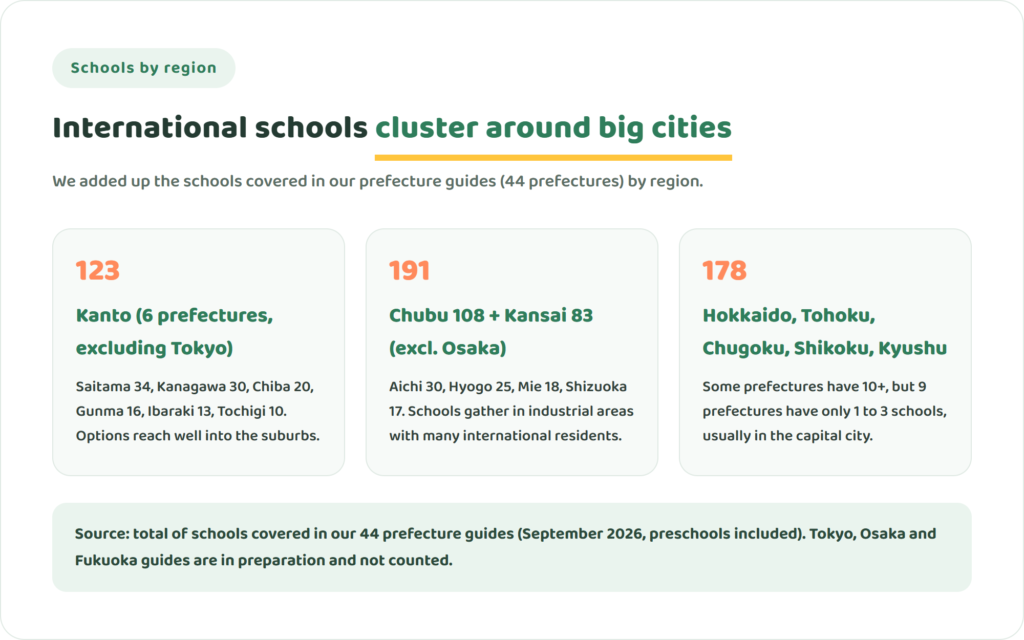
We counted the international schools covered in our prefecture guides, which currently exist for 44 of the 47 prefectures in Japanese. Added up by region, Kanto outside Tokyo has 123 schools, Chubu has 108, Kansai outside Osaka has 83, Kyushu and Okinawa outside Fukuoka have 59, Chugoku has 42, Shikoku has 37, Tohoku has 29 and Hokkaido has 11. Tokyo, Osaka and Fukuoka are not included yet because those guides are still being written, so the real concentration around the three big metropolitan areas is even stronger than these figures suggest. Even without them, the Greater Tokyo suburbs plus Chubu and Kansai account for roughly six in ten of the schools we have mapped.
Kanto: the suburbs are not a desert
Families often assume that outside central Tokyo there is little choice. The numbers say otherwise. Saitama (34 schools), Kanagawa (30) and Chiba (20) each have more options than many whole regions, and Gunma (16), Ibaraki (13) and Tochigi (10) all pass ten. The practical question in Kanto is rarely whether a school exists. It is which type of school it is: a full-time international school, a preschool that ends at age six, or an English-medium after-school programme that uses the word international in its name.
Chubu and Kansai: industry and international residents
Aichi (30) and Shizuoka (17) in Chubu, and Hyogo (25), Mie (18), Shiga (13) and Kyoto (12) in Kansai, show a pattern you will also see in our city guides. Schools tend to gather where manufacturing and international residents are concentrated, and several serve specific language communities as well as Japanese families. If you live in these prefectures, compare the curriculum and language of instruction carefully, because two schools twenty minutes apart can be very different places.
Hokkaido, Tohoku, Chugoku, Shikoku and Kyushu
This is where the map becomes uneven. Some prefectures still have ten or more schools, such as Hokkaido (11), Miyagi (10), Fukushima (12), Hiroshima (17), Okayama (14), Tokushima (17), Kumamoto (15), Okinawa (12) and Oita (11). But nine prefectures have only one to three: Iwate, Aomori, Akita, Yamagata, Fukui, Shimane, Kochi, Nagasaki and Saga. In those prefectures the schools usually sit in the prefectural capital, and the number that take children beyond preschool age can be smaller still. Many of these prefectures only have a Japanese guide on our site for now, and we add English guides every week.
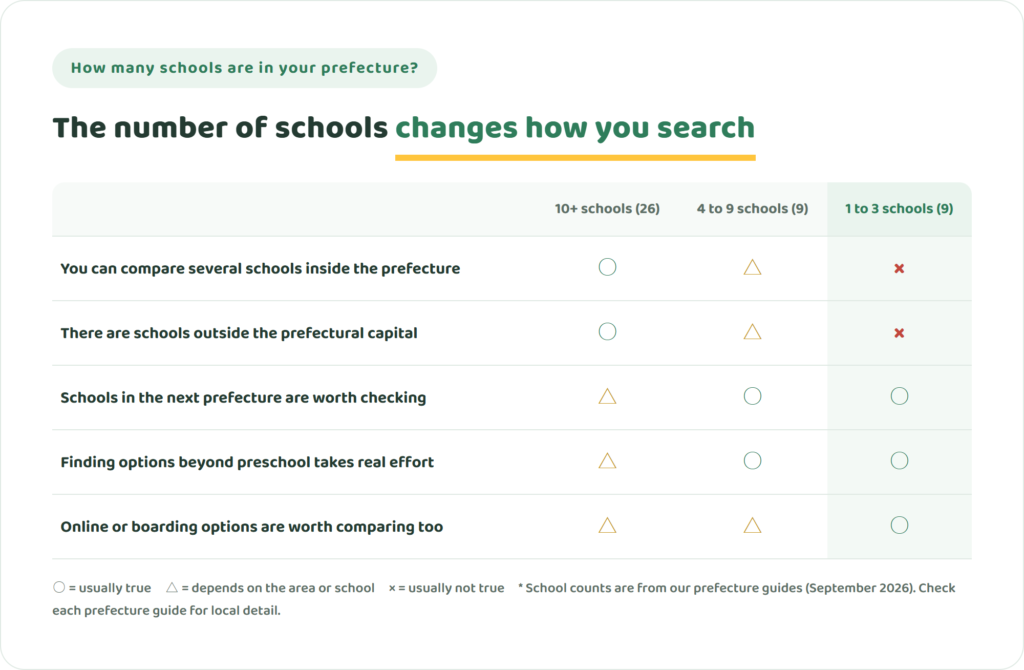
As the table shows, the number of schools in your prefecture changes what you should focus on. With ten or more, the work is choosing between them. With four to nine, the real question is how far you can travel, including across the prefectural border. With one to three, it is what to do if none of them fits your child’s age, language or your budget. None of these is a better or worse position; they are simply different starting points.
Three things to check when you search by prefecture
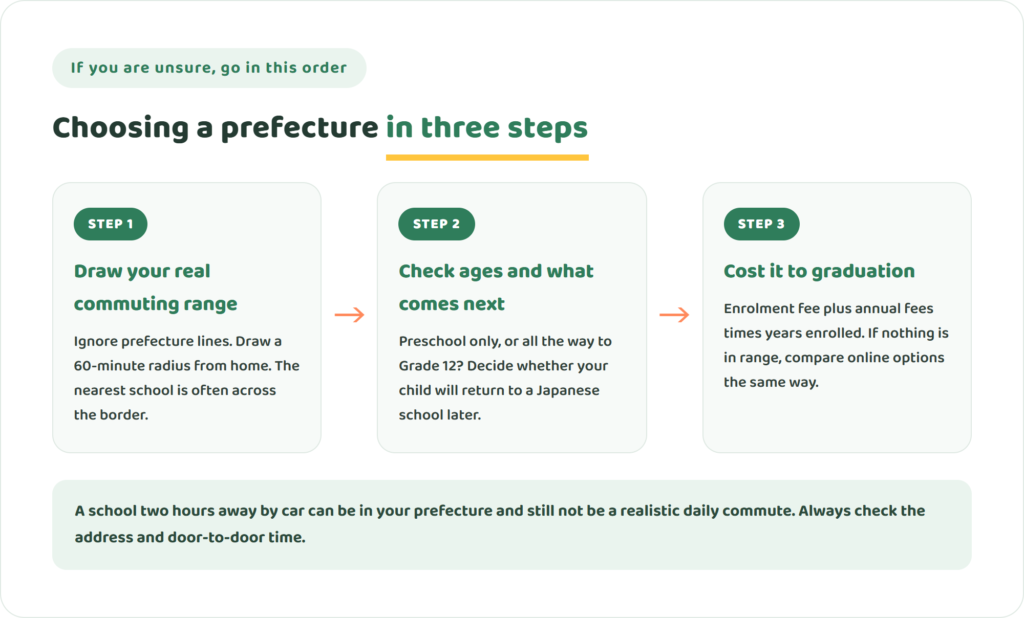
- Is it in the prefecture, or actually within reach? A school two hours away by car is in the same prefecture but not a realistic daily commute. Always check the address and the door-to-door time.
- How far up does it go? A preschool that ends at age six and a school that runs through to Grade 12 are completely different decisions. Look at what happens after.
- Can the fees be sustained for years? Getting in matters less than being able to stay until graduation. See what international school fees actually cover.
Put together as a process, choosing where to look comes down to three steps. Start from what is realistically reachable every day, not from the prefecture you happen to live in.
How to read one of our prefecture guides
Each prefecture guide is built so that you can compare them. It lists the schools we found in that prefecture, where each one is, the ages it accepts, its curriculum (for example IB, Cambridge or an American programme) and a guide to fees. Near the end, each guide explains what families do when nothing is within reach: commuting to a neighbouring prefecture, boarding, homeschooling with an English curriculum, or an online international school.
Two cautions apply to every guide. First, school counts include preschools, so a prefecture with ten schools may have only a few that continue into primary and secondary years. Second, fees and admissions rules change every year. Treat our figures as a starting point and confirm the current numbers directly with each school before you make a decision, especially the enrolment fee, building or facilities fees, and whether there is a waiting list for your child’s year group.
One last practical tip: when you shortlist schools across a border, check the commute at the time of day your child would actually travel. A 40-minute drive on a Sunday afternoon can be 70 minutes at eight in the morning, and a train connection that works for secondary students may not be realistic for a six-year-old. Many families also visit two or three schools on the same trip, which is easier to plan once you know which prefectures are genuinely within reach.
If there is nothing within reach
In most Japanese prefectures, international schools cluster in the largest city. If there is not a single school you can reach, that is a fact of geography, not a failure of effort on your family’s part.
NIJIN GLOBAL ACADEMY (NGA) is an online international school opening in September 2027, operated by NIJIN Inc. Our sister school in Japan, NIJIN Academy, already has more than 1,000 children learning with us. We are building a school that does not depend on where you live and does not rank children by test scores, with small-group dialogue at its centre. We aim to keep fees at roughly one fifth of a face-to-face international school.
See how learning works online →
We have not opened yet, and online will never be identical to a campus. But we do not want “there is nothing near us” to be the reason a family gives up on an international education.