Search for international schools in Nagano Prefecture and one name dominates everything: UWC ISAK Japan. It is a genuinely world-class boarding high school — and it answers almost none of the questions a family with a seven-year-old is actually asking. Where can a primary-age child attend every day? What does it cost? And what happens if you live in Iida or Suwa rather than Karuizawa? This guide maps every school we could verify across four regions — Karuizawa and the east, Matsumoto, Nagano and Nakano, and Hakuba — with the fees that are actually published (they run from roughly ¥1.3 million to ¥7.2 million a year, a fivefold spread) and an honest account of Nagano’s defining problem: the prefecture is 210 km from north to south, and mountains decide what is reachable.
Quick Answer: Your Options in Nagano
If you only read one section, read this. Below are the areas where schools can be confirmed, with their school names, plus the online option — so you can see every route side by side before the details.
- Karuizawa, Saku and Ueda (eastern Nagano) — ABC International School (Karuizawa) / ISN Saku Kirihara Preschool (Saku)
- Matsumoto and Azumino (central Nagano) — ISN Shimauchi and Minami-Matsumoto Preschools (Matsumoto)
- Nagano City and Nakano (northern Nagano) — ISN Nagano Preschool (Nagano City) / ISN Nakano Campus (Preschool and Elementary) (Nakano)
- Hakuba and the Northern Alps — Hakuba International School (HIS) (Hakuba Village)
- NIJIN GLOBAL ACADEMY (online) — Ages 6–18 / opening September 2027, currently taking opening-update registrations / fees around one-fifth of a typical campus international school / Japanese-language support. An option when distance or fees are the wall.
International schools in Nagano Prefecture: the landscape and what they cost
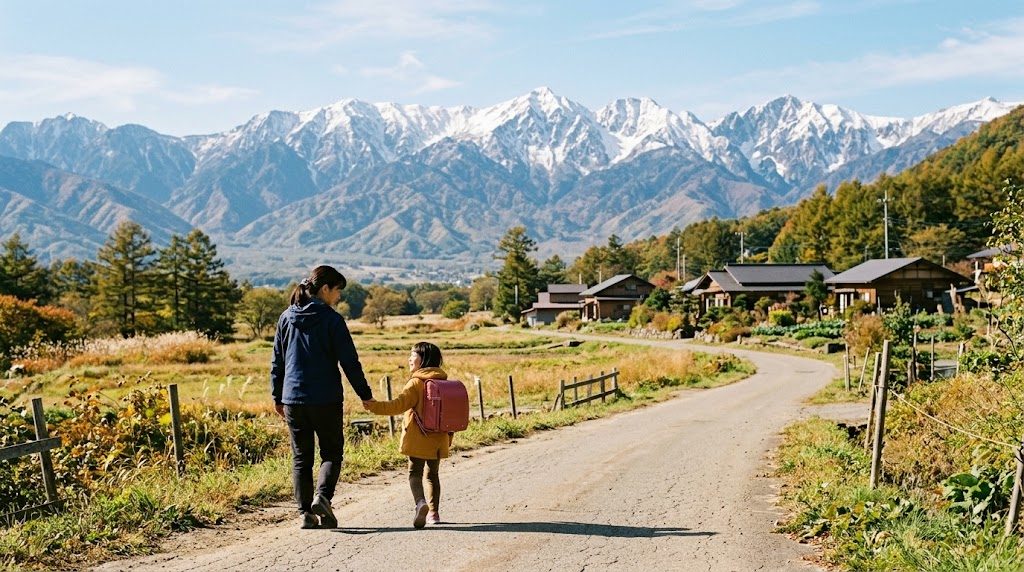
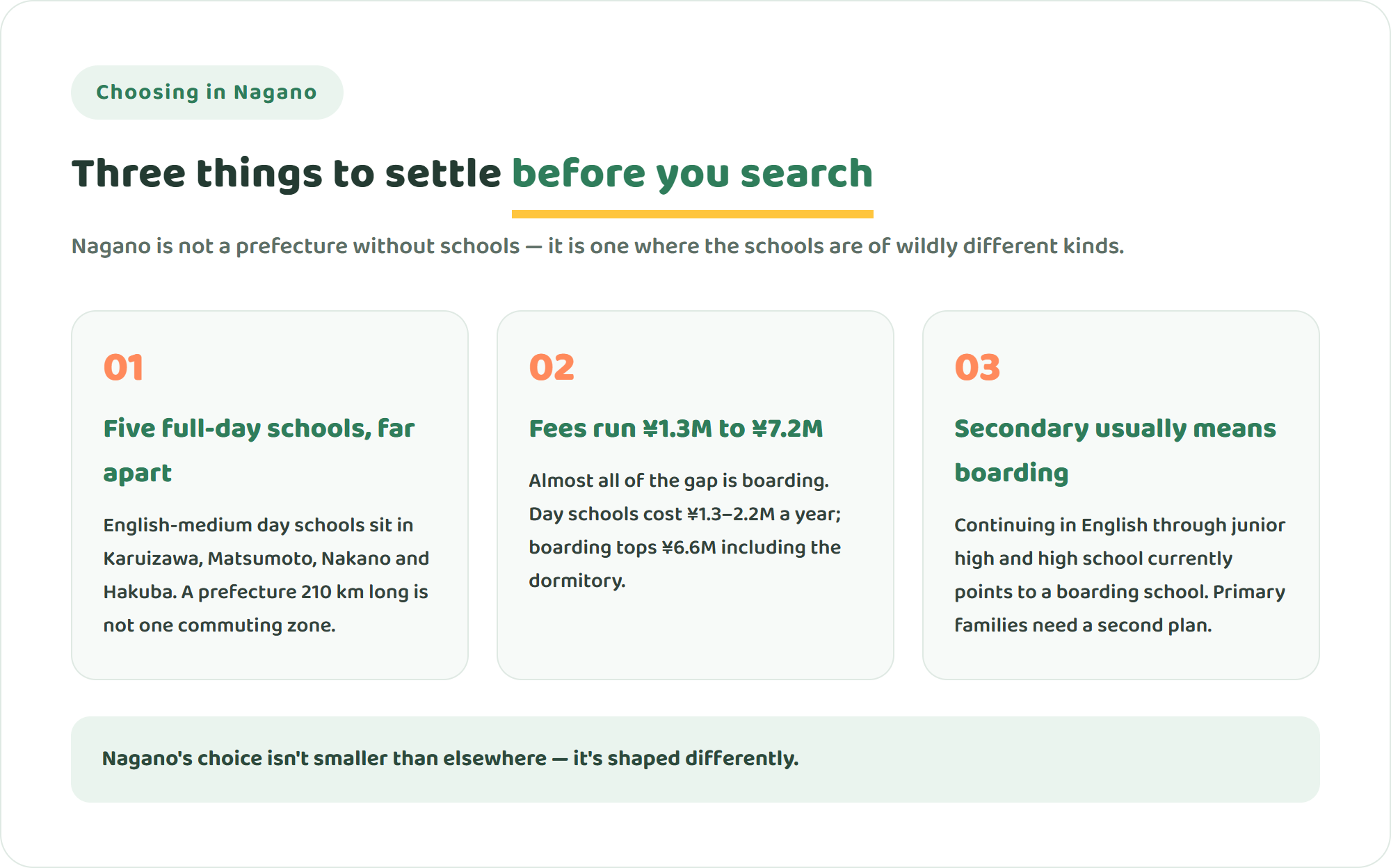
Here is the headline. As of July 2026, Nagano Prefecture has five international schools — six campuses — where English is the main language of instruction and primary-age children or older can attend full time. Add early-years provision and there are more than a dozen English-language environments across the prefecture. Whether that feels like a lot depends entirely on where you live, because Nagano is Japan’s fourth-largest prefecture by area.
Two things make international education here different from anywhere else in Japan.
The first is that Nagano has two international boarding schools drawing students from across Japan and the world: UWC ISAK Japan in Karuizawa and Hakuba International School in Hakuba Village. Both build their programmes around the natural environment and inquiry-based learning. For a prefecture of about two million people, having two international boarding schools is unusual by any national measure.
The second is that a continuous English-medium pathway from early childhood through junior high is now taking shape around Matsumoto, Nagano City and Nakano. The International School of Nagano (ISN) runs an elementary and junior high division at its Gojo campus in Matsumoto plus preschools in Matsumoto, Nagano, Nakano and Saku. Its elementary division was authorised as a Japanese private elementary school — an ichijoko, meaning enrolment satisfies compulsory education requirements — in December 2021 and opened in April 2022, and it is an authorised IB Primary Years Programme school. Matsumoto is also home to Green Forest International School, a full English immersion primary school.
Fees follow directly from those two facts. On published figures, ISN’s elementary division works out to about ¥1.3 million a year, the elementary programme at EtonHouse International School Karuizawa to about ¥2.2 million, while boarding at UWC ISAK Japan totals about ¥7.22 million and Hakuba International School roughly ¥6.6–7.13 million for boarders (details below). That is a more than fivefold spread, and almost all of it comes down to one question: does your child live at home or in a dormitory? For the full anatomy of what these numbers contain, see our breakdown of international school fees. If you are earlier in the process and still working out how international schools relate to Japan’s compulsory education system, start with our explainer on what an international school actually is.
The prefecture itself is internationalising. Nagano Prefecture’s own statistics recorded 46,850 foreign residents at the end of December 2024 — up 3,775 people (8.4%) year on year, a record high and roughly 1.5 times the figure ten years earlier. That is about 2.4% of the prefectural population, ranking Nagano 18th nationally. Hakuba Village is the extreme case: as of December 2019, 1,100 of its 9,464 residents held foreign nationality — 11.6%, among the highest shares of any municipality in Japan.
Every international school in Nagano Prefecture, by region
Below are the schools we could verify through official school websites, municipal publications or news reporting, grouped into the four regions that function as separate daily-life areas. For a nationwide view, see our index of international schools across all 47 prefectures of Japan.
Karuizawa, Saku and Ueda (eastern Nagano)
Karuizawa holds more international options than anywhere else in the prefecture. About 70 minutes from Tokyo by Shinkansen, it has become a landing place for dual-base living and education-driven relocation: the town’s population has grown roughly 1.3 times over the past twenty years, reaching 21,761 as of 1 June 2025 — growth sustained while Nagano Prefecture as a whole continues to shrink.
- UWC ISAK Japan (Nagakura, Karuizawa) | Opened in 2014 as the International School of Asia Karuizawa and became the 17th member of the United World Colleges movement in 2017 — Japan’s first full-boarding international high school. Students take the IB Diploma Programme across grades 10–12; the school has around 200 students representing more than 80 nationalities. For 2026-27, published fees are ¥4,900,000 tuition, ¥1,825,000 boarding and ¥500,000 facilities, totalling ¥7,225,000. The number that matters more, though, is the scholarship budget: approximately ¥600 million a year, with around 70% of students receiving full or partial need-based financial assistance — Japanese students included. Do not rule this school out on the sticker price before you have read the aid criteria.
- EtonHouse International School Karuizawa (1690 Nagakura, Karuizawa) | The Singapore-founded EtonHouse group’s Karuizawa campus, running a preschool for ages 2–6 and an elementary programme on a Reggio Emilia-influenced inquiry curriculum, with camping trips, river trekking and forest exploration built into the year. Published 2025-2026 fees total roughly ¥1,854,000 across three terms for preschool (8:30–14:00) and roughly ¥2,200,000 plus consumption tax for elementary (8:30–15:00), with a ¥200,000 one-time registration fee per family and a ¥22,000 application fee. As a full-day international school a primary-age child can commute to daily, it occupies rare ground in Nagano.
- ABC International School (Karuizawa) | A Karuizawa preschool and language school offering English alongside Korean, French, Chinese and Japanese courses. Not a full-day accredited school, so it fits best as an early-years English environment or as after-school and holiday programming. Fees on enquiry.
- ISN Saku Kirihara Preschool (Saku) | The International School of Nagano’s eastern-Nagano preschool, taking children from infancy — also within reach of families in Karuizawa and Miyota.
- Ueda International School (UIS) (Kamihata and Furusato, Ueda) | A bilingual early-years provider run by Mirai Project Co., Ltd. across three sites in Ueda: the main school for ages 3–5 and two small-scale facilities for ages 0–2. Published fees for the 3–5 programme include ¥120,000 annual enrolment, ¥70,000 monthly tuition, ¥50,000 annual facilities and ¥6,000 monthly meals — roughly ¥1.0–1.1 million a year. The curriculum is built on second-language acquisition research in a genuinely bilingual Japanese-English setting.
Karuizawa’s pull is not only about international schools. Karuizawa Kazakoshi Gakuen, which opened in April 2020, is a private accredited school where children aged 3 to 15 share one building, with no fixed classes, no bells and no periodic tests. Town officials have credited both the pandemic-era shift to remote work and this school’s opening for the population increase, and reporting indicates roughly half its students are families who relocated from outside the prefecture. It is not an English-medium school, but the movement of families who want to rethink how their children learn is useful context for anyone weighing Karuizawa.
Matsumoto and Azumino (central Nagano)
Matsumoto offers the prefecture’s most complete English-medium pathway from early childhood through junior high.
- International School of Nagano (ISN) — Gojo Campus, Elementary and Junior High (Matsumoto) | Housed in a repurposed closed public school, the former Gojo Elementary, with the elementary division opening in April 2022. Authorised as a private elementary school on 28 December 2021, it is an ichijoko, so enrolment satisfies Japan’s compulsory education requirement. It is an authorised IB PYP school and, since the 2023 academic year, a MEXT-designated curriculum special-exemption school. Units of inquiry sit at the centre, combined with English, Japanese and mathematics, and the programme maps onto Japan’s national curriculum. Published 2025-2026 fees are ¥98,000 monthly tuition, ¥125,000 annual facilities, a ¥30,000 registration fee and ¥5,500 monthly lunch — about ¥1.3 million a year. The elementary division opened with 66 students.
- ISN Shimauchi and Minami-Matsumoto Preschools (Matsumoto) | Shimauchi takes children from age three, Minami-Matsumoto from age two, and both qualify under Japan’s early childhood education and care subsidy scheme. The school states that its Shimauchi, Minami-Matsumoto and Nagano campuses are IB-authorised (as of September 2024). Long opening hours plus early-morning, extended and after-school care make these genuinely workable for dual-income families.
- Green Forest International School (1-35 Takamiyanaka, Matsumoto) | A full English immersion primary school for grades 1–6 and an IB PYP candidate school pursuing IB World School authorisation. Operations were taken over in April 2023 by A to Z, an English school operator based in Matsumoto and Okaya. Located near Matsumoto Castle, it builds learning around Nagano’s nature, culture and people. Fees on enquiry.
We could not verify a standalone international school in Azumino or Shiojiri, so families across central Nagano generally look to Matsumoto.
Nagano City and Nakano (northern Nagano)
The prefectural capital has no full-day international school covering primary years and above as of July 2026. The nearest full-day elementary programme is in neighbouring Nakano.
- ISN Nagano Preschool (Nagano City) | Takes children from infancy and is one of ISN’s IB-authorised campuses alongside Shimauchi and Minami-Matsumoto — among the most substantial English environments in the city.
- ISN Nakano Campus (Preschool and Elementary) (Nakano) | A preschool plus an elementary division for grades 1–6, with a junior high division scheduled to open in April 2028. The school’s site records IB PYP candidate status granted in June 2026. This is the only full-day international school a primary-age child can commute to daily in northern Nagano, and it serves families from Nagano City and Suzaka as well.
- Mintleaf International Preschool, Nagano (1-20-7 Aokijima, Nagano City) | A Japanese-English bilingual preschool for children from six months to age five, open 7:00–20:00 Monday to Saturday. Published monthly fees range from around ¥12,300 to ¥59,400 depending on age, subsidy eligibility and enrolment type, including a ¥10,000 monthly international education component. Because it operates inside the licensed and subsidised framework, it is one of the lowest-cost routes into an English environment anywhere in the prefecture.
Hakuba and the Northern Alps
Hakuba, known worldwide as a ski destination, is home to a boarding secondary school built around sustainability education.
- Hakuba International School (HIS) (Hakuba Village) | Run by the Hakuba International School foundation, HIS opened on 1 September 2022 with 19 students in grades 7 and 8. Its pillars are project-based learning, social-emotional learning and outdoor activity: the first four years centre on sustainability-themed projects, with IB coursework in the final two years of the six-year programme. It currently enrols grades 7–11, adding grade 12 the following year. There are around 60 students of 18 nationalities, with an average class size of 6.7 and a 2:1 student-to-staff ratio. Published 2026-2027 fees are ¥3,930,000 tuition for middle school and ¥4,450,000 for high school, ¥2,150,000 boarding, and ¥530,000 maintenance and equipment for boarders (¥420,000 for day students) — roughly ¥6.6–7.13 million a year boarding, or ¥4.35–4.87 million as a day student — plus a ¥25,000 application fee and a registration fee of ¥300,000 (domestic) or ¥500,000 (international). English benchmarks are published by grade: Eiken Pre-2 / CEFR A2+ for grade 7, rising to Eiken Pre-1 / CEFR B2+ for grades 9 and above. Fees are high, and the school has been fundraising to expand its scholarship base.
The school is there for a reason that goes back to the village itself. The 1998 Winter Olympics triggered a lasting influx of foreign visitors and residents, producing the demographic picture above — more than one in ten residents holding foreign nationality. An English-medium school opening in a place where English is already part of daily life is, in that order, entirely logical.
Two clarifications. Directory sites claiming Nagano has “38 international schools” are counting English conversation classrooms and cram schools. And the LCA Kitakaru Mori international elementary programme, reported to open in April 2026 on the site of a former primary school in Naganohara, carries “Kitakaruizawa” in its name but is located in Gunma Prefecture — close enough to drive to from Karuizawa, so worth a look for eastern Nagano families, but not a Nagano school.
Please note: fees and programme details reflect publicly available information as of July 2026, with boarding school figures given as totals including dormitory costs. Always confirm current numbers on each school’s official website.
Comparing your options honestly
Families in Nagano tend to ask three questions: is a day international school inside the prefecture enough? Is boarding the right move, or too early? And what do we do if nothing is nearby at all?
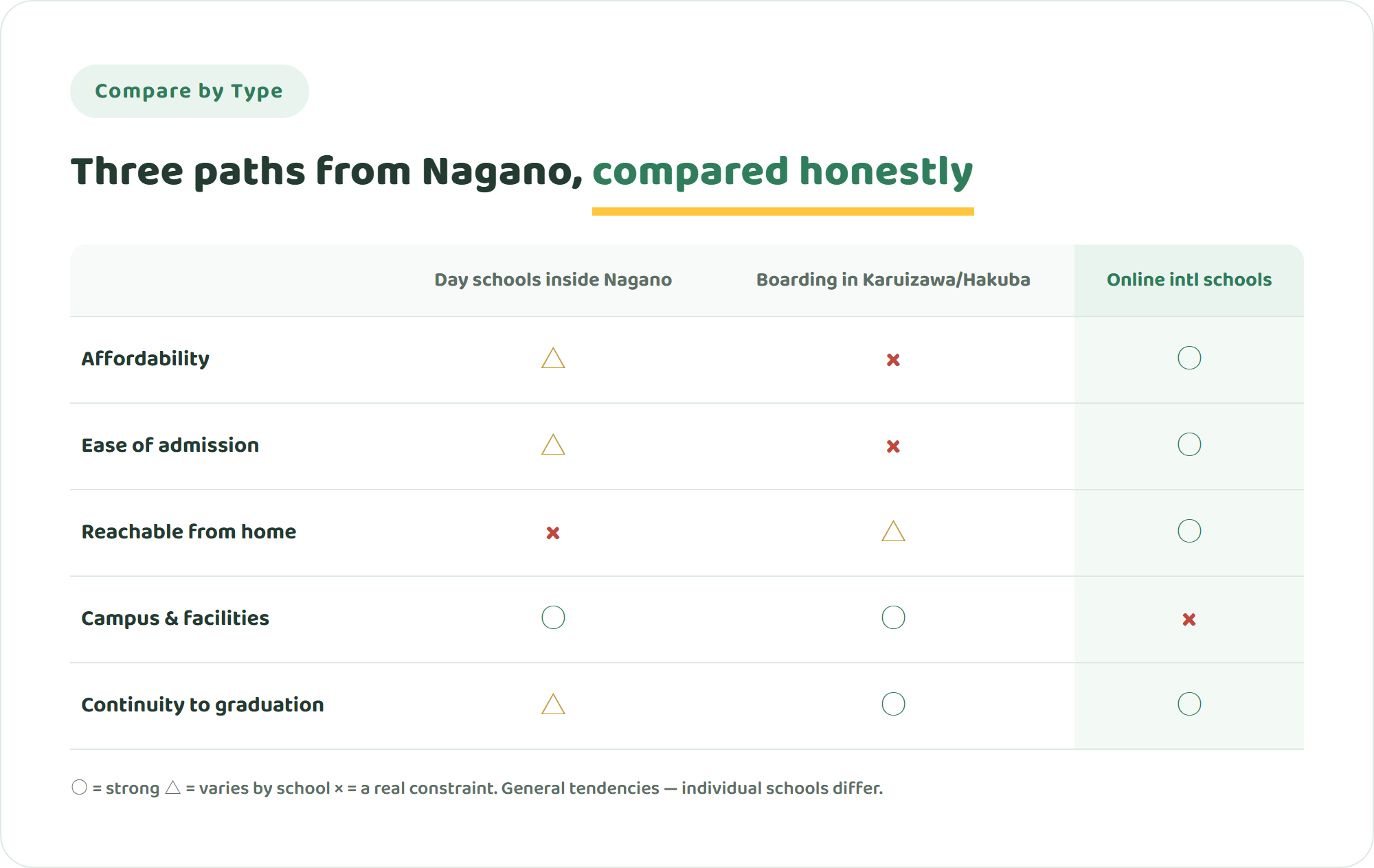
Day schools like ISN, EtonHouse and Green Forest are realistic on both cost and family life. ISN’s elementary division is particularly interesting because it is an ichijoko and an IB school at once, which means an international education without stepping outside Japan’s compulsory system. The constraint is location: Karuizawa, Matsumoto and Nakano. Commuting daily to Matsumoto from Iida, Ina or the Suwa basin is not viable. Nagano runs about 210 km north to south, and no single school serves the whole prefecture.
Boarding solves the distance problem outright — both UWC ISAK Japan and Hakuba International School accept applications regardless of where you live. But entry starts at junior high or high school age, so for a family with a primary-age child this is a plan for later, not an answer for now. It also requires being at peace with living apart, and a funding plan that usually includes scholarships.
A third approach is growing among Nagano families: keeping your child in their Japanese school and adding international learning alongside it — local school by day, English-medium learning after school or at weekends. Nothing has to be given up to start, which makes family agreement much easier to reach. We describe how that works in our guide to the double-school option.
The question that matters is not “which school will accept us” but “which learning can we keep going”. Multiply the annual fee and the daily travel time by twelve years, and the answer usually becomes clear.
See how learning works online →
When nothing is within reach: the online option
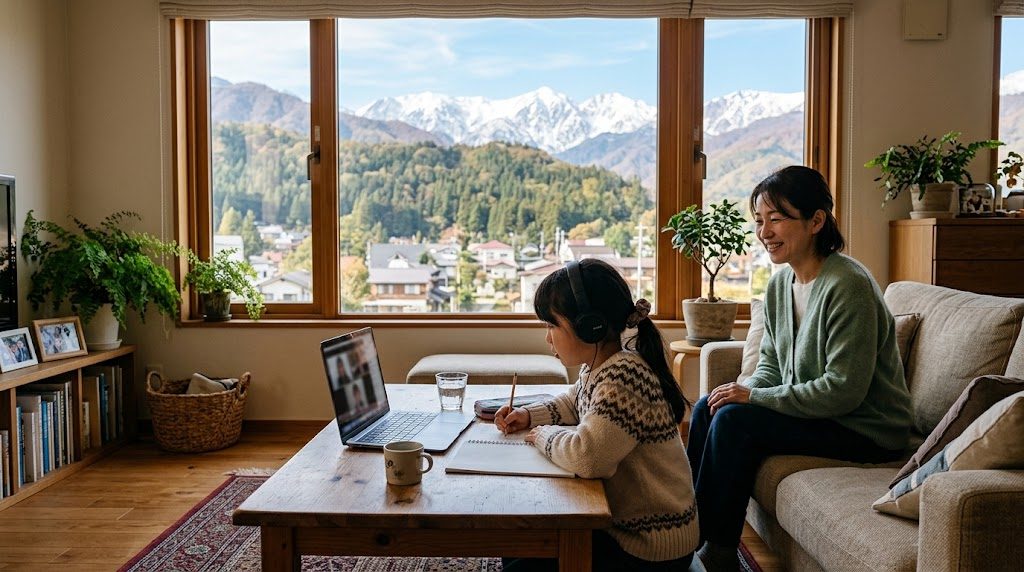
The most common dead end in a Nagano school search is not “there’s nothing good” — it is “we found something good, and we can’t get there”. Iida to Matsumoto, Suwa to Nakano, Omachi to Karuizawa: the same prefecture on a map, different lives in practice. Nagano is about 210 km top to bottom, and mountains and valleys cut daily life into separate pockets. No amount of family effort shortens that.
Which is why it is worth considering learning that does not depend on a commute at all. NIJIN GLOBAL ACADEMY (NGA) is an online international school opening in September 2027, operated by NIJIN Inc. in Japan. Our alternative school in Japan, NIJIN Academy, already has more than 1,000 students enrolled.
NGA is built on two commitments: moving beyond ranking children by test scores, and keeping classes small and dialogue-centred. Our promise to students is simple — to come to love themselves and the world. We serve children aged 6 to 18 across Asia and Oceania, wherever they live, and we are working to make tuition around one-fifth the cost of an in-person international school. English is introduced gradually, with Japanese-language support assumed rather than treated as a failure, so families do not have to choose between the two languages. For families in a prefecture where good schools exist but not within reach, that design matters.
The honest caveats: we have not opened yet, so there are no graduate outcomes to show you. And online learning cannot give a child a day on the snow in Hakuba or an afternoon running around a schoolyard. If those matter most to your family, a day or boarding school inside the prefecture is the better fit. But if the alternative is giving up because nothing is reachable, an option that does not require reaching is worth a look.
Frequently asked questions
Q. Can we reach a school from anywhere in Nagano Prefecture?
No. Nagano runs about 210 km north to south — Iida to Matsumoto takes over 90 minutes even by limited express, and Hakuba to Karuizawa is close to three hours by car. The full-day schools sit in Karuizawa, Matsumoto, Nakano and Hakuba, and we could not verify any full-day international school reachable daily from southern Nagano (Iida, Ina, Suwa, Kiso). Decide first how long a one-way journey your family can sustain for twelve years, then look only at what falls inside that circle. If nothing does, the real choice is between boarding, double-schooling and online.
Q. Can a junior high or high school student enter one of the boarding schools?
UWC ISAK Japan takes students in grades 10–12; Hakuba International School takes students from grade 7 upwards. Both assess English, and Hakuba publishes benchmarks — Eiken Pre-2 / CEFR A2+ at grade 7, rising to Eiken Pre-1 / CEFR B2+ from grade 9. UWC ISAK Japan is competitive, but roughly 70% of its students receive need-based financial assistance from an annual scholarship budget of around ¥600 million. Check the aid criteria and deadlines before the sticker price rules the school out.
Q. Is no English at all a problem? What about Japanese-language support?
At preschool and early-years level, almost every school here accepts children with no English. From upper primary onwards, entry usually involves an English assessment, and standards vary by school. At a Japanese accredited school such as ISN’s elementary division, Japanese-language subjects remain part of the official curriculum, so first-language development is less of a worry. For families with roots outside Japan who are concerned about their child’s Japanese, our sister service Tomodachi Japan (online Japanese for children, also run by NIJIN) is worth a look.
Being in Nagano does not mean having no choice
It is easy to assume families in Tokyo or Yokohama hold all the cards. But Nagano is home to a boarding high school where students from more than 80 countries live together, to a closed public school reborn as a Japanese accredited primary school running the IB, and to an inquiry-driven secondary school in a village where more than one resident in ten is a foreign national. The choice here is not smaller — it is shaped differently.
And in 2028, Nakano adds a junior high division, extending one more English-medium pathway through to age fifteen. The prefecture is changing. Your child’s “now”, though, does not wait. So put the day schools, the boarding route, double-schooling and online learning on the same table, and choose what your family can genuinely sustain. Whichever it is, if your child ends up loving themselves and the world, you chose right.
International School Guides for Other Prefectures
- International Schools in Karuizawa (city guide in Nagano)
- International Schools in Aichi Prefecture
- International Schools in Shizuoka Prefecture
- International Schools in Gifu Prefecture
- International Schools in Niigata Prefecture
- International Schools in Ishikawa Prefecture
- International Schools in Toyama Prefecture
- International Schools in Hokkaido Prefecture
- International Schools in Nagasaki Prefecture
- International Schools in Nara Prefecture
- International Schools in Oita Prefecture
- International Schools in Okayama Prefecture
- International Schools in Okinawa Prefecture
- International Schools in Saga Prefecture
- International Schools in Saitama: All 34 Listed
- Browse all 47 prefectures of Japan