If you have been searching for international schools in Ibaraki Prefecture and every name that comes back is in Tsukuba, you are not searching badly — that really is the map. Ibaraki’s international education is concentrated almost entirely around Tsukuba Science City, and families in Mito, Hitachi, Kamisu or Koga will notice the gap immediately. This guide lists every international school, IB programme inside a Japanese accredited school, and international preschool we could verify in Ibaraki, organised by region, with the fees that are actually published — and it is honest about the thing that decides most families’ choice here: the prefecture is about 180 km from north to south, and “it exists in Ibaraki” is not the same as “we can get there”.
Quick Answer: Your Options in Ibaraki
If you only read one section, read this. Below are the areas where schools can be confirmed, with their school names, plus the online option — so you can see every route side by side before the details.
- Tsukuba — Tsukuba International School (TIS) (Kamigo, Tsukuba)
- International preschools in Tsukuba, Tsuchiura and southern Ibaraki — Cocoas Kids Tsukuba (Kenkyu-gakuen, Tsukuba) / Kids International Tsukuba (Tsukuba) / Mintleaf International Preschool Tsukuba (Tsukuba) and 1 more (4 in total)
- Mito and central Ibaraki (Mito, Hitachinaka) — Global Kids International School (Mito and Hitachinaka)
- NIJIN GLOBAL ACADEMY (online) — Ages 6–18 / opening September 2027, currently taking opening-update registrations / fees around one-fifth of a typical campus international school / Japanese-language support. An option when distance or fees are the wall.
International schools in Ibaraki Prefecture: the landscape and what they cost
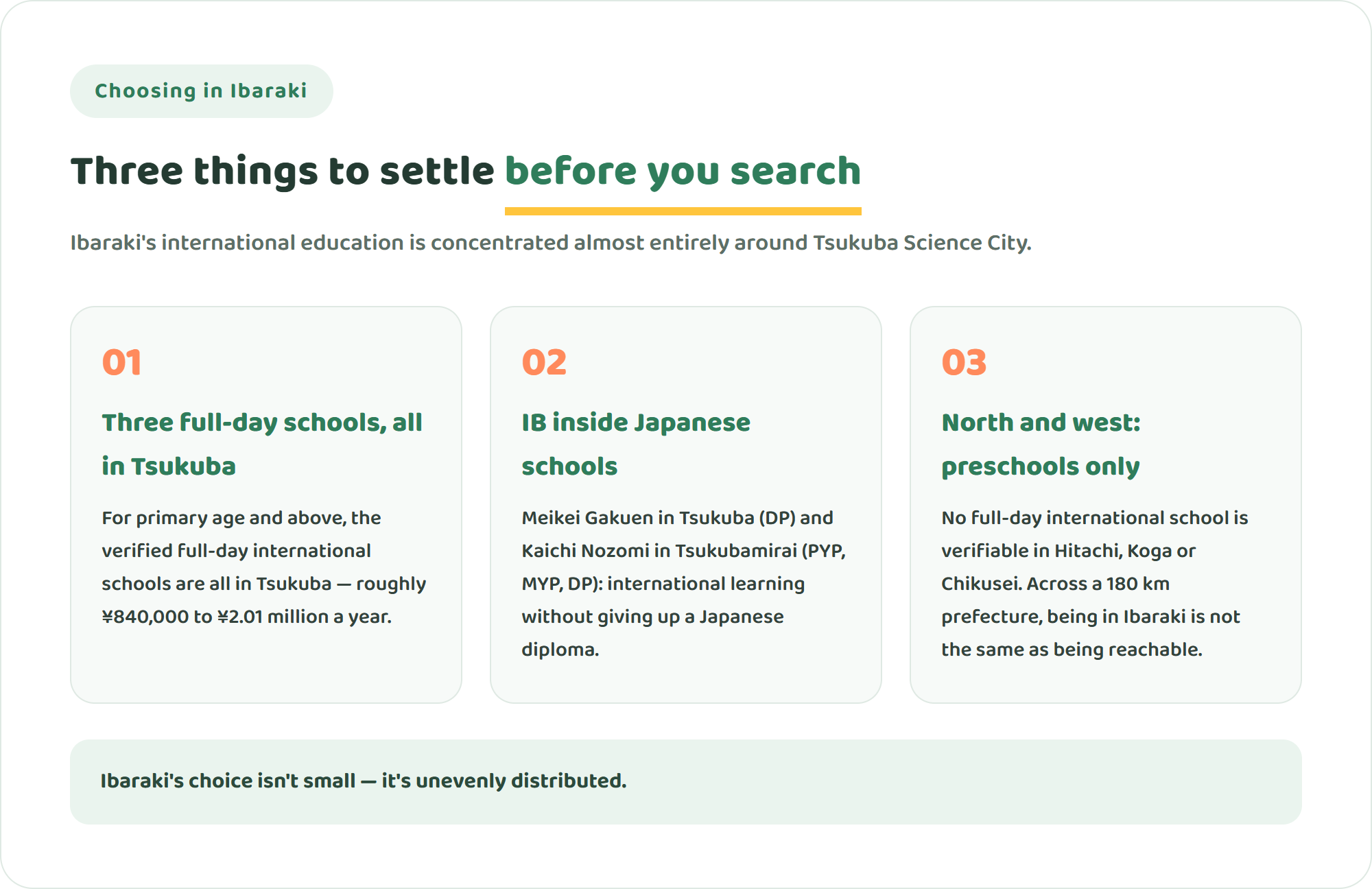
The honest headline first. As of July 2026, there are three full-day international schools in Ibaraki that take students beyond preschool age, and all three are in Tsukuba. Alongside them, two Japanese accredited schools — one in Tsukuba, one in Tsukubamirai — run International Baccalaureate programmes. Beyond that, roughly twenty international preschools are scattered across the southern and central parts of the prefecture. Because the term itself covers very different kinds of institutions, it is worth reading what an international school actually is before comparing them.
The reason for the concentration is straightforward: Tsukuba Science City. According to the Tsukuba Science City Network’s baseline data, the Tsukuba district hosts 58 research institutions and 12,076 researchers (FY2023). Tsukuba City’s own figures record 12,663 foreign residents from 144 countries as of 1 December 2023 — about 4.9% of the city’s population, the highest share of any municipality in the prefecture. Those residents are largely researchers, university staff and international students with families, which is exactly why Ibaraki’s oldest international school was founded in Tsukuba in 1992 to serve children who needed an English-medium education.
Prefecture-wide, Ibaraki’s international affairs division reports 106,490 foreign residents as of the end of June 2025 (10th highest in Japan), based on Immigration Services Agency statistics. But in the north, west and Rokko regions those residents are largely working in manufacturing and agriculture, and demand for English-medium schooling — along with the schools themselves — sits around Tsukuba.
On fees: published figures put Ibaraki’s full-day schools for primary age and above at roughly ¥840,000 to ¥2,010,000 per year (publicly available information as of 2026). The most affordable is Tsukuba Cross Mission Christian School at ¥838,530 a year for grades 1–6 (2025 school year). In the middle sits One World International School Tsukuba at ¥1,291,500–1,612,500 (2026-27). At the top, Tsukuba International School charges ¥1,560,000 in tuition plus a ¥210,000 facilities fee and a ¥240,000 materials fee, about ¥2.01 million a year (2026-27). Compared with Tokyo and Yokohama, where ¥2–3 million a year is standard, Ibaraki is unusual in having a genuinely mid-priced band of options. For the full anatomy of these costs, see our breakdown of international school fees.
Then there is distance. From Toride and Moriya in the south to Kitaibaraki in the north is about 180 km. Driving from Hitachi or Kitaibaraki to Tsukuba takes close to two hours, and the same is true from the Rokko area (Kashima, Kamisu) and the west (Koga, Chikusei). Ibaraki cannot be searched as one prefecture. It has to be searched as five separate living areas: Tsukuba and the south, the central Mito area, the north, Rokko, and the west.
Every international school in Ibaraki Prefecture, by region
Below are the schools we could verify through official school sites or municipal and school-corporation publications. For a nationwide view, see our index of international schools across all 47 prefectures of Japan.
Tsukuba: where Ibaraki’s full-day international schools are
If you want your child learning in English every day from primary age onwards in Ibaraki, these three schools are the realistic starting point.
- Tsukuba International School (TIS) (Kamigo, Tsukuba) | Founded in 1992, the oldest international school in the prefecture. It takes students from age 3 through Grade 12, with around 300 students from roughly 25 countries, and is authorised for all three IB programmes — PYP (ages 3–10), MYP (ages 11–15) and DP (ages 16+). Everything except Japanese is taught in English, and collaborative lessons with Tsukuba’s research institutes are a distinctive feature. Published 2026-27 fees: tuition of ¥1,560,000 (the same for every grade), a ¥210,000 facilities fee and a ¥240,000 materials fee, around ¥2.01 million a year, plus a one-time ¥20,000 application fee and ¥300,000 registration fee. Discounts include ¥90,000 for lump-sum payment, ¥240,000 for younger siblings, and a further discount for children of researchers based in Tsukuba. The school has publicly signalled a tuition increase from 2027-28, so confirm current figures directly.
- One World International School Tsukuba (OWIS Tsukuba) (Kunimatsu, Tsukuba) | Opened in August 2025 by the Singapore-founded OWIS group on the site of a closed Tsukuba municipal elementary school. For 2026-27 it accepts students from Early Childhood through Grade 7, adding one grade a year with the aim of running through to Grade 12. Published 2026-27 tuition: ¥1,291,500 for Early Childhood (EC2, EC1, Kindergarten), ¥1,543,500 for Grades 1–5 and ¥1,612,500 for Grades 6–8, plus an ¥80,000 application fee and a ¥40,000–60,000 annual resource fee depending on grade. A 10% sibling discount applies, and a time-limited 10% founding-family discount is advertised through July 2027. Because the school is new, confirm which upper grades are actually running and where its IB authorisation stands.
- Tsukuba Cross Mission Christian School (CMCS) (Matsushiro, Tsukuba) | A Christian school serving primary through high school years, and a member of ACSI (Association of Christian Schools International), the world’s largest Christian school accreditation body. Its stated aim is a school culture in which bullying and school refusal do not take root. Published 2025 annual fees are ¥838,530 for grades 1–6 and ¥914,760 for grades 7–12, payable in one or two instalments, with sibling discounts of 10% for a second child and 30% for a third. It is the most affordable full-day option in the prefecture.
Tsukuba and Tsukubamirai: IB inside Japanese accredited schools
This is Ibaraki’s quiet strength. These are Japanese schools (ichijoko), so enrolment satisfies compulsory education requirements and Japanese-language subjects remain part of the official curriculum — which removes a worry many bilingual families carry.
- Meikei Gakuen Junior and Senior High School — IB Class (Inarimae, Tsukuba) | Authorised as an IB World School in 2016, with its first cohort entering in April 2017. The Diploma Programme runs across the three high school years, and students who take at least two subjects in English can otherwise combine English and Japanese subjects freely. More than 40 students per year group and over 100 IB students across the high school. The school reports a 94.6% DP completion rate in 2025, with 58.1% of graduates going to universities overseas and 41.8% in Japan — a good fit for families who want a Japanese high school diploma and an international qualification. Confirm fees in the school’s annual admissions materials.
- Kaichi Nozomi Elementary School and Secondary School (Tsukubamirai) | The elementary school opened in 2015 and the secondary school in 2020, forming a 12-year pathway. In March 2018 it became only the second Japanese accredited school nationwide — and the first in Ibaraki — to gain PYP authorisation. Grades 1–5 sit within PYP, Grade 6 moves into MYP, and students can enter a DP course (an overseas-university track) in Year 5 of the secondary school. Published fee details include a ¥100,000 internal progression fee in place of an entrance fee when moving up from the elementary school, an additional ¥350,000 a year in international education fees for the DP course, and annual field-work reserves of ¥120,000 (elementary) and ¥200,000 (secondary). Base tuition is listed in the admissions materials. Being on the Tsukuba Express line, it is also reachable from Moriya and the Kashiwa area.
International preschools in Tsukuba, Tsuchiura and southern Ibaraki
For under-sixes, southern Ibaraki has by far the widest choice in the prefecture — more than ten preschool-type facilities are listed in Tsukuba City alone.
- Kids Creation Tsukuba (Tsukuba) | An international preschool and English school with classes from age zero through primary age, including a kindergarten course. Fees on enquiry.
- Cocoas Kids Tsukuba (Kenkyu-gakuen, Tsukuba) | An English-medium nursery staffed by qualified childcare and kindergarten teachers, covering music, movement, art, science and maths in English, with programming and music-based development added. Fees on enquiry.
- Kids International Tsukuba (Tsukuba) | An all-English environment for children from six months to lower primary age, operating as an unlicensed childcare facility. Fees on enquiry.
- Mintleaf International Preschool Tsukuba (Tsukuba) | An international preschool operated under Japan’s company-led childcare scheme, which means eligibility conditions apply. Check details with the school directly.
- English Spot International School (Tsukuba and Tsuchiura) | Preschool, English kindergarten and after-school programmes for ages one through primary, based on an American integrated-learning curriculum, across two campuses. Fees on enquiry.
- Mirai International School (Playgroup Moriya) (Kokinu, Tsukubamirai) | An English kindergarten serving the Moriya and Tsukubamirai area on an American early-childhood curriculum: parent-and-child classes from eight months, preschool for ages 1.5–3, kindergarten for ages 3–5 and after-school for primary students. Classes run at around eight children per year group, and Japanese-language instruction is built into the curriculum. For eligible families, the national early-childhood education subsidy covers up to ¥37,000 a month for ages 3–5.
Mito and central Ibaraki (Mito, Hitachinaka)
The prefectural capital has no full-day international school for primary age and above as of July 2026. What exists is early-years provision plus English after-school care.
- Global Kids International School (Mito and Hitachinaka) | A continuous pathway from English music-and-movement classes at age zero, through preschool (1.5–3), nursery and kindergarten immersion on an American curriculum (3–6), after-school English from age six, and English day-care for primary and junior high students. Two campuses. Fees on enquiry.
- Play Group Mito (Motoyoshida-cho, Mito) | An international preschool built on America’s Creative Curriculum®, running parent-and-baby classes, preschool, an English-immersion nursery class, kinder school, after-school for grades 1–3 and a Global Kids class for grades 4–6. Listed as an eligible facility under Mito City’s early-childhood education subsidy. Fees on enquiry.
Northern Ibaraki, Rokko and the west (Hitachi, Kamisu, Koga and beyond)
Plainly: in Hitachi, Takahagi and Kitaibaraki in the north, and Koga and Chikusei in the west, we could not verify any international school or international preschool as of July 2026. The Rokko area has one.
- First Learning Kamisu (Hiraizumi, Kamisu) | An international preschool on an internationally benchmarked curriculum for children from age one to kindergarten age, with paired foreign and Japanese teachers. Fees on enquiry.
For families in these areas who want a full-day international school, the realistic options are a long commute to Tsukuba or a route that does not require commuting at all. Hitachi to Tsukuba is close to two hours by car — not a distance a primary-age child can cover twice a day.
Two clarifications. Institutions such as Tsukuba International University and its affiliated high school are Japanese schools with the word “international” in the name, not international schools. And directory sites that credit Ibaraki with dozens of international schools are counting English conversation classrooms and cram schools; some listed names have no verifiable official website at all. Always go back to primary sources.
Please note: fees and programme details reflect publicly available information as of July 2026. Always confirm current figures on each school’s official website.
Comparing your options honestly
Families in Ibaraki tend to ask three questions. Should we go for a full-day international school in Tsukuba? Is an IB programme inside a Japanese school like Meikei Gakuen or Kaichi Nozomi enough? And what do we do if Tsukuba is simply out of reach?
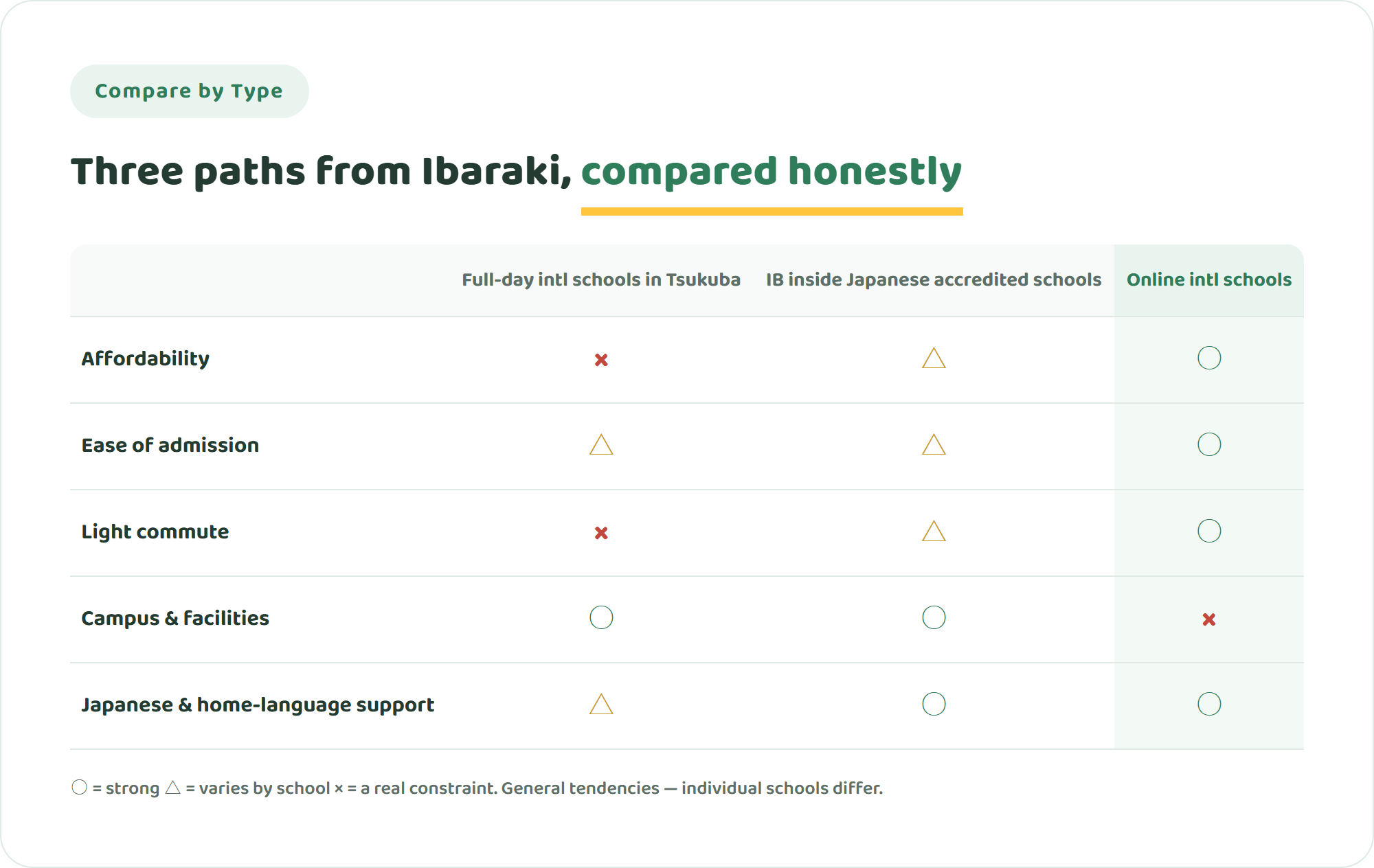
Tsukuba’s full-day schools offer the strongest English environment in the prefecture. TIS in particular is the only school here running IB continuously from age 3 to 18, and the research-city community around it becomes part of a child’s everyday life. The catch is arithmetic: about ¥2.01 million a year is over ¥20 million across twelve years. CMCS and OWIS sit at more reachable price points.
The IB programmes at Meikei Gakuen and Kaichi Nozomi are realistic on both cost and language. A Japanese diploma is secure, Japanese and social studies are taught in Japanese, and families who do not want to trade one language for the other get a genuine answer. The trade-off is entrance exams and limited places.
And for families in the north, west or Rokko who cannot reach Tsukuba, there is the double-school approach: keep your child in the local Japanese school and build international learning on top of it, online, after school and at weekends. Drop the assumption that you must pick exactly one school, and the options widen immediately.
The question that matters is not “which school will accept us” but “which learning can we keep going”. Multiply the annual fee and the daily travel time by twelve years, and the answer usually becomes clear.
See how learning works online →
When nothing is within reach: the online option
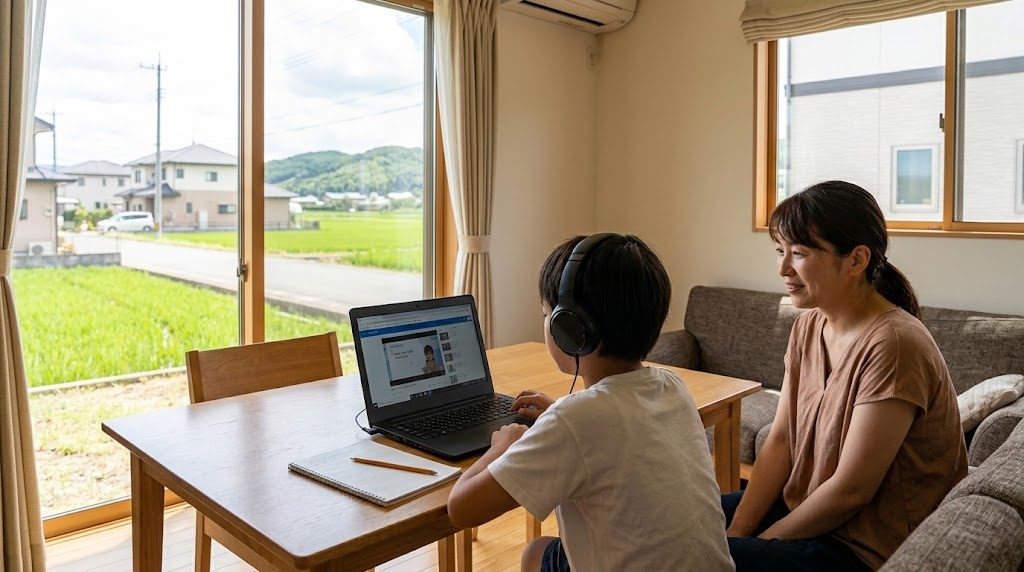
The most common dead end in an Ibaraki school search is not “there’s nothing good” — it is “we found something good, and we can’t get there”. Hitachi to Tsukuba, Kamisu to Tsukuba, Koga to Tsukuba: the same prefecture on a map, different lives in practice. No amount of family effort shortens that distance.
Which is why it is worth considering learning that does not depend on a commute at all. NIJIN GLOBAL ACADEMY (NGA) is an online international school opening in September 2027, operated by NIJIN Inc. in Japan. Our alternative school in Japan, NIJIN Academy, already has more than 1,000 students enrolled.
NGA is built on two commitments: moving beyond ranking children by test scores, and keeping classes small and dialogue-centred. Our promise to students is simple — to come to love themselves and the world. We serve children aged 6 to 18 across Asia and Oceania, wherever they live, and we are working to make tuition around one-fifth the cost of an in-person international school. English is introduced gradually, with Japanese-language support assumed rather than treated as a failure, so families do not have to choose between the two languages. In a prefecture where large stretches simply have no school within reach, that design matters.
The honest caveats: we have not opened yet, so there are no graduate outcomes to show you. And online learning cannot replicate a schoolyard, a sports field, or the walk home with friends. If those matter most to your family, a Tsukuba school or your local school is the better fit. But if the alternative is giving up because nothing is reachable, an option that does not require reaching is worth a look.
Frequently asked questions
Q. Can we reach a school from anywhere in Ibaraki Prefecture?
No — no single school serves the whole prefecture. The full-day international schools are all in Tsukuba, and the IB-authorised Japanese schools are in Tsukuba and Tsukubamirai. It is roughly 180 km from the southern edge of the prefecture to the northern edge, and driving to Tsukuba from Hitachi, Kitaibaraki, Kamisu or Koga takes close to two hours. Decide first how long a one-way journey your family can sustain for twelve years, then look only at what falls inside that circle. The Tsukuba Express corridor (Moriya, Tsukubamirai, Tsukuba) and the Joban Line corridor (Tsuchiura, Ushiku, Toride) are the easiest areas to commute from.
Q. Can we attend an international school in Tokyo or Chiba instead?
Yes, and some families do. The Tsukuba Express runs from Tsukuba to Akihabara in as little as 45 minutes, which makes Tokyo schools a genuine option from southern Ibaraki, and families around Toride and Moriya can also consider schools in Kashiwa or Matsudo in Chiba. Budget honestly, though: commuter passes run to several hundred thousand yen a year, and primary-age children usually need an accompanying adult. A common compromise is to stay local through primary school and switch to a commute at junior high or high school age.
Q. Is no English at all a problem? What about Japanese-language support?
At preschool and kindergarten level, almost all schools here accept children with no English. From upper primary onwards, entry usually involves an English assessment, and standards vary by school. TIS teaches everything except Japanese in English; at Japanese accredited schools like Meikei Gakuen and Kaichi Nozomi, Japanese-language subjects remain part of the official curriculum, so first-language development is less of a worry. For families with roots outside Japan who are concerned about their child’s Japanese, our sister service Tomodachi Japan (online Japanese for children, also run by NIJIN) is worth a look.
Being in Ibaraki does not mean having no choice
It is easy to think families in Tokyo or Chiba have all the options. But Ibaraki has an IB school that has been educating researchers’ children since 1992, a brand-new international school that opened in 2025 on the site of a closed elementary school, and the first Japanese accredited school in the prefecture to earn IB PYP authorisation. People from more than 140 countries already live in the same city here, and their children already share the same parks. The choice in Ibaraki is not small — it is unevenly distributed.
So start from where you live. If Tsukuba is commutable, go and visit the three full-day schools and the two IB-authorised Japanese schools. If it is not, put the cross-prefecture commute, the double-school route and the online route on the same table, and choose the one your family can genuinely sustain. Whichever it is, if your child ends up loving themselves and the world, you chose right.
International School Guides for Other Prefectures
- International Schools in Tsukuba (city guide in Ibaraki)
- International Schools in Kanagawa Prefecture
- International Schools in Chiba Prefecture
- International Schools in Saitama: All 34 Listed
- International Schools in Tochigi Prefecture
- International Schools in Gunma Prefecture
- International Schools in Hokkaido Prefecture
- International Schools in Aichi Prefecture
- International Schools in Ishikawa Prefecture
- International Schools in Iwate Prefecture
- International Schools in Kagawa Prefecture
- International Schools in Kagoshima Prefecture
- International Schools in Kochi Prefecture
- International Schools in Kumamoto Prefecture
- International Schools in Kyoto Prefecture
- Browse all 47 prefectures of Japan