If you are searching for an international school in Shibuya, you have probably noticed something: plenty of preschools come up, the tuition figures are scattered, and it is hard to tell which schools actually run all the way to Grade 12. Shibuya is one of Tokyo’s densest wards for international education — clustered around Hiroo, Ebisu, Yoyogi and Tomigaya — but it leans heavily toward the early years, and only a handful of schools carry through to high school. This guide compares seven real international schools in Shibuya, Tokyo, honestly by fees, curriculum and neighborhood, and walks you through how to choose. By the end you should have two or three schools worth visiting.
Quick Answer: Your Options in Shibuya
If you only read one section, read this. Below are the schools covered in this guide, plus the online option — so you can see every route side by side before the details.
- International School of the Sacred Heart (ISSH) — Ages: 3 (kindergarten) to 18; girls only from Grade 1
- Yoyogi International School — Ages: approx. 4 to 14 (two campuses)
- United School of Tokyo (UST) — Ages: 3 to 14 (K1–G8)
- Elite Open School LRC Tokyo — Ages: elementary through high school (around Grade 3–12, varies by program)
- The Innovation Fellowship (TIF) — Ages: middle and high school (Grades 7–12)
- Yuai International Islamic School — Ages: kindergarten through secondary
- Capital Tokyo International School (CTIS) — Shibuya Campus — Ages: 2 to 5 (early years)
- NIJIN GLOBAL ACADEMY (online) — Ages 6–18 / opening September 2027, currently taking opening-update registrations / fees around one-fifth of a typical campus international school / Japanese-language support. An option when commute or fees are the wall.
International schools in Shibuya, Tokyo: the landscape and fees
Shibuya-ku takes in Hiroo and Ebisu, home to embassies, international firms and expat life, and it packs in more international schools and preschools than most Tokyo wards. Two things stand out. First, the early years are exceptionally well served: Yoyogi, Tomigaya and Ebisu are full of small, English-medium preschools and kindergartens. Second, schools that continue all the way through middle and high school are limited to just a few. The prestigious British school, The British School in Tokyo, once had a Shibuya campus but has since consolidated onto its Azabudai Hills (Minato-ku) and Showa (Setagaya) campuses — so it no longer operates inside Shibuya-ku. The assumption that Shibuya is stacked with big-name K-12 international schools is, in reality, a little off.
For full-time primary and middle years, expect roughly ¥1.7 million to the high ¥2 millions per year. On top of tuition, most schools charge one-time entrance, facility or development fees (from the tens of thousands into the hundreds of thousands of yen) plus an annual maintenance levy. Preschool pricing sits on a separate scale that depends on hours attended. Figures are revised by school, grade and year, so always confirm the latest on each school’s official site. The trick is to judge not by tuition alone, but by two numbers: the all-in cost of the first year, and the annual amount you can comfortably keep paying. Note: fees reflect publicly available information as of July 2026. Please confirm the latest figures on each school’s official website.
7 international schools in Shibuya worth knowing
Here are seven schools that genuinely sit inside Shibuya-ku, ranging from a full K-12 institution to distinctive small schools and strong early-years options. Curricula center on IB, American (WASC / US-benchmarked) and international-Islamic education, and we have added a “best for” note to make shortlisting easier.
1. International School of the Sacred Heart (ISSH)
Founded in Hiroo in 1908, ISSH is Shibuya’s flagship heritage international school. Kindergarten (K3–K4) is co-educational; from Grade 1 it becomes a girls’ school running through to Grade 12. Accredited by the US WASC and the European ECIS, it sends graduates to universities worldwide. Its calm campus and emphasis on small, nurturing classes are a big part of the draw.
- Curriculum: American (WASC & ECIS accredited), continuous K3–G12
- Ages: 3 (kindergarten) to 18; girls only from Grade 1
- Approx. fees: around ¥2.42M–¥2.72M/year depending on grade, plus one-time fees (application ~¥30,000, registration ~¥300,000, development ~¥600,000) and an annual maintenance fee — 2026 official figures, confirm the latest
- Best for: families wanting a settled, continuous girls’ education in Hiroo through high school
2. Yoyogi International School
An authorized IB World School offering the Primary Years Programme (PYP), with campuses in Yoyogi and Tomigaya near Yoyogi Park. Inquiry-based learning in English is built on a blend of the US Common Core and the UK National Curriculum. The Tomigaya campus covers ages 4–6 and the Yoyogi campus ages 6–14. A strong fit if you want your child in genuine inquiry-led learning early.
- Curriculum: IB PYP (inquiry-based); US and UK curricula combined
- Ages: approx. 4 to 14 (two campuses)
- Approx. fees: from around ¥2.3M/year, rising with grade level, plus additional fees — 2026 official figures, confirm the latest
- Best for: families wanting IB inquiry learning from an early age in the Yoyogi/Tomigaya area
3. United School of Tokyo (UST)
A small Tomigaya school founded by parents and teachers in 2014, with about 16 students per class and roughly 220 in total. Its theme-based curriculum runs on four threads — responsibility and caring, global citizenship, environmental impact, and experiential learning — taught in English against US Common Core benchmarks, with Japanese studied daily. Among Shibuya’s full-time schools it sits at the more affordable end, and families are drawn to its warm, tight-knit community.
- Curriculum: theme-based (US Common Core benchmarks), English plus daily Japanese
- Ages: 3 to 14 (K1–G8)
- Approx. fees: around ¥1.7M–¥2.0M/year (tax included, approximate) — 2026 official figures, confirm the latest
- Best for: families who prioritize a small, family-style environment where children are truly known
4. Elite Open School LRC Tokyo
A blended-learning international school in Ebisu-nishi, opened in 2015, combining digital US curriculum with on-site teacher and mentor support. Accredited by both WASC and Cognia, with grades and transcripts issued by US-based course teachers. Its personalized, self-paced model and flexible attendance (full-time or part-time) appeal to students who want to learn at their own pace, including those for whom a conventional school day has not worked.
- Curriculum: American blended learning (WASC & Cognia accredited)
- Ages: elementary through high school (around Grade 3–12, varies by program)
- Approx. fees: varies by program and attendance mode (inquire directly) — 2026 official figures, confirm the latest
- Best for: families wanting flexible attendance and personalized, self-paced learning
5. The Innovation Fellowship (TIF)
A small Grades 7–12 international high school in Spark Shibuya, in the heart of Udagawacho. Learning rests on three pillars — project-based, problem-based and inquiry-based — culminating in an American high-school diploma. TIF became fully accredited by the US MSA-CESS in December 2025, and its annual public “Demo Day,” where students present their projects, captures a culture that values action and self-expression.
- Curriculum: American high school (project / problem / inquiry-based), MSA accredited
- Ages: middle and high school (Grades 7–12)
- Approx. fees: inquire directly (confirm on the official site) — 2026 official figures, confirm the latest
- Best for: families wanting a project-driven, hands-on secondary school in central Shibuya
6. Yuai International Islamic School
Located in Oyamacho, Yuai was established through a collaboration between the FGA Education Foundation and the Islamic Centre of Japan. Spanning kindergarten through secondary education, it blends international schooling with Islamic values — a rarer profile within Shibuya-ku. For families who want a culturally and religiously considerate environment, it is a valuable option, and it draws students from diverse backgrounds.
- Curriculum: international education plus Islamic education (in English)
- Ages: kindergarten through secondary
- Approx. fees: inquire directly (confirm on the official site) — 2026 official figures, confirm the latest
- Best for: families seeking an international education with religious and cultural sensitivity
7. Capital Tokyo International School (CTIS) — Shibuya Campus
A kindergarten for ages 2–5 inside Sakura Stage, directly connected to Shibuya Station. Its ultra-convenient central location lets children build a pre-school foundation in an English-speaking environment. It works well as an “entry point” for families who want to immerse a child in English early and then move on to a primary school in the ward or another international school.
- Curriculum: English-immersion early years (kindergarten)
- Ages: 2 to 5 (early years)
- Approx. fees: varies by attendance hours (inquire directly) — 2026 official figures, confirm the latest
- Best for: families wanting an English environment from the early years, right by Shibuya Station
Beyond these, Shibuya has many more distinctive preschools and early-years programs — Gingertree (Jingumae), OliveTree (Tomigaya), Poppins Active Learning (Ebisu) and The Reggio School of Tokyo (Hatsudai) among them. If you are looking ahead to middle and high school, it is realistic to search beyond the ward too. See our guide to international schools across Tokyo for the full picture.
How to choose the right fit for your family
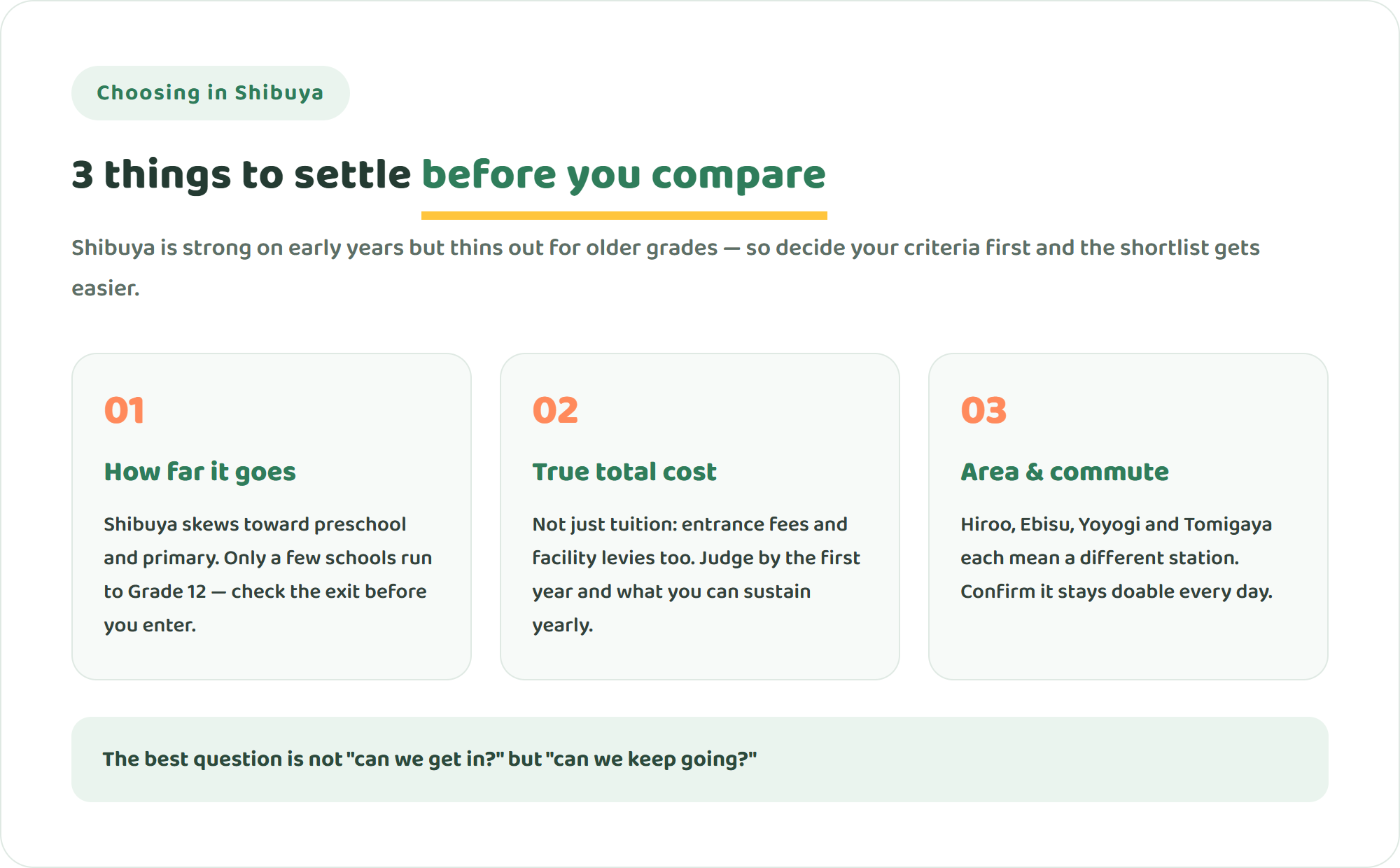
Lining up seven schools can still leave you asking, “so which one is right for us?” In Shibuya, three steps make the decision far easier.
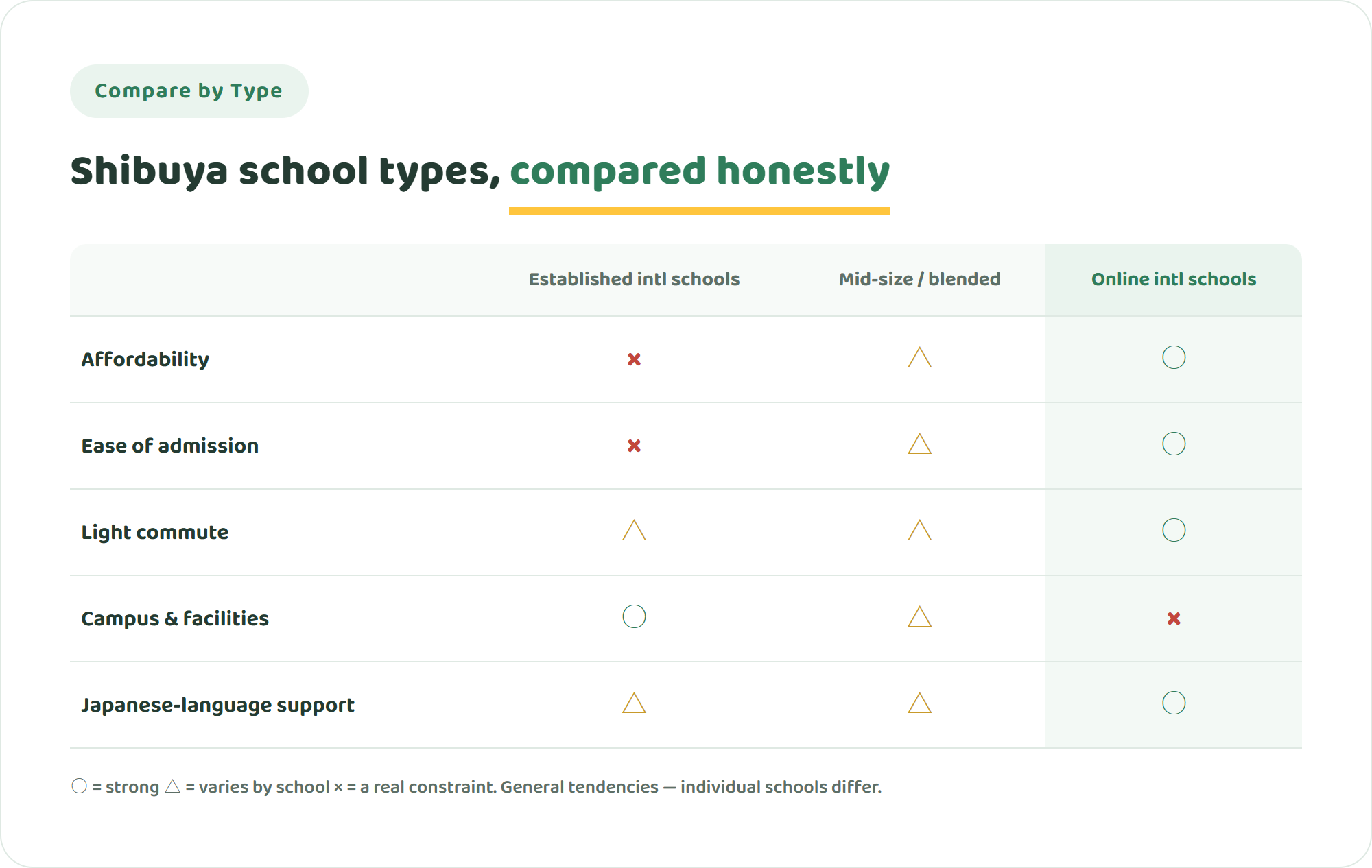
1. Work backward from the exit (how far it goes). Shibuya is rich in early years, but only a few schools — Sacred Heart, TIF, Elite Open, Yuai — continue through secondary. If you want your child to stay for years, start your shortlist with schools that offer continuity. 2. Budget by the total. Add entrance, facility and maintenance fees to tuition to see the “all-in first year” and the “sustainable annual amount.” Our breakdown of international school tuition costs explains how the pieces fit together. 3. Decide on area and commute. Hiroo, Ebisu, Yoyogi and Tomigaya each mean a different station. Since it is a daily reality, put “can my child keep doing this for years?” first. When you are weighing options, it is worth including online learning in the comparison too. See how learning works online →
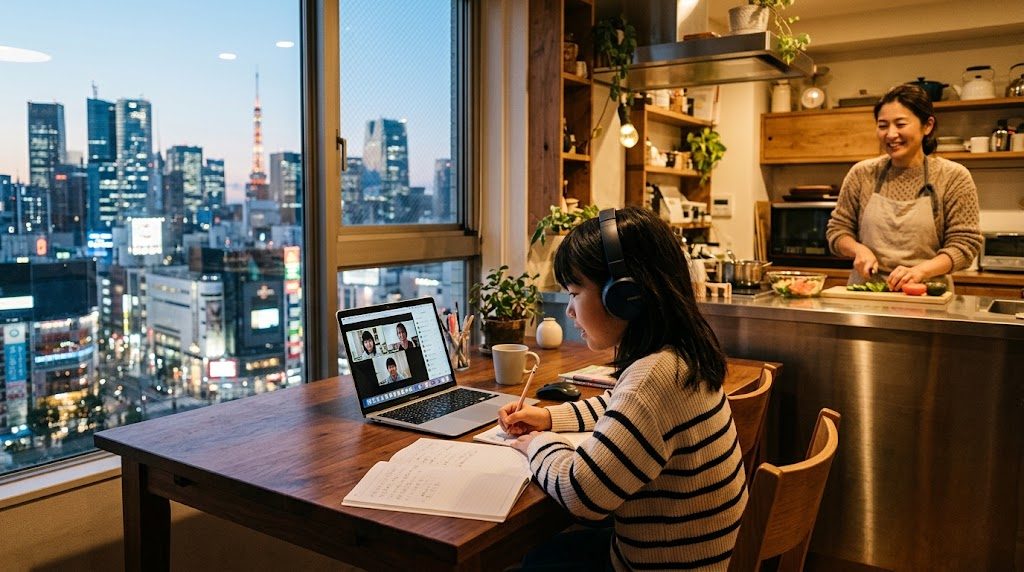
When fees or the commute are the wall — an online eighth option
The more you research Shibuya’s schools, the more likely you are to hit a wall: tuition higher than expected, or few schools that continue into the upper grades. That is exactly when it is worth setting an online option beside the campus-based schools — an eighth choice.
NIJIN GLOBAL ACADEMY (NGA) is an online international school scheduled to open in September 2027. It is run by NIJIN Inc., which operates the alternative school “NIJIN Academy” in Japan with more than 1,000 students enrolled. NGA moves away from ranking children by test scores, centers on small-group dialogue, and is built around helping children “come to love themselves and the world.” It aims to cost roughly one-fifth of a campus-based international school, and serves ages 6 to 18 across Asia and Oceania — no matter where you live, with a design that eases children into English on a foundation of Japanese-language support.
In the interest of honesty: NGA has not opened yet, and its track record is still to come. It cannot offer the playground, the physical campus or the in-person atmosphere in the same way a campus school does. Even so, for Shibuya families wrestling with commutes and costs, we believe it can be a way to not give up on a global education because of where you live or what you can spend. It is worth knowing as one axis to weigh against the local schools.
Frequently asked questions
Q. From what age can children enter international schools in Shibuya?
A. Many preschools and kindergartens accept children from ages 0–2, and Shibuya is especially strong at this level. For schools that continue into primary, entry from a kindergarten class at ages 3–5 is typical. A common path is to build an English foundation in the early years and then move into a continuous school.
Q. Is it okay if my child’s English isn’t ready? What about Japanese support?
A. Most schools teach primarily in English, but some — like United School of Tokyo — study Japanese daily, and others invest in Japanese-language support. Expected entry-level English and mother-tongue (Japanese) care vary widely, so always confirm at a visit. An online school like NGA, designed to ease children into English on a base of Japanese support, is also an option.
Q. Can children transfer in mid-year, and when?
A. Many schools accept transfers mid-year if a place is open, but popular schools fill up, so applying for the September start is standard. Because fewer schools accept transfers at the middle and high school level, we recommend gathering information early and applying to a mix — including options outside the ward and online.
Don’t let “can we get there” decide your child’s possibilities
Shibuya offers a genuinely varied line-up — a heritage girls’ school, an inquiry-led IB school, warm small schools, and strong early-years entry points. It is also true that fees and grade limits are real walls. What matters is not hunting for a single “correct” answer, but choosing a place where — within your family’s life and budget — your child can keep going, and keep smiling, for years. Put campus and online options on the same table and compare them. That first step is where a regret-free school choice begins.
International Schools in Other Cities
- International Schools in Nagoya: All 8 Schools
- International Schools in Minato: Fees
- International Schools in Setagaya: All 14 Schools
- International Schools in Nakano, Tokyo
- International Schools in Tsukuba: Fees
- International Schools in Sendai: 7 Picks and Fees
- International Schools in Ho Chi Minh City
- International Schools in Itabashi, Tokyo
- International Schools in Tokyo
- International Schools in Koto, Tokyo
- International Schools in Shinagawa, Tokyo
- International Schools in Meguro: All 8 Schools
- International Schools in Chofu and ASIJ Fees
- International Schools in Shinjuku: Fees