“He’s on that game again.” “She draws all day and the homework hasn’t been touched.” Perhaps you have started that sentence one evening at the dinner table, and stopped yourself. Your child is clearly happy. They are so absorbed that they don’t hear you the first time. You can see all of that — and still, you cannot see where any of it leads.
Here is the part worth saying first. Whether a child’s interest leads anywhere has very little to do with whether the interest looks respectable. More often than not, the real dividing line is whether the adults around them can translate that interest into the name of a job. This article looks at why that worry appears, then at a practical way of turning a child’s interests into a career path — and at what parents can do this week. It is not an argument for letting a child do only what they enjoy. The honest limits of that idea are in here too.

Worrying about where your child’s interests lead is a normal reaction
Let’s not dismiss the worry. You are not anxious because you think your child’s interest is trivial. You are anxious because you take responsibility for their life, and a path you cannot see ahead on is frightening.
The cause is more structural than personal. Most of us were handed exactly one ruler: exam scores, class rank, the name of a well-known university. On that ruler, anyone can see where a child stands today and what to do next. “Loves insects” and “loves music” have no markings at all. Faced with something unmeasured, people get nervous. That is a limitation of the instrument, not a failure of parenting.
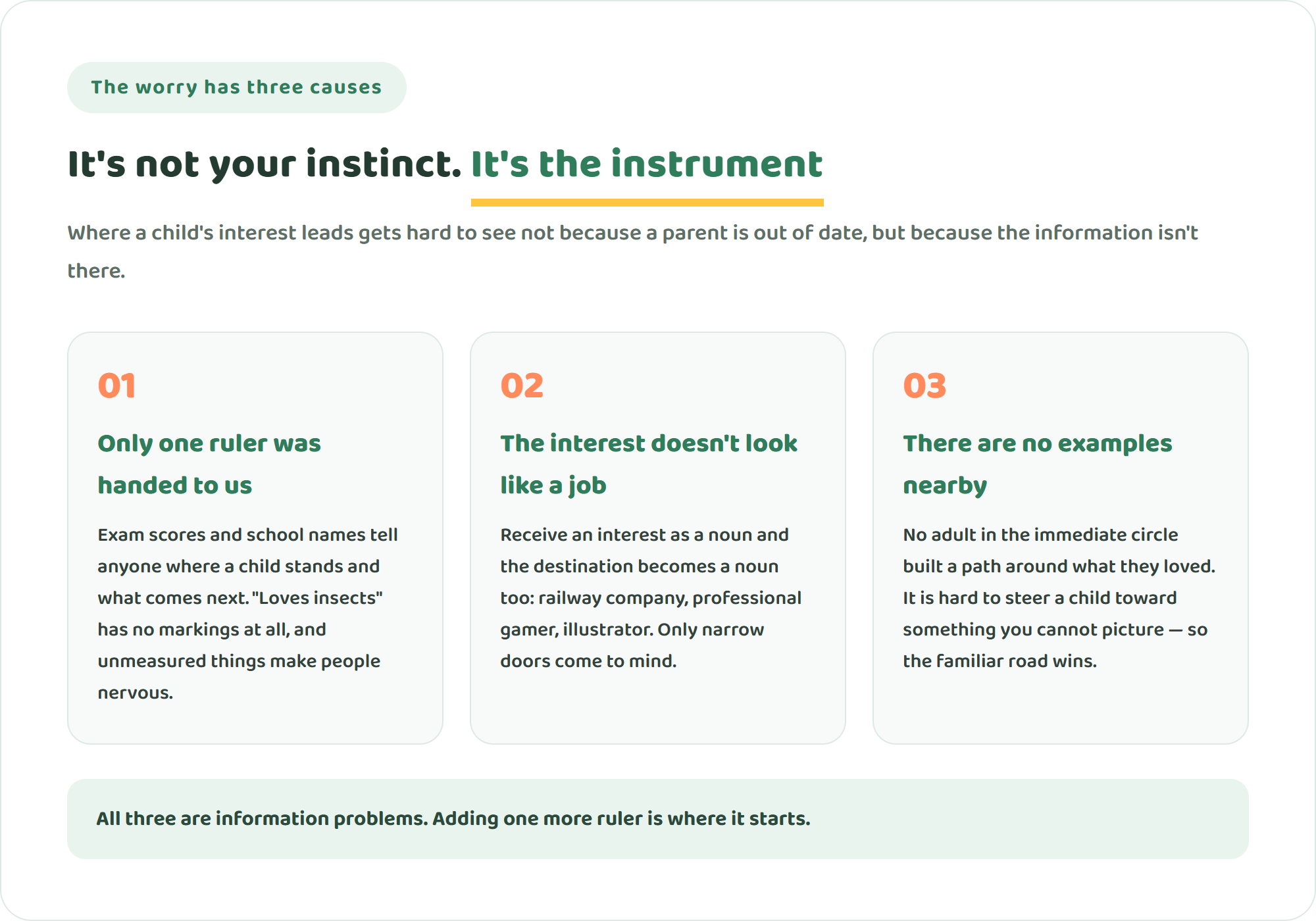
None of the three is a flaw in your family. They are all information problems. And when information is short, people steer a child down the most familiar road. That isn’t wrong in itself — but a path chosen while only one option was visible is the kind that turns into regret later. So we start by adding rulers.
The limits of choosing a future with a single academic ruler
Test scores are a useful instrument. They sort tens of thousands of children with one number, and we are not going to pretend that is worthless. The problem isn’t that they are bad. The problem is that they are convenient enough that nobody bothers to acquire a second ruler.
What an exam measures is the ability to reproduce an agreed answer, in an agreed format, within an agreed time. That is a genuine skill, and it is a small slice of what adult life asks for. Staying with one subject for years. Explaining your thinking to someone you have just met. Continuing to work when the question has no settled answer. Because none of it comes back as a number, it quietly gets treated as though it isn’t there. We looked at those capacities in detail in the skills tests cannot measure.
There is a second cost. Where only one ruler exists, a child who cannot rise on it concludes that they are the problem. They decide, on their own, that an interest which earns no marks has no value. That is the real loss, because turning a child’s interests into a career path starts with the child believing the interest is worth something.

Turning a child’s interests into a career path starts with a verb, not a job title
This is the part of the article that matters most. We instinctively receive an interest as a noun — trains, games, drawing. Nouns lead to nouns, so the next thought is “a railway company, then?” or “a professional gamer?” We picture how few people get through those doors, and the worry arrives.
But what actually holds the child is usually the verb. Watch a child who loves trains and you may find the trains matter less than classifying them. Reading a timetable and working out the best connection may be the real pleasure. With games it might be figuring out a system, or splitting roles with other people. With drawing, observing. With insects, collecting, arranging and naming. With music, designing how sounds sit together.
Translate it into a verb and the destinations multiply. A child who loves classifying has a route into data work, into libraries, into quality management. So instead of asking what your child wants to be, ask “what’s the most interesting part of it?” The answer comes back as a verb — and verbs travel, whatever jobs happen to exist in ten years’ time.
There are more places outside school to go deeper
You cannot rewrite the school curriculum. What has changed over the past decade is everything sitting outside it. People who share a narrow interest are scattered geographically, and online they can now find each other. An interest running into a dead end because there is no club nearby happens less often than it used to. If the concept is new to you, what an alternative school is is a useful primer.
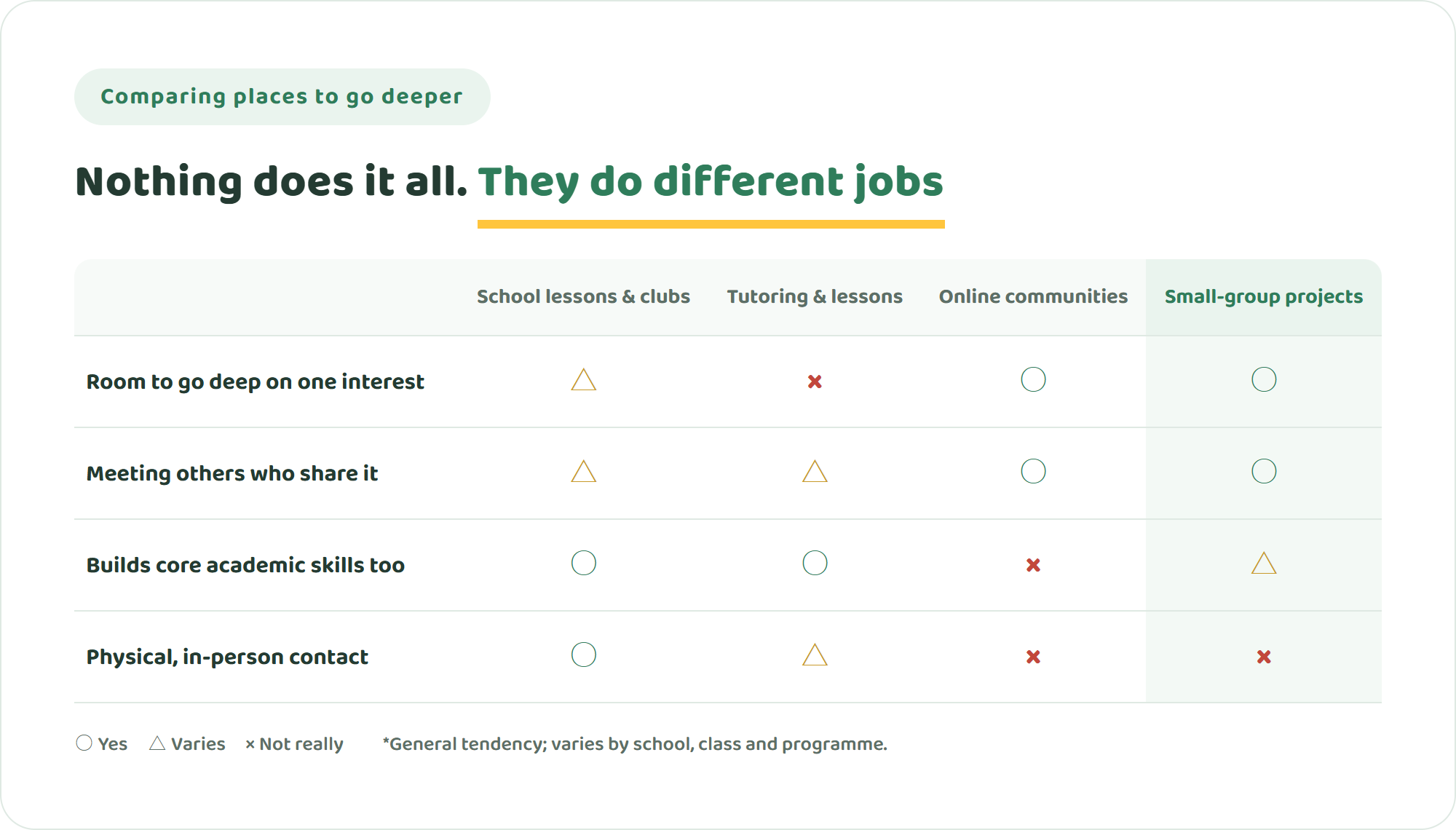
What the table shows is that every option trades something away. Online spaces are excellent for finding people who share the interest, weak at building core academic skills in a structured way, and no substitute for physical, in-person contact. School is strong on core skills and on being in a room together, and structurally poor at giving one child’s interest much time. Rather than betting everything on one, combine them so the gaps cover each other.
See how learning works at NGA →
Add a language and the interest suddenly has somewhere to go
There is one more way to widen the landing area: language. Search in one language only and a niche subject runs out of material surprisingly fast. Add English and the explainer videos, the books, the archives and the communities multiply many times over. Reframing English as a key to more of what you love, rather than as an exam subject, changes the child’s motivation as well.
The order matters. You do not finish the language and then go looking for an interest. The interest comes first, and it creates a reason to read further, which is exactly when a language sticks fastest. A child asking for a foreign field guide, or reading a strategy community in English, has just begun studying English — whatever the timetable says.
Three things a parent can do this week
None of this needs special materials or a big decision.
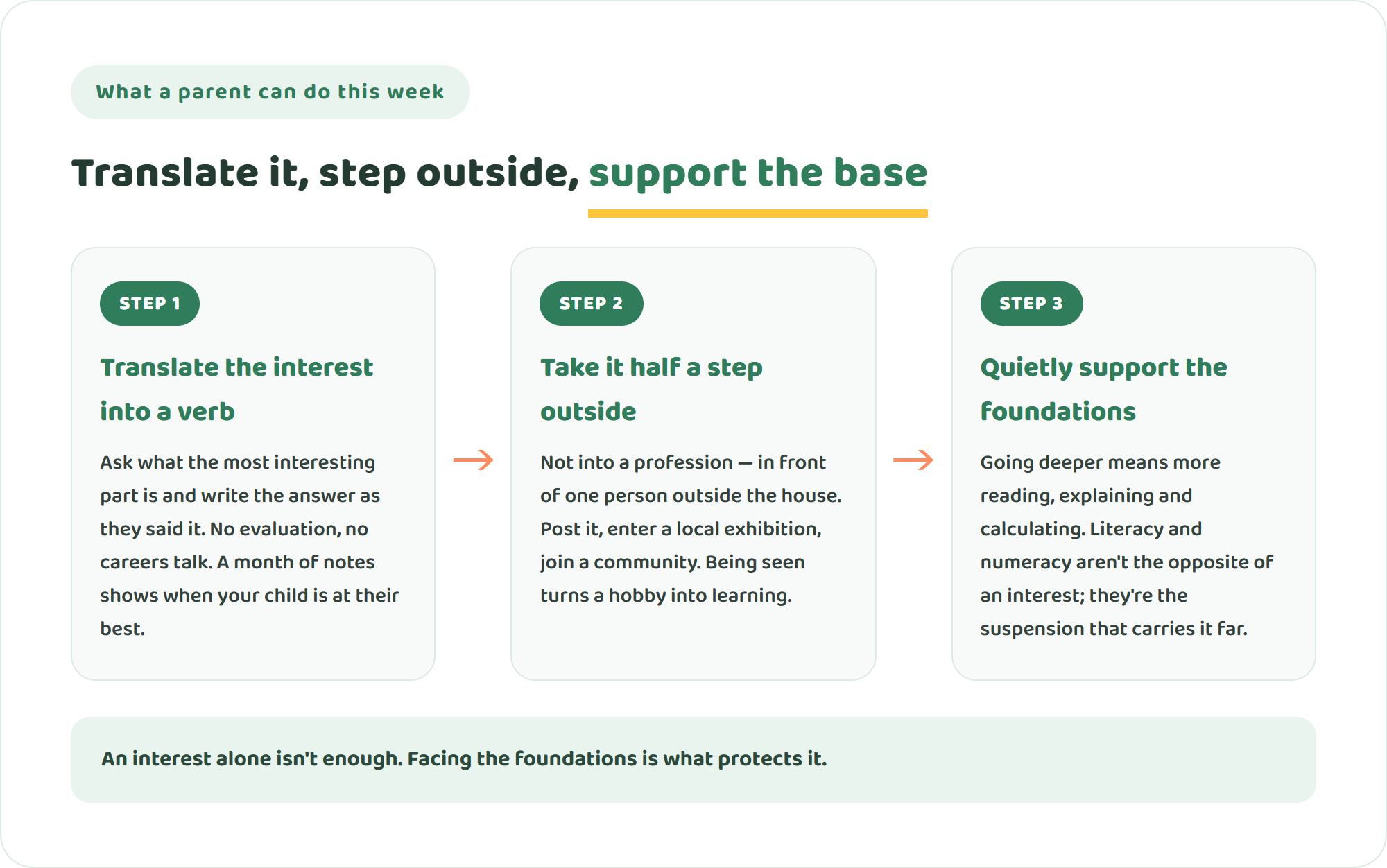
Step 1: translate the interest into a verb. Ask what the most interesting part is, and write the answer down as they said it. No evaluation, no linking it to a career. After a month of notes, you will see with surprising clarity what your child is doing when they are at their best.
Step 2: take it half a step outside. Not into a profession — just in front of one person outside the house. Post the thing they made, enter a local exhibition, join a community that shares the interest. Being seen by someone else is what turns a hobby into learning, and getting a response at all is often a first for them.
Step 3: support the foundations quietly. The deeper an interest goes, the more reading, explaining and calculating it demands. Literacy and numeracy are not the opposite of an interest; they are what carries an interest a long way. Rather than “do your homework”, try “once you can read this, that document opens up”. Same message, completely different effect.
Honestly, an interest on its own is probably not enough
Let’s be direct. Respecting a child’s interest and teaching them that the interest alone will carry them are two different things. Past a certain level, any field requires literacy and numeracy, the ability to put your thinking into words for someone else, and experience of working alongside people who disagree with you. Deepen an interest without those three and the person who suffers most is the child.
With that said, here is where we stand. NIJIN GLOBAL ACADEMY (NGA) is an online international school built around stepping away from exam-score rankings, opening in September 2027 (planned). It is run by NIJIN Inc., and our sister school NIJIN Academy already has more than 900 children enrolled. Learning at NGA is built on small-group dialogue and project work with no single correct answer. Because there is no campus, where a family lives does not limit who a child can work with. Trial classes — a pre-opening term — are planned for April and May 2027.
We don’t think NGA is the only right answer. It is one place to learn by a ruler other than test scores, and no more than that. If daily face-to-face contact or afternoons of team sport are what your family values most, online will feel thin, and building a daily rhythm will ask something of you as parents. Families in Japan should also note that attending an international school which is not an Article 1 school does not by itself satisfy compulsory schooling requirements; keeping a place at the local school is the practical route, and the handling differs by municipality, so confirm with your local board of education.
Frequently asked questions
Can I tell now whether my child’s interest will lead anywhere?
We would not sort interests into “useful” and “not useful” this early, because neither of you has the information to judge. Watch two things instead: what the child is actually doing inside the interest — the verb — and whether it is deepening over time. Knowing more than a year ago, researching without being asked, being able to explain it to someone. If that is happening, the learning is moving forward whatever the subject.
It’s all games and videos, and no studying. Should I take it away?
Removing it usually doesn’t produce studying; it produces less conversation. Separate two things: agreeing the total amount of time together, and taking a genuine interest in the content. Ask “what was good about it?” more often than “how long were you on it?”, and before long the child will start telling you what isn’t working and what they want to look up.
Will following an interest narrow their options for admissions?
It narrows them if you drop core academic skills at the same time. Keep those, deepen the interest, and options widen instead — recommendation-based and comprehensive selection routes assess what a student has actually done. Requirements vary enormously between institutions, so once a specific school is in view, read that school’s own admissions documents.
I know nothing about the subject. How can I be involved?
Knowing nothing is fine, and often better — it produces better questions. A child asked to explain has to rebuild their own understanding to do it, which is a highly efficient piece of learning. Your job is not to hold the answers. It is to be the person who listens, and to open one door to the world outside.
Someone nearby who never dismissed it
Ask adults where their work really came from and a surprising number trace it back to something they were absorbed by as a child for no particular reason. What made the difference wasn’t only luck or circumstance. It was that nobody said, “and where exactly is that going to get you?” That one thing matters more than it seems.
Nothing has to be decided today. This week, just ask once: “what’s the most interesting part of it?” The verb that comes back may be the entrance to the next ten years. NIJIN GLOBAL ACADEMY opens in September 2027 (planned), with pre-opening trial classes in April–May 2027, and if learning by a different ruler sounds like something worth watching, we’ll send opening and pre-opening news to your inbox first.