If you have searched for international schools in Nara Prefecture and come away with very little, that reflects the market rather than your search skills. Nara is home to around 1.3 million people, and as of July 2026 only two full-time international schools in the prefecture take children of elementary age or above. But Nara has three advantages that rarely get mentioned. First, one of those two schools — Kansai Christian School, opened in 1970 — is among the most affordable full-time international schools anywhere in the Kansai region. Second, Nara Prefectural Kokusai Junior and Senior High School became the first public school in the Kansai region authorised for both the IB Middle Years Programme and the Diploma Programme. Third, and most importantly, Osaka is roughly 40 minutes away by train and Kyoto about 35. This guide maps every school and preschool we could verify, area by area, then covers the Japanese-system schools teaching through inquiry and IB, the realistic commute into Osaka and Kyoto, and the option of not commuting at all.
Quick Answer: Your Options in Nara
If you only read one section, read this. Below are the areas where schools can be confirmed, with their school names, plus the online option — so you can see every route side by side before the details.
- Ikoma and Gakken Nara Tomigaoka — Eigo no Kodomo Gakuen SUBARU (4-10 Yamazaki-cho, Ikoma City)
- Central Nara (Kashiba, Koryo, Kashihara and south) — Niko Niko Academy Kids
- NIJIN GLOBAL ACADEMY (online) — Ages 6–18 / opening September 2027, currently taking opening-update registrations / fees around one-fifth of a typical campus international school / Japanese-language support. An option when distance or fees are the wall.
International schools in Nara Prefecture: the landscape and fee ranges
Start with the demographics. Nara is not a prefecture with a large foreign population. Third-party analysis of Japan’s Immigration Services Agency statistics puts foreign residents in Nara at 19,257 in 2024 — rising, at roughly 9% year on year, but an order of magnitude below Osaka or Hyogo. Nara does not receive the steady inflow of corporate expatriate families that sustains large international schools elsewhere, and the supply of schools reflects that.
What exists divides into three clear layers. The first is full-time international schools taking elementary-age children and above: Kansai Christian School in Heguri Town and Noah International School in Kawai Town, both in the northwest of the prefecture. The second layer is Japanese-system schools that have committed seriously to the International Baccalaureate — Nara Prefectural Kokusai Junior and Senior High School and Ikuei Nishi Junior and Senior High School, both in Nara City and both authorised IB World Schools. The third layer is English-immersion preschools and English-medium after-school programmes, clustered in Nara City, Ikoma, Kashiba and Koryo.
Fee levels vary sharply by layer. Kansai Christian School publishes annual fees of ¥1,065,000–¥1,265,000 depending on grade. Against the ¥1.5–2.5 million typical of Kansai international schools, that is genuinely low. The IB schools are Japanese-system: Nara Prefectural Kokusai charges public-school fees, and Ikuei Nishi sits in the normal private secondary range. Preschools generally run ¥40,000–80,000 a month, with children aged three to five often eligible for Japan’s early-childhood subsidy of up to ¥37,000 monthly.
Note: fees reflect publicly available information as of July 2026 and are subject to revision. Always confirm current figures directly with each school.
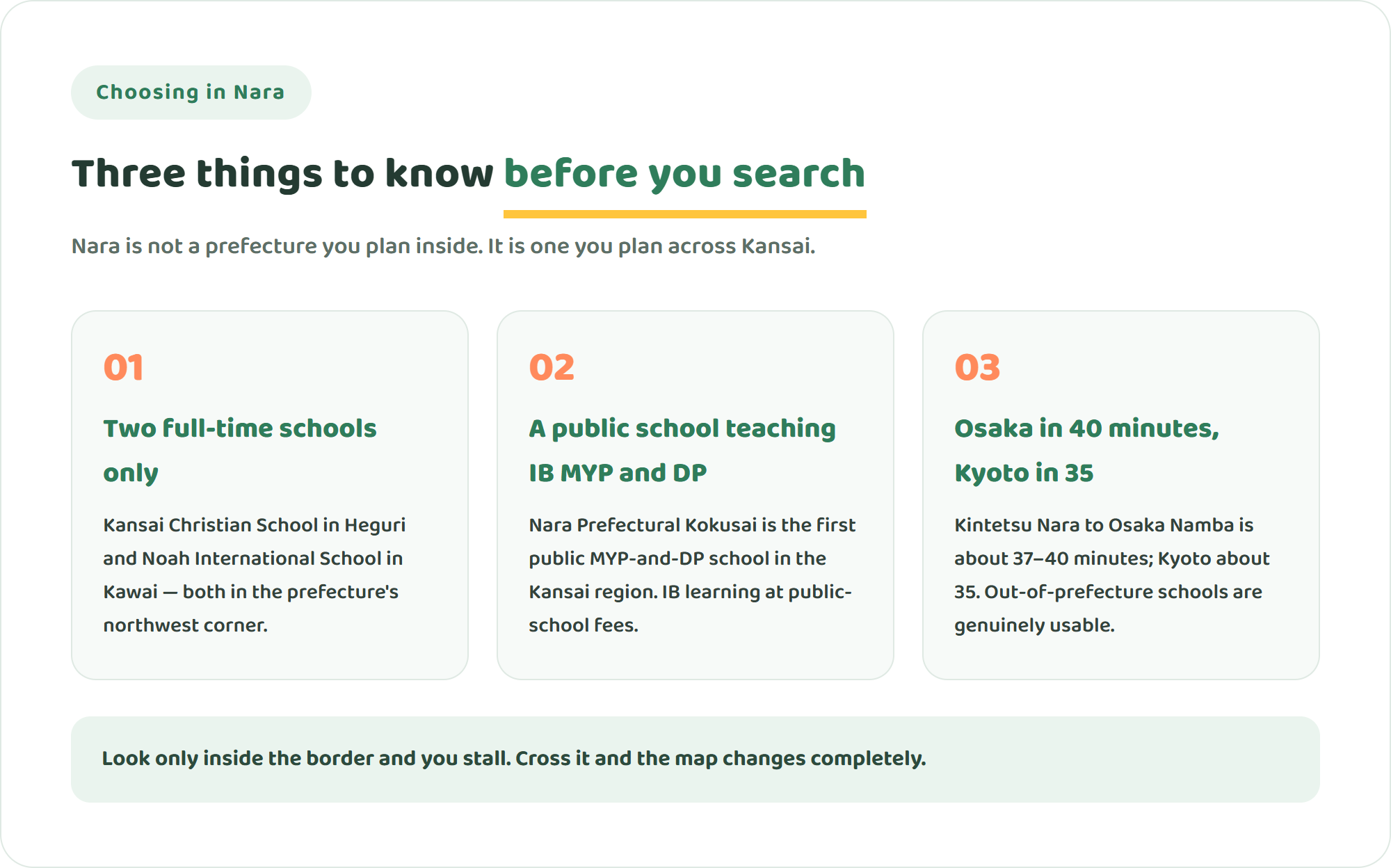
Every international school in Nara Prefecture, by area
Below is everything we could verify as of July 2026, organised by area. No padding to reach a round number — this is what is actually there.
The Seiwa area (Heguri, Kawai, Oji, Ikaruga)
It may be counterintuitive, but the schools that continue past kindergarten are not in Nara City. They are in the northwest corner of the prefecture.
Kansai Christian School (KCS, 282-2 Oaza Misato, Heguri-cho, Ikoma-gun) opened in 1970 to serve the evangelical missionary community in Kansai and is the only full-time G1–G12 English-medium international school in the prefecture. It builds on American curriculum standards with Bible-based teaching, and all school communication happens in English. Classes are multi-grade; third-party database figures list around 35 students across nine nationalities, with an average class of six and a maximum of twelve. Japanese is offered as an additional language. The school is accredited by ACSI (Association of Christian Schools International), and its own accreditation page notes that graduates of ACSI-accredited schools in Japan are considered eligible to apply to Japanese universities. It is a small school, and that smallness is the point. One practical note: third-party listings indicate no school bus service, so confirm transport arrangements with the school directly.
- Curriculum: American curriculum standards with Bible-based teaching; all instruction in English; ACSI accredited
- Ages: 6–18 (Grades 1–12), Heguri Town, Ikoma District
- Fees: ¥1,065,000 a year (G1–4), ¥1,165,000 (G5–8), ¥1,265,000 (G9–12), plus a ¥10,000 application fee, ¥10,000 assessment fee and ¥100,000 enrolment fee (published 2026/27 figures; confirm directly)
- Good fit for: Families in western Nara, Ikoma or eastern Osaka who want an English-medium path to graduation at a manageable cost
Noah International School (2-11-7 Hirosedai, Kawai-cho, Kitakatsuragi-gun) is run by a registered non-profit and is accredited under the American A.C.E. (Accelerated Christian Education) programme. Its foundation is Bible-based character education, and the school states that most lessons are conducted in English. It runs a kindergarten section alongside classes for older students, but the official site lists both the grades currently accepting applications and the fee schedule as enquiry-only. If you are considering it, make those two questions your first email.
- Curriculum: A.C.E. (Accelerated Christian Education) accredited, Bible-based character education, most lessons in English
- Ages: Kindergarten and older classes — grades currently open are enquiry-only; Kawai Town, Kitakatsuragi District
- Fees: Not published; enquire directly (as of 2026)
- Good fit for: Families around Oji, Kawai, Koryo and Yamatotakada looking for a small Christian English-medium setting
Nara City (city centre, Saidaiji, Tomio)
As of July 2026 we could not confirm any full-time international school in Nara City continuing past kindergarten. What the city does have is early-years English provision and, as covered below, both of the prefecture’s IB World Schools.
Ducool International Preschool (1-14-17 Tomio-Motomachi, Nara City) takes children from one year and ten months to six years old in a Japanese-English immersion programme, with age-banded Junior, Pre-K, Kindergarten and Senior classes. Families choose between a short day (roughly 9:00–14:00) and a long day (7:30–18:00). Published fees include a ¥70,000 enrolment fee, a ¥5,000 monthly facility fee and monthly tuition of ¥56,000–58,000 for a five-day short-stay week or ¥80,000–83,000 for long stay. There is also an English after-school programme for elementary students at ¥17,500–31,500 a month for two to five days a week.
Mebae Kokusai Gakuen, Nara campus (2-1-63 Saidaiji Higashimachi, Nara City) serves children from infancy through elementary age, combining English instruction with habit-forming and cognitive development work. For its international division, third-party childcare directories list monthly fees of ¥75,816–103,680 depending on days and hours. Its position beside Kintetsu Yamato-Saidaiji Station — one of the best-connected interchanges in the prefecture — is a real practical advantage.
Ikoma and Gakken Nara Tomigaoka
This is the corner of Nara with the strongest Osaka connections, and families move here for the schools. It is also where English provision for younger children is densest.
Kinder Kids International School, Nara Tomigaoka (3021 Shikahata-cho, Ikoma City) sits a one-minute walk from Gakken Nara Tomigaoka Station on the Kintetsu Keihanna Line and runs an all-English bilingual programme for children aged one to five, with the curriculum consistency that comes from a nationwide chain. The school notes that eligible families with children aged three to five may receive up to ¥37,000 a month through Japan’s early-childhood education subsidy; fees themselves are enquiry-only.
Eigo no Kodomo Gakuen SUBARU (4-10 Yamazaki-cho, Ikoma City) covers toddlers through elementary-age children and is an easy option for families near Ikoma Station. Kids Duo Ikoma (844-6 Tanida-cho, Ikoma City) is an all-English after-school and childcare programme for ages three to twelve, about a six-minute walk from Ikoma Station Exit 3 — the most straightforward way in Nara to keep an elementary-age child in an English environment every afternoon.
Central Nara (Kashiba, Koryo, Kashihara and south)
Provision thins out considerably here. As of July 2026 we could not confirm any permanent international school in Kashihara, Yamatotakada, Sakurai, Tenri, Gojo or Uda. That is the honest picture.
What does exist is Niko Niko Academy Kids, operated by Needs Company, with a Goido Ekimae campus (2153 Kawaraguchi, Kashiba City) and an Ecole Mami Mamigaoka campus in Koryo Town. These are early-childhood education nurseries rather than all-English international schools, offering native-speaker English conversation, ECC English and Montessori-influenced activities among a wide range of specialist classes. Third-party listings give the Goido campus at ¥50,000–60,000 a month for ages 0–2 on a five-day week and ¥40,000–45,000 for ages 3–6 (source; confirm current figures).
Japanese-system schools teaching the IB — Nara’s least-known strength
This is the part of the Nara picture that almost never surfaces in English. Outside the international-school category, two Japanese-system schools here are authorised IB World Schools. The decisive difference is that they award a Japanese school-leaving qualification.
Nara Prefectural Kokusai Junior and Senior High School (Futana-cho, Nara City) opened its high school in 2020 and its junior high in 2023. It was authorised for the IB Middle Years Programme in December 2024 — the first public IB World School in Nara — and for the Diploma Programme on 3 October 2025, making it the first public MYP-and-DP school in the Kansai region. The MYP runs for four years, covering every student from the first year of junior high through the first year of high school. In their first high-school year students study five languages — Chinese, Korean, Spanish, French and German — for eight hours each, then specialise from the second year. There are no conventional mid-term or final exams; assessment runs through presentations, reports and discussion, and the graduation thesis is written in both Japanese and English. Being a public school, fees are at public-school levels. Check the official site for admissions requirements, which are selective.
Ikuei Nishi Junior and Senior High School (Mimatsu, Nara City) is a private girls’ school that was authorised for the IB MYP on 7 May 2021 — the first girls’ school in Japan to be authorised, and the first IB World School of any kind in Nara Prefecture. It also runs a Ritsumeikan course under a cooperation agreement with Ritsumeikan University, pairing inquiry-based learning with a route into Japanese universities. It admits girls only, which narrows who this fits. See the official site for course structure and fees.
If your goal is not an international school as such but an international way of learning, Nara is better supplied than its reputation suggests. Keeping a child in the local system while adding English-medium learning alongside it — the double school approach — works particularly well here.
Commuting into Osaka and Kyoto: Nara’s real advantage
This is the single most important thing to understand about school choice in Nara. It is not a prefecture short of schools; it is a prefecture that can treat the whole of Kansai as its catchment. Kintetsu Nara to Osaka Namba is roughly 37–40 minutes on a rapid express. JR Nara to Osaka Station is about 50 minutes on the Yamatoji Rapid. Kintetsu Nara to Kyoto is about 35 minutes by limited express. Landlocked prefectures like Tochigi or Nagano simply do not have this option.
Southern Kyoto Prefecture is the most overlooked route. Doshisha International School Kyoto (DISK) in Kizugawa runs a continuous G1–G12 programme and in 2014 became the first international school in Japan authorised for the IB Primary Years Programme. KIU Academy in Kyotanabe is a Japanese-English bilingual school accredited by both WASC and ACSI. From Nara City or Ikoma these mean crossing a prefectural boundary, but the actual journey is no longer than a trip to Heguri inside Nara. Our guide to international schools in Kyoto Prefecture covers them in detail.
Osaka widens the field further, with several schools offering English-medium education from early years to graduation — Osaka YMCA International School with its full IB continuum, and Kwansei Gakuin Osaka International School in Minoh among them — each with its own school-bus coverage. Fees, though, climb towards ¥2 million a year and above, which changes the financial picture completely. See our guide to international schools in Osaka for the shortlist and fee ranges, and our guide to international schools across all 47 prefectures for the national view.
The honest counterweight: being able to reach a school is not the same as being able to sustain it. Ask whether a six-year-old can make a one-hour journey with transfers every morning for six years, and whether the combined season ticket and tuition holds up over that period. Put both into numbers before you shortlist.
Comparing the options: what actually fits your family
Schools inside Nara, a commute into Osaka or Kyoto, and online international schools are not ranked best to worst — they fit different constraints. Lay them against five criteria and the decision gets much clearer: affordability, ease of admission, commute burden, in-person campus experience, and whether the path continues through high school.
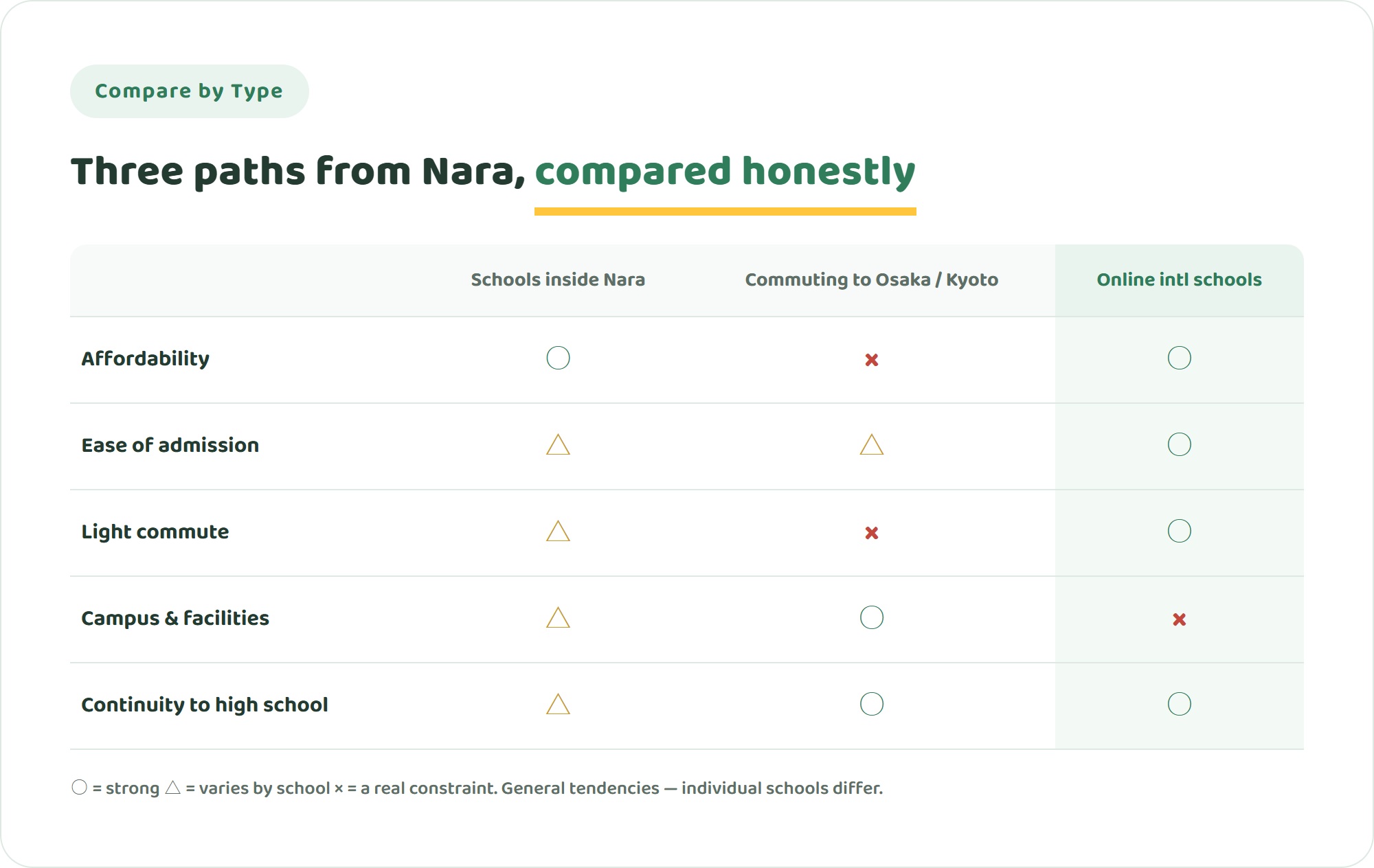
In Nara, the row that catches most families is the commute. The prefecture’s full-time schools sit in the northwest, so from northern Nara City or the central and southern districts you are often looking at close to an hour each way. Osaka and Kyoto open up the choice but push fees and travel time up together. For the costs that sit beyond tuition, our breakdown of what international school actually costs will sharpen the comparison.
See how learning works online →
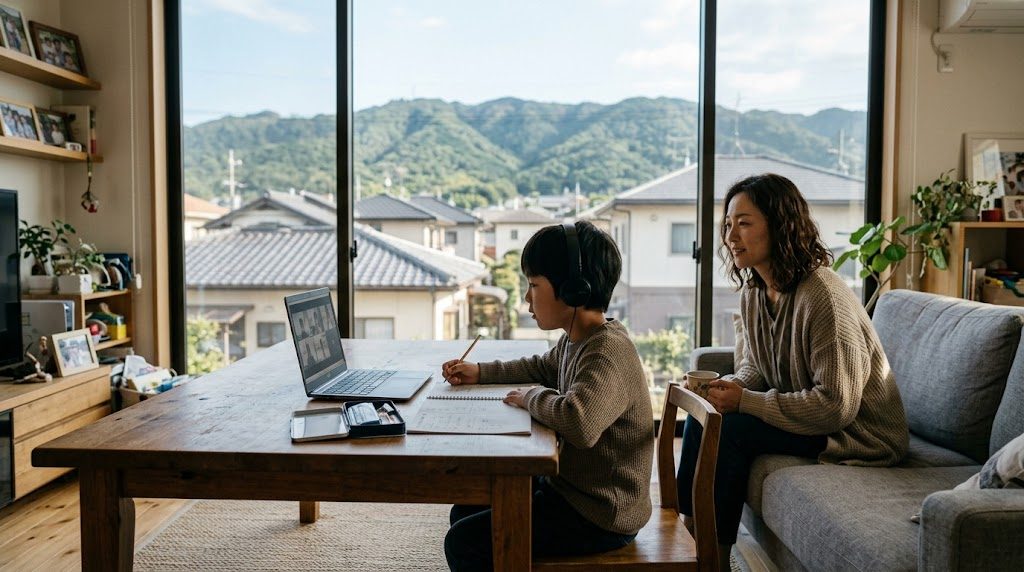
When nothing is within reach — the online option
Some readers will finish that list thinking: the two schools inside Nara are not reachable from where we live, and sending a child into Osaka or Kyoto every day is not workable on cost or energy. That is precisely the family NIJIN GLOBAL ACADEMY (NGA) is being built for. We are an online international school opening in September 2027.
NGA is run by NIJIN Inc., the Japanese company behind NIJIN Academy, an alternative school with over 1,000 students enrolled. What we care about is moving away from ranking children by test scores. Learning happens in small, dialogue-centred groups, built around a simple aim: helping children come to like themselves and the world. We serve ages 6 to 18 across Asia and Oceania, and because location is irrelevant, a family in Nara City, Gojo or the Yoshino mountains has exactly the same access as one in a major city. Japanese-language support underpins the programme so children can move into English gradually. Our goal is to make tuition roughly one-fifth of a bricks-and-mortar international school.
The honest caveats: we have not opened yet, so our track record is still ahead of us. And an online school cannot reproduce a playground, a school field, or the feeling of sitting shoulder to shoulder in the same room. Even so, for a good number of Nara families, this is what turns “we cannot get there, so we will give up” into “we do not need to get there at all”.
Frequently asked questions
Q. Can families anywhere in Nara reach these schools?
A. Not evenly, unfortunately. Both full-time international schools sit in Heguri and Kawai in the northwest, and the preschools cluster in Nara City, Ikoma, Kashiba and Koryo. From Kashihara, Sakurai, Gojo, Uda or the Yoshino district, even an in-prefecture school typically means around an hour each way. Map the actual route with transfers first, then ask whether your family can sustain that every morning for six years.
Q. Do families commute from Nara to schools in Osaka or Kyoto?
A. Yes, and it works. Kintetsu Nara to Osaka Namba is about 37–40 minutes by rapid express, and Kintetsu Nara to Kyoto about 35 minutes by limited express. For schools in Kizugawa or Kyotanabe, the journey can be no longer than reaching a school inside Nara. But school bus coverage varies enormously between schools, and season tickets add up substantially over a year. Check both the bus routes and the fares before you shortlist.
Q. What about Japanese-language support?
A. It depends on the school. Kansai Christian School offers Japanese as an additional language, but teaching is in English. A Japanese-system IB school such as Nara Prefectural Kokusai, by contrast, assumes Japanese-language schooling throughout. Many parents worry their child will end up strong in neither language. Whatever you choose, put “how is Japanese maintained?” on your list of questions at every school visit, and ask to see the actual weekly timetable rather than the brochure description.
Stop searching prefecture-first, start planning Kansai-wide
Searching for an international school in Nara Prefecture is frustrating if you only look inside the prefectural border. Two full-time English-medium schools, and nothing permanent in the central and southern districts — that is the honest fact. But widen the frame slightly and the map changes completely. There is a public school here teaching both IB MYP and DP, Osaka is 40 minutes away, Kyoto is 35, and there is a route that removes the commute entirely.
The better question is not which school will accept your child, but which kind of learning your family can keep going for years. There is no need to rush. Start today by checking one commute route. Even that will change how the map looks.
International School Guides for Other Prefectures
- International Schools in Hyogo Prefecture
- International Schools in Kyoto Prefecture
- International Schools in Mie Prefecture
- International Schools in Shiga Prefecture
- International Schools in Hokkaido Prefecture
- International Schools in Kanagawa Prefecture
- International Schools in Aichi Prefecture
- International Schools in Niigata Prefecture
- International Schools in Oita Prefecture
- International Schools in Okayama Prefecture
- International Schools in Okinawa Prefecture
- International Schools in Saga Prefecture
- International Schools in Saitama Prefecture
- International Schools in Shimane Prefecture
- Browse all 47 prefectures of Japan