If you have been searching for international schools in Gifu Prefecture and finding the results thin, you are reading the market correctly — but not completely. Gifu is home to roughly 1.9 million people and sits just twenty minutes by rapid train from Nagoya, yet the number of schools where a child can keep learning through English is very small. What Gifu does have is unusual: one of the largest concentrations of Brazilian schools in Japan, and the first school inside the Japanese national system ever authorised for the IB Primary Years Programme. Gifu is not a prefecture short of options so much as a prefecture whose options look nothing like anyone else’s. This guide maps all thirteen schools we could confirm as of July 2026 — area by area across Gifu City, Ogaki, Kakamigahara, Minokamo, Kani, and the Tono and Hida highlands — with published fees wherever they exist. It then covers the commute into Nagoya, which is genuinely realistic for southern Gifu, and the option of not commuting at all.
Quick Answer: Your Options in Gifu
If you only read one section, read this. Below are the areas where schools can be confirmed, with their school names, plus the online option — so you can see every route side by side before the details.
- Gifu City and the surrounding area — Sunnyside International School / Sunnyside International Preschool / Oblige International Preschool and 2 more (5 in total)
- Ogaki and the Seino area — HIRO Gakuen (Escola Brasileira Professor Kawase)
- Kakamigahara, Minokamo and Kani (the Chuno area) — Sociedade Educacional Brazilian School / IB Course at Teikyo University Kani High School
- Tono and Hida (Tajimi, Nakatsugawa, Takayama and the north) — Gifu Korean Elementary and Junior High School
- NIJIN GLOBAL ACADEMY (online) — Ages 6–18 / opening September 2027, currently taking opening-update registrations / fees around one-fifth of a typical campus international school / Japanese-language support. An option when distance or fees are the wall.
International schools in Gifu Prefecture: the landscape and fee ranges
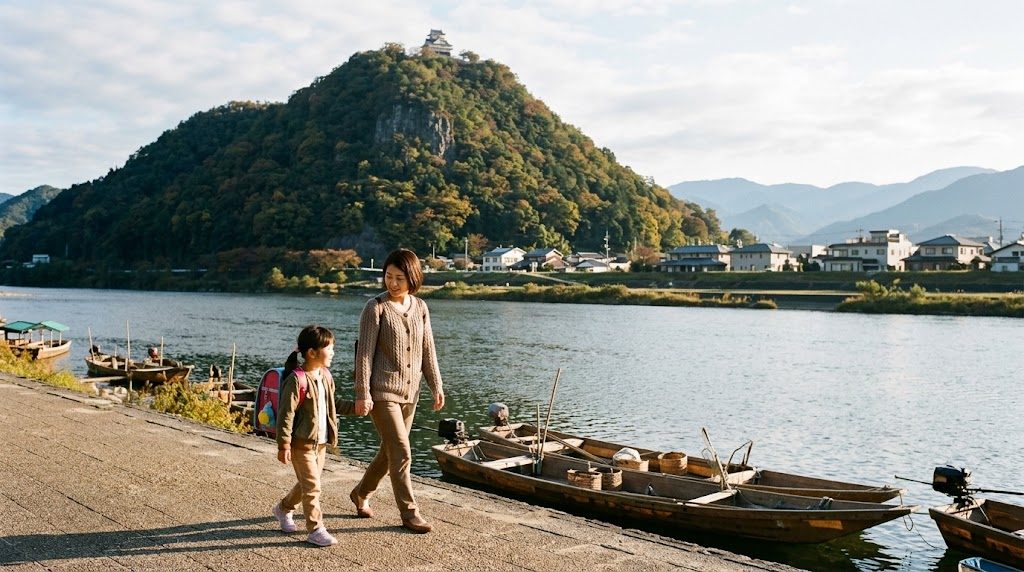
Gifu has internationalised further than most people expect. Analysis by the Gifu Shimbun of Immigration Services Agency data puts the number of foreign residents in the prefecture at 77,301 as of the end of June 2025 — roughly 1.65 times the figure a decade earlier, and over 4% of the prefecture’s population. The automotive, aerospace and machinery belt through Ogaki in the west and Kani, Minokamo and Kakamigahara in the centre is home to large Brazilian, Filipino and Vietnamese communities. That history is why international education in Gifu is shaped differently from anywhere else: the layer of schools teaching a national curriculum in Portuguese is thicker than the layer teaching in English.
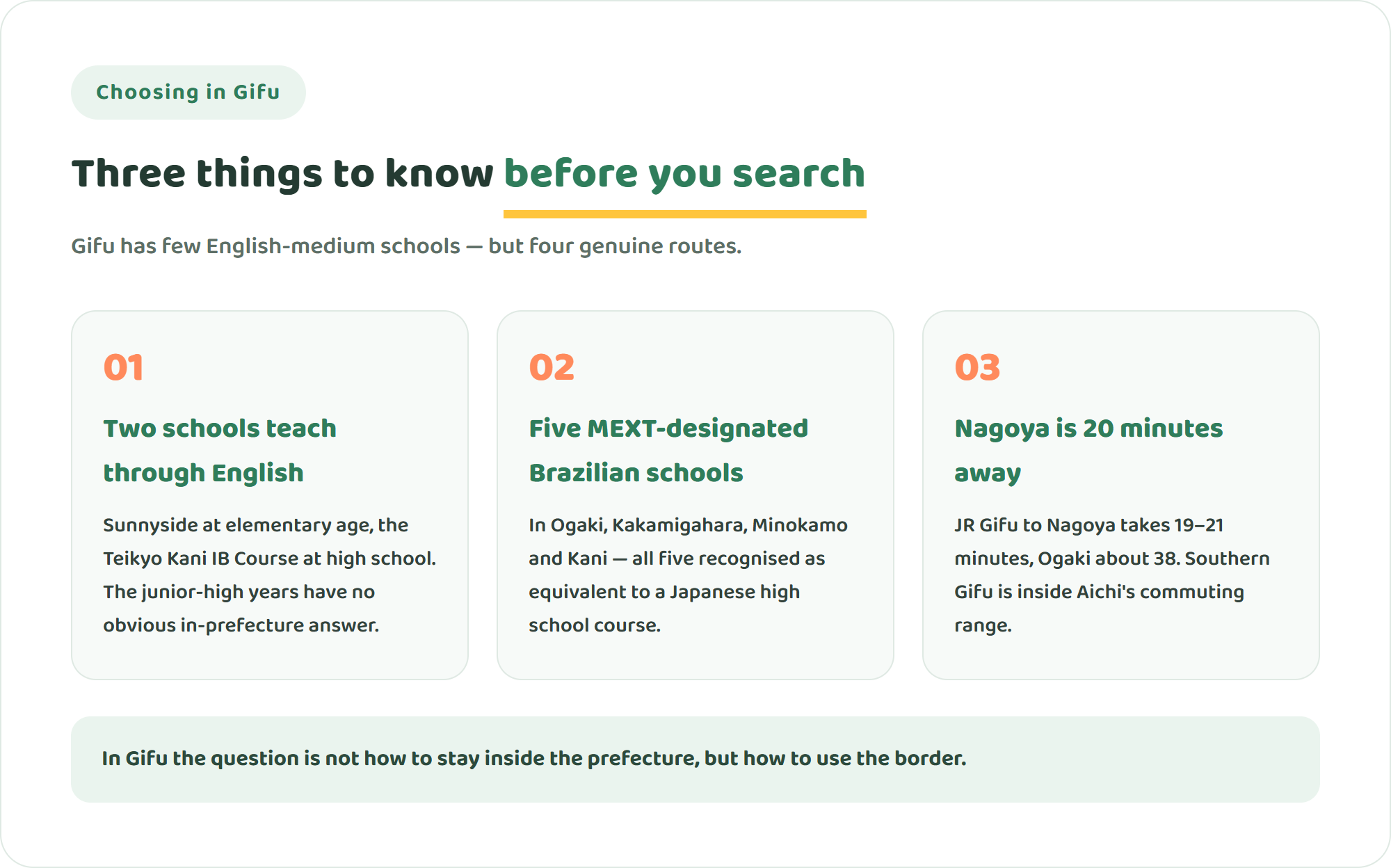
The schools fall into four groups. First, schools inside Japan’s national system (ittijo-ko) that also run an International Baccalaureate programme: Sunnyside International School in Gifu City and the IB Course at Teikyo University Kani High School. Second, five Brazilian schools in Ogaki, Kakamigahara, Minokamo and Kani — all five appear on Japan’s MEXT list of institutions designated as equivalent to a Japanese high school course. Third, a Korean ethnic school in Gifu City. And fourth, a layer of English-immersion preschools, of which we confirmed five across Gifu City, Mizuho and Kakamigahara. Thirteen schools in total, as far as public information allows in July 2026.
Fees vary sharply by layer. Most preschools qualify for Japan’s early-childhood education subsidy — unlicensed facilities can claim up to ¥37,000 a month for children aged three to five — which brings the effective cost down considerably. At elementary level, Sunnyside International School publishes figures that come to roughly ¥860,000–890,000 a year. At high-school level, Teikyo University Kani did not publish fee amounts we could verify, so that one is confirm-directly. Most of the Brazilian schools do not publish fees either. For context, international schools in Nagoya City run mostly from ¥1.2 million to ¥3.3 million a year — so Gifu’s profile is few options, but noticeably more affordable ones.
Note: fees reflect publicly available information as of July 2026 and are subject to revision. Always confirm current figures directly with each school.
Every international school in Gifu Prefecture, by area
Here is every school we could confirm as of July 2026, listed by area. No padding to reach a round number — just what is actually there.
Gifu City and the surrounding area
This is where the options cluster. At the centre of them is Sunnyside International School in Iwai, Gifu City, run by Watanabe Gakuen. It began in 2001 as a model project for educational reform within Gifu Prefecture, pairing a Japanese teacher and an international teacher to co-teach a single kindergarten class. In January 2016 it was authorised as an IB World School, making it the first school inside Japan’s national system to hold IB Primary Years Programme authorisation. It runs a kindergarten department and an elementary department, teaching bilingually in Japanese and English. Because it is an ittijo-ko, enrolment counts as attendance at a recognised Japanese elementary school — a genuine difference from every other international school in the prefecture. Classes are capped at 24 students and inquiry-based learning sits at the centre of the programme.
- Curriculum: IB Primary Years Programme; also a Japanese national-system kindergarten and elementary school
- Ages: Kindergarten department (from age three) and elementary department (grades 1–6)
- Fees: Published admissions figures list a ¥50,000 entrance fee, kindergarten tuition of ¥34,300 a month (after the early-childhood subsidy), a ¥10,000 monthly facilities fee, ¥15,000 a year for materials and around ¥120,000 for supplies. For the elementary department: entrance fee ¥50,000 (internal) or ¥100,000 (external), tuition ¥55,000 a month, facilities ¥10,000 a month, an annual education fee of ¥30,000 and field-trip costs of ¥30,000–60,000 — roughly ¥860,000–890,000 a year (2026; confirm directly). School bus is ¥5,500 a month return
- Good fit for: Families who want inquiry-based, internationally framed learning at elementary age while keeping Japanese school enrolment
Visit the official site — fees are published on the admissions page. The International Schools Database lists an annual range of ¥426,600–630,000 for the school, which differs because it counts different line items; the official guidelines are the figure to work from.
For children under six the picture widens. Sunnyside International Preschool, at the same Iwai address, is a licensed small-scale childcare facility (Type A) for children from six months to age two with 19 places, charged at Gifu City’s standard rates. Clematis (Seas & Stars Clematis), near the prefectural government offices in Gifu City, runs a three-language programme — 85% English, 10% Chinese, 5% Japanese — for children from 16 months to age six, and states that eligible families receive up to ¥37,000–42,000 a month under the childcare subsidy. Oblige International Preschool in Shimonara, Gifu City, is an unlicensed facility for ages three to five with a second campus in Kakamigahara, built around English-led cognitive education. Asahi Kids International, also in Gifu City, is a company-led childcare centre with 19 places taking children from birth to school age, offering six hours of English a day and around 2,000 hours a year. Slightly west, in Beppu, Mizuho City, Marty’s International Kinder runs a full English-immersion day — play and meals included — for children from 16 months to six, and also qualifies for the subsidy.
Ogaki and the Seino area
Ogaki is the centre of Brazilian education in Gifu. HIRO Gakuen (Escola Brasileira Professor Kawase), founded in 2000, is known as the first Brazilian school in Japan to be approved as a Japanese school corporation. It is accredited by Brazil’s Ministry of Education and licensed in Japan as a miscellaneous school, running a continuous path from the International HIRO nursery through elementary (grades 1–5), middle (grades 6–9) and Ensino Médio, teaching primarily in Portuguese alongside Japanese and English. Also in Ogaki, Colégio Sonho de Criança takes children from infancy through to high-school level. Both appear on the MEXT list of institutions designated as equivalent to a Japanese high school course, which keeps the route into Japanese university entrance open for graduates. Neither publishes fees; contact them directly.
Ogaki Station to Nagoya Station is about 38 minutes on the rapid service, which means families here can weigh Gifu schools and Nagoya schools on the same table.
Kakamigahara, Minokamo and Kani (the Chuno area)
Where manufacturing and long-settled migrant communities overlap, three more Brazilian schools operate. Centro Educacional Nova Etapa in Kakamigahara covers nursery through high-school level; Colégio Isaac Newton in Minokamo covers elementary through high-school level; and Sociedade Educacional Brazilian School in Kani likewise runs to high-school level. All three also appear on the MEXT designated list. For families with roots in the Portuguese-speaking world, having five schools offering the Brazilian national curriculum within one prefecture is genuinely rare in Japan. Fees are confirm-directly in each case.
One more school matters a great deal if English is your goal: the IB Course at Teikyo University Kani High School in Kani City. In February 2022 it became the first IB authorised school in Gifu Prefecture. Year one covers the Japanese high school curriculum taught in English; years two and three are the two-year IB Diploma Programme, and graduates leave with both the IB Diploma and a Japanese high school diploma. Intake is 20 students per year group with no nationality restriction, and the school operates an international residence hall. Entry requires the equivalent of Japanese ninth-grade academic records plus English at TOEIC 700 or TOEFL iBT 50 and above. For anyone wanting to keep learning through English at high-school age without leaving Gifu, this is currently the main route.
- Curriculum: IB Diploma Programme, taught in English; the first IB authorised school in Gifu Prefecture (February 2022)
- Ages: High school years 1–3, with transfer places available from year 2
- Fees: We could not verify published fee amounts as of July 2026. Residence hall costs and IB-related fees are additional — confirm directly
- Good fit for: Families whose child attends Japanese school through junior high and wants to take on the IB from high school
Tono and Hida (Tajimi, Nakatsugawa, Takayama and the north)
Here the honest answer is nothing. In Tajimi, Toki, Mizunami and Nakatsugawa in the east, and Takayama, Gero and Hida in the mountainous north, we could confirm no permanent international school and no English-immersion preschool as of July 2026. The Tono area at least connects to Nagoya on the JR Chuo Line, though it is a heavy trip for a young child every day. From the Hida area, Nagoya is more than two hours away even by limited express. For families in these parts of Gifu, the online route described later is often the only genuinely workable answer.
Gifu City is also home to Gifu Korean Elementary and Junior High School. Korean ethnic schools serve a different purpose from English-medium international schools, but it belongs in any complete picture of foreign schools in the prefecture. To see how Gifu compares with everywhere else, our guide to international schools across all 47 prefectures covers the national picture.
Nagoya in twenty minutes: the cross-border commute that actually works
This is the advantage no other landlocked prefecture quite has. JR Gifu Station to Nagoya Station is 19 to 21 minutes on the rapid service — considerably closer than eastern or northern Gifu. From Ogaki it is about 38 minutes. If you live in southern Gifu, schools in Nagoya are inside your commuting range, full stop.
Nagoya offers several genuinely different options, including schools running the full IB continuum from PYP through DP and others combining Canadian and Japanese curricula. Annual fees run broadly from ¥1.2 million to ¥3.3 million, so the financial hurdle is real — but so is the advantage of a single school that can carry a child through to high school graduation in English, which nothing inside Gifu can currently do. For school-by-school comparisons see our guides to international schools in Nagoya and international schools across Aichi Prefecture.
The honest counterweight: crossing the prefectural border costs money and time. Season tickets can run to several hundred thousand yen a year depending on the line and the student’s age, and school bus coverage differs enormously between schools. Before you shortlist anything, work out the door-to-door time and multiply it by the number of years you expect your child to be there. That single calculation clarifies more than any brochure.
Comparing the options: what actually fits your family
Schools inside Gifu, schools in Nagoya and Aichi, and online international schools are not ranked best to worst — they fit different constraints. Lay them against five criteria and the decision gets much clearer: affordability, ease of admission, commute burden, in-person campus experience, and whether the path can continue through high school.
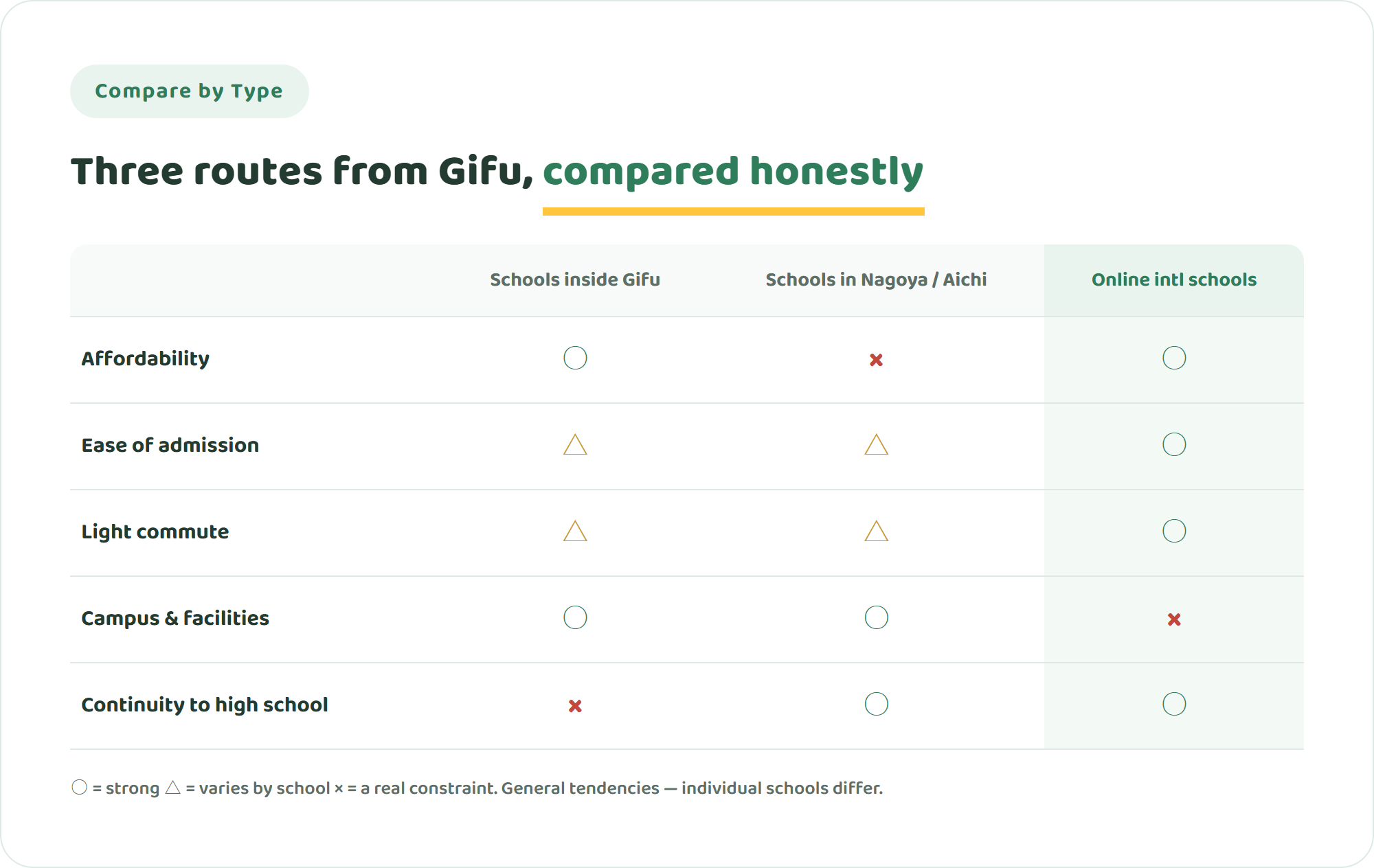
In Gifu, the row that catches most families is the last one. Sunnyside’s elementary department ends at grade six; the Teikyo Kani IB Course begins at high school. If English-medium learning is the goal, there is a structural gap at junior-high age with no obvious in-prefecture answer. Deciding early how to bridge those three years — move towards Nagoya, or attend a Japanese junior high while adding English-medium learning alongside it — makes everything that follows much easier. If you want the cost picture in more detail, our breakdown of what international school actually costs covers the fees beyond tuition that catch families out.
See how learning works online →
When nothing is within reach — the online option
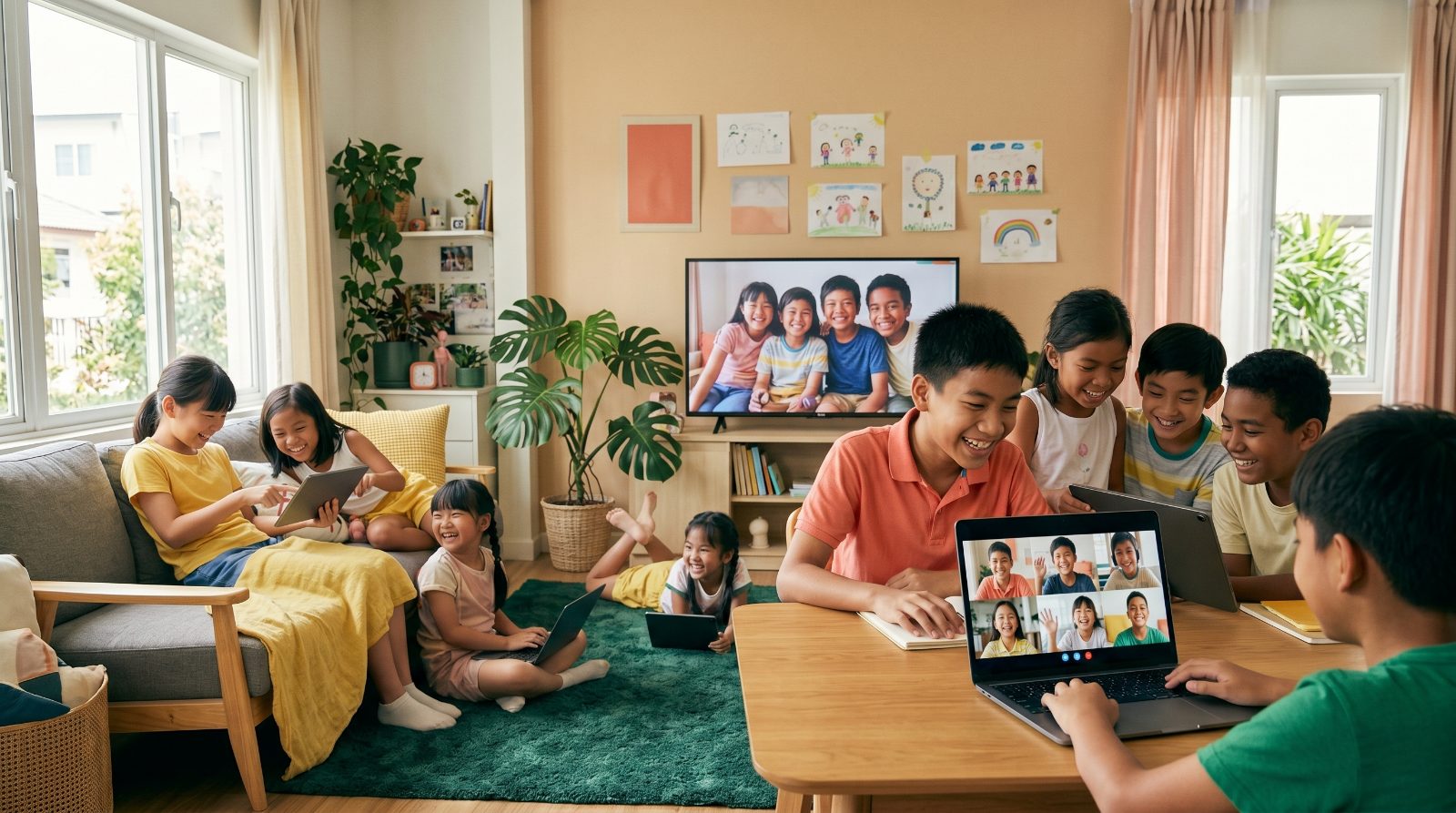
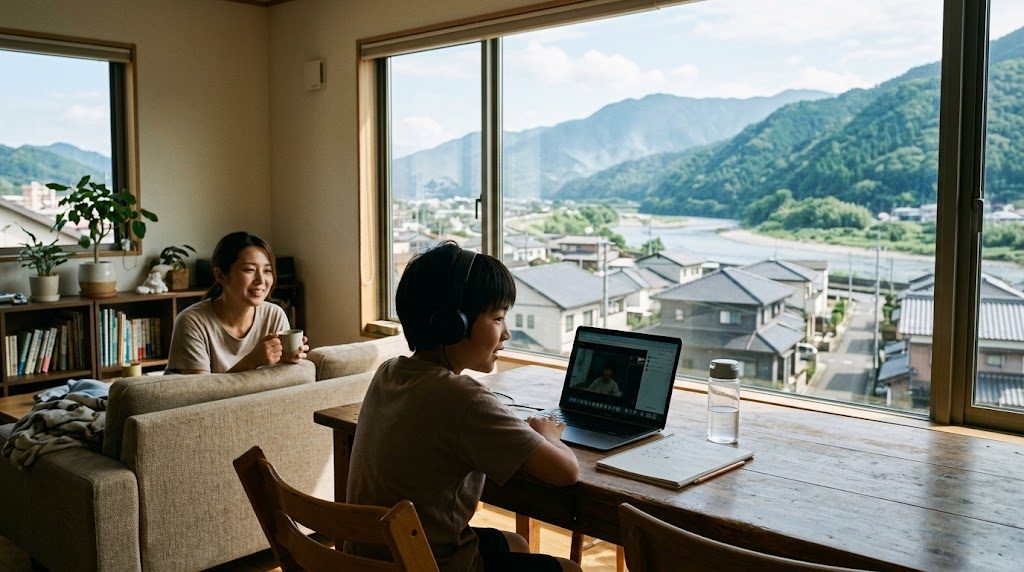
Some readers will finish the list above thinking: there is nothing here that continues, and a daily trip into Nagoya is not workable. For families in the Tono and Hida regions especially, distance is the first wall, not the last. That is precisely the family NIJIN GLOBAL ACADEMY (NGA) is being built for. We are an online international school opening in September 2027.
NGA is run by NIJIN Inc., the Japanese company behind NIJIN Academy, an alternative school with over 1,000 students enrolled. What we care about is moving away from ranking children by test scores. Learning happens in small, dialogue-centred groups, built around a simple aim: helping children come to like themselves and the world. We serve ages 6 to 18 across Asia and Oceania, and because location is irrelevant, a family in Gifu City, Takayama or Nakatsugawa has exactly the same access as one in a major city. Japanese-language support underpins the programme so children can move into English gradually. Our goal is to make tuition roughly one-fifth of a bricks-and-mortar international school.
The honest caveats: we have not opened yet, so our track record is still ahead of us. And an online school cannot reproduce a playground, a school field, or the feeling of sitting shoulder to shoulder in the same room. Even so, for a good number of Gifu families, this is what turns “there is nothing near us, so we will give up” into “we do not need to get there at all”.
Frequently asked questions
Q. Can families anywhere in Gifu reach these schools?
A. Not evenly, unfortunately. Every school we confirmed sits in the southern belt — Gifu City, Mizuho, Ogaki, Kakamigahara, Minokamo and Kani. We found nothing in the Tono area (Tajimi, Nakatsugawa and neighbours) or the Hida region (Takayama, Gero and the north), where even an in-prefecture school typically means around two hours each way. Map the actual route and travel time first, then ask whether your family can sustain that every morning for years.
Q. Do families commute from Gifu to international schools in Nagoya?
A. In southern Gifu, yes, and it is entirely realistic. JR Gifu to Nagoya is 19–21 minutes on the rapid service and Ogaki is about 38 minutes. Door to door will be longer once you add the leg to the school itself, and both season-ticket costs and school-bus coverage vary a great deal between schools. Shortlist from our guide to schools in Nagoya first, then check the bus routes and the fares before committing.
Q. What about Japanese-language support?
A. It varies enormously. Sunnyside International School is part of the Japanese national system, so Japanese-language learning is built into the foundation. The Brazilian schools teach primarily in Portuguese and handle Japanese differently from one another. Many parents worry their child will end up strong in neither language. Whatever you choose, put “how is Japanese maintained?” on your list of questions at every school visit, and ask to see the actual weekly timetable rather than the brochure description.
Choose what you can sustain, not just what you can reach
Searching for an international school in Gifu Prefecture works differently from most of Japan. There are not many schools teaching through English. But there is the first IB PYP authorised school inside the Japanese national system, the prefecture’s first IB high school course, five MEXT-designated Brazilian schools, and Nagoya twenty minutes away. That is four routes, not one.
The better question is not which school will accept your child, but which kind of learning your family can keep going for years. There is no need to rush. Start today by checking one commute route. Even that will change how the map looks.
International School Guides for Other Prefectures
- International Schools in Aichi Prefecture
- International Schools in Shizuoka Prefecture
- International Schools in Nagano Prefecture
- International Schools in Niigata Prefecture
- International Schools in Ishikawa Prefecture
- International Schools in Toyama Prefecture
- International Schools in Hokkaido Prefecture
- International Schools in Gunma Prefecture
- International Schools in Hiroshima Prefecture
- International Schools in Hyogo Prefecture
- International Schools in Ibaraki Prefecture
- International Schools in Iwate Prefecture
- International Schools in Kagawa Prefecture
- International Schools in Kagoshima Prefecture
- Browse all 47 prefectures of Japan