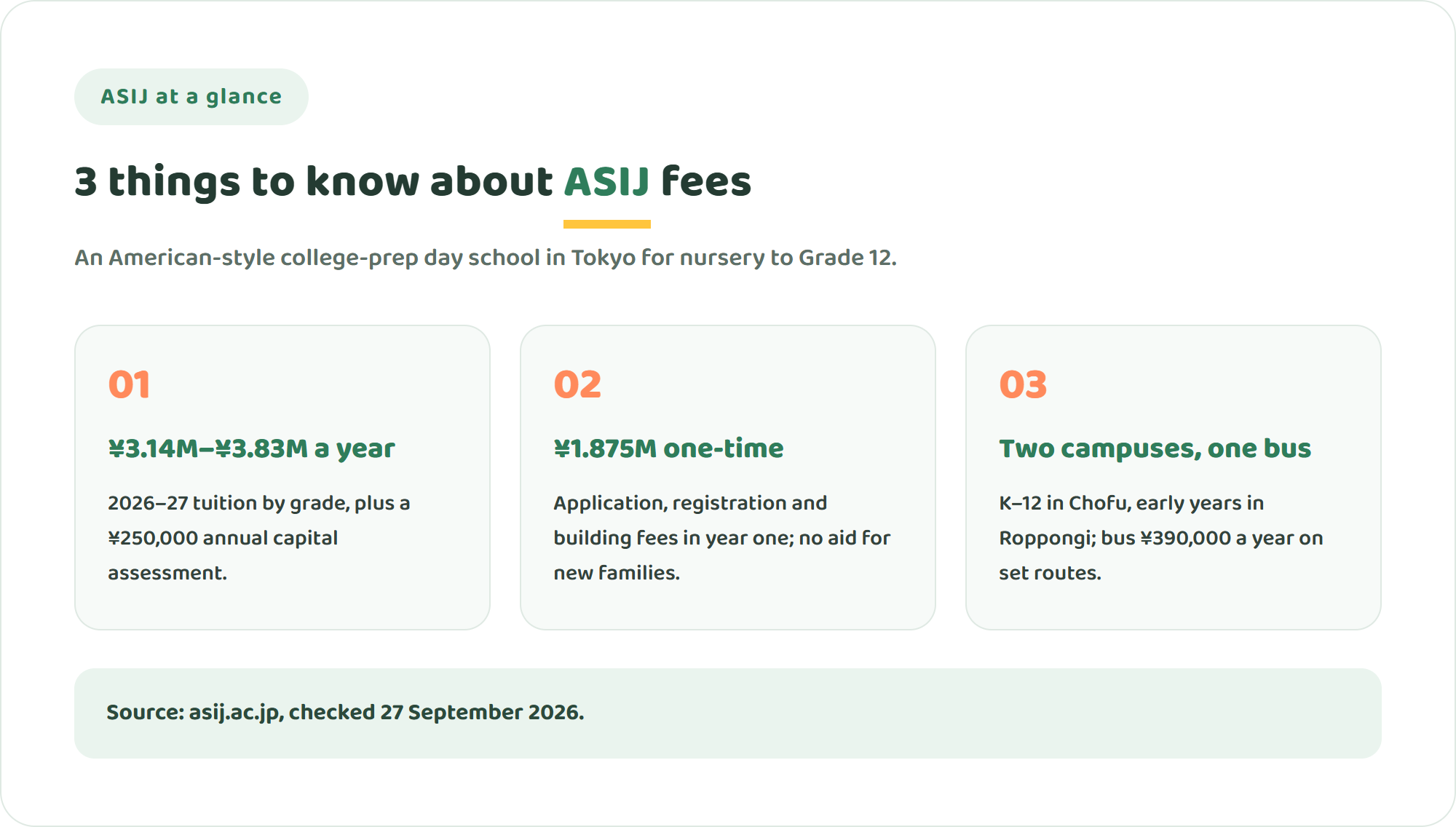
The American School in Japan (ASIJ) tuition for 2026–27 is ¥3,143,000 a year for Nursery–Pre-K, ¥3,498,000 for Kindergarten–Grade 5, ¥3,699,000 for Grades 6–8 and ¥3,826,000 for Grades 9–12 (official Tuition & Fees page, checked 27 September 2026). New families also pay one-time fees of ¥50,000 (application), ¥300,000 (registration) and ¥1,525,000 (building maintenance), plus a ¥250,000 capital assessment every year, and ¥390,000 a year if the child rides the school bus. All fees are billed in Japanese yen; we do not convert them to dollars here because exchange rates move.
If you searched “ASIJ tuition” or “American School in Japan tuition”, you are probably relocating to Tokyo — with a company, an embassy, a university or the military — and you need more than the headline number. This page answers the practical questions from ASIJ’s own website first: what the first-year bill really adds up to, how the two campuses (Chofu and the Roppongi Early Learning Center) and the bus network work, when you can apply, whether your employer can pay through ASIJ’s Corporate Contribution Program, and what families commonly worry about. We then compare ASIJ fairly with St. Mary’s International School, Nishimachi International School and NIJIN GLOBAL ACADEMY, a different kind of option (an online school that opens in 2027).
The short answer: who ASIJ suits — and who it doesn’t
- Suits: families who want an American-style, college-preparatory, English-medium day school in Tokyo, from nursery (age 3) through Grade 12, with Advanced Placement (AP) courses and the AP Capstone Diploma in high school.
- Suits: families who value space and facilities. ASIJ describes its 14.33-acre (5.8-hectare) Chofu campus as the largest and most complete international school facility in Japan, with two turf fields, three gyms, a 25m indoor pool and a 570-seat theater.
- Suits: families living in central Tokyo who can use the bus. ASIJ runs a large fleet from neighborhoods across downtown Tokyo, with GPS tracking and trained bus monitors.
- Suits: expatriate families whose employer covers school fees — the Corporate Contribution Program may reduce the tax cost of that benefit, and participation is one of the factors ASIJ considers in admissions.
- Harder fit: families without a parent who is fluent in English. ASIJ requires at least one parent who speaks, reads and writes English fluently.
- Harder fit: families who need financial aid. ASIJ states it does not offer scholarships or financial aid for new applicants.
- Harder fit: families already living in Tokyo who want to switch mid-year (ASIJ does not allow this), families living outside Tokyo, and students who would need boarding (ASIJ is a day school).

What the American School in Japan is
ASIJ traces its history to 1902, when the Tokyo School for Foreign Children began classes in rented rooms at the Kanda YMCA. It took the name The American School in Japan in 1921, and the first building of today’s Chofu campus opened in 1963. The Early Learning Center (ELC) in Roppongi opened in 2004. Legally, the school is a Gakko Hojin (a Japanese school corporation) governed by a Board of Directors, Board of Trustees and statutory auditors.
ASIJ describes itself as offering “an American-style college preparatory curriculum for international families in Tokyo.” Its admissions page lists 1,734 students, 184 teachers and 59 countries across two campuses. According to its FAQ, American families make up about half of the student body, close to half of families are bi-cultural (US and Japan), and US citizenship is not required to apply. New students typically make up 15–20% of enrollment each year, in every grade.
| Item | ASIJ (official) |
|---|---|
| Type | Private, tuition-based international day school (no boarding) |
| Founded | 1902 (as the Tokyo School for Foreign Children); named ASIJ in 1921 |
| Grades | Nursery (age 3) to Grade 12 |
| Campuses | Chofu Campus (K–12), 1-1-1 Nomizu, Chofu-shi; Early Learning Center (Nursery, Pre-K, K), 6-16-5 Roppongi, Minato-ku |
| Curriculum | American-style college preparatory; AP courses and AP Capstone Diploma in high school |
| School day | Chofu 8:00am–3:00pm; ELC 8:30am–2:30pm |
| School year | August to June |
| Affiliations shown on the official site | ACS WASC, EARCOS, Japan Council of International Schools, College Board, Global Online Academy, CASE, Keeping Children Safe |
| Tuition 2026–27 | ¥3,143,000 to ¥3,826,000 a year depending on grade |
ASIJ tuition and fees (2026–27, official)
ASIJ publishes its fees on its Tuition & Fees page and links a “2026–27 Schedule of Tuition & Fees” document from it. Here is every figure as published, checked 27 September 2026.
| Fee | Amount (JPY) | When / refundable? |
|---|---|---|
| Application fee | ¥50,000 | One-time, non-refundable (per application) |
| Registration fee | ¥300,000 | One-time, non-refundable; a deposit that secures the seat until the first day of school |
| Building maintenance fee | ¥1,525,000 | One-time, non-refundable; for construction and renovation of school buildings |
| Capital assessment | ¥250,000 | Annual, non-refundable; for ordinary maintenance of facilities |
| Tuition — Nursery–Pre-K | ¥3,143,000 | Annual, refundable under the refund policy |
| Tuition — Kindergarten–Grade 5 | ¥3,498,000 | Annual, refundable under the refund policy |
| Tuition — Grades 6–8 | ¥3,699,000 | Annual, refundable under the refund policy |
| Tuition — Grades 9–12 | ¥3,826,000 | Annual, refundable under the refund policy |
| School bus (regular service) | ¥390,000 | Annual; may be prorated by quarter |
| Lunch (Chofu hot meal program; optional ELC delivery) | Not published on the official site (priced per item, with the menus) | Pay as you go |
| Device (iPad in Grades 4–5; MacBook in Grades 6–12) | Not published on the official site (required; specs from Admissions) | Family provides |
| School trips | Varies by trip; not published in advance | Families pay, except the Grade 5 trip, the Middle School Extended Campus Program and certain High School Exploration Program trips |
| Sibling discount | Not published on the official site | — |
| Scholarships / financial aid for new applicants | None, per the admissions page | — |
What the first-year bill adds up to
Using only the official 2026–27 numbers, a new Grade 9 student in the first year pays ¥3,826,000 tuition + ¥50,000 application + ¥300,000 registration + ¥1,525,000 building maintenance + ¥250,000 capital assessment = ¥5,951,000. Add the bus (¥390,000) and it is ¥6,341,000, before lunch, a MacBook and trips.
For four years of high school (Grades 9–12), if 2026–27 fees stayed the same (they usually rise), the total would be ¥5,951,000 in year one plus 3 × (¥3,826,000 + ¥250,000) = ¥12,228,000 for the next three years, or ¥18,179,000; with the bus every year (4 × ¥390,000 = ¥1,560,000), ¥19,739,000.
For a family with two children starting together — say one in Grade 1 and one in Grade 6 — the first year is: application 2 × ¥50,000 = ¥100,000; registration 2 × ¥300,000 = ¥600,000; building maintenance 2 × ¥1,525,000 = ¥3,050,000; capital assessment 2 × ¥250,000 = ¥500,000; tuition ¥3,498,000 + ¥3,699,000 = ¥7,197,000. Total ¥11,447,000, or ¥12,227,000 with two bus passes. The one-time fees are a large share of year one, which is why the length of your posting matters when comparing schools.
Payment, installments, refunds and company payment
- When due: tuition and fees (except the application fee) are due in full on receipt of the invoice, in yen. The application fee can be paid by card or bank transfer; tuition and other fees by bank transfer only.
- Installments: available to individual families paying from personal funds, with a carrying charge; not available to companies or organizations that cover the fees.
- Late enrollment: tuition and bus fees are charged by academic quarter, and attending any part of a quarter means paying the whole quarter.
- Refunds: tuition and bus fees are refunded for full quarters not attended, if written notice arrives by the first day of classes in August (for first-semester withdrawals) or the first day of the second semester.
- Corporate Contribution Program: instead of paying tuition, a participating company donates to the school, which funds corporate scholarships for employees’ dependents. Under an agreement with Japan’s National Tax Administration Agency dating from 1978, those scholarships are not taxable as personal income in Japan, so companies can avoid “grossing up” the benefit. Families still pay on schedule while a company decides; if it later joins, fees already paid are refunded. Ask your HR team early — ASIJ says participation is one of the factors it considers in admissions.
If you are weighing an in-person international school against other models, our guide to online vs in-person international school costs sets out what usually sits outside the tuition line.
How a school day works: campuses, buses and the school calendar
Two campuses. Nursery, Pre-K and Kindergarten are taught at the Early Learning Center in Roppongi (a 1,736 m² campus in central Tokyo, with outdoor play and access to a neighboring park). Kindergarten is also offered at Chofu, and parents indicate their preferred campus when applying. Grades 1–12 are all at Chofu, a residential city in western Tokyo, next to a large park. If you are choosing housing, this is the key decision: the ELC is downtown, the K–12 campus is not. Our guides to international schools in Chofu and international schools in Minato map what else is nearby.
The bus. ASIJ calls its buses “a mobile community”. Its buses page describes a fleet of 33 buses, 276 stops and almost 1,300 riders a day, with most stops a few minutes’ walk from families’ homes in downtown Tokyo. Students tap on and off with ID cards so parents can follow them in the BusMinder app, buses carry GPS and radios, and bus monitors are CPR and first-aid certified. Later buses run for students in after-school activities. One caution from the fee page: ASIJ is not obligated to provide bus service if a family’s housing is not within existing routes — ask for the route map before you sign a lease.
Hours. Classes at Chofu run from 8:00am to 3:00pm; at the ELC from 8:30am to 2:30pm. Co-curricular activities end at various times. The middle school uses a rotating block schedule (humanities daily, other subjects on alternate days for 75 or 80 minutes) with a 35-minute daily advisory, plus extended-campus trips around Japan.
Calendar and timing of your move. The school year starts in August and ends in June. Applications open in mid-November for the following August; decisions usually begin in late February or early March and continue through the summer. Families new to Japan can ask about mid-year seats, but ASIJ asks them to check seat availability before applying, and it does not allow mid-year transfers for families already living in Tokyo. Waitlist length and seat availability by grade are not published on the official site — ask Admissions directly with your arrival date.
Accreditation, diploma and college recognition
ASIJ’s website lists ACS WASC (the Accrediting Commission for Schools, Western Association of Schools and Colleges) among its affiliations and quotes a WASC accreditation team on its About page. It is also a member of the East Asia Regional Council of Schools (EARCOS) and the Japan Council of International Schools. The accreditation term and next visit date are not published on the official site; families who need formal confirmation (for example, for a US employer or a future school transfer) can check the ACS WASC directory or ask ASIJ.
The high school diploma requires four years (eight semesters) of high school attendance and 22 credits, according to ASIJ’s high school page; details are in its High School Learning Framework. ASIJ offers a wide range of AP courses and the AP Capstone Diploma, concurrent enrollment through Syracuse University Project Advance, and online courses through Global Online Academy. It does not offer the IB Diploma — its FAQ explains the differences between AP and IB for families moving from IB schools.
On college outcomes, ASIJ says the largest share of graduates go to US universities, with others attending university in Canada, the UK, Australia and Japan, and that more than 100 college admission officers visit each year. Its recent acceptance list includes Harvard, Stanford, MIT, Yale, Columbia, the University of Toronto, McGill, Imperial College London, LSE, Keio and Waseda. For the full picture, the school points to its High School Profile and Annual Report.
ASIJ vs NIJIN GLOBAL ACADEMY vs two other options (official data)
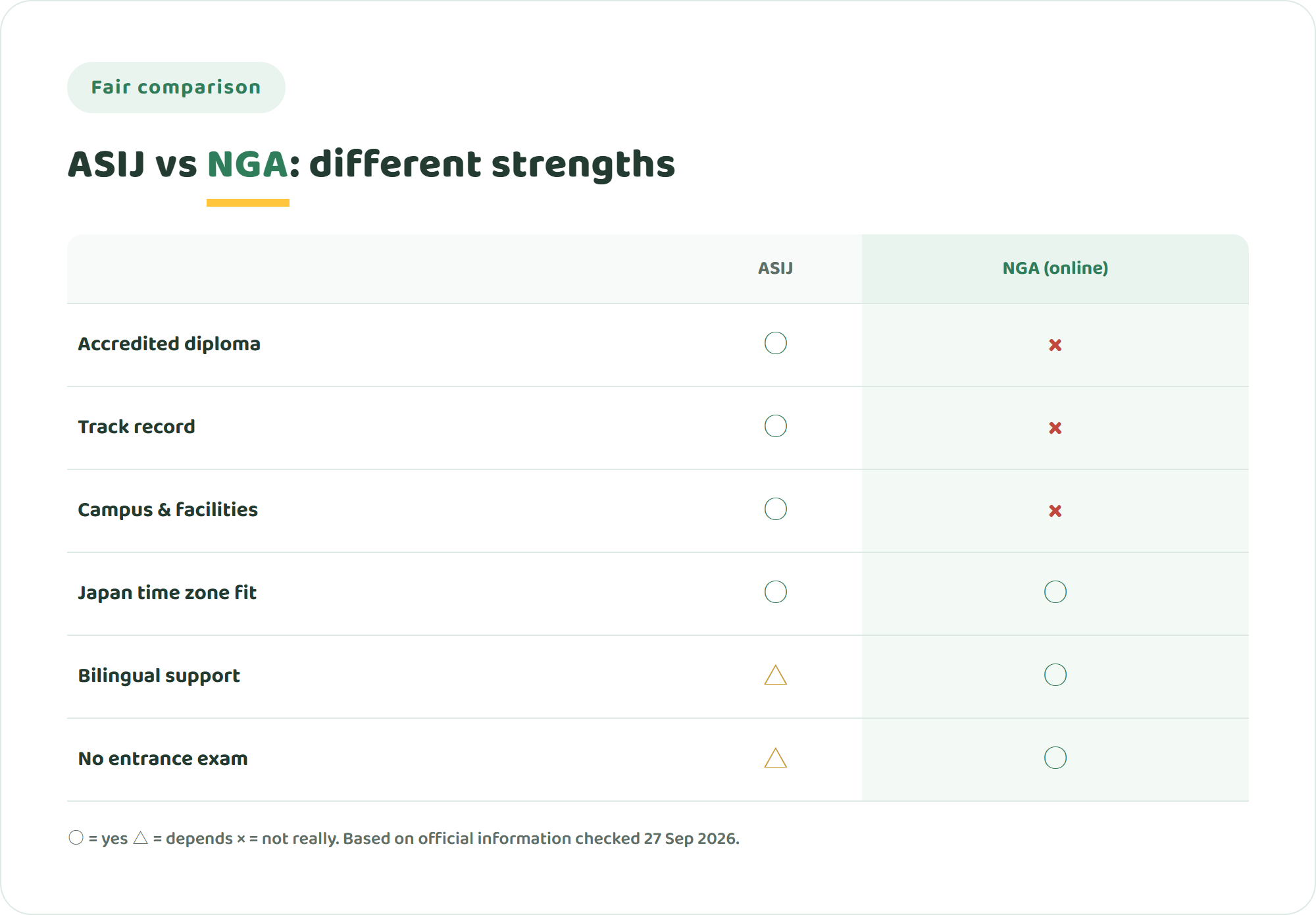
Families moving to Tokyo usually compare ASIJ with other long-established English-medium schools. We chose two with official 2026–27 fees published: St. Mary’s International School (an all-boys school in Setagaya) and Nishimachi International School (Kindergarten to Grade 9, with a Japanese Language and Culture Program). NIJIN GLOBAL ACADEMY is included as a different kind of option — an online school, not a campus school.
| ASIJ | NIJIN GLOBAL ACADEMY | St. Mary’s International School | Nishimachi International School | |
|---|---|---|---|---|
| School type | In-person day school, two campuses (Chofu, Roppongi) | Online international school (Asia & Oceania focus) | In-person all-boys day school, Setagaya | In-person day school, Azabu |
| Grades / ages | Nursery (age 3) to Grade 12 | Ages 6–18 | Elementary to High School (see official site for entry grades) | Kindergarten to Grade 9 |
| Tuition 2026–27 | ¥3,143,000–¥3,826,000/yr + ¥250,000 capital assessment; one-time ¥1,875,000 (application, registration, building) | Not yet published; no enrolment, facility or uniform fees; materials included; sibling discounts | ¥2,860,000–¥3,050,000/yr + ¥200,000 building maintenance; one-time ¥1,450,000 (application, registration, development fund) | ¥3,129,000 tuition + ¥400,000 annual fees; one-time ¥1,125,000 (registration, building) + ¥30,000 application |
| Curriculum | American college-prep; AP and AP Capstone | Subjects learned in English with a bilingual (English–Japanese) mentor; CEFR-based English; optional Cambridge IGCSE / A-Level pathway | IB Diploma Programme in high school | International curriculum with a Japanese language and culture program (see official site) |
| School day & time zone | Chofu 8:00–3:00; ELC 8:30–2:30; bus from central Tokyo | Live small-group classes (about 8) timed for Asia–Oceania daytime — fits Japan time | See official site; bus ¥310,000 one way / ¥420,000 both ways | See official site; school year 26 Aug 2026 – 17 Jun 2027 |
| Accreditation / diploma | ACS WASC listed; ASIJ diploma (22 credits, 4 years of HS) | Not yet accredited; no graduates yet (opens 2027) | CIS and IB listed on official site; IB Diploma | See official site (ends at Grade 9, so no diploma) |
| Admission | No general entrance exam; reports, test scores, recommendations; possible screening; a parent fluent in English | No entrance exam, no English requirement | Application requirements on official site | Admissions criteria on official site |
| Start dates | August; mid-year only for families new to Japan, if seats allow | Opening September 2027 (planned); free trial classes monthly from September 2026; pre-opening trials April–May 2027 | See official site | August (quarterly billing) |
Sources: ASIJ Tuition & Fees, ASIJ Admissions Guidelines, St. Mary’s Tuition & Fees, Nishimachi Tuition + Fees and NGA’s curriculum and timetable page — checked 27 September 2026.

Reviews and common concerns, answered honestly
ASIJ has a long reputation among expatriate families in Tokyo. The questions that come up again and again are practical rather than about quality. Here is what ASIJ’s own site says about each.
“Will we get a seat?”
ASIJ does not publish acceptance rates or waitlist numbers. Its guidelines say decisions consider fit with the school’s philosophy, balance across grades, the school’s current resources, its founding principle of serving students who need an English-medium education, the intention to accept all siblings, and — with extra consideration — alumni status or participation in the Corporate Contribution Program. Apply as early as you can after applications open in November, and tell Admissions your arrival date.
“Is Chofu too far from where we’ll live?”
Chofu is outside central Tokyo, which is why the bus matters so much. Many families choose housing along existing bus routes. Before signing a lease, ask ASIJ which stops serve that neighborhood; the fee page is clear that service is not guaranteed outside existing routes.
“Our child is still learning English.”
You do not need to be a native speaker, but ASIJ says a high level of English proficiency is needed to succeed, and it offers language support in Grades 1–8. High-school applicants without strong English should talk to Admissions early. Language proficiency tests are not accepted in place of the standardized test results the application asks for.
“The one-time fees are high for a two-year posting.”
That is a fair calculation to make. The registration and building maintenance fees (¥1,825,000 together) are paid once, so they weigh more on a short stay. Check what your employer’s education allowance covers, and whether it will consider the Corporate Contribution Program.
“Does my child need special learning support?”
ASIJ has a K–12 learning support program for students with mild learning needs and reviews each applicant individually. It asks for all reports (IEPs, educational-psychological assessments, speech and language reports) before deciding.
“What about US military families?”
ASIJ’s site does not have a dedicated page for military families. Military families assigned to bases in the Tokyo area often use on-base schools; check with your installation’s school liaison. ASIJ’s eligibility rules (living in Tokyo with parents, a parent fluent in English) apply to every applicant.
Alternatives to ASIJ worth comparing
St. Mary’s International School — if you have a son and prefer the IB Diploma, St. Mary’s publishes lower annual tuition than ASIJ for 2026–27 (¥2,860,000–¥3,050,000) with its own set of one-time fees.
Nishimachi International School — for Kindergarten to Grade 9 families who want a Japanese Language and Culture Program alongside an English-medium education; plan for a move to another school for high school.
NIJIN GLOBAL ACADEMY (NGA) — an online international school for ages 6–18 focused on Asia and Oceania, opening in September 2027 (planned), with a first cohort of 100 students. Classes are small live dialogue groups of about 8, subjects are learned in English with a bilingual (English–Japanese) mentor, and English is taught by CEFR level. There is no entrance exam and no English requirement, and NGA can run alongside a local Japanese school or as the main school, and travels with the family if they relocate again. Its timetable is built for Asia–Oceania daytime, which suits families living in Japan. Tuition is not yet published; NGA says it will be far more affordable than a typical international school, with no enrolment, facility or uniform fees, materials included and sibling discounts. The honest limitations: it is not yet open, not yet accredited, has no graduates, and it is not a campus school — families who want daily in-person school life and facilities like ASIJ’s should choose a campus school. Free trial classes run monthly from September 2026. It is operated by NIJIN Inc. in Japan, whose alternative school NIJIN Academy has more than 1,000 students.
For a wider view, see our guide to international schools in Tokyo, our overview of online international schools compared, and how a day at an online international school works. Families also comparing US online schools can read our Stanford Online High School tuition and review and Laurel Springs School tuition and review.
FAQ
How much does ASIJ cost per year?
For 2026–27, tuition is ¥3,143,000 (Nursery–Pre-K), ¥3,498,000 (K–Grade 5), ¥3,699,000 (Grades 6–8) and ¥3,826,000 (Grades 9–12), plus an annual ¥250,000 capital assessment and ¥390,000 for the bus if used. In the first year, new families also pay ¥1,875,000 in one-time fees (application, registration and building maintenance). A new Grade 9 student’s first year is ¥5,951,000 before the bus.
Is ASIJ accredited?
ASIJ lists ACS WASC among its affiliations on its official website and quotes a WASC accreditation team. It is also a member of EARCOS and the Japan Council of International Schools, and offers College Board AP courses. The accreditation term is not published on the site, so confirm with the school or the ACS WASC directory if you need documentation.
Can international students enroll at ASIJ?
Yes. US citizenship is not required, and the student body represents more than 50 nationalities. Every applicant must live in Tokyo with their parents during enrollment, and at least one parent must be fluent in English. ASIJ is a day school with no boarding or homestay.
Is ASIJ worth it?
For families who want an American college-preparatory education in Tokyo with extensive facilities, AP courses, a strong college counseling program and a door-to-door bus, many find it is. It is harder to justify for a short posting paid from personal funds, because the one-time fees are large and there is no financial aid for new applicants. Compare the full first-year cost, not just tuition.
What are the alternatives to ASIJ?
Common alternatives include St. Mary’s International School (all-boys, IB Diploma), Nishimachi International School (K–9, with a Japanese Language and Culture Program) and other Tokyo international schools. For children aged 6–18 who need bilingual support or a flexible, lower-cost option, NIJIN GLOBAL ACADEMY opens online in September 2027 (planned); it is not yet accredited.
Planning your move calmly
ASIJ is one of the most established international schools in Japan, and for many relocating families it is the natural first application. The best next step is concrete: register for an open house or campus visit, ask Admissions about seats for your child’s grade and your arrival date, ask HR whether your company can join the Corporate Contribution Program, and check the bus route before choosing housing. If your plans are still uncertain — a short posting, a child still growing into English, or a gap before a seat opens — it is worth keeping one flexible option in view too. You can read more about why families choose an online international school.
Tuition and admissions details were checked on the official websites on 27 September 2026. Schools revise fees every year — always confirm on the official site before applying.