Maybe the full-time international school near you costs more than your family can sustain. Maybe there isn’t one near you at all. Maybe your child has been finding the daily walk through the school gate harder and harder. Whatever brought you to the idea of learning online, there is a moment that comes next, and it is oddly deflating: you open four or five school websites and they all say the same things. Small classes. Friends around the world. Inquiry-based learning. Every one of them. This is the point at which how to choose an online international school stops being obvious.
This is a guide to getting past that. Learning how to choose an online international school is mostly a matter of translating brochure language into things you can actually verify: accreditation and what your child graduates with, time zones, the language support behind the English, how connection is designed, and the true annual cost alongside how the school is treated where you live. Work through those five and the shortlist narrows itself. At the end you’ll find five questions you can ask, word for word.

Before you compare: an online international school isn’t one thing
The same phrase covers three quite different products. There are full-time schools, with a weekday timetable that becomes the main body of your child’s education. There are supplementary programmes, where a child stays at a local school and learns in English after hours or at weekends. And there are single courses, where you enrol for one subject or one qualification and nothing else.
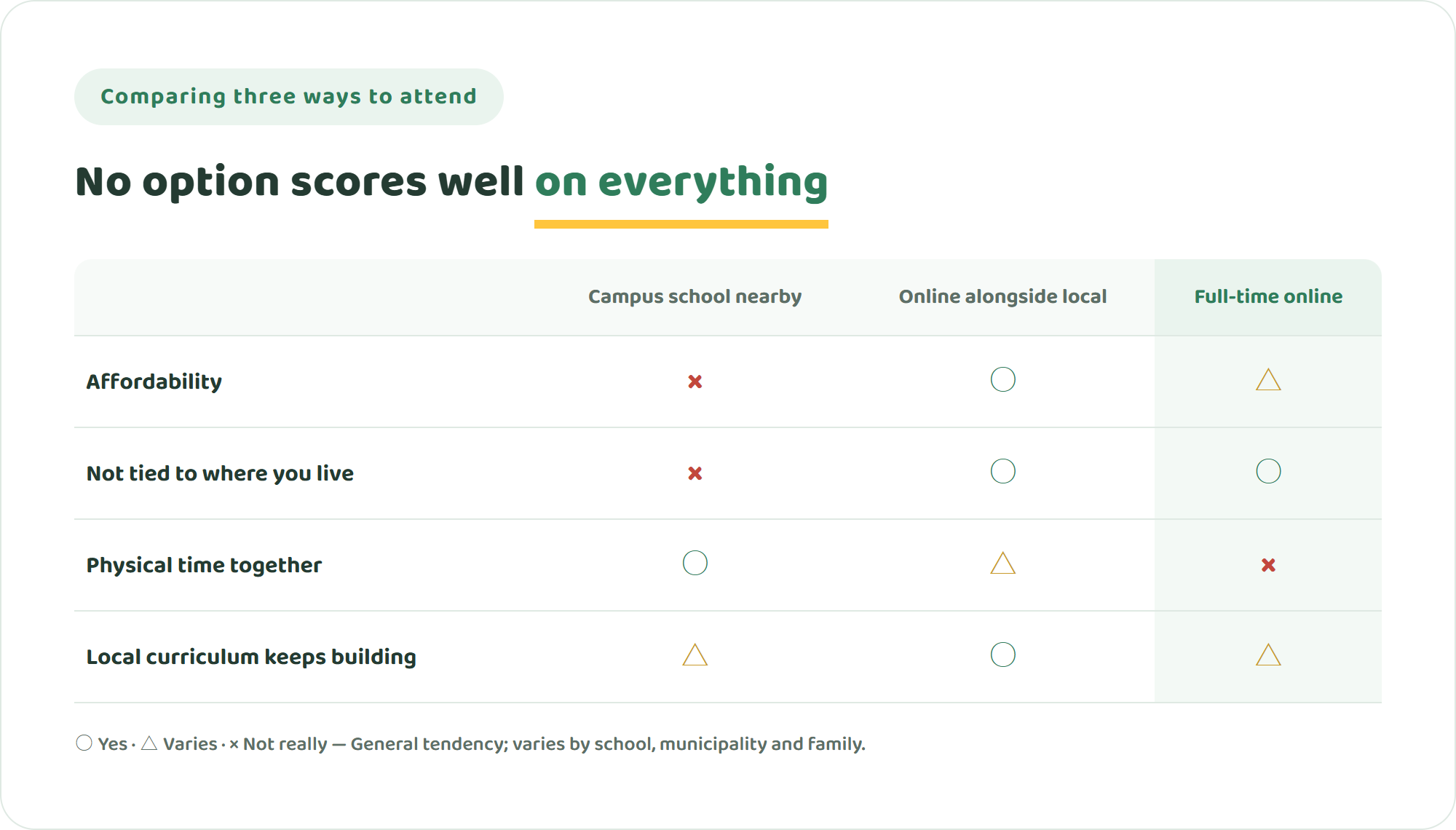
Compare across those categories without noticing and nothing lines up — not the fees, not the hours, not the expectations. When annual costs look wildly different, the usual explanation is simply that the schools are selling different things. So decide, in one sentence, whether your family is looking for a school or for English-medium learning added to the one you already have. If it is the second, a part-time arrangement alongside your local school is often the cleaner answer. If you want the wider landscape first, start with what an international school actually is, or with choosing a campus-based school in general.
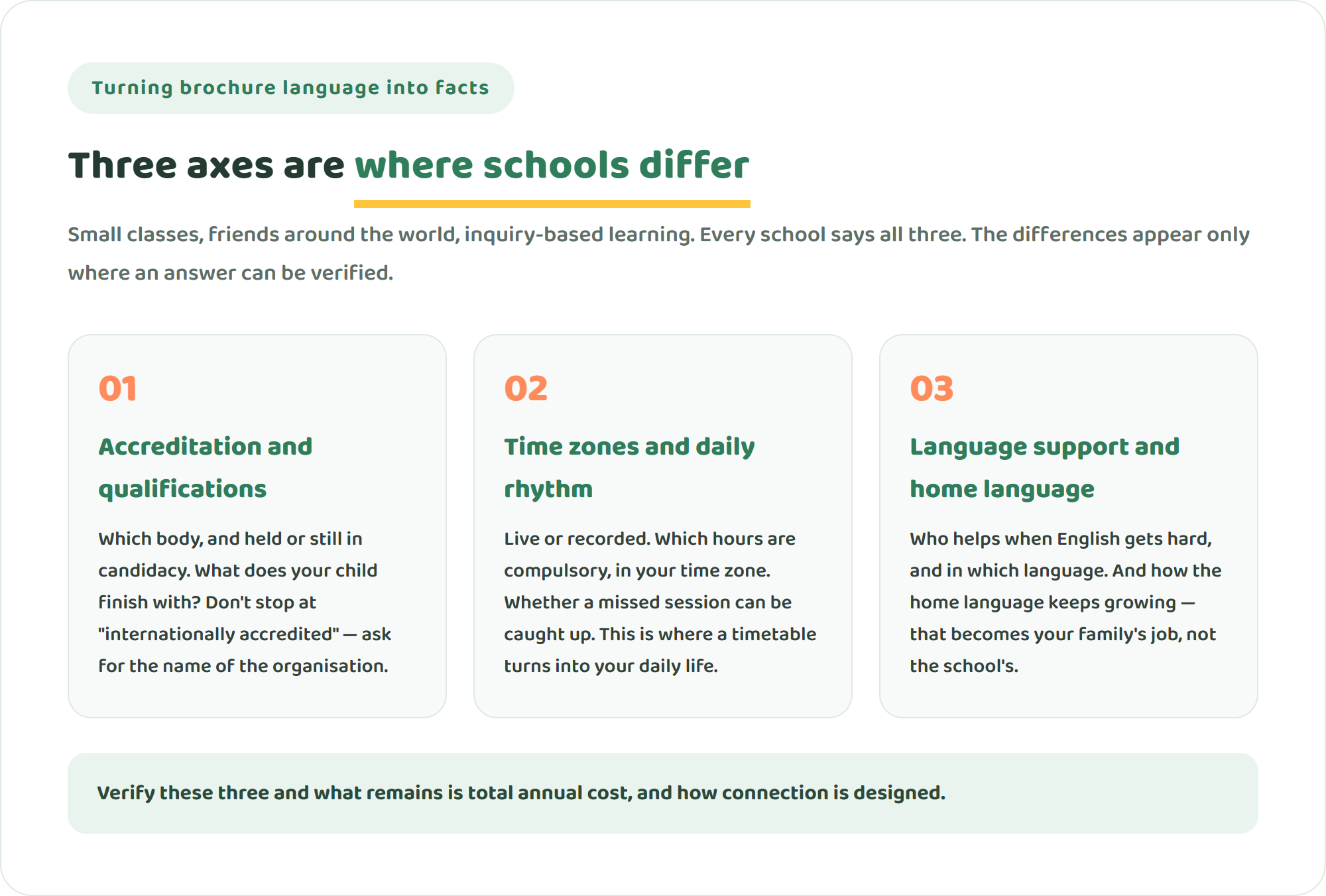
Check 1: Accreditation, and what your child holds at the end
This is the first thing to pin down. If a website says only that a school is “internationally accredited”, ask which body, and at what stage. School accreditation is granted by organisations such as WASC, CIS, Cognia, COBIS and ACSI. Separately, whether a school can offer the International Baccalaureate or Cambridge International programmes such as IGCSE depends on that school’s own authorisation.
Ask, too, whether accreditation is held now or still in application as a candidate school. Candidacy isn’t a red flag — it is a normal stage on the way — but whether it completes before your child graduates is a separate question, and a fair one to ask directly. For the wider picture of what can be earned without a physical campus, see international qualifications you can earn online. If you are in Japan, it is worth mapping the domestic routes at the same time: correspondence high schools and the national upper-secondary equivalency examination both exist and can be combined with online study.
Check 2: Time zones, and what a weekday actually looks like
“Learn from anywhere” is only half true. What changes your family’s life is whether lessons are live (synchronous) or recorded and task-based (asynchronous). Live teaching builds thicker relationships; it also means the school’s core hours land somewhere specific on your clock, which for some families is very early and for others is late evening.
Three questions settle it. What hours are compulsory, expressed in my time zone? How many hours a day is my child in front of a screen? If we miss a session, can we genuinely catch up from a recording? Ask those and an abstract timetable turns into a description of your household. And think honestly about your own child while you’re there — for some children, sitting in front of a screen is itself the demanding part.
Check 3: Language support, and keeping the home language growing
Moving into English-medium learning raises two separate questions that often get merged into one. First: when your child struggles in English, who helps, and in which language? Whether there is someone your family can talk to in your own language changes how exhausting the first year is. Second: how does your child’s first language keep growing? Choose an international education online and the home language quietly stops being something a school takes care of by default.
In our experience, families who leave that until later are the ones who tend to find it hard a few years in. Who, when, and with what materials — write it on the same page as the school comparison. It’s also worth asking the school directly: what do families who keep their home language going actually do here? The answer tells you how real the support is.

Check 4: How connection is designed
This is the most overlooked question of all. Take the sentence “your child will make friends around the world” and ask what it is made of. How many children are in a class? Is there someone who holds the role of a form teacher? Does joining with the camera off still count as taking part? Is writing in the chat treated the same way as speaking? Is there time across year groups? Are there any occasions to meet in person?
For a child who has already found school hard, this design can matter more than the curriculum. What you’re really asking is whether participation comes in more than one shape. Our piece on learning options when school doesn’t fit covers the same ground from the other direction, and the honest pros and cons of international schools is worth reading before you settle on any one option.
Check 5: Total cost, and how the school is treated where you live
Never compare on tuition alone. Enrolment fees, materials, a device and reliable connectivity, examination fees, and the travel and participation costs of any in-person events all sit behind the headline annual figure. For context against campus-based schools, see what international school actually costs, and for online specifically, whether online international schools are genuinely cheaper.
Then there is the legal side, which is local to you. In Japan, for instance, many international schools sit outside the “Article 1” school category under the School Education Act, and how compulsory education and school registration are handled varies between municipalities. This article won’t tell you what your answer is. Name the school you are considering and ask your own municipal board of education about your own situation — and if you live elsewhere, ask the equivalent local authority. Settling this first makes every later decision easier.
See how learning works at NGA →
Five questions to ask, word for word
1. Which body accredits you, and at what stage?
Held or in candidacy. And what qualification does my child finish with? Ask for the name of the organisation, not a general reassurance.
2. Which hours are compulsory, in my time zone?
Plus the live-to-recorded ratio, and whether a missed session can genuinely be caught up.
3. When my child struggles in English, who helps, and in which language?
How many specialists, and is there anyone we can talk to in our own language? The first year turns on this.
4. Does joining with the camera off count as taking part?
Whether participation comes in more than one shape. How the question is answered tells you as much as the answer.
5. Beyond tuition, what will we spend in a year?
Materials, device, examinations, in-person events and the travel to them. Without a total, there is no comparison.
Where NGA sits
Since we are one of the schools you might be weighing, here is our own position, stated plainly. NIJIN GLOBAL ACADEMY (NGA) is an online international school built to step outside the test-score race, opening in September 2027 for ages 6 to 18, with trial classes running as a soft launch in spring 2027. We are operated by NIJIN Inc., and NIJIN Academy — one of Japan’s largest alternative schools — already has over 900 children enrolled.
What we build for first is psychological safety, and we mean something specific by it: each child chooses how many people they engage with, and how. Camera on, voice, or writing in the chat — all of them count as taking part. On the foundations of “coming to like yourself and the world” and “fixing systems rather than blaming people”, we treat the world itself as our classroom.
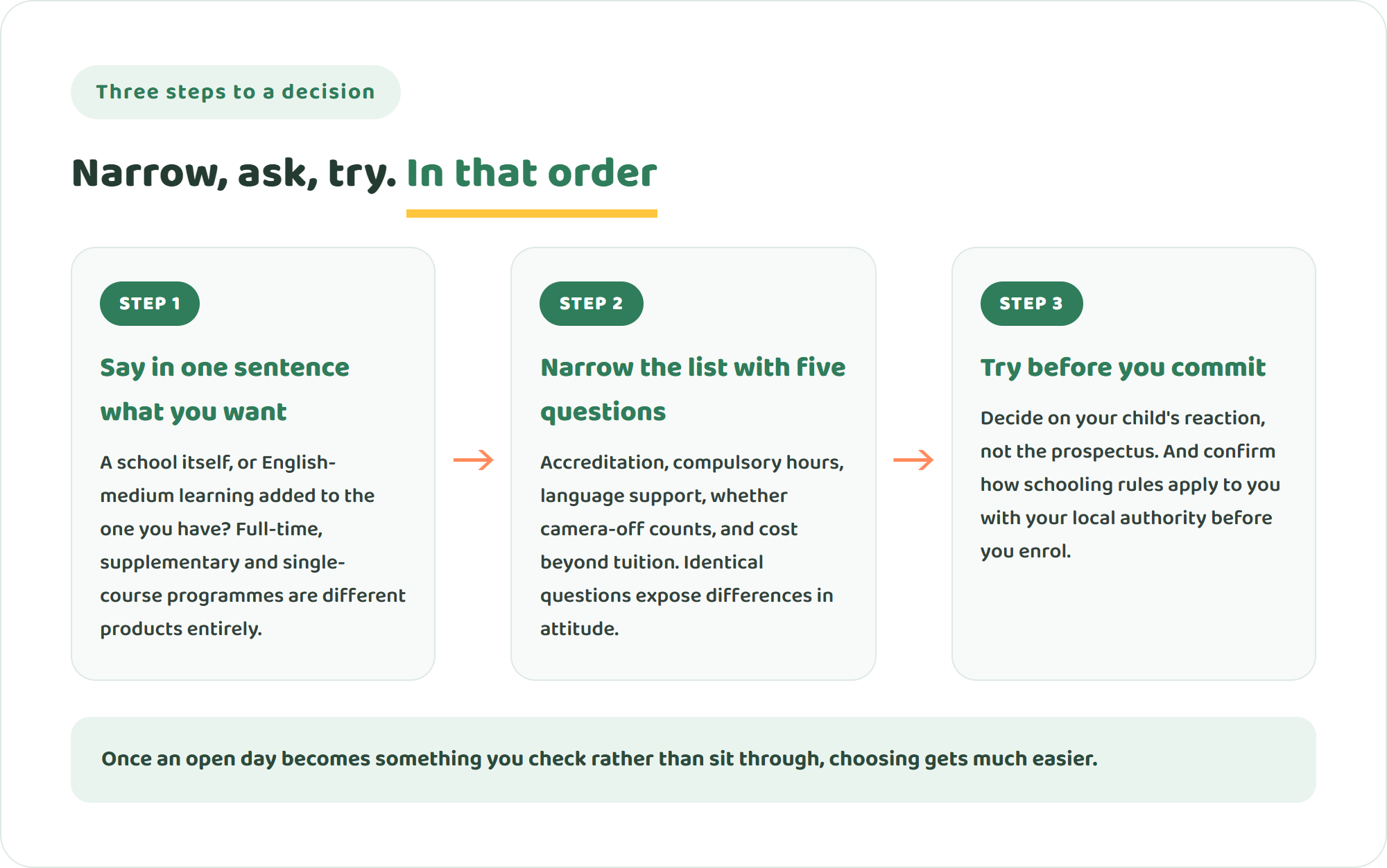
And plainly: we are not right for every family. If what matters most is being in a building every day, physically alongside the same group of children, a campus school within reach fits better. If you need certainty about tracking a national curriculum at grade pace, a local school with something added alongside is the more direct answer. Put the five questions above to us exactly as you would to anyone else, line us up against the alternatives, and consider us only if we genuinely fit your child.
Frequently asked questions about how to choose an online international school
What should I check first when choosing an online international school?
Accreditation and the qualification at the end. Until that is settled you cannot have a sensible conversation about where your child goes next. Ask which organisation accredits the school and at what stage. Then work through time zones, language support, how connection is designed, and total cost, in that order.
Can an online international education alone lead to university?
It depends on the qualification earned and on what the destination requires. Universities abroad and universities at home ask for different things, so decide roughly which direction you are heading and then check that route’s requirements first. In Japan, correspondence high schools and the upper-secondary equivalency examination are additional routes that can be combined with online study.
How many trial lessons should we sit in on?
Fewer than you think, as long as you put the same five questions to every school. Laying identical answers side by side exposes differences in attitude that no prospectus will. And when it comes to it, decide on your child’s reaction rather than on the paperwork.
You aren’t choosing a school. You’re choosing your family’s ordinary weekdays.
Learning how to choose an online international school is hard not because information is scarce, but because everything looks appealing. That is exactly why the comparison has to be built from verifiable facts: accreditation, time zones, language support, connection, cost and legal treatment. Reduce those five to questions you can ask out loud and an open day stops being a presentation you sit through and becomes something you check.
NIJIN GLOBAL ACADEMY is due to open in September 2027, with trial classes as a soft launch in spring 2027. We’ll send you news of our first cohort and how learning works when a child chooses the size and shape of their own participation. You don’t have to decide anything today. Just hold on to this: how your child learns has far more room in it than it looks.
Get opening updates by email →
Related reading
- Accredited online international school: how to check the claim——Four kinds of badge, the UK BSO and OEAS schemes, and five questions before you pay
- A day at an online international school——published lesson hours, time zones and what parents absorb
- Online international schools compared——seven options on curriculum, format and lesson times
- Can you take IGCSE online from Japan?——three routes compared on paperwork, cost and credentials
- Public, private, international or alternative——four criteria that actually decide it