If you have just moved to Kinshicho, Oshiage or Ryogoku — or you are weighing up a flat on Tokyo’s east side before the move — the first thing you will notice is how little reliable information exists about international schools in Sumida. Search in English and you get listing sites recycling addresses from 2019. Search in Japanese and you get the same. So we checked every candidate against the Tokyo Metropolitan Government’s register of childcare facilities, Sumida City’s own subsidy list, and each provider’s official website. The answer is short and worth knowing before you sign a lease: Sumida has exactly two full-day international schools, both for children under six. There is no full-day international school in the ward for primary age or above. Below is what genuinely exists, what it costs, which nearby wards fill the gap from age six, and one option that removes the commute entirely.
Quick Answer: Your Options in Sumida
- Soramame International Preschool (Yokokawa, near Kinshicho) | ages 6 months to 6, plus a primary-age after-school | kindergarten-style class about ¥67,000/month (≈¥804,000/year); nursery-style class about ¥87,000/month (≈¥1,044,000/year), meals and enrolment fee extra (official price list, July 2024 edition) | open 7am to 10pm — by far the widest hours in the ward
- Kids Garden Global School Kinshicho (Kinshi) | ages 1 to 5 | fees not published; enquire directly | more than 720 hours a year of English-only curriculum; opened April 2023 | Japanese–English bilingual rather than English-only
- Kids Duo Tokyo Skytree Station (Higashi-Mukojima) | ages 3 to grade 6 | fees depend on days per week; enquire | English-immersion after-school, not a day school
- Soramame Gakudo after-school (Yokokawa) | primary age | about ¥14,500–¥28,500/month for one to five days a week (official price list) | pick-up from your child’s primary school available
- K. International School Tokyo (Shirakawa, Koto) | ages 3 to 18 | tuition ¥2.85m–¥3.02m/year (Aug 2026–Jun 2027, official) | two stops from Kinshicho on the Hanzomon line; IB PYP, IGCSE and IB Diploma
- Tokyo YMCA International School (Toyo, Koto) | ages 5 to 17 | tuition ¥2,148,000/year for all grades (2026–2027, official) | North American curriculum, K5 through high school, with an English support programme
- India International School in Japan, Tokyo campus (Sengoku, Koto) | kindergarten to grade 12 | ¥600,000/year to junior high, ¥1,200,000/year for high school (Tokyo Metropolitan schools portal) | the affordable full-day route for ages 6 and up
- NIJIN GLOBAL ACADEMY (online, opening September 2027, ages 6–18, aiming for roughly one-fifth of in-person fees, Japanese-language support built in) | no commute, no ward boundary. Still pre-launch; you can register for opening updates now
International schools in Sumida: the real landscape and what it costs
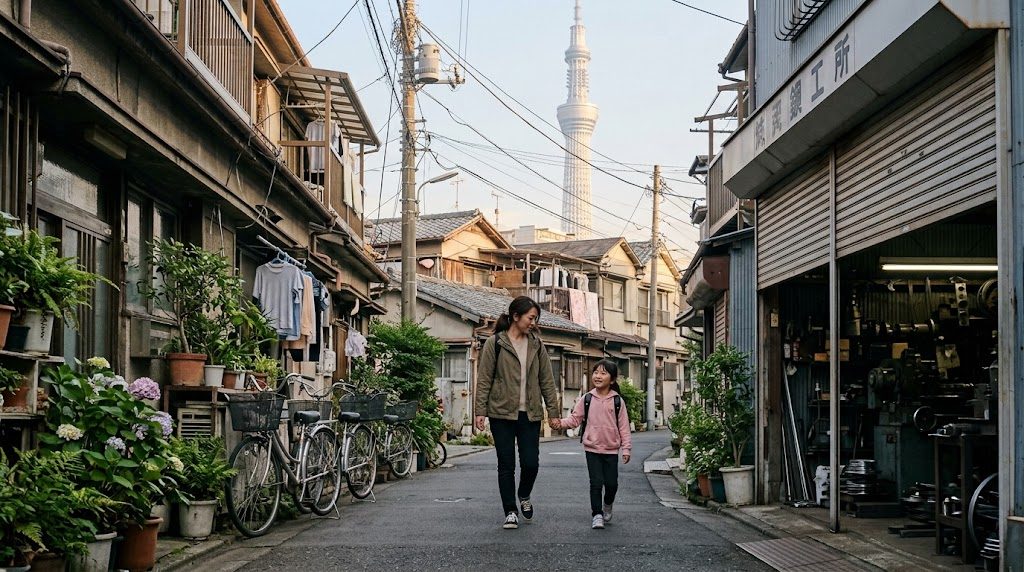
Sumida is one of Tokyo’s most quietly convenient places to live. Kinshicho is the commercial heart of the city’s east side; Oshiage has Tokyo Skytree and a Metro interchange; Ryogoku has the sumo stadium and the Edo-Tokyo Museum. Five rail lines cross the ward, and Otemachi is under fifteen minutes away. Rents are meaningfully lower than in Minato or Shibuya, which is exactly why so many international families end up looking here.
Education, though, follows a completely different map. Cross-check the Tokyo Metropolitan register of unlicensed childcare facilities (as of 1 April 2025) with Sumida City’s list of subsidy-eligible facilities (as of 5 January 2026) and only two facilities in the entire ward run a full day in English: Soramame International Preschool and Kids Garden Global School Kinshicho. Both stop at age six.
Laid out by age band, international schools in Sumida look like this:
- Ages 0–2: options exist — Soramame’s parent-and-child, prep and nursery classes, Kids Garden’s Bambi and Pre-K classes
- Ages 3–5: the ward’s strongest band; both schools run kindergarten-level classes
- Ages 6–12: zero full-day schools. Only English after-school care (Kids Duo Tokyo Skytree Station, Soramame Gakudo)
- Ages 13–18: nothing in the ward. You commute out, or you learn differently
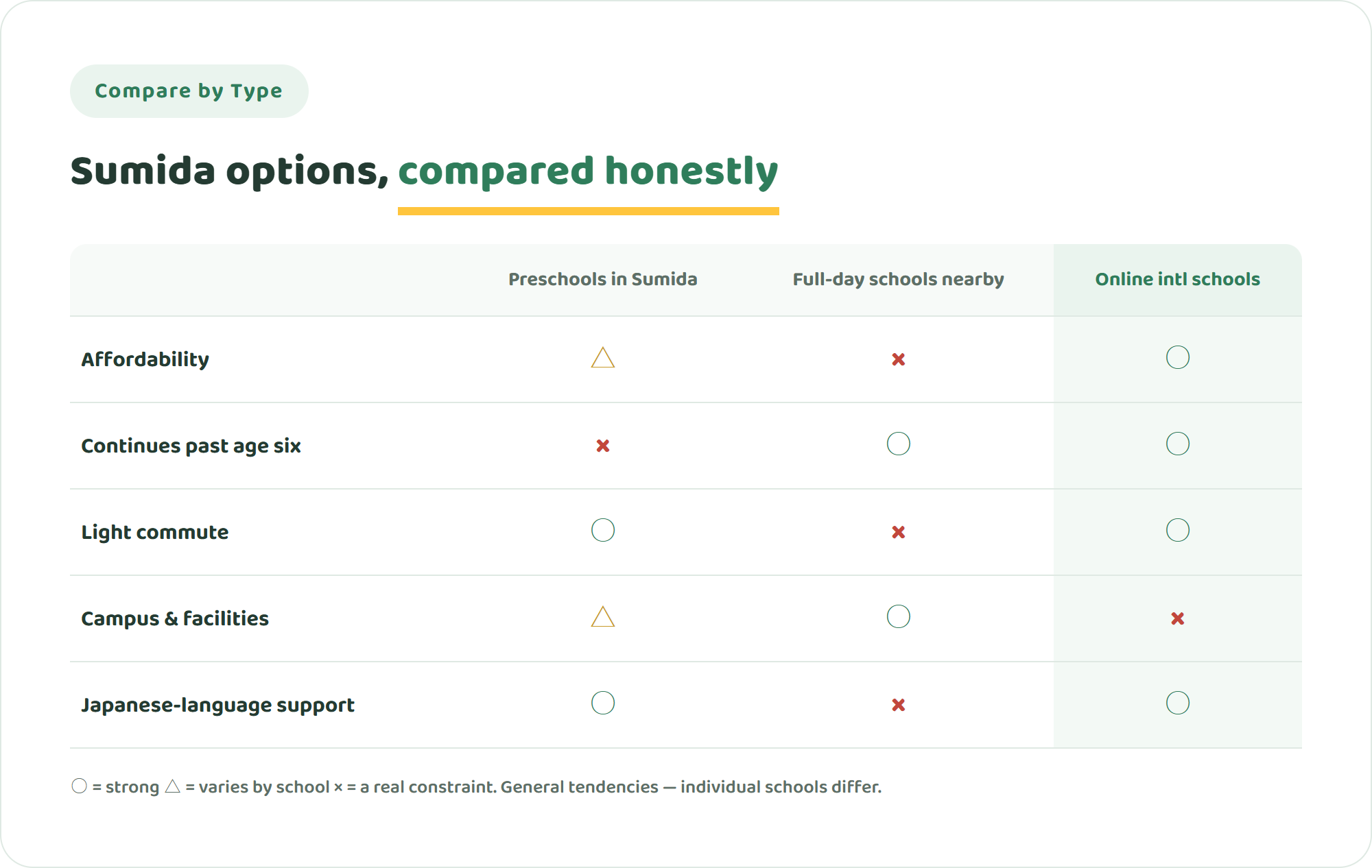
Fees mirror that shape. Inside Sumida, a full day in English for a preschooler runs roughly ¥800,000 to ¥1,050,000 a year plus meals and extras, based on Soramame’s published price list. That is genuinely cheaper than the ¥1.5m–¥2.5m typical of English preschools in Minato or Shibuya. Both Sumida schools also appear on the city’s subsidy-eligible list, which means families of three-to-five-year-olds may qualify for up to ¥37,000 a month towards fees — check your own eligibility with the ward office, because the difference over three years is substantial.
Step outside the ward for a full-day school from age six, and the numbers change category entirely: ¥600,000 to over ¥3,000,000 a year, depending on the school. If you want to understand what sits inside those headline figures before you compare, our breakdown of international school costs in Japan covers enrolment fees, facility levies and the charges that rarely appear in brochures. For the citywide picture, see international schools in Tokyo.
Both international schools in Sumida, honestly described
Here are the two schools we could verify as operating in 2026, with ages, fees and the kind of family each suits. They share a label but not much else.
1. Soramame International Preschool & Soramame Gakudo (Yokokawa)
Soramame International Preschool sits at 3-9-4 Yokokawa, roughly midway between Kinshicho and Oshiage. It is registered as an unlicensed childcare facility with a capacity of 80, operated by Bloom Inc. Its defining feature is opening hours: the metropolitan register lists 7:00 to 22:00. Nowhere else in Sumida covers that span, and no other facility in the ward takes a child from six months old through to primary-age after-school care under one roof.
Classes run as parent-and-child (6 months to under 2), Prep Preschool (1–2, walking independently), nursery-style (1 to kindergarten age, 7:00–18:00), kindergarten-style (3 to kindergarten age, 9:00–14:00) and a weekday after-school for primary pupils (14:00–18:00). Teaching is phonics-led and conducted in English, with Halloween, Christmas and a world market among the annual events.
- Curriculum: English-medium care, phonics-based; unlicensed childcare facility listed on Sumida’s subsidy-eligible register
- Ages: 6 months to 6, plus primary-age after-school
- Fees: kindergarten-style five days a week — ¥58,000 tuition + ¥6,000 facility + ¥3,000 materials = ¥67,000/month (≈¥804,000/year). Nursery-style five days — ¥77,000 + ¥7,000 + ¥3,000 = ¥87,000/month (≈¥1,044,000/year). Enrolment ¥50,000; meals, extended hours and transport extra (official price list, July 2024 edition)
- Best for: dual-income families who need long hours, and anyone who wants one continuous English environment from toddler years into primary school
2. Kids Garden Global School Kinshicho (Kinshi)
Kids Garden Global School Kinshicho occupies the ground floor of the Hulic Kinshicho Collabo Tree building at 4-17-1 Kinshi, a short walk from Kinshicho station. Run by Kids Smile Project Inc., it opened in April 2023 with capacity for 60 children and operates 8:00 to 19:00 per the metropolitan register.
There are three classes: Bambi (age 1), Pre-K (age 2) and Kinder (ages 3–5). The school’s published figures are more than fifteen hours a week of English immersion and more than 720 hours a year of English-only curriculum. Importantly, this is a bilingual programme rather than an English-only one — Japanese develops alongside English, which matters if your family plans to stay in Japan long term.
- Curriculum: Japanese–English bilingual; over 720 hours a year of English-only teaching (official)
- Ages: 1 to 5
- Fees: not published — enquire directly. Listed on Sumida’s subsidy-eligible register, so the three-to-five age band may qualify for support
- Best for: families commuting through Kinshicho daily, and those who want English without letting Japanese slide
After-school English in Sumida: two options for primary age
No full-day school for six-year-olds does not mean no English at all. Two places in Sumida let a child attend Japanese public school and still spend afternoons in English. They serve a different purpose from a day school, and cost a fraction as much.
3. Kids Duo Tokyo Skytree Station (Higashi-Mukojima)
Kids Duo Tokyo Skytree Station is at 2-11-15 Higashi-Mukojima, four minutes’ walk from Hikifune station on the Tobu Skytree line. The kindergarten course runs 14:30–18:30 or 15:00–17:00; the primary course (grades 1–6) runs 13:30–19:30 with extensions to 20:30. Staffing pairs native and bilingual teachers, and the whole session is conducted in English.
- Format: English-immersion after-school care, not academic day schooling
- Ages: 3 to grade 6
- Fees: vary by days per week — enquire
- Best for: families in Japanese public school who need childcare and want those hours spent in English
4. Soramame Gakudo (Yokokawa)
Run by the same operator as school 1 above, this weekday after-school programme costs ¥28,500 a month for five days or ¥14,500 for one, with a ¥20,000 enrolment fee and ¥1,500 hourly drop-in rate. Crucially, it offers pick-up from your child’s primary school — ¥17,500 a month for five round trips a week. For working parents without a Japanese-speaking support network nearby, that logistics detail often matters more than the curriculum.
A warning about outdated listings for international schools in Sumida
The most time-consuming part of writing this guide was disproving things. Sumida in particular has closed and relocated facilities still appearing on aggregator sites years later. This is not criticism of the schools; it is a practical caution before you spend an afternoon phoning around.
- Zoo-phonics Academy Kinshicho (Ishiwara): still listed widely, but the operator’s official school list no longer includes it and the branch URL redirects to the corporate home page
- Play Group Oshiage (Oshiage): absent from the franchise’s official school list, and its own domain no longer resolves
- Kids Time (Kamezawa): appears on neither the Tokyo register (April 2025) nor Sumida’s subsidy list (January 2026)
- Kids Duo Ryogoku (Midori): now operates as Kids Duo Ryogoku-Minami at Shin-Ohashi in Koto ward. The name says Ryogoku; the address is outside Sumida
- St. Paul Azabu Christian Academy / Azabu Christian Academy (Mukojima): several directories still show 2-19-14 Mukojima, but the Tokyo register lists a facility with the same phone number at 3-11-8 Asakusabashi in Taito ward, and the domains cited as its official sites are not publicly viewable. Contact the school directly before relying on any listed detail
From age six, neighbouring wards are the realistic answer
Once your child turns six, the choice in Sumida is to commute out or to learn without a commute. The good news is that southern Sumida runs straight into Koto ward, which has genuine full-day international schools within a short ride. For the full picture see international schools in Koto; heading towards central Tokyo, Chuo and Bunkyo are also worth a look.
5. K. International School Tokyo (Shirakawa, Koto)
KIST is at 1-5-15 Shirakawa, beside Kiyosumi-Shirakawa station — two stops from Kinshicho on the Hanzomon line, and the school describes itself as thirty seconds from the station exit. It runs K1 to G12: IB Primary Years Programme for K1–G5, its own LSP for G6–G8, IGCSE for G9–G10 and the IB Diploma for G11–G12. Tuition for August 2026 to June 2027 is ¥3,020,000 for K1–K3, ¥2,850,000 for grades 1–9 and ¥2,970,000 for grades 10–12, plus a ¥300,000 entrance fee, ¥700,000 facility expansion fee, ¥30,000 application fee and ¥200,000 facility maintenance fee. Expensive, yes — but a full IB pathway inside a fifteen-minute door-to-door commute from much of Sumida is rare.
6. Tokyo YMCA International School (Toyo, Koto)
TYIS sits at 2-2-20 Toyo, by exit 2 of Toyocho station on the Tozai line. It teaches ages 5 to 17 on a North American curriculum from K5 through high school. Tuition for 2026–2027 is ¥2,148,000 across all grades, with first-year additions of ¥22,000 application, ¥275,000 entrance, ¥220,000 school development and ¥198,000 maintenance fees. The school also runs Academic Support for Kids (ASK) at additional cost for students who need language or academic scaffolding — relevant if your child is arriving from a Japanese-language environment.
7. India International School in Japan, Tokyo campus (Sengoku, Koto)
IISJ’s Tokyo campus at 3-1-4 Sengoku follows India’s CBSE curriculum from kindergarten to grade 12, with Montessori methods in the early years and a strong emphasis on mathematics, science and IT. According to the Tokyo Metropolitan international schools portal, tuition is ¥600,000 a year through junior high and ¥1,200,000 a year for high school. It is one stop from Kinshicho towards Sumiyoshi, and it is the single most realistic answer for a Sumida family that wants full-day English from age six without a three-million-yen annual bill.
Fees and details above reflect information published as of July 2026. Always confirm current figures on each school’s official website.
Comparing the options: which one fits your family
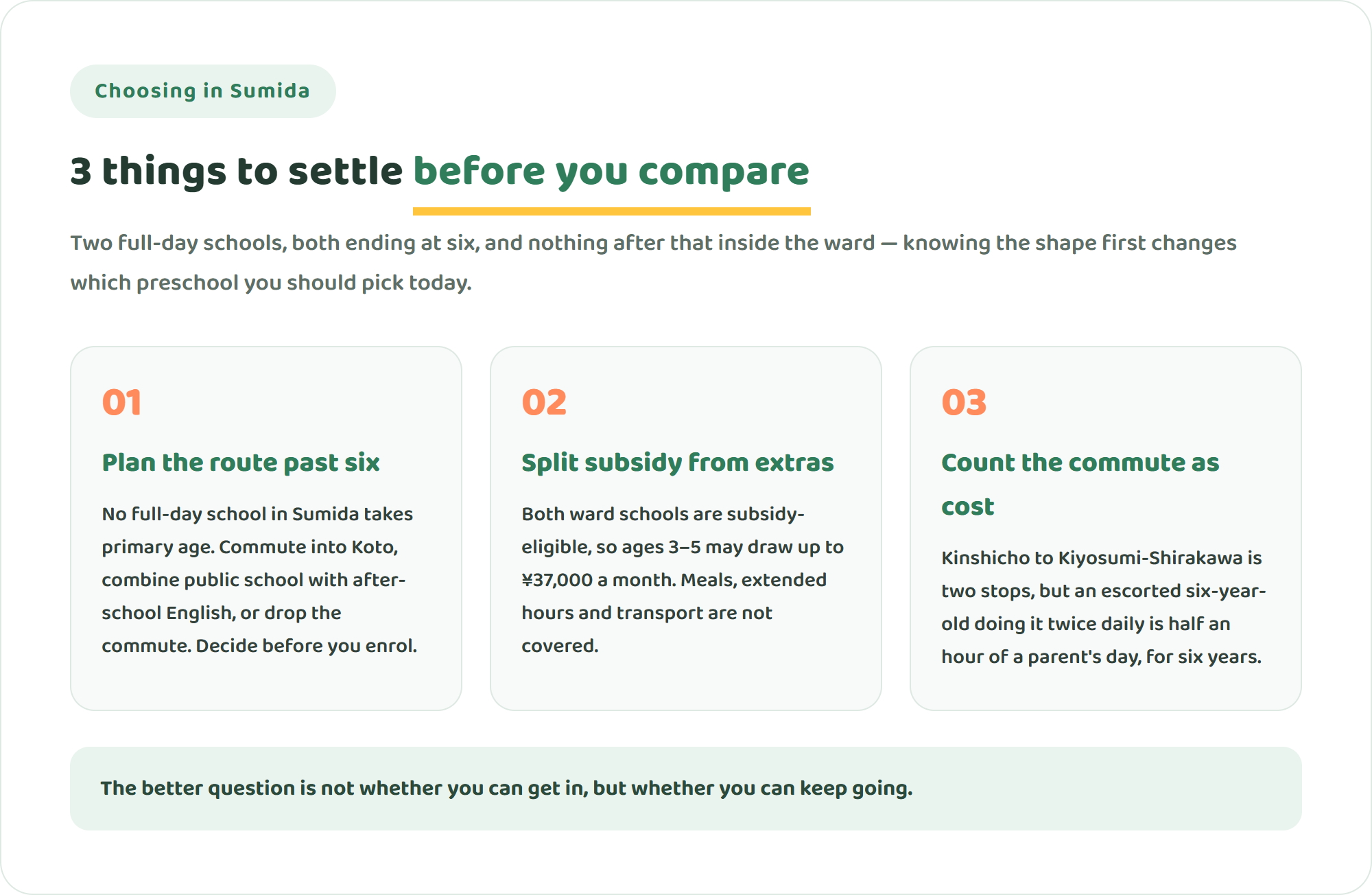
The single highest-leverage decision in Sumida is planning the route past age six before you enrol at three. The ward’s preschools are affordable and convenient, and that is precisely the trap: three comfortable years end abruptly at a cliff. Decide now whether you will commute into Koto, combine public school with after-school English, or drop the commute altogether. That choice changes which preschool you should pick today.
Second, separate subsidised fees from out-of-pocket extras. Both Sumida schools sit on the city’s subsidy list, so the three-to-five band may draw up to ¥37,000 a month. Meals, extended hours, transport and materials are not covered. Families are routinely surprised that a lower headline fee does not translate into a lower monthly transfer.
Third — and this is the one most families underestimate — count the commute as a family cost. Kinshicho to Kiyosumi-Shirakawa is two stops. A six-year-old doing that twice a day, accompanied, is a very different proposition from an adult measuring it on a map. If an adult has to escort, that is roughly half an hour a day for six years. Time runs out before money does, more often than people expect.
See how learning works online →
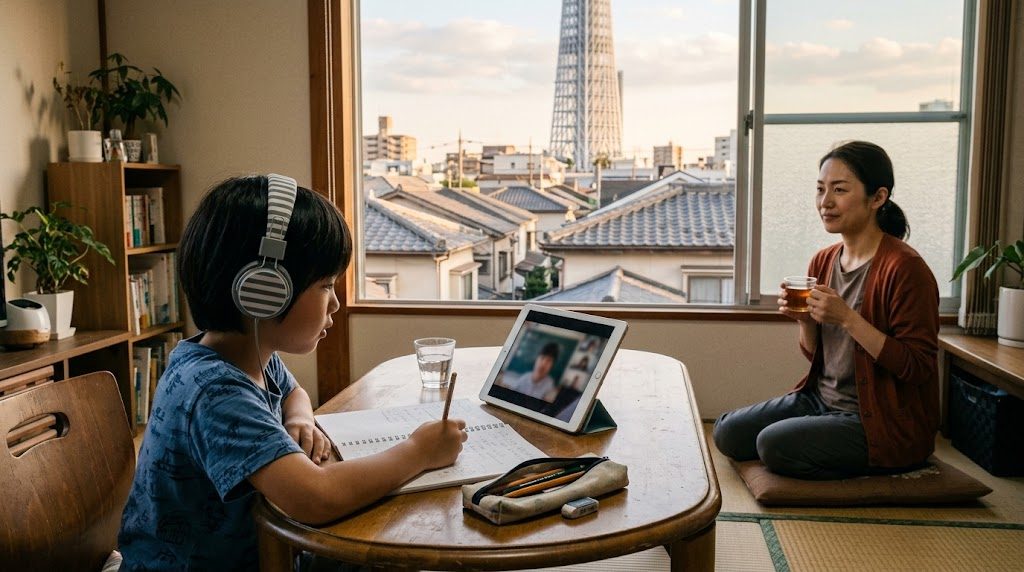
If fees or the commute are the wall — an eighth option, online
If you have read this far and concluded that the Koto schools are beyond your budget and that putting a six-year-old on a rush-hour train is not something you want to do daily, that is a reasonable place to land. There is one more route.
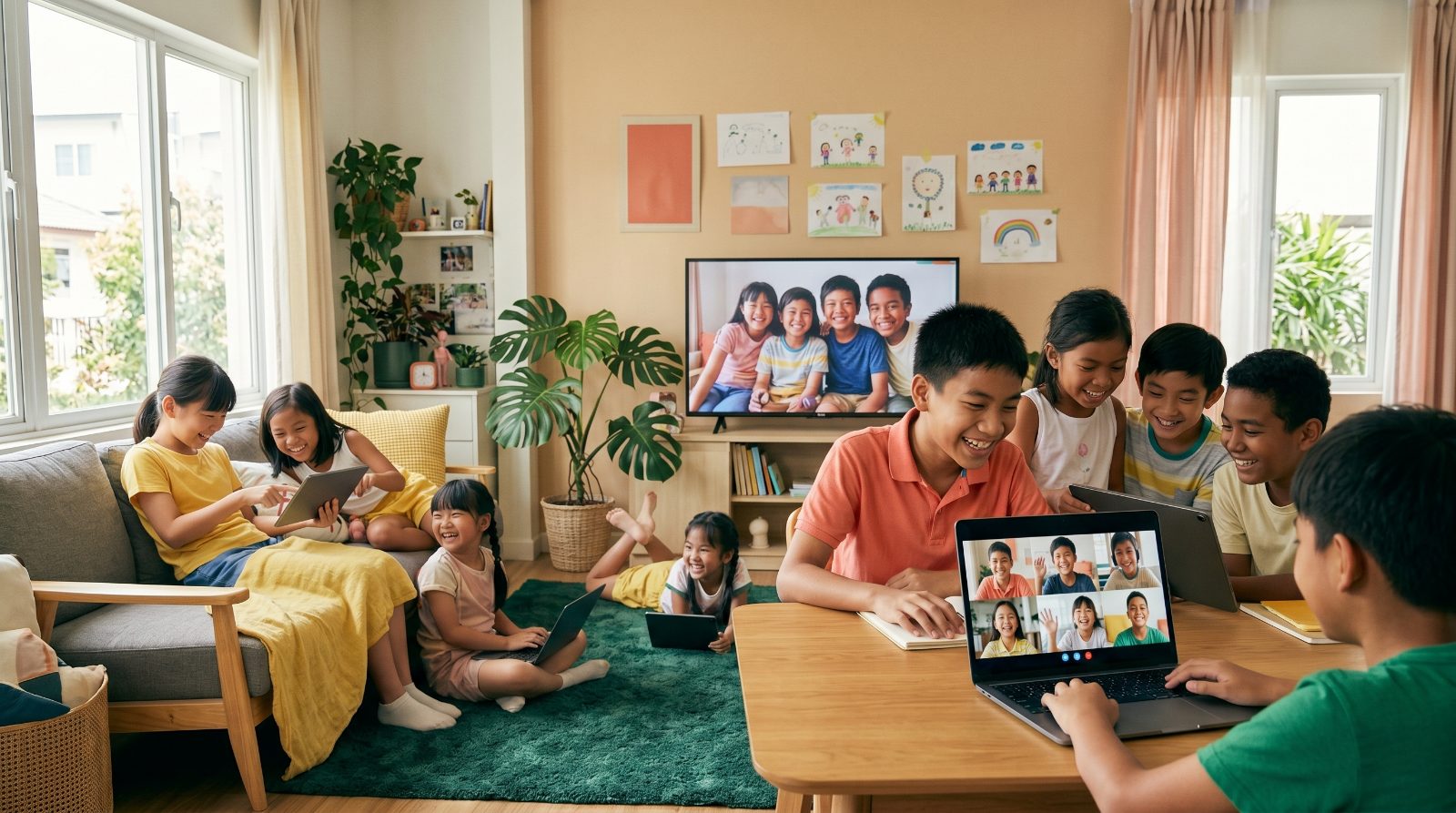
NIJIN GLOBAL ACADEMY is an online international school opening in September 2027, operated by NIJIN Inc. in Japan. The same company runs NIJIN Academy, an alternative school in Japan with more than 1,000 students enrolled. The online school is for ages 6 to 18 across Asia and Oceania, so a family in Sumida joins from home — no ward boundary, no commute.
The philosophy is deliberately anti-ranking: children are not sorted by test scores. Learning happens in small dialogue-centred groups, built around the idea of coming to like yourself and the world. Fees are targeted at roughly one-fifth of in-person international school tuition, and the design assumes Japanese-language support as a foundation, with English introduced gradually rather than all at once.
Two honest caveats. First, the school has not opened yet — there is no graduating cohort and no track record to show you. Second, it is not the same experience as being on a campus: no playground, no shared lunch, no corridor friendships in the physical sense. But for Sumida families facing an empty shelf from age six, removing distance and cutting fees to a fifth genuinely changes what is possible.
Frequently asked questions
Q. From what age can my child start at an international school in Sumida?
Soramame takes children from six months in its parent-and-child class, from age one in its Prep Preschool (once walking independently) and from age one in its nursery-style class. Kids Garden Global School Kinshicho starts at one with its Bambi class. So entry from around age one is realistic. The catch is the other end: both stop at six, so plan the next step before you enrol, not during your child’s final kindergarten year.
Q. Will my child keep up their Japanese — or their English — in a Sumida preschool?
Both Sumida schools are bilingual rather than English-only, so Japanese continues to develop alongside English. That balance suits families staying in Japan long term, but it does mean the English exposure is lower than at a fully English-medium school in central Tokyo. In the other direction, families who go all-in on English often find that Japanese literacy — reading and writing, specifically — needs deliberate support outside school. If Japanese is the side you are worried about, our sister service Tomodachi Japan (online Japanese for children, also run by NIJIN) is worth a look.
Q. Can we transfer mid-year, and how far ahead should we apply?
The two Sumida preschools are unlicensed childcare facilities, so mid-year entry is usually possible if a place is free — call and ask. Full-day schools in Koto are different: admission depends on year-group capacity and your child’s English level. TYIS offers a paid academic support programme for students who need it, but places in it are limited. If you are transferring into a full-day school, start conversations six to twelve months before your target date. Capacity, entry requirements and fees all change, so confirm directly with each school.
A ward with few options rewards the families who decide early
Finding an international school in Sumida is genuinely hard. Two full-day schools, both ending at six, nothing at all for primary and secondary age, and a web full of listings for places that closed years ago. That is the honest picture.
But a short list has one advantage: it makes the real question obvious. What happens at age six? Answer that, and everything else gets lighter. Enrolling locally now and touring Koto schools next year is a valid plan. Public school plus after-school English is a valid plan. Dropping the commute and learning online is a valid plan. The only outcome worth avoiding is discovering the cliff three months before your child starts primary school.
The hours you are spending on this are hours spent thinking carefully about your child. Please don’t spend them being hard on yourself — the research you are doing right now is already the work.
International Schools in Other Cities
- International Schools in Nakano, Tokyo
- International Schools in Tsukuba: Fees
- International Schools in Sendai: 7 Picks and Fees
- International Schools in Shinjuku: Fees
- International Schools in Karuizawa: All 4 Schools
- International Schools in Sapporo: Fees
- International Schools in Minato: Fees
- International Schools in Musashino, Tokyo
- International Schools in Nagoya: All 8 Schools
- International Schools in Tokyo
- International Schools in Shibuya, Tokyo
- International Schools in Setagaya: All 14 Schools
- International Schools in Koto, Tokyo
- International Schools in Shinagawa, Tokyo
- International Schools in Meguro: All 8 Schools