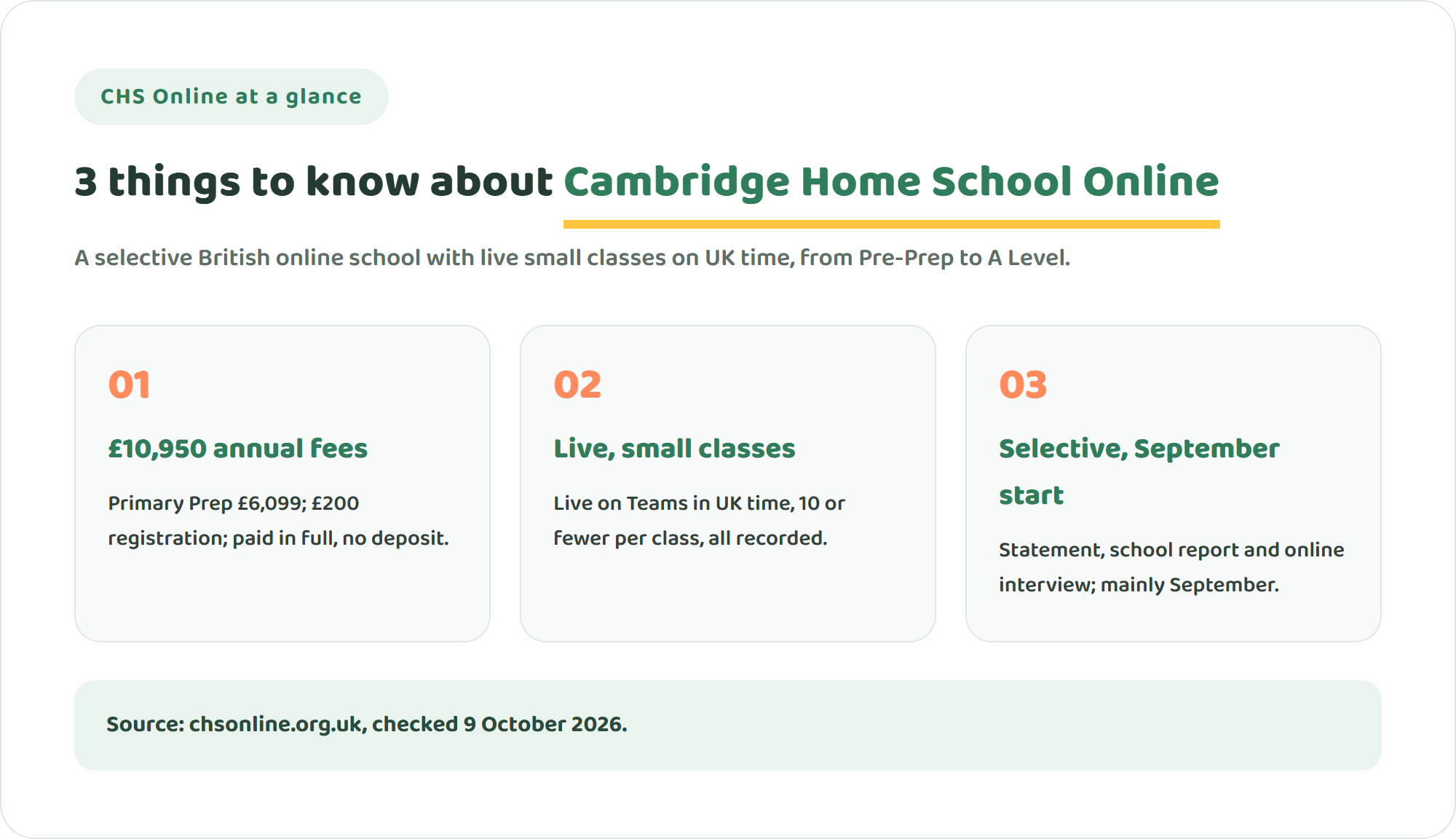
Cambridge Home School Online fees are listed on the school’s official Grades & Fees page as £10,950 GBP in “Annual Fees” (shown as approximately $14,600 USD or €12,600), with a separate Primary Prep School fee of £6,099 GBP, plus a non-refundable £200 registration fee charged when you apply (official site, checked October 2026 — 9 October 2026). The school’s terms say fees are charged annually and paid in full before the start date, deposits are not accepted, and the FAQ says there are no instalment plans. Exam-centre fees are paid separately by families.
If you searched “Cambridge Home School Online fees” or “Cambridge Home School Online review”, you are probably a parent in the UK, or a British or internationally mobile family abroad, considering a selective online school that teaches live, small classes on UK time. You likely want to know which fee applies to your child, what is and isn’t included, how selective admission really is, what time lessons run where you live, whether the school is accredited, and how it compares with other British online schools. This page answers those questions from the school’s own website (CHS Online, run by Cambridge Online Education in Cambridge, UK), points out what the official pages do not say, and then compares it fairly with King’s InterHigh, Wolsey Hall Oxford and NIJIN GLOBAL ACADEMY — a very different online school for ages 6–18 that opens in September 2027.
The short answer: who Cambridge Home School Online suits — and who it doesn’t
- Suits: academically able students who want live, teacher-led lessons in small groups. The FAQ says classes have “no more than 10 students”, and the Sixth Form page says almost all A Level classes have around six students or fewer.
- Suits: families aiming for Cambridge International (CAIE) IGCSEs and A Levels. The Upper School and Sixth Form pages say almost all courses are with Cambridge International, and the school says it is a registered UCAS centre.
- Suits: families in the UK, Europe, Africa or the Middle East, where the UK-time timetable falls in the normal school day.
- Suits: students whose sport, performing arts or travel make a conventional school hard, as long as they can attend lessons at fixed times (the FAQ says there is no “learn whenever you want” option).
- Harder fit: families looking for a non-selective school. The FAQ describes the school as “academically selective”, and admission involves a personal statement, a recent school report and an online interview.
- Harder fit: families who need to spread payments. The FAQ says fees must be paid in full and instalment plans are not offered.
- Harder fit: families in the Americas or far-east time zones. The school says it only accepts applications from families in time zones “conducive to attending LIVE classes”.

What Cambridge Home School Online is
Cambridge Home School Online (often shortened to CHS Online) describes itself as an online independent school offering live, teacher-led lessons in small groups on a British curriculum, for students in the UK and abroad. Its history page says it “supported our first students in 2002” and became fully incorporated as part of Cambridge Online Education in 2008. The registered address is St John’s Innovation Centre, Cowley Road, Cambridge. Despite the word “Home” in its name, the FAQ is clear that it is a real school rather than a homeschooling course: students follow a timetable, attend live classes, hand in assignments and receive feedback, and parents do not need to act as subject teachers.
The school is organised in stages: Pre-Prep (Key Stage 1, ages 5–7), Primary Prep (Key Stage 2), Lower School (Years 7–9), Upper School (Years 10–11, IGCSEs) and Sixth Form (Years 12–13, A Levels). The curriculum page calls it “an independent curriculum” and gives age bands of 8–10 for Key Stage 2, 11–13 for Key Stage 3, 14–16 for Key Stage 4 and 17–19 for Key Stage 5. Able students can move ahead: the school says some take an IGCSE from age 12, and A Level study in a subject can start younger in cases of exceptional aptitude.
| Item | Cambridge Home School Online (official information, checked 9 October 2026) |
|---|---|
| School type | Online independent school, British curriculum, live small-group lessons; operated by Cambridge Online Education, Cambridge, UK |
| Stages | Pre-Prep (KS1, ages 5–7), Primary Prep (KS2), Lower School (Years 7–9), Upper School (Years 10–11), Sixth Form (Years 12–13) |
| Qualifications | IGCSEs and A Levels; almost all courses with Cambridge International (CAIE); IGCSE Psychology with AQA |
| Class size | “No more than 10 students”; A Level classes around 6 or fewer |
| Lessons | Live on Microsoft Teams, UK time (GMT/BST); every lesson recorded for catch-up |
| Registration | UK Register of Learning Providers, provider number 10033485; registered UCAS centre |
| Admission | Academically selective; £200 non-refundable registration fee; personal statement, school report, online interview |
| Main intake | September (applications open for September 2026); late joiners only in exceptional cases |
Cambridge Home School Online fees (2026/27, official)
The figures below come from the official Grades & Fees page, the admissions process page and the terms and conditions, all checked on 9 October 2026. The fees page says the school is “now accepting applications for September 2026”, so we read these as the prices for the 2026/27 school year; the page itself does not print an academic year next to the numbers.
| Item | Amount (official) | What the official site says |
|---|---|---|
| Annual Fees | £10,950 GBP | Shown with approximate conversions (about $14,600 USD / €12,600 / 54,000 AED / 120,000 HKD). The page does not say which year groups this figure covers. |
| Primary Prep School fees | £6,099 GBP | Listed separately on the same page. |
| Pre-Prep (Key Stage 1) | Not published on the official site | Ask admissions which fee applies. |
| Registration fee | £200, non-refundable | Paid before completing the registration form. |
| Deposit | None | The terms say “Deposits are not accepted.” |
| Payment | Annual, in full | Fees are charged annually and paid in full before the start date; the FAQ says instalment plans are not offered. The school says it can invoice employers directly where possible. |
| Exam fees | Extra — amount not published on the official site | Families register with an exam centre and pay it directly; costs vary by centre and country. |
| Sibling discount | Not published on the official site | — |
| VAT | Not stated on the official site | Ask whether the price shown includes VAT for your situation. |
One detail is worth knowing before you budget: the separate Scholarships and Bursaries page still shows lower reference figures (annual fees £10,450 and Primary Prep £5,850), which appear to be an older fee level. The Grades & Fees page is the current source, so use £10,950 and £6,099 — and ask admissions to confirm in writing which fee applies to your child’s year group.
What the fee includes — and what costs extra
The FAQ says the fee covers scheduled teaching and related school provision, while exam fees and optional activities may cost extra. The school lists more than 20 free clubs (for example chess, coding, debating, drama and creative writing), house competitions, a student council and free eLibrary access. You will also need suitable equipment: the FAQ recommends a Windows 10+ or Mac laptop or desktop (Intel Core i5 or equivalent, 8GB RAM, a screen of 15 inches or more), a wired connection of at least 10 Mbps and a headset with a microphone. Tablets are fine for viewing but not for regular study.
Scholarships and bursaries
- Scholarships: awarded at the school’s discretion to pupils it considers “truly exceptional”; applications must be made by 30 November in the year before entry. The amount is not published on the official site.
- Bursaries: up to 50% off fees for a limited number of families. The published criteria include household income below £50,000 a year (£35,000 for a single parent) for the last three years, property worth under £300,000 or renting, a commitment to stay at least three years, and exceptional ability (for example grade 8/9 in maths and English) or exceptional talent. Bursaries are not available for Primary Prep fees.
What a year really costs: worked examples (official prices)
Because the fees page does not say which stages the £10,950 “Annual Fees” figure covers, the examples below assume it applies to your child’s year group. Please confirm this with admissions before you rely on the totals.
One secondary student, first year: £10,950 annual fees + £200 registration = £11,150, paid before the start date, plus exam-centre fees in exam years.
One Primary Prep pupil, first year: £6,099 + £200 registration = £6,299.
Four years at today’s price (for example Years 8 to 11): £10,950 × 4 = £43,800 + £200 registration = £44,000, before exam fees. The terms say fees are fixed for each academic year and that any increase needs at least 30 days’ notice, so future years may differ.
Two siblings, one in Primary Prep and one in secondary: £6,099 + £10,950 = £17,049 + £400 registration (£200 each) = £17,449 for the first year, with no sibling discount published.
Exchange rates move, so treat the dollar and euro figures on the fees page as the school’s own approximations and convert on the day you pay.
Commitment and withdrawal rules
The terms say you commit to paying fees for each academic year. You may end the agreement with effect from the last day of the summer term by giving notice on or before the last teaching day; if a student leaves earlier, fees are owed to the end of the academic year. There is a 14-day cooling-off period from the start date. Late joiners, accepted only in exceptional cases, must pay fees for the remaining terms and for the following academic year, according to the admissions page. Read these rules before you sign: they make CHS Online a full-year commitment rather than a term-by-term arrangement.
How a school day works: schedule, live classes and time zones
CHS Online is built around live attendance. Lessons run on Microsoft Teams to a published timetable in UK time (GMT in winter, BST in summer). Every lesson is recorded, but the FAQ stresses that recordings are for revision and catch-up, not a replacement for attending: there is no “learn whenever you want” option. Students are expected to have their cameras on and to take part fully.
- Pre-Prep and Primary Prep: a morning school day from 9:00 to 12:30 UK time, with optional after-school activities until 5:30 pm. An adult must be nearby, and for Pre-Prep and Prep 3 a parent is expected to sit with the child during lessons. Pre-Prep classes are capped at 10 and include weekly one-to-one teaching.
- Upper School (IGCSE): each subject has 2–4 hours of lessons a week, and students are advised to take a maximum of nine IGCSEs (fewer is allowed).
- Sixth Form (A Level): each subject meets for 4 hours a week with the student’s own teacher and class; most students take up to three A Levels.
- Exact lesson hours for secondary timetables: not published on the official site. The admissions page says a timetable is provided for students in Europe, the Middle East and Asia.
On time zones, the school’s own article on international students says UK times suit Europe, Africa and the Middle East, while students further east may attend in the afternoon or evening, and families in the Americas should check how early lessons would start. It also reminds families to check both winter and summer times, because UK daylight saving shifts the difference. The admissions page goes further: the school “will only accept applications from families living in time zones conducive to attending LIVE classes”. If you live in North or South America, ask admissions directly before applying.
The 2026/27 term dates on the official term dates page are: Term 1, Tuesday 1 September to Friday 11 December 2026 (half term 19–30 October); Term 2, Monday 4 January to Thursday 25 March 2027 (half term 15–19 February); Term 3, Monday 19 April to Friday 2 July 2027 (half term 31 May – 4 June). For a general picture of how live online schooling feels from the student’s side, see a day at an online international school.
Accreditation, exams and university recognition
Here is exactly what the official site says, and what it does not:
- UK Register of Learning Providers: the history page says the school is “Registered on the UK Government Register of Learning Providers”, provider number 10033485. This is a register of organisations that provide learning, not an inspection or a quality rating.
- UCAS: the Sixth Form page says the school is a registered UCAS centre and helps with personal statements, interviews and overseas university applications.
- DfE Online Education Accreditation Scheme (OEAS): not stated on the official pages we checked. The OEAS is a voluntary Department for Education scheme for full-time online providers serving children in England; if it matters to you — for example if a local authority is commissioning a place — ask the school about its status.
- Exam centre status: not stated on the official site. Students sit Cambridge International (and a few other) exams at approved exam centres in the UK or abroad, usually as private candidates, and families register and pay the centre directly.
On results, the fees page reports that in summer 2026, 66% of all GCSE grades were A*/A, and that most of the class of 2026 went on to their preferred Russell Group universities. The FAQ is transparent about method: the school does not receive a single results feed from exam boards and relies on families reporting results with evidence, so it asks families to bear that in mind. The qualifications themselves are standard IGCSEs and A Levels; as the FAQ notes, universities see the exam-board certificate and grade, not “an online qualification”.
Cambridge Home School Online vs NIJIN GLOBAL ACADEMY vs two other options (official data)
Here is CHS Online side by side with two other British online options and NIJIN GLOBAL ACADEMY (NGA), which is a different kind of school. King’s InterHigh is a large, non-selective live online school; Wolsey Hall Oxford is tutor-supported homeschooling paid per course. Each is a real option with its own strengths.
| Cambridge Home School Online | NIJIN GLOBAL ACADEMY | King’s InterHigh | Wolsey Hall Oxford | |
|---|---|---|---|---|
| School type | Selective online independent school, live small classes | Online international school focused on Asia & Oceania; opens September 2027 (planned) | Full online independent school (British curriculum) | Online homeschool college with tutors and a Student Progress Manager |
| Ages / years | Pre-Prep (KS1, 5–7) to Sixth Form (Year 13) | Ages 6–18 | Ages 7–19 (Years 3–13) | Ages 3–18 |
| Fees (2026/27) | £10,950 annual fees; Primary Prep £6,099; £200 registration; paid in full | Not yet published (no enrolment, facility or uniform fees; materials included; sibling discounts) | £4,395–£10,990 / year (annual contract) + £100 registration | Per course / bundle — see official fee lists; £95 registration per student |
| Curriculum | British; IGCSE and A Level, almost all Cambridge International | Subjects learned in English, CEFR-based English levels, projects; optional Cambridge IGCSE / A-Level pathway | British: KS2–KS3, IGCSE, A Level, IB Diploma | Mostly Cambridge (Primary to A Level) |
| Live classes & time zone | Live on UK time, 10 or fewer per class, recorded; Europe, Middle East and Asia timetable | Small live dialogue groups (about 8); built for Asia–Oceania daytime — may fall outside the day in the Americas or Europe | Live 40-min lessons, recorded; UK, Middle East or Southeast Asia timetables | Self-paced with tutor-marked assignments; no live-lesson timetable |
| Accreditation / qualifications | UKRLP registered; UCAS centre; DfE OEAS not stated on official site | Not yet accredited; no graduates yet | DfE OEAS; Cambridge International School; Pearson Edexcel centre; IB | Courses approved by exam boards (see official site) |
| Admission | Academically selective: statement, report, online interview | No entrance exam, no English requirement | Non-selective for most programmes; English guide A2/B1 | See official site (£95 registration fee) |
| Start dates | Mainly September; late joiners in exceptional cases | Opens September 2027; free trial classes monthly; pre-opening trials April–May 2027 | Any time in the year | See official site |
Sources: CHS Online Grades & Fees, CHS Online FAQs, King’s InterHigh fees, Wolsey Hall Oxford fees — checked October 2026 (6–9 October 2026). For the full picture of the two alternatives, read our King’s InterHigh fees and review and Wolsey Hall Oxford fees guide.
Reviews and common concerns, answered honestly
The school publishes parent and student reviews on its own reviews page and links to a Good Schools Guide review. Rather than repeat individual comments, here are the questions families most often raise, with what the school officially says.
“Is it really a school, or a homeschool course?”
The name can mislead. The FAQ says it is a school with a timetable, live classes, assignments and feedback, taught by qualified subject-specialist teachers, and that parents do not need to teach. Younger pupils do need an adult nearby.
“How selective is it?”
The school calls itself academically selective. The admissions page asks for evidence of “good effort grades” through a transcript or recent report, and says top grades are not required. Applicants submit a personal statement and, if the school thinks it can offer a place, are invited to an online interview. Sixth Form subjects generally need at least grade 7 or A at (I)GCSE in that subject.
“Is it worth the price compared with other online schools?”
At £10,950 in annual fees, CHS Online sits towards the upper end of British online schools. What the fee buys, according to the school, is live teaching in classes of 10 or fewer (around six at A Level) by subject specialists. Whether that is worth it depends on how much small live classes matter to your child. Our guide to online vs in-person international school costs puts the figure in context.
“What about time zones?”
Lessons are on UK time and attendance is expected. For families in Asia, lessons may fall in the afternoon or evening; for the Americas, early mornings. The school only accepts families whose time zones allow live attendance.
“What if my child has additional needs?”
The FAQ says applications from students with SEND are welcome and reasonable adjustments are made, but the school is not a SEND specialist and students must keep cameras on and take part fully, so some children may be better served elsewhere. It suggests discussing needs with admissions before accepting a place.
“What happens if we want to leave mid-year?”
The terms commit families to the full academic year: fees are owed to the end of the year if a student leaves early, after the 14-day cooling-off period. This is the single most important rule to understand before paying.
Alternatives to Cambridge Home School Online worth comparing
King’s InterHigh suits families who want a large, established British online school that is non-selective for most programmes, accepts students year-round, offers an annual or a rolling half-term contract and lists DfE OEAS accreditation. Wolsey Hall Oxford suits families who prefer structured homeschooling at their own pace, with tutor marking and a Student Progress Manager, paid per course rather than as a full school fee. If you are also weighing American-style programmes, our reviews of Laurel Springs School tuition and Stanford Online High School tuition cover two well-known US options, and Pearson Online Academy tuition covers another.
NIJIN GLOBAL ACADEMY (NGA) is an online international school for ages 6–18 with a focus on Asia and Oceania. It opens in September 2027 (planned), with free trial classes monthly from September 2026 and pre-opening trial classes in April–May 2027. Its first cohort is 100 students, and it is operated by NIJIN Inc. in Japan, whose alternative school NIJIN Academy has more than 1,000 students. NGA does not rank children on test scores: lessons are small-group live dialogue (classes of about 8), subjects are learned in English with a bilingual English–Japanese mentor, English levels follow the CEFR, and students join social co-creation projects with companies and governments plus international exchange. An optional Cambridge IGCSE / A-Level pathway is listed on the curriculum and timetable page. There is no entrance exam and no English requirement, it can run alongside a local school or as the main school, and it travels with the family if they move. Tuition is not yet published; NGA says it will be far more affordable than a typical international school, with no enrolment, facility or uniform fees, materials included and sibling discounts.
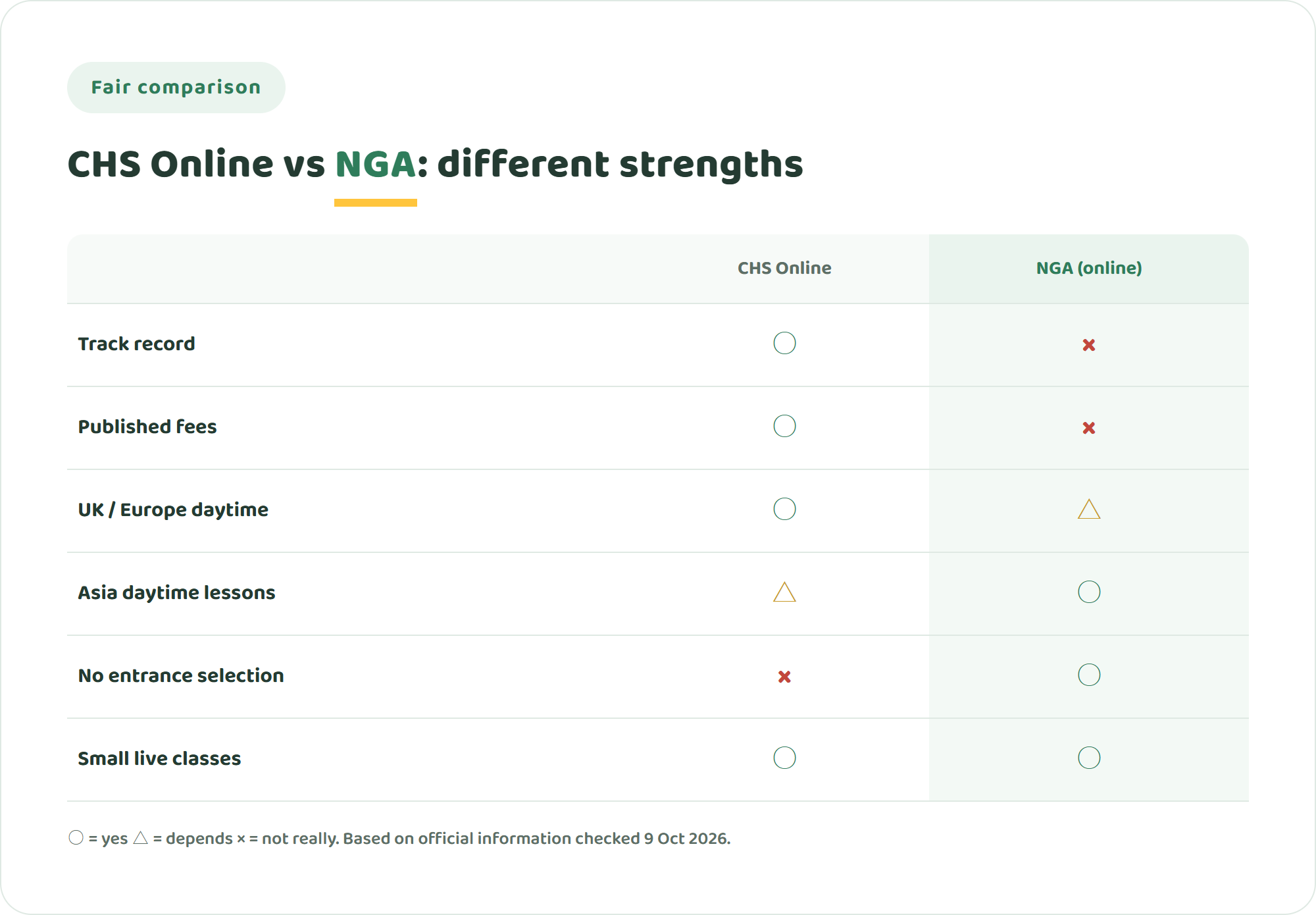
Be clear about the trade-offs: NGA is not yet open, is not yet accredited and has no graduates or track record. Its timetable is built for Asia–Oceania daytime, so for families in the UK, Europe or the Americas live classes may fall outside their day — check the timetable against your local time. If your priority is a selective British school with very small live classes on UK time and an established record of IGCSE and A Level results, Cambridge Home School Online offers that today.
For a broader overview of the field, see our online international schools compared guide, or read why families choose an online international school.
FAQ
How much does Cambridge Home School Online cost per year?
The official Grades & Fees page lists “Annual Fees” of £10,950 GBP (about $14,600 USD) and Primary Prep School fees of £6,099 GBP, plus a non-refundable £200 registration fee. Fees are paid annually in full before the start date; exam-centre fees are extra. The page does not say which year groups the £10,950 figure covers, so confirm with admissions. Checked 9 October 2026.
Is Cambridge Home School Online accredited?
The official site says it is registered on the UK Register of Learning Providers (provider number 10033485) and is a registered UCAS centre. DfE Online Education Accreditation Scheme status is not stated on the official pages we checked; ask the school if this matters to you. Its students sit standard Cambridge International IGCSE and A Level exams at approved exam centres.
Can international students enrol at Cambridge Home School Online?
Yes. The FAQ says the school is designed for expatriate and internationally mobile families, and a timetable is provided for students in Europe, the Middle East and Asia. Lessons are on UK time, the school only accepts families whose time zones allow live attendance, and students need a suitable level of spoken and written English. Families must also find a local exam centre that accepts private candidates.
Is Cambridge Home School Online worth it?
It can be a strong fit for academically able students who want live classes of 10 or fewer, Cambridge International qualifications and UK-time lessons. It is a weaker fit for families who need a non-selective school, monthly payments, year-round entry or a timetable in the Americas.
What are the alternatives to Cambridge Home School Online?
British-curriculum alternatives include King’s InterHigh (non-selective live online school, ages 7–19) and Wolsey Hall Oxford (tutor-supported homeschooling, paid per course). NIJIN GLOBAL ACADEMY is a different option for ages 6–18 focused on Asia and Oceania, with no entrance exam and no English requirement; it opens in September 2027 and is not yet accredited.
Choosing calmly
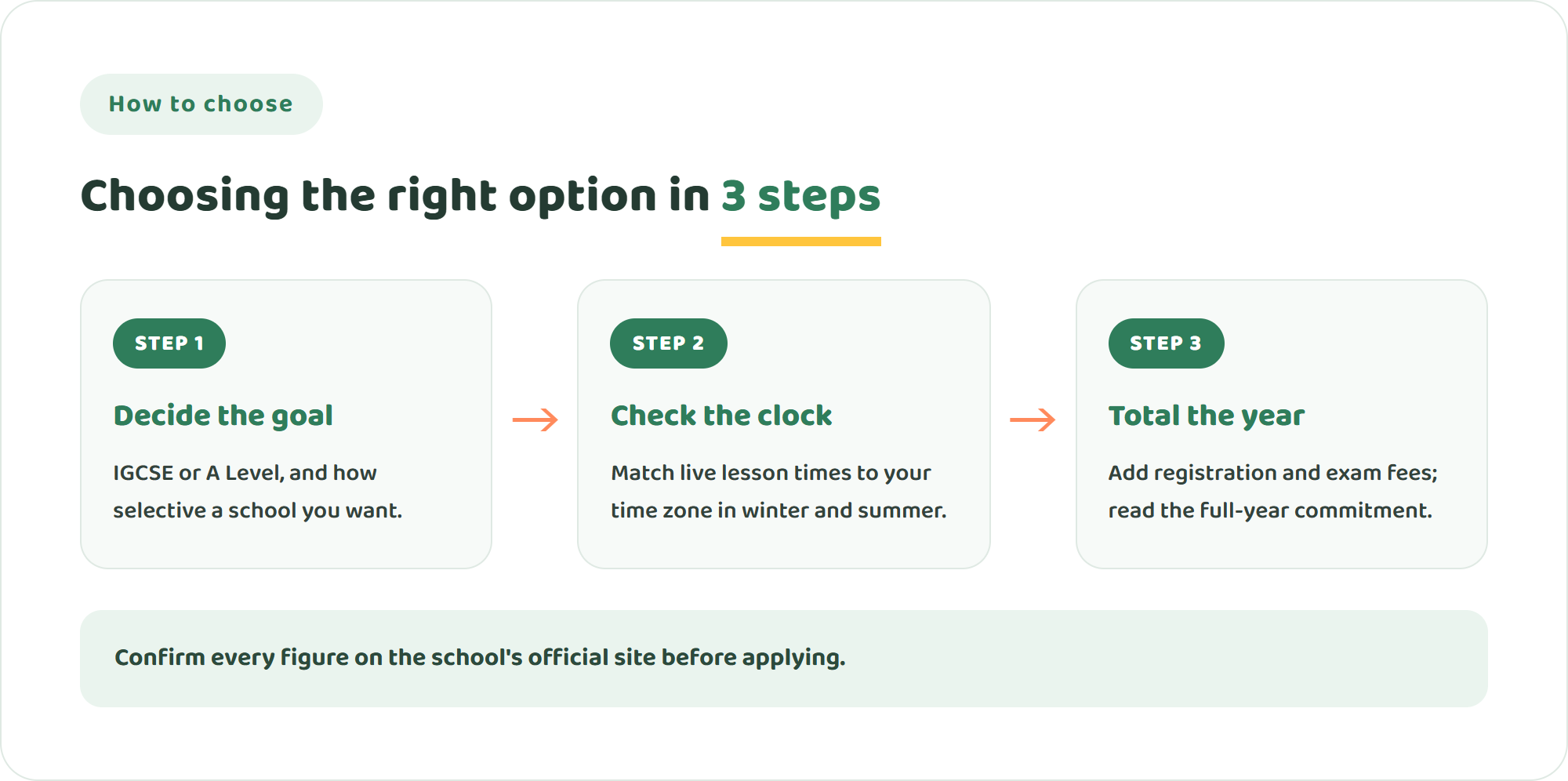
There is no single best online school — only the one that fits your child’s ability, English level, time zone, goals and your budget. Cambridge Home School Online has clear strengths: very small live classes, specialist teachers, Cambridge International exams and a long history since 2002. Read the official pages, book a taster day or an open event, ask admissions which fee applies to your child’s year and what the full-year commitment means, and talk with your child about what they want their school day to feel like.
Tuition and admissions details were checked on the official websites on 9 October 2026. Schools revise fees every year — always confirm on the official site before applying.