If you have been searching for international schools in Ishikawa Prefecture and keep landing on English kindergartens in Kanazawa or adverts for online schools, you are not searching badly — you are seeing the market accurately. Ishikawa is home to roughly 1.09 million people and is now connected to both Tokyo and Osaka by the Hokuriku Shinkansen, yet as of 2026 only two full-time international schools in the entire prefecture accept children at elementary age or above. Neither of them is in Kanazawa: one is in Komatsu, the other in Uchinada Town. This guide maps every option across the prefecture, separating schools that continue past kindergarten from early-years programmes, and grouping them by area — Kanazawa, Komatsu and Kaga, Hakusan and Nomi, Uchinada and Kahoku, and the Noto Peninsula. It then walks through the three routes families here genuinely take when nothing local fits: commuting into neighbouring Toyama or Fukui, building an English-medium path inside Ishikawa, and learning online without commuting at all.
Quick Answer: Your Options in Ishikawa Prefecture
If you only read one section, read this. Below are the schools covered in this guide, plus the online option — so you can see every route side by side before the details.
- Hakusan International School (Komatsu City) — Ages: 5 to 15 (full-time, Saturday, after-school, correspondence and summer options) / Fees: Published registration fee ¥25,000 for the full-time programme (once per family…
- Commute to a school in Toyama or Fukui
- Ishikawa Hope International School (IHI, Uchinada Town, Kahoku District) — Ages: Kindergarten age through high-school age (high school stage planned in combination… / Fees: Not published; enquire directly (as of July 2026)
- Build an English-medium path inside Ishikawa
- Aoba-Japan International School, Kanazawa Campus (opening August 2027)
- Take commuting out of the equation — an online international school
- NIJIN GLOBAL ACADEMY (online) — Ages 6–18 / opening September 2027, currently taking opening-update registrations / fees around one-fifth of a typical campus international school / Japanese-language support. An option when commute or fees are the wall.
International schools in Ishikawa Prefecture: the landscape and fee ranges
Ishikawa is internationalising fast. According to the prefectural government’s own count, 22,892 foreign residents were living in Ishikawa as of the end of December 2025 — an increase of 2,382 in a single year and the highest figure on record. Reporting by the Nikkei puts Kanazawa City at the top with 9,094 residents, with the Technical Intern Training and Specified Skilled Worker statuses together accounting for more than 40% of the total, and Vietnam, China and Indonesia leading by nationality. International families are spread across the prefecture: tourism and universities in Kanazawa, manufacturing in Komatsu, hot-spring hospitality in Kaga, and primary industry across Noto. What has not kept pace at all is the supply of schools where a child can keep learning in English year after year.
The schools divide cleanly into two layers. The first is the early-years layer — English-immersion preschools and certified kindergartens for children roughly aged zero to six, heavily concentrated in Kanazawa City. The second layer, schools accepting elementary-age children and older, contains exactly two: Hakusan International School in Komatsu City and Ishikawa Hope International School in Uchinada Town, Kahoku District. A third is on the way: Aoba-Japan International School is preparing to open a Kanazawa campus in August 2027. It is also worth knowing that international-schools-database, the English-language directory many relocating families rely on, carries no listing for Ishikawa at all as of July 2026. If searching from abroad turns up nothing, that is why.
Fee levels differ sharply between the layers. English preschools and kindergartens in Kanazawa generally run around ¥800,000–950,000 a year according to third-party databases, though children aged three to five often qualify for Japan’s early-childhood education subsidy, which can cut the effective cost substantially. Of the two full-time schools, Hakusan International School publishes ¥250,000 per term for its four-to-five-day programme — roughly ¥750,000 a year across three terms — while Ishikawa Hope International School does not publish fees and asks families to enquire directly. Set against the ¥2–3 million a year typical of major Tokyo international schools, Ishikawa’s profile is distinctive: very few options, but comparatively affordable ones.
Note: fees reflect publicly available information as of July 2026 and are subject to revision. Always confirm current figures directly with each school.
Every international school in Ishikawa that takes elementary-age children
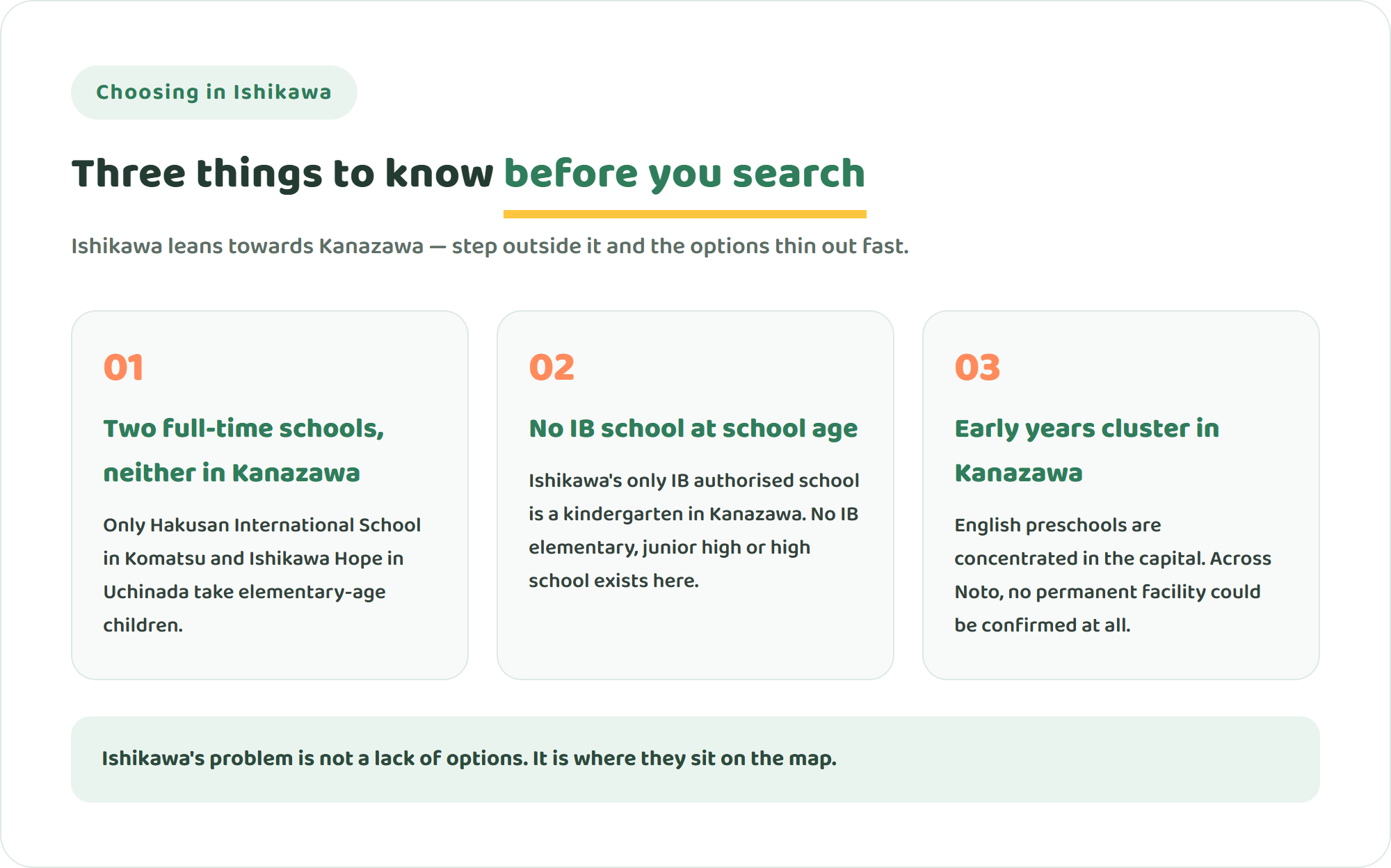
Here are the schools in Ishikawa Prefecture that accept students at elementary age or above, as far as public information allows. There is no padding to reach a round number. There are two, and they are nothing alike — plus one more opening in 2027.
1. Hakusan International School (Komatsu City)
Opened in April 2005, this was the Hokuriku region’s first genuine English-medium international school. Its campus in Sonomachi, Komatsu, serves students aged five to fifteen — roughly kindergarten through junior high — with small classes built around inquiry-based and experiential learning. The school is independent of any national or religious affiliation and states that it welcomes families of any background; returnee children and students preparing to study abroad are among those enrolled. The year runs on three terms: spring (April–July, 14 weeks), autumn (September–December, 14 weeks) and winter (January–March, 12 weeks). Alongside the full-time programme it runs a Saturday school, weekday after-school classes, special seminars for junior and senior high students, a correspondence programme and a summer school — which means a family unsure about committing to full-time enrolment can start with one day a week or a Saturday. In a prefecture with this few options, that low-commitment entry point genuinely matters. Komatsu has both an international airport and, since 2024, its own Hokuriku Shinkansen station, putting Kaga, Nomi and southern Hakusan within reach.
- Curriculum: English-medium inquiry-based and experiential programme, small classes; independent of any national or religious affiliation
- Ages: 5 to 15 (full-time, Saturday, after-school, correspondence and summer options)
- Fees: Published registration fee ¥25,000 for the full-time programme (once per family, waived for siblings); tuition per term of ¥250,000 for four to five days a week, ¥200,000 for three days, ¥150,000 for two and ¥100,000 for one — about ¥750,000 a year across three terms at four to five days. Saturday and after-school programmes are ¥10,000 registration plus ¥80,000 per term for three hours a week. Materials, outdoor lessons and utilities are stated to be included in tuition with no separate charges. Sibling and early-payment discounts apply (2026; confirm directly)
- Good fit for: Families in Komatsu, Kaga, Nomi and southern Hakusan who want English-medium elementary education at a manageable cost — or who want to test the water one day a week first
2. Ishikawa Hope International School (IHI, Uchinada Town, Kahoku District)
The newest international school in the prefecture. The NPO Hope was founded in February 2023, opened the school provisionally that April, and launched formally in April 2024. Its campus in Chidoridai, Uchinada, takes students from kindergarten age through high-school age. The programme combines hands-on project learning with art, STEM and inquiry, and is built around natural language acquisition across more than one language. The school receives support from BC Christian Academy in Canada and states that it is working towards accreditation by ACSI (Association of Christian Schools International). For high-school age, it describes a plan to combine study at IHI with a correspondence high school (Aioi Gakuin) so students can also earn a Japanese high school qualification.
One point matters a great deal to Japanese families: the school states that a child can remain enrolled at their local public school while attending IHI, with attendance at IHI recognised. For families who do not want to give up Japanese school enrolment, that is a genuinely practical middle path — though the final decision on attendance rests with the enrolling school and the local board of education, so confirm with your municipality first. Fees are not published; admissions enquiries go directly to the school president. Uchinada Station is 17 minutes from Hokutetsu Kanazawa Station on the Hokuriku Railroad Asanogawa Line, which puts northern Kanazawa, Kahoku City and Tsubata Town within range.
- Curriculum: Project-based learning with art, STEM and inquiry in a multilingual environment; ACSI accreditation in progress
- Ages: Kindergarten age through high-school age (high school stage planned in combination with a correspondence high school)
- Fees: Not published; enquire directly (as of July 2026)
- Good fit for: Families in northern Kanazawa, Uchinada, Kahoku and Tsubata who want international learning without giving up Japanese school enrolment
3. Aoba-Japan International School, Kanazawa Campus (opening August 2027)
The development most likely to change the picture is the Kanazawa campus of Aoba-Japan International School (A-JIS), a long-established Tokyo school. Its official site describes preparations for an August 2027 opening on the grounds of Hokuriku Gakuin Daiichi Kindergarten (information current as of July 2026). The first year will serve K3 through Grade 3, expanding gradually towards Grade 10, with Grades 11 and 12 continuing through an online IB Diploma Programme. The school is working towards IB authorisation across PYP, MYP and DP. Fees for the Kanazawa campus have not been published, so families considering it should attend an information session and ask directly.
For the schools and preschools inside Kanazawa City in detail, see our guide to international schools in Kanazawa.
Ishikawa’s international education map, area by area
Ishikawa’s real difficulty is not that there are few schools — it is that they are unevenly distributed. Here is what exists, area by area.
Kanazawa and central Ishikawa
The densest cluster in the prefecture, especially for the early years. Kanazawa Izumigaoka Kodomoen in Togashi, Kanazawa, is the only IB authorised school anywhere in Ishikawa: a certified kindergarten authorised for the Primary Years Programme in March 2025, taking children from 57 days old through the five-year-old class with capacity for 135. Weskii Lab (Weskii International Preschool) in Nagata, Kanazawa, runs English-immersion childcare with a STEAM focus for children from 13 months to the final kindergarten year, and Keio Kindergarten and Keio Baby School in Kanaichi-machi offers bilingual education from 11 months to age six. The A-JIS Kanazawa campus described above will also be in this area. None of these, however, continues into elementary school in English — so even Kanazawa families need to plan the next step early. Full details are in our Kanazawa city guide.
Komatsu and Kaga (southern Ishikawa)
Unusually for a region outside the prefectural capital, this is where elementary-age children can actually learn in English. Hakusan International School sits in Komatsu, within reach of Kaga, Nomi and Kawakita. The March 2024 extension of the Hokuriku Shinkansen to Tsuruga gave both Komatsu and Kaga-Onsen their own Shinkansen stations, making travel in and out considerably easier. Komatsu Airport handles international flights, and the area’s manufacturing base — including the home plant of a major construction-equipment maker — brings a steady international population. For preschoolers there are English-school preschool courses, including inside AEON Mall Shin-Komatsu, but full-day English immersion is thinner here than in Kanazawa.
Hakusan, Nonoichi and Nomi
The standout here is the International College of Technology (ICT), Hakusanroku Campus in Setotatsu, Hakusan City. Strictly speaking it is a kosen — a college of technology entered after junior high, from age 15 — rather than an international school. But first- and second-year students live on campus in a boarding environment and study most subjects, including mathematics, science and information technology, in English, with foreign nationals making up more than half the faculty. All third-year students spend a full year in New Zealand at Otago Polytechnic, and fourth- and fifth-year students move to the Kanazawa campus, which shares facilities with Kanazawa Institute of Technology. It is one of very few routes in Ishikawa for continuing to learn subjects in English beyond junior high. Published fees show first and second years at ¥1,824,000 tuition a year including materials, plus ¥45,500 monthly dormitory and ¥52,500 monthly meal charges; third year at ¥250,000 tuition plus NZ$25,831 Otago Polytechnic tuition and NZ$20,713 homestay; and fourth and fifth years at ¥1,600,000 a year (2027 reference figures; confirm directly). Families in Nonoichi and northern Hakusan are also well within reach of Kanazawa and Uchinada.
Uchinada, Kahoku and Tsubata
This is Ishikawa Hope International School’s area. The Asanogawa Line links central Kanazawa to Uchinada in 17 minutes, which makes IHI a realistic option for northern Kanazawa families too. From Kahoku City and Tsubata Town the choice is essentially Kanazawa or Uchinada, and either way a daily drive or public transport routine is the assumption.
Nanao, Wajima and the Noto Peninsula
Here is the honest part. Across Noto — Nanao, Hakui, Wajima, Suzu, Anamizu and Noto Town — we could not confirm a single permanent international school or full-day English-immersion preschool as of July 2026. Nanao to Kanazawa is around an hour and a half each way on the JR Nanao Line, and the northern Noto towns are considerably further. That is simply too far for a child to travel daily. For families in Noto, an international education built on commuting does not work at all — which is the most overlooked fact about education in Ishikawa, and the reason the online option later in this guide matters most to them.
Three options when nothing in the prefecture fits
Families in Ishikawa hit one of two walls: the early years are covered in Kanazawa but the path stops at age six, or there is simply nothing in their town at all. Here are the three routes that actually work.
1. Commute to a school in Toyama or Fukui
Ishikawa borders Toyama, Fukui and Gifu. The strongest option is Trinity International School in Nakatoi, Toyama City, which opened in April 2024. It offers a continuous elementary-through-high-school programme taught entirely in English and is registered as an ACSI member school. Published 2025 figures show a ¥150,000 entrance fee, ¥70,000 monthly tuition (¥840,000 a year) and a ¥100,000 facility fee, for a first-year total of ¥1,090,000, plus ¥5,000 a month for materials. Monthly plans for short-term students and sibling and scholarship reductions are also available. Kanazawa to Toyama is around 20 minutes on the Hokuriku Shinkansen — on time alone, closer than parts of Ishikawa itself. Toyama City also has Frobel’s International School for early years.
Fukui, by contrast, is early-years focused. Fukui International School (FIS) in Fukui City mainly serves kindergarten age, and we could not confirm a full-time school there where elementary-age children continue in English as of July 2026. Kaga City has quick Shinkansen access towards Fukui, but for anything past age six, Toyama is the more realistic direction. You can compare neighbouring prefectures through our guide to international schools across all 47 prefectures. The honest counterweight is that Shinkansen commuting runs to several hundred thousand yen a year in fares, and a young child travelling that far daily costs energy and a parent’s time. Before you shortlist, multiply the door-to-door time by six years and see how it feels.
2. Build an English-medium path inside Ishikawa
You do not have to attend an international school to get an international education — but here the honest answer has limits. On the list of IB authorised and candidate schools published by Japan’s MEXT-affiliated IB Education Promotion Consortium, Ishikawa has exactly one entry: Kanazawa Izumigaoka Kodomoen, a kindergarten. There is no IB authorised elementary, junior high or high school anywhere in the prefecture as of July 2026. Attending an IB school at school age while living in Ishikawa is simply not possible.
What can be built instead comes in two shapes. One is to switch into English at 15, as the International College of Technology route allows: a solid Japanese-language foundation through junior high, then an English-medium environment from high school age. The other is to keep your child at a local school while running English-medium learning alongside it. Hakusan International School’s Saturday and after-school programmes, and the attendance arrangement described by Ishikawa Hope International School, both fit this pattern. Framed as a binary — full-time international school or local school — Ishikawa looks like a dead end. Framed as a combination, there is still a path.
3. Take commuting out of the equation — an online international school
The third route drops the commute entirely. Some families keep their child enrolled at the local public school and study subjects in English online after school or at weekends; others make an online international school the centre of learning instead. In places like Noto, where no reachable school exists at all, and for dual-income households where a daily school run is not possible, this has quietly become the most realistic third path. More on that below.
Comparing the options: what actually fits your family
Ishikawa’s full-time schools, schools in neighbouring prefectures, and online international schools are not ranked best to worst — they fit different constraints. Lay them against five criteria and the decision gets much clearer: affordability, ease of admission, commute burden, in-person campus experience, and whether the path can continue through high school.
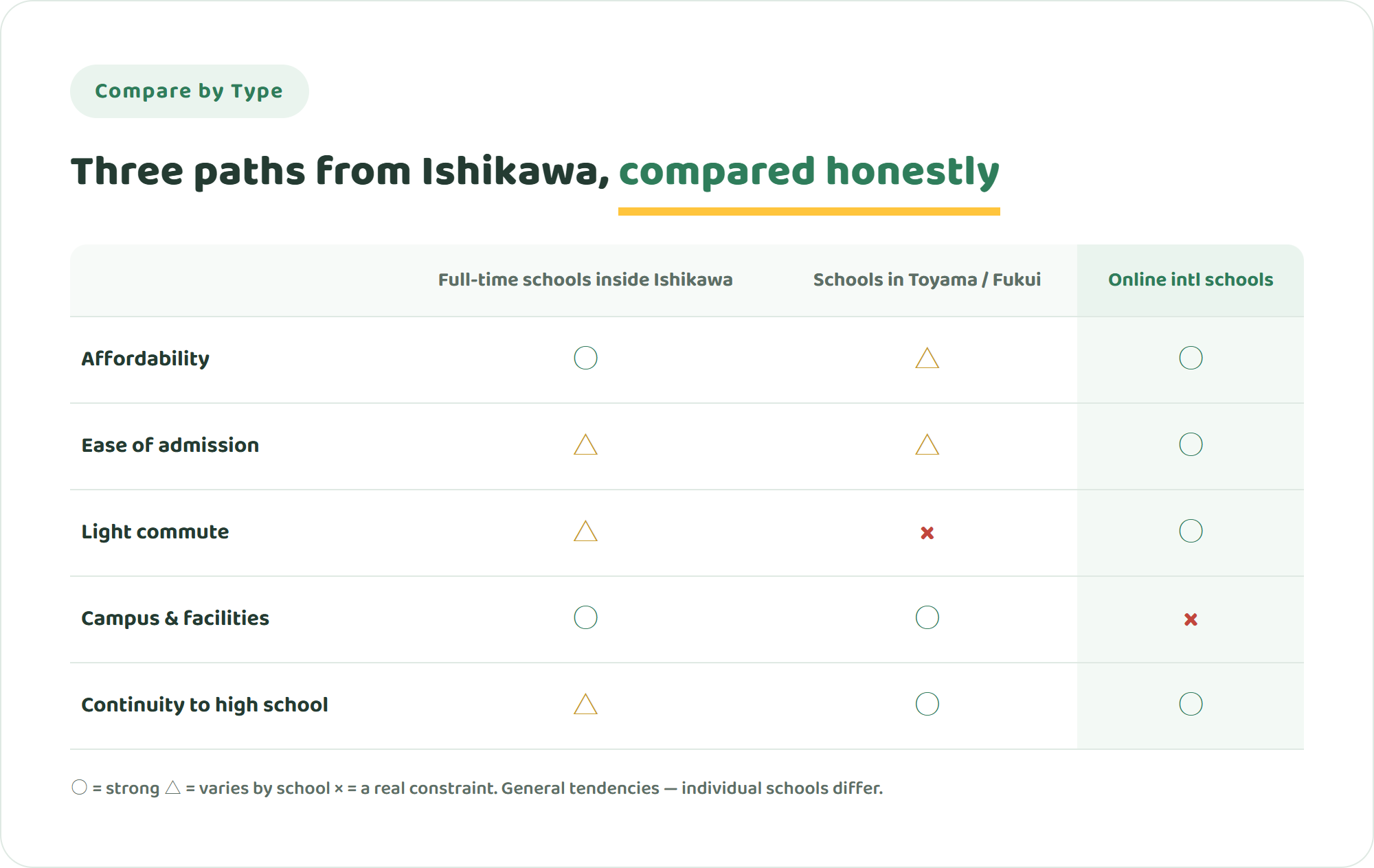
In Ishikawa, the row that catches most families is the commute. Neither of the two full-time schools is in Kanazawa, and from Noto no arrangement makes them reachable. Trinity in Toyama does continue through high school, but a cross-prefecture commute and fees above ¥1 million a year are real constraints. If you want the cost picture in more detail, our breakdown of what international school actually costs covers the fees beyond tuition that catch families out.
See how learning works online →
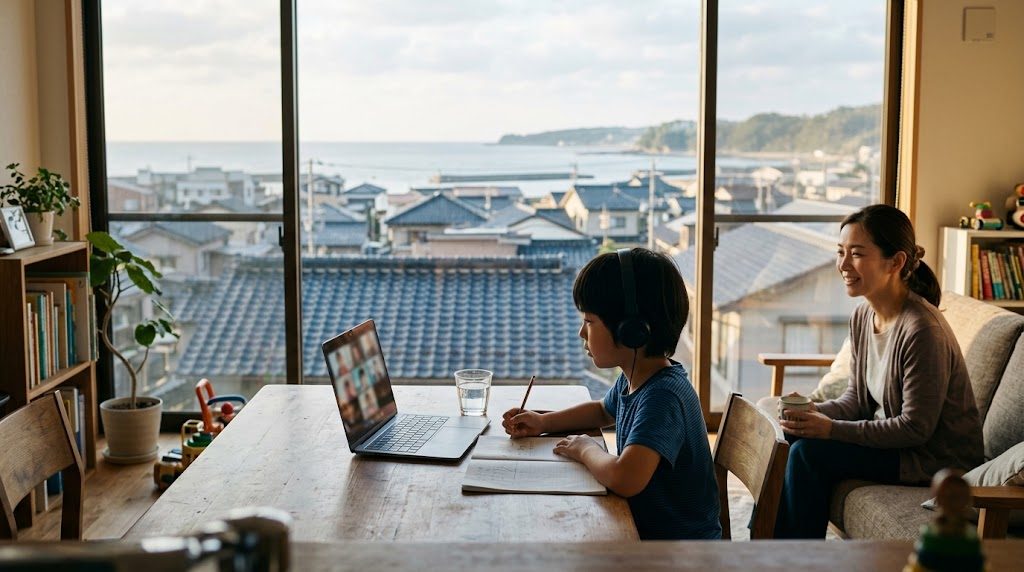
When nothing is within reach — the online option
Some readers will finish the list above thinking: there is no school here that continues, and a daily trip to Komatsu, Uchinada or Toyama is not workable. That is precisely the family NIJIN GLOBAL ACADEMY (NGA) is being built for. We are an online international school opening in September 2027.
NGA is run by NIJIN Inc., the Japanese company behind NIJIN Academy, an alternative school with over 1,000 students enrolled. What we care about is moving away from ranking children by test scores. Learning happens in small, dialogue-centred groups, built around a simple aim: helping children come to like themselves and the world. We serve ages 6 to 18 across Asia and Oceania, and because location is irrelevant, a family in Kanazawa, Komatsu, Wajima or Suzu has exactly the same access as one in a major city. Japanese-language support underpins the programme so children can move into English gradually. Our goal is to make tuition roughly one-fifth of a bricks-and-mortar international school.
The honest caveats: we have not opened yet, so our track record is still ahead of us. And an online school cannot reproduce a playground, a school field, or the feeling of sitting shoulder to shoulder in the same room. Even so, for a good number of Ishikawa families, this is what turns “there is nothing near us, so we will give up” into “we do not need to get there at all”.
Frequently asked questions
Q. Can families anywhere in Ishikawa reach these schools?
A. Not evenly, unfortunately. The two full-time schools sit in Komatsu and Uchinada, and the early-years options cluster tightly in Kanazawa. From Noto — Nanao, Hakui, Wajima, Suzu, Anamizu and Noto Town — even an in-prefecture school means an hour and a half or more each way. Map the actual route and travel time first, then ask whether your family can sustain that every morning for six years. If you live in Kanazawa, start with our Kanazawa city guide.
Q. Do families commute from Ishikawa to schools in Toyama or Fukui?
A. Towards Toyama, yes, it is realistic. Kanazawa to Toyama is about 20 minutes on the Hokuriku Shinkansen, and Trinity International School, which opened in Toyama City in 2024, teaches in English from elementary through high school. Fukui is a different story: the facilities there are mainly early years, and we could not confirm a full-time school where elementary-age children continue in English as of July 2026. Bear in mind that school bus coverage varies enormously and Shinkansen season tickets are a substantial annual cost — check both before you shortlist.
Q. What about Japanese-language support?
A. It depends on the school. In a prefecture with as few English-medium options as Ishikawa, many families end up keeping their child in a Japanese school and adding English alongside — which tends to protect the Japanese-language foundation. If you do choose a full-time international school, put “how is Japanese maintained?” on your list of questions at every visit, and ask to see the actual weekly timetable rather than the brochure description.
Choose what you can sustain, not just what you can reach
Finding an international school in Ishikawa Prefecture is genuinely hard. Two full-time schools, neither in Kanazawa, no IB authorised school at school age, and from Noto nothing reachable at all. But that is not the same as saying international education is out of reach for your child. There are several routes here, not one: the two schools in the prefecture, A-JIS Kanazawa from 2027, a commute into Toyama, a combination built around a local school, or learning online.
The better question is not which school will accept your child, but which kind of learning your family can keep going for years. There is no need to rush. Start today by checking one commute route. Even that will change how the map looks.
International School Guides for Other Prefectures
- International Schools in Aichi Prefecture
- International Schools in Shizuoka Prefecture
- International Schools in Nagano Prefecture
- International Schools in Gifu Prefecture
- International Schools in Niigata Prefecture
- International Schools in Toyama Prefecture
- International Schools in Hokkaido Prefecture
- International Schools in Iwate Prefecture
- International Schools in Kagawa Prefecture
- International Schools in Kagoshima Prefecture
- International Schools in Kanagawa Prefecture
- International Schools in Kochi Prefecture
- International Schools in Kumamoto Prefecture
- International Schools in Kyoto Prefecture
- Browse all 47 prefectures of Japan