One morning your child says, “I don’t want to go to school.” Or maybe they haven’t made it past the front door in days. Each time, something tightens in your chest. “Will they be okay if this continues?” “Should I make them go, even against their will?” “But when I see that look on their face, I just can’t push them out the door.” You haven’t found an answer yet — and that’s precisely because you care about your child more than anything. In this piece, we’ll think through that struggle with you, through the lens of positive school refusal.
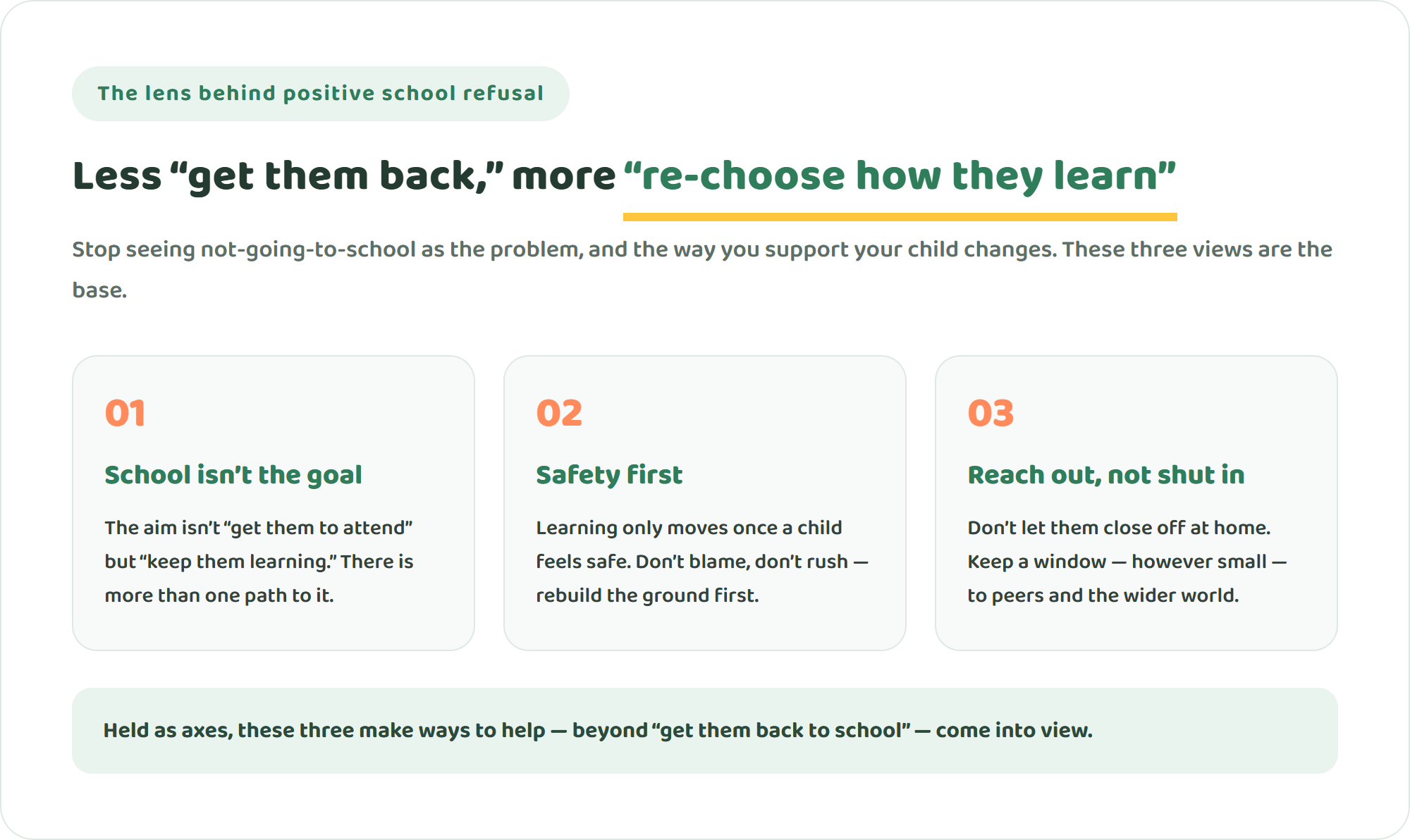
What this piece wants to offer is a different lens: try, for a moment, to stop seeing “not going to school” as the problem. In recent years a term has begun to be heard — positive school refusal. Rather than forcing a child back into school, it reframes the situation as the child choosing, or re-choosing, how they learn. We’ll look honestly at what positive school refusal means, why the usual responses reach a dead end, and a third option that supports a child’s learning without isolating them at home.
What “positive school refusal” means — not “not learning,” but re-choosing how to learn
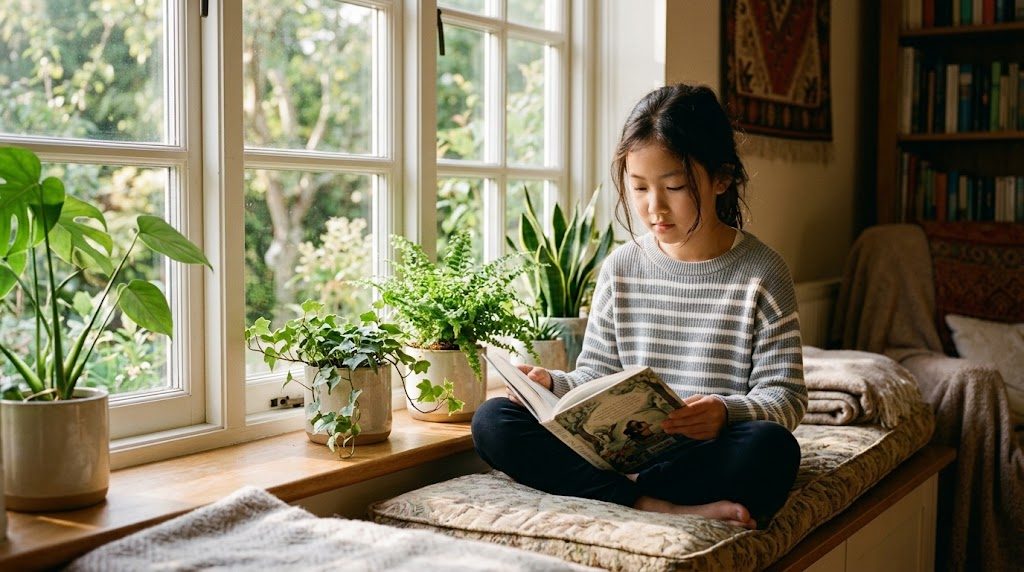
Let’s start with the words. When people hear “school refusal,” most picture a troubled state — a child who “can’t go” to school. Positive school refusal shines a different light on it. The child isn’t failing to go; they are stepping back from an environment that doesn’t fit and trying to re-choose a way of learning that suits them.
Of course, there are stretches when a child is simply too exhausted to move, and we don’t mean to make light of that. But when “getting back to school” becomes the only goal, both the child and the people supporting them suffer. The real aim isn’t attendance — it’s continuing to learn, and staying connected to the world. Reframed that way, the options for how to help open up considerably. In Japan, government figures put the number of elementary and junior-high students not attending school in recent years at roughly 350,000 — a great many children who, right now, need a way of learning that fits them.
Neither “force attendance” nor “isolate at home” works — why the usual responses stall
When a child stops going to school, most families first waver between two roads. One is trying to get them back to the same school. The other is keeping to the home alone. Neither is wrong, but each has its own difficulty.
Forcing attendance sends the child back to face the very environment that didn’t fit. If the cause hasn’t been resolved, they can be pushed further into a corner, and the trust between parent and child can be damaged. On the other hand, when the time spent at home alone stretches on, a different worry appears: connection with peers, and the stimulation of the outside world, begin to thin out. You may recover a safe place to be, but if everything stays inside the house, both learning and human contact struggle to widen.
In other words, what’s needed is a third road — neither “back to school” nor “shut in at home.” Many parents feel it: if only there were an option where the child feels safe, learns at their own pace, and yet stays connected to the world.
A third option — learning connected to the world, from home
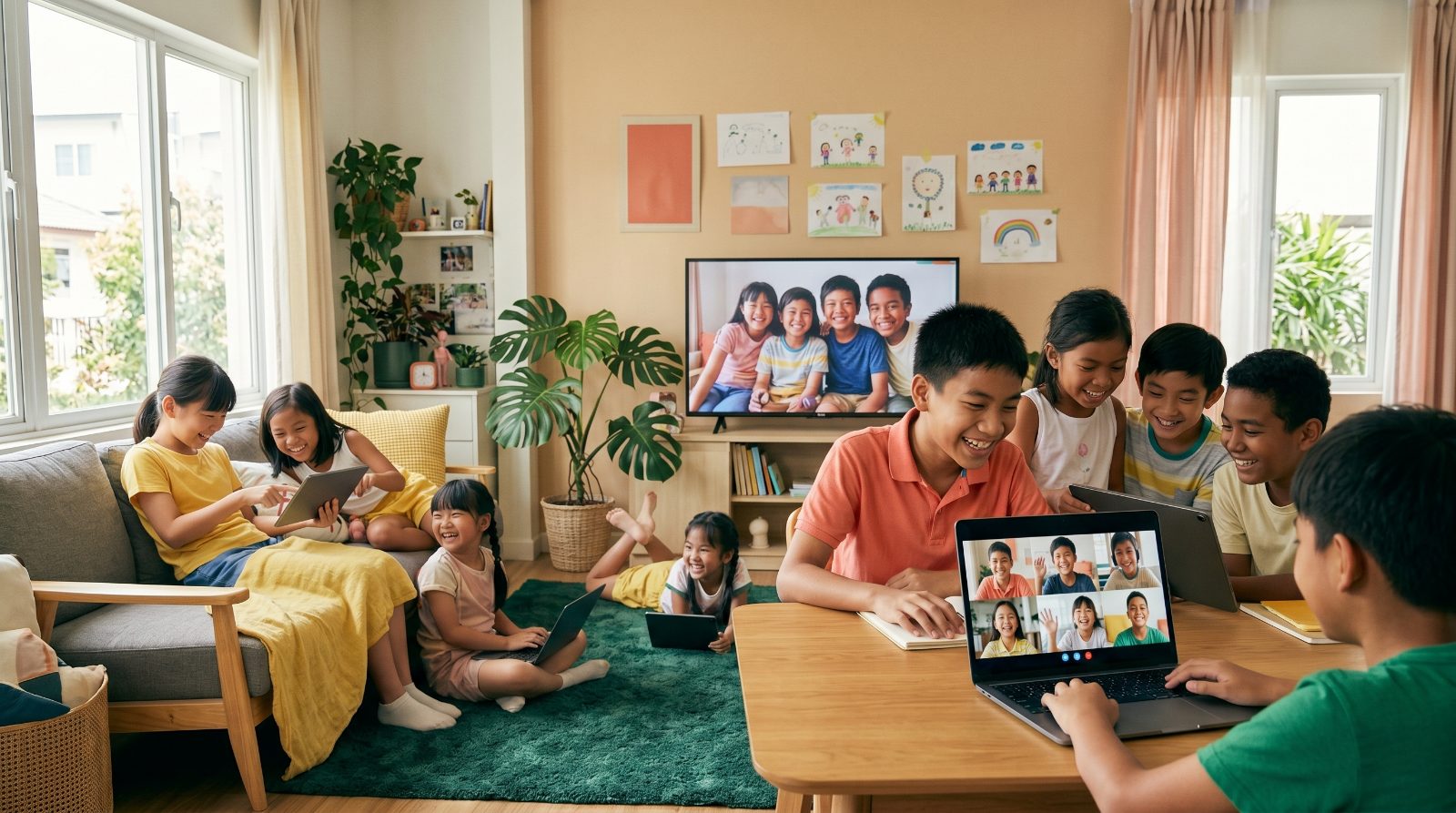
This is where learning that connects to the world online deserves attention. Not long ago, if a child couldn’t go to school, the very chance to learn narrowed sharply. Today, a child can learn from home while connected to diverse peers and a wide world. In fact, environments where a child can stay connected to the world and learn, even out of school, are steadily becoming real.
There’s a reason this third option pairs so well with the idea of positive school refusal. Rather than aiming to “get the child back,” it supports the child in re-choosing how they learn. With home as a safe base, they connect with peers and the world on the other side of the screen. Safety, choosing for oneself, and connection with the world — learning that connects online makes it far easier to hold all three at once.
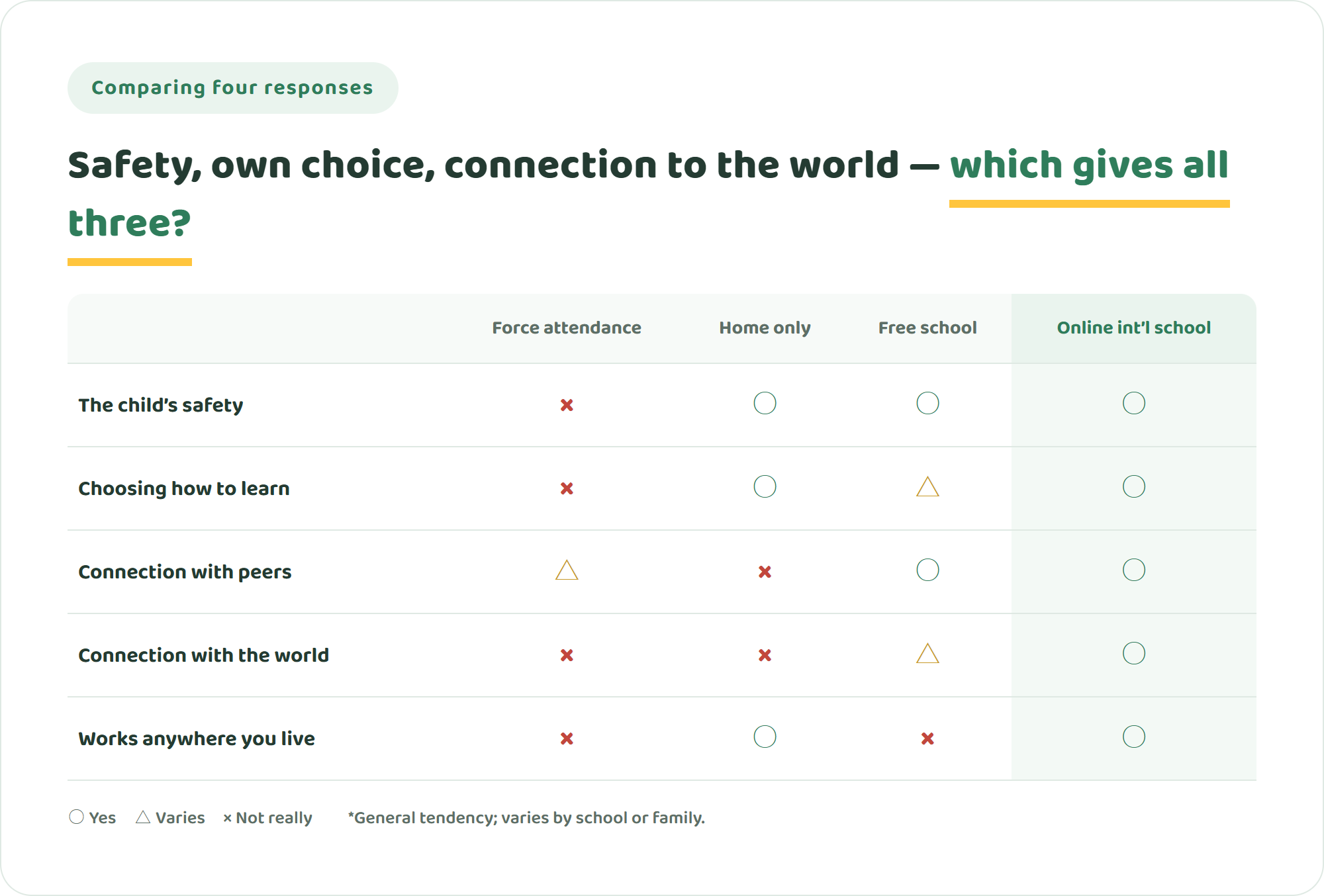
As the table shows, both “force attendance” and “home only” tend to strain against one axis or another. A free school is reassuring on safety and peers, yet depending on where you live you may not be able to attend one. Learning that connects to the world online can fill that gap. It isn’t a cure-all, of course — but the fact that a family need not give up on learning and connection with the world, even from home, is a real source of hope for parents worrying right now.
See how online learning works →
What the learning actually looks like
“Connected to the world online” can be hard to picture. What we at NIJIN GLOBAL ACADEMY (NGA) aim for is learning that doesn’t rank children by test scores, built around small-group dialogue. Instead of memorising a fixed correct answer, we start from “what do you think?” Children exchange views through the screen with peers in different parts of the world, and along the way English, a sense of how wide the world is, and their own interests all grow, little by little.
The important thing is that this is not a substitute for “forcing attendance” — it is a place for a child to re-choose learning for themselves. Rather than bending the body to a fixed timetable, the child reclaims learning at a pace that feels safe, entering through what they love. It’s a way of turning the idea of positive school refusal into an actual shape of learning.
Honestly — who it suits, and when it’s still too soon
To be fair, learning that connects to the world online won’t suit every child right away. It suits a child who has a safe place in home, and in whom even a small wish to “try connecting with the outside world” has begun to stir. Families wanting to step away from the exam-score race, those living rurally or overseas with few options nearby, and those for whom an in-person school didn’t fit — we find it pairs well with them.
On the other hand, there are times when a child is so deeply worn out that “connecting” itself is too much. In that case, resting and recovering a sense of safety comes first. There’s no need to rush into an online switch. And for families who value close in-person contact above all, a free school within reach or another in-person setting may fit better. What matters isn’t the best option in the abstract, but the option that best fits your child right now.
How to support and how to choose — three first steps
So where do you actually begin? Here are three unforced steps for turning the idea of positive school refusal into everyday support.
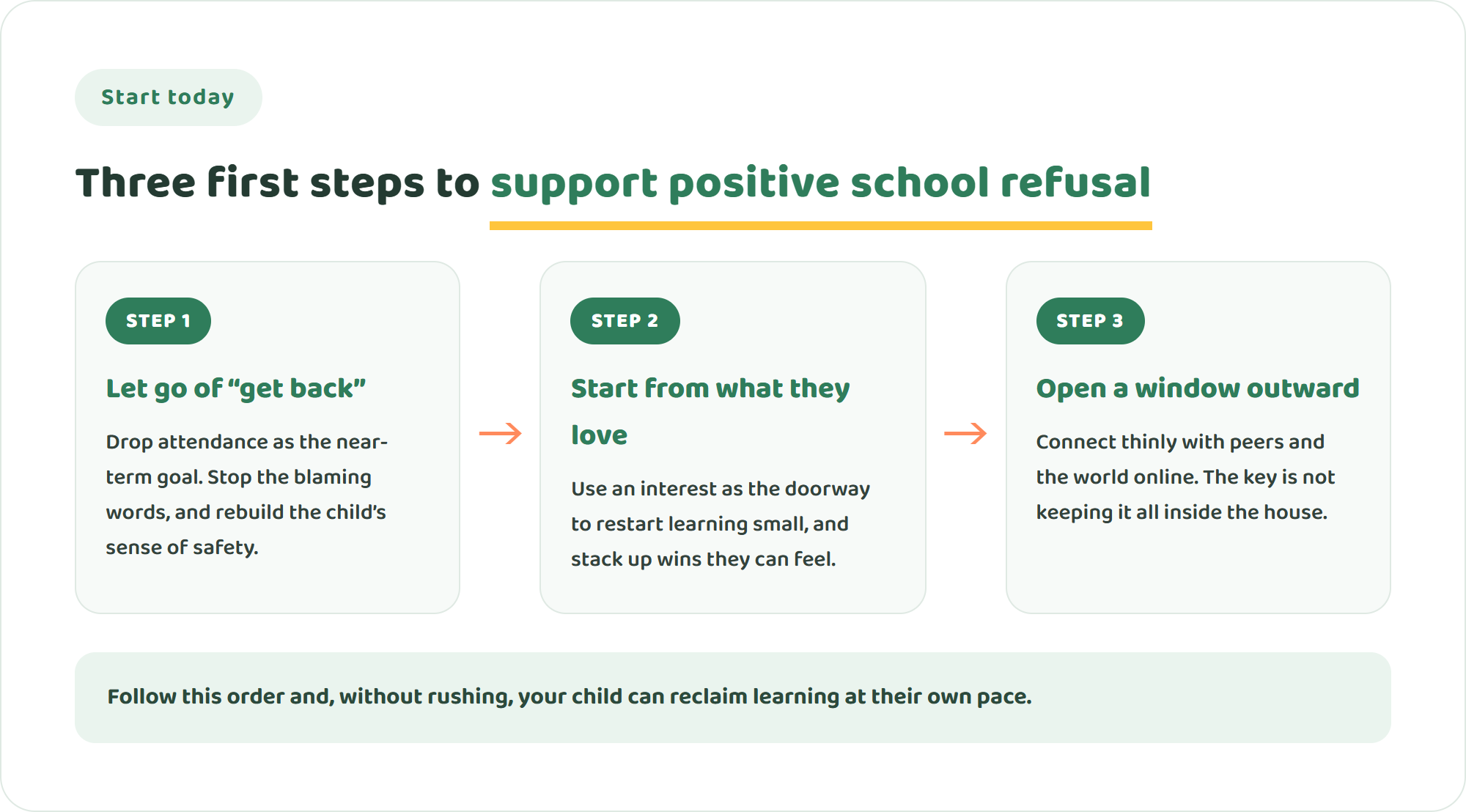
First, let go, for now, of “getting them back to school.” Simply dropping attendance as the near-term goal and swallowing the “pull yourself together” changes the air in the house. The child recovering a sense of safety is the base for everything. Next, start learning from what they love — games, drawing, animals, space, anything. Enter through an interest and they can rediscover that “learning is fun.” Then, open a small window to the outside world. Begin with an online trial or a free course, and judge as you watch how your child responds. Not keeping it all inside the house is what leads to the next step.
Where NGA sits among these
With all of that in mind, here is where our NIJIN GLOBAL ACADEMY (NGA) sits. NGA is an online international school beyond the exam race, opening in September 2027, operated by NIJIN Inc. NIJIN Academy, the alternative school we run in Japan, already has over 1000 children learning with us — many of them, including children for whom school didn’t fit, have reclaimed learning at their own pace.
What we aim for is learning built on the foundation of coming to love yourself and the world. It works wherever you live; it starts from each child’s interests rather than a test score; children connect with the world through small-group dialogue; and we’re aiming for tuition around one-fifth of an on-campus international school — within reach. We want to be a place that turns the forward-looking idea of positive school refusal into an actual shape of learning. It isn’t a cure-all, of course — we’d simply ask that you compare it fairly with the others and choose it when it feels right for your child.
Frequently asked questions
Isn’t “positive school refusal” just letting a child skip school?
No. The difference lies in whether learning continues. Positive school refusal isn’t about leaving school as an end in itself; the aim is to re-choose a way of learning that fits the child and to keep learning. Rest fully during the periods that call for rest, then restart from what they love once the child is ready. When those two hold together, it is quite different from simply letting them skip.
With online learning, I worry about connection with peers.
A fair worry — which is exactly why it matters to choose a place with small-group dialogue and real contact with peers, not just “a child alone with materials.” Even through a screen, the experience of exchanging views on the same question builds genuine connection. Not letting everything stay inside the house is the single best guard against isolation.
Can we begin even if my child speaks no English at all?
Yes. Among beyond-the-exam-race online international schools, some are designed around home-language support so a child can meet English gradually. Choose a place that treats English as “something to grow into” rather than “an entry requirement,” and even a child new to it can take that first step with confidence.
Turning “not going” into “this is how I learn.”
A child not going to school is not the end of learning. The idea of positive school refusal has the power to turn “can’t go” into “a choice not to go,” and then into the forward-looking question of “how shall I learn?” Neither forcing a return nor shutting in at home — with safety as the base, learning at one’s own pace and still connected to the world. That road genuinely exists now.
NIJIN GLOBAL ACADEMY opens in September 2027. We’ll share how our learning works — beyond the exam race, within-reach pricing, and connection with the world through small-group dialogue — along with first-cohort enrolment news, straight to your inbox. Let’s turn days out of school into days of learning in your child’s own way — one step at a time, together.
Get opening updates by email →
More on choosing an international education
- International School Fees in Asia by Country——An honest comparison, and the online third path
- Are There Subsidies for International Schools?——Realistic ways to lower the cost
- A Cheaper Alternative to a Singapore International School——Affordable online options
- Affordable International Schools in Bangkok——Fees, and an online alternative
- 10 Ways to Help Your Child Learn English at Home——What parents can do
- Online High School for Expat and Globally Mobile Families——Learning that moves with you
- How to Choose an International School——7 questions to ask before you enrol
- 6 International Qualifications You Can Earn Online——An honest guide
- When Your Child Does Not Want to Go to School——How to respond, and 5 real options
- How Much Household Income Do You Need for an International School?——Budgeting so it lasts