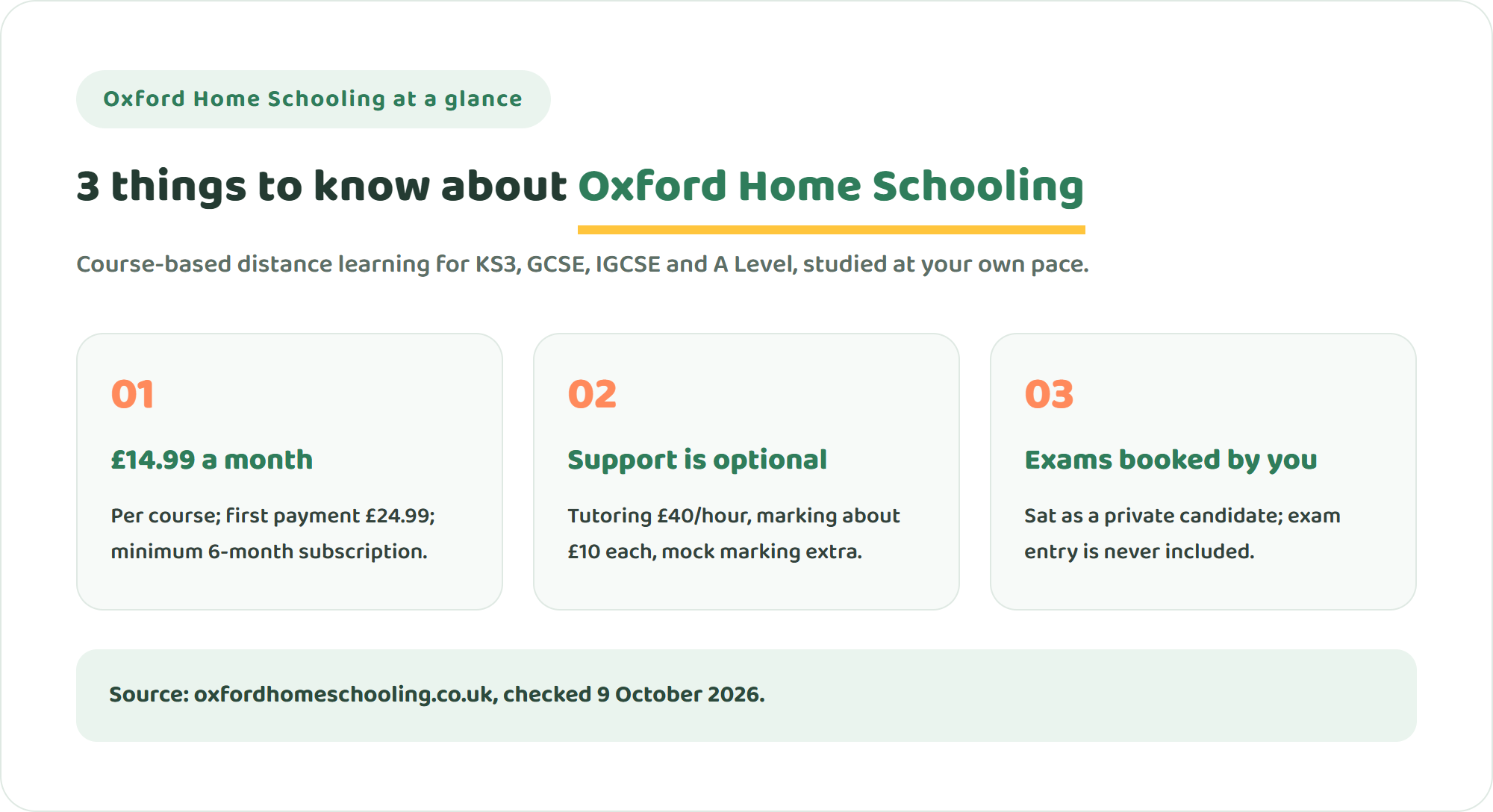
Oxford Home Schooling fees start from a core course subscription of £14.99 per month per course, with a first payment of £24.99 that includes the course materials subscription plus an academic induction session and booking fee, and a minimum subscription of six months (official pricing and course pages, checked 9 October 2026). Everything else is optional and priced separately: personal tutoring at £10 per 15 minutes (£40 per hour), tutor marking of assignments at roughly £10 each, mock exam marking at £25 per paper for GCSE/IGCSE and £30 per paper for A Level, printed course packs (for example £40 or £50 depending on the course), and exam entry, which is never included and is paid to an exam centre.
If you searched “Oxford Home Schooling fees” or “Oxford Home Schooling review”, you are probably a home-educating parent in the UK, or a British family living abroad, trying to work out what a GCSE, IGCSE or A Level really costs once support and exams are added, and whether this is a school or something else. It is important to be clear from the start: according to its own website, Oxford Home Schooling is a course-based distance-learning provider. Students subscribe to self-study course materials subject by subject and add tutor support when they need it; it does not describe a timetable of live classes or a full school day. This page sets out the official prices, works through real first-year totals, explains exams and international study, and then compares it fairly with Wolsey Hall Oxford, King’s InterHigh and NIJIN GLOBAL ACADEMY, a very different online school for ages 6–18 that opens in September 2027.
The short answer: who Oxford Home Schooling suits — and who it doesn’t
- Suits: home-educating families who want structured course materials for one or a few subjects at a low monthly cost, and who are comfortable organising the rest of the week themselves.
- Suits: private candidates preparing for a specific exam, such as an IGCSE, GCSE or A Level, including students who left school or need a resit. The site says many students use its courses “while preparing as private candidates”.
- Suits: students who need to study around health, travel, sport or family commitments. Courses have no fixed term dates and you can start at any time.
- Suits: families who want to pay only for the support they use. The pricing page states: “we believe you should only pay for the support that you use”.
- Harder fit: families looking for a full online school with daily live lessons, classmates and a form tutor. Live contact is limited to one-to-one tutorials you book and pay for.
- Harder fit: children under 11. The admissions policy accepts students from age 11 for Key Stage 3, from 13 for GCSE and from 15 for A Level.
- Harder fit: families outside the UK who want GCSEs or A Levels rather than IGCSEs. The official guidance says that, apart from IGCSEs, students “will need to return to the UK for examinations”.
What Oxford Home Schooling is
Oxford Home Schooling is a UK home education provider offering “flexible home education courses for KS3, GCSE, IGCSE and A Level”. The site footer states that it is a trading name of Oxford Online Learning Ltd, based in Abingdon, Oxfordshire (Company No. 16261841), and describes “thirty years of experience in providing Home Education”. Adults over 18 are referred to its sister company, Oxford Open Learning.
The model is simple. You choose a level and subject, subscribe to the online course materials, study at your own pace, and add tutor support, assignment marking, mock exam marking or a printed course pack when you need them. Each course page names the exam board and specification it prepares for. For example, Biology and Maths International GCSE follow Pearson Edexcel specifications (4BI1 and 4MA1), GCSE Psychology follows AQA 8182, and A Level Maths follows AQA 7357. The catalogue lists seven Key Stage 3 subject areas, 19 GCSE and IGCSE courses (including Latin, Psychology and Sociology GCSE) and 12 A Level subjects, including Law and Psychology.
| Item | Oxford Home Schooling (official information, checked 9 October 2026) |
|---|---|
| Type of provider | Course-based distance learning: online self-study materials per subject, with optional paid tutor support |
| Levels / ages | Key Stage 3 (Years 7–9, from age 11), GCSE and IGCSE (from age 13), A Level (from age 15); over-18s referred to Oxford Open Learning |
| Price model | Core subscription generally £14.99 per month per course; first payment £24.99; minimum 6 months |
| Live teaching | No live class timetable described; one-to-one online tutorials can be booked (£40 per hour) |
| Tutors | Hold a PGCE or equivalent, have a valid DBS check, subject specialists (pricing page) |
| Qualifications | Prepares for exam board qualifications (e.g. Pearson Edexcel IGCSE, AQA GCSE and A Level), sat as a private candidate |
| Accreditation of the provider | Not published on the official site |
| Start dates | Any time; no fixed term dates |
Oxford Home Schooling fees (2026, official)
All figures below come from the Oxford Home Schooling pricing tables, the terms and conditions and individual course pages, checked on 9 October 2026. Prices are in pounds sterling. The pricing page does not mention VAT, so ask the provider whether VAT is included if that matters for your budget.
| Item | Official price | Notes from the official site |
|---|---|---|
| Core course subscription | £14.99 per calendar month, per course (“generally”) | Online access to the course materials; study at your own pace |
| First payment on a course page | £24.99 | Includes the course materials subscription and an “academic induction session and booking fee”; then £14.99 per month |
| Minimum term | 6 months | Terms and conditions: “You may cancel your subscription after 6 months” |
| Personal tutoring | £10 per 15 minutes (£40 per hour in the T&Cs) | A lesson can be booked from 20 minutes to an hour |
| Tutor-marked assignments (TMAs) | About £10 per assignment | Varies by assignment; buying all marking at the start normally gives 10% off |
| Mock exam marking | £25 per paper (GCSE/IGCSE); £30 per paper (A Level) | A Level multi-paper bundles get 10% off |
| Email Tutor Support | £10.00 per month (shown on course pages) | Brief course-related questions; does not replace marking or tuition |
| Printed course pack | Varies by course (e.g. £50.00 Biology IGCSE, £40.00 Maths IGCSE, £50.00 A Level Maths) | UK mainland delivery £11.60; other areas quoted at checkout |
| UCAS reference | £75 to £150 | Minimum study requirements apply (Academic Reference Policy) |
| Textbooks | Not included | Some courses require a named textbook bought separately |
| Exam entry | Not included | Paid to the exam centre; see the exams section below |
Course-specific marking bundles (examples)
Course pages show the current price of bundled support. On 9 October 2026, the Biology International GCSE page listed an assignment marking bundle at £98.90 and a mock examination marking bundle at £47.50. The Maths International GCSE page listed marking bundles of £53.95 (Foundation) and £35.96 (Higher) and a practice exam marking bundle of £47.50. The A Level Maths page listed an assignment marking bundle at £134.86 and a mock exam marking bundle at £85.50. One-to-one tutorial time is “purchased separately” on each page.
What a course really costs: worked examples (official prices)
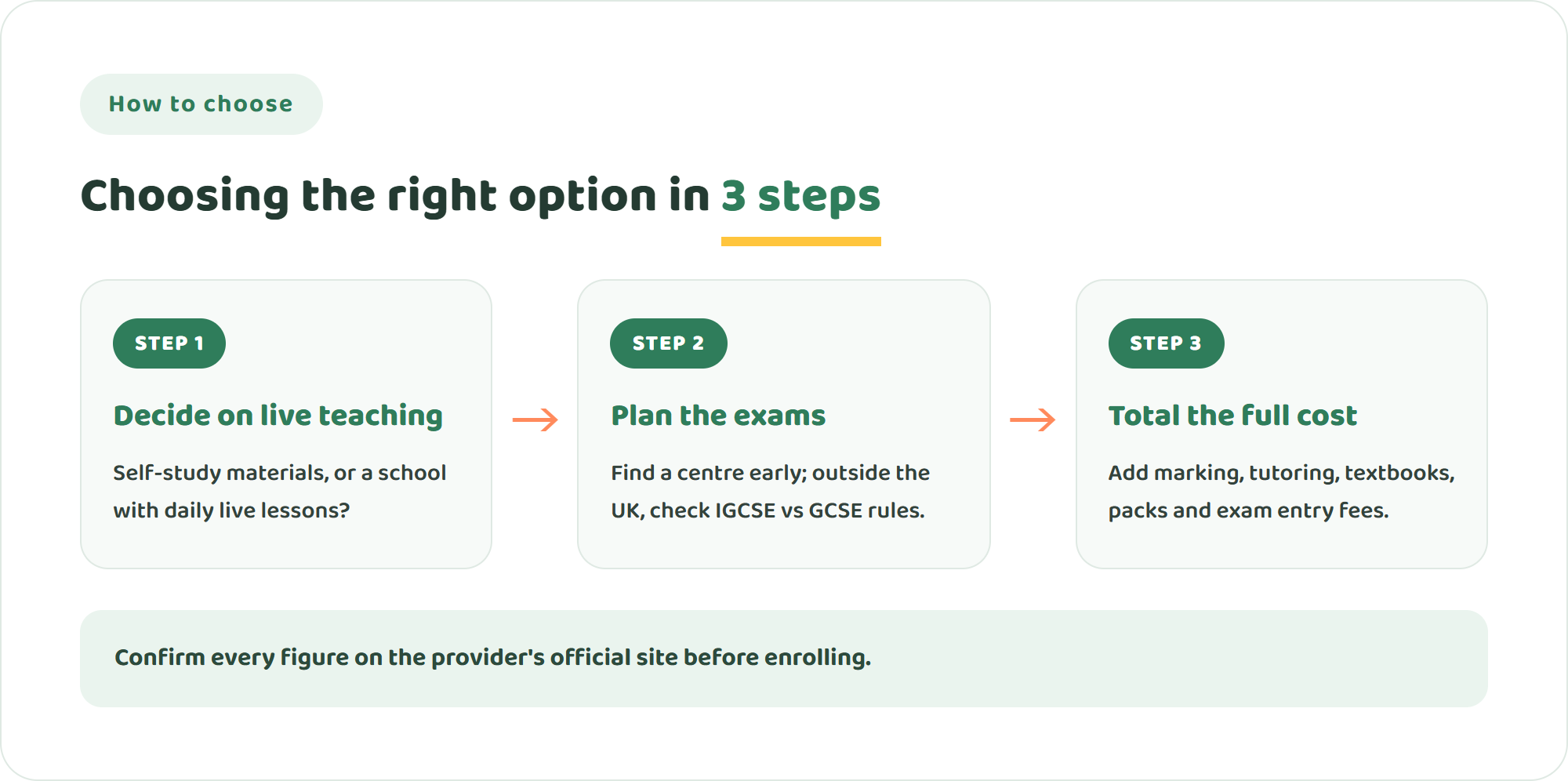
These examples assume the £24.99 first payment and £14.99 monthly subscription shown on each course page, applied per course. Confirm with the provider before you buy, because subscription prices are described as “generally” £14.99.
The minimum commitment for one course (6 months): £24.99 + (5 × £14.99) = £24.99 + £74.95 = £99.94.
One IGCSE Biology studied over 12 months, with marking: subscription £24.99 + (11 × £14.99) = £189.88; add the assignment marking bundle £98.90, the mock marking bundle £47.50 and the printed pack £50.00 = £386.28, plus the required textbook, UK delivery (£11.60) and the exam centre’s entry fee. The course page recommends about 200 hours of study.
A Level Maths over two years, with marking: £24.99 + (23 × £14.99) = £369.76; add assignment marking £134.86, mock marking £85.50 and the printed pack £50.00 = £640.12, plus textbooks and exam entry. The course page recommends about 700 hours over two years.
Five IGCSEs for one year, subscription only: 5 × £189.88 = £949.40. Adding marking, tutorials and exam entry for each subject will raise this considerably, and the total depends heavily on how much support you choose.
For context on how this compares with fully taught schools, see our guide to online vs in-person international school costs.
Cancellation and refunds
The refunds page says you may cancel all or part of your programme before you receive the course materials for a full refund, and that within 14 days of receiving them you may cancel in writing and return the materials at your own expense for a full refund. After that, the six-month minimum subscription in the terms and conditions applies.
How studying works: schedule, tutor support and time zones
There is no school day in the conventional sense. Each course is a sequence of online lessons with notes, textbook references, activities and self-assessment questions. Tutor-marked assignments appear at intervals, and after you submit one you receive a standard sample answer even if you have not paid for tutor marking. The terms and conditions say the subscription includes an induction call with a PGCE-qualified tutor to talk you through the first steps.
The parent or student sets the timetable. As a rough guide, the provider recommends about 100 hours for a Key Stage 3 single year, 200 hours for a single GCSE and 700 hours for a single A Level. If you want to see what a structured day at a fully taught online school looks like by comparison, read how an online international school works day to day.
Enrolment deadlines
Although you can enrol at any time, the provider publishes recommended enrolment deadlines so tutors have time to mark work before exams. On 9 October 2026 the page still listed the 2026 exam series, for example 15 November 2025 for Summer 2026 GCSE and IGCSE exams, and September–October 2025 for Summer 2026 A Levels. Deadlines for the 2027 series are not published on the official site yet. If your child is aiming for summer exams, starting early in the autumn is the safe assumption.
Time zones and studying from abroad
Because study is self-paced, the time zone matters less than at a live school. The official “Studying Outside the UK” page says any course can be studied from anywhere in the world, with “the same level of access to your tutor”. The office is open Monday to Friday, 9:00 am to 4:45 pm UK time, and tutors carry out tutorials outside these hours by prior arrangement. Exams are the bigger time-zone question, covered next.
Exams, accreditation and university recognition
Oxford Home Schooling does not book exams for you. Its terms say: “It is your responsibility to ensure that you find an examination centre and enter for your exam in good time.” Students sit exams as private candidates at an approved centre, and the contract for exam services is with that centre. To help, the exams hub provides an exam centre finder, entry codes and a booking guide, and says it has details of over 30 centres that “often give our students a 10% discount”. Exam centre fees for most subjects are not published on the official site, because each centre sets its own; the booking guide notes that prices “can vary greatly”.
The exception is subjects with non-exam assessment (NEA), such as AQA GCSE English and A Level English Language, English Literature and History. For these, Oxford Home Schooling makes the entry itself and transfers it to a host centre. Its published 2026 exam and admin fees are: A Level entry £200, GCSE entry £100 and transfer of entry £75, plus the host centre’s own invigilation fee, which varies.
For families abroad, the official guidance is specific. IGCSEs (Pearson Edexcel) can be taken at centres worldwide that accept private candidates, such as international schools or British Council offices, and the provider explains Edexcel’s “R papers” for time zones far from the UK. For other GCSEs and A Levels, it says international centres are currently prohibited from entering private candidates, so students “will need to return to the UK for examinations”.
Accreditation: we could not find a statement that Oxford Home Schooling itself is accredited by an external body; this is not published on the official site. What matters for recognition is the qualification: IGCSEs, GCSEs and A Levels are awarded by the exam boards (Pearson Edexcel, AQA), not by the course provider, and are the same qualifications sat by school students. The provider does not issue its own diploma. It can provide a UCAS reference (£75 to £150) if minimum study requirements are met.
Oxford Home Schooling vs NIJIN GLOBAL ACADEMY vs two other options (official data)
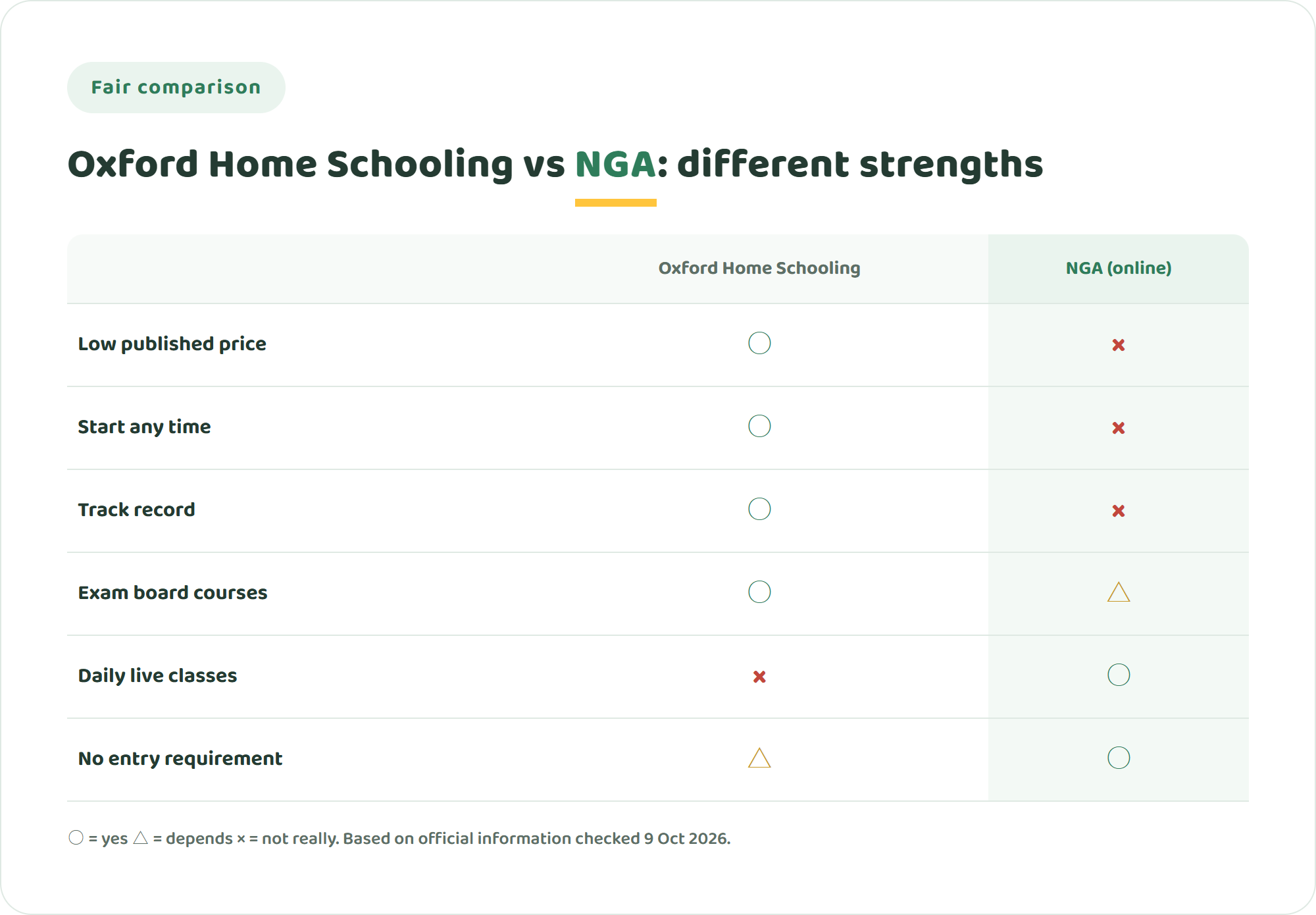
Here is Oxford Home Schooling side by side with Wolsey Hall Oxford, another tutor-supported homeschooling college, King’s InterHigh, a full online school with live lessons, and NIJIN GLOBAL ACADEMY (NGA). They are very different kinds of provision, so the right comparison depends on what you need.
| Oxford Home Schooling | NIJIN GLOBAL ACADEMY | Wolsey Hall Oxford | King’s InterHigh | |
|---|---|---|---|---|
| School type | Course-based distance learning; self-study materials per subject with optional paid tutoring | Online international school focused on Asia & Oceania; opens September 2027 (planned) | Online homeschooling college with tutors who mark work; no fixed timetable or live lessons | Full online independent school, British curriculum |
| Ages / levels | From 11 (KS3), 13 (GCSE), 15 (A Level) | Ages 6–18 | Ages 3–18 | Ages 7–19 (Years 3–13) |
| Fees | £14.99 / month per course (first payment £24.99; 6-month minimum); support extra | Not yet published (no enrolment, facility or uniform fees; materials included; sibling discounts) | Per course, from 1 April 2026: e.g. IGCSE Biology £900 (1–3 courses, paid in full); A Level £1,895 per course (1–2 courses); £95 registration | 2026/27: £4,395–£10,990 / year (annual contract) + £100 registration |
| Curriculum | Pearson Edexcel IGCSE; AQA GCSE and A Level (per course) | Subjects learned in English, CEFR-based English levels, projects; optional Cambridge IGCSE / A-Level pathway | Mostly Cambridge, Primary to A Level; some Pearson Edexcel | British: KS2–KS3, IGCSE, A Level, IB Diploma |
| Live classes & time zone | No class timetable; bookable 1:1 tutorials; office hours UK weekdays | Small live dialogue groups (about 8); built for Asia–Oceania daytime — may fall outside the day in the Americas or Europe | Study without fixed timetables or live lessons | Live 40-minute lessons, recorded; UK, Middle East or Southeast Asia timetables |
| Accreditation / qualifications | Provider accreditation not published; qualifications from exam boards | Not yet accredited; no graduates yet | Cambridge-approved; approved Pearson Virtual Centre | DfE OEAS; Cambridge International School; Pearson Edexcel centre; IB |
| Admission | Higher-level courses expect 4 GCSEs at grade C or above, or equivalent | No entrance exam, no English requirement | See official site | Non-selective for most programmes |
| Start dates | Any time | Opens September 2027; free trial classes monthly; pre-opening trials April–May 2027 | See official site | Any time in the year |
Sources: Oxford Home Schooling pricing, Oxford Home Schooling terms, Wolsey Hall Oxford fees, Wolsey Hall Oxford curriculums and accreditations, King’s InterHigh fees — checked 9 October 2026. For more detail, read our Wolsey Hall Oxford fees guide and our King’s InterHigh fees and review, or the wider look at online British curriculum school fees.
Reviews and common concerns, answered honestly
Parents researching Oxford Home Schooling tend to raise the same questions. Here is what the official pages say about each, so you can judge for yourself. The site links to its Trustpilot page, where you can read families’ reviews directly.
“Is it a school?”
Not in the sense of a full-time school with classes and a timetable. It provides course materials and optional tutor services for home education and private candidates. If your child needs teachers leading lessons every day, a live online school is a different product.
“Is £14.99 a month the real cost?”
It is the core subscription price per course. Marking, mock marking, tutorials, email support, printed packs, textbooks and exam entry are extra. The worked examples above show how a single IGCSE with marking reaches roughly £386 before the textbook and exam entry. That is still low compared with many alternatives, but plan for the full total.
“How much tutor contact will my child get?”
It depends on what you buy. Without add-ons, students receive sample answers after submitting assignments and an induction call. Tutor marking, Email Tutor Support at £10 per month and one-to-one tutorials at £40 per hour can be added as needed. Tutors hold a PGCE or equivalent and have a valid DBS check, according to the pricing page.
“Will finding an exam centre be difficult?”
The provider is candid that this takes effort: centres book up early, many stop taking private candidates after Christmas, and fees vary. It recommends starting the search at the beginning of the autumn term and offers a centre finder with partner centres. Budget time as well as money for this step.
“Will my child feel isolated?”
This is a fair question for any self-study route. Oxford Home Schooling’s pages do not describe clubs, group classes or a student community, so social contact will come from your own home-education network, activities or local groups. Families who want classmates online may prefer a live school.
Alternatives to Oxford Home Schooling worth comparing
Wolsey Hall Oxford also supports homeschooling without live lessons, but prices per course include course books, a tutor who marks work and a Student Progress Manager, and it follows mostly Cambridge courses. It costs more per course and includes more support. King’s InterHigh is a complete online school with live, timetabled lessons from Year 3 to Year 13, accredited by the UK Department for Education through the Online Education Accreditation Scheme. If you are also looking at American-style options, our reviews of Laurel Springs School tuition and Stanford Online High School tuition cover two well-known US online schools.
NIJIN GLOBAL ACADEMY (NGA) is a different kind of option. It is an online international school for ages 6–18 focused on Asia and Oceania, opening in September 2027 (planned), with free trial classes monthly from September 2026 and pre-opening trial classes in April–May 2027. Its first cohort is 100 students, and it is operated by NIJIN Inc. in Japan, whose alternative school NIJIN Academy has more than 1,000 students. NGA does not rank children on test scores: lessons are small-group live dialogue (classes of about 8), subjects are learned in English with a bilingual English–Japanese mentor, English levels follow the CEFR, and students join social co-creation projects with companies and governments plus international exchange. An optional Cambridge IGCSE / A-Level pathway is listed on the curriculum and timetable page. There is no entrance exam and no English requirement, it can run alongside a local school or as the main school, and it travels with the family if they move. Tuition is not yet published; NGA says it will be far more affordable than a typical international school, with no enrolment, facility or uniform fees, materials included and sibling discounts.
Be clear about the trade-offs: NGA is not yet open, is not yet accredited and has no graduates or track record. Its timetable is built for Asia–Oceania daytime, so for families in the UK, Europe or the Americas live classes may fall outside their day — check the timetable against your local time. If your priority is low-cost, self-paced exam preparation in one or two subjects that you can start this month, Oxford Home Schooling offers that today.
For a broader overview, see our online international schools compared guide, or read why families choose an online international school.
FAQ
How much does Oxford Home Schooling cost?
The core subscription is generally £14.99 per month per course, with a first payment of £24.99 (including an academic induction session and booking fee) and a six-month minimum, so at least £99.94 per course. Tutoring (£40 per hour), assignment marking (about £10 each), mock marking (£25–£30 per paper), printed packs and exam entry are extra. Source: official pricing and course pages, checked 9 October 2026.
Is Oxford Home Schooling accredited?
An accreditation statement for the provider itself is not published on the official site. Its courses prepare students for qualifications awarded by exam boards such as Pearson Edexcel and AQA, which are the same IGCSEs, GCSEs and A Levels taken in schools.
Can international students study with Oxford Home Schooling?
Yes. The official site says courses can be studied from anywhere in the world. IGCSE exams can be sat at centres abroad that accept private candidates, but for other GCSEs and A Levels the site says students will need to return to the UK for exams.
Is Oxford Home Schooling worth it?
It can be good value for motivated students who want structured materials for specific subjects and a parent who can organise study and exams. It is a weaker fit if your child needs daily live teaching, classmates or a school that handles exam entries for every subject.
What are the alternatives to Oxford Home Schooling?
Wolsey Hall Oxford (tutor-supported homeschooling with books and marking included, priced per course), King’s InterHigh (a full online school with live lessons) and NIJIN GLOBAL ACADEMY, a different option for ages 6–18 focused on Asia and Oceania with no entrance exam and no English requirement, which opens in September 2027 and is not yet accredited.
Choosing calmly
Home education can be built in many ways. Some families want a full school online; others want a few well-structured courses and the freedom to shape the rest of the week. Oxford Home Schooling clearly belongs to the second group, with low entry costs, a flexible start and support you add only when you need it. Read the official pages, total the cost of the subjects your child actually plans to sit, sort out the exam centre early, and talk with your child about how much structure and company they want in their learning.
Fees and admissions details were checked on the official websites on 9 October 2026. Providers revise fees every year — always confirm on the official site before enrolling.