If you are looking at international schools in Hyogo prefecture, you have probably already noticed something: almost every list you find is really a list of schools in Kobe. Here is the honest picture. Every full international school in Hyogo that takes a child all the way through to high school in English sits inside Kobe city. Everywhere else in the prefecture — Ashiya, Nishinomiya, Takarazuka, Amagasaki, Himeji, Akashi — you will find preschools and small elementary-level schools, and very little beyond that. Annual fees run from roughly ¥700,000 for a preschool place to about ¥3.7 million at Kobe’s flagship campuses. This guide maps the whole prefecture area by area, names the schools we could actually verify, and includes the public international schools that many families overlook. By the end you should know which area and which stage of schooling your family should be looking at.
Quick Answer: Your Options in Hyogo
If you only read one section, read this. Below are the areas where schools can be confirmed, with their school names, plus the online option — so you can see every route side by side before the details.
- Kobe — Canadian Academy / Marist Brothers International School / St. Michael’s International School and 4 more (7 in total)
- Hanshin area — Ashiya International School / Marie International School Ashiya / Nishinomiya International School and 1 more (4 in total)
- Harima area — Sakura International School Himeji / Cambridge International School Mikaeru / Himeji International Academy (HIA) and 1 more (4 in total)
- NIJIN GLOBAL ACADEMY (online) — Ages 6–18 / opening September 2027, currently taking opening-update registrations / fees around one-fifth of a typical campus international school / Japanese-language support. An option when distance or fees are the wall.
International schools in Hyogo prefecture: the landscape and what fees look like
Hyogo has hosted foreign residents since the port of Kobe opened over 150 years ago. Prefectural figures put the foreign resident population at around 148,000 as of June 2025. In Chuo ward of Kobe roughly one resident in nine holds a foreign passport, while inland manufacturing cities such as Kato, Kasai and Miki have their own long-settled communities. That uneven internationalisation is mirrored almost exactly in where the schools are.
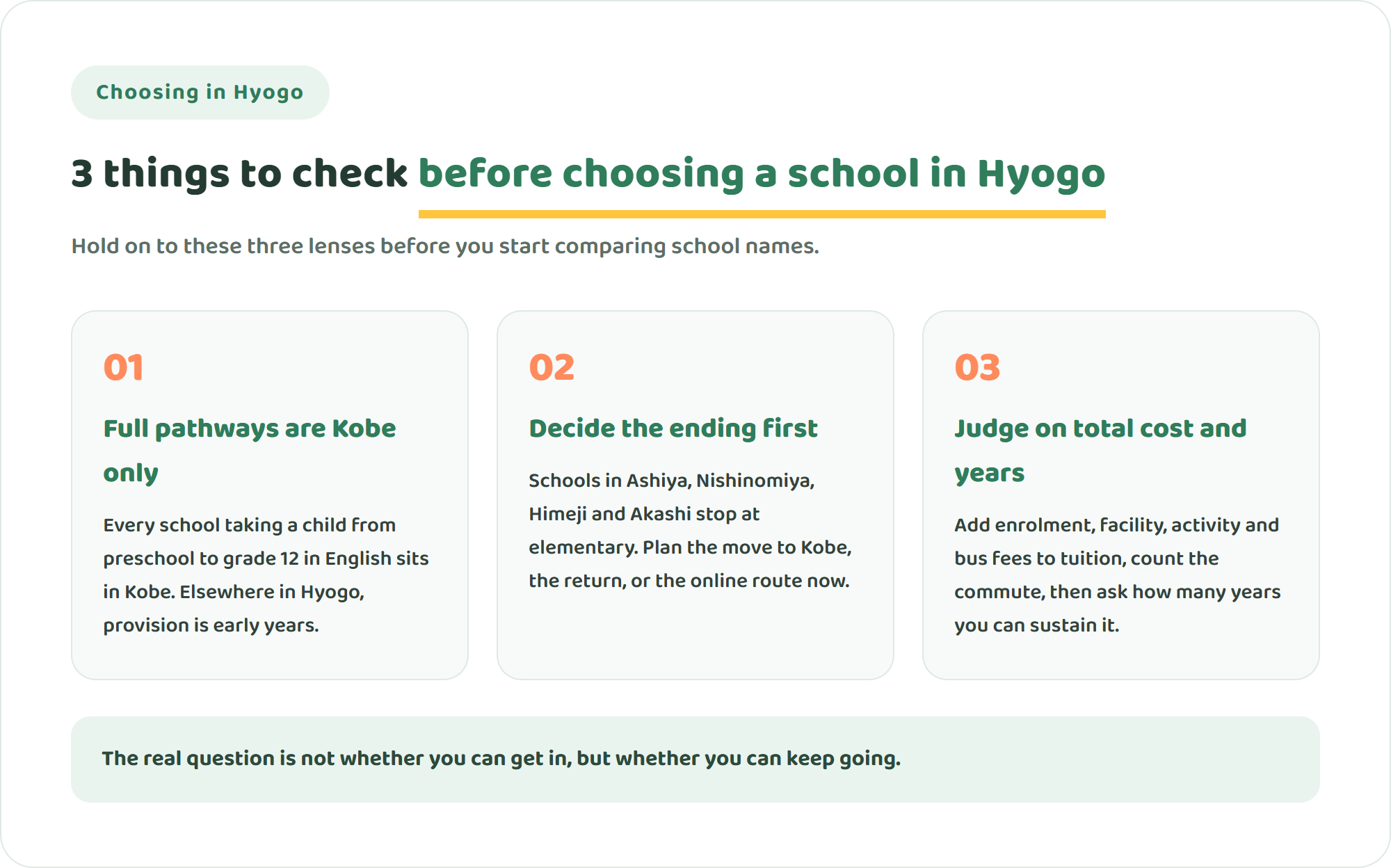
In one phrase, the map of international schools in Hyogo prefecture is Kobe-centric. Full continuum schools — preschool through grade 12, taught in English — are all inside Kobe. Outside the city you will mostly find English-immersion preschools for ages 1.5 to 6, plus a small number of schools that run to the end of elementary. If you want an English-medium secondary education, you are looking at Kobe, or across the prefectural border into Osaka.
Fees separate cleanly by stage. Preschools and kindergartens land at roughly ¥700,000–1,500,000 a year. Small elementary schools outside Kobe run about ¥1,050,000–1,200,000. Kobe’s continuum schools range from about ¥1,300,000 to ¥3,700,000. On top of tuition, expect enrolment fees of ¥100,000–650,000, plus facility, activity and bus charges — so judge on the total, and on how many years you can sustain it. We break the numbers down in what international school really costs. Fees here reflect information published as of July 2026; always confirm current figures with each school.
Every international school in Hyogo prefecture, area by area
Rather than an arbitrary top-seven, this is an attempt at coverage: the schools we could verify as operating. Preschool-only settings are marked as such, so you can see immediately whether a school will still be there for your child at eleven.
Kobe — the only place in Hyogo with a full English pathway
The heart of the prefecture’s international education is Kobe. Canadian Academy (Rokko Island, Higashinada; ages 3–18; roughly ¥2.4M–3.67M a year) has run since 1913 and offers the full IB continuum of PYP, MYP and DP, with boarding available. Marist Brothers International School (Suma; ages 3–18; roughly ¥1.92M–2.32M) pairs an American programme with the IB Diploma. St. Michael’s International School (Chuo; ages 3–11; roughly ¥1.59M–1.78M) is the only genuinely British primary school in Kansai. Deutsche Schule Kobe / European School (Rokko Island) teaches in German with English and French alongside. Kansai International Academy Kobe (Nada; ages 0–18) runs a bilingual Japanese–English IB pathway. Ascot International School (Kanokodai, Kita ward; ages 2–18) follows the Cambridge curriculum, and North London Collegiate School Kobe (Higashinada) opened its junior school with a senior school planned for 2028. Preschool options include Kobe Bilingual School, Peter Pan International Preschool, Shioya Kidsbright and Star Brains.
Fees, age ranges and the type of family each Kobe school suits are covered school by school in our dedicated city guide. → International schools in Kobe: the 7 best options.
Hanshin area — Ashiya, Nishinomiya, Takarazuka, Amagasaki
The corridor between Osaka and Kobe is one of Japan’s most education-conscious neighbourhoods, but its international schools stop at the end of elementary.
- Ashiya International School (Yoko-cho, Ashiya; 18 months to grade 6) — a Christian foundation continuing the philosophy of Mikage International Preschool, established 1964. Core subjects, English literacy, maths, science and social studies are taught in English, with a teacher plus assistant per class. Elementary fees run roughly ¥1.05M–1.15M a year (tuition about ¥880,000 in grade 1 and ¥980,000 in grades 2–6, plus a facility fee around ¥100,000 and activity fee around ¥70,000 a year; enrolment fee around ¥120,000 — published figures, confirm current rates). It is the most substantial English-medium elementary school in Hyogo outside Kobe.
- Marie International School Ashiya (Narihira-cho, Ashiya; ages 3–12) — kindergarten and primary, part of a group with campuses in Omotesando and Matsuyama. Its sister Shukugawa campus (Nishinomiya; ages 3–6) is kindergarten only, with a separate nursery for ages 1–3. Fees on enquiry.
- Nishinomiya International School (Nishinomiya; from age 1 through elementary) — open since 2002, offering English-immersion playschool, childcare and after-school programmes. Many local families use it to keep an English environment going after their child enters a Japanese elementary school.
- Sakura International School Ashiya (Kansai International Academy; Horikiri-cho, Nishinomiya, 7 minutes from Koroen station; ages 0–6) — a bilingual inquiry-based preschool with paired international and Japanese homeroom teachers.
- Kinder Kids Nishinomiya and Takarazuka, Palcl International (Nishinomiya/Takarazuka), Amagasaki International School — all early-years English settings. In Takarazuka and Amagasaki we could not verify any permanent international school running beyond kindergarten.
One option families often miss sits in Shinhama-cho, Ashiya: Hyogo Prefectural Ashiya International Secondary School, opened in 2003 as Japan’s first public international secondary school, admitting foreign-national and returnee students through documents, an essay and an interview. Hyogo Prefectural International High School shares the same site. Public-school fee levels, a genuinely multicultural cohort and second languages including Spanish, Korean, French, German and Chinese make this a realistic answer for families priced out of private international schooling — though eligibility conditions apply, so check directly with the school.
Harima area — Himeji, Akashi, Kakogawa
Western Hyogo has a cluster of early-years provision and little beyond it.
- Sakura International School Himeji (Kansai International Academy; Himeji; ages 0–6) — direct bus from Himeji station, on-site parking, paired bilingual homeroom teachers from infancy to the final kindergarten year.
- Cambridge International School Mikaeru (Himeji), Rainbow International Preschool and Bear’s Garden International Preschool (opened 2022) — English-medium nursery and kindergarten settings in Himeji, several of them covered by Japan’s early-childhood fee subsidy.
- Himeji International Academy (HIA) — Saturday school and supplementary programmes for children attending mainstream Japanese schools.
- Sakura International School Akashi (facing Akashi Park; ages 0–6) and JSE International Preschool (Yamashita-cho, Akashi; from age 2) cluster around Akashi station.
The honest caveat: we could not verify a permanent international school in the Harima area that continues past elementary entry. Himeji to central Kobe is about 40 minutes by rapid train plus a transfer — workable for an adult commute, hard to defend as a daily journey for a nine-year-old.
Tajima, Tamba and Awaji — no permanent international schools found
In Toyooka, Yabu and Asago in the north, in Tamba-Sasayama, and on Awaji Island, we found no permanent international school operating at the time of writing. Daily travel to Kobe is not realistic from these areas, which leaves boarding — Canadian Academy is the main option — or online schooling. For families here, the practical question is how to add international learning on top of a good local public school.
If you are weighing a move or a cross-border commute, our guide to international schools in Osaka covers the largest cluster in Kansai, which is within commuting reach from Amagasaki and Nishinomiya.
Comparing your real options
Pulling all of that together, choosing in Hyogo comes down to three types: Kobe continuum schools, smaller or early-years schools elsewhere in the prefecture, and online international schools. None is objectively better; the right answer moves with your postcode, your budget and your child’s age.
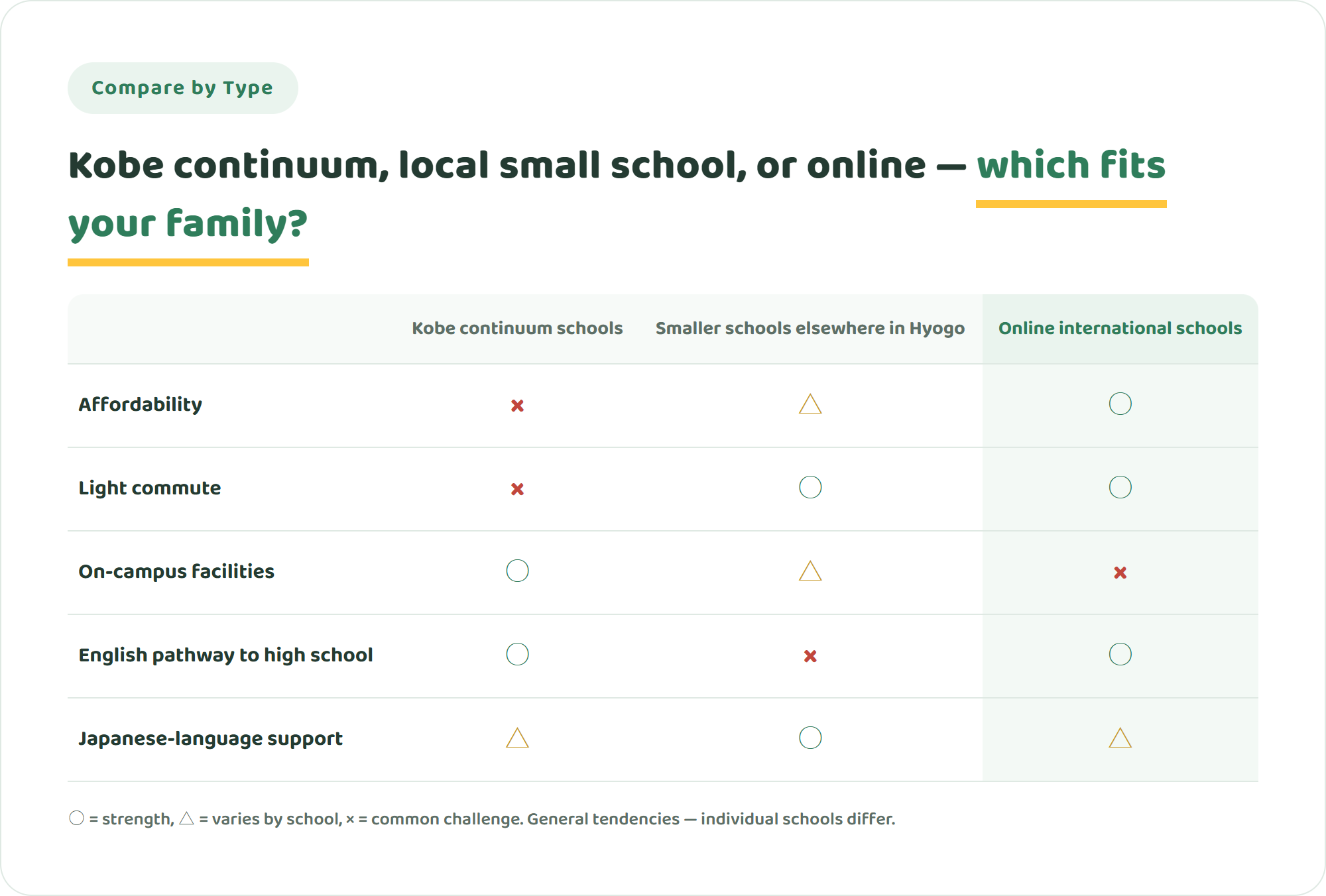
The question that matters most in Hyogo is what happens after elementary school. Schools in Ashiya, Nishinomiya, Himeji and Akashi largely end there, which means planning now for a move into Kobe, a return to the Japanese system, or an online continuation. Decide how the story ends before you decide where it starts. For bilingual families, keeping Japanese strong matters just as much; an online Japanese programme for children such as Tomodachi Japan (also run by NIJIN) can sit alongside an English-medium school. You can see how online learning actually works at See how learning works online →.
When nothing is within reach — the online option
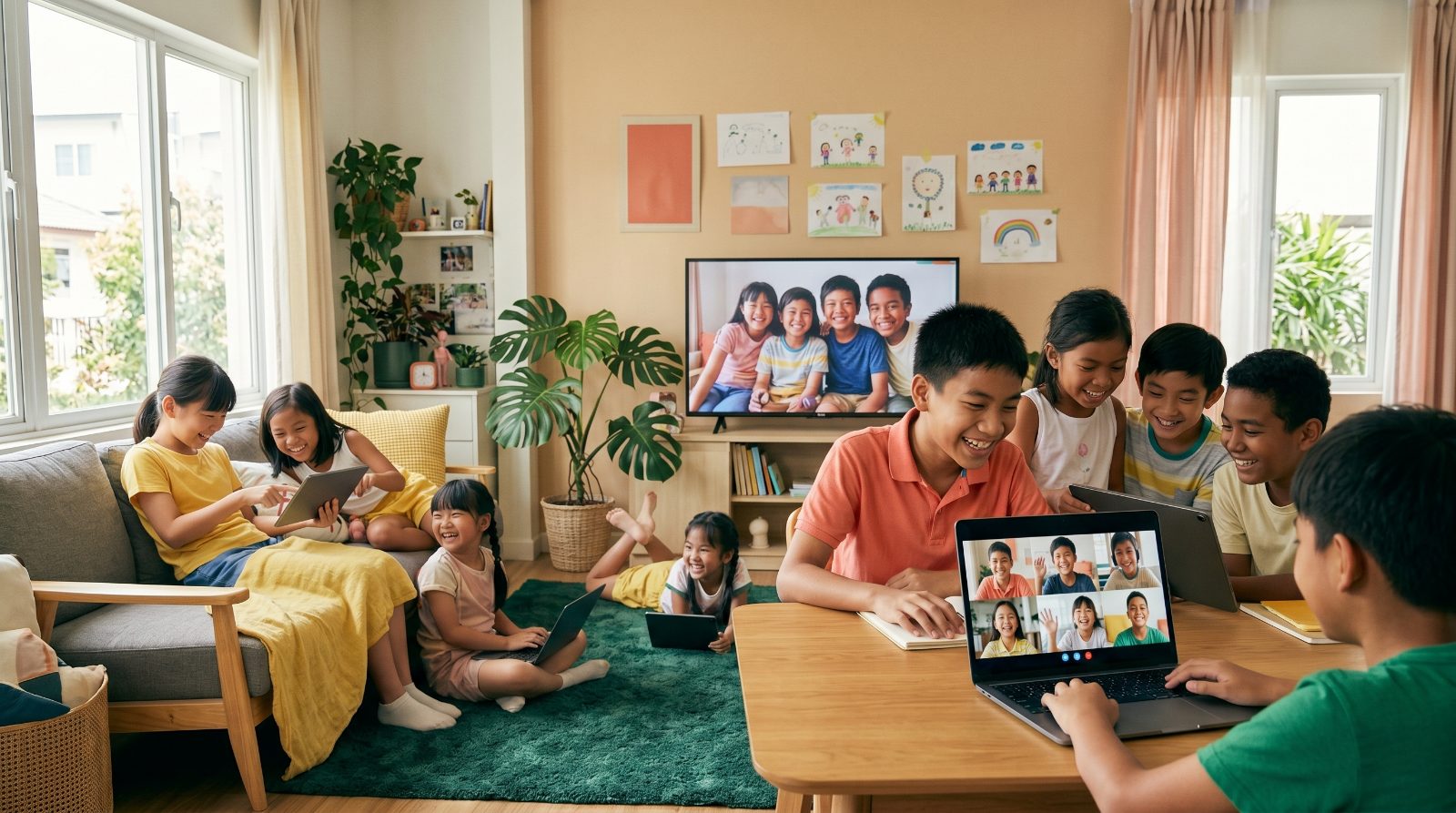
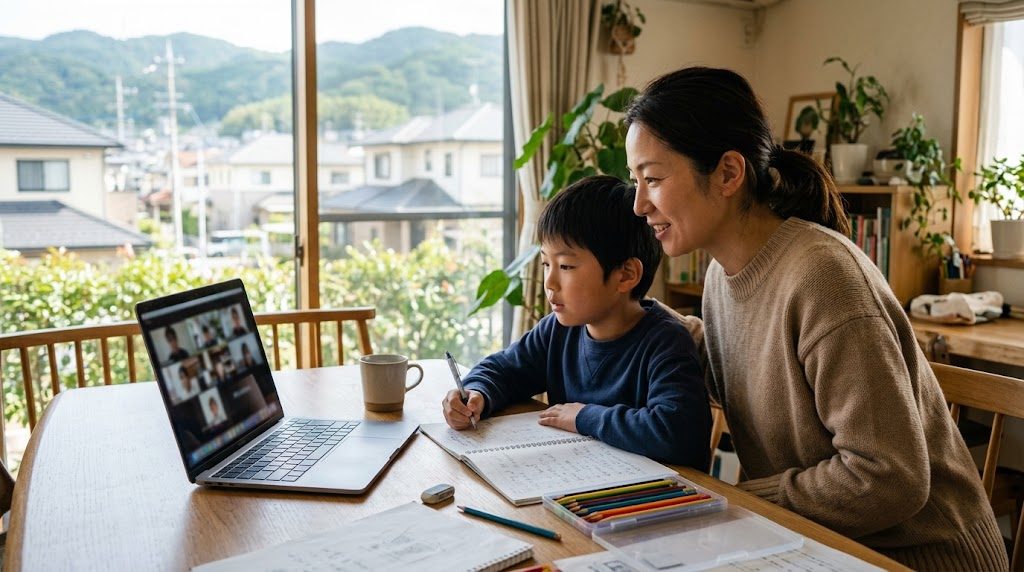
From Himeji, from Tamba, from Awaji Island. Or simply after your child finishes at an Ashiya preschool. In Hyogo, having no sustainable international school within commuting distance is a common situation, not an unusual one. We are NIJIN GLOBAL ACADEMY (NGA), an online international school opening in September 2027, run by NIJIN Inc. Our Japan-based alternative school, NIJIN Academy, already has more than 1,000 students enrolled.
NGA is built around learning that does not rank children by test scores, small dialogue-led classes, and the aim of fees at roughly one fifth of a bricks-and-mortar international school. We are for 6 to 18 year olds across Asia and Oceania — Kobe, Tajima or Awaji, where you live does not decide what you can access. Japanese-language support is built in, so children new to English can build up gradually. Honestly: we have not opened yet, so our track record is still ahead of us, and an online classroom is not the same experience as a schoolyard or a science lab. But against Hyogo’s two real barriers — cost and distance — we think it deserves a place on your list.
Frequently asked questions
Can you reach an international school from anywhere in Hyogo?
Realistically, no. For ages 1 to 11 there are options in Ashiya, Nishinomiya, Himeji and Akashi, but English-medium secondary schooling is concentrated in Kobe. The Hanshin cities are within commuting range of Kobe; Himeji is around 40 minutes plus a transfer, which is heavy for a child; and daily travel from Tajima or Awaji is not viable. Start from your child’s age and the minutes you can genuinely give to a commute, then narrow the list.
Can we attend a school in a neighbouring prefecture?
Yes, and many families do. From Amagasaki and Nishinomiya, schools in Osaka are within reach, and Osaka is the largest and most varied cluster in Kansai, with IB, British, American and Indian curricula. From the Harima side, Okayama can also enter the picture. Ignore the prefectural border and compare on number of transfers and door-to-door minutes.
Is there Japanese-language support?
It varies enormously. Kansai International Academy and the Sakura International School group are explicitly bilingual and build Japanese literacy alongside English; other schools teach entirely in English and treat Japanese as a foreign-language subject. If there is any chance your child will return to the Japanese system, ask each school how many hours of Japanese it teaches and how much of the Japanese national curriculum it covers. The public Ashiya International Secondary School is one route that holds Japanese and multicultural education together.
Where you live should not narrow what your child can become
Hyogo is a prefecture of two truths: it holds one of Kansai’s great concentrations of international schools, and most families in it cannot get their child there every morning. So rather than asking which famous school you can get into, ask how many years you can sustain, from where you actually live. A small school in Ashiya, a public international secondary school, a Kobe continuum campus, or an online classroom — none of these is the wrong answer. Take your time and pick the place where your child can most be themselves.
NIJIN GLOBAL ACADEMY opens in September 2027. We will send you the details on how we learn, our approach to affordable fees, and enrolment news for our first cohort, as soon as they are ready.
International School Guides for Other Prefectures
- International Schools in Kobe (city guide in Hyogo)
- International Schools in Kyoto Prefecture
- International Schools in Mie Prefecture
- International Schools in Shiga Prefecture
- International Schools in Nara Prefecture
- International Schools in Hokkaido Prefecture
- International Schools in Kanagawa Prefecture
- International Schools in Aichi Prefecture
- International Schools in Ibaraki Prefecture
- International Schools in Ishikawa Prefecture
- International Schools in Iwate Prefecture
- International Schools in Kagawa Prefecture
- International Schools in Kagoshima Prefecture
- International Schools in Kochi Prefecture
- International Schools in Kumamoto Prefecture
- Browse all 47 prefectures of Japan