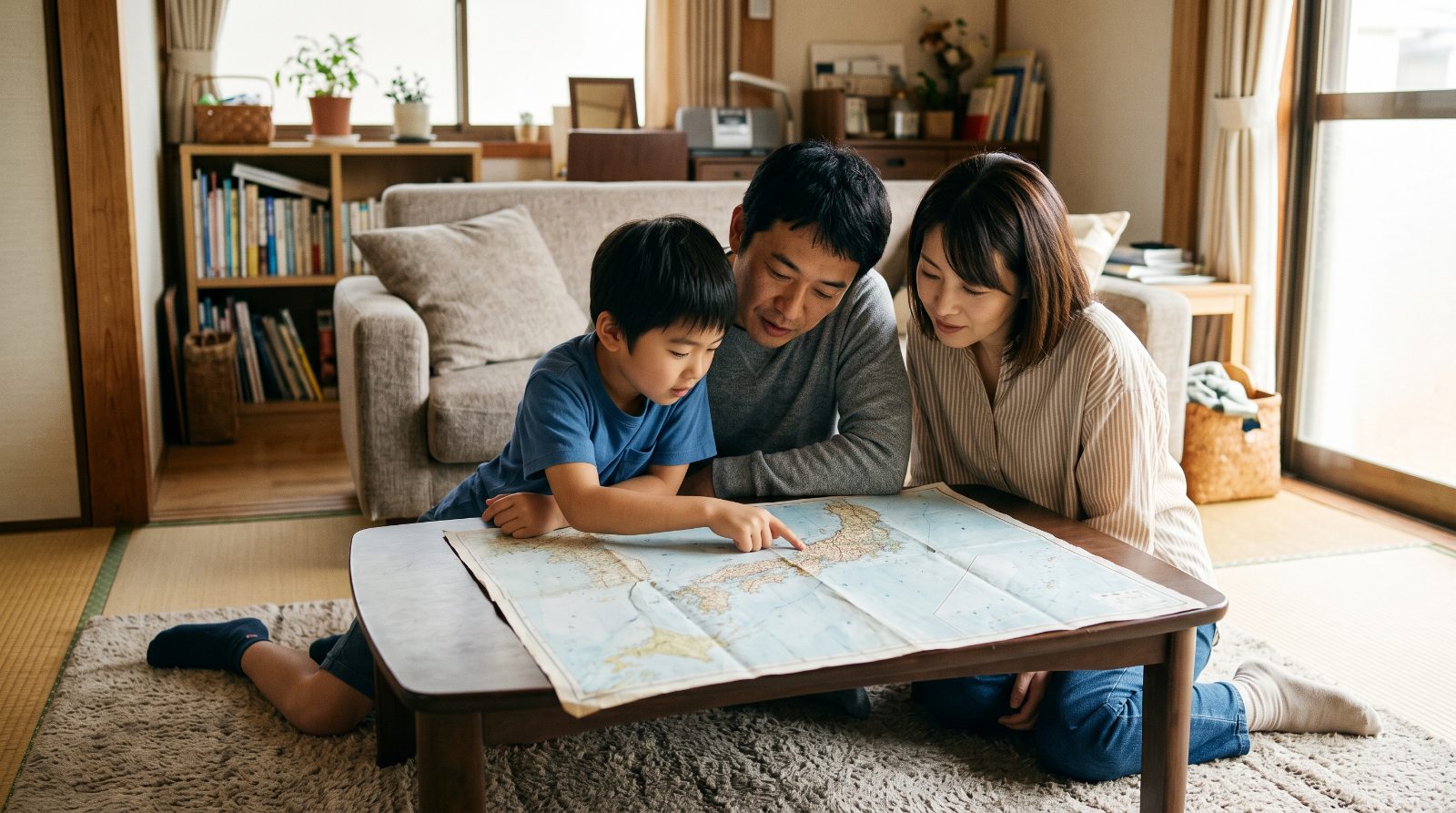
Maybe you have just moved to New Zealand on a work visa and your child is struggling to settle into the local school. Maybe you are a Kiwi family posted overseas for a couple of years, wondering how to keep your children on the New Zealand curriculum. Or maybe you are still deciding where to move, and New Zealand is on the shortlist. Whatever brought you here, the search usually starts the same way: what does an online school in New Zealand actually look like, and which ones can my child use?
This guide to online school New Zealand options is built only from official sources: the Ministry of Education, Immigration New Zealand, and the schools’ own websites. It covers the three real routes — Te Kura, the state distance school; Crimson Global Academy, a registered private online school; and home education — and it is honest about the part most guides skip. In New Zealand, which online school your child can use depends less on the school and more on your child’s residency status, your visa, and where you live. Fees and rules below were checked in October 2026.
Online school New Zealand rules: start with eligibility, not the school
New Zealand children are required to be enrolled in school from age 6 to 16. State schools are free for domestic students — New Zealand citizens, permanent residents and certain others defined in law. Children who are in the country as international students normally pay international fees set by each school.
There is one rule that surprises many newly arrived families. According to Immigration New Zealand’s operational manual, dependent children of work visa holders are regarded as domestic students for primary and secondary school fees for the period of the parent’s work visa. There are exceptions — for example, parents on Recognised Seasonal Employer or Supplementary Seasonal Employment visas. So two families arriving from the same country can face completely different options: one where a parent holds a qualifying work visa and the child counts as domestic, and one where the child holds a student visa and a parent is there as a guardian.
Write down three things before you compare any school: your child’s citizenship and visa, the parent’s visa, and how long you expect to stay. Almost every answer below flows from those three facts.
Te Kura: New Zealand’s state distance school
Te Kura’s full name is Te Aho o Te Kura Pounamu. It began in 1922 as The Correspondence School, posting lessons to 100 children, and according to its website more than 30,000 learners now join each year, making it the largest school in the country. It teaches from early childhood through to NCEA Level 3, the main senior secondary qualification, mostly online and from home.
Who can enrol for free
Te Kura is not an open-door online school. Government-funded enrolment runs through “gateways” set out in the Ministry of Education’s enrolment policy (dated 25 February 2025). For children under 16, these include living a set distance from the nearest suitable school, a long-term illness or medical condition that prevents attendance, a family that moves at least once a term, and referral by the Ministry for students who have disengaged or are at risk of disengaging from school. Every funded gateway requires the student to be a domestic student. Wanting to learn online is not, on its own, a gateway.
Kiwi families living overseas
New Zealand citizens and permanent residents who are overseas can receive funded enrolment if they meet the overseas criteria — for instance, being temporarily abroad with the intention of returning within two years, or being unable to access suitable comparable education where they live. The policy says applications should usually be made within 12 months of leaving New Zealand, and that students should have lived in New Zealand for two or more consecutive years before applying. Families who have emigrated permanently are excluded. Domestic students aged 16 or over who do not meet those criteria can enrol on a fee-paying basis.
International students
Here is the key gate for families on temporary visas. Te Kura’s full-time gateway for international students is for students who are not currently resident in New Zealand and are not studying NCEA-level qualifications. In other words, a child living in New Zealand on a student visa is not the intended user of full-time Te Kura enrolment. If your plan was “move to New Zealand and use Te Kura instead of a local school”, this is where that plan usually stops. The policy does, however, include fee-paying dual tuition gateways for domestic and international students who live in New Zealand and stay enrolled full-time at a local school, so adding individual Te Kura subjects alongside a local school is a separate question worth asking.
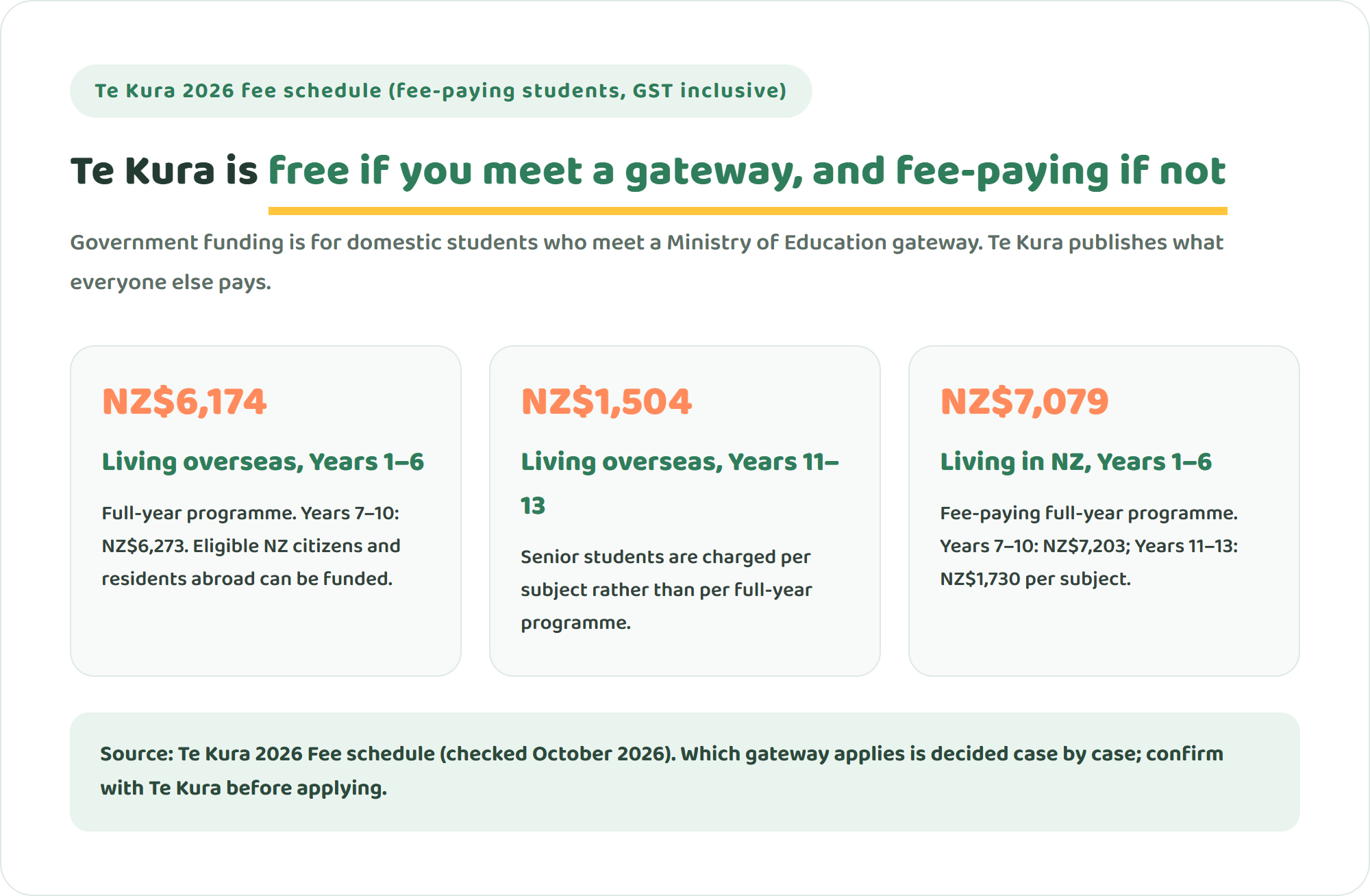
For students who do enrol on a fee-paying basis, Te Kura publishes a 2026 fee schedule (GST inclusive). For students living overseas, a full-year programme is NZ$6,174 for Years 1–6 and NZ$6,273 for Years 7–10. Senior students in Years 11–13 are charged per subject, at NZ$1,504 each. For fee-paying students living in New Zealand, the full-year programme is NZ$7,079 for Years 1–6 and NZ$7,203 for Years 7–10, and NZ$1,730 per subject for Years 11–13. Which gateway applies to your child is decided case by case, so talk to Te Kura directly before you rely on any of these numbers.
Crimson Global Academy: a registered private online school
The best-known private alternative is Crimson Global Academy (CGA), founded in Auckland in 2019. It describes itself as a registered New Zealand private online school for ages 6–18, and offers internationally recognised pathways — Cambridge and Pearson Edexcel qualifications, Advanced Placement and a US high school diploma — through live online classes, with one-to-one and self-paced options. It lists WASC accreditation alongside its exam-board recognitions.
The difference from Te Kura is simple: CGA charges tuition, but you do not need to meet a distance, health or residency gateway to apply. Its New Zealand site publishes fee schedules by campus, including an Aoraki campus aligned to the New Zealand and Australian school calendar. If your child is in New Zealand on a student visa and you want CGA to be their main school, check with both the school and Immigration New Zealand how that fits your visa conditions before you commit. For a broader look at how accreditation works for online schools, see our guide to accredited online international schools.

Home education: learning outside a registered school
New Zealand also allows parents to educate their children at home with Ministry approval. A parent or legal guardian applies to the regional Ministry of Education office, one application per child. Applying is free and normally takes four to six weeks, and a child older than six must stay enrolled at a school while the application is considered. If approved, you receive a Certificate of Exemption from enrolment at a registered school, valid until your child turns 16 or enrols in a registered school.
The standard is that your child should be learning “as well as, and as regularly as” they would at school. You do not have to follow the New Zealand Curriculum, so some families build their programme around online courses. Approved families receive a supervision allowance twice a year; the half-year rate is NZ$398 for the first child, NZ$338.50 for the second, NZ$278.50 for the third and NZ$199 for each subsequent child. The Ministry’s pages do not spell out how temporary visa status affects eligibility, so if you are not a citizen or resident, ask your regional office first.
Online school New Zealand options by visa type
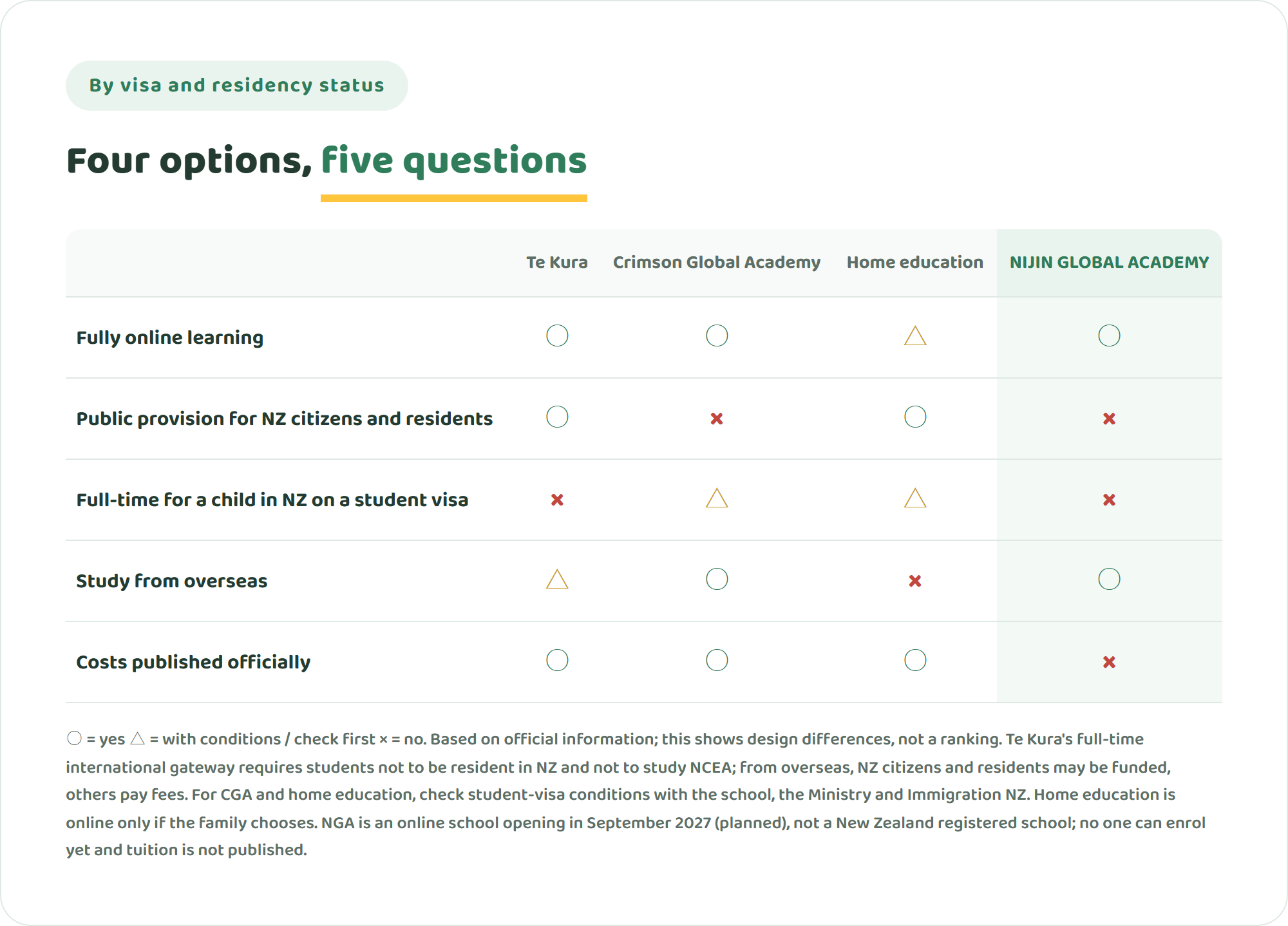
Putting it together:
- New Zealand citizens and permanent residents living in New Zealand can use Te Kura if they meet a gateway, or apply for home education. Private online schools such as CGA are open to them too.
- Children of qualifying work visa holders count as domestic students for school fees, so Te Kura’s gateways may apply if the child meets one. Confirm your specific visa category.
- Children on student visas are generally expected to attend a school as international fee-paying students. Full-time Te Kura is not designed for them; a private online school may be possible, but check the visa conditions.
- Kiwi families living overseas may qualify for funded Te Kura enrolment under the overseas criteria, or pay fees from age 16.
- Non-New Zealanders living overseas who simply want a New Zealand online school can look at private schools, or at Te Kura’s fee-paying international gateway if they are not studying NCEA.
If you are comparing online schools more widely, our online international school comparison and how to choose an online international school walk through the questions that matter. Families weighing a move within the region may also find our guide to international schools in Sydney useful.
Three questions before choosing an online school in New Zealand
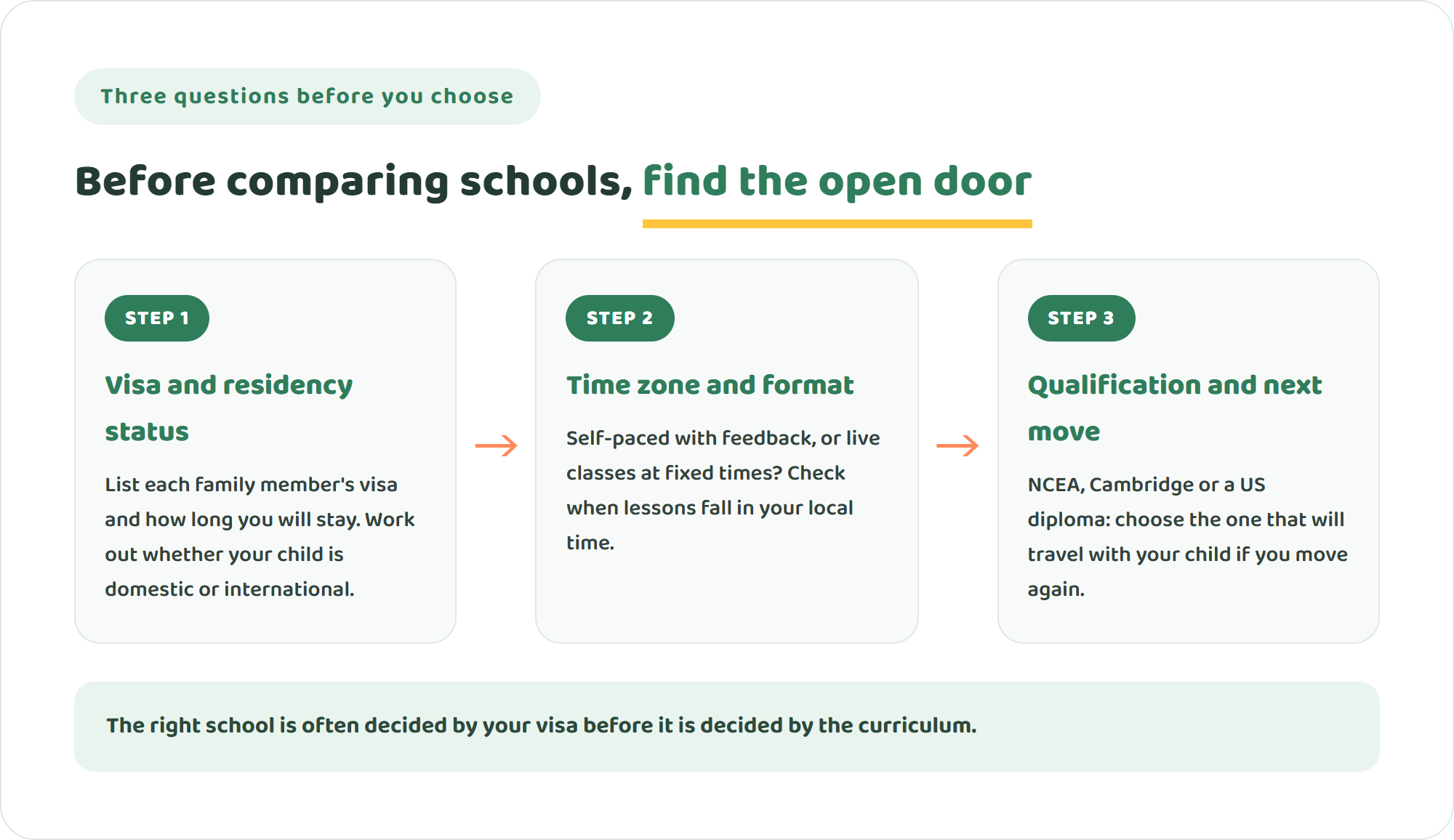
Which door is open to us? Domestic or international, living in New Zealand or abroad, for one year or ten. Settle this first, because it removes options faster than any comparison of curriculum or reviews.
How will the day actually run? Some online schools are mostly self-paced with teacher feedback; others are built around live classes at fixed times. New Zealand sits three to four hours ahead of Japan depending on daylight saving, and further ahead of Southeast Asia, so if your family moves between regions, ask when live classes happen in your local time. To see one model of how live, small-group online learning can work, have a look at our curriculum.
Where does it lead? NCEA is the usual route into New Zealand universities; Cambridge, Edexcel and US diplomas are recognised in different ways elsewhere. If you might move again, think about which qualification will travel with your child. Our article on where online international school graduates go looks at this in more detail, and our list of online international schools in Asia covers options closer to home if you are moving north.
Where NIJIN GLOBAL ACADEMY fits
NIJIN GLOBAL ACADEMY (NGA), which publishes this site, is an online international school opening in September 2027 (planned), with trial classes planned for April and May 2027. It is run by NIJIN Inc., which operates NIJIN Academy in Japan, a place to learn for children who are not attending school, where more than 1,000 children have learned so far. NGA has no test-score-based entrance exam and is built around small, live classes, with a goal we describe simply as helping children grow to like themselves and the world.
To be clear about what NGA is not: it is not a New Zealand registered school, it has not opened, and it has not published tuition or accreditation status. It is not a substitute for Te Kura or CGA if you need a New Zealand school. But if your family moves between countries and wants one learning community that can come along, it may be worth keeping on your list.
FAQ
Is there a free online school in New Zealand?
Yes, for eligible students. Te Kura, the state distance school, is government funded for domestic students who meet one of the Ministry of Education’s gateways, such as distance from school, health, frequent moves, or Ministry referral. Others may be able to enrol on a fee-paying basis.
Can international students enrol in Te Kura?
Only in limited ways. The Ministry’s enrolment policy allows full-time international enrolment for students who are not currently resident in New Zealand and are not studying NCEA. A child living in New Zealand on a student visa is not covered by that gateway (checked October 2026).
How much does Te Kura cost for overseas students?
For fee-paying students living overseas, the 2026 schedule lists NZ$6,174 a year for Years 1–6, NZ$6,273 for Years 7–10, and NZ$1,504 per subject for Years 11–13, GST inclusive. Funded overseas enrolment for eligible New Zealand citizens and residents is free.
Is homeschooling legal in New Zealand?
Yes. Parents can apply to the Ministry of Education for a home education exemption. Applying is free, usually takes four to six weeks, and approved families receive a supervision allowance twice a year. Check with your regional office if you are on a temporary visa.
Find the open door first
New Zealand has genuinely good online options, from a century-old state distance school to private schools teaching international curricula. But the right online school in New Zealand for your child is mostly decided by questions that have nothing to do with teaching: your visa, your child’s status, where you live and for how long. Answer those, and the choice between Te Kura, CGA and home education usually becomes clear.
NIJIN GLOBAL ACADEMY is scheduled to open in September 2027, with trial classes planned for April and May 2027. We will share our curriculum, timetable and approach to fees by email as they are confirmed.
There is no need to decide anything today. Start with one sheet of paper and your family’s visas. It is the most useful step you can take.