You typed “bilingual remote jobs” into the search bar — and what came to mind? Somewhere your Japanese and English could finally be used properly. Ideally without a commute, fully remote, not tied to an office in Tokyo or Osaka. Then you opened the job boards and found either back-office roles more mundane than you pictured, or specialist postings with years-of-experience bars you can’t clear. If that mild deflation is what brought you to this page, you are in very good company.
This article sorts that feeling out honestly. First, what bilingual remote jobs actually look like — which roles exist, and why “I speak English” no longer sets anyone apart. Then, how to turn language into a multiplier: building a specialism, reading job ads properly, and evidencing your track record. That part is useful whether or not you ever apply to us. Finally, we introduce a third option — joining the side that builds an international school where Japanese and English are both used every day.

The reality of bilingual remote jobs — three fields, and the limits of fluency
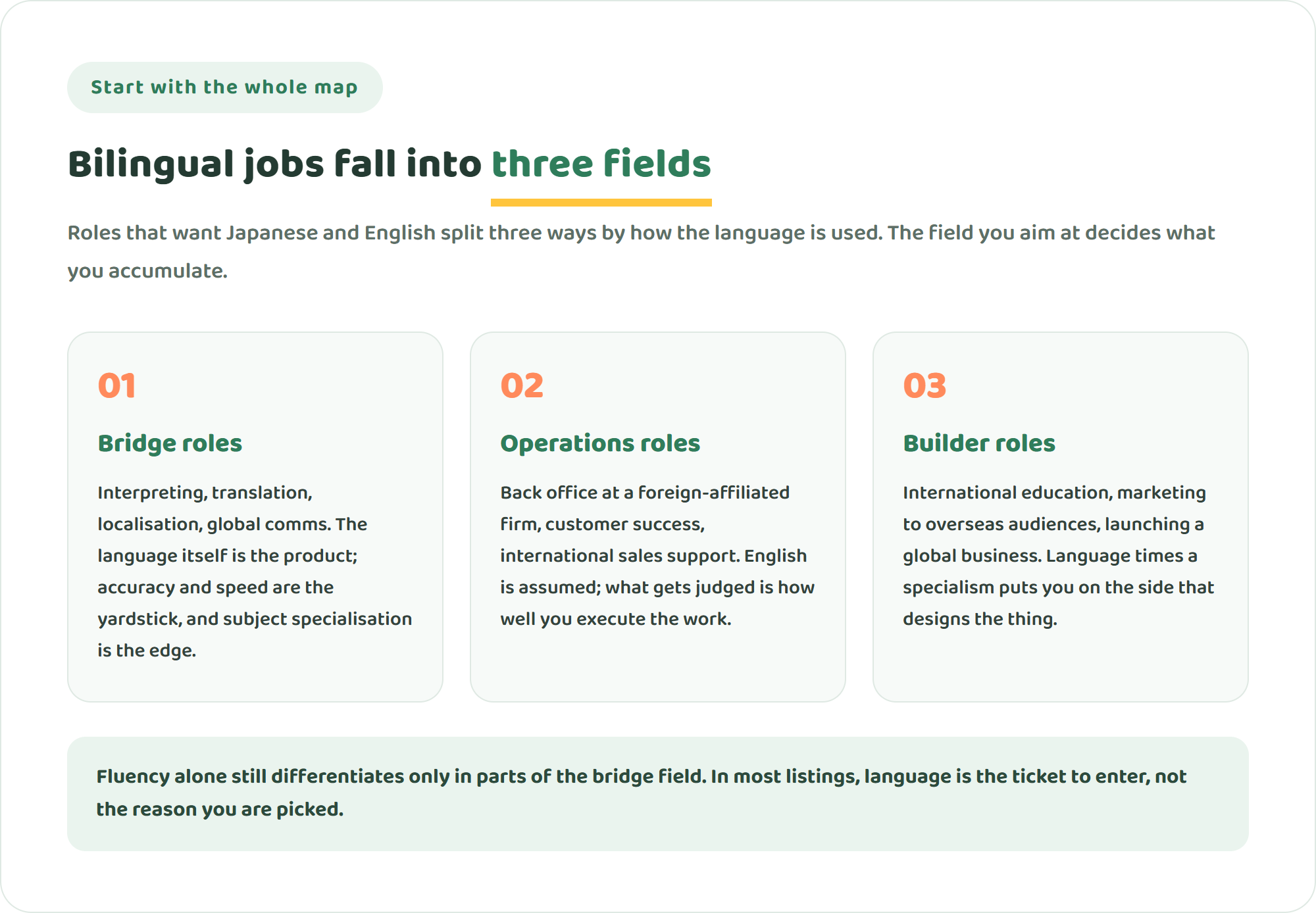
However varied the listings look, roles that want Japanese-English bilinguals fall into three fields once you look at how the language actually gets used. First, bridge roles: interpreting, translation, localisation, global comms — the language itself is the product. Second, operations roles: back office at a foreign-affiliated firm, customer success, international sales support — English is assumed, and what gets judged is how well you execute the work. Third, builder roles: international education, marketing to overseas audiences, launching a global business — where language multiplied by a specialism puts you on the side that designs the thing.
Here is the honest part: being bilingual, on its own, no longer differentiates you. Machine translation and generative AI now handle a good share of routine rendering and first-line responses. The pool of people who move comfortably between Japanese and English — returnees, overseas graduates, long-term residents across Asia — keeps growing. When a listing says “business-level English,” that is usually the ticket to enter, not the reason you get picked.
Remote listings add a second dynamic. A role with no location requirement is a role whose applicant pool is national, and often international. An Osaka or Tokyo posting that expects you in the office narrows the field to people who can commute; a fully remote one puts you alongside candidates anywhere in the country and anyone in a workable time zone. The wish to work from home is shared by the dozens of people reading the same listing. Which is precisely why the people who bring something beyond the language get chosen. That is not a reason to deflate — it just tells you what to add.
Turning language into a multiplier — build a specialism, then read listings properly
This is the heart of the article. Put simply, language is not a standalone skill; it is an amplifier. Being bilingual multiplies whatever expertise you bring — but with nothing to multiply, it idles. So start by choosing one specialism to sit next to the language: education, marketing, web and design, partnerships, recruiting and HR, data. Anything. The moment the second term in “English × ___” is filled in, job ads start reading differently.
Next, how to read a listing. Check three things. First, whether the ad describes concrete situations where English is used — a listing that only says “English required” often means low actual usage, or that the employer hasn’t thought it through. Second, whether language is a requirement or an assumption. Where English is simply assumed, nobody treats it as special, so you are judged on the substance of the work and your specialism compounds. Third, the definition of remote: “remote available” can mean two days a week at home, which is not the same as fully remote. Confirming each of these in an interview, rather than taking the wording on trust, is what closes the gap between the ad and the job.
Third, how to evidence it. A CV that says “English OK” and a test score tells a hiring team almost nothing. Write instead what you owned, how far it went, and what changed: ran the recurring call with the overseas office single-handedly, through to circulating decisions; handled X English enquiries a month and lifted first-contact resolution by Y%. Scores are the baseline; artefacts and numbers are the argument. Note that qualifications and language requirements are generally guidelines only, and how much weight they carry varies by employer and role.
And one more thing. Working from home and moving your career up — most people searching bilingual remote jobs want both at once, and the two do not conflict. Pick a workplace where language is assumed and expertise accumulates, and remote becomes an accelerator rather than a plateau.
See NIJIN GLOBAL ACADEMY’s founding-member roles →
A third path — from using Japanese and English to building with them
One way to multiply your language is to join the side that builds a school where Japanese and English are both used daily. That is what the founding-member roles at NIJIN GLOBAL ACADEMY (NGA) are, ahead of our September 2027 opening. Here English is not a special skill; it is the ordinary tool for working with children and with colleagues around the world. The table below sets three bilingual paths side by side.
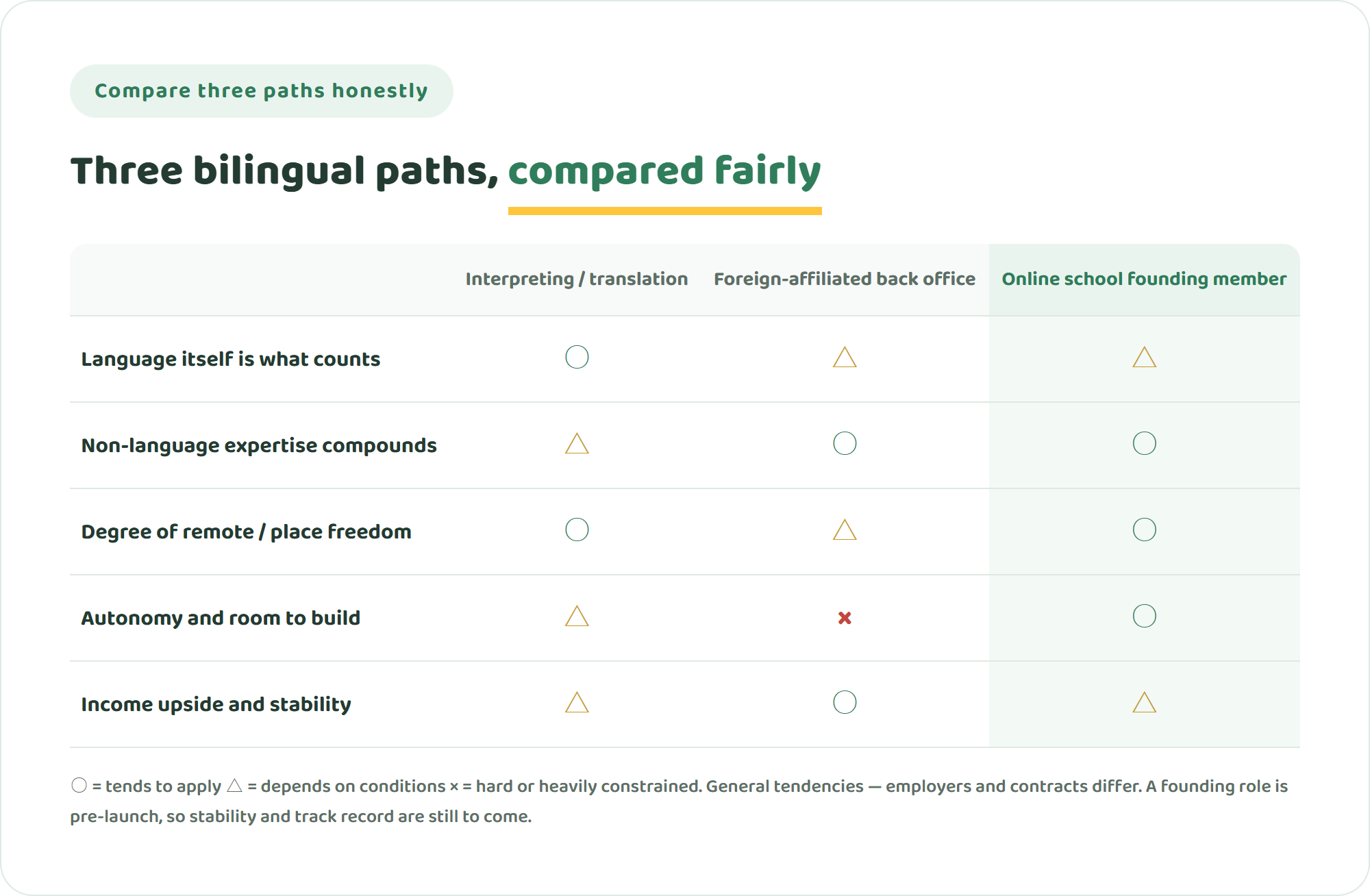
As the table shows, the founding-member path is no cure-all. If you want language itself to be the thing you are judged on, bridge roles like interpreting and translation remain the clearest fit; on income stability, a foreign-affiliated back office often has the edge. Every one of these jobs carries value the others don’t. And because NGA is pre-launch, the stability and track record of an established school are still ahead of us.
With that said, there is a lot here for a bilingual professional. First, it is fully remote — designed around the premise of working while travelling the world, with no commute and no location requirement. Second, you can choose how you contribute beyond teaching: marketing, web, partnerships and HR are among five working styles, and the load scales from part-time to full-time. The specialism you want to place next to your language can simply become the job. Third, we say plainly what the terms are — founding roles on this track begin as volunteer positions ahead of our September 2027 opening, and the detailed terms are shared later in the process. What we ask for is roughly English at CEFR B2+ and an appetite for building from zero. The school stands for learning beyond test scores, and that view of education is set out in how we learn. If you have spent years having your own language measured as a number, that idea may come as a relief.

Three steps to turn your language into a multiplier
Here is a manageable three-step version of everything above.
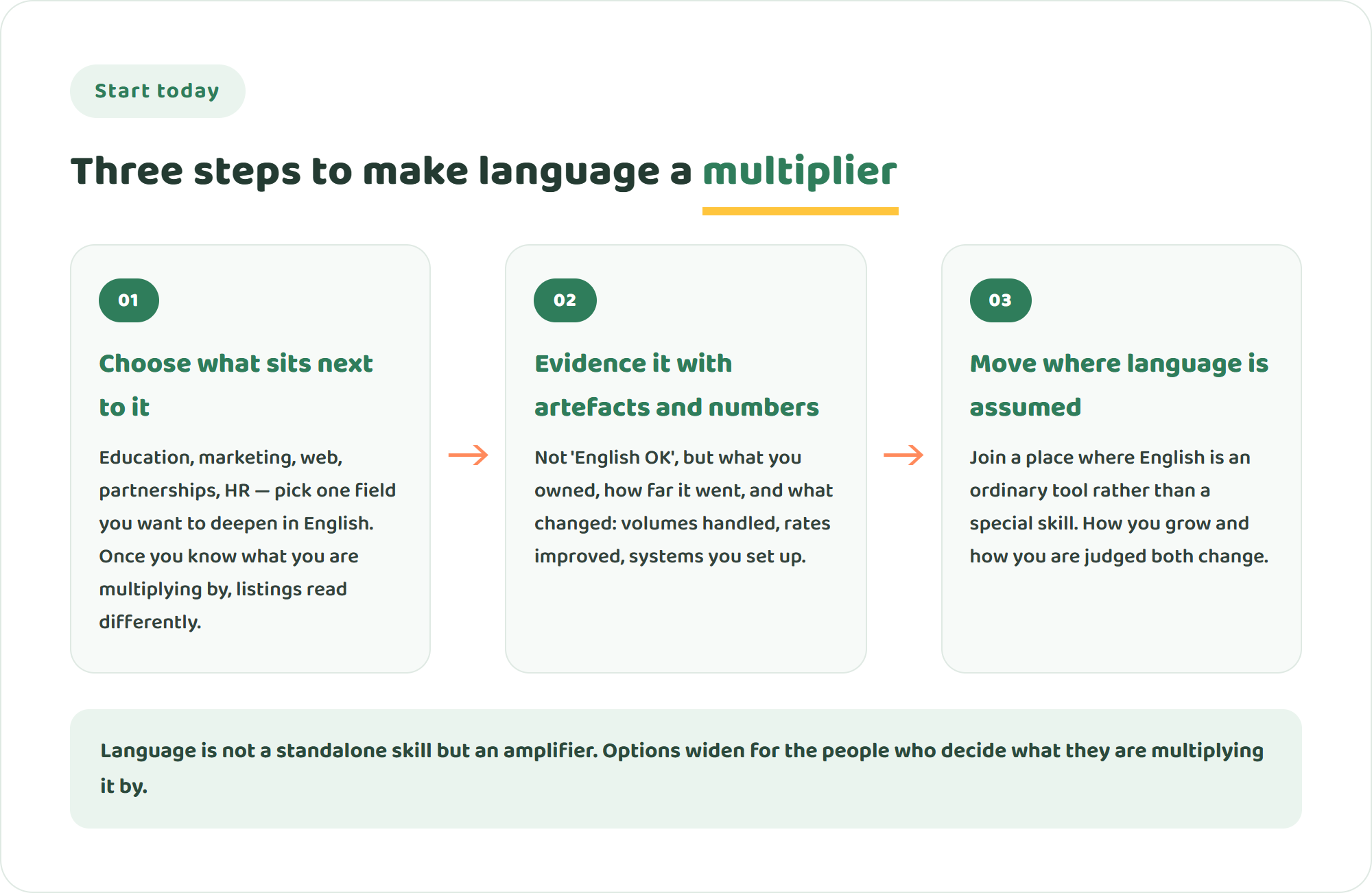
First, choose what sits next to the language. Second, evidence it with artefacts and numbers — rewrite “I can work in English” as scope owned and results delivered. Third, move into an environment where the language is assumed; how you grow and how you are judged both change there. For reference, NGA’s selection runs from document screening to a group interview, an internship at NIJIN Academy, and a final presentation (applications via a Google Form). The internship means you can try before you decide.
Frequently asked questions
Can bilingual jobs really be found fully remote?
Yes — though remote listings draw a much wider applicant pool, so competition is generally tougher. Beyond the language, the deciding factor is whether you can show concretely which work you can own and what you have delivered. NGA’s founding-member roles are fully remote by design.
Am I at a disadvantage if I don’t live in Tokyo or Osaka?
For roles that expect office attendance, location is normally part of the criteria. Where a team is built fully remote, residence is generally not asked about at all. NGA is designed around working while travelling the world, so the shape of the work is the same whether you are in a smaller Japanese city or elsewhere in Asia.
What level of English do I need?
We take roughly CEFR B2+ as a guideline, and we are not looking for native-level perfection. What matters is using English to work with children and colleagues worldwide, and continuing to grow it. You can confirm the exact expectations during selection.
I have no education background. Is being bilingual enough to apply?
What NGA asks for is people who can build from zero. Because you can contribute through marketing, web, partnerships or HR as well as teaching, expertise built in another field multiplies directly with your language. We look at the drive to build together more than at a polished background.
You open in September 2027 — is there any point applying now?
Yes. Being pre-launch is exactly why founding members shape the substance of the learning itself, and the lead-up is built so you gain experience through the NIJIN Academy internship.
Your language may still be running at half capacity.
If you searched for bilingual remote jobs, you are someone who wants their languages properly used — a fair wish, and a reachable one. The precision you sharpened in translation, the operational instincts you built inside a foreign-affiliated firm, the care you have taken in the space between Japanese and English: all of it is yours to keep. What may be missing is not more language, but something to multiply it by. Choose one specialism, put your track record into numbers, and move somewhere the language is simply assumed. Take those in order and the wish to work from home and the wish to move your career up stop competing — they turn out to be the same road.
Working at an International School — More Articles
- international school teacher salary
- how to become an international school teacher
- career change from teaching
- career change from teaching in your 30s and 40s
- how much do teachers earn?
- how to become an IB teacher
- jobs for moving abroad
- international school teaching jobs
- online school jobs
- international school staff jobs
- remote jobs that use English
- private school teacher career change
- qualifications to teach English
- elementary school teacher salary in Japan
- junior high school teacher salary in Japan
- high school teacher salary in Japan
- school principal salary in Japan
- how the Japanese teacher pay scale works
Want to start teaching now?
NIJIN GLOBAL ACADEMY opens in September 2027. If you’d like to start in the classroom sooner, our sister school NIJIN Academy — an already-operating online school run by NIJIN, fully remote with zero commute — is also hiring teachers (mentors), with members from many different backgrounds. See the NIJIN Academy teacher recruitment page.
Take your Japanese and English from using to building.