“Remote teaching jobs.” If you searched that, you probably want to keep teaching — and free only where and when you do it. No commute, no fixed posting, the chance to work from home or even while you travel. That is not a selfish wish. But once you start looking, fully remote teaching roles turn out to be fewer than you hoped, the terms vary wildly, and you catch yourself wondering, “can I actually build a life on this way of working?” If you reached this page carrying that doubt, you are far from alone.
This article meets that doubt honestly. First, the reality of remote teaching jobs — why openings are limited, whether you need a license, and the self-management it quietly demands. Then, how to find and vet remote roles — useful for any remote job hunt, with or without us. Finally, as a “third path” built around teaching online from anywhere in the world, we introduce — without a hard sell — the option of joining the founding team of the online international school we open in September 2027.

The reality of remote teaching jobs — an honest starting point
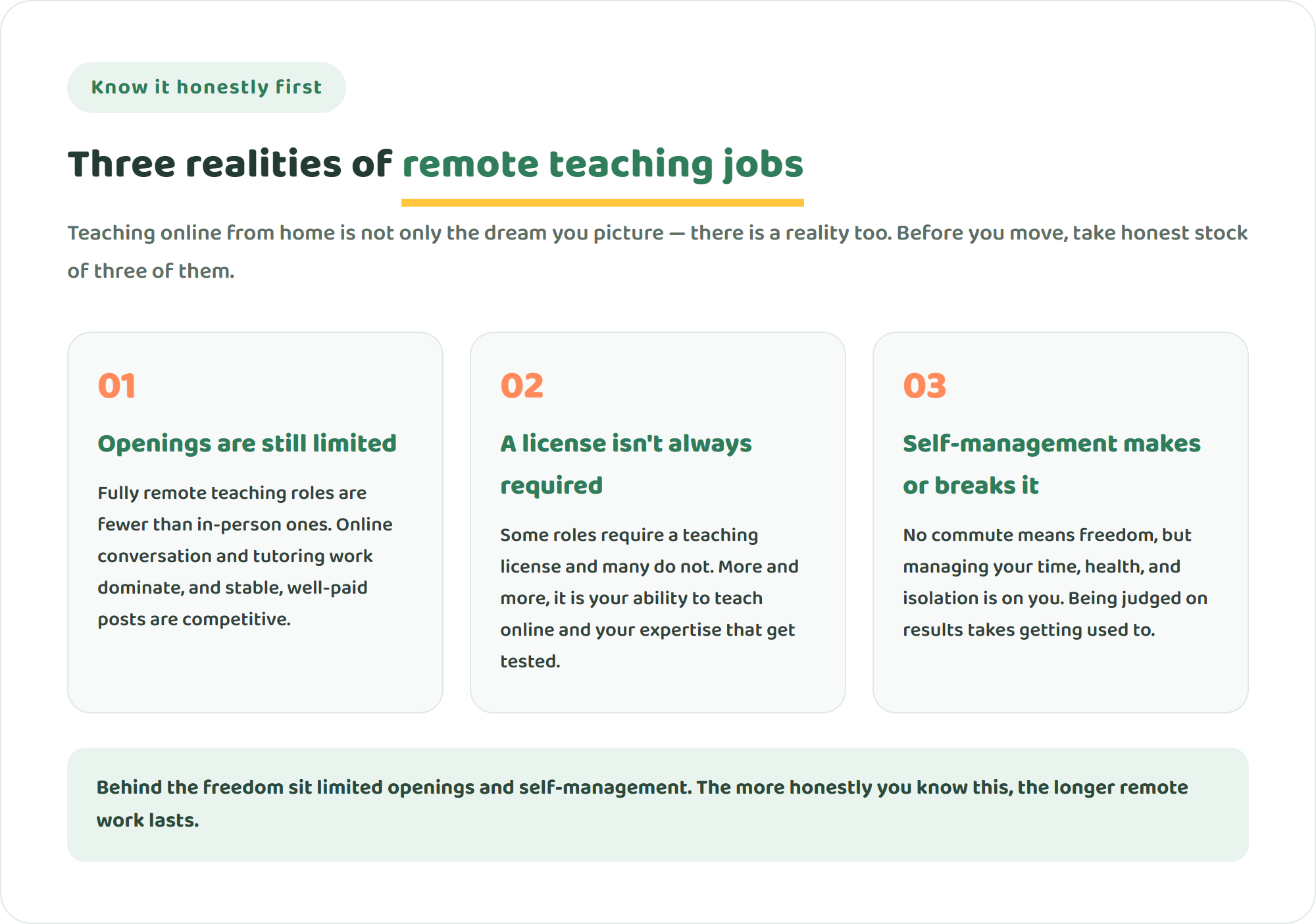
Search “remote teaching jobs” and the suggestions fill with “from home,” “online,” “no license.” That alone tells you how many people share the same questions. Honestly, teaching online from home comes with a few realities worth facing. First, openings are still limited: compared with in-person schools, fully remote teaching roles are fewer, and online English and tutoring work dominates. Stable, well-paid posts are competitive. Second, a license isn’t always required: some roles ask for a teaching license and many do not — increasingly it is your ability to teach online and your subject expertise that get tested. Third, self-management makes or breaks it: no commute is freedom, but managing your time, your health, and the isolation is on you, and being judged on results takes getting used to.
None of this adds up to “it can’t be done.” If openings are scarce, change how you search. Without a license, you can still compete on expertise and on the ability to hold people’s attention online. And self-management, once it becomes habit, turns into your greatest asset: focus that no one can interrupt. What matters is knowing the reality, then finding the place that fits you.
How to find and vet remote teaching roles
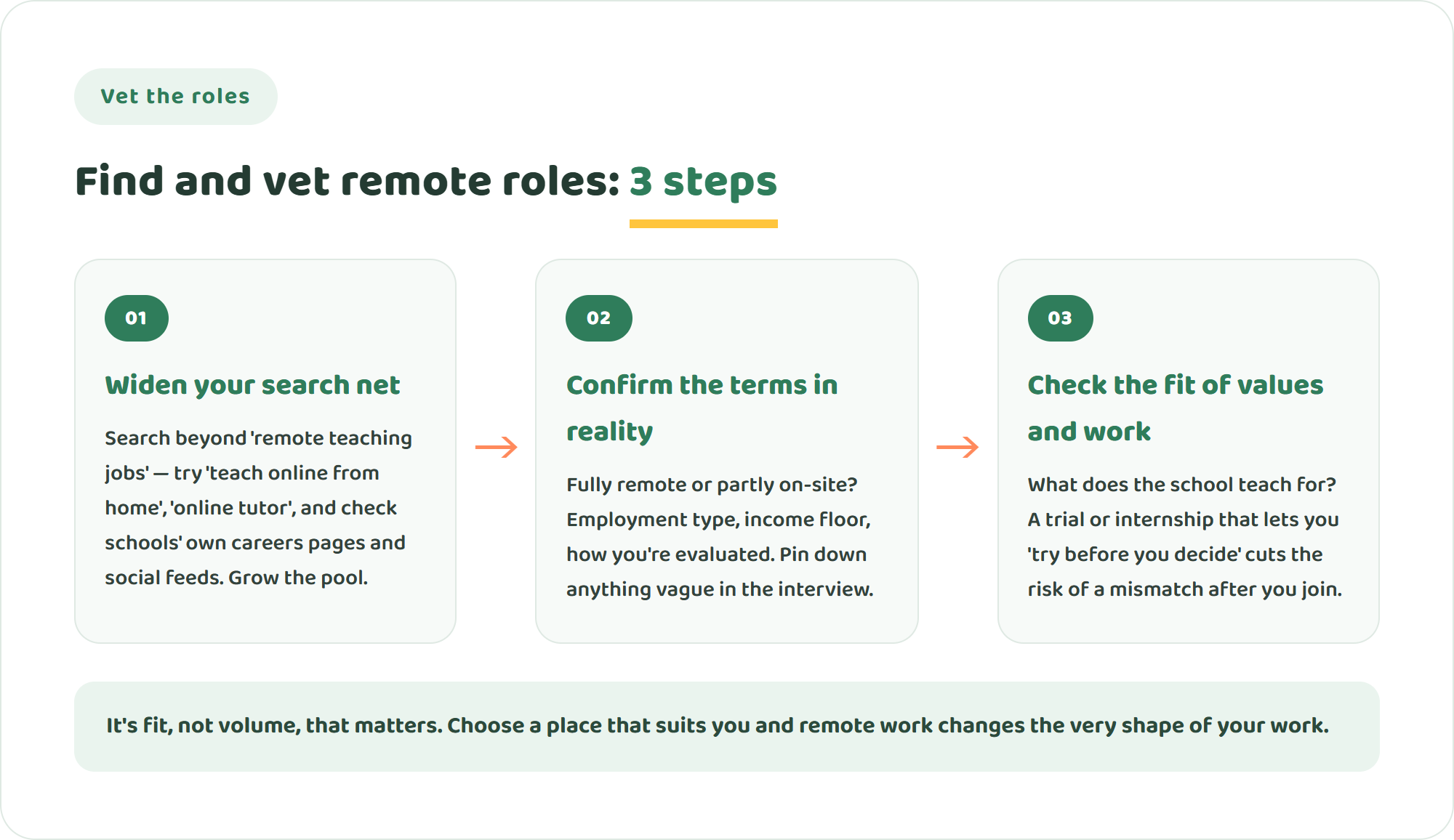
This is the heart of the article. First, widen your search net. Searching only “remote teaching jobs” keeps the pool small. Vary the words — “teach online from home,” “online tutor,” “online school hiring” — and go straight to the careers pages and social feeds of schools you admire. Roles that never reach the big job boards are often sitting right there.
Second, confirm the terms in reality. “Remote-friendly” can mean fully remote or partly on-site, and those are completely different lives. Pin down the employment type (contract or full-time), the income floor, and — crucially — how you are actually evaluated. Rather than applying while it’s all vague, make a habit of checking the specifics in the interview; it is what prevents regret after you join. Third, check the fit of values and work. What does the school teach for? Whether there is a trial period or internship that lets you “try before you decide” is a powerful signal for avoiding a mismatch.
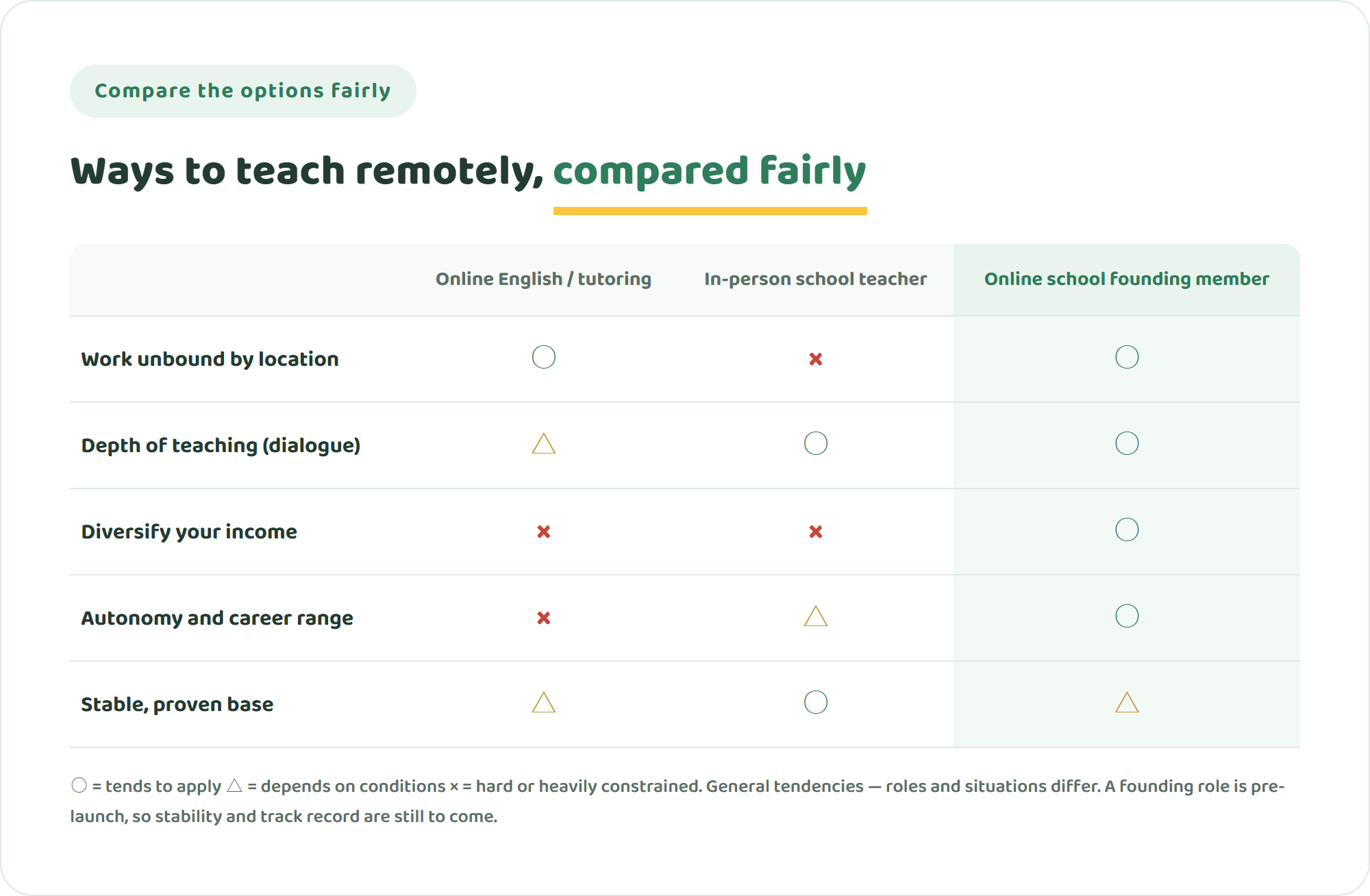
Each way of working suits different people. Online English and tutoring are easy to start but income can be unstable. An in-person school teacher enjoys stability but no freedom of place. The table below sets their strengths and constraints out fairly, side by side.
See NIJIN GLOBAL ACADEMY’s founding-member roles →
A third path — teach fully remotely, from anywhere in the world
Not online English, not an in-person school. There is another way of working: fully remote, taking part in both the teaching and the building of the school. That is the founding-member role オンラインインターナショナルスクールのNIJIN GLOBAL ACADEMY (NGA) is recruiting for ahead of its September 2027 opening. As the table above makes plain, it is not a cure-all — precisely because it is a pre-launch phase, the “stability and track record” of an established school are still to come. Even so, for anyone who wants to teach fully remotely, the appeal is real.
First, it is fully remote — designed around the premise of “working while traveling the world,” with no commute and no fixed location. Second, it centres on small-group dialogue, so you engage deeply with each child even remotely; because it is not one-way lecturing to a big class, the reward of teaching survives the screen. Third, we say plainly what the terms are — founding roles on this track begin as volunteer positions ahead of our September 2027 opening, and the detailed terms are shared later in the process. Beyond teaching, you can choose your involvement from five working styles spanning marketing, web, partnerships, and HR — so your income need not rest on a single pillar. And NGA stands for learning beyond test scores; our view of education is laid out in how we learn. What we ask of applicants is roughly English at CEFR B2+ and an appetite for building from zero — we look at that drive more than at a license or a glossy résumé.

Frequently asked questions
Can you really teach children fully remotely?
NGA is an online international school built around small-group dialogue. Because it draws out each child’s thinking rather than lecturing to a large class, deep engagement is possible even remotely. Being able to teach unbound by location can be the very thing that changes how work feels for anyone worn down by a commute or a fixed posting.
I don’t have a teaching license. Can I still teach remotely?
What NGA asks for is people who “can build from zero.” More than a license, we value the drive to work with children online and the expertise and strengths you already carry. A license is just one entry point — not having one is no reason to give up.
I’m worried about self-management when working fully remotely.
Self-management is a challenge common to all remote work, but at NGA you build the school within a small team — you are not left alone. Roles are shared and the work moves through dialogue with colleagues. The pre-launch internship also lets you “try before you decide” whether remote work suits you.
You open in September 2027. Is there any point applying now?
Yes. It is precisely because it is pre-launch that founding members help design the substance of the learning itself. The lead-up is built so you can gain experience through the NIJIN Academy internship and more. If you are drawn to “joining the side that builds” rather than “entering a finished organisation,” now is arguably the moment.
Take back where you work.
If you searched “remote teaching jobs,” a love of teaching and a wish to live more freely probably live side by side in you — and those two are not in conflict. The scarcity of openings and the wall of self-management are real, but with the right way to search and to vet, the remote role that fits you is out there to be found. You don’t have to leap in blind, and you don’t have to give up on the dream alone. Widen the net, confirm the reality, check the fit — each step carries you toward work unbound by place. Where you work has always been yours to decide.
Working at an International School — More Articles
- international school teacher salary
- how to become an international school teacher
- career change from teaching
- career change from teaching in your 30s and 40s
- how much do teachers earn?
- how to become an IB teacher
- jobs for moving abroad
- remote jobs that use English
- digital nomad teaching jobs
- teaching jobs without a license
- working at an international school: pros and cons
- online school jobs
- thinking of quitting teaching
- international school staff jobs
- bilingual remote jobs
- career change from tutoring
- life after leaving teaching
- a second career for teachers
Turn your passion for teaching into work you can do from anywhere.