Search for international schools in Shinagawa and you hit a confusing wall almost immediately: half the results turn out to be in Minato or Shibuya. Shinagawa Ward is one of Tokyo’s most layered districts — the redeveloped office towers of Osaki and Gotanda, the waterfront canals of Tennozu and Shinagawa Seaside, and the old Tokaido post-town streets that still run through Kita-Shinagawa. International families keep arriving, yet clear information about the ward’s schools is remarkably hard to assemble. This guide sets out every international school genuinely located in Shinagawa Ward — all seven of them — with real published fee figures, the nearest station and walking time for each, an honest look at how to choose, and an eighth option worth knowing about if fees or the commute turn out to be the real obstacle.
Quick Answer: Your Options in Shinagawa
If you only read one section, read this. Below are the schools covered in this guide, plus the online option — so you can see every route side by side before the details.
- Shinagawa International School (SIS) — fees and features: the ward’s only full IB pathway — Ages: 3 (Preschool) to Grade 12, co-educational / Annual tuition: approximately ¥2,575,000 (Preschool–Kindergarten), ¥2,675,000 (Grades…
- Canadian International School Tokyo (CIS) — fees and features — Ages: Kindergarten to Grade 12, co-educational / Annual tuition: ¥2,350,000 (Kindergarten, ages 4–5), ¥2,650,000 (Grades 1–5), ¥2,800,000…
- KAIS International School — fees and features (high school in Kami-Osaki) — Ages: Pre-K to Grade 12 (only Grades 9–12 are located in Shinagawa Ward), co-educational / Annual tuition: ¥2,094,358 (Pre-K–Grade 2), ¥2,144,358 (Grades 3–8) and ¥2,260,659…
- NES International School, Gotanda — fees and features — Ages: 0 to 5 / Annual tuition: not published online — arrange a tour or contact the school directly
- First Learning Osaki Gotanda — fees and features — Ages: from 1 (preschool and kindergarten; after-school classes for primary ages) / Annual tuition: not published online — contact the school directly; one-day-a-week…
- Kids International Gotanda Center — fees and features — Ages: 6 months to primary school age
- Dagis International School Gotenyama — fees and features — Ages: 2 to 5 (attached daycare from 0 to 4) / Annual tuition: not published online — contact the school directly
- NIJIN GLOBAL ACADEMY (online) — Ages 6–18 / opening September 2027, currently taking opening-update registrations / fees around one-fifth of a typical campus international school / Japanese-language support. An option when commute or fees are the wall.
International schools in Shinagawa: the landscape and what they cost
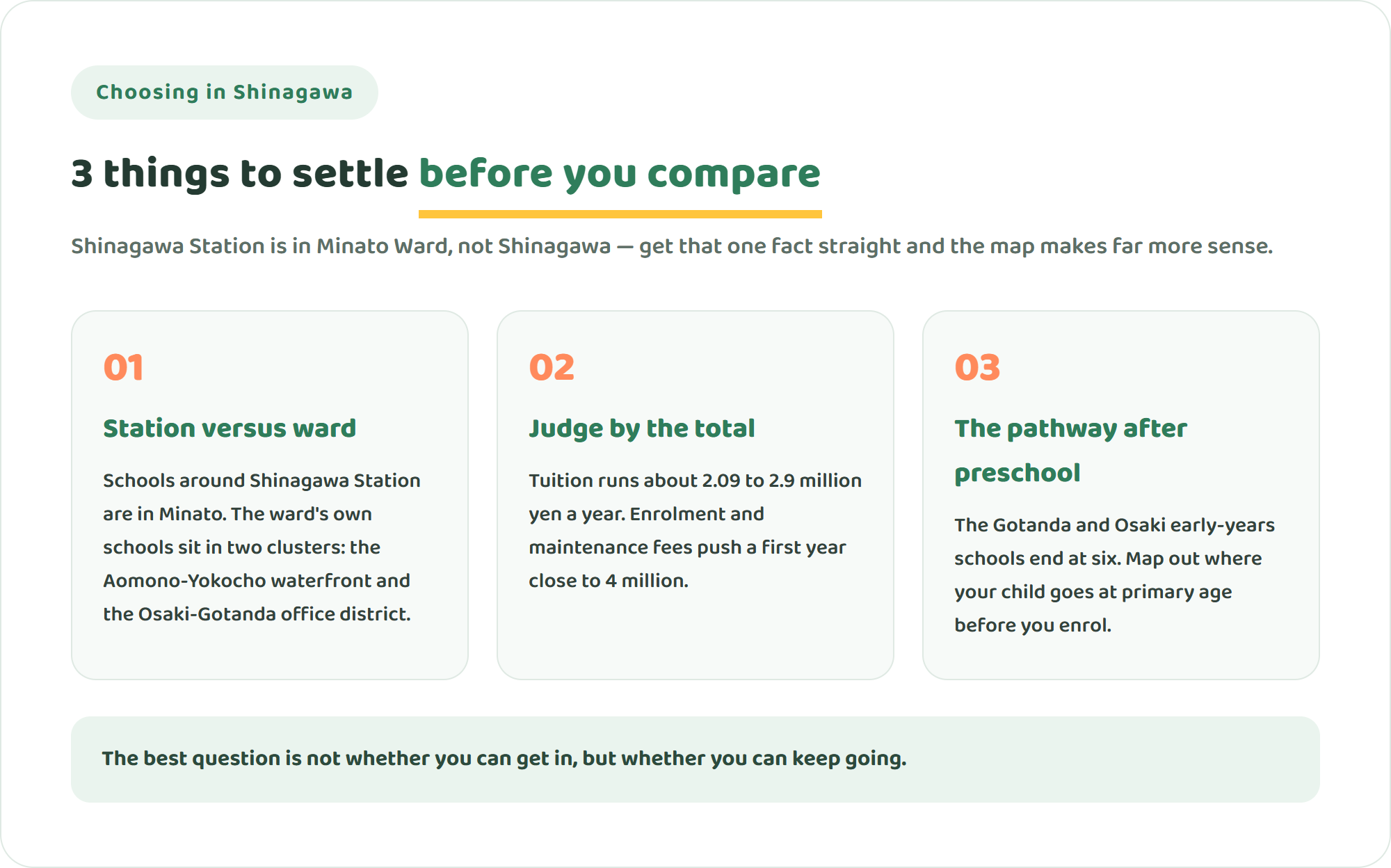
Start with the single fact that causes the most confusion. Shinagawa Station is not in Shinagawa Ward. It sits in Minato Ward, on the Konan and Takanawa side of the boundary. So several schools with Shinagawa in their name — Laurus International School of Science Shinagawa, which opened in March 2026 at 4-2-5 Konan, and the Kids International Shinagawa Center at 3-5-16 Konan — are administratively Minato schools. If you are planning a commute or checking which municipality’s childcare subsidies apply, that distinction matters.
What actually sits inside Shinagawa Ward falls into two clusters. One is the waterfront side — Aomono-Yokocho, Minami-Shinagawa and Higashi-Shinagawa. The other is the office-district side — Osaki, Gotanda and Gotenyama. Three schools take children through to high school, and only one of them, Shinagawa International School, runs an unbroken pathway from age three to Grade 12 entirely within the ward. The remaining options are early-years schools clustered around Gotanda and Osaki.
On fees, expect annual tuition at the three through-schools to run from roughly ¥2,094,000 to ¥2,900,000. Unlike wards such as Koto, where a genuinely low-cost option exists, Shinagawa starts in the two-million range — and tuition is never the whole number. Shinagawa International School adds a ¥1,000,000 enrolment fee plus ¥250,000 maintenance and ¥50,000 supply fees each year; Canadian International School adds a ¥300,000 registration fee, a ¥600,000 building development fee from Grade 1 up, and ¥250,000 in annual maintenance. A first year in primary at SIS lands close to ¥4 million all in. Judge by the total, and by how many years you can sustain it. Our guide to international school tuition costs breaks down where the money actually goes.
Please note: all figures below are publicly available information as of August 2026. Always confirm current fees directly with each school.
Every international school in Shinagawa Ward: fees and features, honestly
Rather than padding the list to a round number with schools from neighbouring wards, here is what genuinely exists inside Shinagawa: three schools that carry children through to high school, and four early-years schools. Curricula and price points differ sharply, so read these with your own child’s age, budget and temperament in mind rather than by reputation alone.
1. Shinagawa International School (SIS) — fees and features: the ward’s only full IB pathway
An IB World School running from age three to Grade 12 across three campuses in Minami-Shinagawa and Higashi-Shinagawa. Children move between them as they grow: the Aoyoko Campus (Preschool to Kindergarten, 5-12-4 Minami-Shinagawa), the Seaside Campus (Grades 1–3, 4-8-8 Higashi-Shinagawa) and the Samezu Campus (Grades 4–12, 3-6-21 Minami-Shinagawa). PYP and MYP have run for years, and the Diploma Programme began in the 2024–25 academic year, completing an unbroken IB route from preschool to university entry within one ward. More than 40 nationalities are represented, and every subject except Japanese is taught in English. Applications are accepted year-round rather than to a fixed deadline.
- Curriculum: full IB continuum — PYP, MYP and Diploma Programme
- Ages: 3 (Preschool) to Grade 12, co-educational
- Annual tuition: approximately ¥2,575,000 (Preschool–Kindergarten), ¥2,675,000 (Grades 1–5), ¥2,775,000 (Grades 6–10) and ¥2,900,000 (Grades 11–12), payable in three terms, plus a ¥250,000 annual maintenance fee and a ¥50,000 supply fee. One-off costs are a ¥40,000 application fee and a ¥1,000,000 enrolment fee. EAL support and learning support, where required, add ¥500,000 a year each (2026–2027, as published by the school).
- Commute: 3–5 minutes on foot from Aomono-Yokocho (Keikyu Line), 5–7 minutes from Shinagawa Seaside (Rinkai Line), about 15 minutes from Oimachi
- Best suited to: families near Aomono-Yokocho, Oimachi or Tennozu who want one uninterrupted IB pathway to university
2. Canadian International School Tokyo (CIS) — fees and features
Founded in 2000 with fifty students and now around 330, CIS has its head office and kindergarten at 5-8-20 Kita-Shinagawa and its high school at 5-7-13 Kita-Shinagawa, both a short walk from Osaki Station. It teaches the curriculum of Prince Edward Island, Canada, layered with the IB Primary Years Programme in the elementary years, and holds WASC accreditation as well. One practical detail worth knowing before you apply: the elementary campus is in Nakameguro, Meguro Ward. The journey therefore goes Osaki for kindergarten, Nakameguro for elementary, then back to Osaki for high school.
- Curriculum: Prince Edward Island (Canada) curriculum with IB PYP in the elementary years; WASC accredited
- Ages: Kindergarten to Grade 12, co-educational
- Annual tuition: ¥2,350,000 (Kindergarten, ages 4–5), ¥2,650,000 (Grades 1–5), ¥2,800,000 (Grades 6–8) and ¥2,900,000 (Grades 9–12), plus a ¥250,000 annual building maintenance fee. One-off costs are a ¥300,000 registration fee and, from Grade 1, a ¥600,000 building development fee; paying in two instalments adds a ¥35,000 handling charge (2026–2027, as published by the school).
- Commute: about 7 minutes on foot from Osaki Station (JR and Rinkai Line); elementary campus in Nakameguro
- Best suited to: families in Osaki, Gotanda or Gotenyama wanting a Canadian high school diploma pathway
3. KAIS International School — fees and features (high school in Kami-Osaki)
KAIS is known for genuinely small classes and an unusually flexible elective range, including robotics and film production. Its high school, Grades 9 to 12, is at 3-10-60 Kami-Osaki in Shinagawa Ward, within walking distance of Meguro Station; the Pre-K to Grade 8 campus is in Nakane, Meguro Ward. If you are looking specifically for a Shinagawa school, treat KAIS as a high school option rather than a full pathway.
- Curriculum: small-cohort international curriculum with an emphasis on creativity and independent projects
- Ages: Pre-K to Grade 12 (only Grades 9–12 are located in Shinagawa Ward), co-educational
- Annual tuition: ¥2,094,358 (Pre-K–Grade 2), ¥2,144,358 (Grades 3–8) and ¥2,260,659 (Grades 9–12), tax included. Materials fees are ¥154,642 (Pre-K–8) and ¥242,674 (Grades 9–12); trip and event fees are ¥40,000 and ¥96,800. One-off costs are a ¥350,000 enrolment fee and a ¥300,000 building maintenance fee (2025–2026, as published by the school).
- Commute: the high school is walkable from Meguro Station (JR, Tokyu Meguro, Namboku and Mita Lines)
- Best suited to: families in Osaki, Gotanda or Meguro who want a small, personalised high school setting
4. NES International School, Gotanda — fees and features
At 7-10-4 Nishi-Gotanda, beside the Gotanda TOC building, NES takes children from birth to age five in a Montessori-based bilingual programme staffed by both foreign and Japanese educators. Much of its design speaks directly to working parents: organic meals cooked on site, careful allergy management, round-the-clock webcam access, and opening hours from 7:30 in the morning to 8:30 at night on weekdays, with Saturday sessions too.
- Curriculum: Montessori-based bilingual early-years education (unlicensed childcare facility)
- Ages: 0 to 5
- Annual tuition: not published online — arrange a tour or contact the school directly
- Commute: about 5 minutes on foot from JR Gotanda Station or Osaki-Hirokoji Station
- Best suited to: dual-income families who need long hours and an English environment in the same place
5. First Learning Osaki Gotanda — fees and features
Located at 2-19-2 Higashi-Gotanda, between Gotanda and Osaki stations, First Learning takes children from age one and follows the Creative Curriculum, one of the most highly regarded frameworks in American early-childhood education. Learning happens through play-based inquiry across language, science, mathematics, literacy and technology, taught bilingually. Alongside preschool and kindergarten there are Music and Movement sessions, an after-school programme for primary-aged children, and STEM classes — and you can enrol for as little as one day a week.
- Curriculum: Creative Curriculum-aligned bilingual early years, with STEM
- Ages: from 1 (preschool and kindergarten; after-school classes for primary ages)
- Annual tuition: not published online — contact the school directly; one-day-a-week options are available
- Commute: Higashi-Gotanda, between Gotanda and Osaki stations
- Best suited to: families not yet ready for full-time enrolment who want to test an English environment a few days a week
6. Kids International Gotanda Center — fees and features
In the basement of FORECAST Gotanda WEST at 8-9-5 Nishi-Gotanda, this is an all-English early-years school with an unusually continuous structure: Baby Steps from six months, a readiness class, preschool from two, kindergarten from three to six, and an academy programme for primary-aged children. It is also one of the few early-years providers in Shinagawa that publishes indicative monthly fees rather than asking you to enquire — genuinely useful when you are still building a shortlist.
- Curriculum: all-English immersion early-years education (unlicensed childcare facility)
- Ages: 6 months to primary school age
- Monthly fees: from ¥16,000 for Baby Steps, from ¥70,800 for preschool at three days a week, and from ¥137,000 for kindergarten at five days a week, tax included (as published by the school)
- Commute: about 5 minutes on foot from Osaki-Hirokoji Station, 8 minutes from JR Gotanda Station
- Best suited to: families who want to build an English environment early, at a pace that suits them
7. Dagis International School Gotenyama — fees and features
Tucked into the quiet Gotenyama district at 5-12-1 Kita-Shinagawa, Dagis serves children aged two to five, with a daycare for under-fours in the same building. Its programme draws on Nordic educational practice — the Swedish Bunne method — using music and drama to build sensory awareness and independence. The environment is English-medium, but the school protects 45 minutes of Japanese every day, which is reassuring if you do not want your child’s Japanese to slip while their English grows.
- Curriculum: Nordic-influenced English-medium early years with 45 minutes of daily Japanese (unlicensed childcare facility)
- Ages: 2 to 5 (attached daycare from 0 to 4)
- Annual tuition: not published online — contact the school directly
- Commute: Gotenyama, walkable from Kita-Shinagawa and Osaki stations
- Best suited to: families who want English without letting Japanese fade
Beyond these, the ward keeps adding English-language after-school provision — Kids Duo in Oimachi and Inter TOMAS in Osaki among them. But once your child reaches primary age, the realistic list in Shinagawa narrows to the three through-schools above, which is exactly where the opening point becomes useful: cross the ward boundary north of Shinagawa Station and you are in Minato, where the choice widens considerably. If you want to weigh those up too, see our guide to international schools in Minato Ward, or step back and compare across the city with our overview of international schools in Tokyo. Ota Ward to the south and Meguro and Shibuya to the west are all within a reasonable commute from Shinagawa as well.
How to work out which one fits your family
Listing schools is the easy part; choosing is harder. It helps to think of Shinagawa in three groups: the three through-schools, the Gotanda and Osaki early-years schools, and a third category many families overlook entirely — online international schools with no commute at all. The table below sets out how each group tends to perform on the criteria that actually decide whether a school works for a family over years, not months.
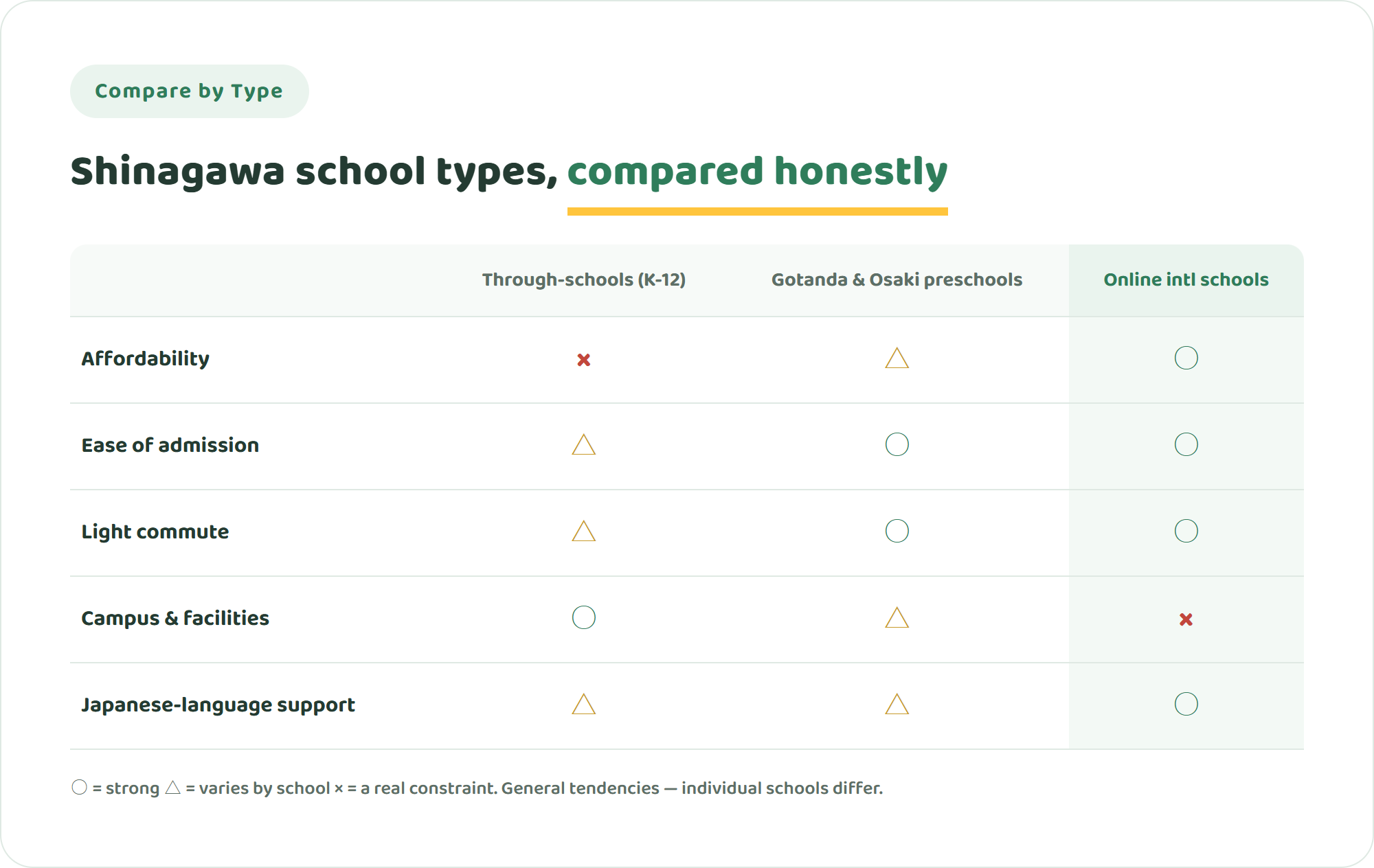
Shinagawa’s real advantage is the commute. SIS is three to five minutes from Aomono-Yokocho; CIS is seven minutes from Osaki. In a city where families routinely accept an hour each way, a station-front campus has genuine value, especially for two working parents. The trade-off is cost: tuition starts a little over ¥2 million a year and, once one-off fees are counted, a first year can approach ¥4 million. The early-years schools are far easier to start — monthly billing, some accepting one day a week — but they end at six, and the question of what happens next arrives sooner than most parents expect. If it is the fees rather than the schools that are giving you pause, it is worth reading whether international school is simply too expensive before you rule anything out.
See how learning works online →
When fees or the commute are the real barrier: an eighth option
Shinagawa is a good place to raise children — close to central Tokyo, well served by parks and transport. Even so, the constraints are real: three through-schools in the whole ward, tuition from roughly ¥2.09 to ¥2.9 million a year before one-off fees, and at least one school whose elementary years happen in a different ward altogether. If you find yourself thinking that you want an international education for your child but cannot see the burden lasting a decade, there is an eighth option that does not assume a commute at all: an online international school.
NIJIN GLOBAL ACADEMY (NGA) is an online international school opening in September 2027. It is run by NIJIN Inc., the company behind NIJIN Academy, an alternative school in Japan with more than 1,000 enrolled students. NGA is built on the idea of stepping away from ranking children by test scores, with small-group, dialogue-centred learning aimed at helping students come to like themselves and the world around them. It is open to children aged 6 to 18 across Asia and Oceania, wherever they live, and it is designed so that Japanese remains a support while English is introduced gradually. We are working towards tuition at roughly one-fifth of a bricks-and-mortar international school.
In fairness, we should say plainly that NGA has not opened yet and has no track record to show you. Nor can an online school replicate a playground, a science lab or a sports field. But if the barriers you are facing are cost and commute rather than conviction, learning that connects your child to the world from your own home is worth putting on the list.
Frequently asked questions
Q. What does Shinagawa International School actually cost in total?
A. Tuition alone runs from about ¥2,575,000 to ¥2,900,000 a year, but the amount you actually transfer includes a ¥250,000 maintenance fee and a ¥50,000 supply fee on top. In the first year you also pay a ¥40,000 application fee and a ¥1,000,000 enrolment fee. So a child starting in Grade 1 costs roughly ¥4 million in year one and about ¥2,975,000 a year thereafter. If the school determines that EAL or learning support is needed, each adds ¥500,000 a year (2026–2027 figures, as published by the school).
Q. From what age can my child start, and what about Japanese-language support?
A. The early-years entry points are plentiful: Kids International Gotanda takes children from six months, NES Gotanda from birth, First Learning from age one and Dagis Gotenyama from two. Among the through-schools, Shinagawa International School starts at age three and Canadian International School at kindergarten. On Japanese, SIS teaches it as a subject throughout and offers Japanese A, Japanese B and Japanese ab initio at Diploma level; Dagis protects 45 minutes of Japanese daily. Because losing Japanese is the single most common regret families report, ask each school directly how many hours a week it teaches and how it streams by level.
Q. Is it possible to transfer in mid-year?
A. Shinagawa International School accepts applications year-round, so a mid-year start is possible where places exist. Elsewhere, availability shifts by grade and by term, and an English assessment or interview is standard. Fees are also reviewed annually, so the figures in a brochure you picked up last year may no longer hold. Contacting schools directly six to twelve months before your intended start date is the safest approach.
The time you spend deciding is time spent caring
There is no single right answer here. In a ward like Shinagawa, where the schools are few but each has a distinct character, the useful question is rarely which school is best — it is which choice your family can sustain for years. Fees, the daily journey, your child’s temperament: every family weighs these differently. The fact that you are hesitating at all is evidence of how seriously you are taking your child’s future. Take your time, visit a few schools in person, and compare what you actually see. And if you would like to keep a no-commute option in view as well, we would be glad for you to hear from us when we open.
International Schools in Other Cities
- International Schools in Tsukuba: Fees
- International Schools in Sendai: 7 Picks and Fees
- International Schools in Shinjuku: Fees
- International Schools in Karuizawa: All 4 Schools
- International Schools in Sapporo: Fees
- International Schools in Dubai: Fees
- International Schools in Kawasaki
- International Schools in Kita, Tokyo
- International Schools in Tokyo
- International Schools in Minato: Fees
- International Schools in Shibuya, Tokyo
- International Schools in Setagaya: All 14 Schools
- International Schools in Koto, Tokyo
- International Schools in Meguro: All 8 Schools