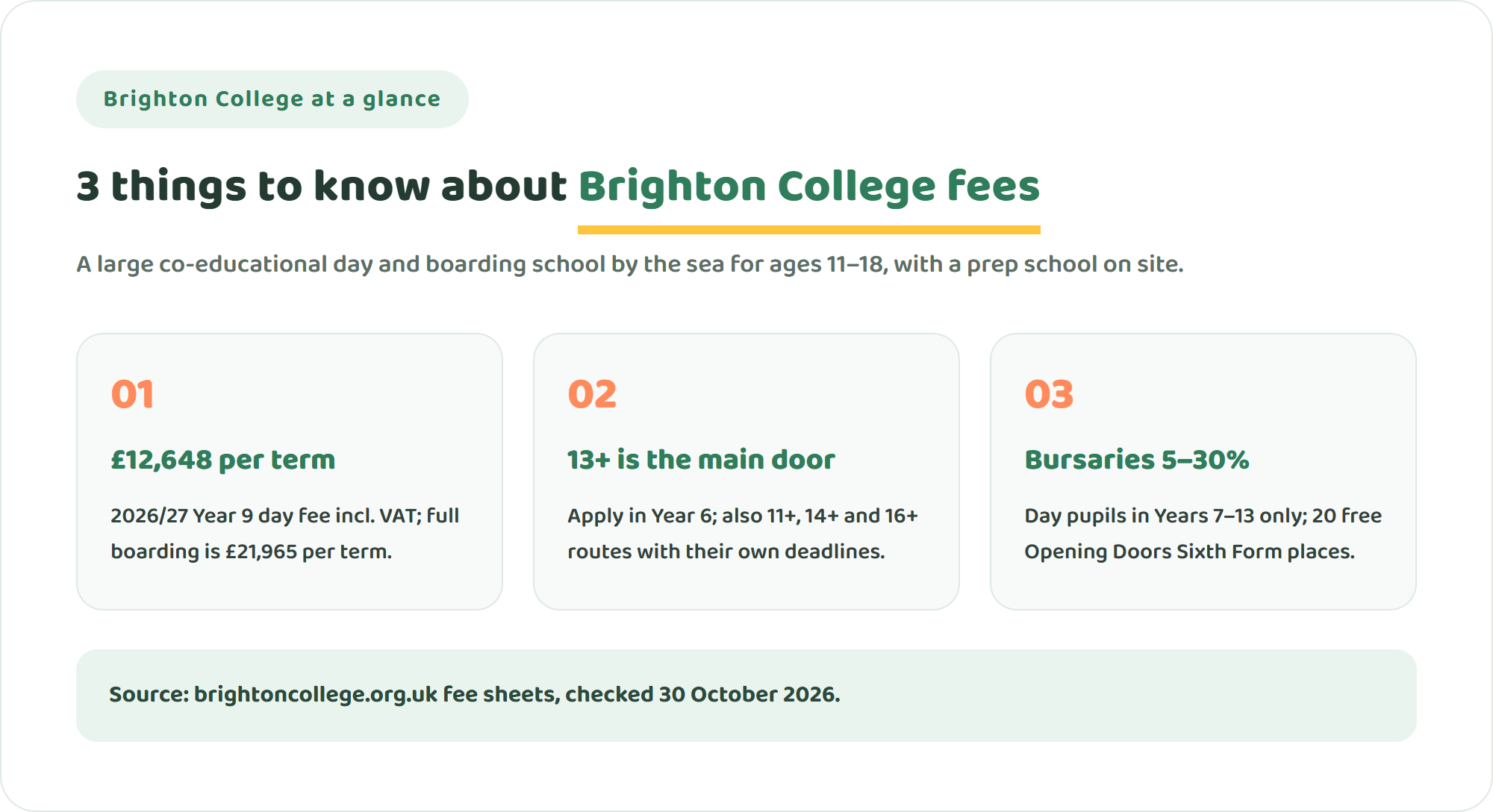
Brighton College fees for 2026–27 are £12,648 per term for a Year 9 day pupil (£37,944 a year), rising to £13,259 per term in Year 13, and £21,965 per term for a Year 9 full boarder (£65,895 a year), rising to £23,187 in Year 13 — all inclusive of VAT and the school’s 2026/27 “transitional price support” (official fee sheets, checked 30 October 2026). Lower School day fees are £9,612 per term in Year 7 and £10,466 in Year 8; weekly boarding runs from £18,511 to £19,087 per term. Families whose parents live overseas pay higher boarding rates (full boarding £27,194–£28,663 per term) but the same day fees. On top of the termly fee, a new pupil pays a £300 registration fee (£470 for overseas applicants), a £120 entrance charge and a refundable deposit of £2,500 to £8,500 for UK families, or £12,000 to £25,000 for overseas families.
If you searched “Brighton College fees”, “Brighton College fees per year” or “Brighton College admissions”, you probably want three things: the real numbers by year group and boarding status, a clear picture of how and when children get in (11+, 13+, 14+ and 16+ each run differently), and an honest sense of who the school suits. This page answers those questions from Brighton College’s official website and fee documents, then compares it with Westminster School and Winchester College, and with NIJIN GLOBAL ACADEMY (NGA) — a very different kind of option: an online international school for ages 6–18 that opens in September 2027.
The short answer: who Brighton College suits — and who it doesn’t
- Suits: families who want a large, academically strong co-educational school. The Independent Schools Inspectorate recorded 1,290 pupils aged 11–18, including 478 boarders, in October 2024, and the school has permission to grow to 1,600. In August 2026 it reported 372 A* grades at A Level, with more than 97% of grades at A*–B.
- Suits: families in Sussex, Surrey, Kent, London and Berkshire who want a day place or weekly boarding. The school runs 25 bus routes, including seven express routes for weekly boarders that run on Monday mornings and Friday evenings, and there is no Saturday school.
- Suits: families who want a long runway. Brighton College Prep School (Nursery to Year 6) shares the site, the Lower School takes children at 11+ and 12+, and the main entry point is 13+, with further doors at 14+ and 16+.
- Suits: children with a talent to develop. Scholarships are offered in academic studies, art, chess, choral singing, dance, debating, design and technology, drama, music, photography and sport, plus an all-rounder “Millennium” award.
- Harder fit: families who need a bursary for boarding. Bursaries are for day pupils in Years 7–13 only, are typically in the 5%–30% range, and are very unlikely if gross family income exceeds £120,000.
- Harder fit: overseas families on a tight budget. Pupils whose parents live abroad or lack settled UK status pay a higher boarding fee (up to £28,663 per term for full boarding), a £25,000 boarding deposit, and EAL lessons are charged on top (£876 to £3,396 per term).
- Harder fit: families who want boarding before Year 9. Brighton College itself does not board pupils until Year 9; the school points younger children to its sister prep at Handcross, which boards from Year 4.
What Brighton College is
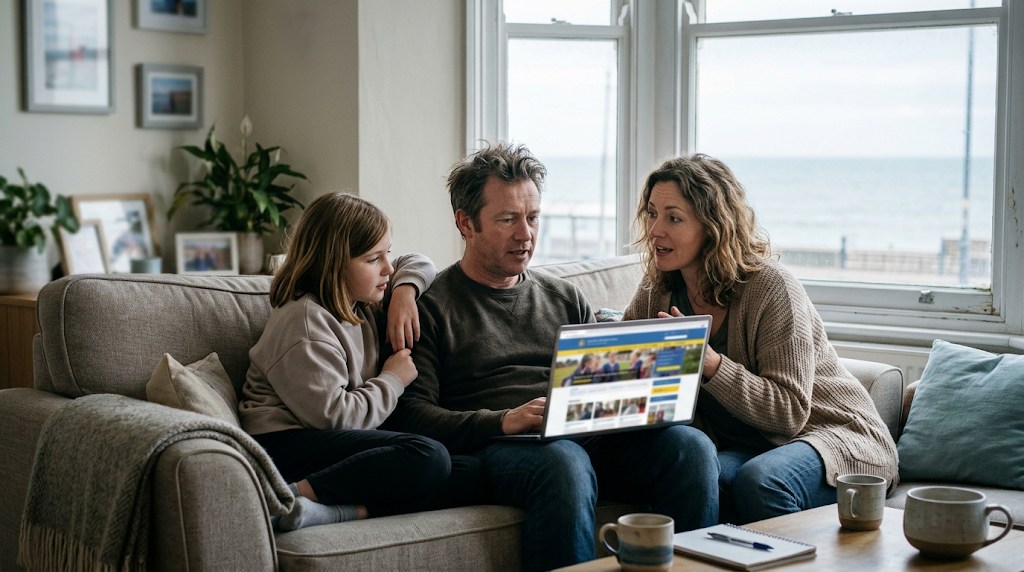
Brighton College is an independent co-educational day and boarding school on Eastern Road in Brighton, East Sussex, founded in 1845 and run as a registered charity. The College takes pupils aged 11 to 18: a Lower School for Years 7 and 8 (day only), a Senior School for Years 9 to 11 and a Sixth Form for Years 12 and 13. Brighton College Prep School, for children from Nursery to Year 6, sits alongside it and is inspected separately. The campus is, in the school’s words, “in sight of the sea and within walking distance of the South Downs countryside”; Gatwick Airport is a 30-minute drive, Heathrow 75 minutes and central London a 50-minute direct train.
The school is also the parent of a “Family of Schools”: three UK prep schools (Brighton College Prep Handcross, Prep Hove and Prep Kensington in London) and ten international schools in Abu Dhabi, Al Ain, Dubai, Singapore, Bangkok, Vibhavadi (Thailand), Hanoi, Madrid, Lisbon and Rome. The official page says these schools “share Brighton College’s aims and ethos”; the fees and admissions on this page relate only to the Brighton campus. In August 2024 the previous Head Master became Principal of the family of schools and Steve Marshall-Taylor became Head Master of Brighton College.
Brighton College’s own site lists The Sunday Times “School of the Decade”, “Top Co-Educational School in the UK” and “UK Boarding School of the Year” in the Parent Power guide for both 2025 and 2026, and “Top School of the Year for A-levels” in 2025. The most recent inspection by the Independent Schools Inspectorate (ISI), on 15–17 October 2024, found that all the Standards were met and described the curriculum and activities programme, and the culture of kindness, as significant strengths.
| Item | Brighton College (official information, checked 30 October 2026) |
|---|---|
| School type | Independent co-educational day and boarding school, Brighton, East Sussex; registered charity 307061 |
| Ages / years | 11–18 (Year 7 to Year 13); Brighton College Prep School on the same site for Nursery to Year 6 |
| Pupils | 1,290 pupils, 478 boarders (ISI report, October 2024); registration being increased from 1,300 to 1,600 places |
| Fees 2026–27 (per term, UK pupils) | Day £9,612 (Year 7) to £13,259 (Year 13); weekly boarding £18,511–£19,087; full boarding £21,965–£23,187; all inclusive of VAT and 2026/27 price support |
| Boarding | Weekly and full boarding from Year 9; six boarding houses on site plus a co-educational Sixth Form house nearby; no Saturday school |
| Entry points | 11+, 12+ (Lower School, day only), 13+ (main entry), 14+, 16+ |
| Inspection | ISI, 15–17 October 2024: all Standards met |
| Financial aid | Means-tested bursaries for day pupils in Years 7–13 (typically 5%–30%); scholarships at 11+, 13+ and 16+; 20 fully funded “Opening Doors” Sixth Form places for local pupils |
Brighton College fees 2026–27 (official, including VAT)
Everything below comes from the three fee documents linked from Brighton College’s admissions pages — the UK Boarding and Day Fees Structure 2026–27, the Overseas/International Fees Structure 2026–27 and the Detailed Fees Structure 2026–27 — checked on 30 October 2026. The structure came into force on 1 July 2026 and applies to the Michaelmas 2026, Hilary 2027 and Trinity 2027 terms. The school publishes two versions of every fee: the underlying fee before VAT, and the fee “inclusive of VAT and the 2026/27 transitional price support” for payers whose fees are subject to VAT. The figures you will actually be billed are the VAT-inclusive ones, so those are what we show. Note that the lunch element within the fee is not subject to VAT, and that the fee sheet labels year groups in Brighton’s own terms: Year 9 is the “4th Form”, Year 11 the “Upper 5th”, Year 13 the “Upper 6th”.
UK pupils (parents settled and ordinarily resident in the UK)
| Year group | Day, per term | Weekly boarding, per term | Full boarding, per term | Day, per year (3 terms) | Full boarding, per year |
|---|---|---|---|---|---|
| Year 7 (Lower 3rd) | £9,612 | – | – | £28,836 | – |
| Year 8 (Upper 3rd) | £10,466 | – | – | £31,398 | – |
| Year 9 (4th Form) | £12,648 | £18,511 | £21,965 | £37,944 | £65,895 |
| Year 10 (Lower 5th) | £12,824 | £18,605 | £22,283 | £38,472 | £66,849 |
| Year 11 (Upper 5th) | £12,906 | £18,687 | £22,424 | £38,718 | £67,272 |
| Year 12 (Lower 6th) | £12,906 | £18,957 | £23,046 | £38,718 | £69,138 |
| Year 13 (Upper 6th) | £13,259 | £19,087 | £23,187 | £39,777 | £69,561 |
The per-year figures are our arithmetic (the official sheet quotes per term only; fees are “spread across three equal tranches”). For reference, the underlying fees before VAT are £8,280 (Year 7) to £11,360 (Year 13) for day pupils, £15,830–£16,320 for weekly boarders and £18,770–£19,810 for full boarders.
Overseas/international pupils
Brighton College defines overseas/international pupils as those “whose parents reside overseas or do not have settled status or who are not ordinarily resident in the UK” — it is about where the parents live, not the child’s passport. Day fees are identical to the UK table above. Boarding fees are higher:
| Year group | Weekly boarding, per term | Full boarding, per term | Full boarding, per year (3 terms) |
|---|---|---|---|
| Year 9 | £22,247 | £27,194 | £81,582 |
| Year 10 | £22,353 | £27,335 | £82,005 |
| Year 11 | £22,435 | £27,476 | £82,428 |
| Year 12 | £22,764 | £28,205 | £84,615 |
| Year 13 | £22,917 | £28,663 | £85,989 |
Brighton College Prep School (same site, Nursery to Year 6)
Prep day fees for 2026–27, inclusive of VAT and price support, are £5,681 per term in Reception, £5,856 in Year 1, £6,008 in Year 2, £7,588 in Year 3, £8,570 in Year 4 and £9,612 in Years 5 and 6. Nursery fees are not subject to VAT and run from £2,700 per term (five morning sessions) to £5,500 (five full days), net of the 15 free hours of Early Years Free Entitlement. The Prep registration fee is £250 (£470 for overseas pupils) and the deposit £2,500 (£12,000 overseas).
One-off charges when your child joins
| Charge | UK pupils | Overseas/international pupils |
|---|---|---|
| Registration fee (non-refundable, incl. VAT) | £300 | £470 |
| Entrance fee (non-refundable, added to the first term’s bill) | £120 | £120 |
| Deposit — Lower School (Years 7–8) | £2,500 | £12,000 |
| Deposit — Senior School and Sixth Form, day | £3,500 | £12,000 |
| Deposit — Senior School and Sixth Form, boarding | £8,500 | £25,000 |
Deposits are not subject to VAT, are “not a contribution towards the first, final or any term’s tuition or boarding fees”, and are held until the pupil leaves, then refunded as a credit against the final bill. A top-up may be required if a pupil switches from day to boarding. If you cancel an accepted place with less than a full term’s notice, or the pupil does not join, the higher of one term’s fees or the deposit becomes payable. Pupils whose parents live abroad and who need a Child Student visa should also budget for visa costs; the fee documents do not state a separate sponsorship charge, so this is not published on the official site.
What the fee includes — and what it doesn’t
The Detailed Fees Structure says day fees include “tuition of the curriculum (including sports and arts), lunch, and pupils’ personal accident insurance”. Boarding fees add accommodation, breakfast, supper, laundry, 24-hour on-site medical, pastoral and security provision, supervised prep and evening and weekend activities. Extras billed on top include textbooks, examination fees, trips and sports tours, taxis and stationery. The published optional charges for 2026–27 give a sense of scale:
- Music: individual lessons £522 per term per instrument; group lessons £258. LAMDA drama £432 per term (shared); debate coaching £258; dance typically £216.
- English as an Additional Language (EAL): £876 per term for one lesson a week, £1,752 for two, £2,574 for three and £3,396 for four or more. An offer may make EAL lessons a condition of joining.
- Learning support: short-term support is free; ongoing specialist support is charged, for example £480–£540 per term for small-group lessons in Years 7–13.
- Bus, insurance and society: the school bus is billed separately; optional personal property insurance is £7.37 per term; the optional Fees Return Scheme costs 0.66% of gross fees; the Brighton College Society is £50 per family per year unless you opt out.
Three things parents on a budget will want to know: there is a 5% sibling discount on tuition and boarding fees for every child except the youngest (new sibling offers from July 2026, applied to net fees); a payment-in-advance discount of 1.25% in the first year and 2.5% in later years when at least a full year is paid up front; and a Direct Debit scheme that splits each term’s bill into three monthly instalments. Otherwise fees are due before 8am on the first day of term, and late payment attracts 1.5% per month. A full term’s notice is required to withdraw a pupil (two terms for boarders in Year 11).
What five years at Brighton College cost at today’s prices
Using only the official 2026–27 figures, with no bursary, no sibling discount and no fee rises, here is the arithmetic for a child who joins in Year 9 and stays to Year 13 (15 terms):
- UK day pupil: 3 × (£12,648 + £12,824 + £12,906 + £12,906 + £13,259) = £193,629.
- UK weekly boarder: 3 × (£18,511 + £18,605 + £18,687 + £18,957 + £19,087) = £281,541.
- UK full boarder: 3 × (£21,965 + £22,283 + £22,424 + £23,046 + £23,187) = £338,715.
- Overseas full boarder: 3 × (£27,194 + £27,335 + £27,476 + £28,205 + £28,663) = £416,619.
- Joining costs: £300 (or £470) registration + £120 entrance fee, plus the refundable deposit of £3,500 or £8,500 (£12,000 or £25,000 for overseas families).
For an overseas family joining only for the Sixth Form as a full boarder: 3 × (£28,205 + £28,663) = £170,604 in fees over two years, plus £590 in registration and entrance charges and a £25,000 refundable deposit, before EAL lessons, travel, guardianship and extras. The UK day equivalent for two Sixth Form years is 3 × (£12,906 + £13,259) = £78,495. Our guide to online vs in-person international school costs shows how boarding budgets like these compare with day and online schooling more generally.
Bursaries and scholarships at Brighton College
Bursaries: day pupils only, typically 5%–30%
The Bursary Policy 2026–27 is unusually candid. Bursaries are means-tested, “usually awarded as a specific monetary value, deducted from net tuition fees”, and are only available to day pupils in Years 7 to 13 — boarding pupils are not eligible. Awards are “typically in the 5%-30% range”, with higher support “only in exceptional circumstance”. The policy says a bursary is “very unlikely” if a family’s total gross income is above £120,000 a year, and lists things it considers inconsistent with a bursary: significant equity in property, cash savings or liquid assets above £30,000, frequent or expensive holidays, new or luxury cars and significant home improvements. The Finance Team may visit the family home as part of the assessment. Awards are for one academic year at a time and families must reapply each year, returning repeat means-testing forms four weeks before the end of the Hilary term.
The application windows matter because they are early. For 11+ entry, apply between 1 August and 30 November of the year before joining; bursaries are confirmed by the first week of February. For 13+ entry, the window runs to 31 October roughly 22 months before entry, so that indicative amounts are known before parents accept a place in January of the year before joining. For 16+ entry, apply between 1 August and 31 October of the year before joining; bursaries are confirmed by the first week of December. The number of pupils receiving bursaries and the total bursary budget are not published on the official site.
Opening Doors: 20 fully funded Sixth Form places
Separately from the bursary policy, Brighton College has offered 20 free 16+ places a year since September 2020 through its Opening Doors programme, described as “fully funded (100%+ bursaries)”. It is aimed at talented young people from the local area, which may include pupils eligible for free school meals, those who are or have been in care, first-generation university applicants, and those who have experienced significant disadvantage or displacement, such as refugees. The registration deadline for 2027 entry was 14 October 2026.
Scholarships: what they are worth is not published
Scholarships are awarded at 11+, 13+ and 16+ in academic studies, art, chess, choral singing, dance, design and technology, drama, music and sport, with debating and photography added at 13+ and an all-rounder “Millennium” scholarship at 11+ and 13+. The official pages say scholars receive “an annual amount deducted from their fees, which lasts throughout their time at the College”, plus benefits such as free instrumental or vocal tuition for music and choral scholars; the percentage or cash value is not published on the official site. Candidates can hold up to three awards (the Millennium award is stand-alone at 13+). For 2027 entry, the 11+ scholarship closing date was 16 November 2026 with assessments on 8 January 2027; most 13+ scholarship applications close on 7 December 2026 (academic scholarships on 22 February 2027) with assessments between January and May 2027 — and at 13+ an offer of a place must already have been accepted before applying. All 11+ and 16+ candidates are automatically considered for an academic scholarship on their entrance papers and interview.
How a school week works: day, weekly boarding and time zones
Brighton College is an in-person school on UK time with three terms. In 2026–27 Michaelmas term begins at 8.20am on Thursday 3 September 2026 with half term from 20 October; Hilary term begins on Wednesday 6 January 2027 with half term from 11 February; Trinity term begins on Monday 12 April 2027 with half term from 28 May. Boarders also have an “Exeat” weekend early in the Michaelmas and Trinity terms. The school does not publish a detailed daily timetable on the pages we checked, so ask at an Open Morning what a typical day looks like for your child’s year group.
Boarding is weekly or full, from Year 9 only, across six boarding houses on the main site (three for boys, two for girls, per the ISI report) plus a co-educational Sixth Form house close to campus. The boarding page is explicit that there is “no Saturday school”, prep is completed during the week, and weekly boarders can go home on Friday night or stay to Saturday. Full boarders have a weekend programme — swimming, cookery, beach volleyball, sports fixtures and debating on Saturdays; go-karting, bouldering, creative workshops and trips to London on Sundays. For weekly boarders there are seven express bus routes (Loxwood, Tunbridge Wells, Chichester, Clapham, Kensington, Oxted and Berkshire/Surrey) that run on Monday mornings and Friday evenings. If you are weighing a Brighton boarding place against learning from home in another country, our explainer on how an online international school day works shows the other side of that trade-off.
Brighton College admissions: entry points at 11+, 13+, 14+ and 16+
The How to Apply page asks first where your child is being educated: “Any applicant who is studying outside of the UK, regardless of nationality, is generally considered an overseas applicant”, and overseas applicants follow a different, earlier timeline. Applications go through the online Admissions Portal.
11+ and 12+ (Years 7 and 8, Lower School — day only)
UK applicants should apply “ideally by mid-November of Year 6” (or Year 7 for 12+). All registered candidates sit the ISEB Pre-Tests in maths, English, verbal and non-verbal reasoning, then attend an Orientation Day in early January of Year 6 with written English and maths assessments and an interview. Places are offered by the end of January of Year 6, and every new Lower School pupil is paired with a pupil buddy. Overseas applicants should apply by the beginning of September of Year 6, sit the ISEB Pre-Tests and the College’s own English and maths papers at an approved invigilation centre in their local city, interview in person or via Microsoft Teams, and receive results by the end of November. Remember that Brighton College does not offer boarding until Year 9.
13+ (Year 9) — the main entry point
- Year 6 pathway (the usual route): apply by the beginning of October of Year 6. Candidates sit the ISEB Common Pre-Tests; those who succeed are invited to an Orientation Day in February of Year 6, with an interview and written English and maths assessments. Places are offered in early March of Year 6 — two and a half years before the child joins.
- Year 7 pathway: for children who missed the Year 6 round or whose school does not support the ISEB Pre-Tests. Apply by the beginning of October of Year 7; Pre-Tests and an Orientation Day in November of Year 7; offers at the end of November of Year 7.
- Year 8 pathway: apply by the beginning of September of Year 8, “subject to availability of places”; written English and maths assessments and an interview; offers at the end of November of Year 8. Families who miss this can ask about the Head Master’s List.
Overseas candidates follow the same three pathways with earlier deadlines (beginning of October of Year 6, beginning of September of Year 7 or Year 8); they may sit the English and maths papers at an approved invigilation centre in their local city and interview via Microsoft Teams, and the school encourages a UKiset report if English is not the child’s first language. Once an offer is accepted, there are Taster Days in Year 7 and an Induction Day before Year 9. Scholarships for Year 9 entry are assessed in Year 8.
14+ (Year 10)
Apply “by the beginning of January in Year 9 at the latest” (UK) or the beginning of September of Year 9 (overseas). Candidates attend an Assessment Day in January of Year 9 with written English, maths and verbal reasoning papers; selected pupils are then interviewed, and places are offered by mid-March of Year 9.
16+ (Sixth Form)
The Sixth Form entry 2027 document and the Sixth Form admissions page give an exact calendar for 2027 entry: application deadline Wednesday 14 October 2026 (UK) or Friday 4 September 2026 (overseas); Assessment Day Wednesday 21 October 2026, with a 45-minute verbal reasoning test, a 45-minute maths paper and a 90-minute General Paper covering scientific reasoning, reading and writing; two interviews with academic staff on Saturday 21 November 2026 for short-listed candidates; offers on Tuesday 1 December 2026; and acceptance by Tuesday 8 December 2026. Offers are conditional on GCSE results: external A Level candidates need a minimum 7.0 average on the 9–1 scale with at least a 6 in both English Language and Maths; the Sports Science BTEC Extended Diploma requires a 5.5 average. The school writes to the current school for a reference and predicted grades in November. Overseas candidates sit the papers at an approved invigilation centre in September or October and receive results by the end of November. Boarding places for overseas pupils are available at Year 12; the school also says it offers day places at all entry points.
International pupils and visas
Brighton College is a licensed sponsor with UK Visas and Immigration and can sponsor non-UK pupils for a Child Student visa “upon request”. The school says such a visa “is most suitable for full boarders”; families applying for a day or weekly boarding place who would need a visa are asked to contact the Visas Coordinator first. The ISI report noted 193 pupils with English as an additional language; EAL lessons are charged separately (see above).
Inspection, qualifications and recognition
UK independent schools are not “accredited” in the American sense; they are registered with the Department for Education and inspected. Brighton College’s most recent ISI inspection took place on 15–17 October 2024. The report states that the Standards relating to leadership and governance, quality of education, pupils’ health and wellbeing, social and economic education and safeguarding were all met, that “pupils achieve very highly in public examinations”, and that the activities programme and the PSHE-led culture of kindness are significant strengths. Its one recommended next step was to strengthen careers guidance in Years 7 and 8. Inspectors also recommended approving the school’s request to raise its capacity from 1,300 to 1,600 pupils and to extend its age range to 19. The previous inspection was in November 2021.
Pupils take GCSEs and A Levels, and the Sixth Form also offers BTECs in Sports Science and Business. The school’s A Level results announcement of 13 August 2026 reported 372 A* grades, more than 97% of grades at A*–B, and 52 pupils with three or more A*s; it named Oxford, Cambridge and Imperial College London as the three most popular destinations for that year group. The school’s own pages say its A Level results have placed it “in the top 1% of schools in England” over the past five years. A full results table by year is not on the pages we checked, so detailed historical percentages are not published on the official site in that form.
Brighton College vs Westminster School vs Winchester College vs NIJIN GLOBAL ACADEMY (official data)
Westminster School (central London, day and weekly boarding) and Winchester College (full boarding in Hampshire) are two famous names that families shortlisting Brighton College often look at, not least because all three take pupils at 13+ and 16+. NIJIN GLOBAL ACADEMY (NGA) is a different kind of school altogether — online, for ages 6–18, and not yet open. For the full breakdowns, see our Westminster School fees guide and our Winchester College fees review.
| Brighton College | NIJIN GLOBAL ACADEMY | Westminster School | Winchester College | |
|---|---|---|---|---|
| School type | Independent co-educational day, weekly and full boarding school, Brighton | Online international school focused on Asia & Oceania; opens September 2027 (planned) | Independent day and weekly boarding school, central London; becoming fully co-educational by 2030 | Independent boarding school with day places, Winchester, Hampshire |
| Ages / entry | 11–18; entry at 11+, 12+, 13+ (main), 14+, 16+ | Ages 6–18 | 13–18; 11+ (via Under School), 13+, 16+ | 13+ and 16+ (see official site) |
| Fees 2026–27, per term | Day £12,648 (Year 9) to £13,259 (Year 13); weekly boarding £18,511–£19,087; full boarding £21,965–£23,187 (overseas families £27,194–£28,663); incl. VAT | Not yet published (no enrolment, facility or uniform fees; materials included; sibling discounts) | Day £16,456 (13+) / £17,482 (16+); boarding £23,094; incl. VAT | Boarding £20,700; day £15,318; incl. VAT where applicable |
| Full boarding, per year | £65,895 (Year 9) to £69,561 (Year 13) | Not applicable (online) | £69,282 | £62,100 |
| One-off fees | Registration £300 (£470 overseas); entrance fee £120; deposit £3,500 day / £8,500 boarding (£12,000 / £25,000 overseas) | No enrolment fee | Registration £360; entrance fee £2,400; deposit £4,000 (£5,000 international boarders); visa sponsorship £1,200 at 16+ | Registration £480; acceptance fee £2,000; deposit £4,000 UK / £20,700 non-UK; visa support £1,440 a year |
| Curriculum | GCSE and A Level; BTEC Sports Science and Business in the Sixth Form | Subjects learned in English, CEFR-based English levels, projects; optional Cambridge IGCSE / A-Level pathway | (I)GCSEs and A Levels | See official site |
| Classes & time zone | In person, UK; no Saturday school | Small live online dialogue groups (about 8); built for Asia–Oceania daytime — may fall outside the day in the UK, Europe or the Americas | In person, UK; Saturday morning school | In person, UK |
| Inspection / diploma | ISI October 2024, all Standards met; public GCSE and A Level exams | Not yet accredited; no graduates yet | ISI February 2024, fully compliant; public (I)GCSE and A Level exams | See official site |
| Admission | ISEB Pre-Tests, Orientation Day papers and interview (11+/13+); assessment papers and two interviews, GCSE conditions (16+) | No academic entrance exam, no English requirement | ISEB pre-tests, school tests and interview (13+); four subject exams and interviews (16+) | See official site |
| Financial aid | Bursaries 5%–30% typical, day pupils only; 20 fully funded Opening Doors Sixth Form places | Tuition not yet published; sibling discounts | Bursaries up to 100% of day fees, London-based families | See official site |
| International pupils | Welcomed at all entry points; higher boarding fee and deposit; Child Student visa sponsorship mainly for full boarders | Learn from home in any country; travels with the family if they relocate | Under 16 only with parents resident in the UK; visa sponsorship at 16+ only | Non-UK-resident deposit £20,700; visa support £1,440 a year |
Sources: Brighton College UK fees 2026–27, Brighton College overseas fees 2026–27, Brighton College how to apply, Westminster School fees, Winchester College fees — checked 30 October 2026.

Is Brighton College worth it? Reviews and common concerns, answered honestly
“Worth it” depends on your child and your circumstances, not on an awards list. These are the questions parents raise most often when they research Brighton College, with what the official documents say.
“Is it too big?”
Brighton College is large by UK independent-school standards — 1,290 pupils at the last inspection, with approval sought to grow to 1,600. The ISI report describes recent building work in the Sixth Form, performing arts and dining spaces and an expanded wellbeing hub to cope with the larger numbers. If size worries you, visit on a normal school day rather than only at an Open Morning, and ask how the House system and tutor groups work for your child’s year.
“How selective is it, really?”
Brighton College does not publish application-to-place ratios on the pages we checked, so we cannot quote odds. What is clear is that every route involves testing — ISEB Pre-Tests plus Orientation Day papers and an interview at 11+ and 13+, an Assessment Day at 14+, three papers and two interviews at 16+ — and that Sixth Form offers are conditional on a 7.0 GCSE average. The school also notes that Year 8 applications for Year 9 are “subject to availability of places”. A sensible plan is to apply in the Year 6 round if you can, and to keep a second school in play.
“Will we get help with the fees?”
Only in specific circumstances. Bursaries are for day pupils in Years 7–13, usually worth 5%–30%, very unlikely above £120,000 gross family income, and reassessed every year. Boarders are not eligible. Opening Doors offers 20 fully funded Sixth Form places, but it is aimed at disadvantaged young people from the local area. Scholarships reduce fees by an unpublished “annual amount”. Most families should budget for close to the full fee.
“What about VAT and future increases?”
VAT at 20% has applied to UK private school fees since 1 January 2025. Brighton College’s 2026–27 sheets quote both the pre-VAT fee and the fee including VAT and a “transitional price support” that the school is applying this year; the documents do not say how long that support will continue, so the gap between the two columns is worth asking about. The school also states plainly that “fees may be subject to revision” and that its policy is to make “only appropriate fee increases year on year”.
“We live abroad — is the higher fee fair, and what else should we expect?”
The overseas rate applies when parents live abroad or lack settled status, regardless of the child’s nationality; a Year 9 full boarder from an overseas family pays £27,194 per term against £21,965 for a UK family, and the boarding deposit is £25,000 rather than £8,500. Add EAL lessons if they are a condition of the offer (£876 to £3,396 per term), travel, and a guardian if required. On the other hand, the school welcomes overseas applicants at every entry point, runs assessments at invigilation centres abroad, interviews on Teams and sponsors Child Student visas for full boarders.
“Is boarding before Year 9 possible?”
Not at Brighton College itself. Boarding starts in Year 9; for younger children the school points to Brighton College Prep Handcross, which boards from Year 4. Families who need boarding at 11+ should compare schools that board from Year 7, such as those in our Charterhouse fees guide and Wellington College fees guide, where the entry points differ.
Alternatives to Brighton College worth comparing
Westminster School suits academically very able children who want a London day school, with 13+ day fees of £16,456 per term and a bursary scheme that can reach 100% of day fees for London families. Winchester College suits families who want traditional full boarding at £20,700 per term, with a day option at £15,318. For other boarding schools in the same price range, see our Eton College fees review and Harrow School fees review; for a selective London day school, our guide to St Paul’s School fees; and for a co-educational full boarding school, our Rugby School fees guide. If you are open to a British curriculum studied online instead, compare our King’s InterHigh fees and review and our overview of online British curriculum school fees.
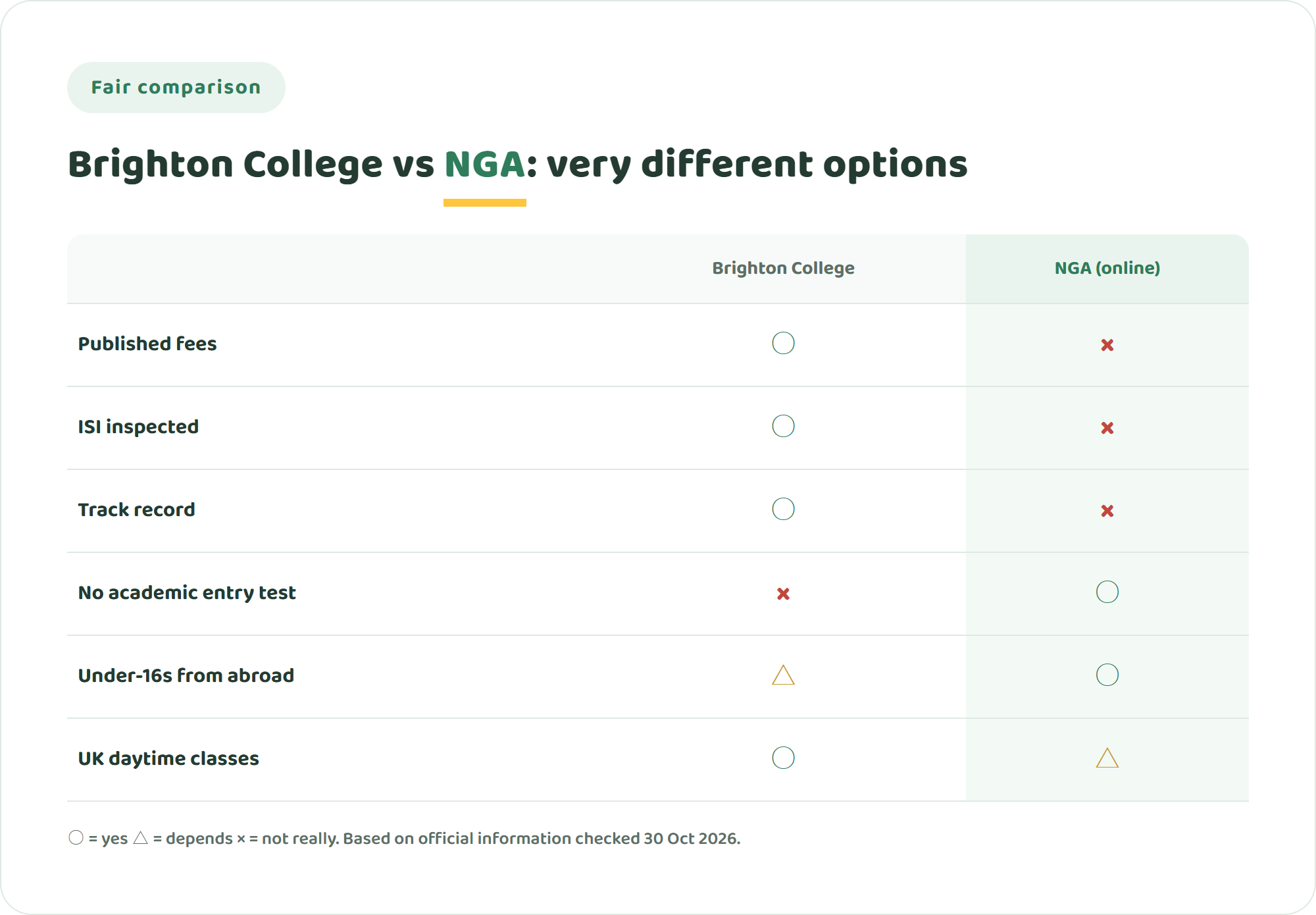
NIJIN GLOBAL ACADEMY (NGA) is a different kind of option. It is an online international school for ages 6–18 focused on Asia and Oceania, opening in September 2027 (planned), with free trial classes monthly from September 2026 and pre-opening trial classes in April–May 2027. Its first cohort is 100 students, and it is operated by NIJIN Inc. in Japan, whose alternative school NIJIN Academy has more than 1,000 students. NGA does not rank children by test scores: lessons are small-group live dialogue (classes of about 8), subjects are learned in English with a bilingual English–Japanese mentor, English levels follow the CEFR, and students join social co-creation projects with companies and governments plus international exchange. An optional Cambridge IGCSE / A-Level pathway is listed on the curriculum and timetable page. There is no academic entrance exam and no English requirement; it can run alongside a local school or as the main school, and it travels with the family if they relocate. Tuition is not yet published; NGA says it will be far more affordable than a typical international school, with no enrolment, facility or uniform fees, materials included and sibling discounts.
Be clear about the trade-offs: NGA is not yet open, is not yet accredited and has no graduates or track record. It is not a Brighton school and offers nothing like Brighton College’s teaching in person, its boarding houses, its sports fields or its seaside campus. Its timetable is built for Asia–Oceania daytime, so for families in the UK, Europe or the Americas live classes may fall outside their day — check the timetable against your local time. If your child is a strong candidate for a selective school and you can plan from Year 5 or Year 6, Brighton College, Westminster and Winchester are the schools to compare.
For a wider view, see our online international schools compared guide.
FAQ
How much does Brighton College cost per year?
For 2026–27, a UK day pupil pays £28,836 a year in Year 7 (£9,612 per term), £37,944 in Year 9 (£12,648 per term) and £39,777 in Year 13 (£13,259 per term). Full boarding is £65,895 a year in Year 9 (£21,965 per term) and £69,561 in Year 13 (£23,187 per term). All figures include VAT and the school’s 2026/27 price support. New pupils also pay £300 registration, a £120 entrance fee and a refundable deposit (official fee sheets, checked 30 October 2026).
What are Brighton College’s boarding fees for international students?
Where parents live overseas or do not have settled UK status, full boarding costs £27,194 per term in Year 9 (£81,582 a year) rising to £28,663 in Year 13 (£85,989 a year), and weekly boarding £22,247 to £22,917 per term, including VAT. The registration fee is £470 and the boarding deposit £25,000. Day fees are the same as for UK families.
Does Brighton College offer bursaries or scholarships?
Yes, but bursaries are limited to day pupils in Years 7–13, are typically worth 5%–30% of fees and are very unlikely above £120,000 gross family income; boarders are not eligible. Twenty fully funded Opening Doors places are offered each year in the Sixth Form to disadvantaged local pupils. Scholarships at 11+, 13+ and 16+ deduct an annual amount from fees that the school does not publish.
When do you apply to Brighton College?
The main entry point is 13+: apply by the beginning of October of Year 6, sit the ISEB Common Pre-Tests, attend an Orientation Day in February of Year 6, and receive an offer in early March of Year 6. There are later Year 7 and Year 8 routes to Year 9, an 11+ route (apply by mid-November of Year 6), a 14+ route (apply by the beginning of January of Year 9) and a 16+ route (for 2027 entry, the UK deadline was 14 October 2026 with an Assessment Day on 21 October). Overseas applicants have earlier deadlines, usually the beginning of September or October.
Is Brighton College worth it, and what are the alternatives?
For a family that wants a large, ambitious co-educational school with strong exam results, a seaside campus and flexible day, weekly or full boarding, many decide it is; the fee is high and bursaries are narrow. Families often also compare Westminster School and Winchester College. NIJIN GLOBAL ACADEMY is a very different, online option for ages 6–18 focused on Asia and Oceania, with no academic entrance exam and no English requirement; it opens in September 2027 and is not yet accredited.
Choosing calmly
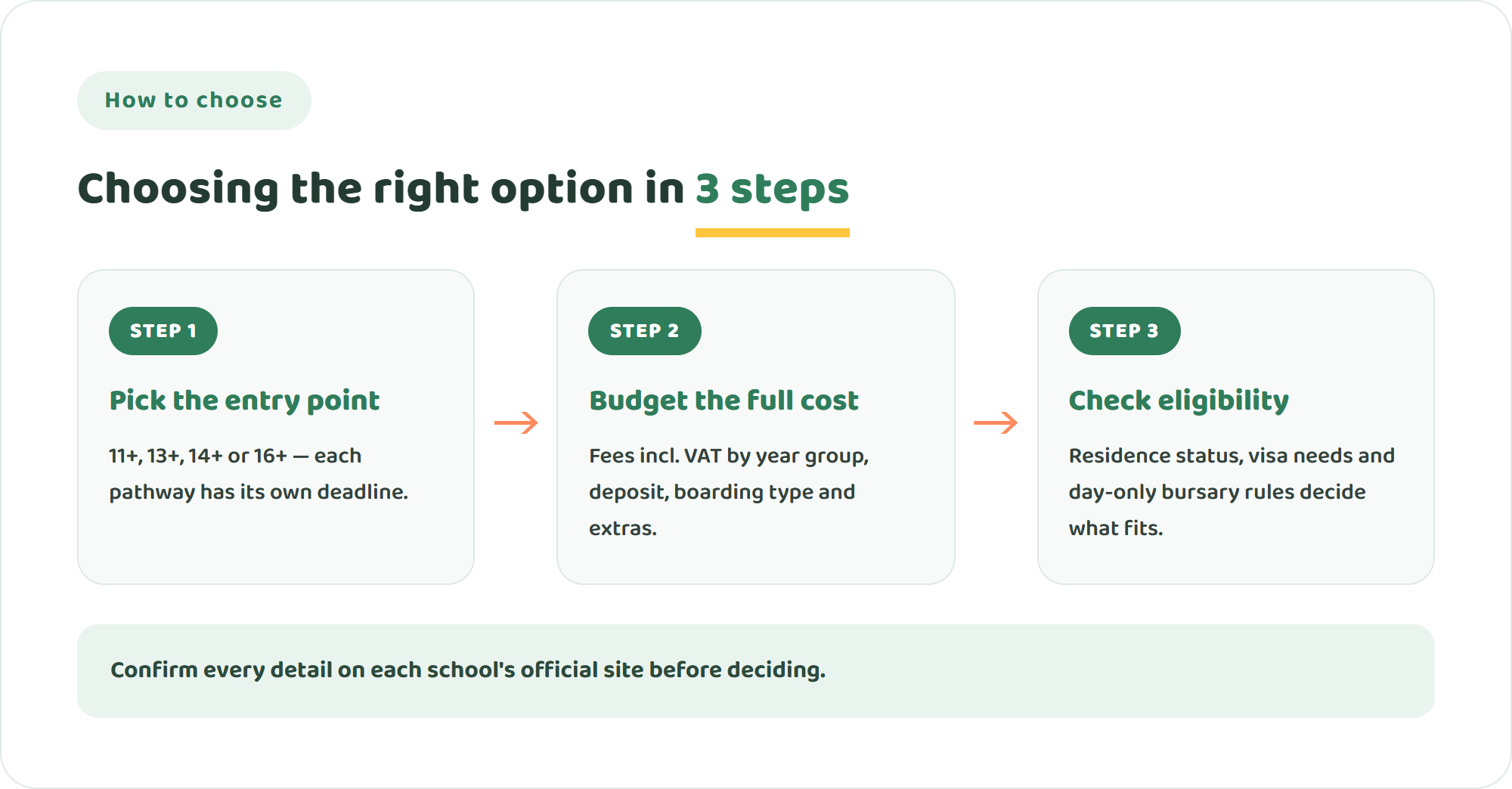
Brighton College is a confident, fast-growing school with a great deal to offer, and applying is a big step for any family — academically, financially and emotionally. The most useful thing you can do now is work out which entry point and pathway fits your child, budget the full cost honestly by year group and boarding status, and check the residence, visa and bursary rules before you start. Whichever school you choose, the right one is the place where your child will be known, stretched and happy.
Tuition and admissions details were checked on the official websites on 30 October 2026. Schools revise fees every year — always confirm on the official site before applying.