If you have just moved to Nishi-Kasai, or you are already living in Edogawa and wondering where your child goes after preschool, you have probably run into the same three questions everyone here asks: which schools actually exist in this ward, what do they really cost per year, and is there anywhere a primary-age child can attend full time? Edogawa is not an ordinary Tokyo ward for this. It has the largest foreign population of any of Tokyo’s 23 wards at 54,314 residents, and 8,493 of them are Indian nationals. Around Nishi-Kasai station alone, 4,596 Indian residents live within walking distance of each other (ward figures as of 30 April 2026). That community built something most Tokyo wards do not have. This guide covers every international school genuinely located in Edogawa, all eight of them, with age ranges and real published fees, then breaks the annual cost down into registration, tuition, building fee, materials and bus charges. Finally, if fees or the curriculum fit are the sticking point, we will be honest about one more option.
Quick Answer: Your Options in Edogawa
- GIIS Tokyo (Global Indian International School, four campuses: Seishincho, Kita-Kasai, Nishi-Kasai, Higashi-Kasai) | Ages 3-18 (K-12) | Roughly JPY 1.05m-2.33m a year (tuition plus building fee, registration extra) | The only school in the ward running all the way to Grade 12, on both a CBSE and an IB/Cambridge track
- Global Wisdom International School (Funabori and Kasai) | Age 2 to Grade 8 | Kindergarten about JPY 810,000 a year; primary about JPY 620,000-660,000 | Montessori into Cambridge, and the most affordable full-time option in the ward
- Smile International School (Nishi-Kasai and Funabori) | Ages 3-6 | JPY 78,000-98,000 a month, JPY 20,000 entrance fee | All-English preschool, 8:30-18:30, eligible for subsidies of up to JPY 80,000 a month
- Eagle International School (Higashi-Kasai, one minute from Kasai station) | Age 1 to school entry | Contact the school | Operating in Kasai since 1987, the longest-established all-English preschool in Edogawa
- Kids International Nishi-Kasai Center | 6 months to school entry | JPY 77,000-80,000 a month | Certified for the national early-childhood subsidy, with an after-school academy for older children
- Little Garden International School Koiwa (Higashi-Koiwa) | Ages 0-5 | Contact the school (Tokyo-certified nursery) | Open 7:00-19:00 on weekdays, deliberately bilingual rather than English-only
- Kerria International School of Japan (Komatsugawa) | Preschool and kindergarten | Contact the school | Thematic, play-based bilingual programme, approved for the Japanese government subsidy
- MintLeaf International Preschool Hirai | From age 0 | Contact the school | A 30-child Reggio Emilia-inspired bilingual setting three minutes from Hirai station
- NIJIN GLOBAL ACADEMY (online, opening September 2027, ages 6-18, aiming at about one-fifth of on-campus fees, with Japanese-language support built in) | An online international school you attend from wherever you live. Pre-opening; registration for opening updates is open now
International schools in Edogawa: the landscape and what they cost
Here is the one-sentence version: Edogawa is close to being the only Tokyo ward with no gap between preschool and secondary school. In most of Tokyo’s 23 wards, families find plenty of English-immersion preschools and then hit a wall, because there is one full-time international school for primary-age children, or none at all. In Edogawa, a child can start at three and finish Grade 12 without leaving the ward. GIIS Tokyo covers ages 3 to 18 across four campuses; Global Wisdom takes children from age 2 through Grade 8. For families with primary and secondary-age children, that makes Edogawa unusually well served.
The reason is demographic. Edogawa has more foreign residents than any other Tokyo ward: 54,314 as of 30 April 2026, of whom 18,568 are Chinese (34.2%) and 8,493 Indian (15.6%). Around Nishi-Kasai station the concentration is far higher still, with 4,596 of the area’s 10,324 foreign residents being Indian nationals. Twenty years of that community’s growth produced the schools you see today. The important difference is that Edogawa’s international schools were not imported for short-term corporate expatriates; they were built by families who live here permanently. Fees, calendars and bus routes reflect that.
The trade-off is range. Every full-time international school in Edogawa is Indian-founded, and the curricula on offer are CBSE, IB and Cambridge. There is no American or British K-12 international school inside the ward. Whether that suits you depends entirely on where you want your child to end up.
On cost, Edogawa is genuinely different from central Tokyo. Annual tuition plus building fee at the ward’s full-time schools runs from about JPY 620,000 to about JPY 2,330,000. The low end is Global Wisdom’s primary programme; the top end is the IB Diploma at GIIS Tokyo. Compare that with Minato or Shibuya, where roughly JPY 3 million a year is the starting point, and you can see why families relocate here specifically for schooling. Just remember to judge on the total, not tuition alone, since registration, building fees, books and bus charges all sit on top. If you want to understand how these costs are structured in general, see what international school actually costs, and for the wider picture, international schools across Tokyo.
Note: fees and details here reflect information published as of July 2026. Always confirm the current figures directly with each school.
Every international school in Edogawa: all 8, by age range and fees
We are not going to pad this out to a round number. What exists in Edogawa is two full-time schools and six preschool-focused settings: eight in total. Age ranges and price points differ enormously between them, so read for fit rather than reputation.
1. GIIS Tokyo (Global Indian International School)
Founded in Nishi-Kasai in July 2006 with fifty students, GIIS Tokyo now runs four campuses across the ward and is the anchor of international education in Edogawa. Seishincho handles pre-primary, Kita-Kasai covers pre-primary and early primary, Nishi-Kasai is home to CBSE Grades 3-12, and Higashi-Kasai runs primary, secondary and high school on the IB and Cambridge pathway. English is the sole medium of instruction, and the student body is genuinely mixed, with Japanese nationals making up a large share alongside Indian and other families. The key advantage is that both routes finish inside the ward: CBSE Grade 12, or the IB Diploma. Official site / Fees page
- Curriculum: CBSE (Grades 1-12), Global Montessori Plus (pre-primary), IB PYP (Grades 1-5), Cambridge Lower Secondary (Grades 6-8), IGCSE (Grades 9-10), IB Diploma (Grades 11-12)
- Ages: 3 (Nursery) to 18 (Grade 12), co-educational
- Fees: tuition plus building fee, per year: pre-primary JPY 1,050,810-1,250,091; CBSE Grades 1-5 JPY 1,250,091; CBSE Grades 11-12 JPY 1,695,435; IB PYP JPY 1,635,564; IB Diploma JPY 2,329,743. Registration JPY 40,000 (CBSE and pre-primary) or JPY 50,000 (IB and Cambridge), one-time (2026-27 published fee structure)
- Best for: families who want one school from age three to eighteen, a strong STEM emphasis, or a serious IB or Cambridge pathway without central-Tokyo pricing
2. Global Wisdom International School
An Edogawa-grown school with two campuses: Funabori for kindergarten and Kasai for primary and lower secondary. The kindergarten runs a mixed Montessori programme for ages two to six; from Grade 1 students move onto Cambridge Primary and Lower Secondary, up to Grade 8. Kasai campus is two minutes from Kasai station’s north exit and Funabori is four minutes from Funabori station, which matters more than people expect when you are doing the trip twice a day. This is the most affordable full-time English-medium option in the ward by a wide margin. Official site
- Curriculum: Mixed Montessori (kindergarten), Cambridge Primary and Lower Secondary (Grades 1-8)
- Ages: 2 to Grade 8
- Fees: kindergarten (9:00-14:00) JPY 70,000 a month, or JPY 810,000 paid annually; half-day JPY 50,000 a month or JPY 3,500 a day. Primary JPY 55,000-60,000 a month, JPY 220,000 per four-month term, JPY 620,000 paid annually. Admission fee JPY 30,000, annual miscellaneous JPY 10,000-15,000, insurance JPY 800 a month, books at cost
- Best for: families who want a full-time English-medium education without a seven-figure annual bill, or a natural Montessori-to-Cambridge progression
3. Smile International School
Two sites, at Nishi-Kasai 5-chome and Funabori 4-chome, running an all-English day for children from age three to six. Programmes are built in blocks of six to ten hours, weekdays 8:30 to 18:30, which makes it workable for two-income households in a way that shorter kindergarten hours are not. It is an unlicensed childcare facility (ninkagai) that meets Edogawa Ward’s standards, so eligible families can claim the national early-childhood subsidy of up to JPY 80,000 a month. Official site
- Curriculum: all-English preschool and kindergarten, organised as Pre-K, LKG and UKG classes
- Ages: 3 to 6
- Fees: entrance fee JPY 20,000 (non-refundable); monthly JPY 78,000 (six hours a day, five days) to JPY 98,000 (ten hours a day, five days). Lunch JPY 480 per meal, uniform T-shirt JPY 1,500
- Best for: working parents needing genuinely long hours, families using the subsidy to bring net cost down, and children you want fully immersed before primary school
4. Eagle International School
Opened in Kasai in 1987, Eagle has been teaching young children in English in this neighbourhood for more than three decades, which in the preschool world is rare. It sits one minute from Kasai station on the Tozai line. Children under two can start with three mornings a week; from age two there are weekday courses of five to nine hours. The long track record means the staff have seen a lot of children through to primary school and can talk you through what tends to happen next. Official site
- Curriculum: all-English preschool with native-speaker teachers, uniform worn
- Ages: 1 to school entry, with after-school classes for older children
- Fees: contact the school; charges vary substantially by age, hours and days per week
- Best for: families right by Kasai station, anyone wanting to start with two or three days a week, and parents who value a long, stable history over a new facility
5. Kids International Nishi-Kasai Center
Part of a national group, five minutes from Nishi-Kasai station’s south exit. Children can join from six months old, with core hours of 9:30 to 18:30 plus extended care. The centre holds certification that it meets the supervisory standards for unlicensed childcare facilities and is registered for the national early-childhood subsidy. Because the group also runs academy classes for school-age children, it suits families planning a Japanese primary school with English continuing after hours. Official site
- Curriculum: English-immersion preschool, plus an academy programme for primary-age children
- Ages: 6 months to school entry (academy for older children)
- Fees: childcare programme JPY 80,000 a month for ages 1-2, JPY 77,000 a month for ages 3-5 (published on the official site; local subsidies may apply)
- Best for: families starting English before age one, households using the subsidy, and anyone who wants English to continue part-time after primary school begins
6. Little Garden International School Koiwa
A Tokyo-certified nursery (Tokyo-to ninsho hoikusho) in Higashi-Koiwa 4-chome, with places for ninety children from birth to age five. Hours are 7:00-19:00 on weekdays and 7:00-18:00 on Saturdays. Foreign and bilingual teachers work alongside each other, and the stated aim is balance between English and Japanese rather than English-only immersion, which makes it a common choice for families who expect their child to attend a Japanese primary school. About thirteen minutes’ walk from Koiwa station. Official site
- Curriculum: bilingual English and Japanese childcare, Tokyo-certified nursery
- Ages: 0 to 5 (capacity 90)
- Fees: contact the school; as a Tokyo-certified nursery, ward subsidies may reduce the cost depending on household circumstances
- Best for: families in the Koiwa and Shin-Koiwa area, households needing very long hours, and parents who want Japanese developed alongside English
7. Kerria International School of Japan
Located on the second and fourth floors of a building in Komatsugawa 3-chome, close to Higashi-Ojima station on the Toei Shinjuku line. The programme is bilingual English and Japanese and uses a thematic approach, drawing children into learning through cognitive, manipulative, sensory and dramatic play rather than formal instruction. The location makes it accessible from the Koto ward side as well as western Edogawa, and it is approved for the Japanese government subsidy programme. Official site
- Curriculum: bilingual, thematic and play-based preschool and kindergarten
- Ages: preschool and kindergarten classes
- Fees: contact the school; charges are set per term, so ask for the full-year total rather than a single term figure
- Best for: families in Komatsugawa, Hirai or Higashi-Ojima, and anyone who prefers play-led early learning to a structured academic start
8. MintLeaf International Preschool Hirai
A three-minute walk from Hirai station on the JR Chuo-Sobu line, this is a company-led childcare facility with thirty places. Foreign teachers are on site permanently and the environment is deliberately bilingual. The school draws on the Reggio Emilia approach in its own method, with a stated focus on non-cognitive skills, the things standardised tests never capture. It is the main English-language option on the western edge of the ward. Official site
- Curriculum: Reggio Emilia-influenced bilingual childcare, company-led facility, capacity 30
- Ages: from 0 to school entry
- Fees: contact the school; company-led facilities allocate places through employer and community quotas, which affects pricing
- Best for: families around Hirai and Komatsugawa, parents who want a small setting, and children starting bilingual exposure in the first two years
What international school in Edogawa really costs, year by year
If you searched for fees, this is the section you came for. Below, the published 2026-27 figures broken into registration, tuition, building fee, materials and bus. All amounts include 10% consumption tax.
What does primary school cost per year?
Two schools in Edogawa take primary-age children full time. Annual tuition plus building fee:
- Global Wisdom primary (Kasai): JPY 55,000-60,000 a month; JPY 220,000 per four-month term across three terms, so JPY 660,000 a year, or JPY 620,000 paid annually. Plus admission fee JPY 30,000, annual miscellaneous JPY 15,000, insurance JPY 800 a month and books at cost
- GIIS Tokyo, CBSE Grades 1-5: tuition JPY 378,616 plus building fee JPY 38,081 = JPY 416,697 per term, so JPY 1,250,091 a year. Registration JPY 40,000, one-time
- GIIS Tokyo, IB PYP Grades 1-5: tuition JPY 506,358 plus building fee JPY 38,830 = JPY 545,188 per term, so JPY 1,635,564 a year. Registration JPY 50,000, one-time
So primary schooling in this one ward spans JPY 620,000 to JPY 1,635,000 a year, a factor of 2.6. The gap is largely accreditation: running IB and Cambridge programmes costs a school more, and that flows through to fees. The useful question is not which school is better but which exit you are aiming for.
How do fees rise through secondary and high school?
They rise every stage. From the GIIS Tokyo 2026-27 fee structure, annual tuition plus building fee:
- CBSE route: Grades 1-5 JPY 1,250,091 → Grades 6-8 JPY 1,349,706 → Grades 9-10 JPY 1,489,194 → Grades 11-12 JPY 1,695,435
- IB and Cambridge route: IB PYP JPY 1,635,564 → Cambridge Lower Secondary JPY 1,660,104 → IGCSE JPY 1,979,160 → IB Diploma JPY 2,329,743
Global Wisdom stops at Grade 8, so from Grade 9 you are looking at GIIS Tokyo or moving outside the ward. Across twelve years, that works out at roughly JPY 17 million on the CBSE route and roughly JPY 22 million on the IB and Cambridge route, assuming no fee revisions. Decide against that number, not against year one.
Preschool costs in Edogawa
Monthly fees for preschool cluster at JPY 70,000-100,000. Smile International School is JPY 78,000-98,000 depending on daily hours, Kids International Nishi-Kasai is JPY 80,000 for ages 1-2 and JPY 77,000 for ages 3-5, and Global Wisdom’s kindergarten is JPY 70,000 full-day or JPY 50,000 half-day. GIIS Tokyo’s pre-primary works out at roughly JPY 87,000-104,000 a month.
What changes the real number is Japan’s free early-childhood education programme. Even unlicensed facilities can qualify, and eligible families may receive up to JPY 80,000 a month, which can transform the arithmetic. Smile International School and Kids International Nishi-Kasai both list themselves as eligible. Check your own eligibility with the ward office before you rule anything out on price.
The costs beyond tuition: registration, building fee, books and the school bus
This is where budgets break. Using the GIIS Tokyo 2026-27 published structure:
- Registration: JPY 40,000 (pre-primary and CBSE) or JPY 50,000 (IB and Cambridge). One-time, non-refundable
- Building fee: JPY 38,081 per term (pre-primary and CBSE) or JPY 38,830 (IB), meaning JPY 114,243-116,490 a year on top of tuition
- Books and uniform: charged at cost. Exchanges are only accepted within one day of purchase, so check sizes on the spot
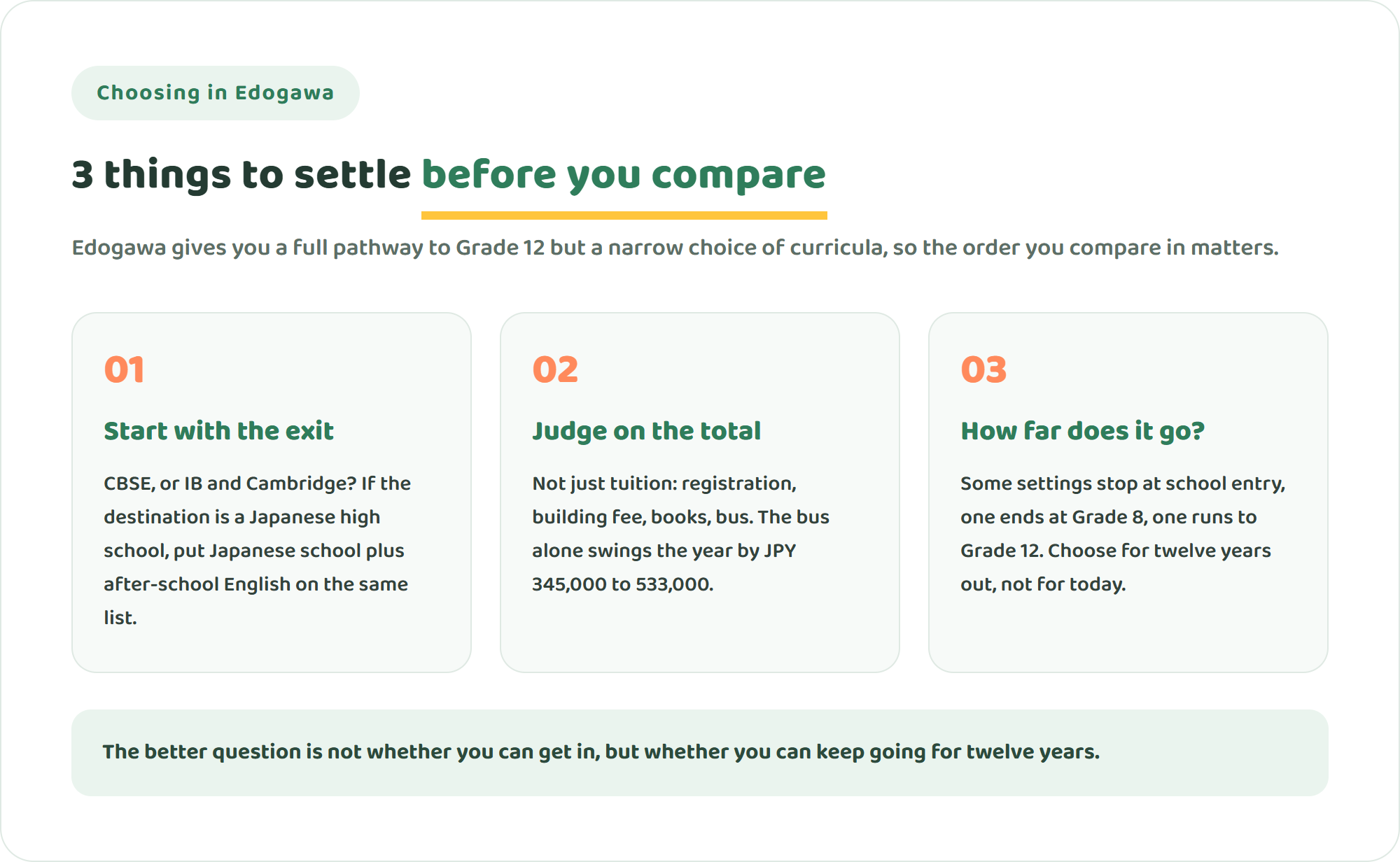
- School bus: JPY 114,941-177,694 per term depending on route, which is JPY 344,823-533,082 a year, plus a one-time bus registration fee of JPY 25,000. The shorter shuttle routes are JPY 50,820 per term (JPY 152,460 a year) plus JPY 10,000 registration
- After-school programme (optional): JPY 88,800 per term for 13:00-15:15 up to JPY 250,500 for 13:00-18:30, so JPY 266,400-751,500 a year
In practice, a CBSE primary place listed at JPY 1.25m a year becomes roughly JPY 1.6m with a bus route, and over JPY 2m with full after-school care. Conversely, if you live close enough to walk or cycle, you delete JPY 345,000-533,000 a year at a stroke. In Edogawa, where you live is a fee decision. It is also worth knowing that GIIS Tokyo publishes a sibling discount: 25% off tuition and 25% off bus fees for a second child, and 50% off tuition for a third. With two or three children, that changes the comparison entirely.
Fees can be revised, and enrolment caps and entry requirements vary. Confirm everything directly with each school before you commit.
How to work out which one fits your family
Edogawa gives you something most wards cannot, a full-time pathway to Grade 12, but it gives you fewer curricular directions. That makes the order in which you compare things unusually important.
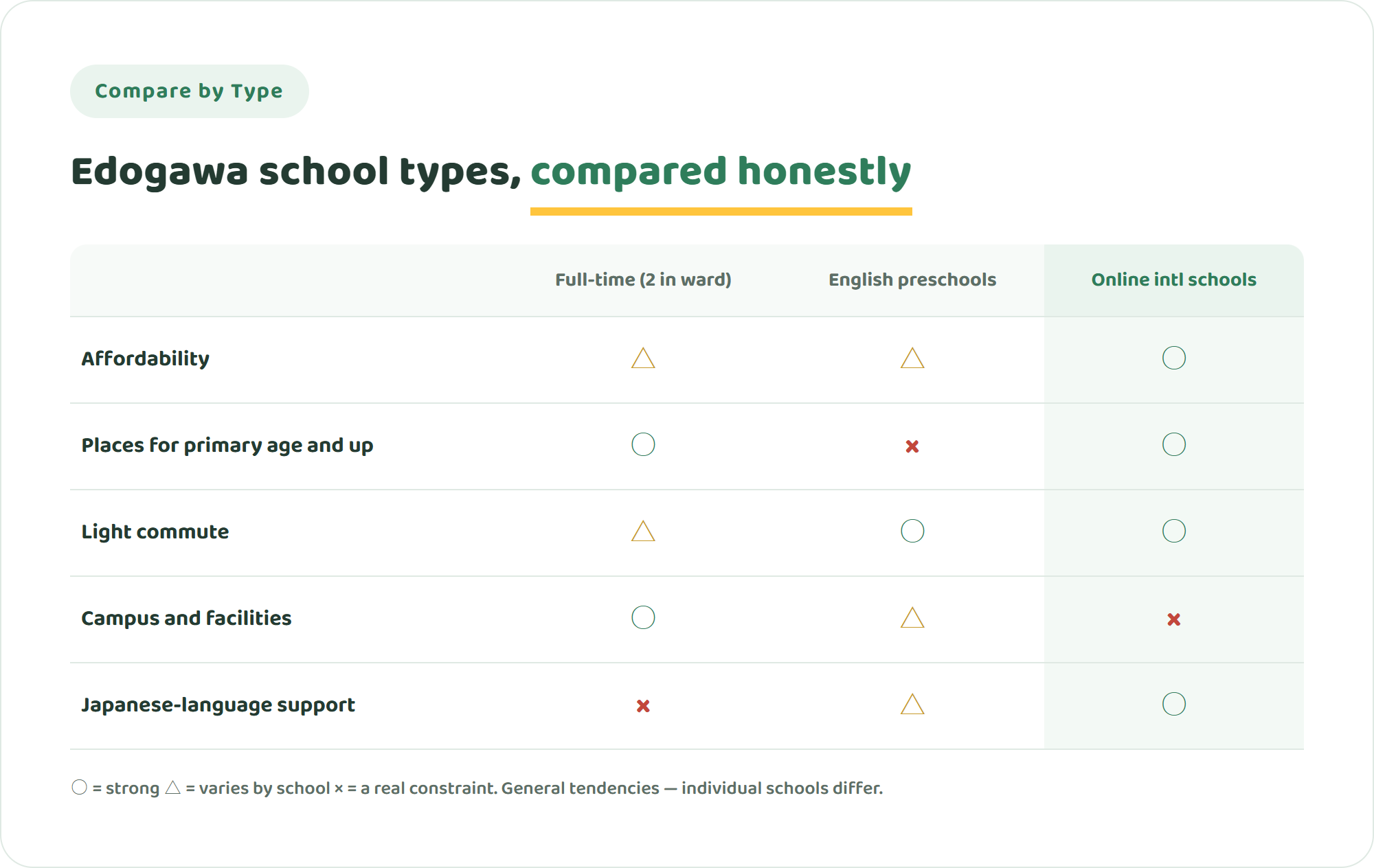
Start with the exit, not the entrance. CBSE connects cleanly to Indian universities and professional education and has a deserved reputation for mathematics and science depth. IB and Cambridge qualifications travel widely for university applications almost anywhere. If your child’s likely destination is a Japanese high school or university, a full-time international school may not be the best route at all, and a Japanese school plus serious after-school English deserves a place on the same shortlist.
Then widen the map if you need to. If you want to see a Western-style curriculum or simply compare more options, the Tozai line puts international schools in Koto within easy reach, and a few stops further gets you to international schools in Chuo. From Edogawa, Kiba and Kiyosumi-Shirakawa are a realistic daily commute.
Finally, ask whether you can sustain it. Full-time schooling here runs from JPY 620,000 to JPY 2.33m a year, and bus routes and sibling discounts move the total further. Replacing the question, can we get in, with the question, can we keep paying for twelve years, changes which school looks right. See how learning works online →
When fees or the commute are the real barrier: a ninth option
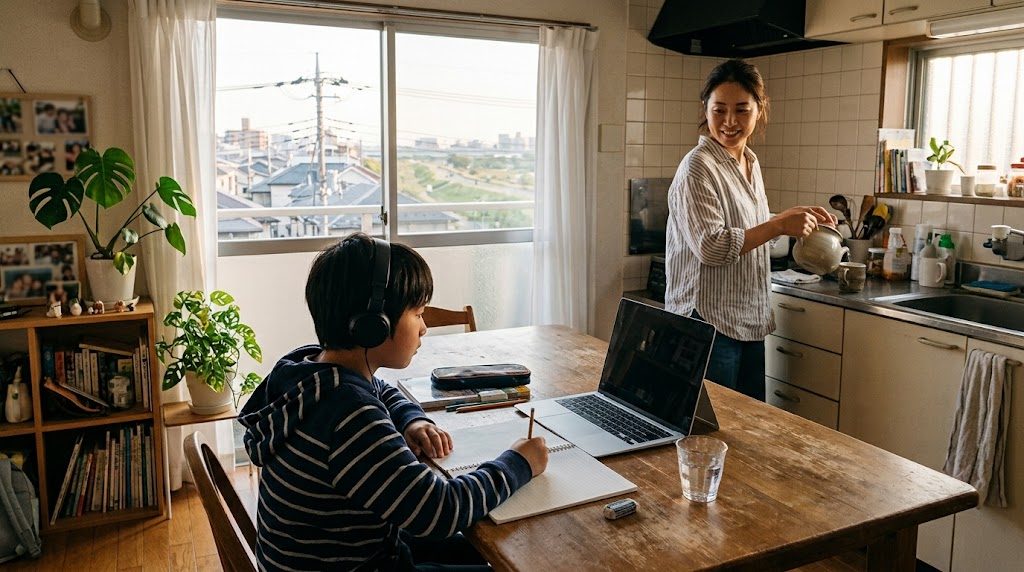
You may have got this far thinking: it is good that the ward has full-time schools, but I am not sure the curriculum suits my child, and JPY 1.5m a year for twelve years is not something we can commit to. If that is you, there is one more option worth knowing about.
NIJIN GLOBAL ACADEMY is an online international school opening in September 2027, run by NIJIN Inc. in Japan. The same company already operates NIJIN Academy, an alternative school in Japan with more than 1,000 children enrolled.
What we care about most is moving away from ranking children by test scores. Learning happens in small groups built around dialogue, and the aim we hold onto is that children come to like themselves and like the world. We are open to children aged 6 to 18 across Asia and Oceania. Because it is online, where you live stops mattering: a family can move within Tokyo, or leave Japan altogether, and the child stays at the same school. We are aiming for fees at roughly one-fifth of an on-campus international school. And rather than dropping children into full English immediately, the design assumes Japanese-language support underneath, with English introduced gradually.
Two honest caveats. We have not opened yet, so there are no graduate outcomes to show you. And a playground, a school field and the walk home with friends are things online schooling does not replicate. It is not the same experience as an on-campus international school. But for Edogawa families blocked by fees, by commuting, or by the absence of a curriculum that fits, we think it is a route worth considering.
Frequently asked questions
Q. From what age can children start at an international school in Edogawa?
A. At the preschool level, from infancy. Kids International Nishi-Kasai accepts children from six months, Little Garden Koiwa and MintLeaf Hirai from birth, Eagle International School from age one, Global Wisdom from age two, and Smile International School from age three. On the full-time side, GIIS Tokyo starts at age three in Nursery. Narrowing by your child’s age is the fastest way to shorten the list.
Q. Can primary and secondary-age children attend full time in Edogawa? What about Japanese-language support?
A. Yes, and this is what sets Edogawa apart. GIIS Tokyo runs to Grade 12 and Global Wisdom to Grade 8, both full time inside the ward. That is rare in Tokyo. Both are Indian-founded and teach in English, and Japanese is generally positioned as a second or third language, so ask precisely how many hours of Japanese your child would get. Note too that international schools in Japan are not ichijoko under the School Education Act, so if your family is subject to Japanese compulsory education rules, speak to the Edogawa Ward board of education in advance. If you are worried about your child’s Japanese slipping as their English hours grow, our sister service Tomodachi Japan, an online Japanese programme for children run by NIJIN, is worth a look.
Q. Can we transfer mid-year, and when should we apply?
A. GIIS Tokyo runs an April-start year in three terms (April-July, August-November, December-March) and is currently accepting applications for 2026-27; Global Wisdom also starts in April. Because that matches the Japanese school calendar, transferring from a Japanese school is more straightforward here than at a September-start Western international school. That said, popular campuses fill up by year group, and English assessments or interviews may be required. Contact schools six to twelve months before your intended start, book a campus tour, and check at the same time whether your home address falls on an existing bus route.
The time you spend deciding is time spent caring
There is no single right answer here. In a ward like Edogawa, where a child genuinely can stay in one school until eighteen but the range of curricula is narrow, the useful question is rarely which school is best. It is how many years you can keep this going, and whether the destination this school points to is one your child will thrive in. Fees, distance and temperament differ in every household. The fact that you are weighing all of it right now is itself evidence of how seriously you are taking your child’s future. Take your time, visit two or three schools, and compare how the classrooms feel. And if you would also like to know what learning without a commute could look like, we would be glad for you to keep us on the list.
International Schools in Other Cities
- International Schools in Karuizawa: All 4 Schools
- International Schools in Sapporo: Fees
- International Schools in Dubai: Fees
- International Schools in Meguro: All 8 Schools
- International Schools in Kobe: All 20 Schools
- International Schools in Yokohama: Full Comparison
- International Schools in Manila
- International Schools in Melbourne
- International Schools in Minato: Fees
- International Schools in Tokyo
- International Schools in Shibuya, Tokyo
- International Schools in Setagaya: All 14 Schools
- International Schools in Koto, Tokyo
- International Schools in Shinagawa, Tokyo
- International Schools in Chofu and ASIJ Fees