If you have started looking for international schools in Nakano, Tokyo, you have probably already hit the wall: search after search returns English preschools, and almost nothing for a child who is six or older. That is not a gap in your research. It is the actual shape of the ward. Nakano is one of Tokyo’s most liveable and most densely populated wards — over 22,000 people per square kilometre, four minutes from Shinjuku on the Chuo Line, wrapped around a shopping street that people move here for. But as of August 2026, there is not a single full-time international school in Nakano Ward that teaches children past kindergarten age. This guide lists every school in the ward that genuinely runs an English-medium day, shows you exactly where the age gap opens, and maps the realistic options in Suginami, Shinjuku and Nerima — plus one route that does not involve a commute at all.
Quick Answer: Your Options in Nakano
- Aoba-Japan Bilingual Preschool, Nakano Campus (Minamidai) | 18 months to age 5 (K2–K5) | fees on enquiry | IB PYP inquiry learning; becomes A-JIS Nakano in April 2027, but the age range does not change
- GLOBAL FIELD KIDS (Nakano) | preschool 2–6, afterschool 3–12 | fees on enquiry | all-English, three minutes from Nakano Station south exit
- Bilingual Art Nursery Room Fairy Tale (Nogata) | 6 months to 6 years, plus afterschool 3–12 | fees on enquiry | small-group English and art, open 8:00–18:00
- Kids UP Saginomiya | age 3 to Grade 6 | fees on enquiry | all-English afterschool care by Saginomiya Station, the first of its kind in the ward
- Kids Duo Nakano-Sakaue | age 3 to Grade 6 | fees on enquiry | all-English afterschool, two minutes from Nakano-Sakaue Station
- (Related) Tokyo Community School (Nakano) | Grades 1–6 | fees on enquiry | not an international school, but the ward’s only full-time inquiry-based microschool, taught mainly in Japanese
- (Nearby) Everest International School Japan (Ogikubo, Suginami) | roughly 3–18 | JPY 50,000 per month for Grades I–X | a full Nursery-to-Grade-12 school a few stops down the Chuo Line
- NIJIN GLOBAL ACADEMY (online, opening September 2027 — ages 6–18, aiming at roughly one fifth of on-campus fees, with Japanese-language support) | currently taking registrations for opening updates
International schools in Nakano: what exists, and what it costs
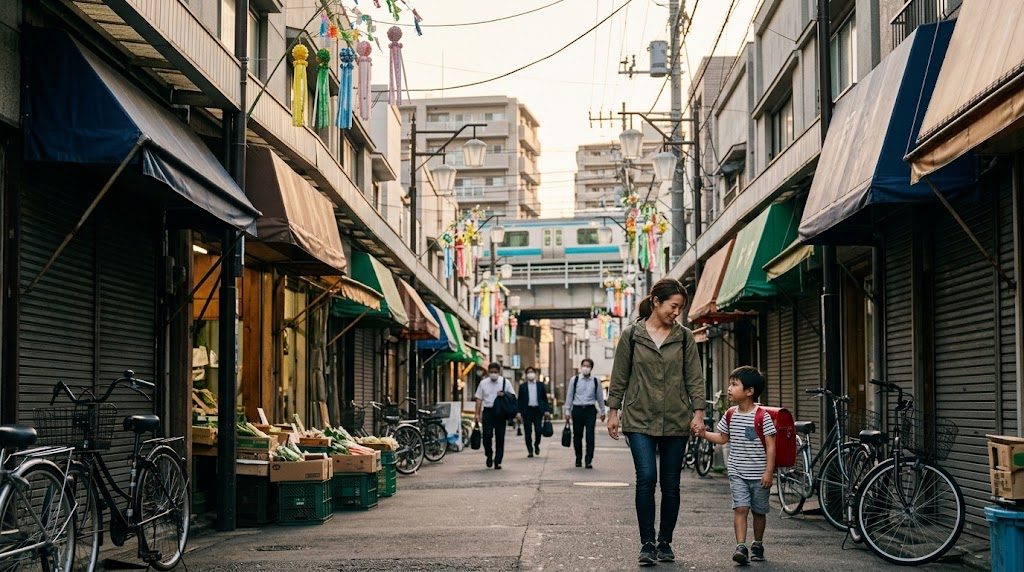
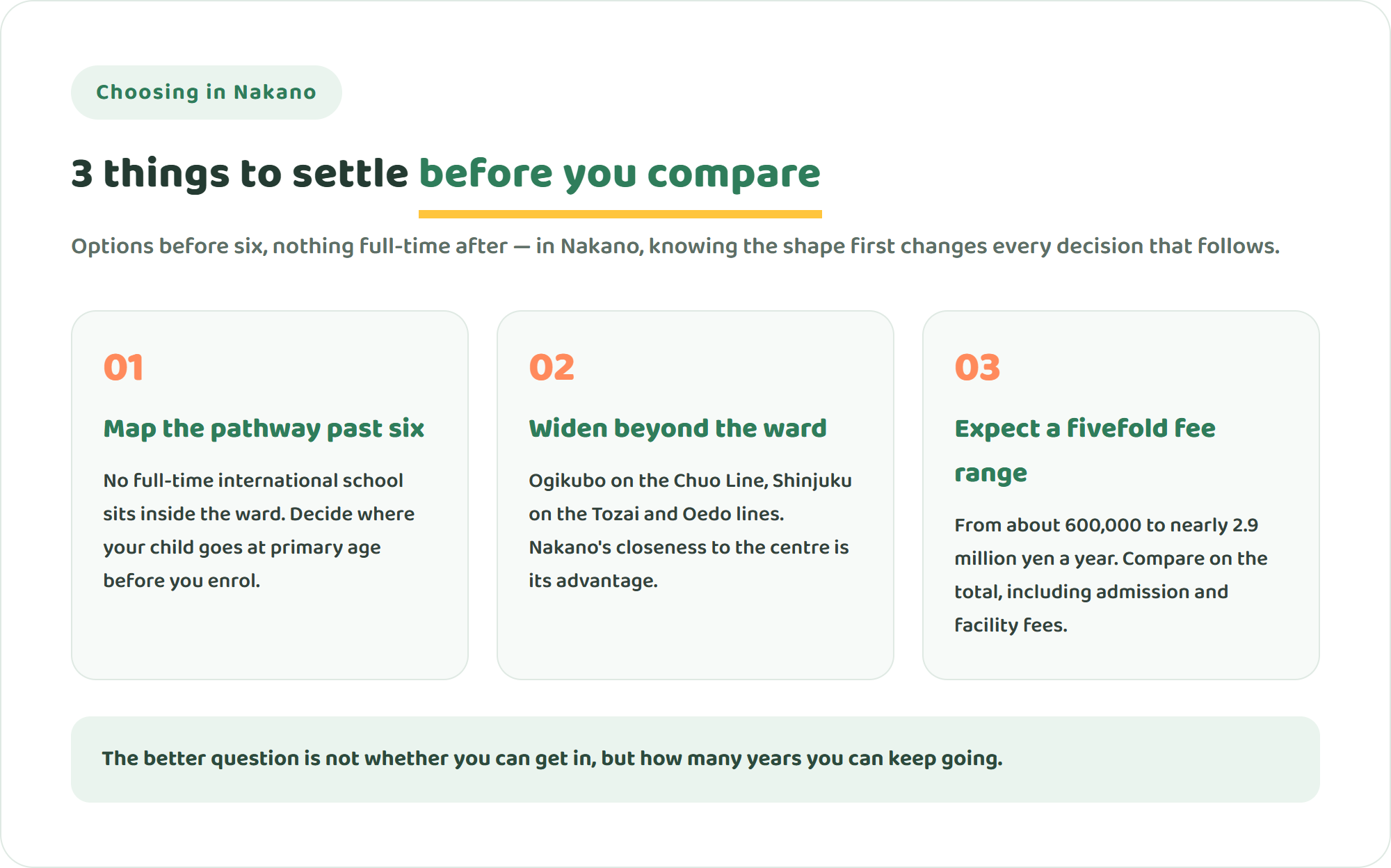
The map of English-medium education in Nakano can be summed up in one line: strong before six, afterschool only after six, and nothing full-time in between. Minamidai, Nakano, Nogata, Saginomiya and Nakano-Sakaue each have a school where children spend real hours in English. But the moment your child reaches primary age, the daytime hours belong to a Japanese school. That is the difference between Nakano and neighbouring Suginami or Shinjuku, and it is the single most important fact to know before you sign anything.
On fees, Nakano schools are consistent in one respect: none of them publish prices. Every one of the five is an enquiry-only school, with costs that move by course and by how many days a week your child attends. Look one ward out, though, and published numbers appear. Everest International School Japan in Ogikubo charges JPY 50,000 a month in tuition for Grades I–X, with a JPY 50,000 admission fee and around JPY 30,000 for books. Waseda International Christian School in Shinjuku publishes roughly JPY 1.05m–1.45m a year depending on the division. Aoba-Japan International School’s Hikarigaoka campus in Nerima publishes JPY 2,332,000 for K3–K5, JPY 2,518,000 for Grades 1–5 and JPY 2,862,000 for Grades 6–12 in 2026–2027.
That is the real spread a Nakano family compares: from around JPY 600,000 a year to nearly JPY 2.9 million, a factor of almost five, for schools that are all within commuting distance. Compare on the total — admission fee, facility fee, lunch, bus — not the headline number. If you want the breakdown, see what international school actually costs. Fees and details here reflect what schools published as of August 2026; always confirm the current year directly with each school.
Every international school in Nakano, by age and fees
What follows is not a top-seven list. Nakano does not have seven, and padding the number would not help you. These are the five places in the ward where a child spends part of the day in English — three preschool-centred, two afterschool-centred. Read them in this order: age range first, then hours and frequency, then curriculum and cost.
1. Aoba-Japan Bilingual Preschool, Nakano Campus (Minamidai)
A few minutes from Nakano-Fujimicho Station on the Marunouchi Line, at 3-6-17 Minamidai, this is the anchor of international education in the ward. Core hours run 8:10 to 14:30 with extended care to 18:00 and afterschool options, which makes it workable for two-career households. The teaching is built on IB PYP inquiry. The important news: from 1 April 2027 the campus becomes Aoba-Japan International School Nakano (A-JIS Nakano), switching to an English-medium IB PYP Early Years programme while keeping Japanese language and culture in the week. Applications for April and August 2027 entry opened on 1 September 2026.
- Curriculum: IB PYP inquiry-based learning; English-medium from April 2027
- Ages: 18 months to 5 (K2–K5) — and still K2–K5 after the 2027 change
- Fees: not published; enquire (the Hikarigaoka campus children move on to publishes JPY 2.33m–2.86m a year)
- Best for: families in Minamidai, Yayoicho and Nakano-Fujimicho who want a genuine IB early-years setting
Official site / official notice on the April 2027 change
2. GLOBAL FIELD KIDS (Nakano)
Three minutes from the south exit of JR Nakano Station at 2-12-9 Nakano, this is an all-English setting built around inquiry and hands-on projects, with roughly eight to ten children per staff member. The day is split cleanly: preschool 9:00–13:00, after-kinder 14:00–18:00, and afterschool for primary-age children 15:00–19:00. That structure makes it one of the more practical ways in Nakano to keep English going once a child starts Japanese school — and the location next to the station does a lot of quiet work for working parents.
- Curriculum: all-English inquiry and experiential programme built on international-school standards
- Ages: preschool 2–6; after-kinder and afterschool 3–12
- Fees: not published; enquire (varies by course and days per week)
- Best for: families who use Nakano Station and want English to continue after primary entry
3. Bilingual Art Nursery Room Fairy Tale (Nogata)
A small facility at 4-44-10 Nogata, near Nogata Station on the Seibu Shinjuku Line, running two tracks: childcare from six months to school age, and an afterschool programme for ages 3 to 12 that has been going since 2018. English communication and art-making sit side by side in the curriculum, and with roughly fifteen places the setting is genuinely small. Open 8:00 to 18:00 with early drop-off and extended care. In a ward with this few options, the fact that a child can stay in the same place from infancy to Grade 6 counts for something.
- Curriculum: English communication plus art and creative expression, in small groups
- Ages: 6 months to 6 (childcare); 3 to 12 (afterschool)
- Fees: the site has a fees section but amounts are given individually; enquire (ask about childcare-subsidy eligibility)
- Best for: families around Nogata, Toritsukasei and Numabukuro who want a warm, small-group start
4. Kids UP Saginomiya
At 4-4-24 Saginomiya, a minute or two from Saginomiya Station on the Seibu Shinjuku Line, this was the first Kids UP in Nakano when it opened in winter 2021. There is a KINDY course for ages 3 to 6, an ELEMENTARY course structured as English-medium afterschool care for Grades 1 to 6, and a SPECIALIST track for stronger English speakers. The draw is continuity: a child can stay in the same English environment from preschool through the end of primary school. Pick-up is available from selected schools and kindergartens in Nakano and Suginami.
- Curriculum: all-English afterschool care — sports, games, crafts and project work
- Ages: 3 to Grade 6 (kindy / elementary / specialist tracks)
- Fees: not published on the campus page; enquire
- Best for: families in Saginomiya, Toritsukasei and Shirasagi building English alongside Japanese school
5. Kids Duo Nakano-Sakaue
Two minutes from exit A2 at Nakano-Sakaue, at 2-10-9 Chuo, on the Marunouchi and Oedo lines. Morning and afternoon kindergarten courses plus a primary course take children from 3 to Grade 6 through blocks of time conducted only in English, with a bus service and holiday season programmes. Because Nakano-Sakaue sits on two subway lines, it draws families from Honcho, Chuo and Yayoicho as well as from Higashi-Nakano and Shin-Nakano.
- Curriculum: English-immersion afterschool care, kindergarten and primary courses
- Ages: 3 to Grade 6
- Fees: not published on the campus page; enquire
- Best for: families near Nakano-Sakaue who want the afternoon converted into English time
The age gap in Nakano international schools, laid out plainly
A list of names hides the real problem. Sort the same five schools by age band and it becomes obvious.
- Pre-school, ages 0–5: covered. Aoba-Japan Nakano, GLOBAL FIELD KIDS and Fairy Tale all run English-medium days; Kids UP and Kids Duo add kindergarten courses.
- Primary, ages 6–12: zero full-time international schools. Four schools offer English afterschool; the school day itself is Japanese.
- Lower secondary, ages 13–15: zero. Most afterschool programmes stop at Grade 6.
- Upper secondary, ages 16–18: zero. Out-of-ward or online is the only route.
The break happens precisely at age six. And note what the 2027 change does and does not do: when Aoba’s Nakano campus takes the words international school into its name, the age range stays at K2–K5, with Grade 1 onwards served by the Hikarigaoka campus in Nerima. A change of name is not the same as a new pathway.
One more thing worth knowing before you trust any roundup. Several Nakano listings still show schools whose websites no longer resolve as of August 2026 — among them Nakano International School in Yayoicho and First Learning Nakano in Kamitakada, which no longer appears on its operator’s own branch list. They may have moved or changed names. Either way, verify directly with the school before you build a plan around a listing.
Not an international school, but worth knowing: a full-time microschool in Nakano
There is one more option most families never find. Tokyo Community School, at 1-62-10 Nakano, is a full-time microschool for Grades 1 to 6 with a pre-elementary programme for ages 3 to 5. It is not an international school — the language of instruction is Japanese — but its curriculum is built on inquiry drawn from real experience, in small mixed-age groups, which puts it a long way from a conventional Japanese primary school. If what drew you to international schools was not the English so much as the way of learning, this is worth a visit. Fees and admissions change by year, so check the school directly. Official site
Looking beyond Nakano: Suginami, Shinjuku and Nerima
Since the ward has no full-time option past six, almost every Nakano family ends up looking outward. Before you do, run the commute maths across six years. Thirty minutes each way is an hour a day; at roughly 180 school days that is 180 hours a year and over 1,000 hours across primary school. Nakano’s central position keeps that number lower than most wards — but for younger children, whether a school bus serves your address is still the deciding factor.
Suginami is the first place to look. Everest International School Japan in Ogikubo runs Nursery through Grade 12 with monthly tuition of JPY 50,000 for Grades I–X — an annual figure in the six-hundred-thousands, which is remarkable for a full-time international school in Tokyo. There is a second site in Asagaya, within reach of northern Nakano. See international schools in Suginami for the wider list.
Shinjuku is the most realistic catchment for primary and above. Waseda International Christian School runs kindergarten through high school at roughly JPY 1.05m–1.45m a year, and Yotsuya International School offers a primary-to-high-school pathway with a US diploma option. Both are a short ride from Nakano on the Tozai, Chuo or Oedo lines — see international schools in Shinjuku.
Nerima matters because it is where Aoba’s Nakano children continue: the Hikarigaoka campus covers K3 to Grade 9 at JPY 2.33m–2.86m a year. From northern Nakano that means the Oedo Line, or the Seibu Shinjuku Line plus a bus — worth timing once during the morning peak before you commit. See international schools in Nerima, and for the whole picture, international schools in Tokyo.
Comparing the three routes honestly
Nakano’s options really come down to three types: local preschools and English afterschool, a full-time international school outside the ward, or an online international school with no commute at all. The table below sets out how each tends to perform on cost, commute, continuity past six, campus life and availability of places.
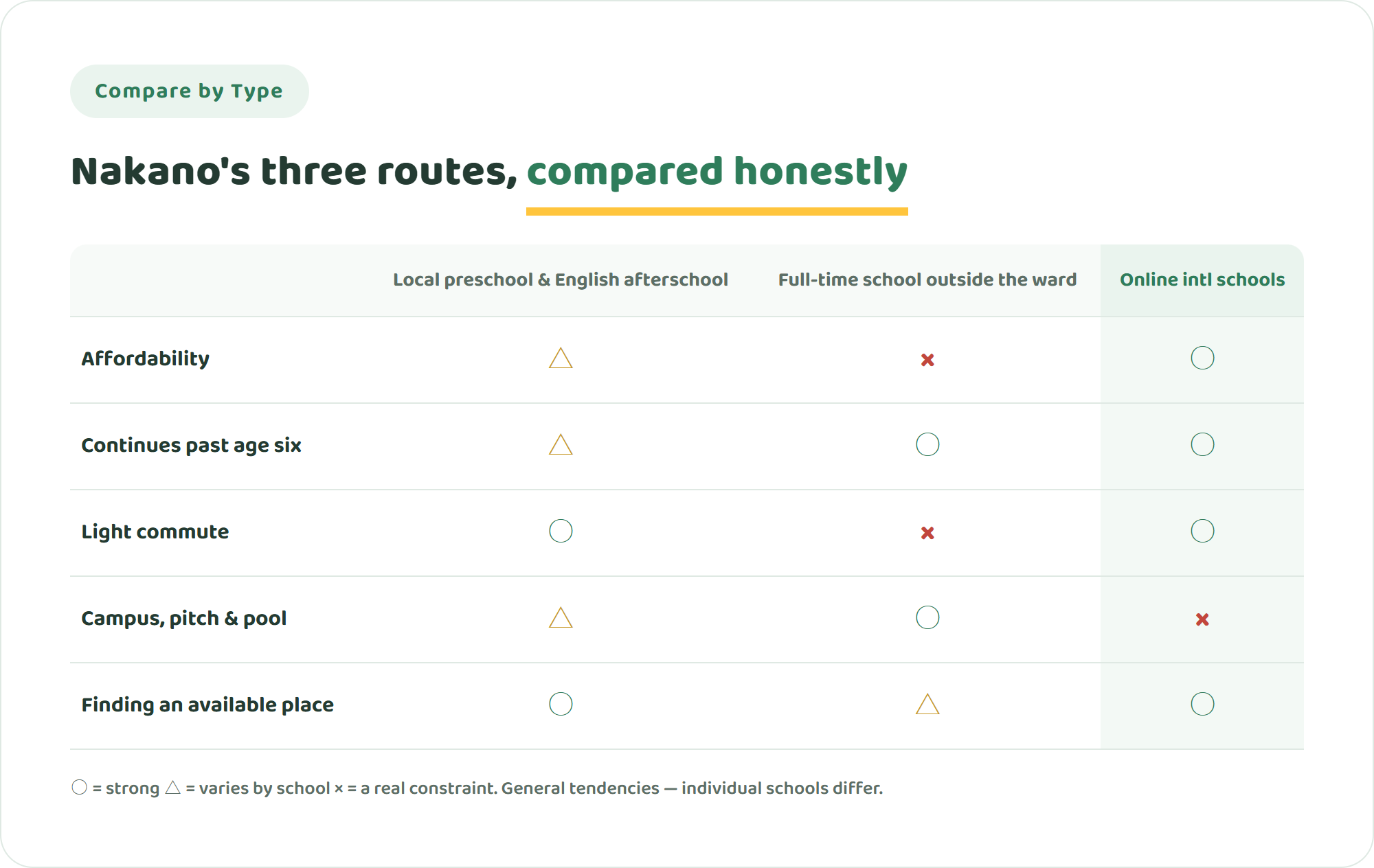
Local preschools and afterschool programmes win on convenience — walking or cycling distance, sometimes subsidy-eligible — but the daytime learning belongs to a Japanese school, which caps how much English a week can hold. An out-of-ward full-time school gives you subjects taught in English, at the price of both a commute and a fee. And the third route is the one that means most in a ward like Nakano, precisely because there is nothing full-time inside it: online learning does not care which side of the ward line you live on. If the fee itself is what is stopping you, is international school too expensive? may help you think it through.
See how learning works online →
When fees or the commute are the wall: online as an eighth option
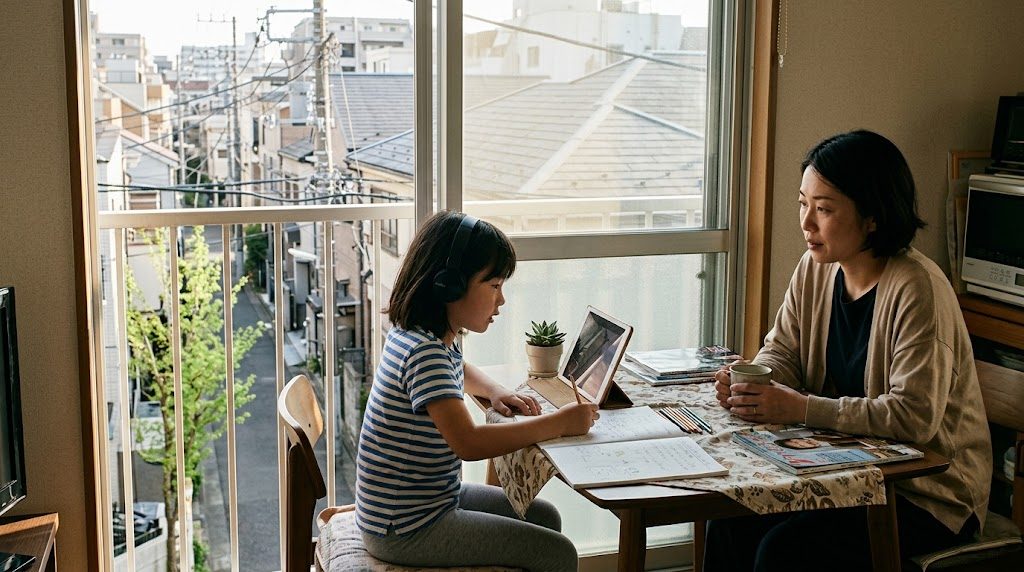
Nakano is a good place to raise a family — minutes from Shinjuku, a shopping street with a pulse, two subway lines and the Seibu Shinjuku Line crossing the ward. But no full-time English-medium school inside the ward for anyone over six, and a commute plus a fee if you look outside it, is a genuine wall for many households. If you are weighing whether that load is sustainable for years, there is another route: an online international school.
NIJIN GLOBAL ACADEMY (NGA) is an online international school opening in September 2027. It is run by NIJIN Inc., the company behind NIJIN Academy, an alternative school in Japan with more than 1,000 enrolled students. Our approach rejects ranking children by test scores, and centres on small-group dialogue and the aim of helping each child come to like themselves and the world. We serve ages 6 to 18 across Asia and Oceania, wherever a family lives, with Japanese-language support built in so English can be added gradually. We are working toward fees at roughly one fifth of an on-campus international school.
To be straight with you: NGA has not opened yet, and our track record is still ahead of us. We cannot offer the field, the pool or the corridor friendships of a campus school in the same way. But taking the daily commute out of family life while staying connected to the world is, we think, worth putting on your Nakano shortlist.
Frequently asked questions
Q. What is the youngest age international schools in Nakano accept?
A. Six months, at the earliest. Fairy Tale takes infants from six months, Aoba-Japan’s Nakano campus from 18 months (K2), and GLOBAL FIELD KIDS from age 2. Kids UP Saginomiya and Kids Duo Nakano-Sakaue start at 3 and continue to Grade 6. Start by filtering on your child’s age — in Nakano that narrows the list fast.
Q. Is there any school in Nakano for primary-age children, and what about Japanese support?
A. No full-time English-medium school in the ward serves primary age as of August 2026. Your three routes are English afterschool inside Nakano (four providers), a full-time school in Suginami, Shinjuku or Nerima, or online. On Japanese, policies differ enormously between schools — ask how many hours a week are actually taught, not whether support exists. Families worried about maintaining Japanese may also want to look at Tomodachi Japan, NIJIN’s online Japanese programme for children.
Q. Can we transfer mid-year, and when should we start?
A. Most schools accept transfers, but in a ward as thin as Nakano the binding constraint is whether an out-of-ward school has a place. Intakes cluster around April and August–September, and an English assessment or interview is common. Aoba’s Nakano campus opened applications for April and August 2027 entry on 1 September 2026 — which tells you the rhythm: start about a year ahead, contact schools directly, and go to an open house before you decide.
The time you spend deciding is time spent caring
There is no single right answer in school choice. In a ward like Nakano, where the options inside the boundary run out at age six, the useful question is not which school is best but which arrangement your family can sustain for years. Fees, morning transfers, your child’s stamina — every household weighs these differently. The fact that you are sitting with the question at all is the clearest sign of how seriously you are taking your child’s future. Visit two or three schools, ride the commute at the hour your child would ride it, and decide from there. And if you would like to keep a no-commute option in view while you do, we would be glad to keep you posted.
International Schools in Other Cities
- International Schools in Meguro: All 8 Schools
- International Schools in Kobe: All 20 Schools
- International Schools in Yokohama: Full Comparison
- International Schools in Chofu and ASIJ Fees
- International Schools in Fukuoka: Fees
- International Schools in Ho Chi Minh City
- International Schools in Shanghai
- International Schools in Shibuya, Tokyo
- International Schools in Shinagawa, Tokyo
- International Schools in Tokyo
- International Schools in Minato: Fees
- International Schools in Setagaya: All 14 Schools
- International Schools in Koto, Tokyo
- International Schools in Shinjuku: Fees
- International Schools in Bunkyo, Tokyo