Once you have looked at Seoul Foreign School and Seoul International School, the next two names on most expat families’ lists are Yongsan International School of Seoul (YISS) and Dwight School Seoul. Both are inside the city, and in high school they cost almost exactly the same. That is where the similarity ends: YISS is an American college-preparatory school with 27 AP courses and a Christian ethos; Dwight is an IB continuum school from preschool to the Diploma Programme. This guide puts Yongsan International School of Seoul tuition next to Dwight School Seoul’s fees for 2026-27 and compares curriculum, religion, admissions testing and waiting lists using only what the two schools publish.
All figures come from each school’s official 2026-27 fee document and school profile, checked on 24 October 2026. Approximate US dollar totals for fees billed in won use the 23 October 2026 cross rate (KRW 1 = JPY 0.11839, US$1 = JPY 156.8) and are rough estimates. One clarification: Dwight School Seoul is the Seoul campus of the New York-based Dwight network, and a different school from Dwight Global Online School.
The short answer: AP and a Christian ethos at YISS, the IB continuum at Dwight, and a fee gap only in the early grades
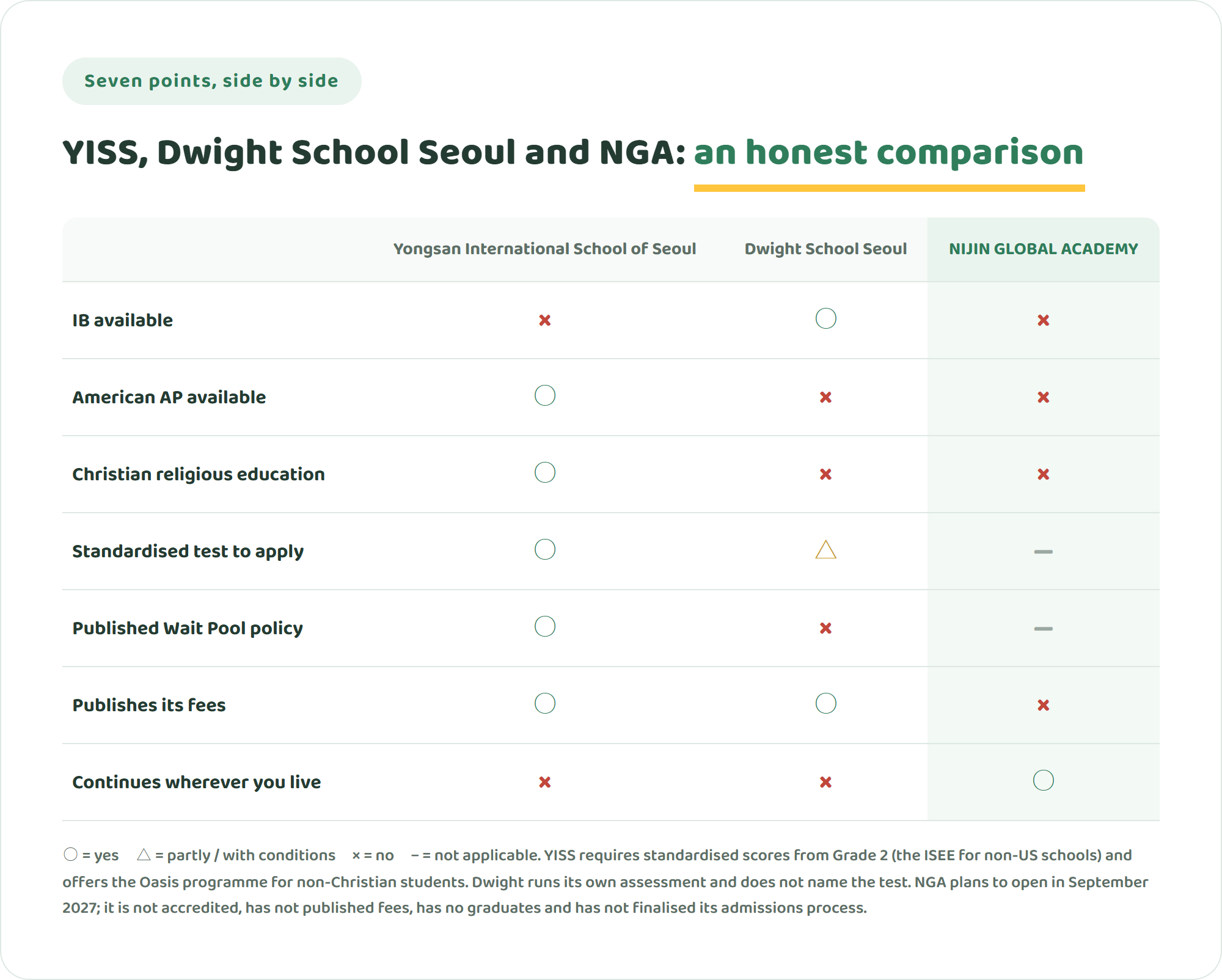
- Curriculum: YISS teaches an American college-preparatory programme; its 2026-27 High School Profile lists 27 AP courses and no IB. Dwight teaches the full IB continuum (PYP, MYP and DP), authorised in 2014, and offers no AP.
- Religion: YISS belongs to the Network of International Christian Schools (NICS). Families choose at application between the NICS programme (Bible classes and a weekly chapel) and the Oasis programme for non-Christian students (character education and philosophy); four credits of Theology, Ethics and Values are required to graduate. Dwight makes no reference to any religious affiliation.
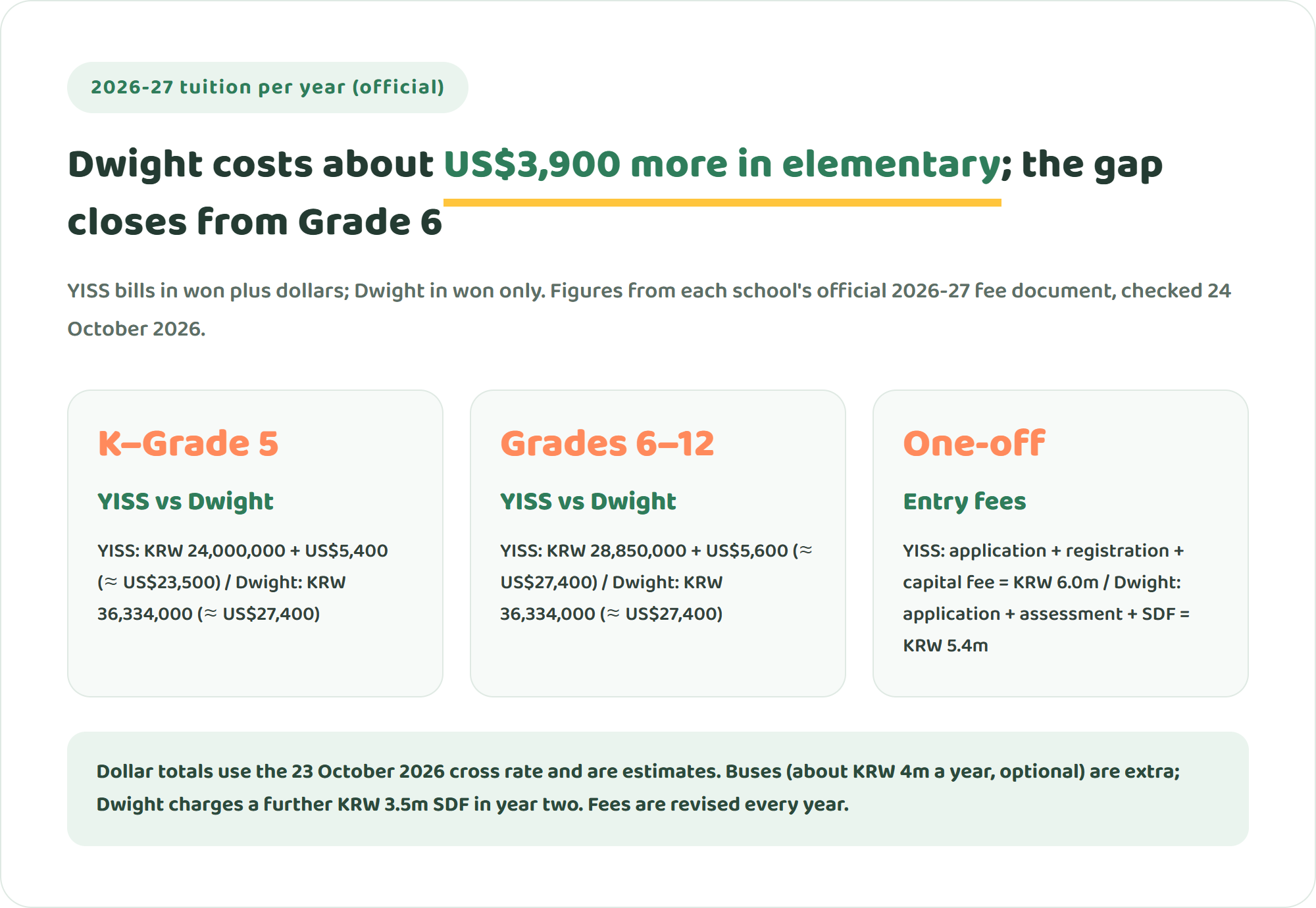
- Tuition: in Kindergarten to Grade 5, YISS charges KRW 24,000,000 plus US$5,400 and Dwight KRW 36,334,000. Dwight is about US$3,900 a year more in elementary school. From Grade 6, YISS rises to KRW 28,850,000 plus US$5,600 while Dwight stays flat, so in middle and high school the two cost almost the same.
- Size and mix: YISS has 985 students in K–12, 54% with US passports, from 25 nationalities (2026-27 profile). Dwight has 542 students from age 2 to Grade 12 and 50 nationalities.
- Admissions: YISS requires standardised test scores from the past 12 months for Grades 2–12 (the ISEE for non-US schools) and places qualified applicants in a Wait Pool when a grade is full. Dwight runs its own 1.5–2 hour assessment and publishes no waiting list policy.
In practice: if you are aiming at US universities through AP and the SAT, or want the lower fee in the early grades, start with YISS. If you want the IB Diploma or prefer a school with no religious programme, start with Dwight. Either way you are committing to more than US$23,000 a year before buses and one-off fees, so check how long that is sustainable first.
Yongsan International School of Seoul tuition vs Dwight School Seoul tuition (2026-27)
YISS bills tuition in two parts, one in Korean won and one in US dollars, each paid in its own currency. Dwight bills in won only. The table shows the published 2026-27 amounts side by side.
| Grade band | Yongsan International School of Seoul | Dwight School Seoul |
|---|---|---|
| Preschool (ages 2–4) | Not offered (school starts at Kindergarten) | Full day KRW 28,083,000 / half day KRW 14,041,500 |
| Kindergarten – Grade 5 | KRW 24,000,000 + US$5,400 (≈ US$23,500) | KRW 36,334,000 (≈ US$27,400) |
| Grades 6–12 | KRW 28,850,000 + US$5,600 (≈ US$27,400) | KRW 36,334,000 (≈ US$27,400) |
| One-off fees for new students | Application processing KRW 500,000 + registration KRW 1,000,000 + capital development fee KRW 4,500,000 (total KRW 6.0m, ≈ US$4,530) | Application KRW 100,000 + assessment KRW 300,000 + School Development Fund KRW 5,000,000 (total KRW 5.4m, ≈ US$4,080) |
| School bus (per year, optional) | KRW 4,000,000 | KRW 3,960,000 (round trip) |
| How you pay | Won portion annually or quarterly (quarterly costs more); dollar portion in US dollars | Lump sum by default; instalments with 2% interest if approved by 30 April; 1% discount for payment by 31 March |
Some costs sit outside the headline numbers. At YISS, add a Technology Fee (KRW 300,000 in elementary, KRW 600,000 in middle and high school), and note that the KRW 1,000,000 registration fee is charged every year. At Dwight, the KRW 5,000,000 School Development Fund for new students is followed by a further KRW 3,500,000 in a returning student’s second year. The KRW 3,000,000 enrolment deposit due on accepting an offer is credited against tuition, so it is not an extra cost.
Source: YISS “Tuition and Financial Information for the 2026-2027 Academic Year” and Dwight School Seoul “2026-27 Tuition and Fee Structure”, both checked 24 October 2026.
Why the gap closes in middle school
Dwight charges one flat tuition from Kindergarten to Grade 12. YISS has two bands, and the step up at Grade 6 adds KRW 4,850,000 and US$200. Converted at the October 2026 cross rate, YISS is about US$3,900 a year cheaper in Kindergarten to Grade 5 and within about US$50 of Dwight from Grade 6. If price is your deciding factor, the answer depends on the grade your child enters and how long they will stay. Paying the YISS won portion quarterly adds KRW 1,200,000–1,450,000 a year, and because part of the bill is in dollars, families paid in another currency will feel exchange-rate moves. For what fees usually include and exclude, see how much international school really costs.
Curriculum and religion: 27 AP courses at YISS, PYP to DP at Dwight
Yongsan International School of Seoul: American college prep with AP
YISS was established in 2006 on its current Yongsan campus; its predecessor, the International Christian School of Seoul, had operated since 1990, which is why the school’s profile says “founded in 1990”. It is fully accredited by WASC and ACSI, with an average class of 13 and a student–teacher ratio of 9:1. The high school follows an American college-preparatory curriculum; the 2026-27 profile lists 27 AP courses, with a cap of one in Grade 10 and two in each of Grades 11 and 12. In 2026, more than 202 students sat 508 AP exams; 88% scored 3 or higher (global 71%) and the mean score was 4.06 (global 3.24). Of the Class of 2026, 71% enrolled in the United States. High school languages include Japanese I–IV.
The religious question at YISS
YISS describes its community as “students, parents, and Christian educators”: it hires Christian teachers, but its students come from many faiths. At application, families choose between the NICS programme, with Bible classes and a weekly chapel, and the Oasis programme for non-Christian students, with character education, philosophy and a weekly assembly. Whichever track you choose, four credits of Theology, Ethics and Values are a graduation requirement. Ask to see a chapel or an Oasis assembly when you visit.
Dwight School Seoul: Seoul’s first full IB continuum foreign school
Dwight School Seoul was founded in 2012 and belongs to a network that traces its history to 1872 in New York. Authorised for the full IB continuum in 2014, it describes itself as the first full IB continuum foreign school in Seoul: PYP from Preschool to Grade 5, MYP in Grades 6–10 and the DP in Grades 11–12. It is accredited by the IB, CIS and NEASC, with a student–teacher ratio of 8:1. In 2026, its 24 Diploma candidates averaged 34 points (world average 31) with a top score of 44 and a 96% pass rate (world 83%). DP language options include Korean A, Chinese B, German B and Spanish B, but Japanese is not offered. If the IB is new to you, our guide to what the International Baccalaureate is explains how PYP, MYP and DP fit together.
Admissions: eligibility, the ISEE, the Wait Pool and Dwight’s assessment
Who is eligible under Korea’s foreign school rules
Both schools operate as foreign schools under Seoul Metropolitan Office of Education rules, which limit who can enrol. At YISS, a child whose parents both hold non-Korean passports and are not of Korean ethnicity falls under Category 1; Dwight’s equivalent category is “one or both parents hold a foreign passport”. Most expatriate families therefore qualify on nationality, but both schools require the parents’ Korean Alien Registration Cards, so part of the paperwork can only be completed after you arrive. Children with two Korean-citizen parents must show more than 1,095 days of overseas residence or six semesters at an overseas school. Both schools state plainly that they are not recognised as equivalent to Korean domestic schools.
Applying to YISS: standardised scores and the Wait Pool
- Check your eligibility category against the school’s published requirements.
- Gather documents: passports for the child and both parents, a birth certificate, and school reports (for Grades 2–12, the current year plus the previous two, translated and notarised).
- Arrange recommendations: the class teacher for K–5; English and maths teachers for Grades 6–12.
- Standardised testing: none for K–1. Grades 2–12 must submit scores from the past 12 months: a state test or MAP from US schools, or the ISEE from non-US schools (at-home testing accepted; fee US$100–180).
- Apply online through OpenApply. Offers must be accepted within two business days.
Applicants whose first language is not English may be asked to take an English proficiency test; the ELL programme admits a limited number each year. Because places are limited, foreign families residing in Korea are the first priority, and the school weighs English ability, previous records and whether a parent works for a company making direct investment in Korea. If your child meets the standard but there is no space, they enter the Wait Pool. It is not a first-come queue, and it is valid only for the application year. No deadlines are published; there is an Open House on 2 November for families entering Kindergarten and Grade 1 in August 2027.
Applying to Dwight: a 1.5–2 hour assessment and an interview for DP
- Enquire and visit (the Whole School Open House is on 11 November 2026).
- Apply online and pay the KRW 100,000 application fee.
- Submit documents: passports, parents’ ARCs, a birth certificate, a health form, the current and previous two years’ reports, and recommendations (the class teacher for Grades 1–5; an English teacher and one other subject teacher for Grades 6–12).
- Attend the assessment (fee KRW 300,000; 1.5–2 hours). Grade 11–12 DP applicants also interview with the Head of School and the DP Coordinator.
Dwight does not publish the name of its assessment, any score thresholds, priority categories, a waiting list or application deadlines. English support comes through the Quest programme (individual and small-group EAL). Students admitted on condition of joining Quest must take the Full Quest Program, priced at 50% of tuition. In the DP, Dwight states that it does not offer EAL, so a Grade 11 entrant needs to arrive with the English already in place. If your child’s English is still developing, our guide to preparing English before international school lists what you can do before the assessment.

Where YISS and Dwight sit among Seoul’s four big-name schools
Using the same 23 October 2026 rate, here is how the two schools compare with the pair we covered last week in Seoul Foreign School vs Seoul International School. Approximate dollar totals combine the won and dollar portions.
| School | Grade 1 (per year) | High school (per year) | One-off fees on entry |
|---|---|---|---|
| Seoul Foreign School | KRW 27,285,000 + US$13,500 (≈ US$34,100) | KRW 33,370,000 + US$14,955 (≈ US$40,150) | KRW 6.6m |
| Dwight School Seoul | KRW 36,334,000 (≈ US$27,400) | KRW 36,334,000 (≈ US$27,400) | KRW 5.4m (+ KRW 3.5m SDF in year 2) |
| Seoul International School | KRW 22,880,000 + US$8,140 (≈ US$25,400) | KRW 27,840,000 + US$9,900 (≈ US$30,900) | KRW 4.5m |
| Yongsan International School of Seoul | KRW 24,000,000 + US$5,400 (≈ US$23,500) | KRW 28,850,000 + US$5,600 (≈ US$27,400) | KRW 6.0m |
YISS has the lowest annual tuition of the four in both Grade 1 and high school. Dwight’s flat fee makes it the second most expensive in elementary school and the third in high school. For the wider field, see our overview of international schools in Seoul. Source: each school’s official website (SFS and SIS checked 17 October 2026; YISS and Dwight checked 24 October 2026).
Which one fits your family? Three questions
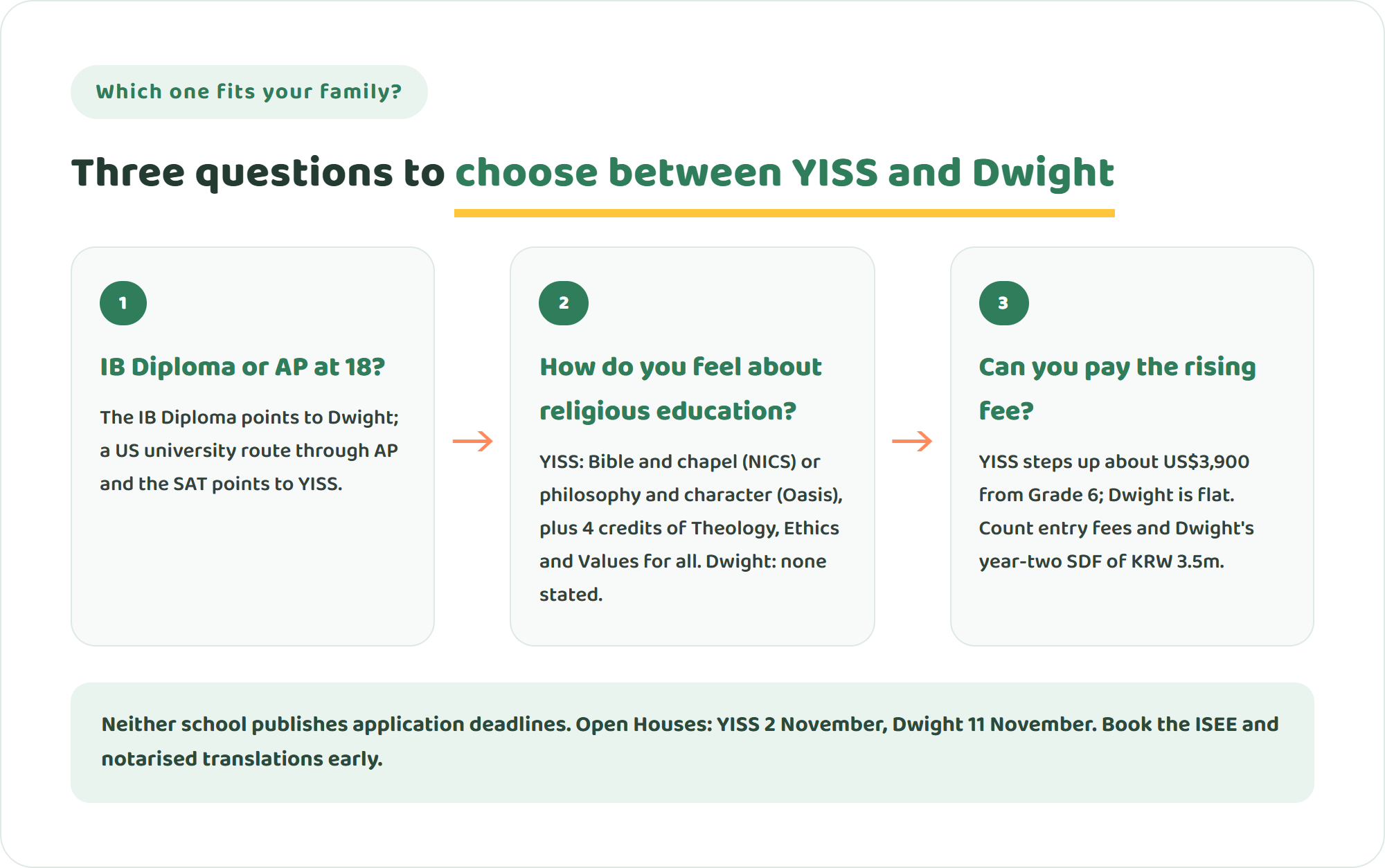
1. At 18, the IB Diploma or AP and the SAT?
If you want the IB Diploma, recognised by universities worldwide, Dwight is the natural fit. If the plan is a US university with AP scores and the SAT, YISS is built for that route. YISS also teaches Japanese in high school, which Dwight does not.
2. How do you feel about Christian religious education?
Non-Christian families can enrol at YISS through the Oasis programme, but every student completes four credits of Theology, Ethics and Values. If you would rather the school had no religious programme at all, Dwight’s materials make no reference to one.
3. Can you pay the rising fee and the one-off costs until graduation?
YISS steps up by about US$3,900 a year from Grade 6; Dwight is flat but charges a further KRW 3.5m SDF in year two. Check whether an employer allowance covers one-off fees and the bus, and think about what happens if the posting ends early.
A second option that moves with you
The YISS Wait Pool expires at the end of the application year, and Dwight publishes no waiting list at all. If the grade you need is full, the fees exceed your allowance, or another posting is likely within a few years, an online international school is a route that does not depend on your address. You can see how classes work at NGA in our online school curriculum overview.

Where NIJIN GLOBAL ACADEMY fits
NIJIN GLOBAL ACADEMY (NGA) is an online international school for ages 6–18, planned to open in September 2027. It is run by NIJIN Inc., which operates NIJIN Academy in Japan, a learning community for children who do not attend school, where more than 1,000 children have studied. NGA plans small live classes, with bilingual Japanese–English mentors supporting subjects taught in English, and admission that is not based on test-score rankings.
To be clear about the limits: NGA has not opened yet, is not accredited, has not published its fees and has no graduates. If your child needs an IB Diploma, AP scores or a US high school diploma, NGA does not replace YISS or Dwight. Where we hope to help is as a bridge while you wait for a place, as continuity for families who move often, or as extra English-medium learning alongside a local or Japanese school.
Frequently asked questions
How much is Yongsan International School of Seoul tuition?
For 2026-27, Kindergarten to Grade 5 costs KRW 24,000,000 plus US$5,400, and Grades 6–12 cost KRW 28,850,000 plus US$5,600. New students pay a KRW 500,000 application processing fee, a KRW 1,000,000 registration fee (charged annually) and a KRW 4,500,000 capital development fee, plus a Technology Fee of KRW 300,000–600,000.
How much is Dwight School Seoul tuition?
For 2026-27, tuition is KRW 36,334,000 for every grade from Kindergarten to Grade 12. Preschool (ages 2–4) is KRW 28,083,000 full day or KRW 14,041,500 half day. New students pay a KRW 100,000 application fee, a KRW 300,000 assessment fee and a KRW 5,000,000 School Development Fund, with a further KRW 3,500,000 SDF in the second year.
Can non-Christian students attend YISS?
Yes. The school’s FAQ says its students come from many faiths. Families choose between the NICS programme (Bible classes and a weekly chapel) and the Oasis programme for non-Christian students (character education and philosophy). Four credits of Theology, Ethics and Values are required of everyone.
Is the ISEE compulsory for YISS?
For Grades 2–12, standardised scores from the past 12 months are compulsory: a state test or MAP for applicants from US schools, and the ISEE for applicants from schools outside the US (YISS’s ISEE code is 682450). Kindergarten and Grade 1 applicants do not take a standardised test.
Is Dwight School Seoul the same as Dwight Global Online School?
No. Dwight School Seoul is a campus-based school in Mapo-gu; Dwight Global Online School is a separate online school in the same network. Everything in this article refers to the Seoul campus.
Choose for the 18-year-old and the everyday atmosphere, not the name
Yongsan International School of Seoul and Dwight School Seoul cost almost the same in high school, yet they offer very different school lives: AP or the IB, a Christian framework with an Oasis alternative or no stated religious programme, a student body that is 54% US passport holders or one drawn from 50 countries, standardised scores and a Wait Pool or an in-house assessment. Decide as a family what you want your child to graduate with and what kind of atmosphere you want around them every day, then visit both in November.
While you compare schools in Seoul, you are welcome to keep NIJIN GLOBAL ACADEMY on the list too. Ahead of its planned September 2027 opening, we expect to run trial classes in April–May 2027.