If you are moving to Tsukuba for a research post — or you already live here and your child is approaching school age — you have probably discovered how hard it is to get a straight answer about international schools in Tsukuba. Search results mix full K-12 schools with English preschools, and it is never clear which ones a seven-year-old could actually attend. Tsukuba Science City is home to roughly 20,000 researchers and dozens of national institutes and university laboratories, so demand for English-medium education here is unusually high for a Japanese city of its size. The supply, however, is smaller than you might expect. This guide lists every genuine option honestly, gives fees taken directly from each school’s own published schedule, explains a tuition discount that exists only in Tsukuba, and covers the nearby and online alternatives. By the end you should be able to see which path fits your family and your posting.
Quick Answer: Your Options in Tsukuba
If you only read one section, read this. Below are the schools covered in this guide, plus the online option — so you can see every route side by side before the details.
- Tsukuba International School (TIS) — Ages: 3 (Pre-K) through Grade 12 / Fees: Tuition 1,560,000 yen a year for all grades, plus a 210,000 yen facilities fee and…
- OWIS Tsukuba (One World International School) — Ages: Early Childhood (from age 3) upward, expanding by one grade each year; the 2026-27… / Fees (per term, three terms a year, including building fee): EC 430,500 yen; Grades 1-5…
- Kids Creation Tsukuba — Ages: 0 through elementary school / Fees: Enquire via the school (varies by course and days attended; subsidy-eligible)
- English Spot Tsukuba — Ages: 1 through elementary school / Fees: Enquire via the school
- COCOAS Kids International School Tsukuba — Ages: From 13 months to preschool age / Fees: Enquire via the school (ages 3-5 may receive up to 37,000 yen a month under Japan’s…
- Meikei Gakuen Junior and Senior High School (Tsukuba) — Ages: Junior high through senior high (boarding available) / Fees: Check the official admissions materials — as an Article 1 private school its cost…
- Kaichi Nozomi Primary and Secondary School (Moriya) — Ages: Grade 1 through the end of secondary education / Fees: See the school’s official tuition page; the DP course adds a published 350,000 yen…
- NIJIN GLOBAL ACADEMY (online) — Ages 6–18 / opening September 2027, currently taking opening-update registrations / fees around one-fifth of a typical campus international school / Japanese-language support. An option when commute or fees are the wall.
International schools in Tsukuba: the landscape and what they cost
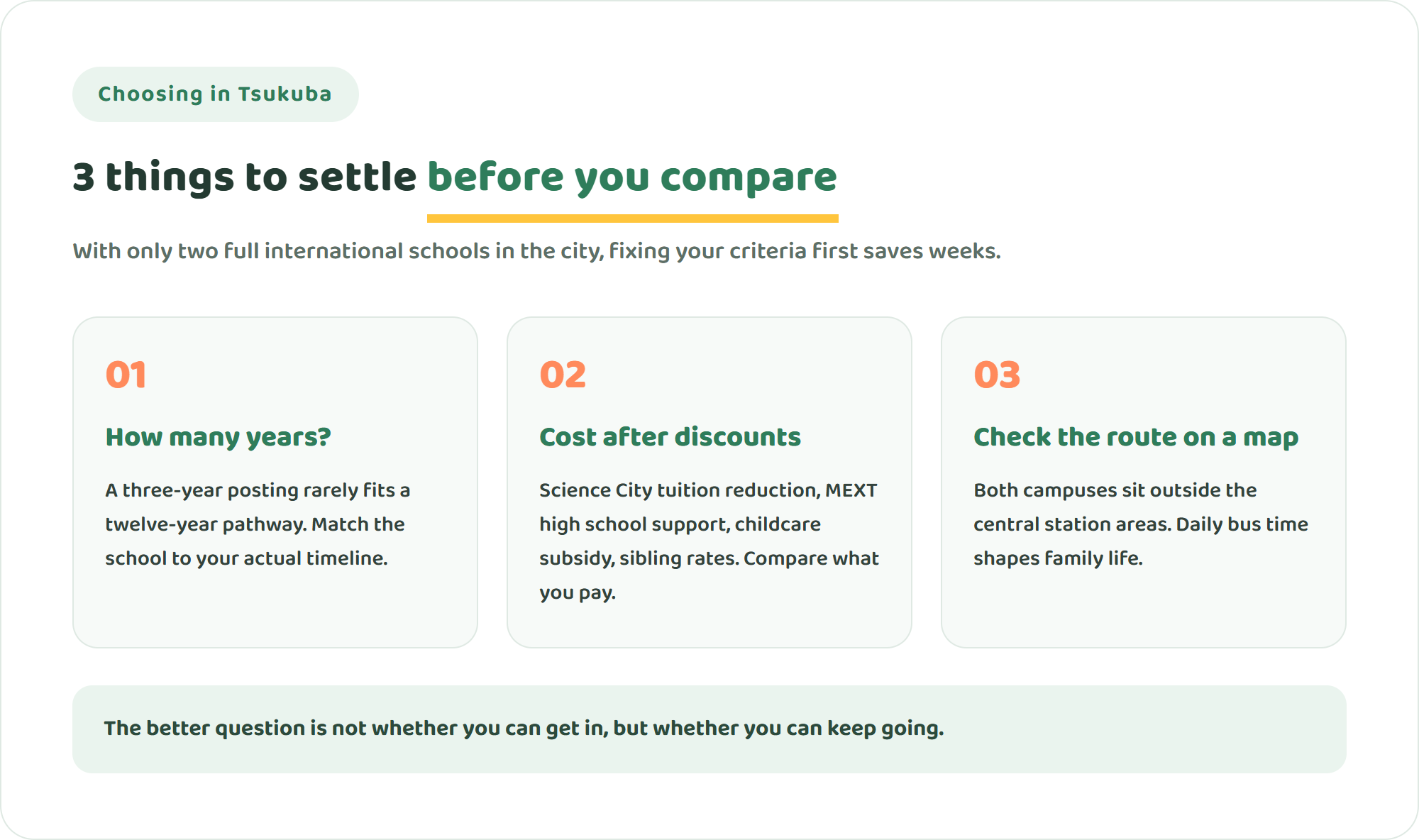
Start with the honest headline. Only two schools in Tsukuba City offer full-time, English-medium education for school-aged children: Tsukuba International School (TIS) and OWIS Tsukuba. Everything else marketed locally as an “international school” is a preschool or an English immersion nursery — valuable in the early years, but not a place your child can attend from Grade 1 onward. Families who count preschools as options often discover the gap only when their child turns six.
On price, Tsukuba is comparatively kind. Annual fees at the two full schools land roughly between 1.29 and 2.0 million yen. Large international schools in central Tokyo commonly run 3 to 3.5 million yen a year, so a Tsukuba posting can cut your education budget close to half. Add one-time enrolment fees and bus charges, though, and a first year still reaches the two-million-yen range. If you want to understand what makes up that number, our breakdown of what international school actually costs goes through it line by line.
Fee figures below are from each school’s own published schedule as of August 2026. Always confirm the current year with the school directly.
One legal point matters if your child holds Japanese nationality. Tsukuba City states officially that international schools are not schools defined under Article 1 of Japan’s School Education Act, and that attending one does not satisfy Japan’s compulsory education requirement (Tsukuba City official website). For foreign nationals, no board of education procedure is required. For dual nationals or Japanese citizens, read that page before you commit.
The two full international schools in Tsukuba City
Here are the two schools where a school-aged child can enrol full time. They differ in almost every respect — age, size, location and stage of development — so read them against your own child’s age and your family’s timeline rather than reputation.
1. Tsukuba International School (TIS)
Founded in 1992 by Tsukuba’s foreign researcher community, TIS sits in Kamigo on a green campus on the edge of the city. It is run by Tsukuba Global Academy, an educational corporation recognised by Ibaraki Prefecture, and it is a fully authorised IB World School offering all three programmes — PYP, MYP and the Diploma Programme — from age 3 through Grade 12. Around 300 students with ties to some 25 countries study here, and everything except Japanese class is taught in English. A three-programme IB continuum in a regional city exists only because Tsukuba is what it is.
One detail worth knowing: TIS is designated by Japan’s Ministry of Education for the High School Tuition Support Fund, limited to Grades 10 through 12 — a designation few international schools hold (MEXT list of designated schools).
- Curriculum: Fully authorised IB continuum — PYP, MYP and Diploma Programme
- Ages: 3 (Pre-K) through Grade 12
- Fees: Tuition 1,560,000 yen a year for all grades, plus a 210,000 yen facilities fee and a 240,000 yen materials fee — about 2.01 million yen annually. One-time: 20,000 yen application, 300,000 yen registration. Discounts of 90,000 yen for payment in full and 240,000 yen for younger siblings. Bus 15,000-21,000 yen a month (2026-27 published schedule)
- Best for: Families who want one uninterrupted IB pathway from primary through university entrance
Official website · Published fee schedule
2. OWIS Tsukuba (One World International School)
OWIS Tsukuba opened in August 2025 in Kunimatsu, at the foot of Mount Tsukuba. It belongs to the Singapore-headquartered Global Schools Group, and it occupies the buildings of a closed municipal elementary school that Tsukuba City offered for private reuse (Tsukuba City official website) — which means wooden classrooms and a large playing field, an unusual setting for an international school. It is an IB PYP candidate school pursuing authorisation, with class sizes capped around 18, an inquiry-led approach and a strong STEM strand. Grades are being added one year at a time. Because the campus is 20-30 minutes by car from the Tsukuba and Kenkyu-Gakuen station areas, check the bus routes before anything else.
- Curriculum: Inquiry-led international curriculum, IB PYP candidate school, STEM focus
- Ages: Early Childhood (from age 3) upward, expanding by one grade each year; the 2026-27 fee schedule extends to Grade 8, with Grade 12 planned
- Fees (per term, three terms a year, including building fee): EC 430,500 yen; Grades 1-5 514,500 yen; Grades 6-8 537,500 yen — roughly 1.29m, 1.54m and 1.61m yen a year. Application fee 80,000 yen; resource fee 40,000 yen (EC) or 60,000 yen. 25% sibling discount, a 10% founding-family discount and a 20% bus subsidy available until July 2027 (2026-27 published information)
- Best for: Families who value small classes and open space, and are comfortable joining a school still being built
Official website · Published fee schedule
English preschools in Tsukuba for the early years
If your child is not yet school age, your options widen considerably. These are licensed as childcare facilities rather than schools, and many qualify for Japan’s early childhood education subsidy. Just plan the next step at the same time — none of them continues past the early years.
3. Kids Creation Tsukuba
An English-environment school with several facilities across Tsukuba, taking children from infancy through elementary age. The philosophy is learning through play and experience in English rather than formal instruction, and Japanese-speaking staff work alongside foreign teachers, so parents are not required to speak English. School buses run, and the facilities fall under Japan’s childcare subsidy scheme.
- Programme: Experience-based English preschool, kindergarten and after-school care
- Ages: 0 through elementary school
- Fees: Enquire via the school (varies by course and days attended; subsidy-eligible)
- Best for: Families who want an English start while keeping local school on the table
4. English Spot Tsukuba
With campuses in Kise, Tsukuba and in Tsuchiura, English Spot offers a preschool from age 1, an English kindergarten for ages 3-5 at the Tsukuba campus, and after-school programmes for both preschoolers and elementary students. The curriculum mixes play-based and academic work with STEAM and inquiry elements.
- Programme: English preschool, English kindergarten and after-school classes
- Ages: 1 through elementary school
- Fees: Enquire via the school
- Best for: Families building English alongside a Japanese local school
5. COCOAS Kids International School Tsukuba
Opened in April 2026 in Kenkyu-Gakuen, a one-minute walk from Kenkyu-Gakuen Station, this facility combines an all-English environment with programming and music-based rhythm activities. It accepts children from 13 months, and the station-front location suits dual-income families commuting along the Tsukuba Express.
- Programme: All-English bilingual childcare with programming and rhythmics
- Ages: From 13 months to preschool age
- Fees: Enquire via the school (ages 3-5 may receive up to 37,000 yen a month under Japan’s early childhood education subsidy)
- Best for: Families who need a walkable, station-side English environment from toddler age
IB without an international school: Article 1 schools near Tsukuba
This is the fork in the road that most guides skip. Because international schools sit outside Japan’s compulsory education system, some families — particularly those with a Japanese parent, or those planning to stay long term — look instead at Japanese Article 1 schools that are authorised to teach the IB. You keep a Japanese school record and a domestic university pathway, usually at a lower cost.
6. Meikei Gakuen Junior and Senior High School (Tsukuba)
Located in Inarimae, Tsukuba, Meikei is a private junior and senior high school with boarding facilities, authorised as an IB World School in 2016. Its distinctive feature is flexibility in the language of instruction: students can take a largely English Diploma Programme, or a Japanese-language DP with a smaller number of subjects in English. That makes the IB reachable for children educated mainly in Japanese. Each DP year group now exceeds 40 students, with more than 100 IB students across the senior school.
- Curriculum: Japanese Article 1 secondary education plus an IB Diploma Programme course, in Japanese or English combinations
- Ages: Junior high through senior high (boarding available)
- Fees: Check the official admissions materials — as an Article 1 private school its cost structure differs entirely from international schools, and the IB course carries additional charges
- Best for: Families who want a Japanese school record and a DP qualification together
7. Kaichi Nozomi Primary and Secondary School (Moriya)
A one-minute walk from Shin-Moriya Station in Moriya City, Kaichi Nozomi holds PYP authorisation at the primary school and MYP at the secondary school, and gained DP authorisation in 2024 — making it only the second Article 1 school in Japan, and the first in the Kanto region, able to offer a 12-year PYP-MYP-DP continuum. From Tsukuba it means a drive or a train connection, but for IB from Grade 1 inside the Japanese system it is close to the only choice in Ibaraki.
- Curriculum: PYP, MYP and DP continuum within a Japanese Article 1 school
- Ages: Grade 1 through the end of secondary education
- Fees: See the school’s official tuition page; the DP course adds a published 350,000 yen a year in international education costs
- Best for: Families committed to Japan long term who want the IB from primary school
If you want the wider picture, see our guide to international schools in Ibaraki Prefecture. And because the Tsukuba Express reaches Akihabara in as little as 45 minutes, some families do consider international schools in Tokyo — worth a look, though a daily commute of that length is demanding for a young child.
A Tsukuba-only discount most guides never mention
If you are a researcher posted to Tsukuba, this section may be worth more than the rest of the article combined. The Tsukuba Science City Network (Tsukuba Kenkyu Gakuen Toshi Koryu Kyogikai, known locally as Chikkyo) operates a tuition reduction at Tsukuba International School for families of foreign researchers and faculty employed at its member institutions. According to the network’s own published information, annual tuition of 1,560,000 yen is reduced by 240,000 yen, to 1,320,000 yen.
The stated conditions are that one parent is a researcher or faculty member at a member institute or university, that one parent is a foreign national, and that combined household income does not exceed 8 million yen (revised 2026). Eligibility and member institutions can change, so confirm with both the Tsukuba Science City Network page and the TIS fee support page. TIS describes the arrangement as part of creating an environment that lets Tsukuba’s research institutes invite top-level researchers from abroad.
Stack it with the other support available — the MEXT high school tuition designation for Grades 10-12, the early childhood subsidy for residents of Tsukuba, Tsukubamirai and Ryugasaki, sibling and full-payment discounts — and the real number you pay can look very different from the sticker price. Compare schools on what you will actually pay, not on published tuition.
Comparing the options for your own family
Three broad types cover almost everything available around Tsukuba: full international schools such as TIS and OWIS; Japanese Article 1 schools teaching the IB, such as Meikei and Kaichi Nozomi; and online international schools with no commute at all. The table below sets out how each type tends to perform — including where each one is genuinely weak.
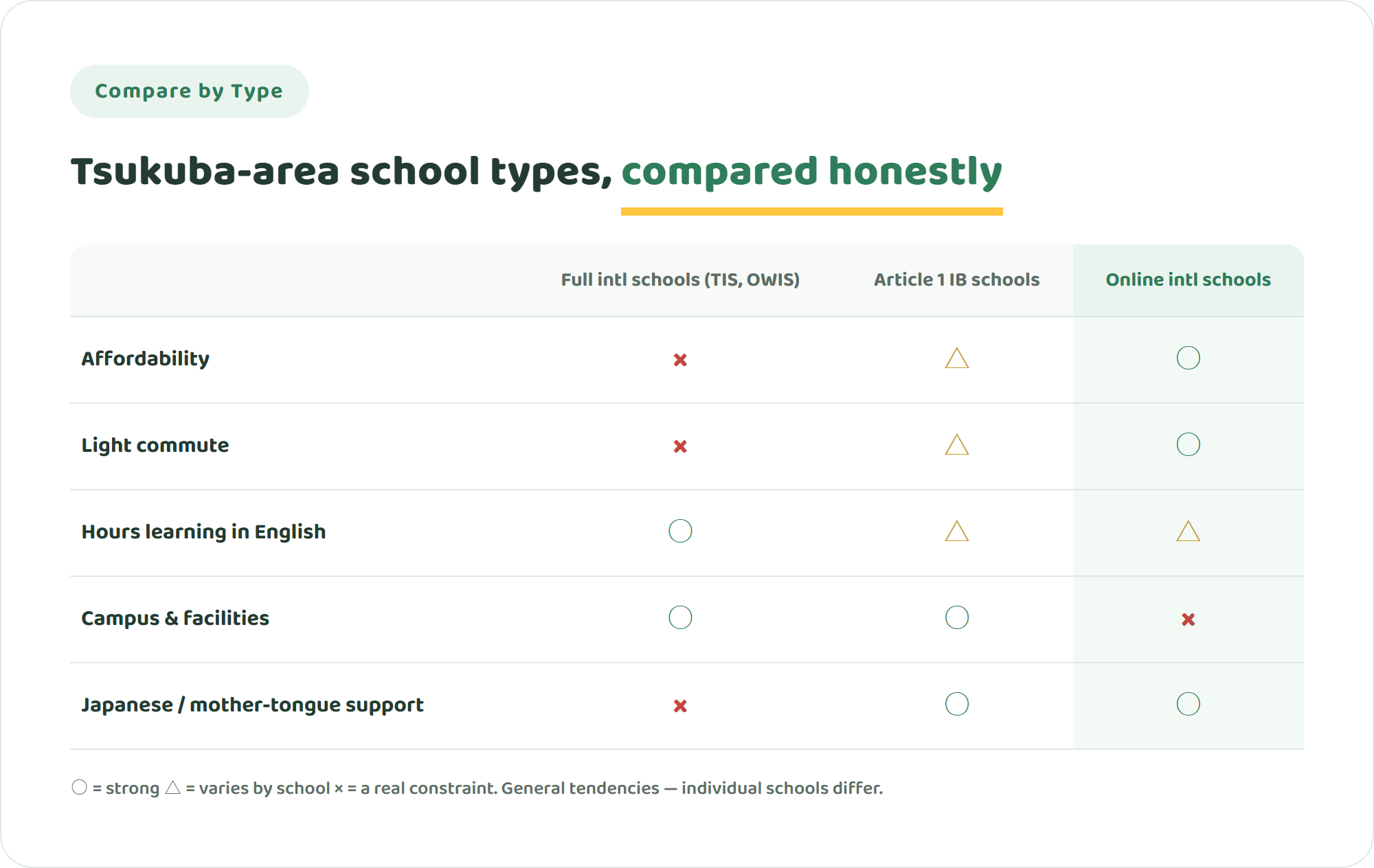
Full international schools are unmatched for immersion and for a genuinely international peer group. The trade-offs are the position outside Japan’s compulsory education framework and the daily journey — both Kamigo and Kunimatsu sit well outside the central Tsukuba station areas, and bus time shapes family life more than most parents expect. Article 1 IB schools give you academic security inside the Japanese system, but far fewer hours in English. And there is a fourth path parents often forget: keeping a local school place while adding international learning alongside it, which is a realistic answer when the city offers only two full options. Before you decide, be honest about the length of your posting. Choosing a twelve-year pathway for a three-year contract is a common and expensive mistake.
See how learning works online →
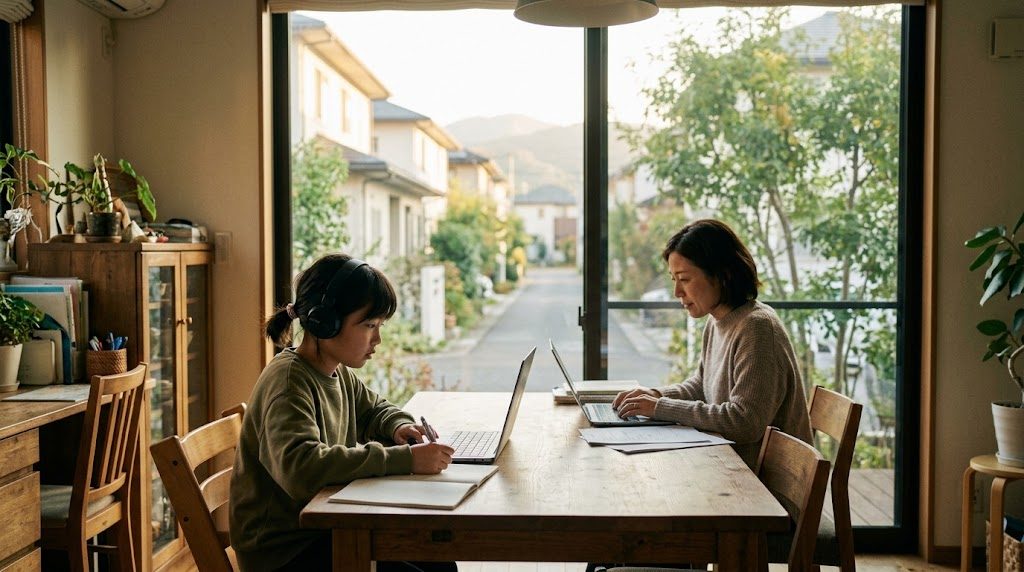
When fees or the commute are the obstacle: a third option online
Tsukuba is better served than almost any comparable Japanese city. Even so, four things stop families in their tracks: only two full schools for school-aged children, annual fees of 1.3 to 2 million yen, campuses far from the residential centre, and a place outside Japan’s compulsory education system. If you find yourself thinking that you want international learning for your child but cannot see the burden lasting for years, there is a third option that does not require a commute at all.
We are NIJIN GLOBAL ACADEMY (NGA), an online international school opening in September 2027. We are run by NIJIN Inc., the company behind NIJIN Academy, an alternative school in Japan with more than 1,000 enrolled students. We reject the practice of ranking children by test scores, teach in small dialogue-centred groups, and aim for something simple: that children come to like themselves and the world. We serve ages 6 to 18 across Asia and Oceania, wherever a family happens to live, and the design assumes Japanese-language support while children gradually build their English. We are working toward fees around one-fifth of a campus-based international school.
Honestly: we have not opened yet, and our record is still ahead of us. We cannot offer the playground, the gym or the corridor friendships of a campus school in the same way. But learning that connects your child to the world without the commute, at a cost your family can sustain, is worth putting on the list as you compare options in Tsukuba.
Frequently asked questions
Q. From what age can my child start at an international school in Tsukuba?
A. Both full schools start at age 3 — Pre-K at Tsukuba International School and Early Childhood at OWIS Tsukuba. For younger children, Kids Creation, English Spot and COCOAS Kids accept infants and toddlers. Bear in mind that preschools do not continue into the school years, so plan on choosing again when your child turns six.
Q. Does my child need English already? What about Japanese-language support?
A. It varies. TIS teaches everything except Japanese class in English, so the level of English needed rises with the grade. OWIS Tsukuba publishes that it offers English language support programmes. Going the other way, if you want your child to build or maintain Japanese while living in Tsukuba, Meikei Gakuen’s Japanese-language DP shows that an IB pathway does not have to mean giving up Japanese. Families who want dedicated Japanese lessons for children may also like our sister service Tomodachi Japan, an online Japanese programme for children run by NIJIN.
Q. My contract runs only a few years. Is mid-year entry — or leaving mid-year — realistic?
A. Yes. Tsukuba schools are built around researcher families who arrive and depart on institute schedules, so mid-year transfers are routine. Popular year groups do fill up, and entrance assessments or English requirements are common, so contact schools directly six to twelve months before your target date to check availability and paperwork. It is also worth asking now whether the learning can continue after you leave Japan or move to your next posting.
The time you spend deciding is time spent caring
There is no single right answer in school choice. In a city like Tsukuba — excellent schools, but few of them, and a family timeline that is rarely certain — the decision feels heavier than it should. What matters is less whether your child can get in, and more whether your family can keep going for as many years as you need. Fees, bus times, English level, temperament: every family weighs these differently. The fact that you are hesitating at all is evidence of how seriously you are taking your child’s future. Take your time, visit a few schools, and compare them in person. And if you would like to know more about the path that does not involve a commute, we would be glad to keep you posted.
To compare every option across the wider prefecture, see our guide to international schools in Ibaraki Prefecture, which covers schools outside this city and prefecture-wide fee ranges.
International Schools in Other Cities
- International Schools in Dubai: Fees
- International Schools in Meguro: All 8 Schools
- International Schools in Kobe: All 20 Schools
- International Schools in Yokohama: Full Comparison
- International Schools in Chofu and ASIJ Fees
- International Schools in Fukuoka: Fees
- International Schools in Sumida, Tokyo
- International Schools in Sydney
- International Schools in Taipei
- International Schools in Tokyo
- International Schools in Osaka
- International Schools in Nagoya: All 8 Schools
- International Schools in Minato: Fees
- International Schools in Shibuya, Tokyo
- International Schools in Setagaya: All 14 Schools