If you have been searching for an international school in Suginami, Tokyo, you have probably hit the same wall everyone else does: the search results are almost entirely preschools. Suginami is one of the most family-friendly wards in Tokyo — leafy, quiet, well served by the Chuo and Inokashira lines, with a genuinely good reputation for its public schools. But that same strength explains the gap. English-medium preschools are scattered across Ogikubo, Asagaya, Koenji and Kugayama, while only one full-time international school in the ward takes children past kindergarten. This guide covers all seven international schools in Suginami, preschools included — every one genuinely located in the ward, sorted by the two things that confuse parents most — ages served and fees — then shows where families realistically look once a child turns six, and one option that removes the commute entirely.
Quick Answer: Your Options in Suginami
If you only read one section, read this. Below are the schools covered in this guide, plus the online option — so you can see every route side by side before the details.
- Everest International School, Japan (Ogikubo and Asagaya campuses) — Ages: Nursery through Grade 12 (roughly 3–18) / Fees: monthly tuition ¥50,000 (Grades 1–10), ¥60,500 (Grades 11–12), ¥75,000 plus tax…
- Busy Bees International School (Izumi) — Ages: 2–6 (Nursery through Kindergarten) / Fees: five-day and three-day courses; figures are set out in the school’s admissions…
- Prime Academic Preschool Ogikubo (Kamiogi) — Ages: 1 year through pre-primary (up to K3 classes) / Fees: issued as a separate schedule — enquire directly
- Pocket International Preschool (Koenji and Ogikubo) — Ages: 2–6 (from 18 months at some campuses; parent-and-child classes at 1–2) / Fees: monthly rates listed on the official site and varying by course and days per week —…
- JUN International Preschool (Kugayama) — Ages: from 1 year through pre-primary / Fees: not published online — enquire directly (also ask whether the childcare subsidy…
- doors International School (Asagaya-minami) — Ages: 3–5 (affiliated nurseries take children from 0) / Fees: not published online — enquire directly
- Sophie International Preschool (Zenpukuji) — Ages: from 2 (Saturday classes extend to primary age) / Fees: vary by course and days per week — see the official fee system page or enquire
- NIJIN GLOBAL ACADEMY (online) — Ages 6–18 / opening September 2027, currently taking opening-update registrations / fees around one-fifth of a typical campus international school / Japanese-language support. An option when commute or fees are the wall.
Quick Answer: The International Schools in Suginami, at a Glance
- Everest International School, Japan (Ogikubo & Asagaya) | Nursery–Grade 12 | approx. ¥50,000–¥75,000 per month in tuition (roughly ¥600,000–¥900,000 a year) | the ward’s only full-time school past age six, with a Cambridge qualifications track
- Busy Bees International School (Izumi) | ages 2–6 | fees on enquiry | bilingual preschool open since 2007, 7:30am–6:30pm
- Prime Academic Preschool Ogikubo (Kamiogi) | age 1 to pre-primary | fees on enquiry | English immersion with phonics, Reggio-influenced art, project work and music
- Pocket International Preschool (Koenji & Ogikubo) | ages 2–6 | fees on enquiry | monthly themes plus a structured reading programme, weekdays 10:00–14:00
- JUN International Preschool (Kugayama) | age 1 upward | fees on enquiry | founded 1998, small groups, all-English daily routines
- doors International School (Asagaya-minami) | ages 3–5 | fees on enquiry | deliberately balances English with Japanese, 7:30am–6:30pm
- Sophie International Preschool (Zenpukuji) | age 2 upward, plus Saturday classes for primary age | fees on enquiry | flexible hours, serving the Nishi-Ogikubo and Kichijoji side of the ward
- NIJIN GLOBAL ACADEMY (online, opening September 2027, ages 6–18, roughly one-fifth the cost of a campus school, Japanese-language support built in) | no commute at all. Pre-opening — you can register for updates now
International schools in Suginami: the landscape and what fees really look like
The shape of Suginami in one line: plenty of choice before six, almost none after. Around Ogikubo, Asagaya, Koenji, Kugayama, Zenpukuji and Izumi you will find around seven English-medium or bilingual preschools, which is more than enough for the pre-primary years. Move up to primary and secondary age, however, and the ward has exactly one full-time international school: Everest International School, Japan. Suginami is not Minato or Setagaya, where several established campuses sit within a few train stops of each other.
That is not a sign of weak education here — rather the opposite. Suginami’s public elementary and junior high schools are well regarded, and private junior-high entrance exams are popular locally, so demand for full-time international schooling has historically spread outward rather than concentrated in the ward. The practical consequence for you is simple: decide what happens at age six before you enrol at age two.
On fees, very few schools in the ward publish numbers. The clearest published figures come from Everest International School, Japan, whose fee page lists monthly tuition of ¥50,000 for Grades 1–10, ¥60,500 for Grades 11–12, and ¥75,000 plus tax for the Cambridge track — roughly ¥600,000 to ¥900,000 a year. Against the ¥2–3 million a year that central Tokyo campuses typically charge, that is a genuinely different order of magnitude. Preschools in the ward generally start around ¥100,000 a month, varying widely with days per week and extended hours. Whatever you compare, compare totals: enrolment fees, facility levies, materials, lunches and bus charges all sit on top of tuition. Our breakdown of international school costs walks through the full picture.
Note: fees above reflect publicly available information as of August 2026. Always confirm current figures on each school’s official website.
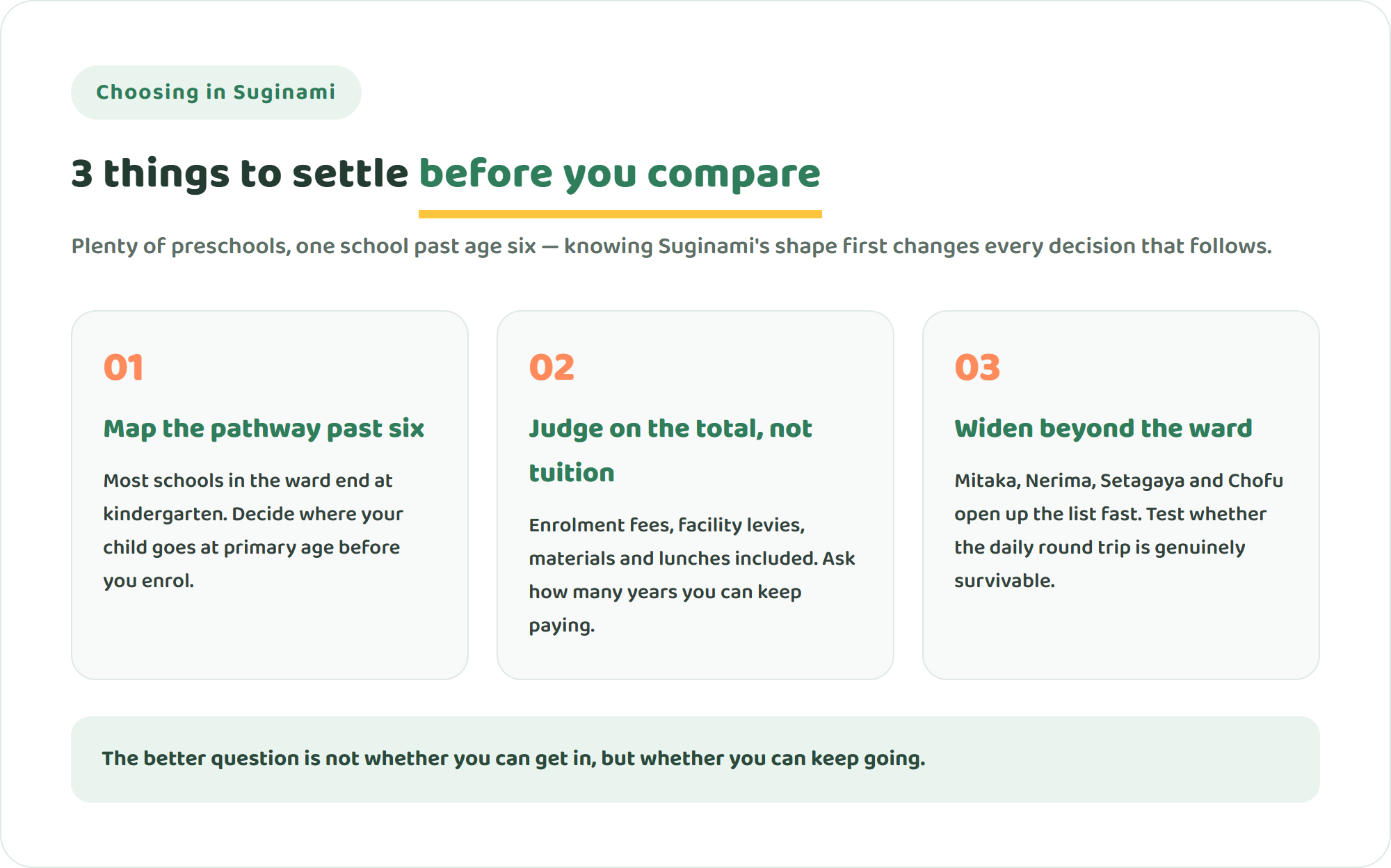
All 7 international schools in Suginami, by age range and fees
What follows is every international school and international preschool we could verify as currently operating inside Suginami Ward. We are not padding the list with schools from neighbouring cities — there are seven, and only one continues past kindergarten. Read them in this order: ages first, fees second, educational philosophy third.
1. Everest International School, Japan (Ogikubo and Asagaya campuses)
Suginami’s only full-time international school, with its main campus in Ogikubo. It opened in 2013 to serve children of the Nepalese community in Japan alongside Japanese and other international families, with an explicit mission of affordable English-medium education. Teaching is in English throughout, and older students follow a Cambridge pathway leading to IGCSE and A Level qualifications. Within Suginami there are two campuses — Ogikubo for the upper grades and Asagaya for the lower primary years — with further campuses in Shin-Okubo and Arakawa. The defining feature is cost: monthly tuition starting at ¥50,000 and enrolment fees between ¥50,000 and ¥75,000 put it in a bracket almost no other international school in Tokyo occupies. Japanese language classes are part of the timetable.
- Curriculum: English-medium full-time programme; Cambridge International (IGCSE and A Level) pathway in the upper years; Japanese and Nepali language classes
- Ages: Nursery through Grade 12 (roughly 3–18)
- Fees: monthly tuition ¥50,000 (Grades 1–10), ¥60,500 (Grades 11–12), ¥75,000 plus tax (Cambridge track). Admission fee ¥50,000–¥75,000, books and stationery ¥25,000–¥30,000, plus a refundable one-month deposit. Confirm the applicable academic year directly
- Best for: families near Ogikubo or Asagaya who want their child to keep learning in English past primary age without a seven-figure annual bill
Official website / Fee structure
2. Busy Bees International School (Izumi)
Open since 2007, Busy Bees sits in Izumi, reachable from Honancho and Eifukucho. Classes are split tightly by age — Nursery (2–3), Pre-K1 (3–4), Pre-K2 (4–5) and Kindergarten (5–6) — inside an English-speaking environment that still makes room for Japanese language and cultural activities. Opening hours run from 7:30am to 6:30pm, which matters enormously if both parents work full time.
- Curriculum: English-led bilingual early years programme with Japanese language and culture sessions
- Ages: 2–6 (Nursery through Kindergarten)
- Fees: five-day and three-day courses; figures are set out in the school’s admissions handbook, so enquire directly
- Best for: working families in the Izumi, Honancho and Eifukucho area who need long daily coverage
3. Prime Academic Preschool Ogikubo (Kamiogi)
A short walk from JR Ogikubo station, this is the Suginami campus of a group that also operates in Ebisu, Kamikitazawa and Gotanda. The programme is unusually broad for the pre-primary years: a proprietary phonics course builds early reading, the art curriculum follows the Reggio Emilia approach, children research and present their own project topics, and there are weekly violin and pianica sessions. Long bilingual day-care hours are available.
- Curriculum: full English immersion combining phonics, Reggio-influenced art, project-based learning, music and physical activity
- Ages: 1 year through pre-primary (up to K3 classes)
- Fees: issued as a separate schedule — enquire directly
- Best for: Ogikubo-based families who want literacy and expression built in English, not just exposure through play
4. Pocket International Preschool (Koenji and Ogikubo)
Two Suginami campuses — Koenji-minami and Kamiogi — plus one in Kamikitazawa, Setagaya. The teaching draws on Canadian early childhood practice, with monthly themes shaping play and activities and an established reading system underneath. Native-English-speaking and Japanese children learn side by side, which changes the sound of a classroom in a way brochures rarely capture. A free one-hour trial and a paid full-day trial let you test the fit before committing; parent-and-child classes are available for ages 1–2.
- Curriculum: theme-based English communication with a structured reading programme
- Ages: 2–6 (from 18 months at some campuses; parent-and-child classes at 1–2)
- Fees: monthly rates listed on the official site and varying by course and days per week — confirm directly
- Best for: Koenji and Ogikubo families easing into an English environment with weekday mornings rather than a full day
5. JUN International Preschool (Kugayama)
Founded in 1998 and a short walk from Mitakadai station on the Inokashira line, JUN is a long-established preschool registered as an unlicensed childcare facility with the Tokyo Metropolitan Government. The approach is deliberately domestic in scale: small groups, a homelike atmosphere, and everything — changing, eating, tidying up — handled in English. Children are accepted from twelve months, which suits families who want early exposure to the sounds of the language.
- Curriculum: all-English daily-living programme in small groups
- Ages: from 1 year through pre-primary
- Fees: not published online — enquire directly (also ask whether the childcare subsidy applies)
- Best for: Kugayama and Hamadayama families who want close attention rather than a large cohort
6. doors International School (Asagaya-minami)
Near Minami-Asagaya station, doors is run by a company that also operates nurseries and English classes for primary-age children. What sets it apart is that it does not push all the way to English-only: the stated approach is to keep English and Japanese learning in balance. Small class sizes allow genuine one-to-one relationships, mixed-age grouping encourages cooperation, and the school explicitly emphasises recognising effort over results as a way of building self-esteem. Hours run 7:30am to 6:30pm.
- Curriculum: balanced English and Japanese programme with mixed-age grouping
- Ages: 3–5 (affiliated nurseries take children from 0)
- Fees: not published online — enquire directly
- Best for: Asagaya families planning on Japanese primary school who still want a real English foundation
7. Sophie International Preschool (Zenpukuji)
Set in Zenpukuji and drawing families from Ogikubo, Nishi-Ogikubo, Kichijoji and Mitaka, Sophie runs a pre-primary preschool programme alongside Saturday classes for both kindergarten and primary-age children — which makes it one of the few options in the ward where the relationship with English does not simply end at six. The school is upfront about flexible care hours, aimed at families who cannot commit to full-time but want several substantial English days a week.
- Curriculum: English early-years care and instruction, with Saturday courses for kindergarten and primary ages
- Ages: from 2 (Saturday classes extend to primary age)
- Fees: vary by course and days per week — see the official fee system page or enquire
- Best for: Nishi-Ogikubo, Zenpukuji and Kichijoji families building an English routine a few days a week
Beyond these seven there are other English-touching options in the ward: a bilingual licensed nursery in Eifuku, an English school in Nishi-Ogikubo, and Wisdom Academy PRIME beside Asagaya station, an English-immersion after-school club for kindergarten and primary ages. If your child attends Japanese elementary school, that after-school route is a genuinely practical way to keep English going. But the core fact is worth repeating: only Everest takes children full time past age six inside Suginami. One further caution — preschools in this ward open, close and change operators fairly often, so verify current status on the official site before you visit.
What happens after six: international schools in Mitaka, Nerima, Setagaya and Chofu
Trying to solve the age-six problem inside the ward boundary rarely works. Widening the commute does. Immediately west, in Mitaka, is Musashi International School Tokyo (MIST) in Shimorenjaku, one of the few schools in Japan accredited by Cambridge International at both primary and secondary level, running PreK through Grade 12. Published tuition is roughly ¥1,518,000 to ¥1,819,000 a year for 2025/26 — meaningfully below the central Tokyo norm — and it is a realistic journey from Kugayama, Nishi-Ogikubo or Hamadayama.
North, in Nerima, Aoba-Japan International School runs an IB-authorised K–12 campus at Hikarigaoka. South, Setagaya holds two of Japan’s best-known campuses: St. Mary’s International School in Seta (boys) and Seisen International School in Yoga (girls, IB-authorised) — see our guide to international schools in Setagaya. Further west, the American School in Japan in Chofu runs an extensive bus network across western Tokyo; our guide to Chofu covers it. If you commute into the city on the Chuo or Marunouchi line, Shinjuku is also within reach. To compare across the whole city, start with our overview of international schools in Tokyo.
How to choose the option that actually fits your family
A list of schools does not tell you what to do. It helps to reduce Suginami to three types: the ward’s one full-time international school, the ward’s preschools, and online international schooling that requires no commute at all. The table below sets out, honestly, where each type is strong and where it is not.
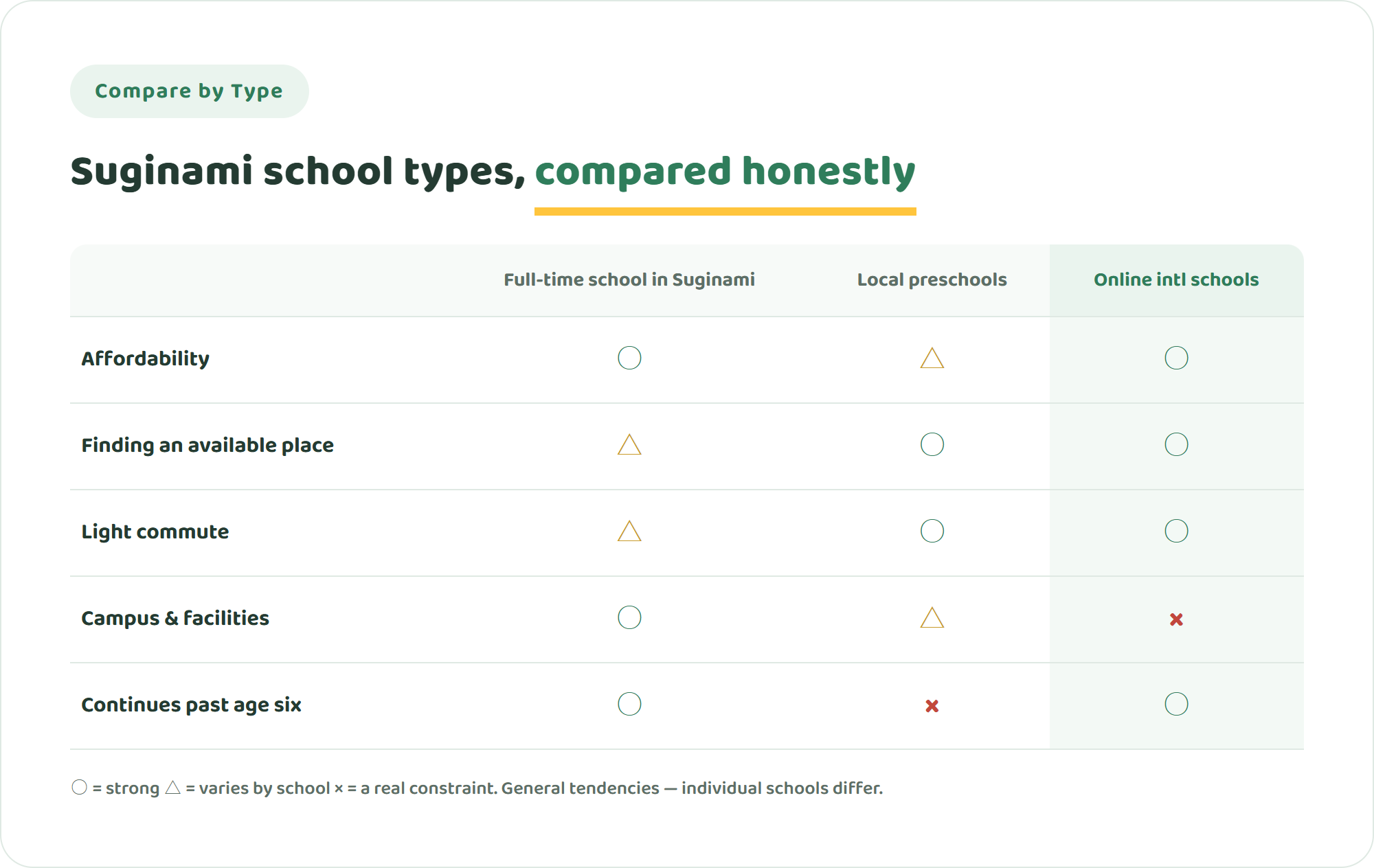
The ward’s full-time option is remarkably affordable, but with a single school the real question is whether a place exists in your child’s year group when you need it. Preschools win on convenience — walking or cycling distance, sometimes subsidy-eligible — but every one of them ends at six, and then you are searching again. The third route is the one most families overlook. With no commute, where you live stops determining what your child can learn. If cost is the sticking point, our honest look at whether international school is too expensive may help you think it through.
See how learning works online →
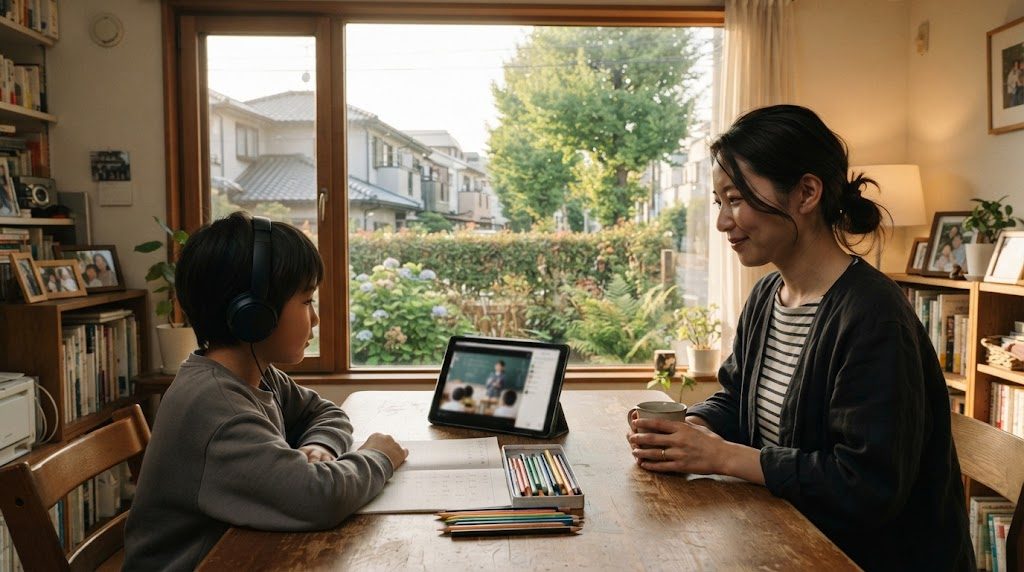
When fees or the commute are the barrier: online as a ninth option
Suginami is a fine place to raise a child — the cherry trees along the Zenpukuji river, the bookshops and coffee houses of Nishi-Ogikubo, public schools people actively choose. And yet: one full-time international school in the ward, longer journeys if you look outside it, and central Tokyo campuses that start well above ¥2 million a year. For plenty of families those are real constraints, not minor inconveniences. If you find yourself thinking that you want an international education for your child but cannot see how to sustain the cost or the travel for a decade, there is another shape this can take.
NIJIN GLOBAL ACADEMY (NGA) is an online international school opening in September 2027. It is run by NIJIN Inc., the company behind NIJIN Academy, an alternative school in Japan with more than 1,000 students enrolled. Our approach rejects ranking children by test scores, and centres small-group dialogue around a simple aim: helping children come to like themselves and the world. We serve ages 6–18 across Asia and Oceania, wherever a family happens to live, with Japanese-language support built in so English can be approached gradually. We are working toward tuition at roughly one-fifth the cost of a campus international school.
Honestly: we have not opened yet, and our track record is still ahead of us. We cannot offer the playground, the corridors and the physical school day that a campus provides. But learning that connects your child to the world without the commute and without the seven-figure bill is, we think, worth putting on your shortlist while you compare.
Frequently asked questions
Q. What is the youngest age international schools in Suginami accept?
A. At the preschool level, from twelve months. JUN International Preschool and Prime Academic Preschool Ogikubo start at around age one, Busy Bees, Pocket and Sophie from two, and doors International School from three. For full-time schooling, Everest International School, Japan takes children from Nursery (around age three) all the way to Grade 12. Narrowing by your child’s current age is always the fastest first filter.
Q. Can my child stay in an international school in Suginami past primary age? What about Japanese support?
A. Inside the ward, Everest International School, Japan is the only full-time option beyond kindergarten. Everything else is pre-primary, so from age six most families either look outside Suginami — Mitaka, Nerima, Setagaya, Chofu — or combine Japanese elementary school with an English after-school programme. Japanese-language provision varies enormously between schools in both hours and philosophy, so ask specifically before you enrol. If you are worried about maintaining your child’s Japanese while they study in English, our sister service Tomodachi Japan (online Japanese for children, also run by NIJIN) is worth a look.
Q. Can we transfer mid-year, and when should we apply?
A. Most schools do accept transfers, but in a ward with a single full-time school the binding constraint is simply whether a seat exists. Intakes generally cluster around April or August–September, and admission may involve an English assessment, a student interview and a parent meeting. Start contacting schools roughly a year before you want to enrol, and attend open houses in person. Where a school feeds up from its own preschool, external places are tighter still.
The time you spend deciding is time spent caring
There is no single correct school. In a ward like Suginami, where full-time options are scarce, the useful question is not which school is best but which one your family can sustain for years. Fees, travel time, your child’s temperament — none of these generalise. The fact that you are weighing them carefully right now says more about your parenting than any admissions decision will. Take your time, visit two or three schools, and compare how the rooms actually feel. And if you would like to keep a no-commute option on the table while you decide, we would be glad to keep you posted.
International Schools in Other Cities
- International Schools in Fukuoka: Fees
- International Schools in Ho Chi Minh City
- International Schools in Melbourne
- International Schools in Nagoya: All 8 Schools
- International Schools in Minato: Fees
- International Schools in Setagaya: All 14 Schools
- International Schools in Manila
- International Schools in Meguro: All 8 Schools
- International Schools in Musashino, Tokyo
- International Schools in Tokyo
- International Schools in Shibuya, Tokyo
- International Schools in Koto, Tokyo
- International Schools in Shinagawa, Tokyo
- International Schools in Chofu and ASIJ Fees
- International Schools in Shinjuku: Fees